Best Business to Start with No Inventory: A Complete Guide (2026)
Quick Answer
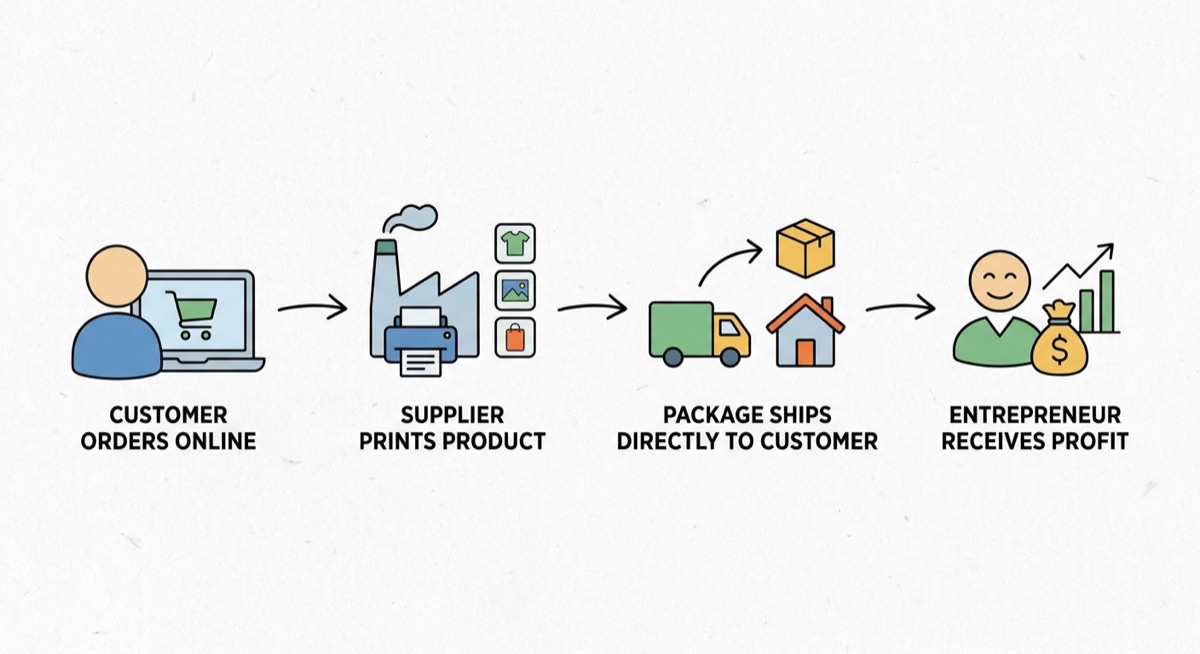
The best business to start with no inventory is print on demand (POD). You design products, customers order, and suppliers print and ship directly to them. No upfront inventory costs, no warehouse, no risk of unsold stock. Combined with platforms like Shopify and suppliers like Gelato or Printful, you can launch a legitimate ecommerce business for under $500.

Why “No Inventory” Businesses Are Booming in 2026
Traditional retail requires capital—sometimes tens of thousands of dollars tied up in stock that may or may not sell. For people escaping corporate jobs, starting a side hustle, or building their first online business, that risk is a dealbreaker.
No-inventory business models eliminate that barrier. You sell first, then fulfill. The supplier handles production, packaging, and shipping. Your job? Marketing and customer experience.
This shift has opened entrepreneurship to anyone with a laptop and the willingness to learn. No warehouse. No minimum orders. No guessing how many mediums versus larges to stock.
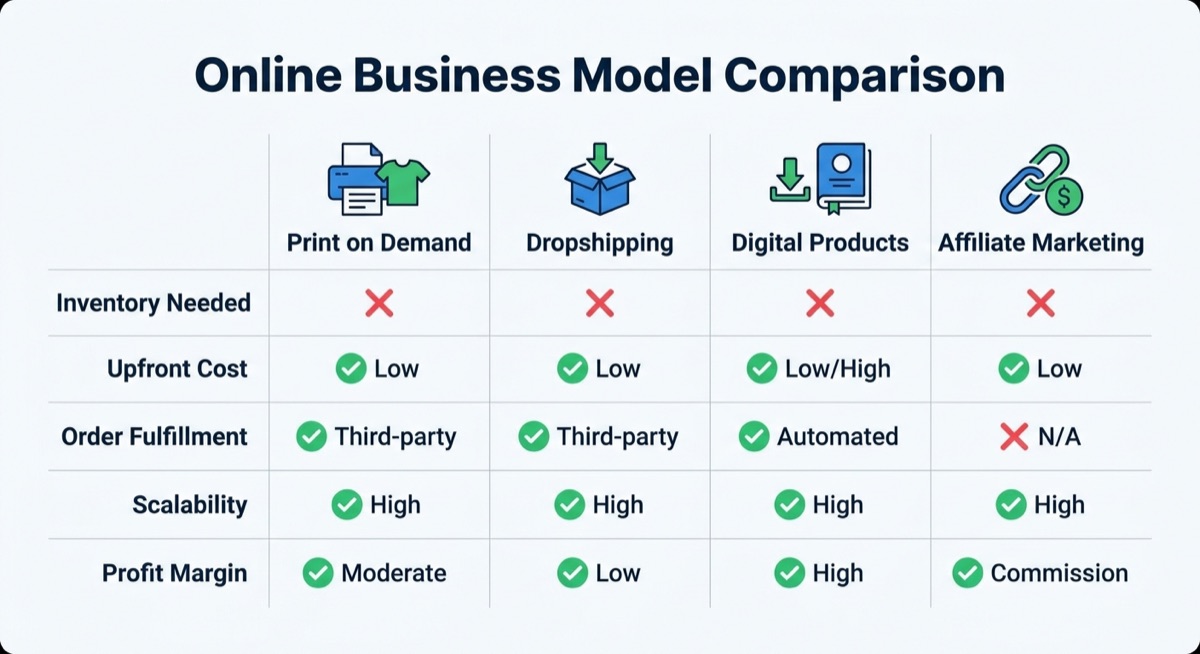
Top No-Inventory Business Models Compared
Print on Demand: You create designs for apparel, mugs, phone cases, and more. When someone orders, your supplier prints and ships it. You keep the profit margin. Best for creative entrepreneurs who want to build a brand.
Dropshipping: You list products from wholesalers. When orders come in, the supplier ships directly. Margins are slimmer and competition fierce—you’re often selling the same products as thousands of others.
Digital Products: Ebooks, courses, templates. Zero fulfillment costs but requires expertise and audience building. Great long-term but harder to start from scratch.
Affiliate Marketing: Promote others’ products for commissions. No products to create or ship, but income depends entirely on traffic and conversions you don’t control.
For most beginners, print on demand offers the best balance: low startup costs, creative control, brandable products, and real profit margins.
Why Print on Demand Wins for Beginners
Here’s what makes POD particularly suited for first-time entrepreneurs:
Low risk: You never buy inventory. A design that doesn’t sell costs you nothing but time.
Test fast: Launch 10 designs, see what sells, double down on winners. Traditional retail doesn’t offer this flexibility.
Build a real brand: Unlike dropshipping generic products, you’re creating unique designs. Your store has identity.
Work on your schedule: Design on weekends, run ads in evenings. Perfect for side hustlers.
Proven results: At Skup, we’ve helped students generate over $50 million in combined sales using the print on demand model. These are regular people—many over 50—who learned the system and executed.
What You Actually Need to Start
A Shopify store: $39/month gets you a professional storefront.
A POD supplier: Gelato or Printful connects directly to Shopify. They handle production and shipping worldwide.
Designs: This is where beginners get stuck. You don’t need to be an artist—tools like AvatarIQ help you create professional print-ready designs even if you’ve never used design software.
Ads budget: Start with $20-50/day on Facebook or TikTok. Learn what works, scale what converts.
Total startup cost: $500-1,000 for your first month including store, apps, and initial ad spend.
Common Mistakes to Avoid
Chasing trends instead of testing: Don’t assume you know what will sell. Run data-driven tests.
Overcomplicating designs: Simple, bold designs often outperform complex artwork.
Ignoring your target customer: Generic stores selling to “everyone” sell to no one.
Giving up after one failed product: Most successful POD sellers launched dozens of designs before finding winners.
Skipping education: YouTube videos give fragments. A structured system like the Apparel Cloning System shows you the complete process.
Real Results from Real People
This isn’t theory. Skup students are building real businesses with the no-inventory model:
Sean Young hit 1,000 orders and $50,000+ in sales. He started part-time while working his day job.
Adam Schneider generated $500,000 in total sales after learning the system. No previous ecommerce experience.
Shannon Roles broke $7,000 in monthly sales—consistent revenue without touching inventory.
These aren’t outliers. They’re the result of learning a proven process and putting in the work.
FAQ
Is print on demand profitable in 2026?
Yes. Profit margins typically range from 30-50% on apparel, higher on some products. The key is finding designs that resonate with specific audiences and running effective ads.
Do I need design skills to start?
No. Tools like AvatarIQ use AI to generate professional designs. Many successful POD sellers have zero design background.
How much money can I realistically make?
It varies wildly. Some make a few hundred monthly. Committed students often reach $5,000-10,000/month within their first year. Top performers hit six figures annually.
What’s the best platform to sell on?
Shopify for most sellers. It gives you control over branding, customer data, and marketing. Etsy works for some but limits growth potential.
How long until I see my first sale?
With proper setup and ads, most students see their first sale within the first week or two. Profitability takes longer—usually 2-3 months of testing and optimization.
The Bottom Line
If you want to start a business with no inventory, print on demand is the model that gives you the best shot. Low startup costs, unlimited testing, and the ability to build something you actually own.
The catch? You still need to learn the system. Design research, ad strategy, conversion optimization—these skills separate successful POD sellers from everyone else.
That’s exactly what we teach at Skup. The Apparel Cloning System walks you through the complete process, from finding winning designs to scaling profitable campaigns. For those ready for hands-on coaching, the Skup Incubator provides weekly calls with expert guidance.
No inventory. No warehouse. Just a proven system and your willingness to learn.