Intellectual Property Strategy for POD Brands
You've finally found a niche that sells. The artwork is original, the listing is converting, and orders are moving often enough to make the business feel real. Then you notice another seller offering nearly the same design, using a cheaper price and a storefront that looks uncomfortably familiar. Your first reaction is probably frustration. Your second should be a plan.
For POD creators, intellectual property strategy isn't legal overhead added after the business succeeds. It's part of building a brand that can keep its value when designs spread, marketplaces change, and competitors move quickly. The right plan helps you decide what to protect, where protection matters, how to collect evidence, and when action is worth your time.
Table of Contents
- Why Every POD Creator Needs an IP Game Plan
- What Intellectual Property Strategy Really Means
- The Four Types of IP That Matter for POD Brands
- Common Infringement Scenarios in POD and How to Spot Them
- A Prioritized Protection Roadmap from Zero to Scale
- Smart Protections You Can Put in Place This Week
- Enforcement Thresholds and When to Take Action
- Your IP Checklist and Next Steps to Build Brand Equity
Why Every POD Creator Needs an IP Game Plan
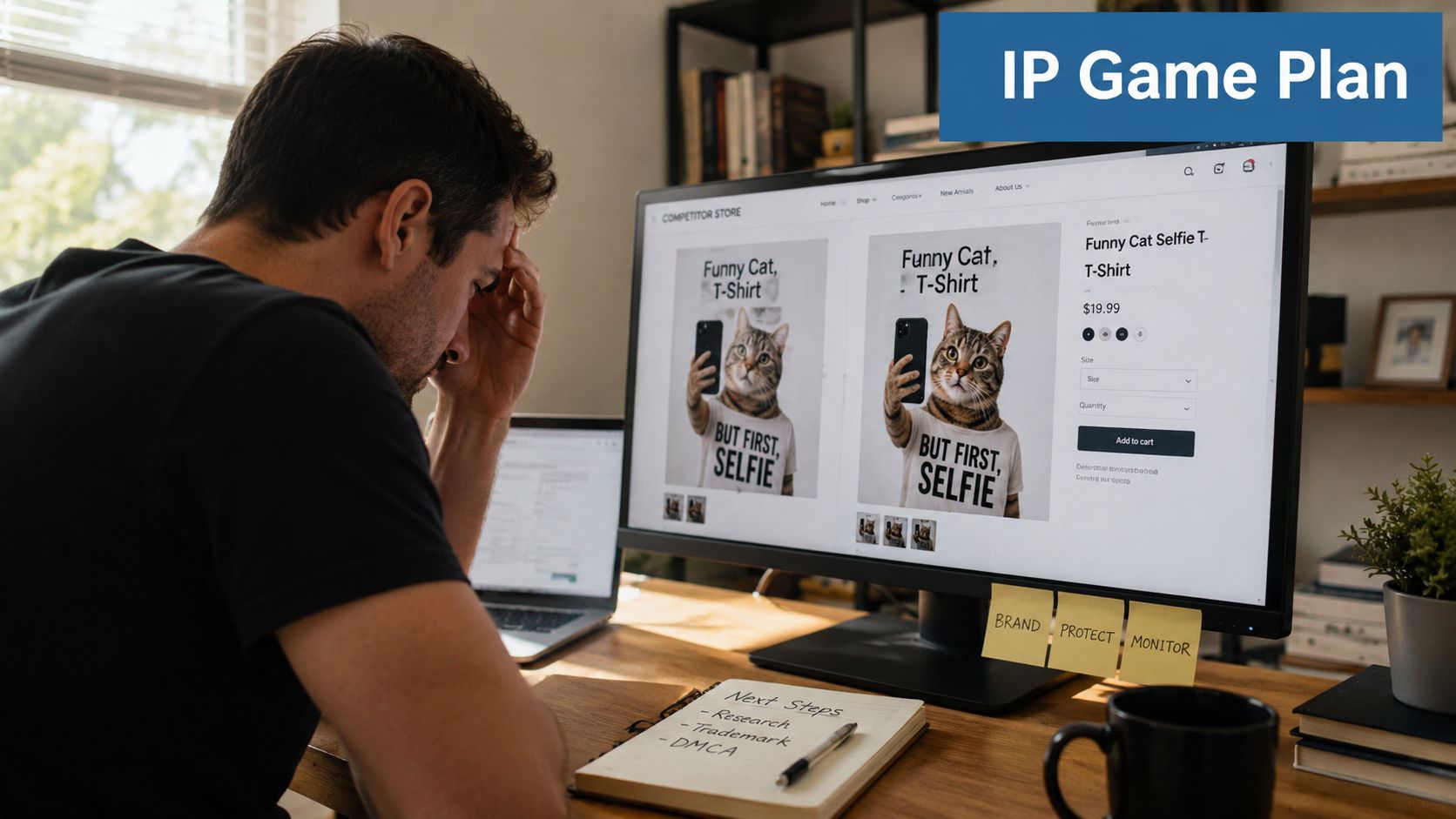
A creator launches a shirt for a narrow audience, sees early sales, and starts expanding the idea into hoodies, mugs, and new colorways. A few weeks later, the same artwork appears on another marketplace listing. The copycat's price is lower, the description borrows the original wording, and the seller has no connection to the creator.
That moment feels personal because it is personal. You made the design, tested the niche, built the listing, and took the risk. But the commercial problem is bigger than one stolen graphic. If every successful design forces you to start over, your store never builds durable authority. You're constantly replacing products instead of turning successful creative work into a recognizable brand system.
Protection creates leverage
The modern global IP environment changed significantly when the TRIPS Agreement entered into force in 1995 alongside the creation of the WTO. It established broad international baselines covering copyright, trademarks, geographical indications, industrial designs, patents, integrated-circuit layout designs, undisclosed information, and enforcement procedures, as explained in this history of TRIPS and international IP rules.
That history matters to a POD seller because your customers, suppliers, marketplaces, and copycats may sit in different countries. A single-country mindset can leave important gaps when your revenue comes from several markets.
Practical rule: Every design that proves demand should also receive a protection decision.
The Apparel Cloning method gives this idea a useful creator-first frame. You study what works, then build a distinct product for an underserved niche rather than copying another seller's protected expression. Each original design can strengthen your catalog, your customer recognition, and your store authority. The four-part plan is simple: identify the asset, choose the right layer, monitor the market, and enforce selectively.
What Intellectual Property Strategy Really Means
Think of IP strategy as a lock on your studio door. The lock won't stop every determined intruder, but it filters out careless visitors and gives you an edge when someone deliberately takes what you created. For a POD brand, the strategy is a repeatable set of decisions, not a dramatic courtroom event.
Start with the asset in front of you.
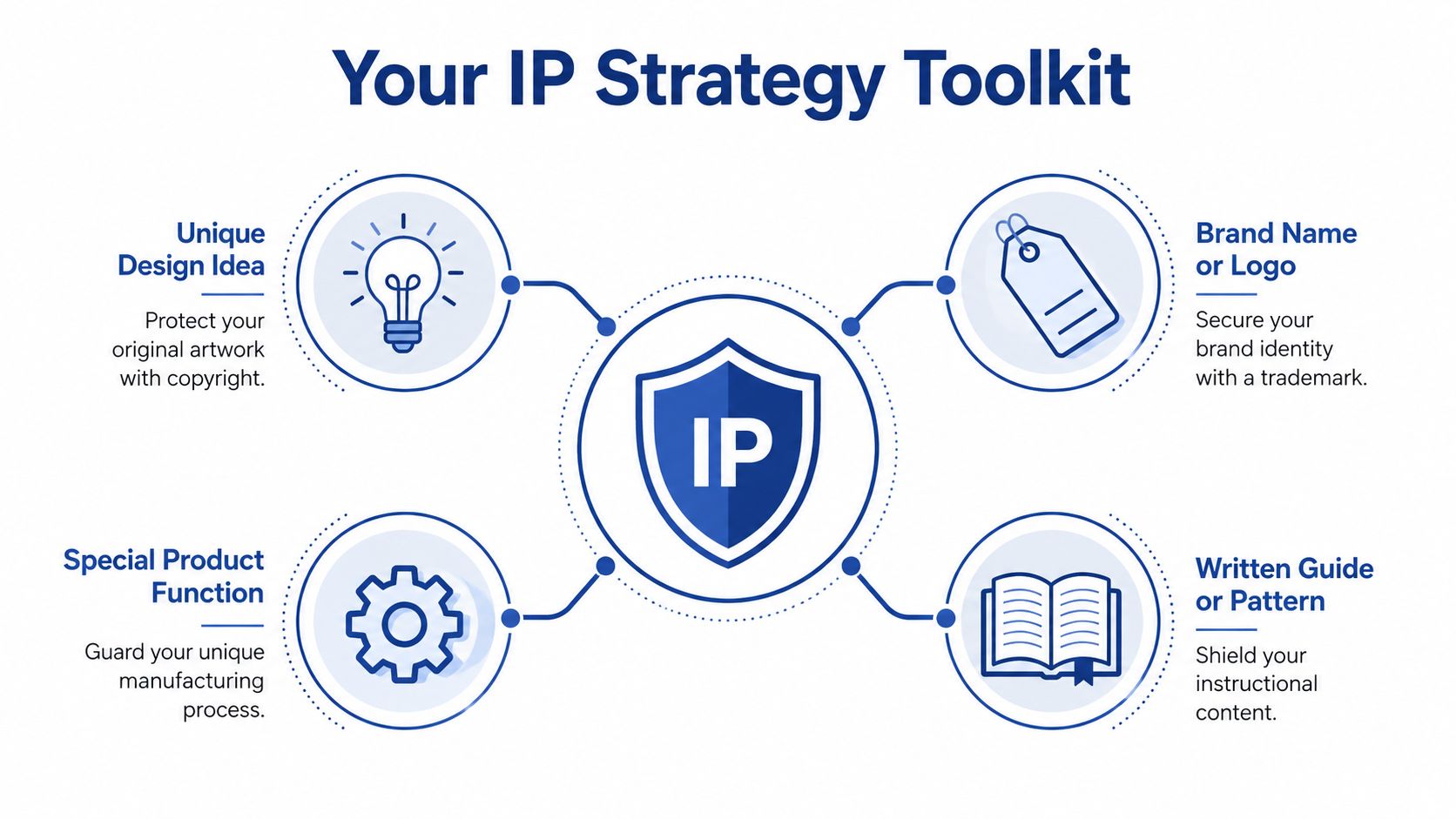
- Copyright can apply to an original illustration, product description, photograph, or written guide once the work is fixed in a tangible form. U.S. copyright guidance also requires independent creation and at least a minimal degree of creativity, according to this overview of U.S. copyright originality standards.
- Trademark supports the identity customers use to recognize your shop, such as its name, logo, or a distinctive source identifier. Trademark rights are territorial and connected to goods-and-services classes, so a name that feels available in one place may create problems elsewhere.
- Design patent protection may be relevant to a novel ornamental feature, such as an unusual pocket shape or garment surface treatment. It isn't a substitute for copyright on a graphic.
- Trade dress can protect the recognizable overall presentation of a product or business, such as a consistent packaging system or storefront appearance, when the legal requirements are met.
Make decisions in layers
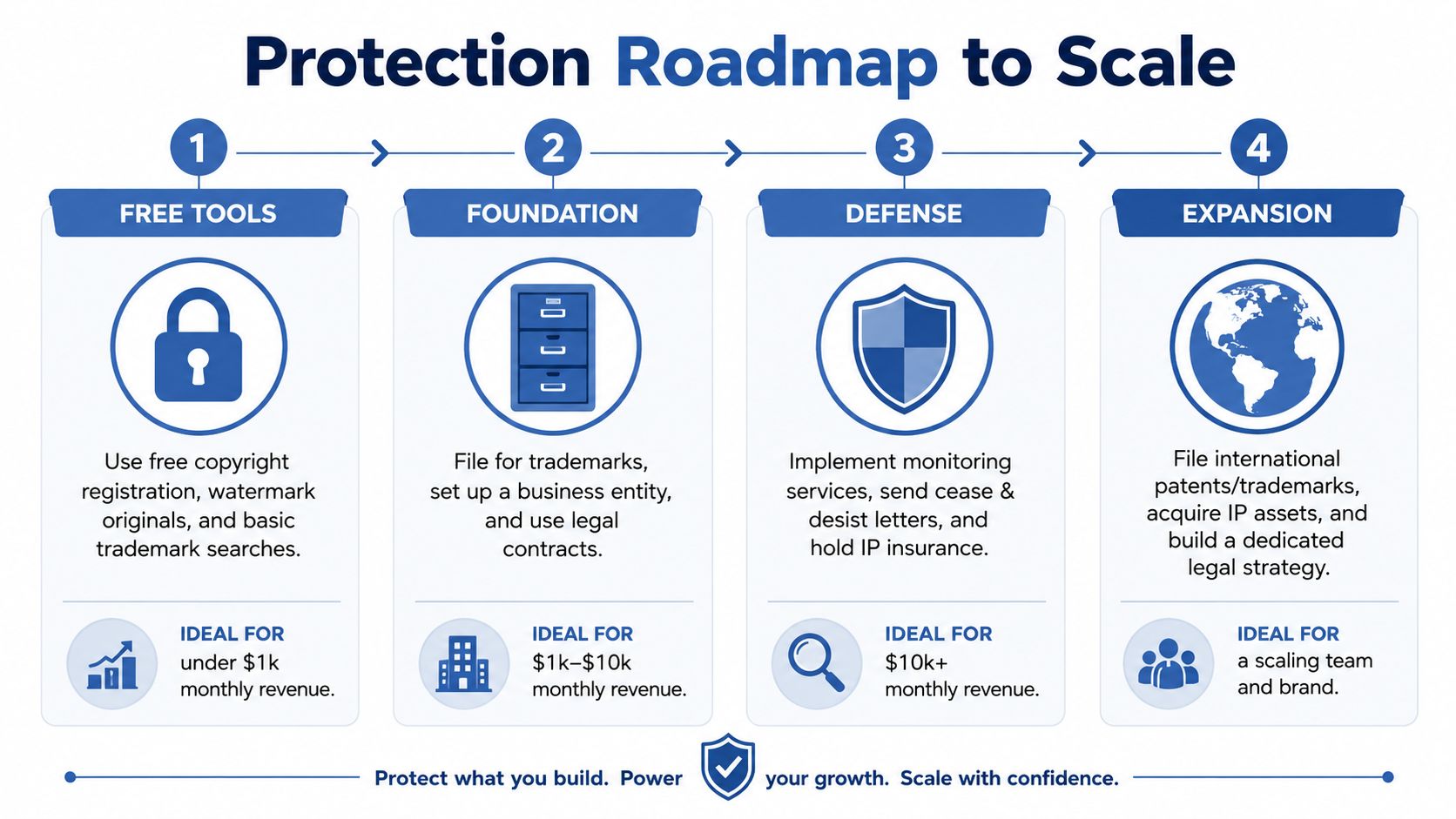
The most practical sequence is free protections first, paid protections next, and enforcement for high-value assets. Save original files, document creation dates, and use clear agreements before spending heavily on filings. Then invest in formal protection for names, designs, or product features that support your strongest commercial position.
A useful explanation of logo design considerations can help you think about the brand asset itself, but the legal question remains separate. A polished logo isn't automatically a strong trademark, and an attractive design isn't automatically protected in every category.
The key question is always commercial: What does this asset help you sell, defend, license, or expand?
The Four Types of IP That Matter for POD Brands
POD sellers often group every creative asset under “copyright.” That shortcut creates blind spots. A shirt illustration, a store name, a novel garment feature, and a recognizable packaging system may need different forms of protection, and each form has limits.
| IP Type | POD Asset | Protection | Duration | Typical Cost |
|---|---|---|---|---|
| Copyright | Original illustration, photo, description, or guide | Protects original expression fixed in a tangible form | Automatic upon fixation in the U.S., with registration strengthening enforcement leverage | Often no upfront cost for automatic protection, registration and legal support add costs |
| Trademark | Store name, logo, or brand identifier | Protects source-identifying branding connected to goods and services | U.S. federal registration lasts 10 years and can be renewed indefinitely when use and formalities continue, according to this USPTO trademark overview | Filing and professional support vary by application |
| Design patent | Novel ornamental garment feature | Protects qualifying ornamental design features, not a general business concept | Depends on jurisdiction and right | Filing, examination, and professional support vary |
| Trade dress | Recognizable packaging, storefront, or presentation | Protects qualifying overall commercial look and feel | Depends on facts and jurisdiction | Evidence development and legal support vary |
Match the right right to the right asset
Copyright covers expression, not a generic phrase, basic idea, or common symbol. If your illustration includes original lettering and artwork, copyright may address the creative work, but it won't automatically give you ownership of every similar concept.
Trademark protects brand recognition, not individual design files. A trademark on your store name doesn't stop another seller from creating an unrelated illustration, while copyright in an illustration doesn't necessarily prevent someone from using a different design under a similar brand name.
Design patents can be powerful for distinctive ornamental product features, but they demand a more deliberate filing decision. Trade dress also requires more than choosing attractive colors. You need a consistent presentation that customers associate with your business, along with evidence supporting the claim.
U.S. copyright protection is automatic when an original work is fixed, but registering within three months of first publication or before infringement can strengthen enforcement and preserve additional remedies, as described in this U.S. IP planning guide for investors. That makes registration a strategic choice for designs you expect to keep selling, license, or defend.
Common Infringement Scenarios in POD and How to Spot Them
Copying doesn't always look like a pixel-for-pixel duplicate. Sometimes it's a brand name that creates marketplace confusion. Sometimes it's a stock image used outside its license. Sometimes the creator is the one taking the risk by using a famous character without permission.
Seven problems worth checking before launch
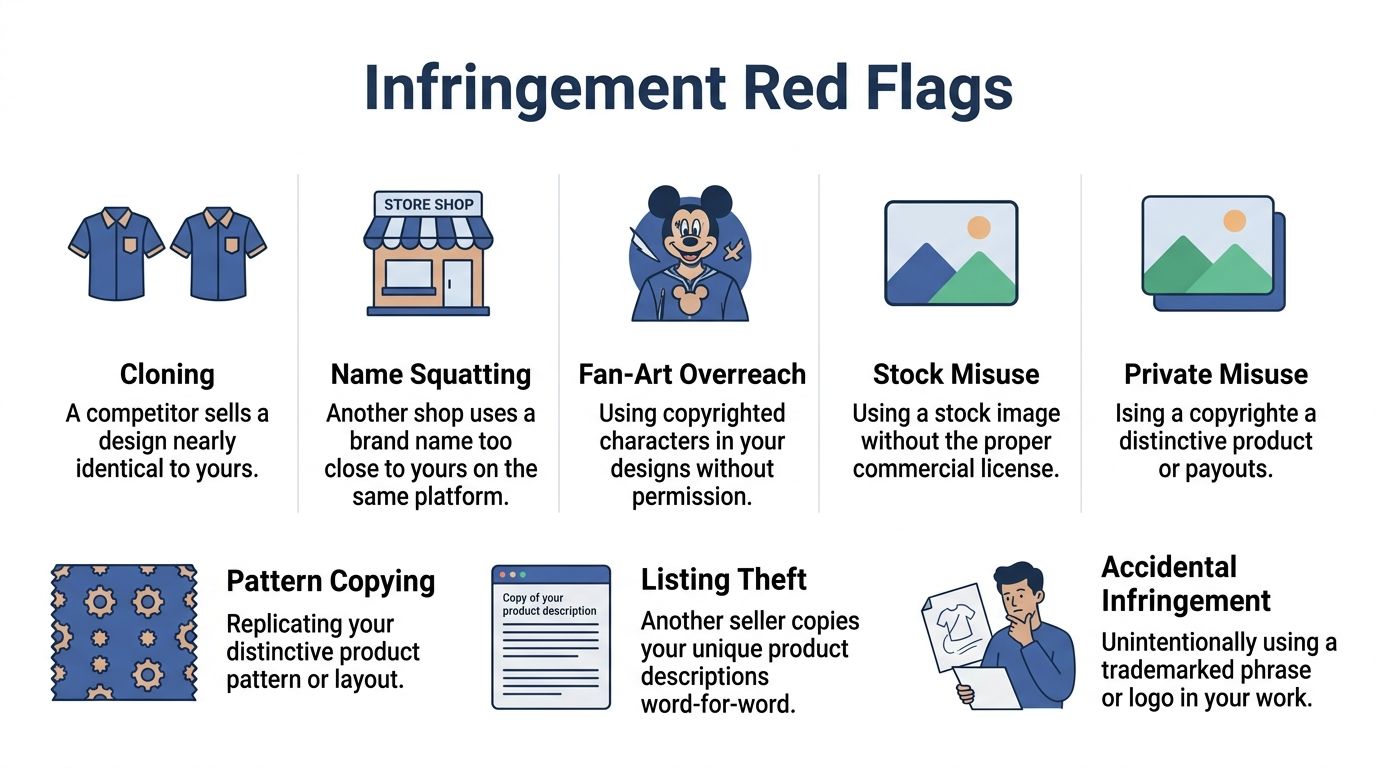
- Design cloning: A competitor mirrors the composition, typography, and visual arrangement of your shirt. Save the source files, listing dates, and screenshots before contacting the platform.
- Name squatting: Another shop adopts a confusingly similar name on the same marketplace. Search the name, related spellings, and relevant product classes before publishing.
- Fan-art overreach: A modified famous character still may rely on protected expression. Treat recognizable characters, logos, and franchises as clearance issues, not easy niche opportunities.
- Stock misuse: A stock image may permit personal use but restrict commercial merchandise. Keep the license record with the project files.
- Logo or wordmark theft: A seller places your brand identifier on apparel or reproduces it in a listing. Trademark evidence and dated brand use can support a clearer complaint.
- Trade dress mimicry: A competitor copies your unusual packaging, color system, and storefront presentation together. Document consistent use rather than relying on one isolated screenshot.
- Overseas print-farm reproduction: A remote seller may reproduce a popular design across several listings and platforms. Build a monitoring routine around your highest-value artwork instead of trying to watch everything.
A seller should have completed an originality and clearance check before each listing. The POD trademark infringement guide offers a practical way to examine names and designs before launch.
The defensive principle is straightforward: don't wait for a complaint to discover what you own or what you borrowed. Search first, save evidence, and keep the commercial license for every third-party asset.
A Prioritized Protection Roadmap from Zero to Scale
Your protection plan should follow the business you're running. Revenue can help determine when a formal filing or monitoring service makes sense, but it shouldn't replace judgment. A design that anchors your entire brand may deserve attention before a less important product that happens to generate occasional orders.
Stage one, establish ownership records
Begin with actions that cost little or nothing. Keep editable artwork, exports, sketches, source prompts, invoices, and publication screenshots in organized folders. Watermark preview files shared with freelancers or suppliers, and maintain cloud-stamped versions that show when the work existed.
A basic trademark search also belongs here. Search the USPTO database, marketplace names, domain availability, and social handles before committing to a brand identity. The goal isn't to create a legal opinion. It's to avoid an obvious collision.
Stage two, make clearance part of production
Before each Apparel Cloning launch, record the inspiration source, separate market research from creative expression, and run an originality audit. Ask whether the new design merely borrows a broad product idea or reproduces distinctive wording, composition, character elements, or branding.
Use written agreements with freelance designers. The agreement should address ownership, permitted reuse, confidentiality, revisions, and delivery of source files.
Stage three, formalize the assets that carry the business
When your store has consistent revenue and a small team, consider formal trademark filings, stronger designer contracts, and licensing structures. A license should define territory, field of use, term, exclusivity, sublicensing, improvements, milestones, and royalties. WIPO recommends using cost, market, and income approaches when valuing IP, as explained in its IP valuation guidance.
Stage four, plan for expansion
International filing, customs recordation, and dedicated monitoring become more relevant when overseas demand or copying creates a real commercial exposure. The Paris Convention provides a 12-month priority window for patents and a 6-month window for designs and trademarks, according to this Paris Convention priority explanation. Discuss timing with qualified counsel before relying on a filing window.
Smart Protections You Can Put in Place This Week
You don't need to hire a lawyer before taking useful defensive steps. Spend one focused week turning scattered creative files into an evidence system.
Day one, organize originals. Create a folder for each core design containing sketches, editable files, exports, mockups, invoices, and publication screenshots. Cloud storage can preserve a useful timeline, but keep local backups too.
Day two, register priority artwork. Review the U.S. Copyright Office process for original illustrations you expect to keep selling or licensing. Copyright already exists when qualifying work is fixed, but timely registration can improve enforcement strength in the United States. Use the official process rather than uploading sensitive originals to an unverified service.
Day three, clear the brand name. Search the USPTO database and marketplace results for identical and confusingly similar marks. Save the search terms, dates, screenshots, and your conclusion in a clearance folder.
Day four, check third-party assets. Review every stock image, font, texture, reference photo, and outsourced element. Store the commercial license beside the project, and remove anything whose permitted use you can't verify.
Day five, sign designer agreements. Use a written freelance agreement that addresses assignment of rights, source-file delivery, confidentiality, revisions, and permission to use the work in merchandise and advertising. Don't assume payment alone resolves every ownership question.
Day six, prepare enforcement materials. Draft a marketplace complaint or DMCA notice with the original work, your contact details, the infringing URL, a clear ownership statement, and the requested action. Keep the template factual and avoid exaggerated claims.
Day seven, monitor the core catalog. Use reverse-image search tools and marketplace searches for your most valuable designs. You can also set alerts for distinctive phrases and brand names. The point isn't to patrol the entire internet. It's to create an early-warning habit around assets that matter.
AvatarIQ can fit into the production side of this system by helping creators generate original apparel designs and mockups quickly, but originality checks and ownership records still belong in your workflow. A faster design process is useful only when the resulting assets are tracked and cleared.
Enforcement Thresholds and When to Take Action
Not every copied listing deserves the same response. Treat enforcement as triage, not warfare. A calm escalation system protects your time while keeping serious problems from sitting untouched.
Document
Use this tier for a low-level copy, an uncertain similarity, or a listing that may disappear quickly. Capture the URL, seller name, screenshots, product images, dates, your original files, and any evidence showing earlier publication. Don't send an angry message before preserving the record.
Ask three questions: Do I have evidence? Is the similarity meaningful? Is the likely benefit worth my time?
Takedown
Use a marketplace complaint when the evidence is clear and the platform has a defined process. Organized design cloning, repeated listing theft, copied product descriptions, and obvious brand misuse justify a more structured response.
Keep the submission narrow. Identify the protected work, explain your ownership, provide the original and infringing links, and request removal under the platform's applicable policy. Avoid claiming rights you don't have, because inaccurate complaints can weaken your credibility.
Escalate
Brand impersonation, repeated infringement across platforms, meaningful revenue exposure, threats, or a coordinated copying operation can justify professional advice. Bring your evidence folder, correspondence, licenses, registration details, and a timeline to the attorney.
For broader commercial conflicts, use a documented dispute resolution process rather than improvising every response. The biggest mistakes are public accusations without evidence, vague demands, repeated emotional messages, and spending more on a minor dispute than the asset can reasonably justify.
EUIPO reported that 2023 was a record enforcement year, with over 138 million detained articles valued at EUR 2.7 billion, and its enforcement infrastructure includes centralized portals and databases for authorities, as detailed in the EUIPO enforcement report. That scale reinforces why monitoring and evidence workflows matter for consumer brands.
Your IP Checklist and Next Steps to Build Brand Equity
The Apparel Cloning method works best when creative experimentation sits on top of disciplined ownership practices. You're not trying to protect every rough idea. You're building a catalog of original assets, then giving the strongest ones enough structure to support sales, licensing, and future expansion.
Your working checklist
- Secure originals: Save editable artwork, exports, sketches, prompts, licenses, invoices, and publication screenshots.
- Clear names early: Search the USPTO database and marketplaces before investing in packaging or paid promotion.
- Use designer agreements: Confirm assignment, commercial use, source-file delivery, confidentiality, and reuse restrictions.
- Create evidence folders: Add new screenshots, URLs, and sales materials to a monthly record.
- Review quarterly: Remove weak or unused assets from your protection priorities and focus resources on designs that support the brand.
- Plan international markets: Prioritize countries where you sell, manufacture, or expect meaningful expansion instead of trying to protect everything everywhere.
Three starter templates
DMCA notice outline: Identify yourself, identify the original work, provide the original publication details, list each infringing URL, state your good-faith belief, confirm the information is accurate, and request removal through the platform's official process.
Designer work-for-hire clause: State that the designer assigns all transferable rights in the commissioned work to the business upon payment, agrees to deliver source files, and won't reuse or license the work outside the written agreement. Have qualified counsel adapt the clause to your jurisdiction.
Licensing checklist: Define the asset, territory, field of use, term, exclusivity, sublicensing, improvements, approval rights, milestones, payment structure, royalties, attribution, and termination conditions.
Your IP portfolio should be pruned, not worshipped. WIPO's 2025 country profiles report that innovators filed 3.7 million patent applications, trademarks reached about 15.2 million filings, utility models about 3.3 million, and industrial designs about 1.6 million worldwide in 2024, with the data allowing comparisons across 190 countries in the WIPO global IP statistics profiles. Those figures show the scale of global activity, but your job is more focused: protect the assets that make your store recognizable and commercially valuable.
Every documented design, cleared brand name, signed agreement, and sensible enforcement decision can create more advantage later. Start with the files on your computer this week, then build the layer your next stage of growth can support.
Skup helps POD entrepreneurs build original apparel businesses through the Apparel Cloning method, while AvatarIQ supports faster creation of designs and mockups for the product workflow. Visit Skup to explore practical systems for launching, protecting, and growing a brand with more control.