How to Calculate Profit Margins for High-Profit POD
You get the sale notification, smile at the order, and start thinking about the next design. Then you open your payout details and realize the selling price isn't the same thing as the money your business keeps. The shirt still has to be produced, shipped, advertised, processed through a payment platform, and sometimes returned.
That gap between revenue and actual profit is where many promising POD brands lose clarity. Learning how to calculate profit margins gives you a reliable view of every product, campaign, and pricing decision. You stop guessing, protect cash flow, and build with the confidence that comes from knowing the math.
Table of Contents
- Your First Sale Is Exciting But Is It Profitable
- Calculating Your Gross Profit Margin
- Finding Your Net Profit Margin The Real Bottom Line
- Avoiding Common Profit Killers in POD
- Pricing Your Products for a 30 to 50 Percent Profit Margin
- Your Path to Profitability Starts Now
Your First Sale Is Exciting But Is It Profitable
Your first print-on-demand sale confirms that a customer will pay for your design. The useful question comes after the notification: how much money remains once the order is produced, delivered, and supported?
A shirt priced at $30 may carry supplier charges for the garment and printing, yet those costs show only part of the result. Payment processing, advertising, fulfillment, shipping, discounts, platform fees, customer support, and returns can reduce what you keep. A product can have a healthy gross margin and still produce little profit, or lose money, after the costs required to win and complete the sale.
Practical rule: Judge a product by the money left after the costs that make the sale possible, not by revenue alone.
Profit margin gives you a consistent way to compare designs, prices, and campaigns. It also shows whether a product can support paid traffic and still leave room for growth. The standard framework separates gross, operating, and net profit margin, so production costs, overhead, and other expenses do not get blended into one misleading figure. Margin means profit divided by revenue, multiplied by 100.
For POD apparel, calculate the result per order instead of waiting for a month-end summary. Record the selling price, direct product cost, transaction charges, marketing allocation, and expected return exposure. Keep the same categories for every product, then compare the amount left after each sale. That comparison reveals which designs can scale and which ones need a higher price, lower cost, or different acquisition strategy.
Advertising deserves its own line. If a campaign spends heavily to produce an order, the product needs enough room after fulfillment and fees to absorb that expense. Use the order-level result to optimize your ad spend, adjust pricing, or stop promoting an item that cannot support profitable growth.
The math is simple enough to use from your first order. Review every sale as evidence, not just as revenue, and you will build toward the 30% to 50% profit margins that give sustainable POD apparel brands room to handle returns, platform costs, and future growth.
Calculating Your Gross Profit Margin
Gross profit margin is your first product health check. It shows what remains after subtracting the direct cost of making an item, called cost of goods sold, or COGS. For a POD shirt, COGS usually starts with the blank garment and printing. Keep the definition consistent across products, or comparisons will mislead you.
The formula is:
Gross Profit Margin = (Revenue − COGS) / Revenue × 100
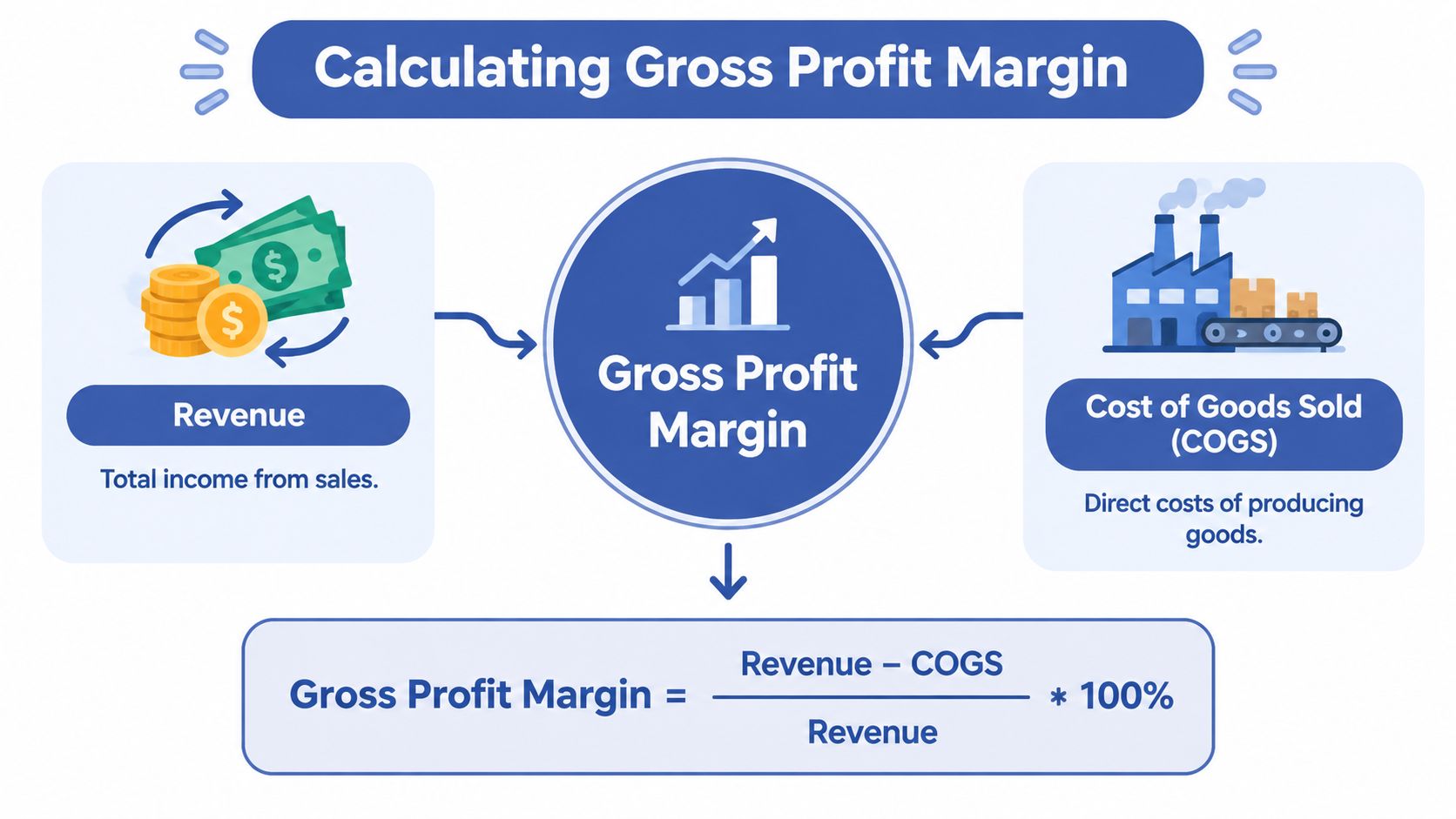
Use one product and follow the math
Suppose you sell a T-shirt for $30, while your POD supplier charges $12 for the blank shirt and printing.
- Start with revenue: $30.
- Subtract COGS: $30 − $12 = $18 gross profit.
- Divide gross profit by revenue: $18 ÷ $30 = 0.60.
- Convert to a percentage: 0.60 × 100 = 60% gross profit margin.
The product retains $0.60 from each sales dollar before advertising, overhead, taxes, and other expenses. The same structure applies to the standard example described in the accounting explanation of profit margin, where $50 in revenue minus $30 in costs leaves $20 in gross profit and a 40% gross margin.
Use gross margin to judge whether the product itself has enough room to support the rest of the business. A stronger margin gives you more flexibility for customer acquisition, discounts, software, returns, and platform costs. A weaker margin may still work, but it leaves less room for expensive traffic, mistakes, or refunds. For POD apparel, that trade-off matters before you scale an ad campaign.
Keep your COGS definition consistent
Do not compare one product using only the supplier's production charge and another using production plus shipping. Choose the cost categories that belong in the metric, then apply them to every product. Start by recording supplier charges and organize the inputs with this guide to calculating product costs.
Gross margin is not take-home profit. It answers a narrower question: does the product generate enough gross profit before operating expenses? The answer helps you decide whether to adjust the price, reduce direct costs, or continue testing the product before reviewing the complete business result.
Finding Your Net Profit Margin The Real Bottom Line
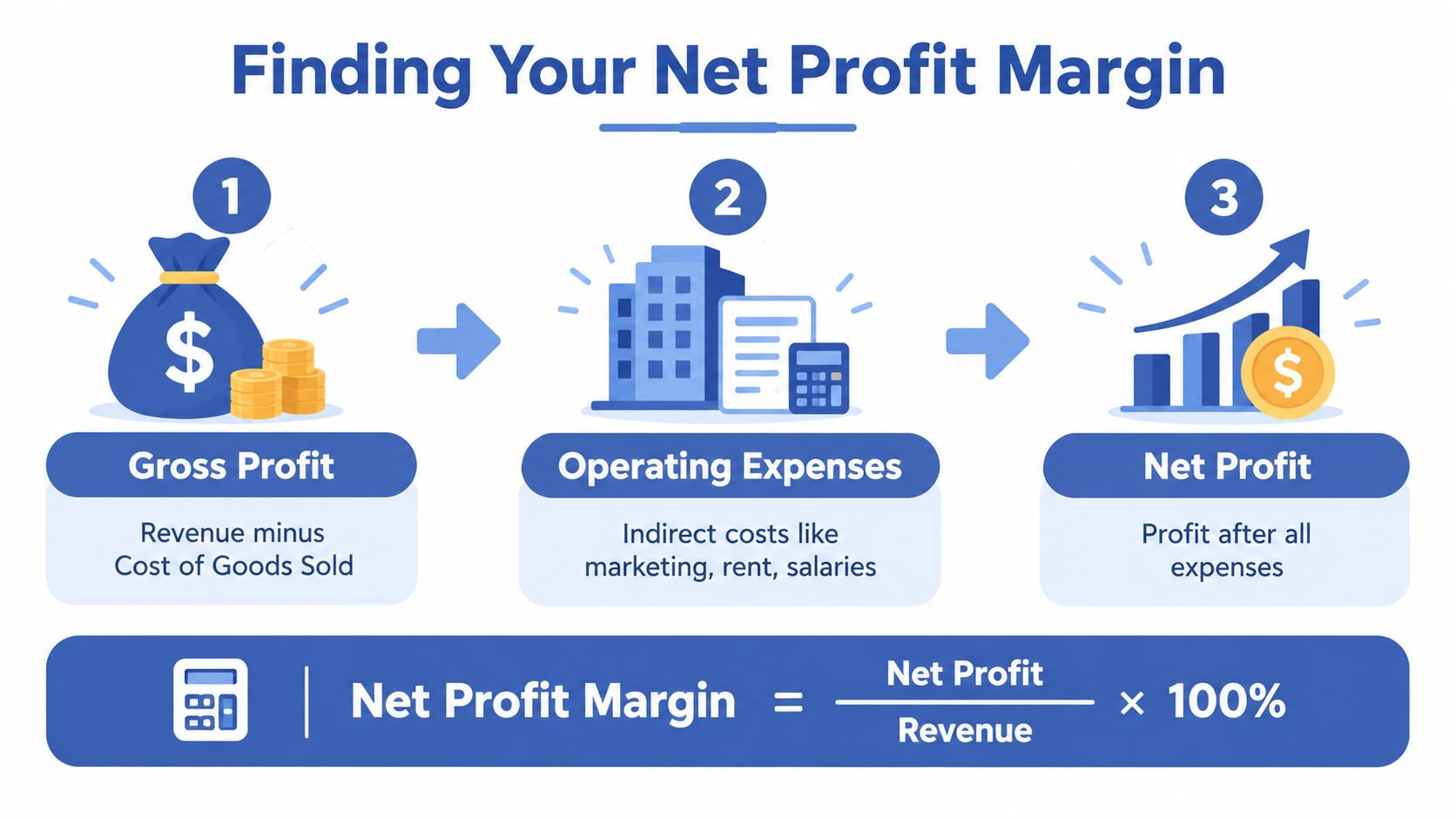
A product can look excellent at the gross-margin level and still fail to produce cash. Net profit margin accounts for the expenses left after COGS, including operating costs that support the store, the customer, and the marketing engine.
The standard structure is:
Net Profit Margin = Net Profit / Revenue × 100
For a practical POD calculation, define net profit as the revenue from the order minus COGS and the operating expenses you allocate to that order. Depending on your reporting system, this can include advertising, platform and app costs, payment charges, customer service, and other business expenses. Taxes, interest, and broader overhead may be tracked separately for management reporting, but they still matter when you evaluate the business as a whole.
Extend the shirt example
The shirt sells for $30, and the supplier cost is $12, leaving $18 gross profit. Now allocate $1 for the Shopify plan and $8 for advertising connected to that sale.
- Revenue: $30
- COGS: $12
- Allocated operating expenses: $1 + $8 = $9
- Net profit: $30 − $12 − $9 = $9
- Net profit margin: $9 ÷ $30 × 100 = 30%
The result tells a more useful story than the gross margin alone. The product retains $9 after the selected expenses, not $18. That distinction affects whether you can scale ads, offer a discount, absorb a customer-service issue, or reinvest in new products.
Margin and markup aren't interchangeable
New sellers often say they want a certain markup when they mean margin. Margin uses revenue as the denominator. Markup uses cost as the denominator. If a shirt costs $12 and sells for $30, the profit is $18. The gross margin is 60%, while the markup is 150%.
That difference matters when you set prices. A markup instruction can produce a price that sounds profitable but doesn't leave the percentage of revenue you need after expenses. Use markup as a pricing input if that's how your supplier or worksheet is structured, but use margin to assess the economic health of the sale.
For store-level reporting, separate product performance from business performance. Order-level net margin helps you judge an offer or campaign. A monthly net margin review helps you see whether subscriptions, contractors, refunds, taxes, and other costs are consuming the profit your individual orders appear to generate. Accurate categorization is easier when you maintain a dedicated eCommerce accounting process.
For another visual explanation of the calculation, watch the walkthrough below.
Avoiding Common Profit Killers in POD
A shirt can show a healthy gross margin and still lose money on the order. The gap usually comes from costs that arrive after production, including advertising, discounts, platform fees, fulfillment, shipping, returns, storage, and customer support. POD apparel becomes profitable only when these deductions are visible before you increase traffic.
Fashion returns can materially change the result. One analysis places fashion return rates in the 20–30% range and estimates per-return losses of roughly $15–$25 on a $50 item, showing why a revenue-minus-COGS calculation can overstate apparel profitability. The return-adjusted margin analysis provides that context.

Allocate the costs that create each order
Assign advertising cost to the sale it helped generate. Divide the relevant campaign spend by its attributed orders to estimate cost per conversion. Keep that figure visible at the product or campaign level. Hiding paid acquisition inside a general monthly expense can make an unprofitable offer look ready to scale.
Apply the same discipline to transaction costs. Payment processing and marketplace fees reduce the money retained from the customer's payment. Fulfillment and shipping determine what delivery costs. Your contribution calculation should show each deduction before you judge a product's performance.
Treat discounts as a pricing decision
A coupon lowers revenue while many direct costs stay fixed. Calculate the discounted selling price first, then recalculate gross and net margin from that lower amount. If the offer only works at full price, the promotion is not a profitable growth strategy.
Returns need their own expected-cost line. Include product cost, shipping impact, processing expense, and the share of returned inventory that cannot be resold. Clear product descriptions, accurate sizing information, and responsive customer service can reduce avoidable returns while keeping the buying experience attractive.
Payment disputes can create another direct loss. Store order records, delivery details, product information, and customer communication in an organized system. Follow a defined process for managing Shopify payment disputes, so a preventable chargeback does not distort your margin report.
Margin discipline: If an expense changes because you made the sale, include it when testing the order's profitability.
Pricing Your Products for a 30 to 50 Percent Profit Margin
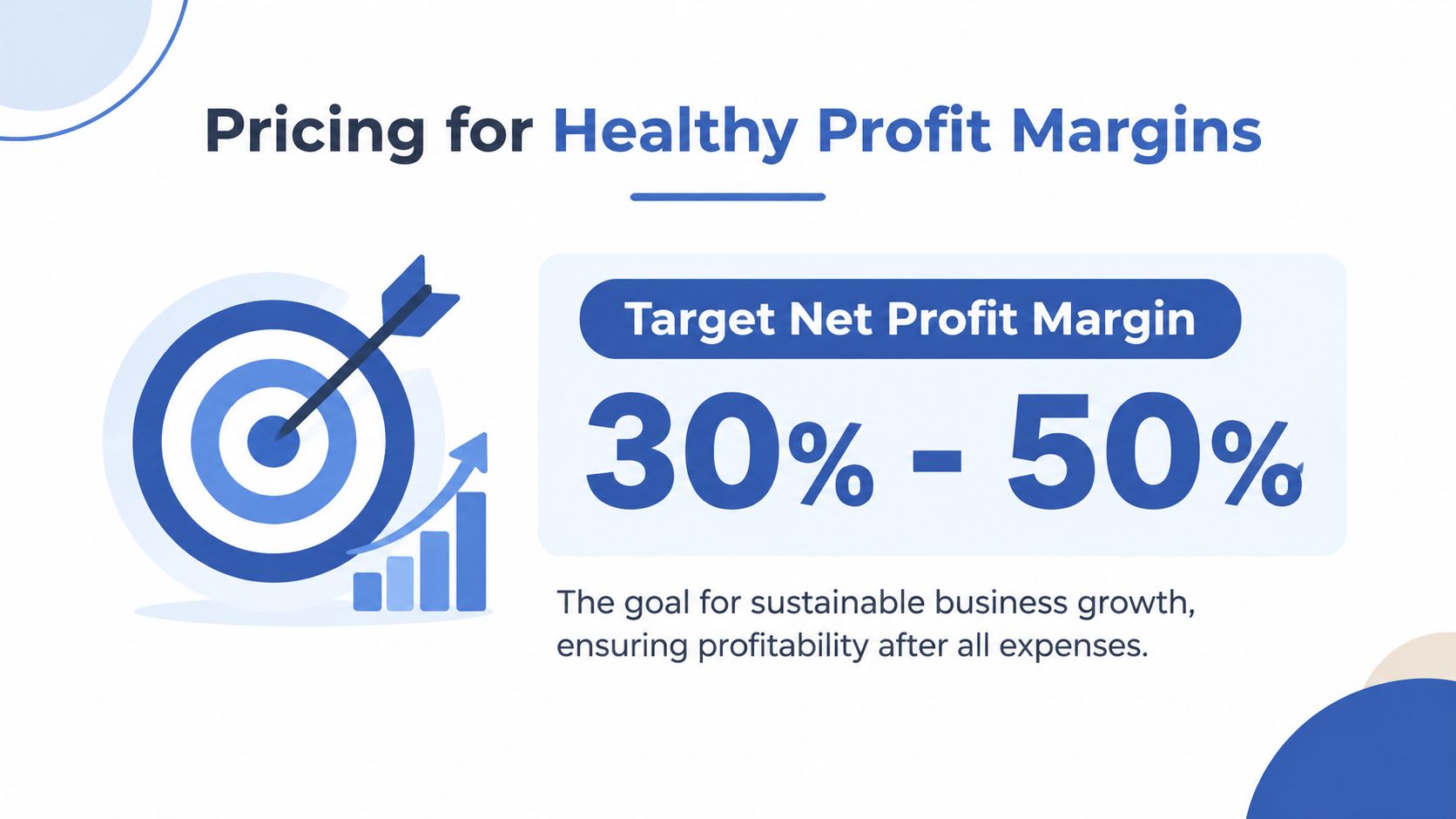
Sustainable POD brands need room to acquire customers, handle operational surprises, fund new designs, and pay the owner. Aiming for 30% to 50% net profit margin gives you a practical target for a business that needs to remain profitable after its major expenses, not merely look attractive at the gross level.
That range isn't a promise for every product or stage. It's a strategic benchmark. Your actual result will depend on product cost, selling price, advertising efficiency, discounts, returns, fees, and overhead. The important point is to price from the economics backward instead of copying a competitor's price and hoping the numbers work.
Build the price from total cost
Start with a per-order cost sheet. Add the supplier's production cost, expected fulfillment and shipping cost, payment and platform fees, allocated ad spend, expected return cost, discount allowance, and the portion of overhead you want the product to carry. The total becomes your working cost base.
Then set the target margin as a decimal and use:
Required Price = Total Cost / (1 − Target Margin)
This formula protects the margin because the target applies to revenue, not cost. If your fully loaded cost is $20 and your target net margin is 40%, the price calculation is $20 ÷ (1 − 0.40), which produces a required price of $33.33. That example is a pricing illustration, not a claim about what every shirt should cost. You still need to test customer demand and positioning.
Test the offer, not only the number
A price works when the customer understands the value and the business retains enough profit. Use product quality, design relevance, brand presentation, bundles, and clear delivery expectations to support the price rather than immediately cutting it. If the market resists, inspect the offer and costs before reducing the target margin.
Run at least two views in your worksheet:
- Base case: Uses your normal product, fulfillment, fee, and advertising assumptions.
- Conservative case: Adds realistic allowance for discounts, returns, and weaker campaign efficiency.
- Decision case: Shows the lowest price you can accept while preserving your chosen margin.
Use this product-pricing guide to structure the pricing logic, then review actual order data and update assumptions. A margin target becomes useful when you compare it with what customers buy, what ads cost, and what returns do to the order.
Your Path to Profitability Starts Now
You don't need advanced finance knowledge to run a serious POD business. You need consistent inputs, a clear distinction between gross and net margin, and the discipline to include the costs that follow every sale.
Gross margin tells you whether the product has a solid foundation. Net margin tells you whether the complete operation can support growth. Return-adjusted and fully loaded calculations give you the visibility to price confidently, protect cash, and choose products that can carry a real brand.
The opportunity in eCommerce is still exciting because POD lets you test ideas without building a traditional inventory operation. Tools such as AvatarIQ can help create apparel graphics and product mockups faster, while Skup's Apparel Cloning course provides a step-by-step framework for finding and launching POD apparel products from zero toward $10k a month and beyond. The numbers remain your responsibility, but they also give you control.
Skup offers practical POD education, the Apparel Cloning system, coaching, and tools such as AvatarIQ to help you move from product ideas to listings with clearer economics. Visit Skup to explore the systems and resources that can help you price every product for sustainable profit.