Dynamic Pricing Models for POD Apparel
You've got a shirt that sells steadily at one price, while demand around it changes every week. A niche trend starts moving, a seasonal event approaches, competitors adjust their offers, and your store keeps showing the same number. That consistency feels safe, but it can cost you margin during strong demand and leave slow designs stuck when interest fades.
Dynamic pricing models give POD apparel sellers a practical way to respond. Instead of treating every product and every selling period the same, you adjust prices according to observable conditions, such as demand, timing, market movement, or product age. The objective isn't to charge every buyer the highest possible amount. It's to make deliberate pricing decisions that protect margin while keeping the customer relationship intact.
This approach has been tested well beyond eCommerce. Airlines were already using demand-sensitive fares during the 1980s and 1990s, and a Wharton study found that 34% of the revenue gains from dynamic pricing compared with uniform pricing came from intertemporal price discrimination. The broader pricing literature connects the strategy's spread to richer demand data, faster technology-enabled price updates, and decision-support tools for analysis and optimization, as documented in the Wharton research on dynamic pricing and airline revenue management.
For a POD store, the useful question isn't whether you should copy an airline. It's which signals you can trust, which model fits your data, and how you can make price changes feel reasonable. Your foundation still starts with sound product economics, which is why the POD product pricing guide belongs beside any automation plan. A practical overview of strategic AI pricing for ecommerce can also help clarify where software supports judgment and where it shouldn't replace it.
Table of Contents
- Why Static Pricing Leaves Money on the Table
- The Four Dynamic Pricing Models Explained
- The Trust and Fairness Gap Most Guides Ignore
- How to Implement Dynamic Pricing in Your POD Store
- Choosing the Right Model for Your Business Stage
- Navigating the New Regulatory Landscape
- KPIs and Next Steps for Your Pricing Strategy
Why Static Pricing Leaves Money on the Table
A POD owner launches a shirt at $24.99 and leaves it there for an entire year. The design performs well around a holiday, gets picked up by a niche community, and attracts fresh traffic after a social post. Meanwhile, competing stores move their prices, bundle related products, or use short sale windows to capture urgency. The owner sees orders, so the static price feels validated, but the store has no way to distinguish a normal week from a high-intent buying window.
That's the central weakness of a fixed price. It gives you operational simplicity, but it ignores the conditions that shape willingness to buy. A trending design may support a stronger price while interest is high. A seasonal design may need a carefully timed reduction when the relevant moment passes. A product with weak engagement may need a different offer, not an automatic discount applied across the entire catalog.
What changes in the market
Dynamic pricing means connecting your price to conditions you can observe. Those conditions might include:
- Time: A holiday, season, launch window, or event can change how customers value a design.
- Demand: Traffic, product views, add-to-cart activity, and order velocity can reveal growing interest.
- Competition: Comparable offers may influence how shoppers evaluate your product.
- Product status: New releases, evergreen winners, and aging seasonal designs deserve different treatment.
- Customer behavior: Broad segment patterns can inform offers, but individual-level pricing demands much greater care.
The strategy works best when each adjustment has a clear reason. Raising the price because an algorithm can do it creates confusion. Raising it because a design is receiving unusual attention, while showing a clear end date or value explanation, is easier to defend.
Why POD is a strong testing ground
Print on demand gives entrepreneurs a broad catalog without requiring them to commit to large physical inventory positions. That makes it possible to test pricing alongside designs, niches, product types, and promotional windows. The opportunity is attractive, but the operating discipline matters. A price change affects more than today's conversion. It can influence perceived quality, ad efficiency, customer expectations, and whether a buyer returns.
The rest of the strategy should therefore progress from simple rules to more advanced automation. Start with transparent time-based or rule-based changes, measure demand by product, and only introduce more complex models once your store has reliable signals. The point isn't maximum volatility. It's better timing and stronger margin decisions.
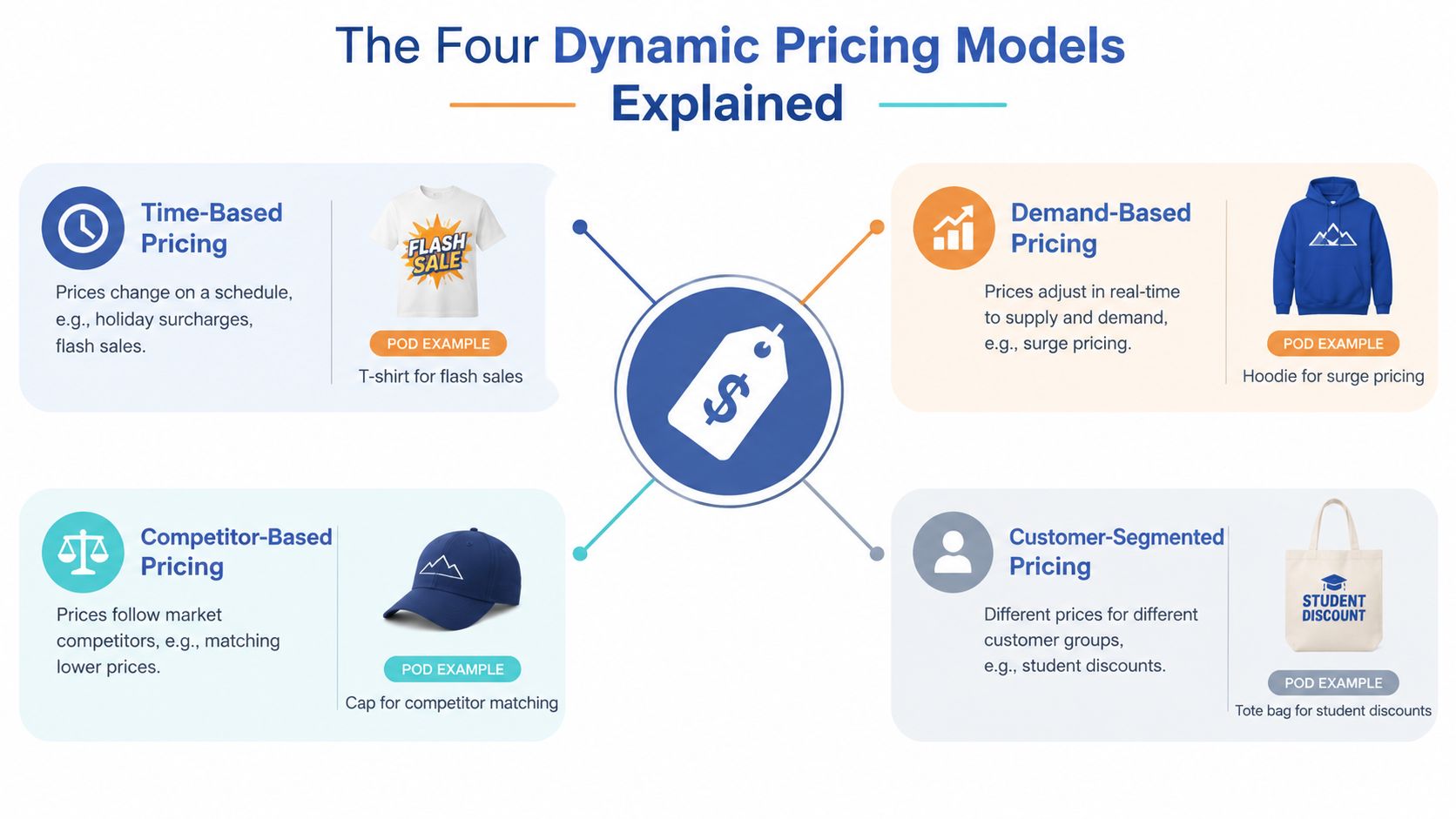
The Four Dynamic Pricing Models Explained
Not every store needs machine learning. Most POD entrepreneurs should begin with the model that matches their current data and operating capacity, then add complexity only when it solves a real problem.
Time-based pricing
This model changes prices according to a calendar. You might set a standard price for an evergreen shirt, introduce a limited seasonal offer around a holiday, or create a clearly defined launch window for a new collection. The data requirement is modest because the schedule comes from known dates and planned campaigns.
Time-based pricing suits beginners because it's easy to explain and audit. Customers can understand a holiday promotion or a sale that ends on a stated date. The risk is applying the same calendar logic to every product when different niches have different demand cycles.
Demand-based pricing
Demand-based pricing reacts to signals such as rising product views, stronger cart activity, or a sudden increase in orders. A hoodie tied to a fast-moving trend might move into a higher price band while interest is strong. A design that loses momentum might return to its base price or receive a controlled promotion.
This approach needs cleaner reporting than a calendar rule. You'll need enough activity to separate a meaningful signal from random noise. It also requires guardrails, because a short traffic spike shouldn't trigger a dramatic change that surprises shoppers.
Competitor-based pricing
Competitor-based pricing uses market offers as an input. A cap might remain close to comparable products, or you might deliberately price above them when your design, brand, or presentation creates additional value. The model is more useful in crowded categories where customers compare similar products directly.
The danger is a race to the bottom. If you automatically match every lower price, you can surrender margin without learning whether the competing product has the same quality, delivery promise, or audience fit.
Customer-segmented pricing
This model presents different offers to defined customer groups, such as loyalty members or first-time buyers. It can help you create a structured welcome offer or reward repeat customers without changing the public price of the product.
It also creates the steepest trust challenge. Shoppers may accept a clearly labeled loyalty benefit, but they can react badly when two people see different prices for the same shirt without an understandable reason. Segment logic requires careful data governance, plain-language communication, and a review for discriminatory outcomes.
A sensible progression is time-based first, rule-based controls next, demand signals after that, and algorithmic assistance only when your data supports it. For broader context on pricing strategy types for eCommerce, compare the model's complexity with the customer experience you're prepared to manage.
The Trust and Fairness Gap Most Guides Ignore
Dynamic pricing can improve revenue capture, but revenue isn't the only outcome that matters. Recent research found that algorithmic pricing can reduce trust in retailers and increase the time consumers spend searching for prices. The same research indicates that resistance may weaken as shoppers become more familiar with dynamic pricing, while reactive pricing and price-matching guarantees can help reduce backlash. These findings are summarized in the research on algorithmic pricing, trust, and consumer resistance.
Another line of recent work found that consumers still judge online dynamic pricing as unethical, with discrimination, disrespect, and opacity shaping that judgment more strongly than concerns about data use or intrusiveness. That distinction matters for apparel. A customer may accept that a seasonal design has a temporary promotion, but feel disrespected if the store calculates a different shirt price for them than for someone else.
Fair changes have visible logic
Customers tend to have an easier time with pricing that follows a public rule. Examples include:
- Seasonal pricing: A winter design receives a planned promotion as the season closes.
- Launch pricing: A new collection has a stated introductory window.
- Inventory-aware markdowns: A slow-moving product gets a clear reduction rather than remaining indefinitely at full price.
- Loyalty benefits: Returning customers receive a labeled reward, not a hidden individualized price.
- Market-wide adjustments: A price changes for everyone because the offer or selling period changed.
The common thread is consistency. Buyers don't need to see your formula, but they should understand the kind of event that caused the change.
Where the model starts to feel exploitative
Personalized pricing deserves a higher bar than ordinary demand-based adjustment. A store that charges different people different amounts based on browsing history can create suspicion, particularly when the customer has no notice and no way to understand the difference. Frequent price movement can create a second problem, training shoppers to postpone purchases until the next discount appears.
Practical rule: If you wouldn't explain the pricing rule on your product page, don't let automation apply it silently.
For DTC apparel, repeat purchase intent and customer lifetime value often matter more than squeezing an extra amount from one checkout. Set a public base price, use limited and explainable promotions, and avoid making customers feel that every visit is a negotiation against an invisible system. Margin growth becomes sustainable when shoppers trust that your store's prices follow rules rather than personal judgments about what each visitor will tolerate.
How to Implement Dynamic Pricing in Your POD Store
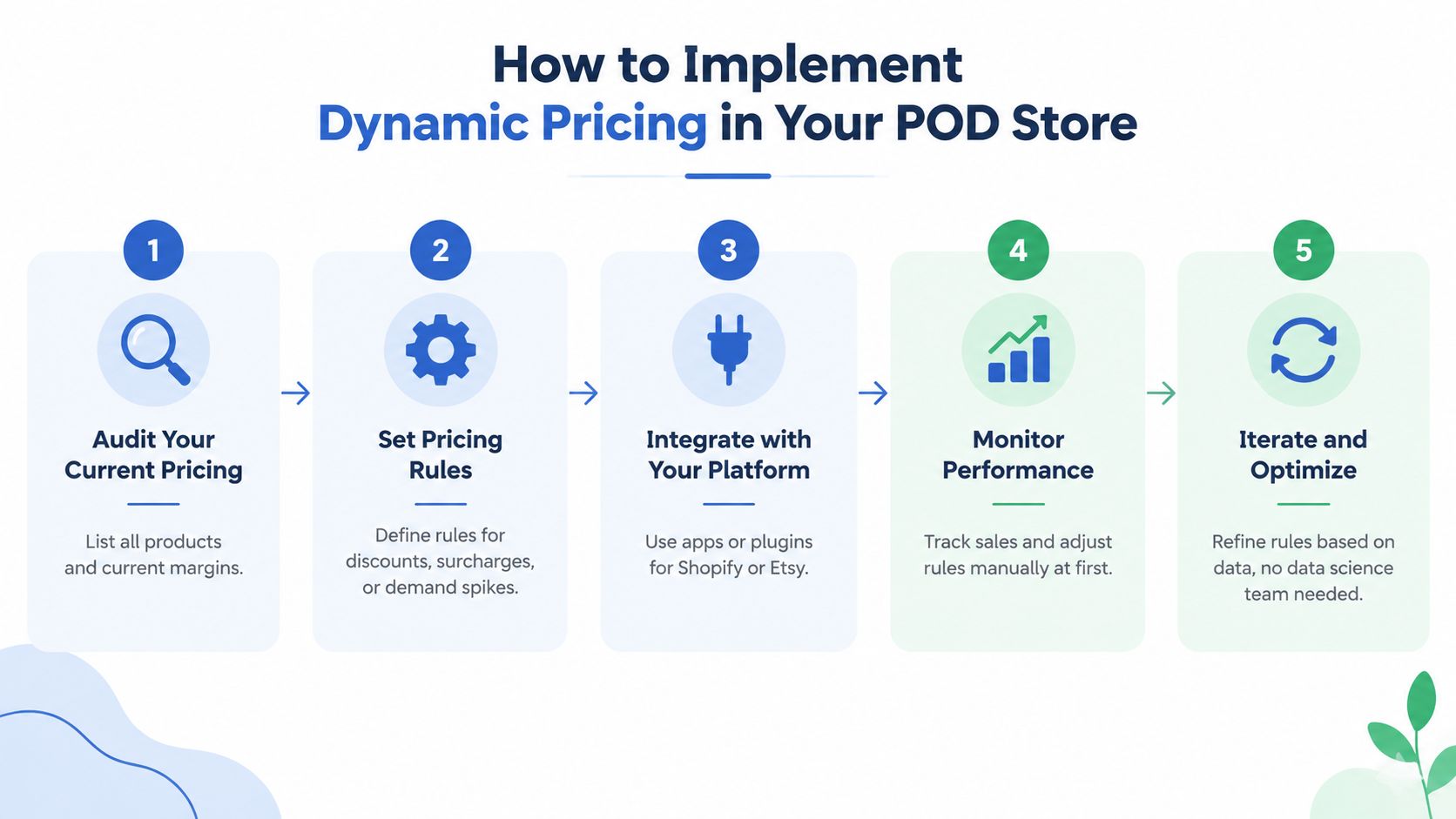
A small store doesn't need a data science department to begin. It needs clean product economics, a narrow test, and a pricing rule that a human can inspect. Start with one product or collection rather than changing every listing simultaneously.
Begin with a pricing audit
List every product, its base price, fulfillment cost, payment costs, advertising contribution, and resulting margin. Then mark the products with enough traffic and order activity to support a test. A design with almost no activity can't tell you much about price sensitivity, so leave it on a stable price until you have a stronger signal.
Separate evergreen products from seasonal designs and trend-driven products. They shouldn't share identical pricing rules because their demand patterns differ.
Choose a simple model and define guardrails
Use time-based rules for known events and rule-based adjustments for product age or planned promotions. Add demand triggers only after you've established what normal activity looks like for that product.
Your guardrails should answer four questions:
- Margin floor: What is the lowest acceptable contribution after fulfillment and marketing costs?
- Change limit: How large can one adjustment be?
- Cooldown period: How long must a price remain unchanged before another adjustment?
- Approval point: Which changes require manual review before publication?
AvatarIQ can support the design-to-listing workflow by helping create apparel designs, mockups, and product imagery faster. That matters because faster listing production can give you more products to evaluate, but it doesn't replace pricing discipline. Use it to expand creative testing, then let evidence determine which products earn deeper pricing attention.
Test before you automate
Create a control group that keeps the original price and a test group that follows the new rule. Keep the product, audience, offer presentation, and advertising conditions as consistent as practical. Compare revenue per visitor, conversion rate, average order value, refund behavior, and repeat purchase signals rather than judging the test on order count alone.
Run the test for a defined period that captures normal purchasing conditions for the product. Don't stop after a brief spike, and don't extend a failing rule because you want the result to improve. Review the outcome manually before expanding it to another collection.
A useful first experiment is modest: one proven shirt, one transparent seasonal or demand rule, one control price, and one documented success criterion. If the rule increases revenue but reduces repeat behavior or creates more customer-service friction, it needs revision.
Choosing the Right Model for Your Business Stage
Your store's maturity should determine how much pricing complexity you introduce. A new seller usually needs consistency and learning, not an opaque system trying to infer willingness to pay from limited information. An established operator can use more signals, but only if the underlying data is reliable and the pricing logic remains explainable.
| Model Type | Best For | Data Required | Complexity | Expected Margin Lift |
|---|---|---|---|---|
| Time-based | Seasonal launches, holidays, planned promotions | Calendar and product schedule | Low | Protects or improves margin during strong buying windows |
| Demand-based | Proven products with changing interest | Traffic, carts, orders, demand history | Medium | Can capture more value during demand peaks |
| Rule-based | Catalog maintenance and controlled markdowns | Product age, sales activity, margin data | Low to medium | Reduces unnecessary discounting and supports sell-through |
| Algorithmic or machine learning | Large catalogs with dependable data pipelines | Connected sales, demand, market, and customer signals | High | Potentially stronger optimization, with greater model risk |
The table describes expected direction, not a guaranteed result. A price increase can reduce conversion, while an aggressive markdown can reduce contribution. Measure the trade-off instead of assuming that every dynamic adjustment creates a lift.
Match the model to your operating stage
For a beginner with limited order flow, start with a calendar. Holiday pricing, launch windows, and planned seasonal markdowns provide useful structure without pretending that sparse data can support advanced predictions. Rule-based pricing is the next practical layer, especially for aging seasonal products.
An intermediate seller with consistent traffic can add demand triggers. For example, a trending niche design might move into a higher price band during a strong demand window, while a stale design returns to its base price rather than receiving an automatic discount.
Advanced operators with broad catalogs and connected reporting can explore algorithmic pricing. A 2026 review describes the field's movement from classic econometric approaches toward deep learning and contextual bandits, while identifying unresolved challenges involving demand learning, strategic interaction, fairness, and computational efficiency (review of AI-driven dynamic pricing methods). That's a reason to proceed carefully, not a reason to buy complexity prematurely.
The Apparel Cloning method can help you identify proven product patterns and adapt them with original designs in new niches. More reliable winners give your pricing tests a meaningful commercial foundation, while the method itself remains focused on product discovery rather than automatic price manipulation.
Navigating the New Regulatory Landscape
United States pricing regulation is moving quickly, especially where algorithms use personal or competitor data. New York's 2025 algorithmic-pricing disclosure law requires a business using personalized algorithmic pricing to display a clear notice stating, “THIS PRICE WAS SET BY AN ALGORITHM USING YOUR PERSONAL DATA,” whenever that price is advertised, promoted, labeled, published, or otherwise shown to a consumer in New York (New York algorithmic-pricing disclosure overview).
California took a different route. AB 325, signed on October 6, 2025, prohibits agreements to use or distribute a common pricing algorithm. The law defines that technology as software used by two or more parties that ingests competitor data to recommend, align, stabilize, set, or otherwise influence a price or commercial term (California AB 325 analysis).
Maryland became the first state to pass dynamic-pricing legislation in April 2026. The law takes effect on October 10 and requires grocery stores to keep price changes in place for at least one business day while banning surveillance data for individualized prices (Maryland dynamic-pricing legislation coverage).
Consumer Reports found that qualifying state bills expanded from three in 2024 to 12 by July 2025, showing how quickly lawmakers increased attention to algorithmic pricing (Consumer Reports state bill tracker).
A practical compliance check
- Disclose clearly: Tell shoppers when personal data determines the displayed price.
- Document logic: Keep an internal record of inputs, rules, approvals, and changes.
- Review data use: Separate broad market signals from individualized surveillance data.
- Avoid competitor coordination: Don't participate in agreements involving shared common pricing algorithms.
- Check locations: Review the laws that apply where customers see or purchase your offers.
Treat compliance as part of the customer experience. Clear pricing rules can reduce suspicion and give your brand an advantage over stores that leave buyers guessing.
KPIs and Next Steps for Your Pricing Strategy
A dynamic pricing test needs more than a revenue screenshot. Track revenue per visitor, conversion rate by price point, average order value, repeat purchase rate, and customer lifetime value. Add refunds, customer-service complaints, and promotion usage when they help explain why a result changed.
Build a simple weekly dashboard with one row per product or test group. Record the active price rule, exposure period, visitors, orders, revenue, contribution margin, and repeat-purchase signals. The eCommerce analytics guide can help you organize the measurement layer before you add more automation.
Read the results as a system
A higher price with fewer orders may still work if contribution improves and customer quality remains stable. A discount that raises conversion may still fail if it trains buyers to wait, attracts low-value transactions, or reduces later purchasing. Look for patterns across price points rather than reacting to one unusual day.
Measure the customer relationship, not just the checkout.
Your first test can stay small and controlled. Pick one product, choose one model, run a two-week test, and compare it with a stable control. If the result is positive without damaging trust signals, expand carefully. If it fails, you've still learned which assumption needs adjustment.
POD rewards entrepreneurs who publish, measure, and iterate. Pricing is one of the most overlooked levers in apparel, and you don't need a complicated algorithm to start using it. A transparent rule applied to a proven product can teach you more than a large system built on weak data.
Skup helps POD entrepreneurs build and grow apparel stores through practical training, coaching, and tools such as AvatarIQ for design creation, mockups, and faster product listings. Visit Skup to explore the Apparel Cloning system and see how a stronger product workflow can give your pricing experiments better products to work with.