Best Print on Demand T-Shirts for eCom Success
One winning t-shirt can fund an entire brand, but the shirt itself is usually the overlooked growth lever. The print may earn the click, yet fabric, fit, weight, and print compatibility determine whether the buyer keeps the shirt, leaves a strong review, and orders again. Apparel remains the largest revenue pool in print-on-demand, with estimates placing it at 39.5% and 47.8% of POD revenue in 2025 from separate market outlooks, while the global POD market is estimated at USD 10.8 billion in 2025 and projected to reach USD 57.5 billion by 2033 at a 23.6% CAGR (Grand View Research print-on-demand market analysis).
The best print on demand t-shirts aren't just the ones with the cleverest designs. They're the blanks that make your artwork feel premium, survive real use, match the niche, and leave enough room for acquisition costs. This guide gives you a practical way to choose the blank, match the print method, select a provider, test samples, and scale without quality drift.
Table of Contents
- Why Print on Demand T-Shirts Are Still the Smartest Way to Start
- The Four Quality Criteria That Make a POD Tee Actually Sell
- Print Methods Explained and Which One Fits Your Designs
- Comparing the Top POD Providers Side by Side
- Your First Sample Order and Quality Control Workflow
- Pricing and Margin Examples for Real POD Shirts
- Best Shirts by Niche and Use Case
- Mockups, Photoshoots, and Your Scaling Game Plan
Why Print on Demand T-Shirts Are Still the Smartest Way to Start
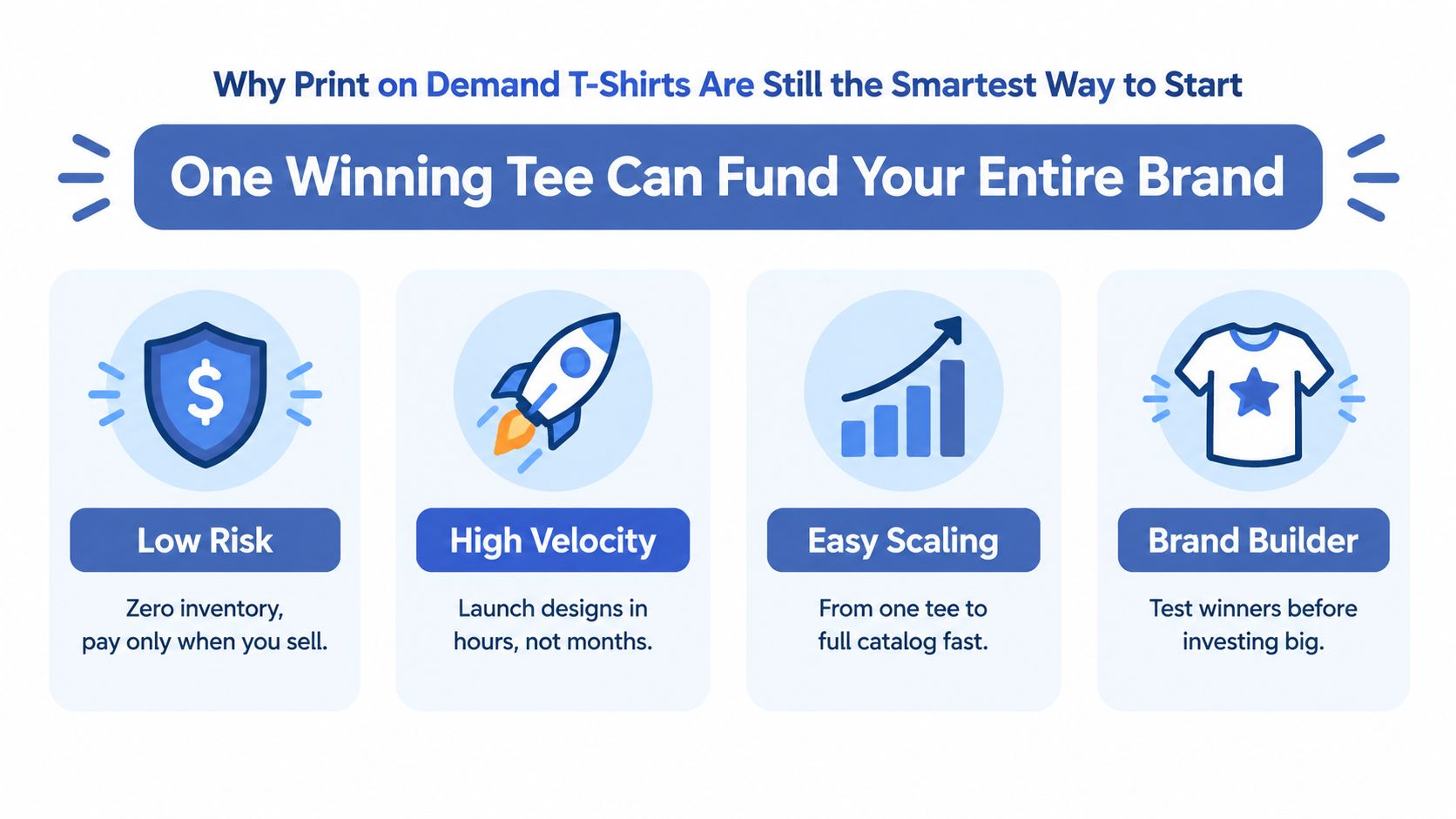
One winning tee can fund your entire brand. That isn't because every shirt becomes a bestseller. It's because t-shirts give you a fast, low-commitment way to test a niche, an offer, a design language, and a customer profile before you tie up cash in inventory.
The broader t-shirt category is already enormous. A 2026 industry overview values the worldwide t-shirt market at USD 30.68 billion, with a projection of USD 44.81 billion by 2035 at a 4.3% CAGR (Printful's t-shirt industry statistics). POD sellers aren't trying to create demand from nothing. They're competing inside an established apparel category while using on-demand production to reduce the cost of experimentation.
Operator rule: Use the first tee to validate the audience, not to prove you can upload a product.
A good POD t-shirt ships without you holding stock, lets you test designs quickly, and gives you a product customers understand immediately. That combination makes tees a strong validation engine for communities, hobbies, identities, events, and gift occasions.
The four decisions that matter most are straightforward:
- Choose the blank: Fabric composition, construction, weight, and fit shape both conversion and returns.
- Choose the print method: DTG, DTF, screen printing, and sublimation each suit different artwork and fibers.
- Choose the provider: Catalog depth matters less than consistent output, fulfillment coverage, branding options, and support.
- Choose the scaling gate: A design shouldn't receive serious ad spend until its garment and print have survived your quality checks.
Use AvatarIQ to accelerate the design and mockup workflow, then use the Apparel Cloning playbook to study proven silhouettes, offers, and niche positioning. The point isn't to guess which shirt might work. It's to build a repeatable process that links the blank to conversion, contribution margin, customer satisfaction, and reorders.
The Four Quality Criteria That Make a POD Tee Actually Sell
A blank shirt earns its place in your catalog by passing four tests: fabric, weight, fit, and print compatibility. A compelling design can't rescue a shirt that feels thin, twists after washing, fits unpredictably, or produces a weak print.
| Criterion | What to Look For | Target Benchmark |
|---|---|---|
| Fabric | Soft hand-feel, reliable sizing, suitable fiber content | 100% combed ringspun cotton for core DTG styles |
| Weight | Drape, opacity, seasonal versatility | 180 to 200 GSM for year-round everyday wear |
| Fit | Consistent measurements and flattering shape | Side-seamed construction with a clear size chart |
| Print compatibility | Fibers that accept the selected ink or transfer | High-cotton content for DTG, especially 100% cotton |
Fabric comes first. Cotton controls how the shirt feels against the skin, how it absorbs water-based ink, and how the garment behaves after laundering. DTG guides commonly recommend 100% cotton or at least 80% cotton because absorbent cotton fibers hold water-based inks more effectively, supporting sharper and more vibrant artwork (DTG printing guide).
Weight changes perceived value. A shirt in the 180 to 200 GSM range can feel substantial enough for regular wear without becoming a niche seasonal item. Heavier blanks can support premium streetwear positioning, while lighter garments suit active or warm-weather use. Don't choose weight from a product thumbnail. Hold the sample, check opacity under light, and see how the shoulder seams sit.
Fit and construction decide the return experience
A side-seamed shirt generally gives you a more intentional silhouette than a basic tubular construction. Tear-away tags also make relabeling easier when you want a cleaner brand presentation. The size chart still matters more than the label, so measure the sample and compare it with the provider's published dimensions.
Run a simple side-by-side test before listing either blank:
- Stretch the collar and side seams, then check whether they return cleanly.
- Rub the print area and fabric surface to identify roughness, loose fibers, or early cracking.
- Wash the sample according to the care label, then inspect shrinkage, pilling, fading, and distortion.
- Score each shirt from one to ten for hand-feel, fit, construction, print appearance, and post-wash condition.
For formal testing, textile guidance commonly references ISO 6330 wash tests and rubbing or abrasion checks. Color fastness is often scored on a 1 to 5 gray scale, with 5 as the strongest result, and good commercial printed fabrics often target the 4 to 5 range across wash, rubbing, perspiration, and light exposure (independent textile-testing guidance).
Print Methods Explained and Which One Fits Your Designs
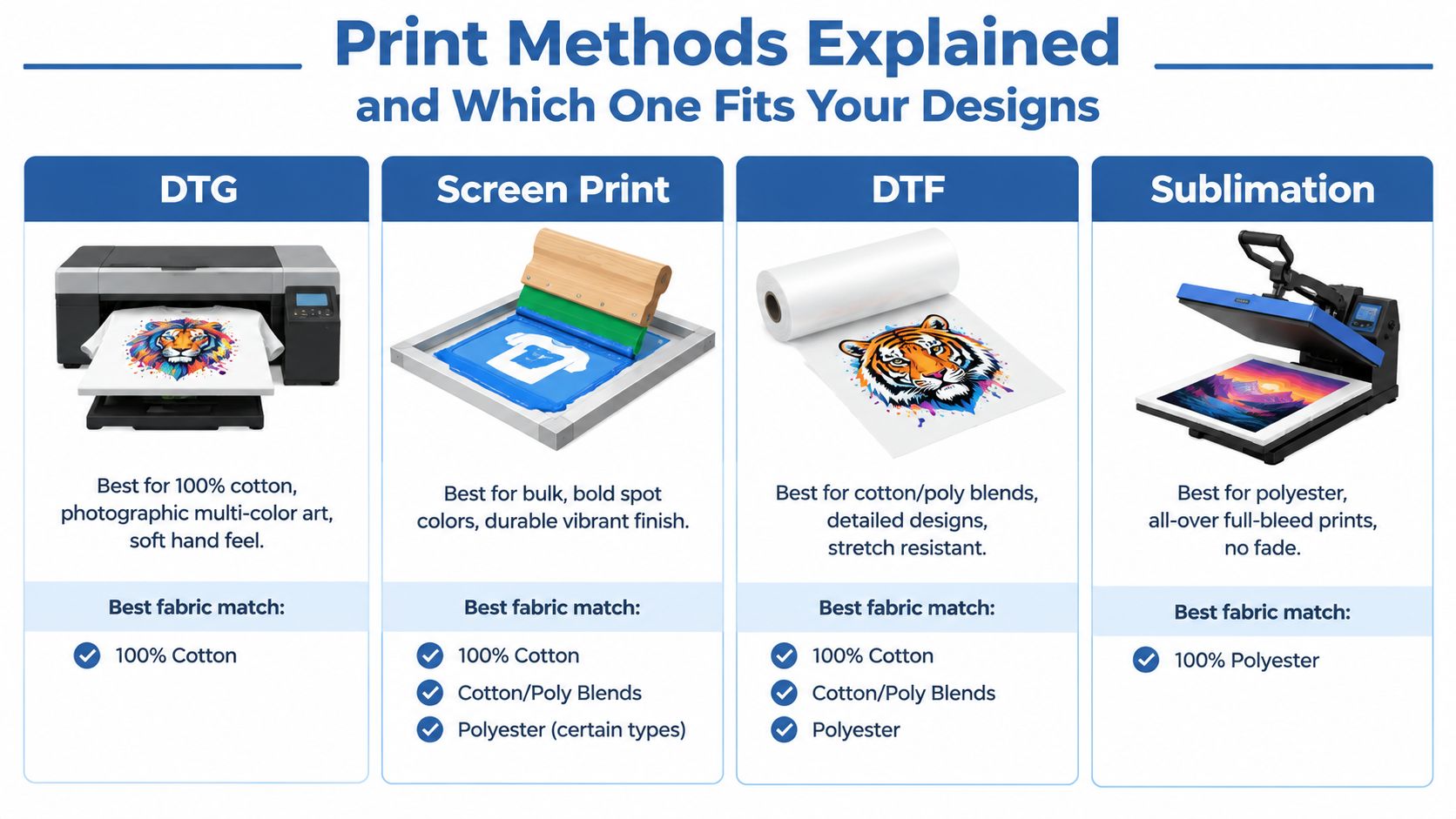
Your design should determine the print process, not the other way around. DTG is the natural choice for detailed artwork on cotton, DTF gives you more flexibility across blends, screen printing earns its advantage with bold designs and volume, and sublimation belongs on polyester.
DTG, or direct-to-garment, works best for photographic artwork, gradients, illustrations, and multi-color designs where a soft hand-feel matters. Choose a high-cotton blank, especially 100% cotton, and pay close attention to pretreatment and curing. A recent manufacturer benchmark found that prints on an Atlas MAX PLUS sample remained strong after 50 and 100 wash cycles, with each test cycle defined as one hour at 40°C and 600 rpm with standard detergent. The garment visibly faded while the print stayed bright, showing why supplier wash testing matters (Kornit DTG print-quality test).
DTF, or direct-to-film, transfers artwork onto film before heat application. It suits detailed graphics, cotton and polyester blends, and designs that need crisp edges or stretch resistance. Its common failure is a heavier plastic feel, particularly when the transfer covers a large area.
Screen printing remains the margin-focused option for bold artwork, limited spot colors, and higher-volume runs. It produces a vibrant, durable finish, but setup becomes less attractive when you're testing many designs in tiny quantities. A design with broad color blocks and a simple message is a stronger screen-print candidate than a detailed portrait.
Sublimation requires polyester or a polyester blend. The ink bonds into the fabric, making it useful for all-over prints and performance apparel. It isn't the right choice for standard cotton tees, and dark garments create additional color limitations.
For a deeper technical comparison, review this guide to different types of t-shirt printing. The operational rule is simple: match the fiber, artwork complexity, surface feel, and expected order volume before you compare provider prices.
Many guides cite a practical expectation of roughly 30 to 50 washes for properly cured DTG prints on 100% cotton, with better production and care sometimes extending durability beyond 60 washes (DTG print longevity guidance). Treat those figures as a supplier benchmark to verify with your own samples, not a substitute for testing.
Comparing the Top POD Providers Side by Side
Provider selection should follow your product strategy. Printful is the safer choice for consistency and brand control, Printify usually wins on network breadth and base-cost flexibility, Gelato makes sense for regionally distributed European demand, SPOD suits sellers prioritizing fast production, Gooten is built for operational routing, and Apliiq stands out when labels and woven branding matter.
| Provider | Strongest Blank | Print Methods | Avg. Production Time | Best For |
|---|---|---|---|---|
| Printful | Bella+Canvas 3001 | DTG, DTF, embroidery, sublimation | Test by product and region | Consistent quality and brand positioning |
| Printify | Gildan 5000 | Varies by print provider | Test by selected provider | Low base cost and broad network |
| Gelato | Stanley/Stella | DTG, DTF, embroidery, sublimation | Test by local production partner | European and international regional fulfillment |
| Gooten | Catalog varies by partner | DTG, DTF, sublimation, other methods | Test by product and route | Brands needing routing flexibility |
| SPOD | Catalog varies by region | DTG, DTF, laser, embroidery | Test current product listing | High-volume production workflows |
| Apliiq | Premium fashion blanks | DTG, embroidery, labels, woven tags | Test by product and customization | Custom neck labels and branded apparel |
Printful is my pick for a hero SKU when the garment, print, and presentation need to stay predictable. Its in-house production model and branding options support a more controlled customer experience, though you should still sample every color and garment variation.
Printify is the testing workhorse. Its partner network lets you compare providers and base costs, but that flexibility creates a quality-control obligation. Never assume one Printify provider represents the whole network. Approve the exact provider, blank, color, and print method attached to each live product.
Gelato is strongest when your customers are distributed across regions and local production can improve the delivery experience. Gooten deserves attention from brands that need broader operational routing, while SPOD fits sellers who care about fast production workflows. Apliiq is the specialist choice for custom neck labels, woven tags, and a more fashion-oriented branded finish.
Margin decision: Use Printify's network pricing for tests, then place one premium Printful blank behind the hero SKU once the offer proves itself.
For wording that supports product presentation, browse these promotional T-shirt caption examples and adapt the language to your actual audience rather than copying generic slogans. For a broader provider evaluation, this founder's guide to the best print-on-demand services for 2026 is a useful companion.
Your First Sample Order and Quality Control Workflow
Don't launch a blank because the mockup looks good. Order samples and run the same inspection process every time, especially when a provider uses multiple production partners.
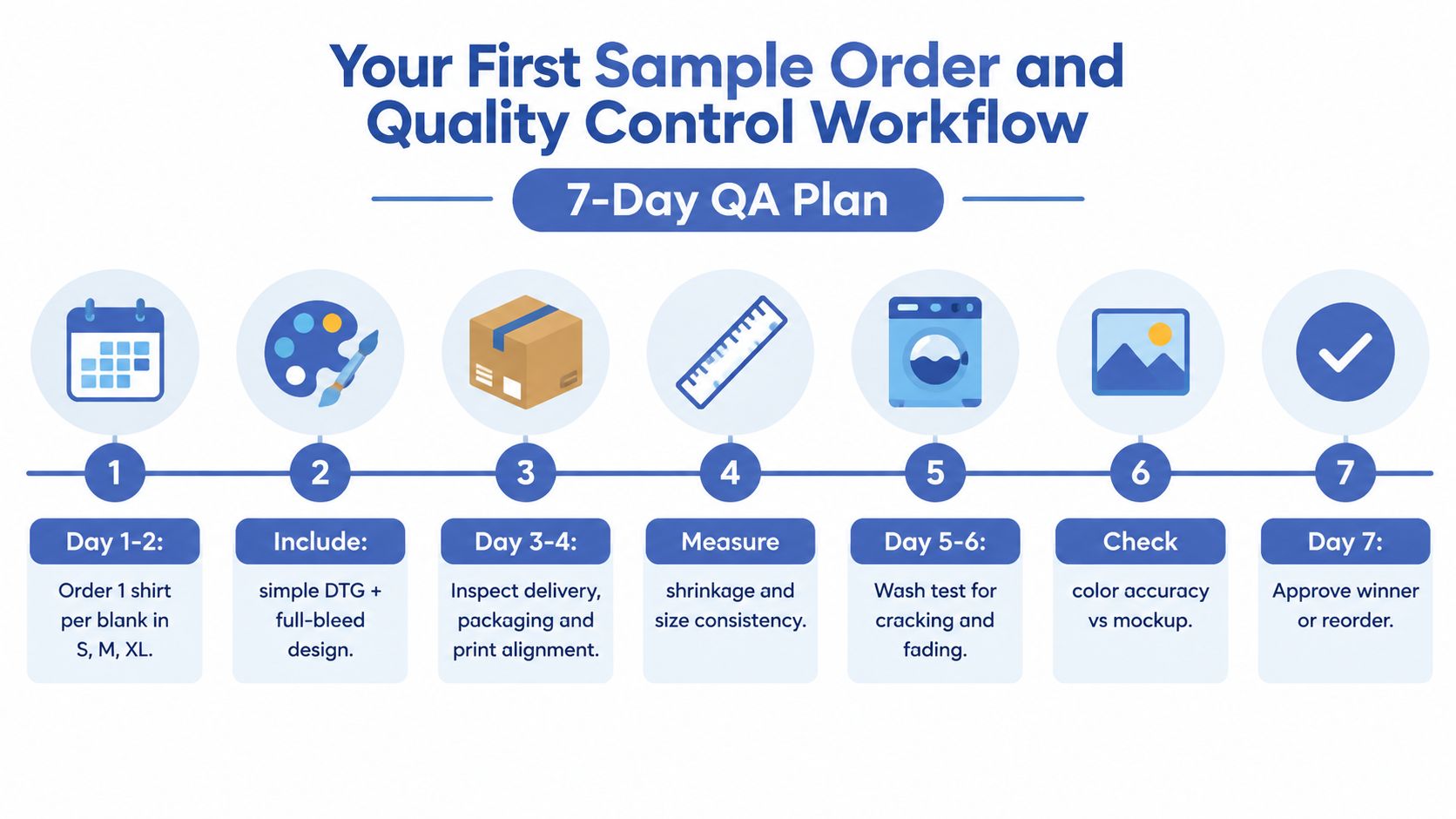
Days one through four
Order one shirt from every shortlisted blank in S, M, and XL. Include one simple DTG design and one full-bleed DTF transfer so the garment faces both a restrained print and a demanding surface application.
Use the first four days to inspect delivery, packaging, garment measurements, seams, labels, fabric feel, print alignment, opacity, color accuracy, and the comfort of the neck area. Compare the physical shirt with the mockup under natural light. A design that looks centered digitally can sit too high or too low on the actual blank.
Use a spreadsheet with a 10-point checklist:
- Stitch consistency: Look for skipped stitches, loose threads, and uneven hems.
- Fabric hand-feel: Record softness, stiffness, surface texture, and opacity.
- Weight tolerance: Compare the listed weight with the physical feel across samples.
- Color accuracy: Check the print against your approved artwork and color reference.
- Print opacity: Inspect dark garments for weak underbase coverage.
- Registration: Look for misalignment between colors and edges.
- Stretch behavior: Pull the printed area and inspect early cracking or separation.
- Label comfort: Check whether the neck label scratches or sits awkwardly.
- Size consistency: Measure chest width, body length, sleeve length, and shrinkage risk.
- Packaging condition: Record folds, moisture exposure, damage, and presentation.
Days five through seven
Wash each sample at 40°C, tumble dry on low, and inspect the print and garment again. Compare fading, cracking, shrinkage, pilling, collar recovery, and shape retention against the unwashed sample. Textile print durability is often evaluated with standardized repeatable wash testing, including the AATCC TM61 accelerated method, which one industry source describes as simulating 50 home washes in 45 minutes (apparel print durability testing).
Calculate a weighted quality score, then keep only blanks scoring 8/10 or higher. If a shirt fails after the first wash test, it hasn't earned the right to receive ad spend. This gate protects your margin, your review profile, and the customer experience before order volume exposes a weak supplier.
Pricing and Margin Examples for Real POD Shirts
The shirt price alone doesn't tell you whether an offer works. You need to separate base cost, gross margin, payment fees, transaction fees, shipping, refunds, and acquisition cost before you call a product profitable.
The following scenario uses a $24.99 retail price and the assigned base-cost examples:
| Blank Tier | Example Blank | Base Cost | Gross Margin | Net Contribution at $12 CPA |
|---|---|---|---|---|
| Premium | Bella+Canvas 3001 | $9.50 | Roughly 62% | About $1.99 before other variable costs |
| Mid-tier | Gildan 5000 | $7.20 | About 71% | About $4.29 before other variable costs |
| Budget | Gildan 64000 | $6.10 | Toward 76% | About $5.39 before other variable costs |
These are directional product-level examples, not guaranteed take-home profit. Once you include payment processing, store fees, shipping, refunds, and advertising, the gap between a premium and budget blank can narrow quickly. A 3% payment-processing assumption would remove roughly $0.75 from a $24.99 order before acquisition cost, so build the full order model in a spreadsheet rather than relying on the provider's product margin display.
The acquisition scenario matters even more:
- At an $8 CPA, the premium example retains more room for shipping and support.
- At a $12 CPA, the mid-tier blank creates a stronger contribution cushion.
- At an $18 CPA, the budget blank may still struggle if shipping and transaction costs remain high.
The blank decision can compound. Swapping a premium SKU for a mid-tier blank on a $20 design can add $2.30 per unit, which becomes $2,300 across 1,000 units. Those figures are meaningful only if the mid-tier garment maintains conversion and satisfaction, so the sample process comes before the margin spreadsheet.
For the underlying economics, see this practical guide to understanding print-on-demand profit margins. Your final provider comparison should include region-matched fulfillment, because lower shipping cost can matter as much as a cheaper blank.
Best Shirts by Niche and Use Case
The best blank depends on who wears the shirt. A performance-oriented runner wants a different hand-feel and fiber profile than a pet owner buying a relaxed everyday tee.
| Niche | Recommended Blank | Weight/Fabric | Why It Wins |
|---|---|---|---|
| Run clubs and fitness crews | Bella+Canvas 3010, A4 NB3143 | Lightweight polyester blends or performance fabric | Better suited to movement, sweat, and active use |
| Family reunions and vacations | Gildan 5000, Next Level 6010 | Heathered mid-weight cotton | Comfortable, practical, and forgiving during travel |
| Pet lovers | Bella+Canvas 3001, Comfort Colors 1717 | Ringspun cotton, relaxed options | Soft daily wear with strong color presentation |
| Fishing, gaming, and faith identities | AS Colour 5001, Stanley/Stella Creator | Premium heavyweight cotton | Higher perceived value and stronger brand feel |
Run clubs and fitness crews need shirts that feel light and move well. Family groups usually need practical garments that can handle long days, repeated photos, and varied body types. Pet designs benefit from a soft ringspun cotton base because the shirt needs to work as everyday clothing, not just event merchandise.
Hobby and faith-based buyers often respond better to a premium-feeling blank when the design represents identity. A heavyweight shirt can make a simple graphic feel like a considered product rather than a disposable souvenir.
Validate the micro-community before expanding
Test one design across three blanks and compare cost per click with the add-to-cart ratio within the first 72 hours. Kill combinations where CPC exceeds $1.50 or the add-to-cart ratio falls below 4%, then retest the winning design and audience with both a premium and budget option.
That process reveals whether the buyer is responding to the design, the garment, or the complete offer. Apparel Cloning adds another useful layer. Study the leading silhouettes and blank choices in the niche, create a distinct version, then run the cloned concept through AvatarIQ scoring before increasing ad spend.
Mockups, Photoshoots, and Your Scaling Game Plan
A winning shirt needs to look like a real product before it gets real traffic. Use PSD mockups matched to the exact blank, including its neckline, sleeve shape, seams, drape, and print area. Place artwork at 300 DPI with the provider's correct print dimensions so the design doesn't float unnaturally on the garment.
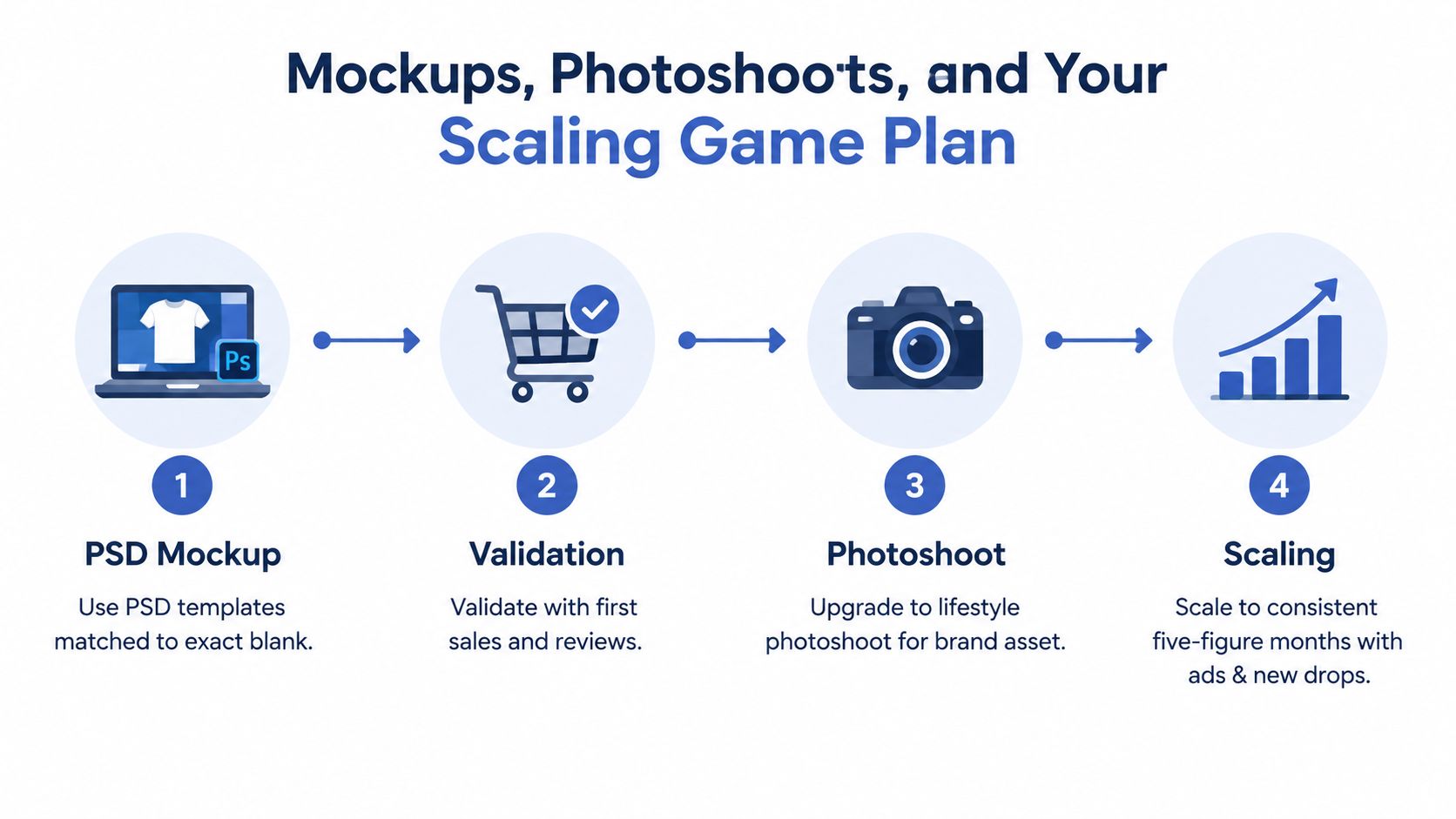
A lean photoshoot can stay below $150 if you use one model, one location, two lighting setups, and capture lifestyle content for your top three niches in one half-day. Shoot front, back, close-up, fit, movement, fabric texture, and group-context images. A single session can produce 30 or more creative variations for ads, Pinterest, email, and organic posts.
If arranging a traditional shoot isn't practical, an AI fashion photoshoot can help you explore presentation angles before committing to a physical production day. Use generated visuals to test concepts, but keep your approved sample as the reference for fit, print placement, and fabric appearance.
Phase one
During months one through three, launch five designs across two blanks. Test at $30 per day and look for a 2.5% conversion rate before increasing spend. The goal is to identify the combination of audience, design, blank, and offer that deserves more capital.
Phase two
During months four through six, add a third blank, expand to ten designs, build lookalike audiences from purchasers, and introduce a premium upsell. The premium tier should offer a clear reason to upgrade, such as heavier fabric, better construction, or stronger branding.
Phase three
From month seven onward, use Apparel Cloning to study winning competitor silhouettes and AvatarIQ to score new designs against your customer avatar before buying traffic. Keep the same quality gate for every new product, even when a design resembles an existing winner.
Better blanks can lift conversion, better mockups can improve click-through, and better validation can protect margin. That flywheel turns a small tee test into a catalog with structure, repeatability, and real brand value.
Skup gives you practical POD apparel education through Apparel Cloning and workflow support through AvatarIQ, so you can validate shirt concepts, build accurate mockups, and test blanks before scaling ads. Visit Skup to apply this t-shirt testing system to your next product launch.