Brand Messaging Framework: A Fill-In Template for POD
You've got a niche you care about and products ready to list. But your listings sound playful, your Facebook ad sounds like a business seminar, and your welcome email could belong to a different store. A buyer may meet all three in a short time and still struggle to understand who your brand is for or why its products belong together.
A brand messaging framework gives your store one reliable story to tell. It doesn't limit your creativity. It helps each channel use the same core ideas, backed by proof customers can see for themselves.
Table of Contents
- What a Brand Messaging Framework Is and Why It Pays Off
- A Fill-In-the-Blank Brand Messaging Template
- How to Build Your Framework in Five Steps
- Sample Messaging for Four Apparel Niches
- Putting Your Message Into Listings, Ads and Email
- Pitfalls That Weaken Your Message and How to Fix Them
- Run the Quick-Check Before You Publish
What a Brand Messaging Framework Is and Why It Pays Off
A brand messaging framework is the working document that keeps your store's communication consistent. It brings together your brand promise, target audience, value proposition, proof points, tone of voice, and approved message pillars. Use it to check whether a listing, ad, or email makes the same promise, gives buyers the same reasons to trust it, and sounds like it belongs to your store. The wording can change by channel. The message should still hold together.
For a print-on-demand store, a buyer might find a design in search, see an ad, read the product page, and later receive an email. Each touchpoint has a different job, but the claims should match. If your store serves weekend gardeners, for example, a listing can describe a comfortable tee, while an ad and email express the same connection to gardening. The product details and buyer photos on the page give the promise something concrete to rest on.
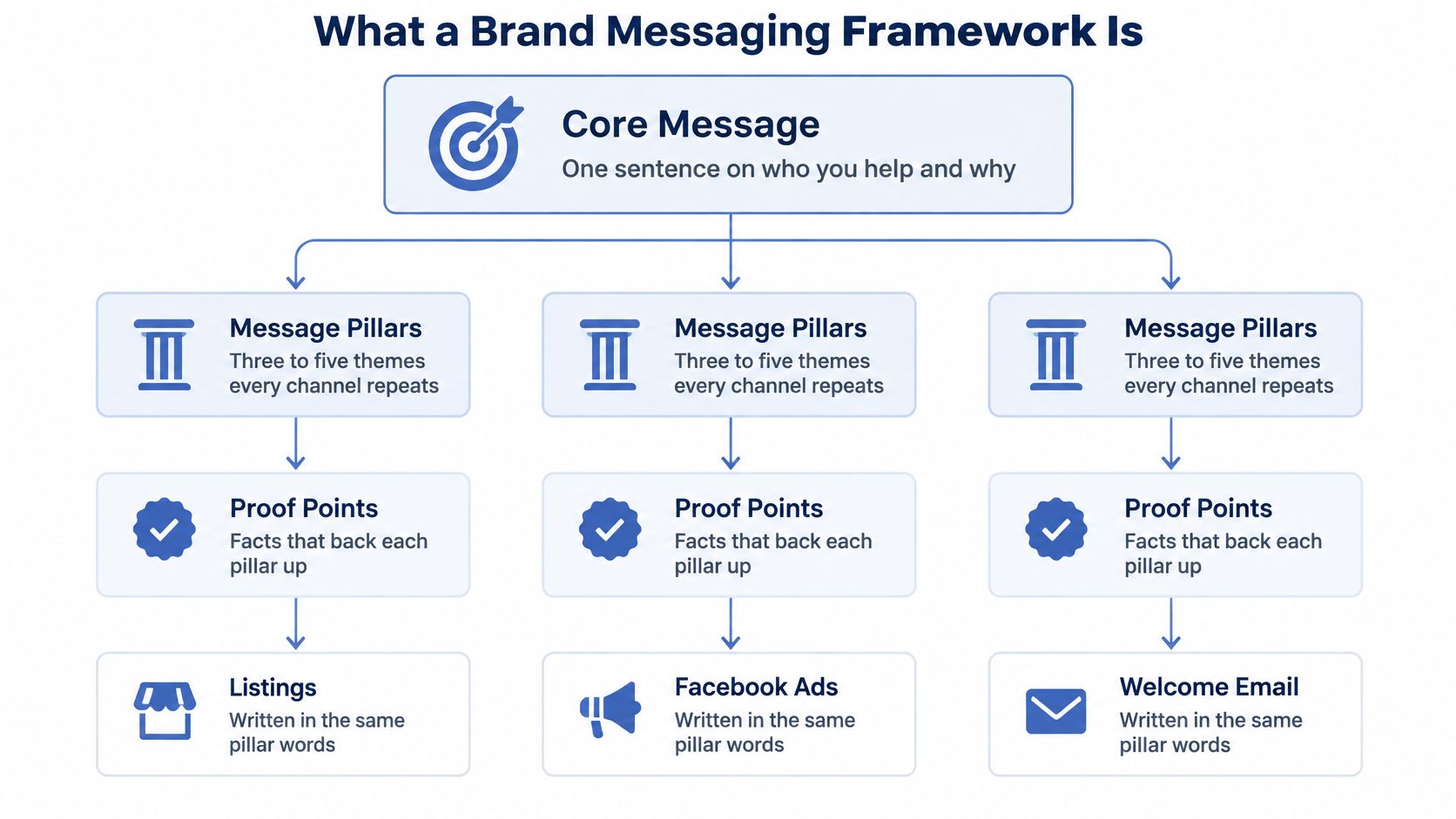
Consistency helps buyers understand your store
A recognizable message saves buyers from having to piece together what you sell and who it is for. That does not guarantee a sale or a return visit. It does make the store easier to understand, and gives you a practical standard for reviewing your own marketing.
Use the framework as a control system, not a slogan exercise. Compare the promise in an ad with the listing title, product description, sizing details, and email copy. If a claim about comfort appears in each place, check that the product information or customer photos support it. If the evidence is missing, revise the claim or add proof buyers can see on the page.
Print on demand lets you test designs without buying inventory in advance, and you can explore niches without holding stock. The trade-off is that a wide range of designs can make a store feel scattered. A clear, evidence-backed message helps connect the products you choose and gives you a consistent way to assess what belongs.
Start by writing down the message and the proof your store can show. Keep the first draft short enough to check against each customer-facing channel.
A Fill-In-the-Blank Brand Messaging Template
Complete each row in order, starting with the audience and promise because the remaining choices depend on knowing whom you serve and what you help them find.
| Element | Fill-in blank | Example for backyard gardeners |
|---|---|---|
| Brand promise | We help [audience] [outcome] without [pain] | We help weekend gardeners laugh at their dirt-under-the-nails life |
| Target audience | [Who] who [situation] and [trigger] | Weekend gardeners who spend Saturdays in raised beds and want clothes that show it |
| Core problem | They struggle with [problem] because [reason] | They want gear that says gardener, not yard work chore |
| Value proposition | [Product] gives them [benefit] through [mechanism] | Soft tees with garden humor that hold up to a full day of digging |
| Proof points | [Proof 1], [proof 2], [proof 3] | Fabric weight listed, real buyer photos, size chart with chest measurements |
| Tone of voice | We sound [trait] and never [anti-trait] | Warm and witty, never snobby about gardening |
| Message pillars | [Pillar 1], [pillar 2], [pillar 3] | Gardener identity, everyday comfort, gift-ready |
| Risk disclosure | This is not for [who it does not suit] | Not for indoor-only plant hobbies or professional landscaping crews |
The example uses backyard gardeners, but the same blanks work for any niche. Keep every answer to one sentence you can read aloud. If your promise takes a paragraph to explain, narrow it until the buyer and outcome are clear.
Don't skip the less flashy rows
Proof points connect your claim to visible evidence. For apparel, that could be a size chart with chest measurements, fabric details, care instructions, or real buyer photos. Don't claim a shirt is ideal for long shifts if you can't show the features that support that statement.
Tone of voice is your store's recognizable personality. A warm, witty gardening brand shouldn't suddenly sound like a technical performance manual. Risk disclosure is equally useful: it clarifies who may not be a fit. Saying a shirt is designed for casual gardening rather than professional landscaping can set expectations clearly.
Read the completed framework aloud. If two blanks conflict, such as a playful voice paired with a serious performance claim, rewrite the weaker line instead of making both less clear. The finished framework should fit on one page, roughly eight lines, and sit above every product brief, ad brief, and email you write.
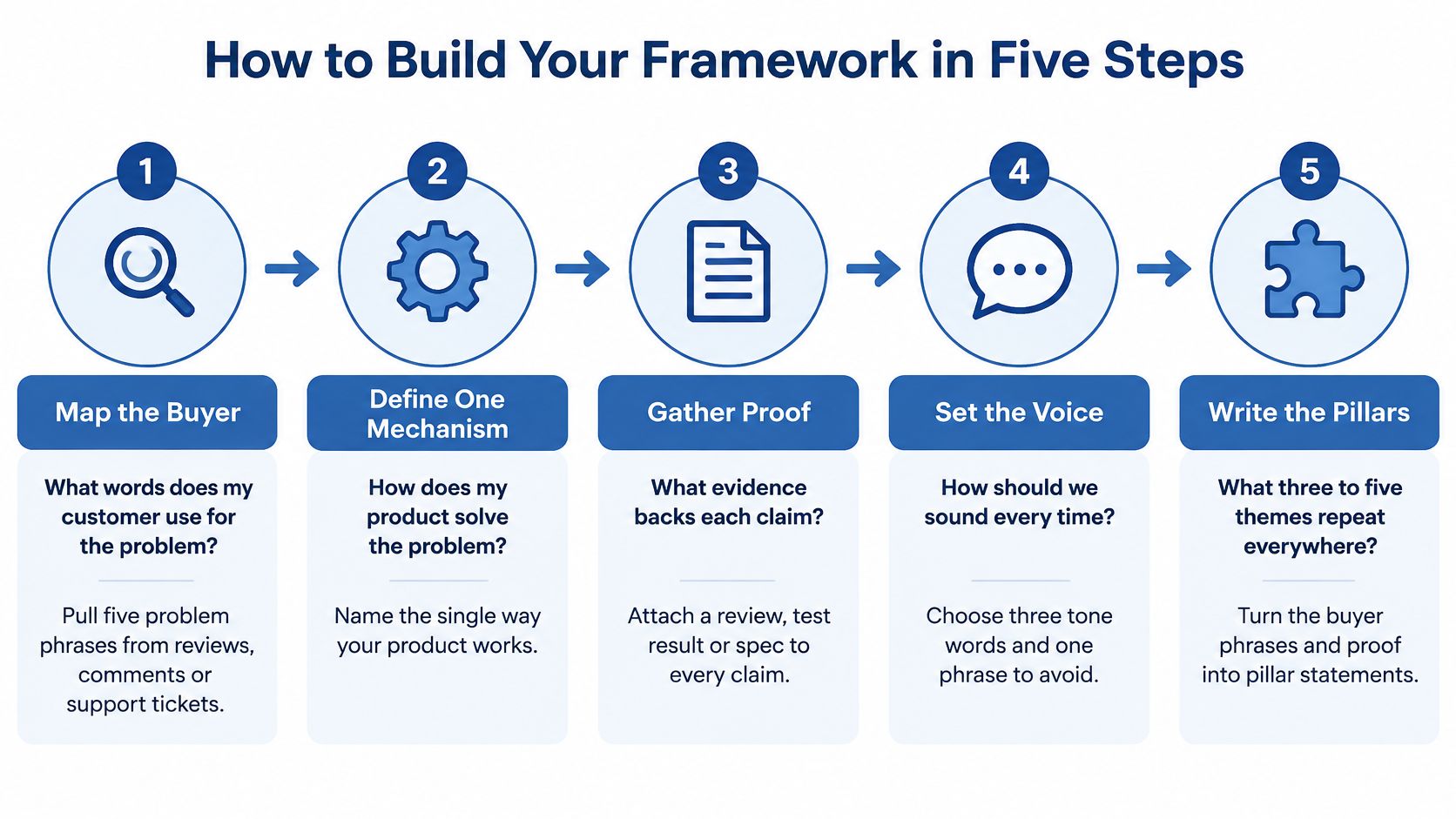
How to Build Your Framework in Five Steps
1. Map the buyer
Question: What words does my customer use for the problem? Write down five phrases from reviews, comments, or support messages, plus one thing the buyer may feel embarrassed to purchase. Customer language is more useful than a clever phrase the buyer would never say.
Prompt for today: What are five exact phrases a likely buyer uses when describing what they want from a niche apparel product?
2. Choose one ownable angle
Question: Which promise can your store support better than a broad, interchangeable claim? Cluster possible promises, then fill in this positioning line three times: “For [audience] who [problem], [brand] is the [category] that [mechanism].” Keep the version you can back up with something a buyer can inspect, such as a photo, product specification, or size chart. For more on the distinction between positioning and messaging, see Skup's guide to what product positioning means.
Prompt for today: Which of your three versions has proof you can place directly on the product page?
3. Write the single-message control
Question: What is the one message every later version should preserve? Write one sentence containing one audience, one priority problem, one mechanism, one outcome, and the proof that supports it. This is your control, a steady version you can compare with future copy rather than changing the entire story at once.
Prompt for today: Can a buyer understand the sentence without knowing anything about your store?
4. Build the message matrix
Question: What does each audience need to hear, and what evidence supports the claim? Use these nine columns: audience segment, trigger, claim, mechanism, proof, objection, risk disclosure, call to action, and measurement event. The matrix keeps the practical details attached to the promise instead of scattering them across drafts.
Prompt for today: What proof can you place beside the first claim you plan to publish?
5. Adapt, don't rewrite
Question: How should the same idea sound in each channel? Keep the central meaning and change the expression to fit the space. List three voice adjectives, then write one sentence that sounds like your store and one that doesn't. That makes the voice easier to apply in listings, ads, email, and customer conversations.
Prompt for today: What one sentence can you carry across channels without changing its promise?
A working draft is achievable in one sitting. Once it's written, test it against a real listing and an ad before expanding the system.
Sample Messaging for Four Apparel Niches
The buyer changes from niche to niche, so the pain, pillar, and proof should change too. A dog owner may want apparel that reflects their identity; a night-shift nurse may be looking for comfort and fun; a home brewer may want a gift that feels like an inside joke; and a pickleball player may want a shirt that fits court life.
| Niche | Buyer pain | Message pillar | Sample headline | Proof to show |
|---|---|---|---|---|
| Dog owners | Wants gear that reflects their identity, not just their pet | Dog parent identity | For the dog parent who has opinions about everything | Print sharpness on dark shirts, chest measurements in the size chart |
| Night-shift nurses | Needs comfortable, shift-proof tees that still feel fun | Built for long shifts | Twelve hours on your feet and a shirt that gets it | Fabric weight, stretch notes, wash care instructions |
| Home brewers | Wants a gift that feels insider, not cringe | Insider humor | Hop-friendly humor for people who own a carboy | Real buyer photos, gift packaging note |
| Pickleball players | Wants to look like a player on and off the court | Court identity | Your partner called it a lob, your shirt says it better | Moisture-wicking fabric details, sizing notes for layering |
The pickleball row shows why proof matters: moisture-wicking details and notes about layering help answer practical questions a buyer may have before ordering. Across every row, keep the voice recognizable and make the promise honest about fit. A headline that has no evidence you can show won't hold up when a buyer reaches the product page.
Treat these headlines as starting points, not copy to paste unchanged. A joke that feels right for a nurse coming off a night shift may land differently for a home brewer shopping for a gift. For help shaping a concise statement around your own niche, see these brand statement examples.
To add a niche of your own, pick one buyer, fill in the template, and check whether the headline could belong only to that buyer. If it could fit almost any apparel store, sharpen the audience or the problem.
Putting Your Message Into Listings, Ads and Email
Give each channel one job. Repeat the same message pillar across listings, ads, and email, but phrase it to fit the format. A listing helps a shopper understand the product; an ad earns attention for one relevant reason; an email sets expectations or supports the buyer after purchase.
For a listing, pair the relevant keyword with the pillar in the title. Put proof in the first two bullets, then explain the product mechanism and sizing in the description. Avoid keyword stuffing that buries the promise, and don't paste the same generic description across dozens of listings. Specific details help a buyer judge whether the item suits them.
For a paid ad, name the buyer's pain in the first line, provide a proof point in the second, and ask for one action. Keep the imagery faithful to what the product actually shows. A mockup made with AvatarIQ should match the message pillar, so the scene supports the headline rather than suggesting a different product or use.
A welcome email should make clear what the buyer can expect and, if it includes an offer, keep to one offer. A post-purchase email can reinforce the customer's choice; hold new product pitches until the order arrives. If you're making channel-specific copy, Skup's Shopify copywriting guide can help you keep the product page focused on the buyer and the item.
A consistent message also needs a consistent workflow. If you publish the same idea across platforms, a resource on social media cross posting can help you coordinate where and how you share it without changing its meaning.
Make disclosures visible where they matter
The FTC requires social-media endorsers to clearly disclose material connections with brands. Those connections can include money, employment, personal or family relationships, free or discounted products, and other perks. The disclosure should appear with the endorsement itself, in wording that makes the relationship obvious to consumers, rather than hidden in a bio or separate link page (FTC disclosure guidance for social media influencers).
Use this quick check before publishing creator, affiliate, customer, or founder content: place the disclosure beside the endorsement; use plain language; make it visible without opening a profile or link page; and check that product claims have proof nearby. That applies even when the brand doesn't dictate the endorser's exact wording. Start by auditing one listing and one ad against your framework before changing anything else.
Pitfalls That Weaken Your Message and How to Fix Them
A buyer lands on your shirt listing and sees an income promise, a lifestyle image, founder credentials, and a software benefit in the first screen. Each may have a place in your business, but together they compete for attention. The buyer may leave unsure what the product offers, and you cannot tell which claim earned the click or contributed to a refund.
Keep the first message focused on one audience, one benefit, and proof the buyer can see. Positioning helps you choose which ideas belong in the lead and which should move lower on the page (Columbia Business School review of brand positioning). Treat that choice as a control you can audit across your listing, ad, and email, rather than a slogan you set once and forget.
| Symptom | Likely cause | Fix |
|---|---|---|
| Ads get clicks but refunds rise | Promise runs ahead of what the product delivers | Match the claim to the mockup, size chart, and print quality |
| Listings in one store sound like three brands | Different audiences share one voice and page | Split collections by audience and give each one its own message pillar |
| Lifestyle ads get clicks but few buyers | Too many ideas compete in the first impression | Lead with one buyer problem and one visible proof item |
| Customers ask the same question after purchase | Listing omits proof or care details | Add sizing, care, and production details to the description |
| Email gets clicks but no purchases | Tone and offer shift from message to message | Keep a consistent voice and focus each email on one offer |
| Headlines change every week and results never settle | No control message stays in rotation | Keep a control variant running while gathering enough optimization events to judge performance |
Fix the smallest change that could explain the result. If buyers misunderstand fit, make sizing clearer before rewriting the whole listing. If one collection speaks to unrelated audiences, separate its pages before changing every headline. For paid ads, wait for enough optimization events to assess performance instead of drawing conclusions from a handful of clicks. Meta's advertising optimization guidance can help you plan campaign testing, but it does not make a small sample conclusive.
Change one variable at a time. Keep the control message in place while you test, and record what changed, where it appeared, and what result you measured. Clicks can show that a message attracted attention; they do not prove that the promise matched the product or led to a satisfied buyer.
Run the Quick-Check Before You Publish
Treat this as a pass-or-fail check, not a score to chase. Review three listings and one ad before you publish or increase spend. The point is to catch a message that sounds appealing in a draft but leaves the buyer uncertain on the page.
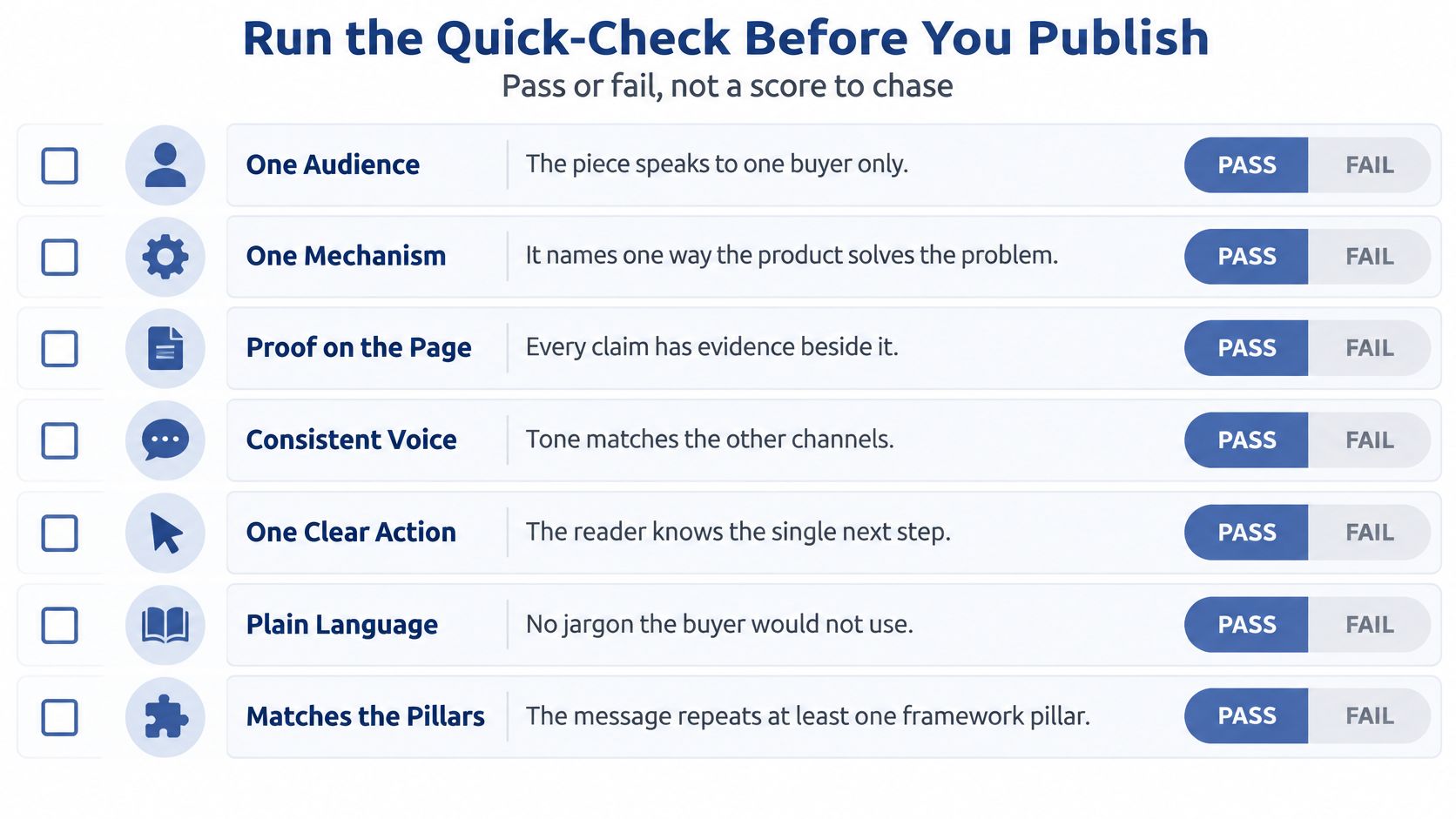
| Criterion | Pass test | Red flag |
|---|---|---|
| One audience | You can name one buyer in a single sentence | An ad targets two unrelated groups |
| One mechanism | You can explain how the product works in one sentence | Claims shift between listing and ad |
| Proof on the page | Every claim has a visible proof item nearby | A claim appears with no evidence |
| Consistent voice | Listing, ad, and email sound like one person | Email sounds like a different brand |
| Realistic expectations | Effort and timeframe are stated plainly | Income is implied anywhere in the copy |
| Visible disclosure | Creator posts show a disclosure beside the endorsement | Disclosure sits in a bio or link page |
| Measurement event | Each message has a metric and a time window | The message is judged by one day of clicks |
If three or more criteria fail, fix the framework before scaling spend. When the checks pass, track unaided message recall, refund rate, and 30-day retention alongside clicks. Clicks show attention; those additional measures help you judge whether buyers understood the promise and stayed with the purchase.
If you're still choosing a niche, Skup's Apparel Cloning System teaches the product-research side of finding a niche worth building a message around. Whatever your next step, make one listing your first test. Each listing built on clear claims and visible proof gives you a sharper test, and each test moves you closer to a business that can grow with intention.
Skup offers practical education for building a print-on-demand apparel business, including the Apparel Cloning System for product research and AvatarIQ for creating apparel designs and mockups. Visit Skup to explore tools and guidance for turning a clear brand message into a store buyers can understand.