Facebook Ads Targeting Strategy: A Step-by-Step Guide
The most popular Facebook ads targeting strategy still says the same thing. Stack interests until the audience looks precise, then trust the dashboard. That advice treats a category label as a buyer. It is not. For print-on-demand apparel, the ad concept, the offer, and the purchases you can verify do most of the sorting. A clever interest list is only a hypothesis you are willing to spend against.
Privacy changes made the old habit more expensive, not more accurate. Reported return on ad spend can flatter a campaign that claimed customers who were going to buy anyway, and it can punish a campaign whose sales the browser never sent back. I would rather judge an audience by new buyers and contribution margin than by a single platform number.
What you can build is straightforward, and it is exciting. One niche, a few honest design angles, and a testing order that tells you when to stay manual and when to let Meta look further. Print on demand is built for that kind of learning. You can ship a design, read real behaviour, and tighten the next test without a warehouse full of inventory.
Table of Contents
- Choosing Your Targeting Layer and When to Hand Over to Meta
- Research Your Audience Before You Spend
- Splitting Cold and Warm Traffic into Funnels
- Lookalikes and Interest Stacking That Actually Work
- A Testing Framework for New Audiences
- Measure Real Sales Before You Scale an Audience
Choosing Your Targeting Layer and When to Hand Over to Meta
Six layers cover most apparel accounts. Use them as a menu, not a rulebook. A store testing its first design will live in the top rows. A store spending every day can use the whole list.
| Targeting layer | What it does | Best for | Watch for |
|---|---|---|---|
| Broad (location and age only) | Meta finds buyers from your creative and offer | Stores testing two or more design angles | Needs strong creative and is slow to judge early |
| Advantage+ audience with suggestions | Interests act as starting points rather than hard limits | Beginners with some purchase data | Can drift beyond the intended niche |
| Stacked interests | Combines two or three related interests in one ad set | Designs tied to a hobby, identity or community | Overlap shrinks reach and raises costs |
| 1% lookalike | Finds people similar to a seed list of buyers | Stores with a seed of 100+ purchasers | Weak when the seed is mostly one-time buyers |
| Website visitor retargeting | Shows ads to people who visited the store in the last 7-30 days | Warm audience once traffic arrives | Small pool, so exclude past buyers |
| Customer list | Matches your customer emails or purchases to Meta | Repeat-buyer and new-drop campaigns | Match rates vary, so check audience size before launch |
Build in this order
Prospect first. Warm retargeting comes after people have visited. Customer-based audiences come after repeat buyers exist. Most new stores should open with broad targeting or suggestion-based delivery, paired with two or three distinct design angles. The shirt does a lot of the qualifying that a long interest list used to claim.
Manual campaign setup is usually better for beginners. You keep direct control over configuration, and you can test specific placements before automation rewrites the account. Learn how spend moves, which placement gets the click, and whether the offer holds up. Then you have a reason to loosen the reins.
In many Advantage+ campaign types, age, gender, interests, and lookalikes work as suggestions rather than strict delivery limits. Location, minimum age, language, and certain regulatory controls stay harder gates. JD Stride's notes on Meta's newer advertising rules report that Advantage+ audience campaigns produce, on average, 7% lower cost per website conversion. Excessive restriction can block cheaper buyers the system would have found.
Location is one control worth keeping deliberate. Jewelry retailers make the same call when a radius is doing real work versus when it is only habit, and geo-targeted ads for jewelry retailers from JewelryBuyDirect is a clear walkthrough of that trade-off.
When to hand delivery over
Switch to broad or Advantage+ delivery once two or more creative angles have worked and the account has steady recent purchases. Keep narrow controls when the niche is too small to fill delivery. Stay manual while the design speaks to an identity no interest category represents and conversion data is still thin.
A camping-humour tee is the classic case. A tight stack of outdoor brands can starve it. The same design, gated only by country and age, often finds the people who laugh at the line because the creative already named them.
Pick the row you can launch this week with the data you already have. Designs plus a country is enough for broad. A real buyer list is enough for a lookalike. Waiting for a perfect stack is how test budgets die.
Research Your Audience Before You Spend

You can finish this research in an afternoon. The point is a one-page brief, not a personality novel.
- Pick one niche and commit. Our programmes advise picking one specific niche and focusing entirely on that audience first. Spreading across several niches at the start is the most common early mistake. It makes designs generic and ads expensive, because every creative has to speak to nobody in particular.
- Describe the buyer through the design's job. Who wears it, what they would say about it, and which occasion or community it represents. A birthday gift for a night-shift nurse is a different job from a tee someone wears to their own trail race. Customer segmentation examples help you separate those jobs before you spend.
- Collect seed interests where buyers already gather. Scan competitor ads in the Meta Ad Library, note pages tied to top-selling products in the niche, and list the communities or hashtags people use without being sold to. Three seeds are enough for a first test.
- Turn each guess into a hypothesis. "People who follow trail-race pages will click a muddy-shoe joke" is testable. "Outdoor lovers" is not. You are collecting starting points, not a final portrait of the customer.
- Write copy that sells the product, not a label. Meta's advertising standards prohibit ads that assert or imply sensitive personal attributes, including race, ethnicity, religion or beliefs, age, sexual orientation, gender identity, disability, health conditions, vulnerable financial status, voting status, trade-union membership, criminal record, and name. You also cannot ask someone to disclose those attributes, and targeting must not be used to discriminate, harass, or run predatory ads. Ordinary "you" and "your" are fine when you are not naming a prohibited attribute, and broad place references such as "American" or "New Yorker" are allowed.
A design can speak to an identity without naming the person. Sell the line, the print quality, the gift moment, or the use case. "Soft tee for early trail mornings" does the work. "For tired moms over 40" does not.
The one-page brief
Write five lines and stop. Niche. Buyer description in one sentence. Three seed interests. Two copy angles. The offer, including price and what the buyer gets. That page is what you build ads from tomorrow. If a later idea does not fit the page, it waits for the next test, which is how a small catalog stays sharp instead of scattered.
Splitting Cold and Warm Traffic into Funnels
Cold and warm traffic want different jobs. Mix them in one ad set and you pay prospecting prices to talk to people who already know the store, while new people see a reminder they have no reason to understand.
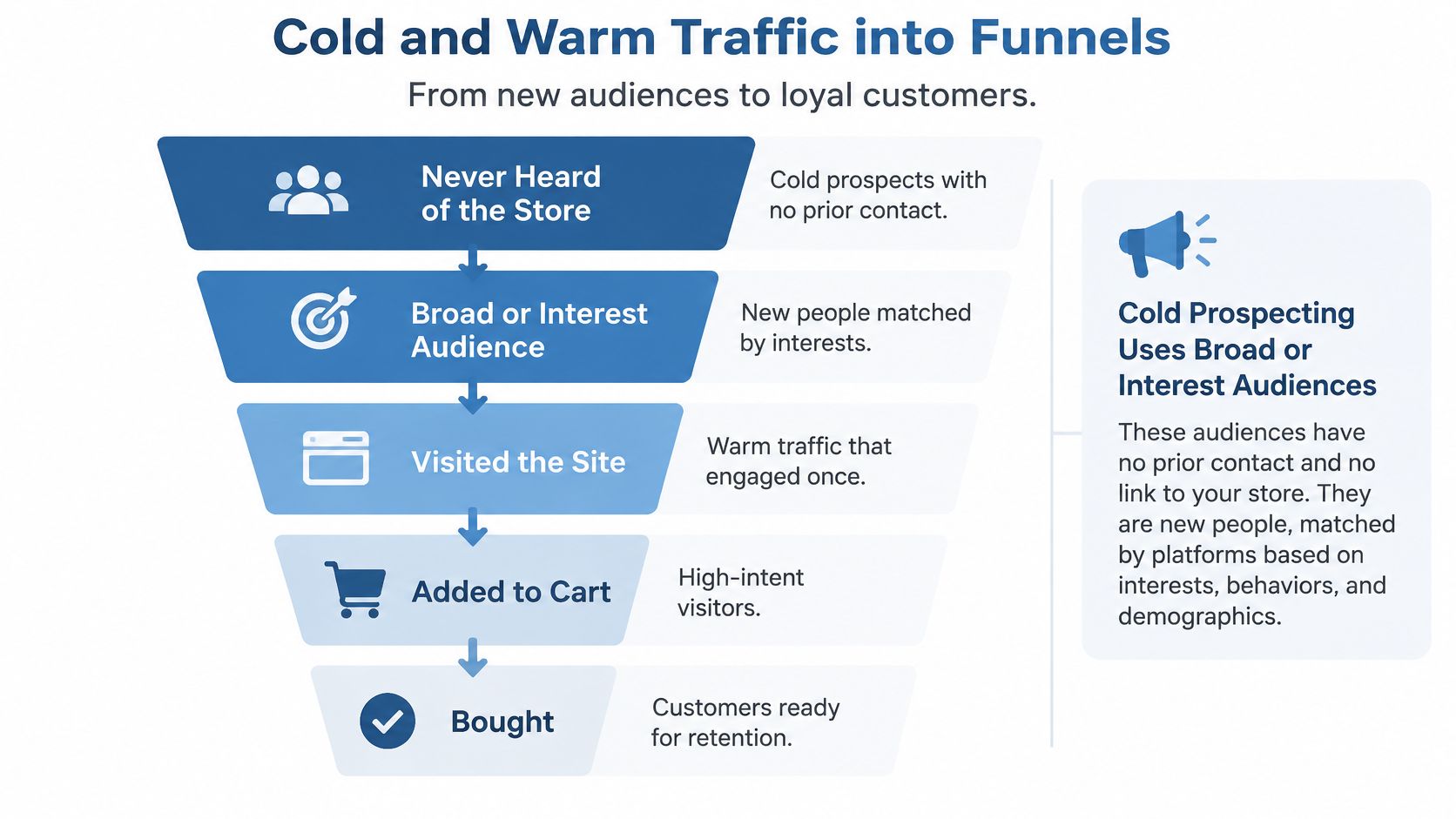
Read the funnel from people who have never heard of you up to people who have already paid. Cold prospecting uses broad or interest audiences with no link to the store. It gives you the most reach and the least certain intent. Engaged audiences come next, then site visitors, then people who added to cart. Past purchasers sit at the top for repeat offers, and they stay out of cold prospecting so you do not pay to find buyers you already have.
| Funnel stage | Audience | Lookback window | Campaign goal |
|---|---|---|---|
| Cold prospecting | Broad or interest audiences with no store link | None | Purchases |
| Engaged with content | Video viewers at 50% or more, and page engagers | 30-90 days | Add to cart or purchases |
| Website visitors | Anyone who visited the store | 30 days | Purchases |
| Add to cart, no purchase | Users who added an item to cart | 14 days | Purchases with a reminder offer |
| Past purchasers | Customers who bought from the store | 180 days | Repeat purchases, excluded from cold |
How the split should spend
Keep each tier in its own ad set. During early testing I would give cold roughly 60-70% of the budget and the warm tiers the rest. Warm only earns more once the pools are large enough to deliver. Pools under about 1,000 people often stall, so do not build a cart reminder for twelve visitors and call it a funnel.
The windows above are a starting point. A high-traffic store can shorten them, because yesterday's visitor is a different person from someone who bounced three weeks ago. A newer store should not shrink windows just to feel precise. Empty audiences do not teach you anything.
The split is working when warm tiers show a lower cost per purchase than cold, and cold keeps bringing new buyers rather than repeats. If cold cost per purchase looks amazing and every order is a name you already know, the exclusion failed. Membership businesses watch the same handoff from first contact to repeat relationship, and it is worth the time to browse membership acquisition case studies from GolfRep for how they separate acquisition from retention. For the build itself, our walkthrough on Facebook retargeting ads for print on demand covers the custom audiences you will click together in Ads Manager.
Practical rule: Cold introduces the design. Warm reminds. Buyers hear about the next drop. One message per tier, or the funnel is just five ways to say the same thing.
Lookalikes and Interest Stacking That Actually Work
Lookalikes and stacks fail for opposite reasons. A lookalike fails when the seed is weak. A stack fails when it describes three neighbouring hobbies instead of one buyer, then gets so small it cannot spend.
Build the lookalike
- Seed it with buyers. Purchasers beat add-to-cart lists. One hundred buyers is the minimum I would use. One thousand or more gives Meta a clearer pattern, because a handful of one-off orders mostly describe luck.
- Start at 1%. That is the closest match to the seed. It is the audience you judge first, not a size you skip because reach looks modest.
- Test 3-5% only after the 1% ad set has spent enough to judge. Wider lookalikes are a scale move, not a day-one move. If 1% cannot find a purchase, 5% usually finds a more expensive version of the same miss.
- Refresh the seed monthly. Recent buyers describe the store you have now. A list from last year describes a design you may not even sell.
Build the stack
- Pick two or three interests that describe the same buyer. Cat ownership and a specific cat-breed community can belong together. Cats plus generic "shopping" usually does not.
- Read the audience size in Ads Manager before you launch. If the meter is already warning you, the stack is a museum piece, not a campaign.
- Do not stack so tight that delivery cannot fill. Overlap feels precise and then raises costs because the same small group is all you can bid on.
Meta's detailed targeting uses demographics, interests, and behaviours. Meta's detailed targeting help gives examples such as the interest "Blues music," the behaviour "Frequent travelers," and the demographic "In college." Those selections are generally audience suggestions, not absolute limits. Meta may deliver outside them when it predicts better results, and Advantage+ detailed targeting can expand past your defined audience for the same reason. Treat every stack as a starting signal. Creative, the optimization event, and enough performance data decide whether the signal was commercially real.
Exclusions that still exist
You cannot lean on the old exclude-an-interest trick. Meta's help on detailed targeting exclusions states that those exclusions were removed from new ad sets beginning March 31, 2025, and from boosted posts on Facebook and Instagram on June 10, 2025, including from active existing Ads Manager campaigns as of that March date. Custom-audience exclusions still work, along with certain controls for brand protection or employment.
Say you are testing a cat-themed mug. Run one ad set on cat-owner interests and another on a 1% lookalike of people who already bought cat-themed products. Exclude purchasers with a custom audience on both. Then check older ad sets, because a setup saved last year may not still be excluding what you think it excludes.
A Testing Framework for New Audiences
Interest labels are hypotheses. In a 2019 Pew Research Center study, 59% of Facebook users said the advertising-interest categories assigned to them reflected their real-life interests, while 27% said those categories were not very or not at all accurate. A majority may recognise the label. More than one in four will not. That is why you compare audiences instead of believing the interest picker.
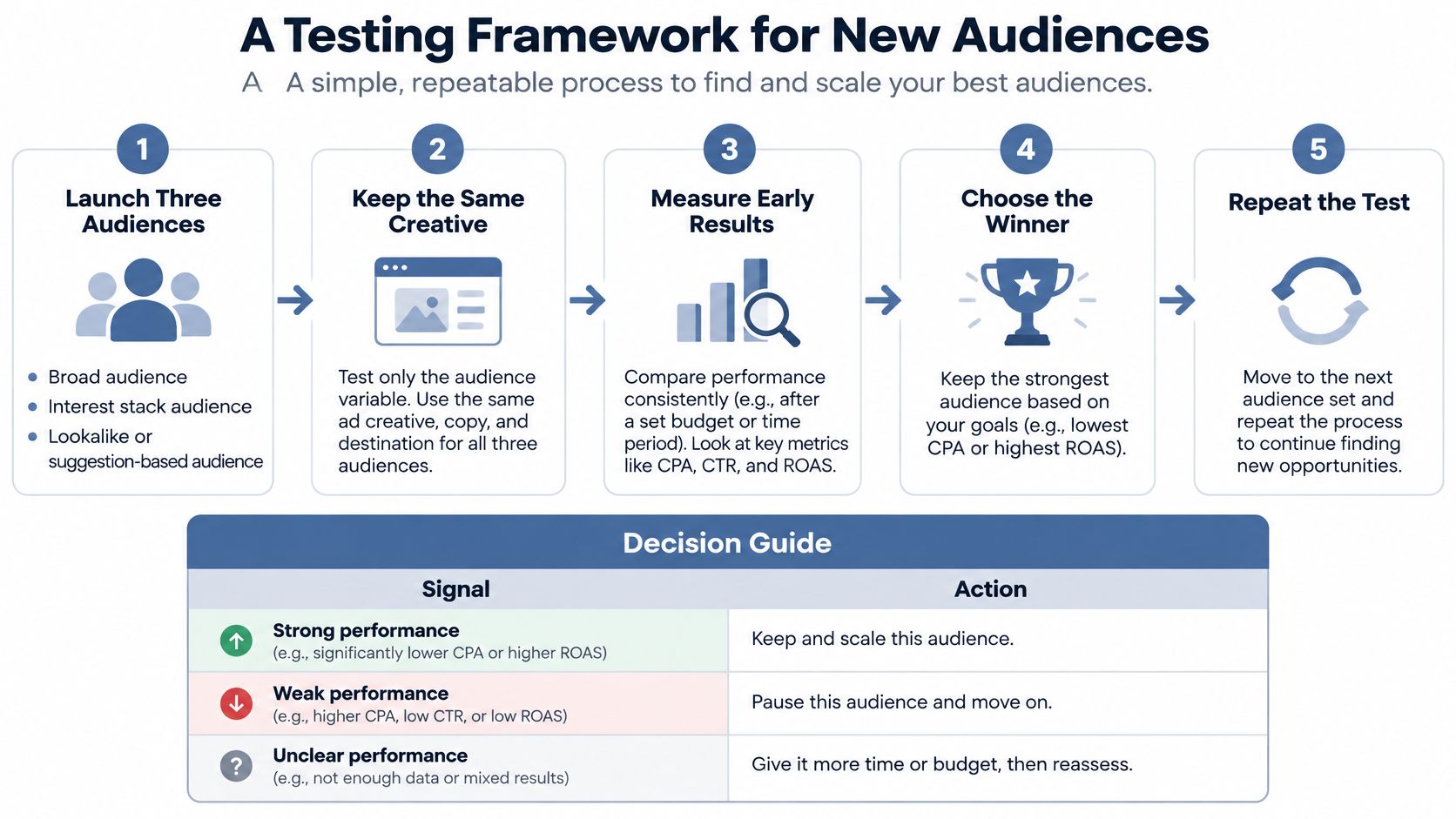
We recommend focusing on one traffic source until it works, then adding others. Facebook is enough until this routine produces a winner. Adding a second platform in week one only splits a small budget into two confused stories.
- Launch three audiences with the same creative and the same daily budget. One broad, one interest stack, one lookalike or suggestion-based audience. If the design changes too, you will not know what won.
- Judge each audience around 2-3 times your target cost per purchase. When purchases are scarce, read click-through rate and add-to-cart rate first. An audience with clicks and no carts is already telling you to stop.
- Keep the strongest audience and test three creatives inside it. Same offer, three angles. The audience already earned the right to see better ads.
- Raise the winning ad set's budget by about 20% every two to three days while cost per purchase holds. Big jumps reset learning and make a good audience look broken.
- Pause any audience that stays above target after its spend cap. Do not "give it one more day" out of affection for the interest you researched.
Read metrics in this order: click-through rate, add-to-cart rate, purchase conversion rate, cost per acquisition, then contribution margin. A cheap click that never becomes a paid order is not a win. If a niche is too small to fill delivery, add a related interest set rather than throwing the whole audience open. You want a neighbouring buyer, not the entire country.
| Test stage | Spend guide | Judge after | Decision rule |
|---|---|---|---|
| Audience screen | 2-3x target cost per purchase per audience | Enough spend for 50+ link clicks | Drop any audience with no add-to-cart |
| Creative check | Same audience, three creatives | 3-5 days | Keep the creative with the lowest cost per add-to-cart |
| Purchase proof | Winning audience at its daily budget | 1-2x target cost per purchase | Continue if purchases arrive near target |
| Scale step | Raise budget by 20% | 2-3 days stable | Hold if cost per purchase stays above target for 3 days |
The scale row is a hold rule, not a victory lap. If cost per purchase climbs above target for three days after a budget increase, put the budget back. The audience did not fail. The pace did.
Measure Real Sales Before You Scale an Audience
Scale an audience when it brings new buyers above your break-even contribution margin and keeps cost per acquisition under target for two weeks. Pause it, or merge it into a broader set, when it mostly re-counts customers who were going to purchase anyway. That rule matters more than whichever row looks best in Ads Manager.
Apple introduced App Tracking Transparency with iOS 14.5 in April 2021, and eMarketer's 2021 Facebook advertising analysis describes what that did to the journey. Apps had to ask permission before tracking activity across other apps and websites. People who declined became harder to connect from impression and click through visit and purchase, which weakened pixel retargeting, conversion measurement, and attribution for iPhone and iPad users. An audience can look profitable because the platform claimed credit, or look weak because the browser hid the sale.
Independent research summarised by the meta-ads research notes indicates that Meta Pixel capture may cover only about 40-60% of conversions. The useful question is whether this audience generated purchases that would not have happened without the ads. Our guide to setting up the Facebook pixel for print on demand is the tracking baseline. The ad setup walkthrough sits in the course, with further checks in our Facebook hub for monitoring ads. If you want to scale to higher volume, you can connect with our team through a call.
| Measurement method | What it tells you | Setup | Limitation |
|---|---|---|---|
| Holdout test | Incremental purchases compared with a group that saw no ads | Withhold ads from a random share of the audience | Needs enough volume to read the gap |
| Geographic split | Lift between matched regions with and without ads | Run ads in some regions and pause them in matched ones | Regions must be genuinely comparable |
| Post-purchase survey | How customers say they heard about the store | Ask one question on the order confirmation page | Self-reported, so answers can be vague |
| Contribution margin per new customer | Whether new buyers pay back their acquisition cost | Subtract product cost, shipping, fees and ad spend from revenue | Needs accurate margin data per order |
Pick one method you can run. A holdout or a geographic split is cleaner when volume allows. A one-question survey plus margin per new customer is enough for a small store. First-party records make that math possible. If you are comparing how a simple customer system should store orders, surveys, and repeat buyers, explore key CRM features from EndureGo Tax as a checklist for the fields you will wish you had kept.
Every audience you test teaches you something new about your buyers. A stack that never carts tells you the design's joke is narrower than the interest. A broad ad set that finds strangers who pay tells you the creative is doing the targeting. That learning is how a small store builds a real edge, and it is one of the most exciting parts of selling apparel online. You are not stuck with a guess. You get to improve it with the next drop.
Skup teaches print-on-demand sellers how to turn that testing habit into a store that can scale, including the Apparel Cloning method for finding proven products and the Facebook ads training that sits beside it. AvatarIQ is the design workflow we use when you need fresh angles to test without stalling the ad account. When you are ready to build the next audience with a real offer behind it, visit Skup.