How to Find a Reliable Phone Cases Supplier
The global phone case market is estimated at USD 16.31 billion in 2025 and projected to reach USD 21.6 billion by 2030, with a 5.8% CAGR, according to The Business Research Company's phone case market report. That scale creates a real opportunity for print-on-demand entrepreneurs, but it also creates a problem beginners often underestimate: the supplier determines whether your design becomes a profitable product or a steady stream of refunds, replacements, and disappointed customers.
A polished storefront can't compensate for loose fit, crooked printing, weak camera protection, or packaging that arrives damaged. The right phone cases supplier gives you dependable production, accurate fulfillment, and enough flexibility to test designs before you commit serious cash. The wrong one can make a promising product impossible to scale.
Table of Contents
- Why Phone Cases Are a Smart Category for POD Entrepreneurs
- Understanding the Four Main Supplier Types
- Where to Search and How to Vet Potential Suppliers
- Quality Testing and Sample Evaluation Checklist
- Negotiating Terms and Setting Up Your Partnership
- Red Flags and Compliance Requirements to Watch For
Why Phone Cases Are a Smart Category for POD Entrepreneurs
Phone cases sit in a useful position within eCommerce. Customers replace devices, update their style, buy gifts, and look for protection, while sellers can offer many designs without carrying a large inventory. That combination makes cases attractive for entrepreneurs who want to build a catalog around niches, interests, events, and personalized artwork.
The broader mobile phone accessories market has been estimated at USD 119.2 billion in 2026 and projected to reach USD 230.1 billion by 2036, according to the referenced industry estimate. Phone cases are only one part of that ecosystem, but their role is unusually accessible for POD because the product is compact, visually driven, and compatible with repeat design testing.
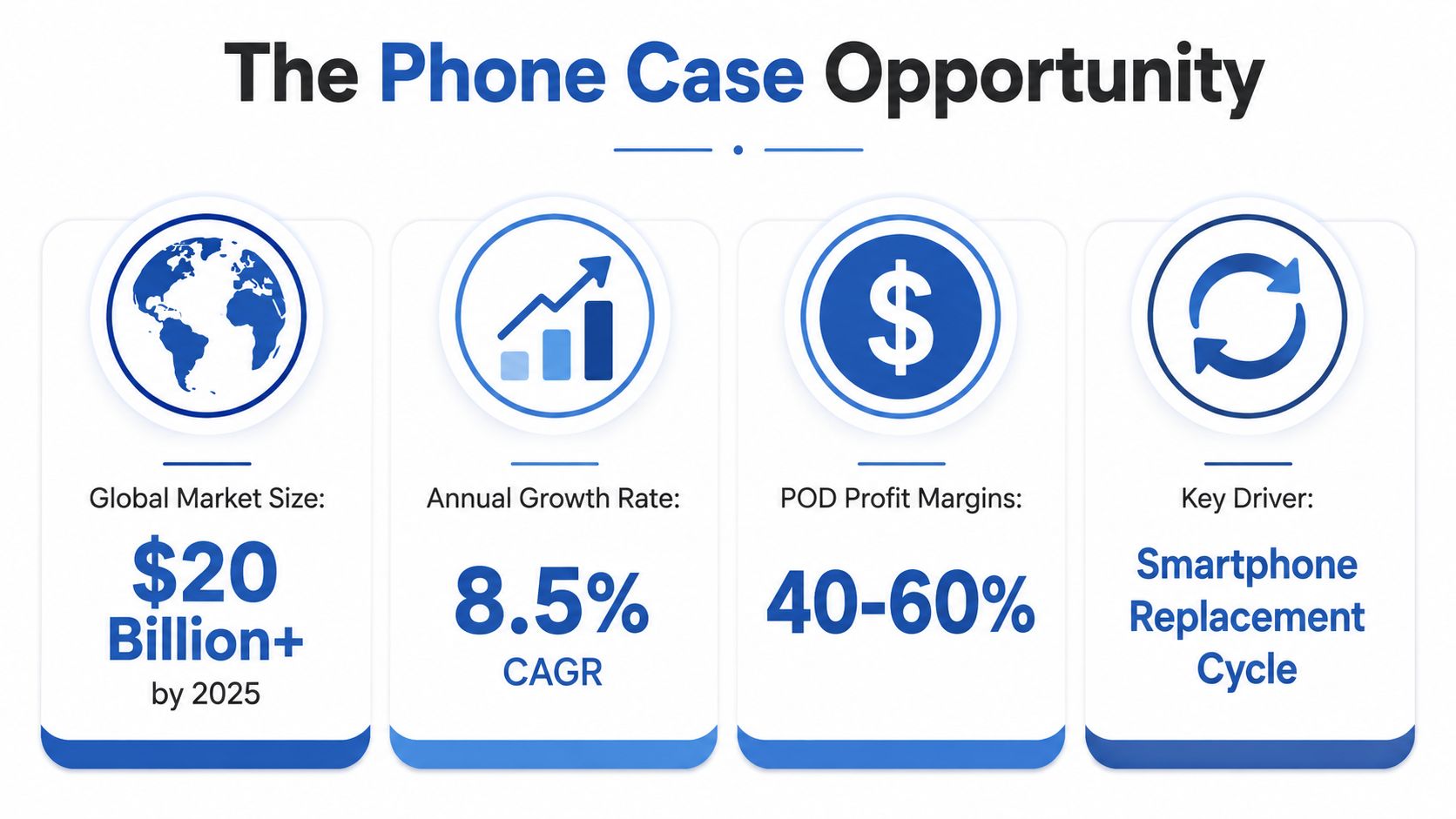
The category also has enough room for different business models. A beginner can test a small collection through a POD partner, while an established store can work with an OEM or ODM factory on packaging, materials, and exclusive designs. The key is matching the supplier relationship to your current demand instead of paying for control you aren't ready to use.
Why supplier choice affects profit
A phone case may look simple, but production involves several points where quality can fail. The printed artwork can be misregistered, the case can fit one device poorly, the buttons can feel stiff, or a camera opening can expose the lens. Each issue affects customer satisfaction and your support workload.
Your supplier also controls practical details that customers notice immediately:
- Model coverage: A design may sell well, but only if the supplier supports the device models your audience uses.
- Print consistency: Color, placement, coating, and edge coverage need to remain stable across orders.
- Fulfillment accuracy: The correct model and design must reach the correct customer.
- Shipping presentation: Clean packaging helps a low-cost accessory feel like a deliberate product.
- Data access: Order status and tracking should flow into your store or fulfillment workflow.
Design speed matters too. Entrepreneurs can use make your own phone case art as a starting point for developing original concepts, then validate those concepts through samples before listing them widely. For broader product research, Skup's guide to the best print-on-demand products can help you compare cases with other POD categories.
Asia-Pacific was the largest regional phone case market in 2025 in the cited market report, which matters because many manufacturing and export networks are concentrated there. That doesn't mean every factory in the region is suitable. It means the sourcing market is deep, and your advantage comes from disciplined evaluation rather than choosing the first attractive listing.
Understanding the Four Main Supplier Types
The phrase phone cases supplier covers several very different operating models. Beginners often compare unit prices without comparing control, fulfillment responsibility, customization, or inventory risk. That approach creates expensive surprises later.
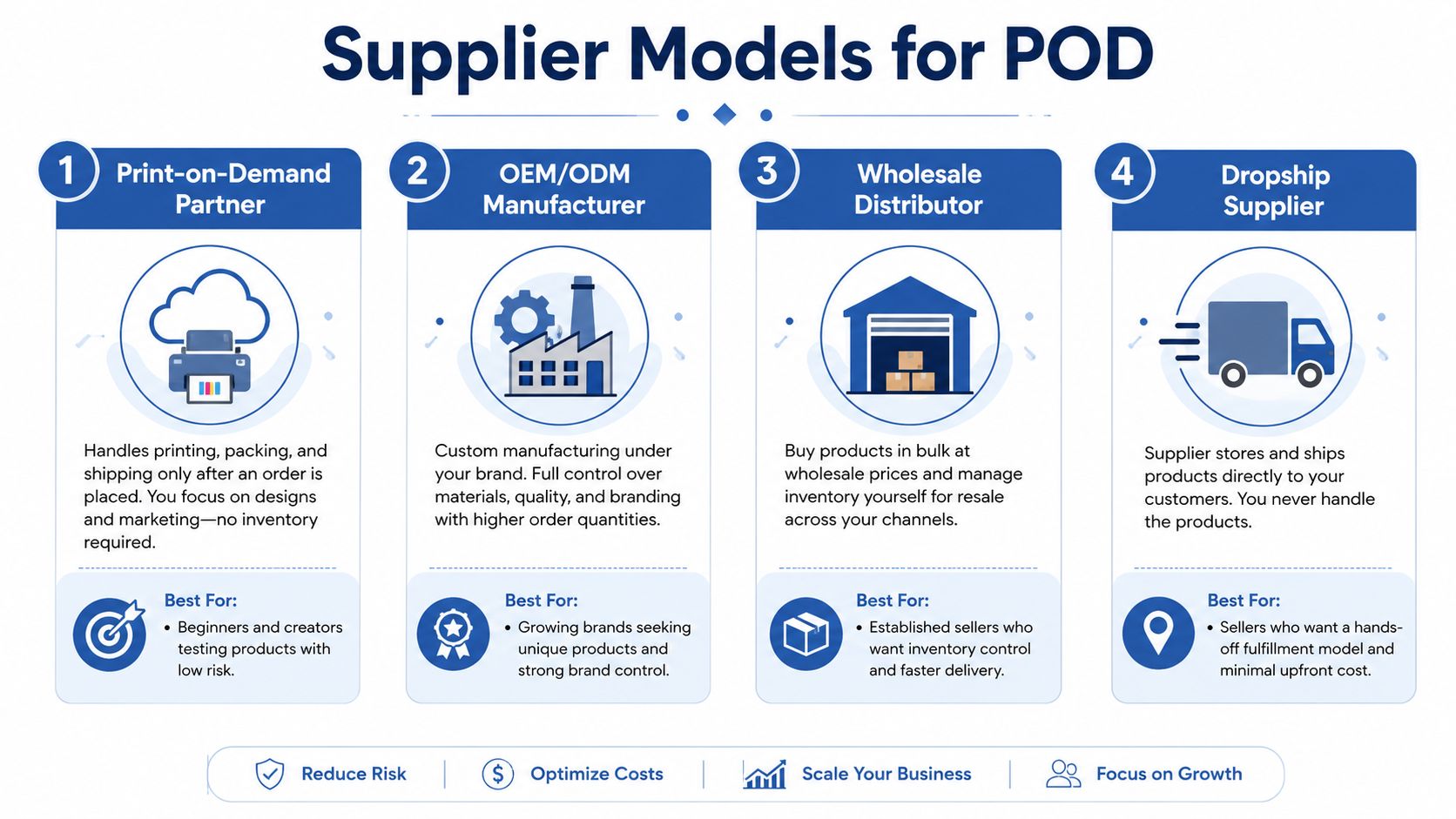
Print-on-demand partners
A POD partner produces a case after a customer places an order. You upload artwork, connect the catalog to your store when supported, and let the provider handle production and shipping.
This model suits early testing because you don't need to purchase a large batch of one design. The trade-off is reduced control. You may have fewer material choices, less packaging customization, and a higher per-unit cost than a factory order. Still, that cost can be rational when you're buying flexibility and avoiding unsold inventory.
OEM and ODM manufacturers
An OEM manufacturer makes products to your specifications. An ODM manufacturer may provide an existing product platform that you customize with branding, materials, packaging, or design details.
These suppliers make more sense after you know what customers want. They can provide greater control over case construction and presentation, but they usually require more communication, technical review, and planning. Ask whether the quoted MOQ applies per model, color, finish, or total order, because those conditions can change the economics completely.
Wholesale distributors
A wholesaler buys or holds finished inventory and sells it to retailers. This option can provide quick access to established case styles and multiple device models.
Wholesale works when speed and product breadth matter more than exclusive design control. You may receive better pricing than a retail purchase, but the catalog can be shared with many sellers. That makes differentiation harder, and you may need to manage storage, packing, and customer shipping yourself.
Dropship suppliers
A dropship supplier ships directly to your buyer after receiving an order. The model reduces your need to hold inventory, but the supplier's shipping process becomes part of your customer experience.
Dropshipping can be useful for testing complementary products or expanding your catalog. It becomes risky when the supplier has inconsistent stock, unclear tracking, or generic packaging that weakens your brand. A POD partner and a dropship supplier may both ship one order at a time, but they aren't interchangeable. One is centered on customization, while the other may be centered on ready-made inventory.
Decision rule: Start with the model that limits irreversible risk. Add manufacturing control only after your designs, device mix, and order flow justify it.
Many mature stores combine models. A POD provider can support experimentation, while an OEM or ODM factory handles proven designs once consistent demand makes customization worthwhile. That staged approach preserves the excitement of fast product testing without forcing a new entrepreneur into unnecessary inventory commitments.
Where to Search and How to Vet Potential Suppliers
Directory browsing is only the opening move. Alibaba and Global Sources can help you identify manufacturers, while specialized POD networks can help you compare catalog coverage and fulfillment options. Search using specific terms such as custom phone case manufacturer, UV printed phone cases, TPU phone case factory, private label phone cases, or print-on-demand phone cases.
Don't judge a supplier by photos, badges, or a polished storefront. Build a shortlist, then make each candidate answer the same operational questions.
Start with a structured first message
A useful inquiry should include your target device models, material preferences, printing method, estimated order pattern, packaging requirements, destination markets, and request for samples. Ask directly:
- Factory status: Do you manufacture the cases, or do you source them from another facility?
- Customization scope: Can you print full-wrap artwork, edge artwork, logos, inserts, and custom packaging?
- MOQ terms: Is the MOQ per design, model, color, finish, or total order?
- Production timing: What happens between artwork approval, production, inspection, and dispatch?
- Quality records: Can you provide batch-level QC documentation and test reports for the exact product?
- Integration options: Can orders, addresses, tracking, and status updates move through your store or POD platform?
The quality of the reply matters. A serious supplier may ask clarifying questions because device compatibility and print specifications affect production. A reseller often sends a generic catalog and avoids answering how quality is controlled.
Verify beyond the profile page
Request a live video call from the production floor. Ask the representative to show the printing area, case materials, packaging station, sample room, and current production activity. A video call won't prove everything, but it can reveal whether the contact understands the process or is merely forwarding factory information.
Pay for a physical sample. Free stock samples may show the supplier's standard product, not the exact artwork, finish, packaging, or production route you'll receive. Use the sample to check the complete customer experience, including print quality and delivery presentation.
Keep a supplier scorecard rather than relying on memory. Record response quality, sample accuracy, documentation, lead-time clarity, MOQ rules, and willingness to correct mistakes. You can also compare broader supplier options through Skup's guide to top dropship suppliers, then apply the same verification process before selecting anyone.
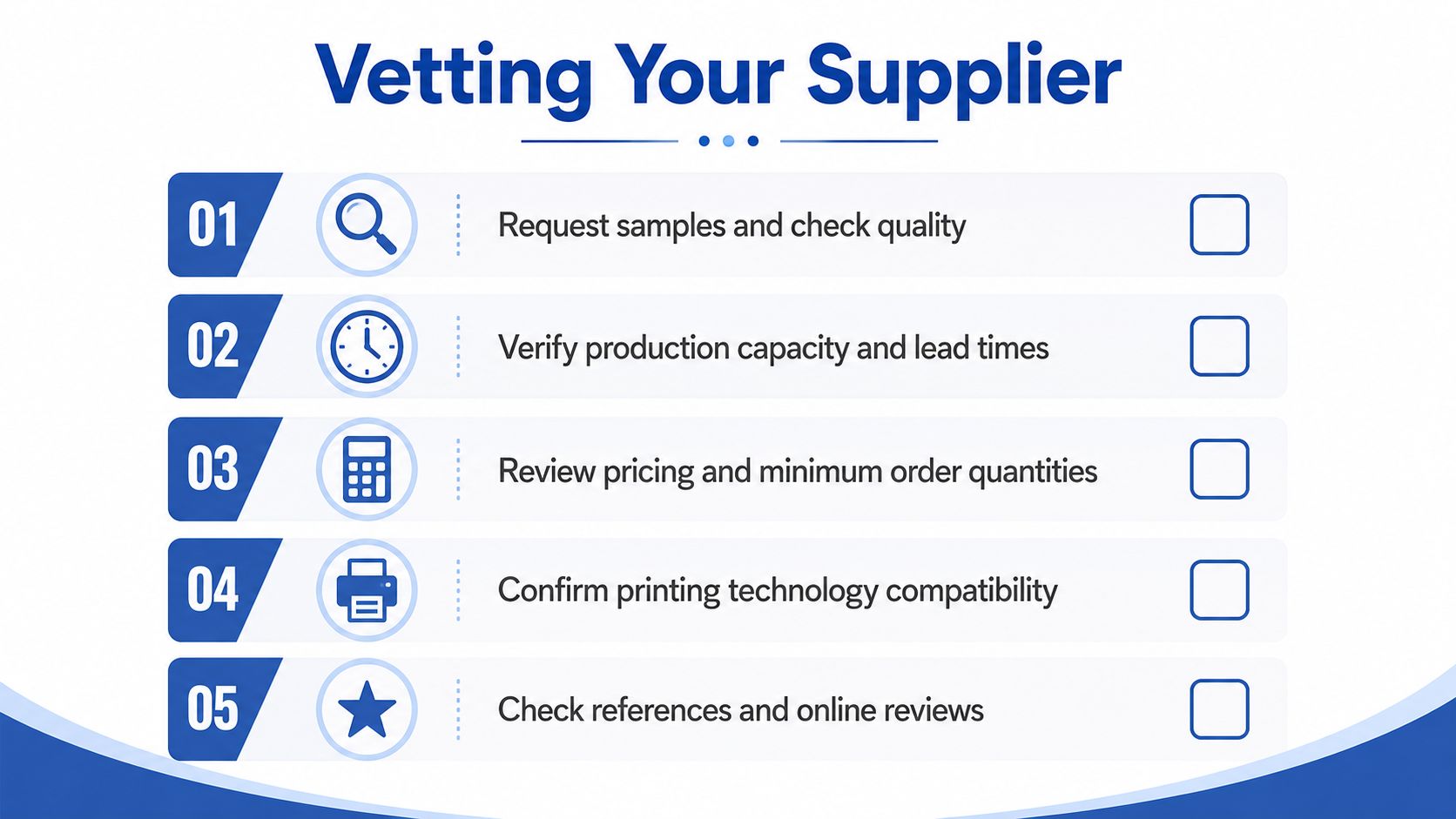
A supplier that can't show where production happens, how samples are approved, or how batch quality is documented hasn't earned a large order. Treat “verified” labels as a lead-generation signal, not as a substitute for evidence.
Quality Testing and Sample Evaluation Checklist
A sample isn't a formality. It's the first physical proof that the supplier can translate your product specification into something a customer can use. Test it on the exact device model it claims to support, and document every issue with photographs, notes, and the supplier's response.
Reliable workflows generally use four checkpoints: incoming material inspection, in-process inspection, fit testing on real devices, and final packaging verification. Suppliers that document these stages and provide batch-level QC reports generally report defect rates below 2–3%, while weaker suppliers commonly fail on port alignment, button feel, and finish consistency, as described in this phone case supplier quality workflow.
Inspect the case before installation
Look for scratches, warping, bubbles, uneven edges, inconsistent coating, weak seams, and visible material contamination. Compare the left and right sides, especially around the camera opening and buttons. A case can look acceptable in a product photo while feeling cheap or unstable in the hand.
Install the case on a real device. Check that the phone sits fully into the corners and that the case doesn't lift around the screen or camera. Test every opening:
- Charging port: Insert the intended cable and check clearance from different angles.
- Speakers and microphones: Confirm that openings aren't partially blocked.
- Buttons: Test volume, power, mute, and any programmable controls for consistent responsiveness.
- Camera cutout: Open the camera and check that the case doesn't intrude into the image area.
- Wireless charging: If the product is marketed as compatible, test charging with the relevant device and charger combination.
Test protection claims honestly
If the supplier promotes drop resistance, request the test method, sample identity, test conditions, and result documentation. Supplier QA workflows may use a drop test from about 6 ft, with checks for fit, cracking, button function, and camera protection, as outlined in this phone case manufacturing guidance.
For a military-style durability claim, distinguish general “shockproof” wording from a defined protocol. MIL-STD-810 Method 516.6 Procedure IV uses 26 drops from a 48-inch height, covering 8 corners, 12 edges, and 6 faces, with functional checks before and after testing, according to this testing guide for shockproof phone cases. Don't repeat that claim in your listing unless your product and documentation support it.
Finish your review with packaging. Verify barcode or SKU accuracy, artwork inserts, protective sleeves, labels, and shipping cartons. For a repeatable process, adapt the checkpoints in Skup's quality assurance procedures guide to your case specifications.
Negotiating Terms and Setting Up Your Partnership
The strongest negotiation starts after the sample passes, not before. At that point, you can discuss a real product, real defects, and real operating requirements instead of arguing over a catalog photo.
Suppose a supplier offers an attractive price but requires an MOQ that feels too aggressive for an untested design. Don't negotiate only on unit cost. Ask whether the MOQ can be shared across artwork variations, whether the supplier can begin with a smaller pilot, and whether the same blank case can support several designs. You may accept a less favorable unit price for the first order if it lets you validate demand without locking cash into weak products.
Put the agreement in writing
Your supplier agreement should define the approved sample, artwork specifications, materials, packaging, inspection rights, acceptable defect handling, replacement or credit procedures, production timing, shipping responsibilities, and ownership of your artwork. Make the supplier identify the exact model and finish, not just a broad description such as “premium case.”
Payment terms deserve the same attention. Confirm the deposit, balance trigger, payment method, currency, bank details, and what happens if inspection fails. Businesses exploring the operational side of supplier payments can review the benefits of payment automation from Zaro, particularly when order volume makes manual reconciliation harder.
Onboard in controlled stages
Connect the supplier only after the product data is clean. Your store or POD platform should use consistent SKUs for device model, design, finish, and packaging. Map order status and tracking fields, then place a test order using a real shipping address before opening the catalog to customers.
A practical sequence looks like this:
- Negotiate the initial scope: Agree on the approved product and pilot quantity.
- Document the specification: Attach sample photos, artwork files, packaging details, and inspection conditions.
- Approve the sample: Record the exact sample version that becomes the reference unit.
- Connect the workflow: Test product data, order routing, tracking, and customer notifications.
- Run a test order: Check production, dispatch, delivery presentation, and post-delivery support.
Choose shipping based on customer promise, not supplier convenience. Clarify whether the supplier ships directly, uses a fulfillment partner, or expects you to move stock to a third-party logistics provider. If you move into bulk inventory, ask how cartons are labeled and whether the warehouse can separate designs and models without creating picking errors.
A reliable relationship is collaborative, but it isn't casual. Review delivery, quality, communication, and corrective actions regularly. Suppliers should know what success looks like, and you should be willing to share forecasts or design plans when that helps them prepare capacity.
Red Flags and Compliance Requirements to Watch For
The most dangerous supplier isn't always the one with the highest quote. It's the one that promises everything, avoids specifics, and pressures you to place an order before you can verify the product.
Be cautious when a supplier refuses a live factory video, won't provide a physical sample, changes MOQ terms after quoting, or sends certificates that don't identify the product, material, market, or test scope. Generic certificates may establish that a document exists, but they don't prove that your exact batch meets the requirement.
Treat compliance as a product feature
For a standard non-electronic case sold in the EU or UK, CE marking generally isn't required. A case with LED lights, wireless charging components, or a battery can trigger CE-related obligations and additional directives, according to EU and UK phone case compliance guidance.
Keep a technical file, supplier declarations, product labeling records, and test evidence appropriate to the product. In the EU context, the cited guidance says documentation should be retained for 10 years. Ask the supplier for records tied to the exact materials and configuration you sell, rather than accepting a document for a different case.
For material and process assurance, reputable suppliers should be able to discuss ISO 9001, RoHS, REACH, and relevant drop-test evidence. ISO 9001 relates to process control, while RoHS and REACH address chemical restrictions in applicable markets. The supplier still needs to connect those documents to your actual product and production batch.
Don't ignore packaging obligations
The EU Packaging and Packaging Waste Regulation requires packaging placed on the EU market to be recyclable and introduces phased minimum recycled-content targets for plastic packaging. Industry summaries describe targets ranging from 30% to 65%, depending on packaging type and category, with 2030 as a major compliance milestone, as summarized alongside the official PPWR legal text.
That means packaging decisions belong in supplier discussions early. Ask what materials the package uses, whether components can be separated for recycling, what recycled content documentation is available, and which party is responsible for market-specific obligations.
The right phone cases supplier won't respond to compliance questions with vague reassurance. They'll provide traceable documents, explain limitations, and help you keep your product claims accurate. Start with a sample, test it like a customer, document the standard, and scale only when the supplier consistently meets it.
Skup gives POD entrepreneurs practical education and tools for building a product-testing workflow, including the Apparel Cloning System and AvatarIQ for creating designs and mockups faster. Visit Skup to explore resources that can help you turn supplier research, product validation, and store execution into a more organized eCommerce business.