Best Products to Sell in 2026 and How to Find Winners
You're staring at a blank print-on-demand catalog, scrolling through trendy designs and wondering which products to sell first. The temptation is obvious: upload everything, open the store, and hope the market tells you what works.
That approach creates busywork, not a business. Product selection is the most important decision in eCommerce, because the right product makes advertising, organic content, customer retention, and brand building easier. The wrong product forces you to compensate with more traffic, steeper discounts, and endless redesigns.
Global retail e-commerce sales reached about $6.42 trillion in 2025, with online channels representing roughly 20.5% to 20.8% of worldwide retail spending that year, according to Quantumrun's e-commerce sales analysis. Print on demand is growing inside that enormous market, but opportunity alone doesn't pick your product for you.
The winners use a repeatable sequence: choose a specific audience, validate demand, inspect competition, protect your margins, test designs quickly, and scale only what earns the right to grow. That's the system behind the Apparel Cloning approach, and it's far more reliable than guessing from a trending keyword.
Table of Contents
- Why Your First Product Choice Changes Everything
- Why Apparel Dominates the POD Opportunity
- The Apparel Cloning Method for Finding Winners
- How to Validate Demand and Protect Your Margins
- Smart Product Categories to Watch in 2026
- Removing the Design and Mockup Bottleneck
- Your Next Step Toward a Real eCommerce Business
Why Your First Product Choice Changes Everything
A weak product can make a capable seller look inexperienced. You might write a strong listing, build clean product pages, and run competent ads, yet still struggle because shoppers don't feel a clear reason to buy. More traffic won't fix a product that lacks identity, utility, or a compelling offer.
A strong product gives every part of the store something to work with. A niche audience understands the message faster. A specific design earns more relevant clicks. A clear product promise helps shoppers make decisions without needing a long explanation. Customers who feel represented by the product are also more likely to return for another design or buy it as a gift.
The practical rule: Don't ask whether a product is popular. Ask whether a defined group of people wants this version of it badly enough to buy.
The validation process starts with four checks:
- Niche clarity: Identify the person, community, identity, or use case the product serves.
- Demand evidence: Look for marketplace activity, recurring search interest, social engagement, and real competitors.
- Margin room: Calculate the complete cost of fulfillment, platform fees, advertising, and customer support before launching.
- Testability: Favor products you can present with multiple creative angles and evaluate without committing to large inventory.
This sequence protects you from a common beginner mistake, confusing attention with demand. A design may receive views because it is funny or controversial, but that doesn't mean shoppers will pay for it, wear it, or recommend it.
The best products to sell usually sit at the intersection of clear audience identity, proven demand, operational simplicity, and room for differentiation. That combination gives you a chance to improve the offer instead of constantly rescuing it.
Treat your first product like a business decision, not a creative vote. Stores that build profit usually make disciplined choices before launch, while stores that stall at break-even often test ideas without knowing what success should look like.
Why Apparel Dominates the POD Opportunity
Apparel is the strongest starting point for most print-on-demand beginners because it combines a large market with emotional buying behavior. The global print-on-demand market was valued at $10.8 billion in 2025 and is projected to reach $57.5 billion by 2033, representing a projected 23.6% CAGR from 2026 to 2033, according to Grand View Research.
Within that market, apparel isn't merely one option among many. Apparel accounted for 47.8% of total print-on-demand market revenue in 2025, making it the largest product segment in Future Market Insights' 2026 market report.
That dominance makes sense operationally. A hoodie, sweatshirt, or premium tee can support a stronger order value than a single sticker, while clothing gives customers a way to express identity. A buyer isn't only purchasing fabric and ink. They're buying a signal connected to a hobby, belief, profession, family role, or community.
Apparel also gives you more creative territory. You can build collections around a shared theme, introduce seasonal colorways, create matching products, and develop designs that work across tees, crewnecks, and hoodies. Mugs, wall art, and accessories still matter, but apparel often gives a beginner the cleanest path to proving whether a niche responds.
For a foundational explanation of the model, what print on demand means is a useful starting point before you choose a supplier or product range.
| Category | Avg Order Value | Repeat Purchase | Ad Performance | Beginner Fit |
|---|---|---|---|---|
| Apparel | Medium to high | Strong when identity-led | Strong visual storytelling | Excellent |
| Mugs | Medium | Moderate, often gift-driven | Good with clear themes | Good |
| Wall art | Medium to high | Lower, but collection-friendly | Strong lifestyle presentation | Moderate |
| Stickers | Low | Can be strong for collectors | Requires efficient creative testing | Good for add-ons |
| Personalized gifts | Medium to high | Strong around occasions | Strong when the recipient is clear | Good with careful fulfillment |
The point isn't to ignore adjacent categories. It's to begin where customer emotion, product visibility, and design flexibility already work in your favor. Start with apparel, then add products that increase basket size or give the same audience another way to buy.
The Apparel Cloning Method for Finding Winners
Apparel Cloning isn't a copying strategy. It's a research shortcut that helps you avoid inventing demand from scratch. You study what already attracts buyers, identify the underlying pattern, and create an original offer for a less crowded audience.
Start with proven winners
Search bestseller lists, Etsy bestsellers, TikTok Shop top sellers, and competitor Shopify stores with apparel filters. Don't focus on one isolated listing. Look for repeated signals across multiple stores, such as similar audiences, recurring garment types, common visual themes, or consistent product positioning.
Record what you see. Note the niche, design hook, garment, headline, price positioning, color choices, and customer comments. Your job is to identify the structure behind the sale, not reproduce the artwork.
Audit the winning angle
A winning shirt may appear to be about a phrase, but the hook could be belonging, humor, pride, nostalgia, or a shared frustration. Separate the surface design from the emotional reason a shopper would wear it.
Ask:
- Does the design speak to a specific identity?
- Is the message immediately understandable?
- Does the garment fit the audience's lifestyle?
- Are buyers responding to the artwork, the wording, or the gift occasion?
- Can the concept support a collection rather than one isolated listing?
Find the gap
Look for audiences with visible demand but thin design supply. Search volume, marketplace listing counts, customer reviews, and competitor quality can reveal where shoppers have interest but aren't receiving strong creative options.
A narrow niche isn't automatically too small. It becomes attractive when the audience is easy to recognize, the buying motivation is clear, and existing products look repetitive or poorly positioned.
Improve instead of imitate
Create original artwork, original copy, and a distinct brand voice. You might keep the broad audience insight while changing the visual language, garment style, offer, photography, and product story.
A useful test is simple: if a shopper saw both stores side by side, would yours look like a sibling brand with its own point of view? If it looks like a duplicate, you haven't done enough strategic work.
Reject saturation traps
Generic motivational tees, broad hobby slogans, and over-served identity categories often look easy because they have abundant examples. That abundance is also a warning. You need a sharper audience, a stronger point of view, or a more specific use case to compete.
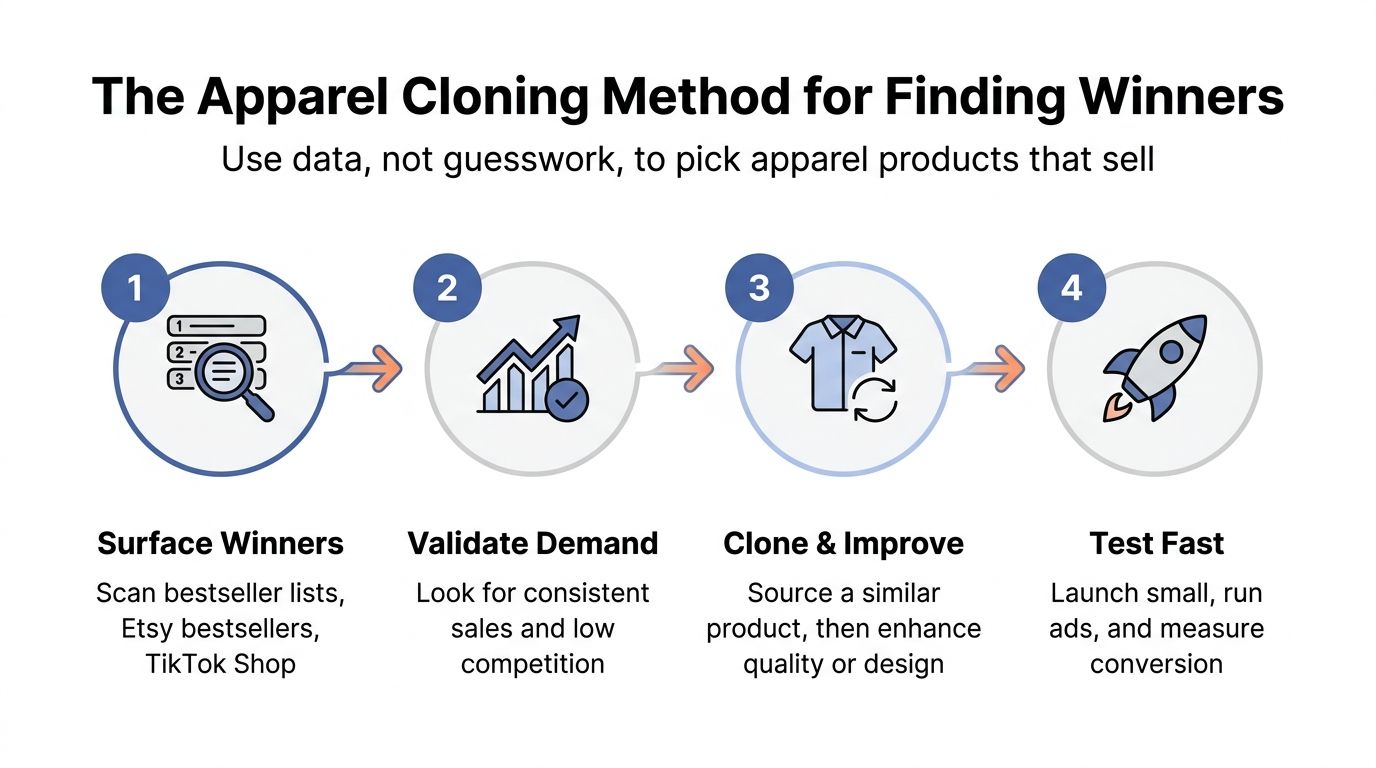
The process works because it combines proven demand with original execution. You aren't waiting for inspiration. You're taking a known market signal and moving it into an underserved angle where your store can earn attention.
How to Validate Demand and Protect Your Margins
Before spending seriously on ads, run every product through a short validation checklist. A product deserves testing when several signals point in the same direction, not when one keyword happens to be trending.
Check four demand signals
Sustained search interest matters more than a brief spike. Look for language shoppers use repeatedly and compare related phrases to understand whether the audience has depth.
Social engagement can reveal emotional energy. Study comments, shares, creator content, and recurring questions. A product tied to conversation gives you more creative material than one that only receives passive views.
Competitor sales provide useful confirmation. Look for multiple sellers with consistent activity, reviews, or visible customer response. One successful listing may be an outlier. Several credible sellers suggest a market you can study.
Marketplace competition needs context. A large listing count doesn't automatically kill an idea, but generic products inside a crowded category need a sharper angle. A smaller listing pool can help, provided real buyers are present.
For apparel and footwear stores, a practical conversion benchmark sits in the 1% to 3% range, as outlined by True Fit's fashion eCommerce conversion benchmarks. Use that range as a filter, not a promise. If your product page receives qualified visits but can't generate purchase behavior, inspect the design, offer, photos, sizing information, and price before increasing traffic.
Build the margin backward
Healthy POD margins are typically 20% to 40%, according to Printful's product research guidance. Calculate the full delivered cost, including the blank product, printing, shipping, platform fees, refunds, discounts, and advertising allocation.
| Product Type | Base Cost | Print + Ship | Platform Fees (15%) | Net Margin | Margin % |
|---|---|---|---|---|---|
| T-shirt | Enter your cost | Enter your cost | Sale price × 15% | Sale price minus all costs | Net margin ÷ sale price |
| Hoodie | Enter your cost | Enter your cost | Sale price × 15% | Sale price minus all costs | Net margin ÷ sale price |
| Mug | Enter your cost | Enter your cost | Sale price × 15% | Sale price minus all costs | Net margin ÷ sale price |
| Wall art | Enter your cost | Enter your cost | Sale price × 15% | Sale price minus all costs | Net margin ÷ sale price |
Use the POD product cost calculation guide to organize the numbers before you launch. If you plan to expand into marketplace fulfillment or Amazon operations, a resource on forming a US LLC for Amazon FBA sellers can help you investigate the business structure separately from product validation.
Separate trends from durable demand
Score each idea qualitatively on seasonality risk, longevity, repeat purchase potential, and creative depth. A holiday design may perform well during a narrow window, while a profession, lifestyle, or identity niche can support products across the calendar.
The strongest portfolio usually mixes timely designs with evergreen concepts. That gives you opportunities during major shopping periods without making the business dependent on one moment.
Smart Product Categories to Watch in 2026
The best adjacent products aren't random additions to your catalog. They serve the same buyer who already likes your apparel, increase the number of ways that buyer can purchase, or give you a fresh creative angle.
Wellness and self-care
Wellness and self-care offer strong creative territory because customers connect with routines, recovery, movement, and personal identity. Test yoga-themed apparel, recovery-focused accessories, gym designs, journal-style wall art, or gift products for people building healthier habits.
Keep the offer lifestyle-led unless you have the right compliance knowledge for regulated claims. A design celebrating training consistency is safer and more flexible than a product promising a medical outcome.
Validation tip: Search for a specific routine or audience, then inspect whether existing products look generic. A narrow angle such as a particular training identity gives you more room than a broad “fitness” store.
Pet products
Pet owners often buy emotionally, which creates room for apparel, mugs, blankets, and personalized gifts centered on breeds, habits, and family roles. The strongest designs don't merely show an animal. They capture the relationship between the owner and the pet.
Start with a precise audience, such as a breed community, rescue supporters, or owners of senior pets. Read customer reviews to find language that real buyers already use, then turn those emotional phrases into original design concepts.
Home and lifestyle
Mugs, blankets, wall art, and other home products work well as companions to apparel. They let customers bring the same identity into a kitchen, office, bedroom, or gift occasion.
Bundles can also raise the value of an order without forcing you to find a new audience. A customer who buys an identity-led sweatshirt may respond to matching wall art or a mug if the collection feels intentional.
Same-day test: Pick one apparel concept and create a coordinated home product. If the message works naturally across both, you've found a stronger brand theme than a one-off design.
Personalization
Personalized apparel, accessories, gifts, and home decor deserve serious attention because names, initials, dates, and relationships make the product feel specific to the recipient. The same base concept can support many buyer situations, but quality control and fulfillment accuracy have to be excellent.
Don't treat personalization as adding a name to a generic template. Build around the occasion, relationship, or identity that makes the customization meaningful. A product for a specific family role or milestone usually has clearer intent than a blank product with an optional text field.
The broader pattern is clear: prioritize niches tied to wellness, pets, home, convenience, emotional value, and personal identity. These categories give you more than a trend. They give you reasons to create collections.
Removing the Design and Mockup Bottleneck
Most POD sellers don't run out of product ideas. They run out of time to turn those ideas into polished listings. If every design requires a long handoff between concept, artwork, mockup, resizing, and store upload, testing slows down before the market can give you useful feedback.
Place AvatarIQ immediately after niche selection and concept validation. Use it to turn one approved idea into multiple original design directions, then prepare the product visuals needed for an actual listing. The objective isn't to generate endless variations. It's to create enough strong options to test the audience, message, garment, and presentation.
A practical workflow looks like this:
- Select one niche and one emotional angle.
- Produce a batch of related design variations.
- Compare typography, layout, colorways, and garment choices.
- Apply lifestyle mockups that match the buyer's context.
- Export clean images for Etsy or Shopify.
- Launch the strongest concepts and record conversion behavior.
That speed matters because a live mockup creates a real test. You can evaluate clicks, product-page engagement, add-to-cart behavior, and purchases instead of debating which design feels best in a private folder.
Use a dedicated apparel mockup generator workflow to keep the creative process connected to product validation. AvatarIQ functions as an in-house creative production layer, helping one operator produce the listing volume that previously required separate design and virtual assistant support.
Keep your attention on output. More features don't build a business by themselves. A finished, differentiated listing that reaches the market can teach you something. An unfinished idea cannot.
Your Next Step Toward a Real eCommerce Business
You don't need another month of collecting product ideas. You need a controlled sequence that turns one idea into evidence.
Your 30-day starting plan
During the first week, choose one niche, audit proven apparel winners, and identify a gap in audience or creative supply. Use the Apparel Cloning method to create an original concept rather than copying a competitor.
By the end of the first month, launch the initial store and collect conversion data. Your job isn't to prove that every design works. Your job is to identify which combinations of audience, message, garment, price, and presentation earn further testing.
The next 60 days
In the second month, keep the products that show credible buying behavior and cut concepts that fail your margin or conversion checks. The roadmap supplied for this process uses a 2x markup threshold as a decision point for removing weaker offers, so treat pricing discipline as part of product selection rather than an afterthought.
In the third month, expand into adjacent niches using the same research process. Add coordinated products only when they serve the existing audience or strengthen the collection. Random catalog growth creates more work, while focused expansion gives customers more reasons to buy.
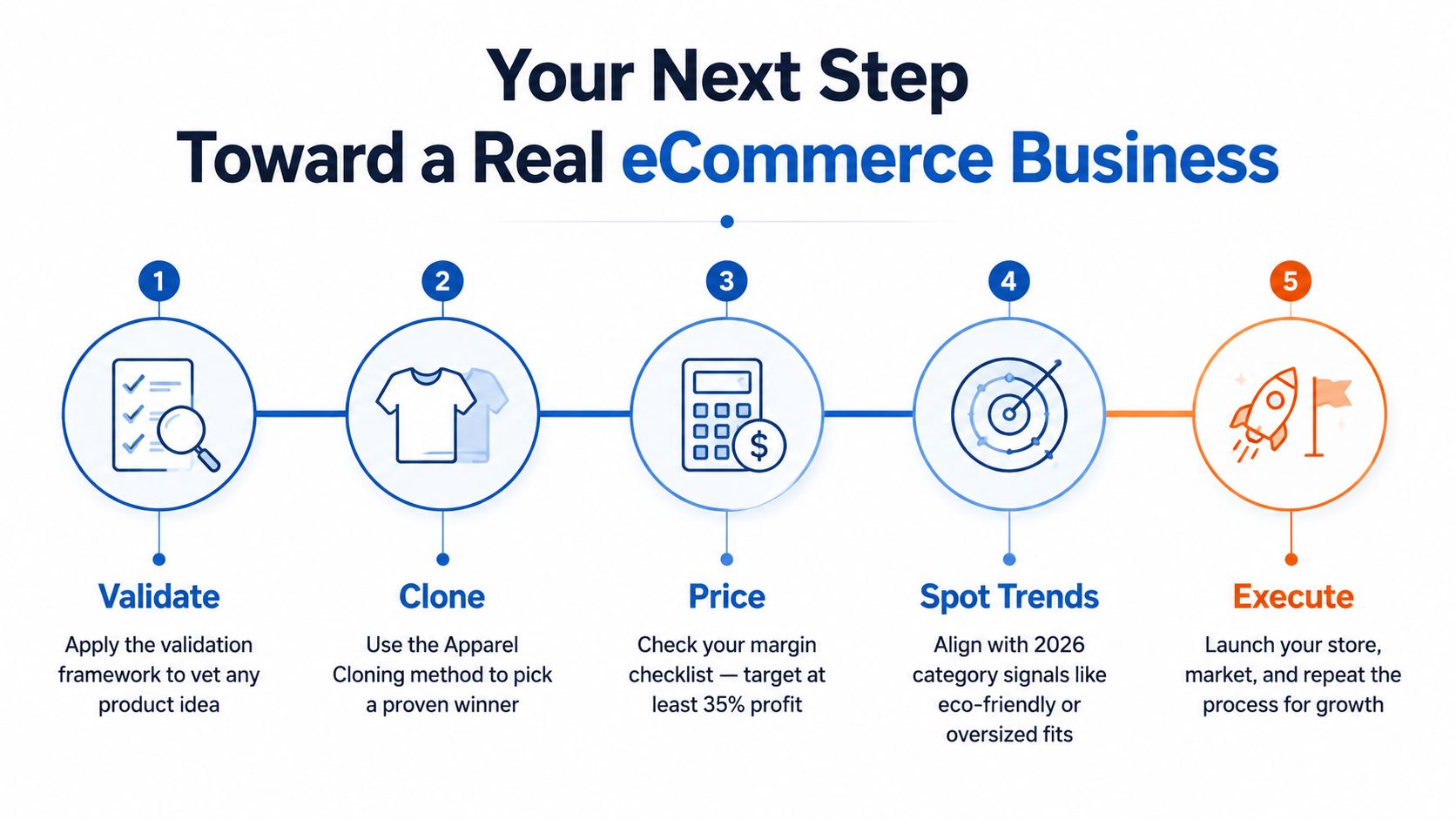
This is a system, not a lottery ticket. You validate, clone the underlying demand pattern, price carefully, watch category signals, execute, and repeat. Consistent reps beat one-off inspiration because every test improves your judgment and your store's operating process.
You can also review a practical clothing business launch guide if you want another perspective on turning an apparel idea into a functioning operation. The next serious step is structured support through the Apparel Cloning System and Skup Incubator, where the focus stays on guided implementation, coaching, and scaling decisions rather than hype.
Start today by choosing one audience, finding three proven competitors, and writing down the gap your product will fill. Build the first original concept, price it from complete costs, and publish a real test within your 30-day window.
Skup helps entrepreneurs build POD apparel businesses with the Apparel Cloning System, practical training, and the Skup Incubator for ongoing coaching and mentorship. Visit Skup to see how the validation system, AvatarIQ workflow, and guided execution can help you move from product ideas to a real eCommerce store.