Onboarding New Customers: A POD Retention Playbook
63% of customers consider the onboarding experience when deciding whether to subscribe or buy, and poor onboarding ranks as the third-most important reason for churn. SundaySky's customer onboarding data makes the commercial point clear: the experience after checkout can influence whether a buyer ever reaches the next purchase.
For a print-on-demand store, onboarding new customers begins the second an order is placed. The buyer has paid, but the product may still be waiting for production, quality checks, packaging, and transit. That gap between checkout and delivery is where confidence either grows or disappears. A transparent flow turns uncertainty into anticipation, gives support a chance to prevent avoidable questions, and creates the trust needed for repeat sales.
Table of Contents
- Why Onboarding New Customers Drives POD Revenue
- Building Your Welcome and Confirmation Email Flow
- Keeping Buyers Confident During Production and Shipping
- Turning First Orders Into Repeat Purchases
- Automating Your Onboarding System
- KPIs and Your Implementation Checklist
Why Onboarding New Customers Drives POD Revenue
A POD store can pay heavily to acquire a first-time buyer, then lose future revenue during the quiet period between payment and delivery. The customer receives a receipt, waits for production, and hears little else. That silence invites doubt, especially when timelines vary by product and destination.
The commercial impact goes beyond support workload. Personalized onboarding paths can increase completion rates by 35%, while a 5% improvement in retention can raise profits by 25% to 95%, according to SundaySky reports. For POD, retention begins when buyers see that the brand remains organized, honest, and present after checkout.
Practical rule: Treat the period between checkout and delivery as part of the product experience, not as dead time.
Production transparency reduces purchase anxiety. Tell buyers when printing starts, what quality control covers, and when tracking should arrive. Clear expectations replace guesswork with visible progress, which matters especially after a first order, before the customer has evidence that fulfillment is reliable.
| Metric | No Onboarding Flow | With Onboarding Flow |
|---|---|---|
| Order status | Buyer searches for answers | Buyer receives clear updates |
| Production period | Feels like unexplained waiting | Feels like visible progress |
| Support demand | Repetitive status questions | Fewer avoidable questions |
| Brand perception | Transactional and distant | Organized and attentive |
| Repeat purchase readiness | Trust remains unproven | Delivery reinforces confidence |
Personalized communication and clear next steps help preserve trust before frustration takes over. The best onboarding strategies for 2025 apply directly to POD when they make each update relevant, explain what happens next, and flag delays before the buyer has to ask.
The sequence boils down to four messages: confirm, explain, update, and follow up. Confirm the order immediately, explain the production process in plain language, send useful status updates, and continue the relationship after delivery. Automation keeps timing consistent, while a human brand voice makes the flow feel attentive rather than mechanical. That combination turns a silent fulfillment window into a reason to buy again.
Building Your Welcome and Confirmation Email Flow
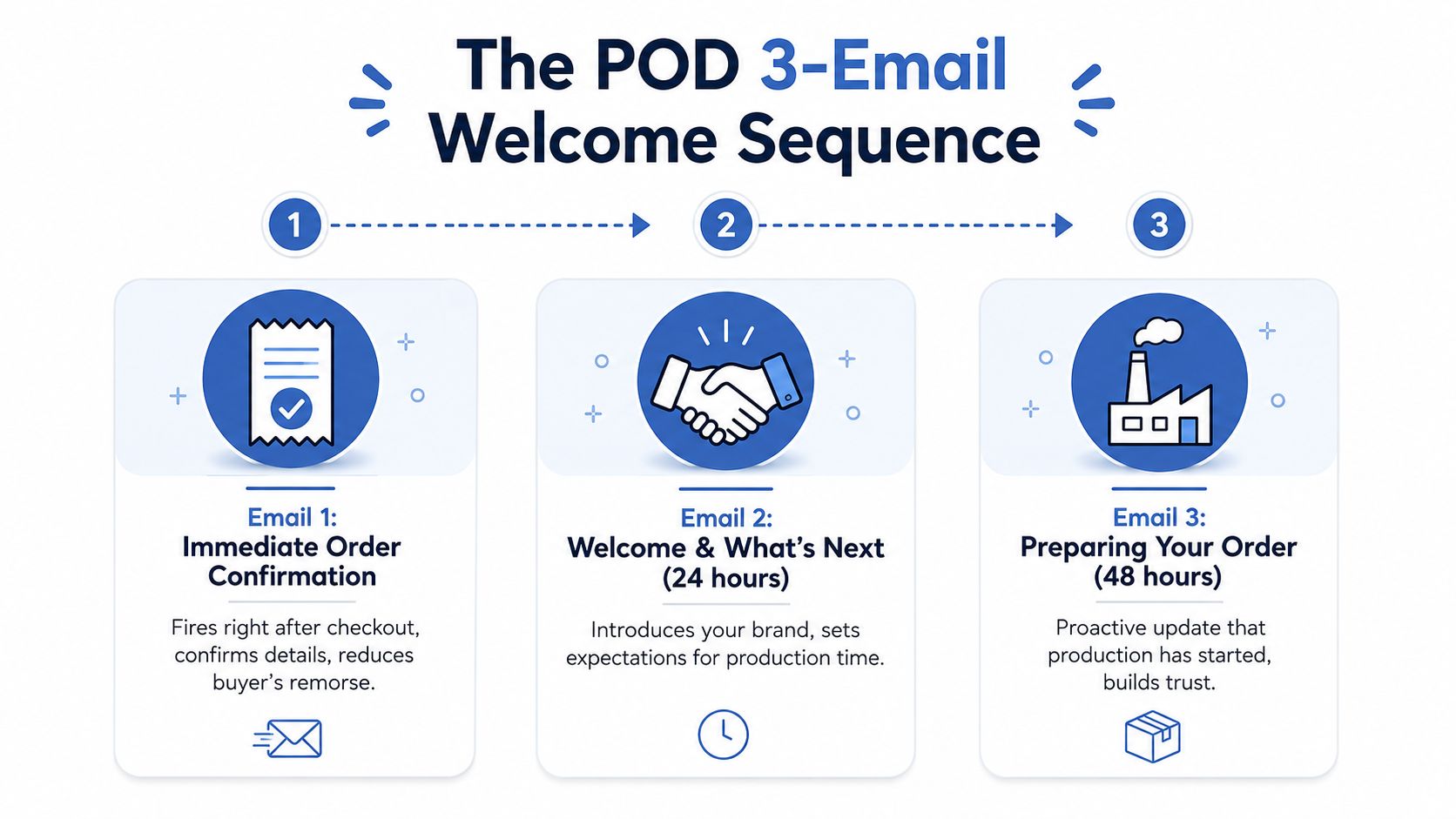
The first 48 hours after purchase should feel like a guided handoff from checkout to production. Three emails are enough to establish the relationship without flooding the buyer's inbox. Each message has a distinct job, and each should give the customer one useful reason to engage.
Email one confirms the order and introduces the brand
Send this message immediately after checkout. It must confirm the practical details, but it shouldn't read like a sterile receipt.
Subject: Your order is confirmed, {{first_name}}
Preview text: We've received your order and it's moving into production.
Body framework:
Thanks for ordering from {{brand_name}}. Your {{product_name}} is confirmed and will now move through our made-to-order production process.
Order summary: {{product_name}}, {{size or variant}}, {{quantity}}
We expect production to take {{production_timeline}}, followed by shipping to the address you provided. We started {{brand_story}} because we wanted to make products for people who care about {{customer identity or interest}}.
CTA: View your order status
Place the primary CTA after the order summary, not at the very bottom. The buyer's first question is usually whether the order details are correct. A secondary reply invitation, such as “Reply to this email if anything looks wrong,” adds reassurance without competing with the main action.
Email two explains what happens next
Send this message 12 to 24 hours after purchase. The goal is to make print-on-demand understandable. Avoid manufacturing jargon and don't promise a delivery date you can't support.
Subject: What happens next with your {{product_name}}
Preview text: Your item is being prepared, printed, checked, and shipped.
Body framework:
Your order is now entering the production process. Because your item is made after you order, we can produce it specifically for you instead of pulling it from stored inventory.
The usual path is simple: prepare the design, print the item, inspect the finished product, package it, and send tracking details when it leaves our facility.
We'll email you again when production begins and when your package ships. You can follow the process here:
CTA: Follow your order
Include a product mockup or production visual below the explanation. The image should make the process feel tangible, not mysterious. If you're reviewing an existing sequence, fix your email onboarding strategy by checking whether each message answers the buyer's next natural question.
You can also use this email marketing for sales resource to align post-purchase communication with broader revenue goals. The important distinction is that these early emails shouldn't push another product aggressively. They should earn attention first.
Email three adds reassurance and social proof
Send the third message at the 48-hour mark. Feature customer photos, reviews, or short usage notes for the same product category the buyer ordered. Don't bury the update beneath a large promotional offer.
Subject: Your order is getting ready
Preview text: Here's what customers love about the product you chose.
Body framework:
We're preparing your {{product_name}} now. While you wait, here are a few photos and notes from customers who ordered the same style.
“{{verified customer review}}”
See how other customers wear or use theirs:
CTA: Explore customer photos
The CTA can lead to a product gallery or community page. Keep the tone conversational, and let the confirmation, explanation, and proof work together. A receipt tells someone a transaction happened. A conversation tells them they made a good decision.
Keeping Buyers Confident During Production and Shipping
The hidden revenue leak in POD often sits between payment and delivery. Buyers cannot see the production queue, quality check, or carrier handoff, so silence leaves them to invent an explanation. A first order that feels uncertain is less likely to become a second order.
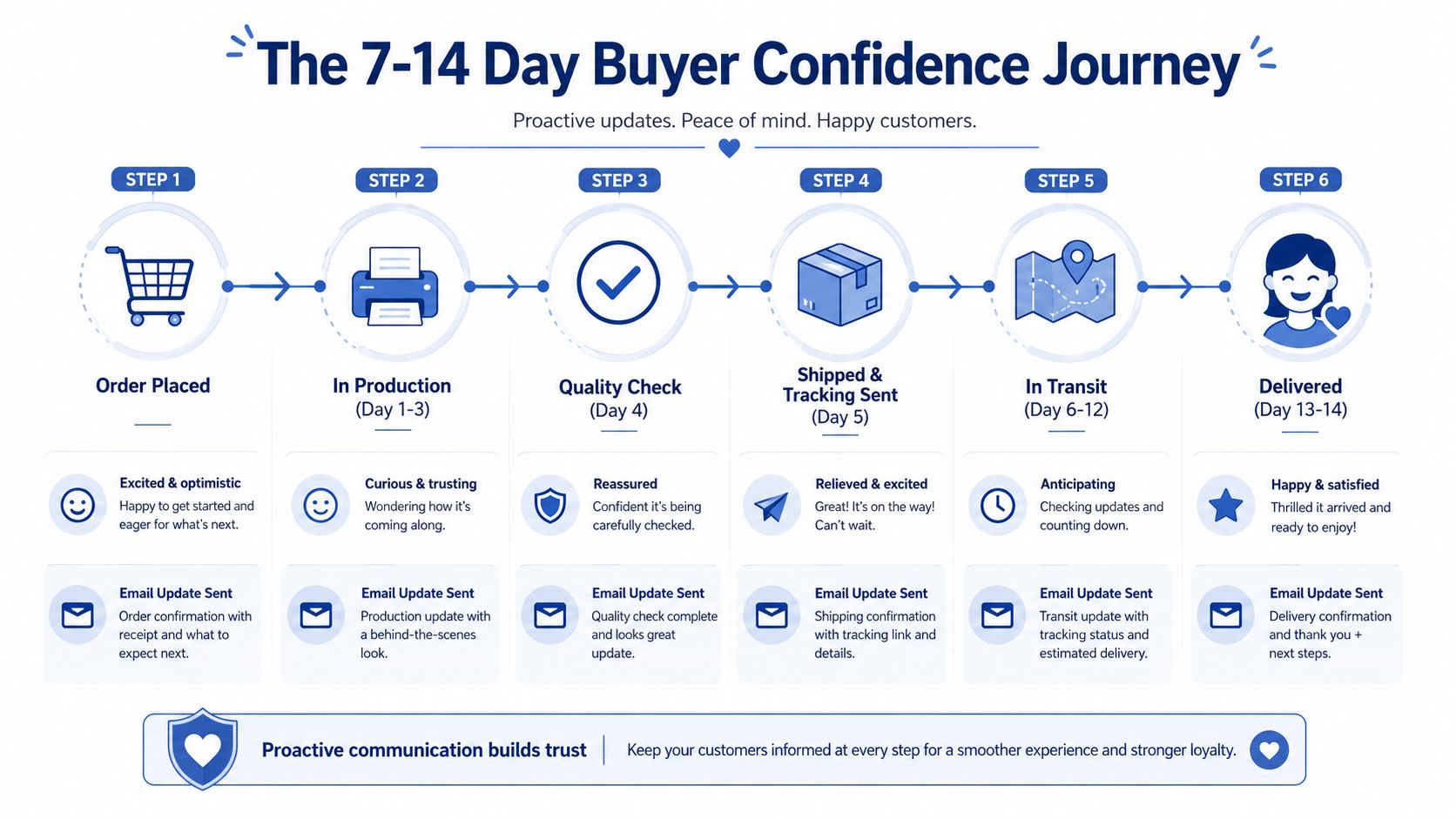
Send updates when the order reaches a meaningful milestone. A birthday mug needs confirmation that production has started. A first-time POD buyer needs a clear reason the item is made after payment. A holiday shopper needs shipping progress and a realistic view of the remaining journey.
Use milestone emails instead of vague reassurance
Write each message around the event that just occurred.
Production started
Your design is being printed right now. We've moved your {{product_name}} into production, and we'll send another update after it passes our quality check.
Quality check complete
Your {{product_name}} has passed its quality check and is being prepared for shipment. The next email will include tracking once the package leaves our facility.
Shipped
Your order is on the way. Track the package here: {{tracking_link}}. The carrier's latest delivery estimate is {{delivery_estimate}}.
Out for delivery
Your order is out for delivery today. Keep an eye out for {{product_name}}, and reply to this email if anything looks unusual after delivery.
Each message closes one uncertainty and names the next event. For the birthday mug, the production update confirms the gift is being made. For a first-time buyer, the quality-check email explains why shipment does not happen immediately. For a holiday order, tracking gives the customer a practical reference point.
A status email should answer three questions: what happened, what happens next, and where can the buyer get help?
Keep the copy short while retaining useful context. An order status page can explain the process in greater detail, but the email should answer the immediate question. Your POD production timeline must use the same wording as these messages, or customers may receive conflicting explanations.
Transparency does not require exposing every internal detail. It requires enough progress information for the buyer to understand what is happening, plus a clear way to request help. By delivery, the customer should be ready to enjoy the product rather than question where it went. That confidence protects the sale and gives the post-delivery flow a stronger starting point.
Turning First Orders Into Repeat Purchases
Delivery is not the end of onboarding new customers. It's the moment when your store can connect the product to the buyer's identity, invite useful feedback, and suggest a logical next purchase. Silence wastes that attention. A thoughtful sequence makes the first order feel like the beginning of a collection, routine, or community.
Start with a delivery confirmation that celebrates arrival without immediately demanding a review. Give the customer a simple way to get help if the item is damaged or incorrect, then follow with engagement once they've had time to use the product.
Ask for feedback when the product has been experienced
For apparel, request a review around day 7 after delivery. For mugs and accessories, request it around day 3, because those products can often be used sooner. The timing should follow the customer's opportunity to form a real opinion.
Subject formula: How's your {{product_name}} working for you, {{first_name}}?
Review email framework:
Your {{product_name}} should have arrived by now. If you've had a chance to wear or use it, we'd love to know what you think.
A quick review helps other shoppers choose confidently. If you took a photo, you can include that too.
CTA: Leave a review
Don't ask for praise. Ask for an honest experience. That creates better feedback and gives your team language for future product pages, ads, and customer support responses.
Recommend the next product by connection, not randomness
A cross-sell should make the original purchase more useful. A buyer who ordered one shirt may want another design in the same niche. Someone who bought a phone case may respond to a “complete the collection” message with a related case or matching accessory. A customer who bought a gift may appreciate complementary items for the same recipient.
Use the original product category, design theme, color preference, and likely use case to choose the recommendation. Place one primary recommendation in the email, then offer a secondary browse link. Too many products turn a relevant suggestion into a catalog dump.
The same logic applies to replenishment or subscription offers. If the product naturally supports repeat purchasing, introduce that option within 14 days of delivery. If it doesn't, don't force a subscription onto a one-time gift or novelty item. A useful guide on how to reduce churn can help you think through retention as a customer experience problem rather than a discount problem.
| Tactic | Trigger Timing | Avg. Conversion Rate | Best For |
|---|---|---|---|
| Delivery check-in | After confirmed delivery | Not provided | Every product category |
| Review request | Day 7 for apparel, day 3 for mugs and accessories | Not provided | Products customers can experience quickly |
| Category cross-sell | After the buyer has received the product | Not provided | Collections and complementary items |
| Replenishment or subscription offer | Within 14 days | Not provided | Naturally repeatable products |
| User-generated content request | After positive engagement | Not provided | Apparel and visual products |
The table keeps the operating order clear. Confirm the delivery, protect the experience, request feedback, then recommend something that makes sense. Repeat sales come from relevance and trust, not from sending a coupon before the first package has even arrived.
Automating Your Onboarding System
Automation should remove repetition, not remove judgment. Your system needs reliable triggers for order events, clear branches for product types and destinations, and a human fallback when the data looks wrong.
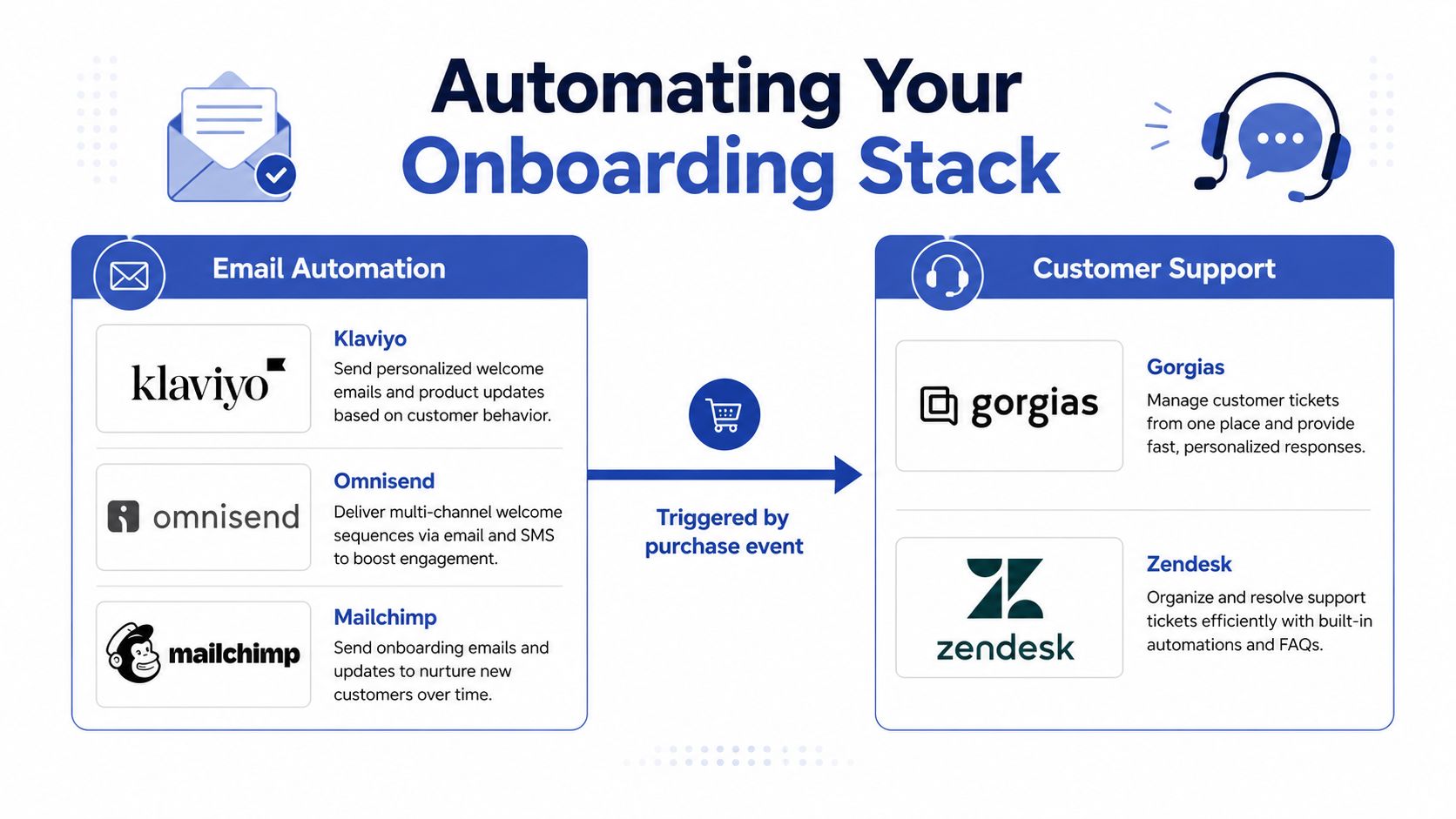
A practical stack can combine Klaviyo, Omnisend, or Mailchimp for email with Gorgias or Zendesk for support. Choose the system your team can maintain consistently. A complex setup that nobody audits will underperform a simpler flow with accurate status data.
Build the event logic first
Connect your store and POD provider so each order can pass through defined states. Then map the customer-facing message to the state, rather than manually scheduling every email.
- Order confirmation: Trigger when payment is confirmed. Include the product, variant, address summary, and expected production language.
- Production started: Trigger when the provider marks the item as entering production. If that event doesn't arrive, send an internal alert rather than claiming production has started.
- Shipped confirmation: Trigger when a carrier tracking number exists. Include the tracking link and the latest delivery estimate.
- Delivered follow-up: Trigger when the carrier marks delivery complete. Offer help first, then schedule the review request.
- Win-back sequence: Trigger when a buyer has no repeat purchase by day 30. Recommend a relevant product and give the customer a reason to return.
Use conditional branches for apparel, mugs, accessories, and other product groups. Shipping destination can also change the wording and expected delivery guidance. A buyer should never receive an apparel review request on the same schedule as a product that can be used immediately.
Add safeguards for exceptions
Production delays need a separate path. If an order remains in the same state beyond your expected window, send a helpful delay notice and create a support task. Lost packages should pause promotional messages until the issue is resolved. A delivered event followed by a complaint should suppress review and cross-sell emails until support closes the conversation.
Automation standard: Never let a system claim progress that your fulfillment data hasn't confirmed.
Solo operators can start with one email platform, basic order events, and a small support inbox. Growing brands need stronger tagging, event history, and ticket synchronization. Before choosing a larger stack, review eCommerce automation tools with one question in mind: can the system show the customer's current order state without manual investigation?
Test every branch with real order scenarios before activating the flow. Place a test order, verify each message, check the links, and confirm that support suppression works. A reliable automated system gives your team more time to improve products, creative, and acquisition while every buyer still receives a consistent experience.
KPIs and Your Implementation Checklist
The hidden revenue leak between checkout and delivery appears in the metrics. A buyer who receives accurate production and shipping updates is less likely to contact support in frustration and more likely to consider another purchase. Track results by customer cohort and product category, since apparel and accessories can produce different delivery questions, defects, and repeat-buying patterns.
Review these seven KPIs regularly:
- Repeat purchase rate: Measure the share of first-time buyers who purchase again at 30, 60, and 90 days. Compare customers who received the new flow with earlier cohorts.
- Email engagement: Review opens and clicks for each message. A confirmation email should reduce uncertainty, while a cross-sell email should create a relevant next-order opportunity.
- Support ticket volume: Count tickets per 100 orders, then separate delivery questions, product issues, and confirmed defects. This shows whether clearer updates reduce avoidable conversations.
- Review submission rate: Track requests sent, reviews received, and reviews that include customer photos.
- Time to second purchase: A shorter interval can indicate that the post-delivery recommendation matches the buyer's interests.
- Customer lifetime value at six months: Compare the commercial effect of better onboarding with acquisition activity.
- Net promoter score: Ask whether customers would recommend the brand, then examine written responses for production, delivery, and product clues.
Use the benchmark data as context, not as a direct POD target. OnboardMap's 2026 benchmark report says top-performing firms respond within 4 hours of signing, complete onboarding in 5 days or fewer, and report median first-90-day churn of 5.2%, compared with 14.8% for the middle group and 28.6% for the bottom group. POD fulfillment follows a different path, yet the operating lesson holds: accurate status updates and disciplined follow-up protect retention.
A practical rollout sequence
Sprint one: Build the immediate confirmation and production-started emails. Connect your email platform to order events and a support reply address. Compare every message with the fulfillment state it describes.
Sprint two: Add shipped, delivered, quality-check, and review flows. Use carrier data, product tags, and review collection. Pause promotional messages whenever an order issue is open.
Sprint three: Add category cross-sells and the day-30 win-back sequence. Segment by product type, design theme, and customer behavior. Review results weekly, then remove messages that confuse buyers or arrive before the order is ready.
One 2026 industry report found that 62% of customer success leaders lack real-time visibility into onboarding progress, while 57% said onboarding friction directly affects revenue. It also says 70% expect AI to handle half of onboarding tasks by 2027. Clean event data gives those systems reliable states to act on. The State of Onboarding report identifies the operational gap: teams cannot correct a customer journey they cannot see.
Start with the first message, verify its trigger, and add each milestone only after the previous one reflects real fulfillment data. For POD brands, transparency during production and shipping turns an anxious first order into a credible path toward repeat sales.
Skup helps POD entrepreneurs build systems around product creation, customer communication, and growth, including AvatarIQ for AI-powered designs and mockups and the Apparel Cloning program for launching POD apparel brands. Visit Skup to explore its tools and education.