How to Make Graphic Tees That Actually Sell
A common starting point for a graphic tee business is asking which printer to buy. That's backwards. The global custom T-shirt printing market is projected to grow from USD 5.1 billion in 2026 to USD 12.4 billion by 2036, with a 9.3% CAGR, according to PR Newswire's market forecast. The opportunity isn't merely learning how to put ink on cotton. It's learning how to turn a specific idea, for a specific audience, into a product people want to wear.
A printable design can still be commercially weak. A simple design can become a strong seller when it communicates identity, humor, belonging, or a point of view. The practical playbook below focuses on both sides of the business, creating artwork that stands apart and building a production and listing system that can support real sales.
Table of Contents
- The Graphic Tee Market Opportunity You Should Not Ignore
- Finding Your Niche and Creating Designs That Stand Out
- File Setup and Choosing the Right Print Method
- Creating Professional Mockups and Optimizing Your Listings
- Pricing Strategy and Quality Control That Protects Your Margins
- Legal Requirements and Copyright Protection for Graphic Tees
- Launching Your Graphic Tee Brand and Building Momentum
The Graphic Tee Market Opportunity You Should Not Ignore
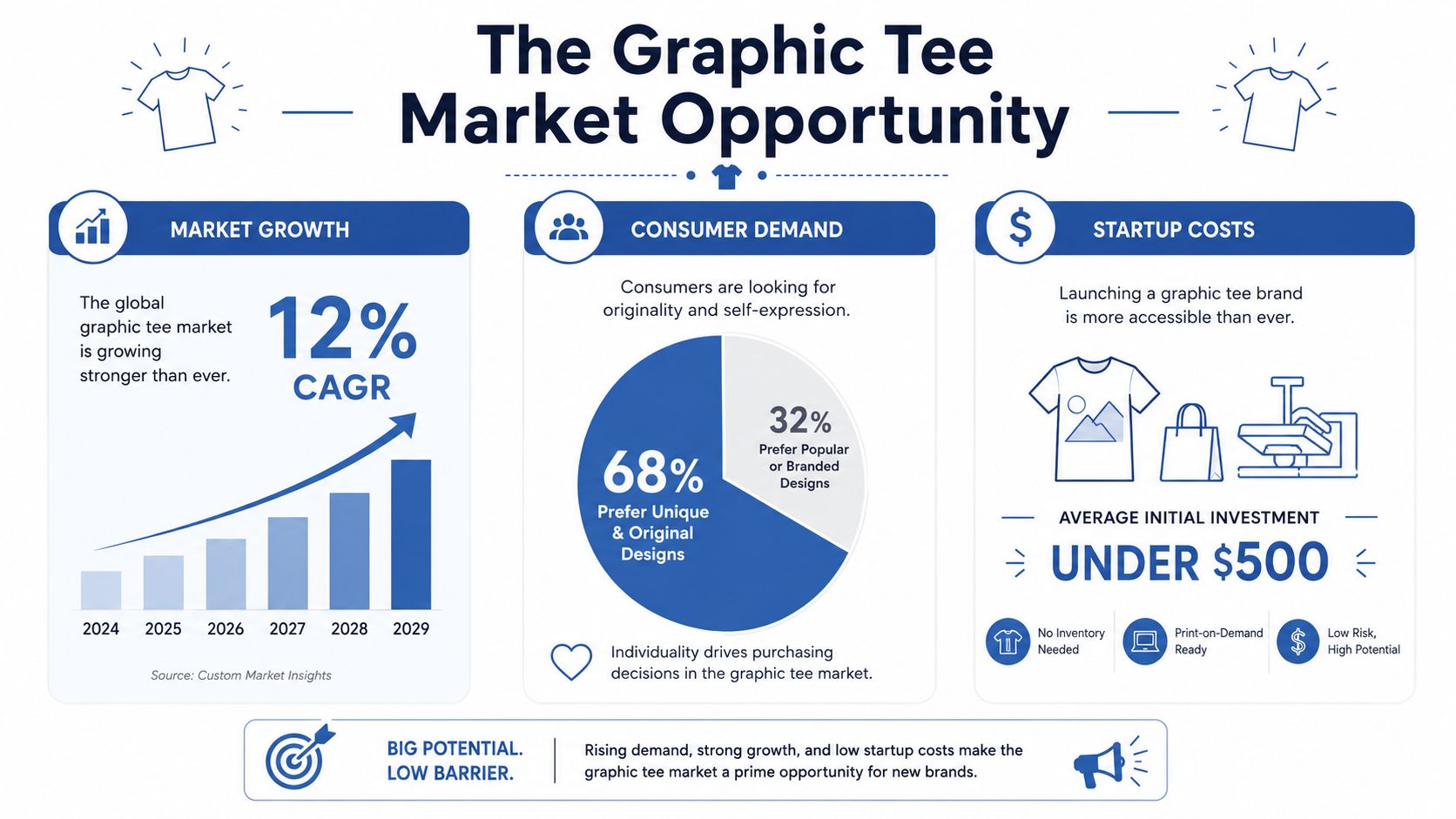
A growing market creates room for new brands, but commercial results still depend on design-led differentiation. As the market forecast above shows, the category is moving from USD 5.1 billion in 2026 to USD 12.4 billion by 2036, a gain of more than 143% over the decade. You are entering an established product market with demand across regions and sales channels, rather than a shrinking craft category.
That opportunity does not make every idea viable. Buyers already see endless shirts built around broad themes, generic slogans, and recycled visual styles. A technically clean print can still underperform if the design feels interchangeable. Strong graphic tees give a specific audience a reason to identify with the product, share it, or wear it repeatedly.
Build around identity instead of inventory
Start with a design-led brand. Choose a defined audience, then create a visual language that audience can recognize across a collection. Random uploads may produce an occasional sale, but a coherent point of view gives customers a clearer reason to trust the brand and consider another product.
Your niche can center on a profession, hobby, lifestyle, place, belief, or shared experience. A focused audience makes the commercial decisions easier: product copy becomes more relevant, imagery has a clear direction, and customer feedback tells you what to develop next. AI-powered tools such as AvatarIQ can help you test audience-facing concepts and refine how a design communicates before you spend on production or promotion.
The channel mix also supports small, focused brands. Companies History's custom T-shirt market overview reports that online channels account for 48% to 62.1% of custom T-shirt sales, while North America represents roughly 34% to 39.3% of global share and Asia Pacific represents about 39.4% to 40%. Online selling gives a new brand access to customers without a traditional storefront or a large inventory commitment.
Commercial rule: Start with a recognizable point of view, then choose the production method that protects that point of view.
Print on demand lets you test designs, products, and audiences without buying manufacturing equipment or turning the first launch into a warehouse project. Your real work is selecting ideas worth testing, presenting them professionally, and using customer response to improve the next release.
Finding Your Niche and Creating Designs That Stand Out
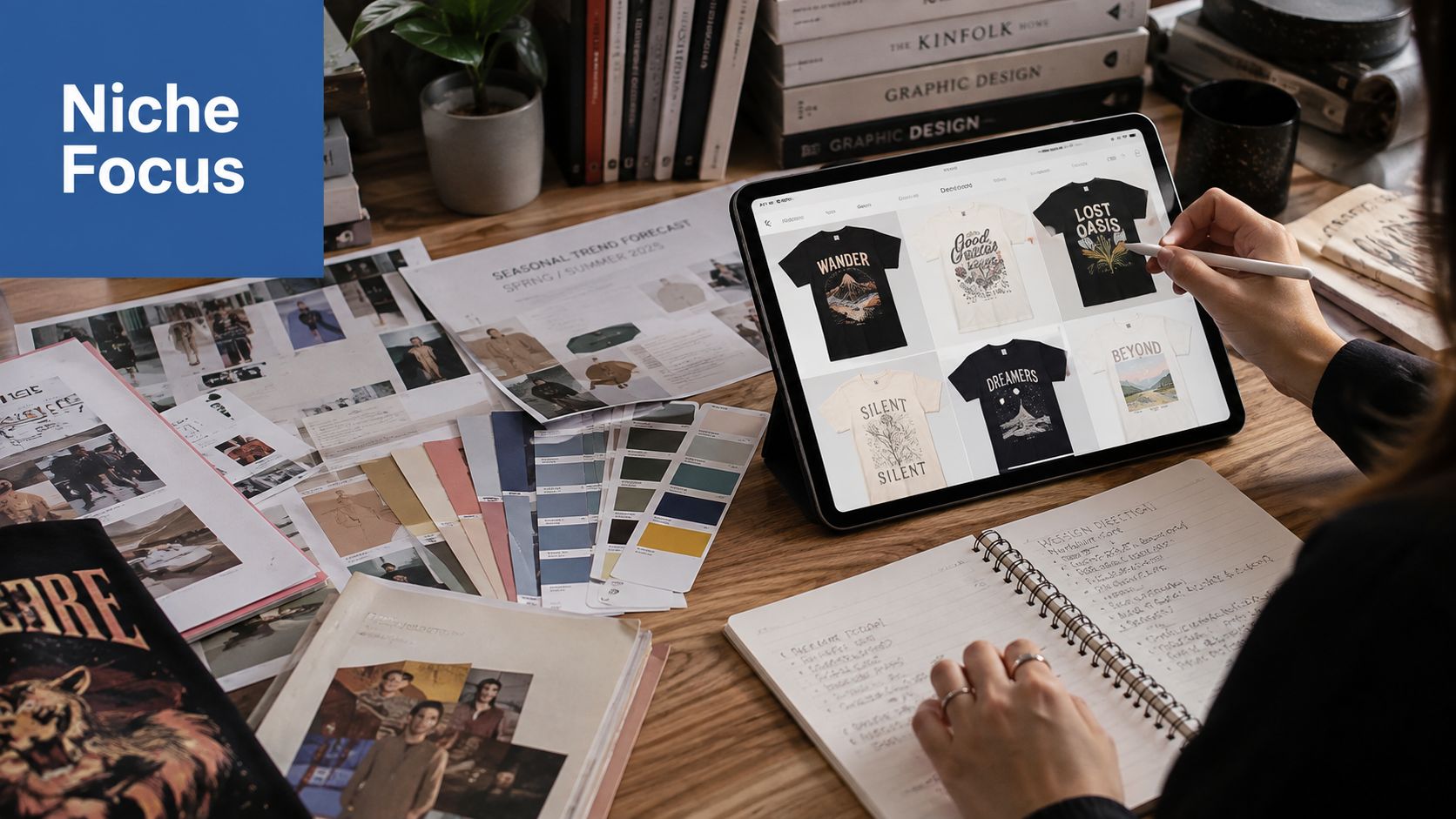
A profitable niche usually begins with a tension you can observe. People may love a hobby but dislike the existing merchandise. They may identify with a profession but find the available shirts bland. They may share an inside joke, local reference, or daily frustration that broad apparel brands don't understand.
Start by collecting phrases, visual references, products, and communities connected to the audience. Look at what already sells, but don't copy the surface treatment. The Apparel Cloning method is useful here because it separates proven product structure from original execution. You identify demand, then build a distinct design for an underserved angle rather than reproducing another seller's artwork.
For a deeper research workflow, use this guide to find niches for print on demand.
Turn a vague idea into a product concept
Suppose your starting thought is “a shirt for people who love trail running.” That's too broad. Refine it by combining the audience with a specific emotional or behavioral insight:
- Audience: Trail runners who train before work.
- Tension: They're proud of doing difficult things while everyone else is asleep.
- Visual direction: A dark mountain silhouette, a small headlamp beam, and compact type.
- Product promise: The shirt signals discipline without looking like generic race merchandise.
AvatarIQ can help you move from that brief to visual directions quickly. Use it to explore compositions, illustration treatments, typography-led concepts, and apparel-ready artwork, then reject anything that feels generic or too close to existing market language. The tool should accelerate decisions, not replace them.
A second example could begin with “a shirt for rescue-dog adopters.” Instead of stopping at a dog illustration, build a point of view around the audience's identity. A hand-drawn shelter tag, a playful adoption phrase, or a visual that combines a dog silhouette with a meaningful local reference can create a stronger connection than a stock-style pet portrait.
Use a differentiation check before production
Before you approve a design, ask:
- Would the intended buyer recognize themselves in it?
- Can the idea be understood quickly when the shirt is worn?
- Does the artwork have one memorable visual feature?
- Can you describe why it belongs to this niche in one sentence?
- Does it look sufficiently original from both a creative and legal perspective?
Graphic-designed shirts represented 45.35% of the custom T-shirt printing market in 2025 in one independent market report, while another reported a 36.7% share for graphic design, as summarized in the available market reference from Glamour. The difference between those estimates isn't the important takeaway. It's that graphic tees are already a broad, crowded category, so a technically clean design still needs a clear reason to exist.
File Setup and Choosing the Right Print Method
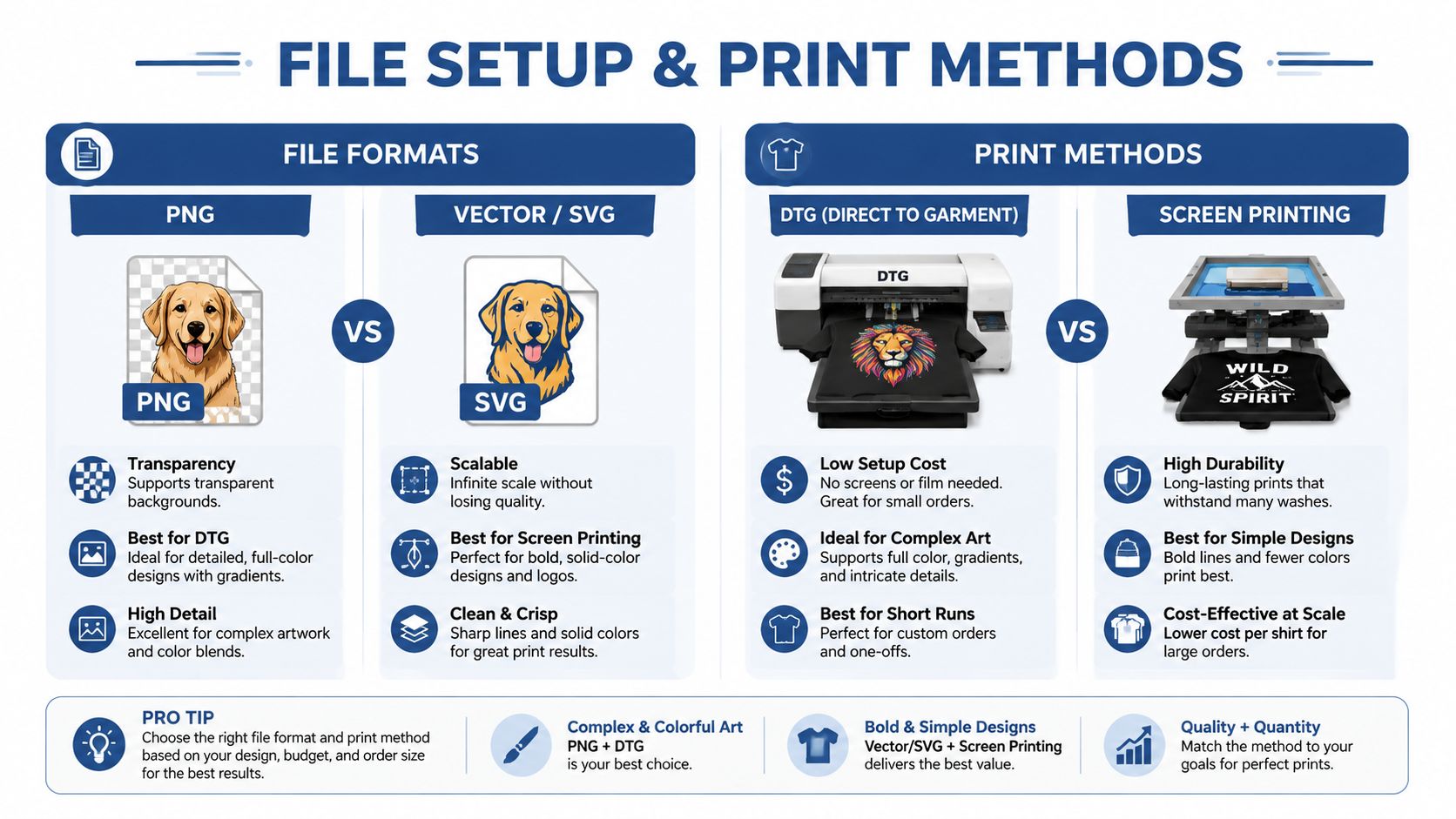
A market-ready graphic tee starts with production-aware artwork, not a file exported at the last minute. Build the master file at the largest practical size, keep the background transparent when needed, and inspect the design at its actual print dimensions. Small text, thin outlines, dense details, and weak contrast may look fine on a monitor yet disappear or blur on fabric.
For raster artwork, use a high-resolution transparent PNG for digital garment printing. Vector artwork, including SVG files, scales cleanly and keeps color shapes separated, which suits screen printing. Store editable source files separately, then export a production file only after checking transparency, edges, spelling, and placement. For a deeper comparison of methods, see this guide to different types of T-shirt printing.
Match the method to the order pattern
Screen printing remains a major established method, while DTG and DTF continue gaining adoption. The practical decision depends on order volume, artwork detail, garment type, fulfillment model, and the setup cost you can absorb.
| Print Method | Best For | Break-Even Volume | Setup Complexity |
|---|---|---|---|
| DTG | Detailed, multicolor artwork and individual orders | Roughly 80 to 120 units compared with screen printing | Low to moderate |
| DTF | Detailed designs across varied garments and flexible production | Depends on supplier and order structure | Moderate |
| Screen printing | Batches with simpler artwork and repeatable colors | Roughly 80 to 120 units compared with DTG | High |
| Heat transfer | Small runs, personalization, and controlled in-house production | Depends on equipment and transfer costs | Moderate |
DTG usually fits design-led testing because you can offer detailed, multicolor artwork without committing to a large batch. Screen printing becomes more attractive for repeatable designs and larger runs, but it requires color separation, separate mesh screens, sequential printing, and curing. The workflow described by Portugal Clothing Factory uses a flash dryer at 160 to 170°C for plastisol or water-based ink. Above 300 units, screen printing can become 2 to 3 times cheaper, yet its setup makes untested, low-volume concepts harder to justify.
Heat transfers require fabric-specific calibration. For smooth HTV on polyester, one reference recommends 305°F for 10 to 15 seconds with medium pressure after a 2 to 3 second pre-press. Plastisol transfers may require 325°F to 365°F for 4 to 6 seconds, depending on the fabric, as outlined by The Laughing Giraffe. Use stretchable vinyl on stretch garments. Sublimated polyester may also need a sub-block film to limit dye migration. Perform a post-press inspection every time, and repress a lifting edge for 2 to 3 seconds.
Creating Professional Mockups and Optimizing Your Listings
Customers don't experience your design as an isolated file. They see a product image, a model, a garment color, a pose, and a page that either gives them confidence or creates doubt. A strong mockup shows scale, placement, texture, and how the shirt fits into a real outfit.
AvatarIQ helps create apparel mockups and photoshoot-style product imagery without arranging a physical shoot for every concept. Generate several contexts that fit the niche, then keep the set consistent. A streetwear design might need an urban setting and relaxed styling, while a minimalist hobby shirt may work better with a clean everyday outfit.
Build a listing that answers buying questions
Use the product title to combine the audience, design concept, and product type naturally. Avoid stuffing every possible keyword into one line. A buyer should understand who the shirt is for and what makes the design relevant without decoding a search-oriented phrase.
Your description should connect the graphic to the customer's identity before listing specifications. Explain the idea, describe the garment clearly, and state what the buyer can expect regarding fit, fabric, care, and fulfillment. Keep claims accurate and consistent with the actual product.
Common listing problems include:
- Flat presentation: A flat lay can help show the full artwork, but it shouldn't be your only visual.
- Unclear scale: Include a worn view so buyers can judge the graphic's apparent size.
- Feature-heavy copy: Fabric details matter, but they shouldn't bury the reason the customer wants the shirt.
- Inconsistent colors: Show the same garment color and print appearance across your main images.
- Unverified promises: Don't claim exceptional softness, durability, or fit unless you've checked the actual product.
Use this free T-shirt mockup resource to supplement your product-image workflow, then review every mockup as a customer would. If the design looks too small, too low, distorted, or poorly contrasted, fix the listing before spending money to drive traffic.
Pricing Strategy and Quality Control That Protects Your Margins
Revenue isn't profit. A shirt can sell regularly while losing money if you price from competitor screenshots instead of your own cost structure. Calculate the complete cost per order before setting the retail price, including the blank, printing, shipping, platform fees, transaction fees, refunds, samples, and customer acquisition.
The target should support a sustainable operation. Skup's operating guidance centers on 30% to 50% profit margins, but that range only makes sense after you include the costs that beginners tend to omit. If you don't account for advertising, replacement orders, and failed samples, your reported margin is only a guess.
Price from the inside out
Write down the cost of delivering one successful order. Then decide how much room the business needs for testing, support, and future product development. A lower introductory price may attract attention, but it can also leave you unable to fund traffic or absorb a quality issue.
Premium pricing works when the customer can see the reason for it. That reason might be a distinctive concept, a better garment, stronger photography, a limited collection, or a clear connection to a community. Don't charge more just because you want a larger margin. Give the buyer evidence through presentation and product quality.
Margin discipline: Never confuse a popular price with a viable price.
Create quality checkpoints before launch
Order a sample of every new garment and print combination. Check the neckline, fabric weight, sizing, print placement, color appearance, edge quality, and wash performance according to the supplier's care guidance. Compare the physical product with the mockup, because a digital preview can hide scale and color problems.
Use a short approval checklist:
- Artwork: Confirm spelling, transparency, edges, and intended dimensions.
- Placement: Check horizontal alignment and distance from the collar.
- Color: Compare the printed result with the approved design, allowing for fabric differences.
- Garment: Verify size labeling, material, seams, and overall feel.
- Packaging: Make sure the finished order arrives clean and presentable.
A sample costs less than repeated replacements and damaged customer trust. Quality control also protects your ability to test new ideas confidently, because every launch follows a repeatable standard instead of guesswork.
Legal Requirements and Copyright Protection for Graphic Tees
Legal compliance belongs in the production checklist, not in the emergency response plan. For most U.S. textile apparel, the Federal Trade Commission labeling guidance requires labels showing fiber content, country of origin, and the identity of the manufacturer or another responsible business. Care labels fall under a separate FTC rule, so confirm that your garment and supplier meet the applicable requirements.
Country-of-origin placement also matters. For necked garments such as shirts, the U.S. Customs rule in 16 CFR 303.15 requires the mark inside the center of the neck, midway between the shoulder seams or near another label in that area, with the disclosure visible on the front side of the label.
Imported apparel must carry a legible English country-of-origin marking unless an exception applies. U.S. Customs and Border Protection explains that the mark must be permanent and conspicuous to the ultimate purchaser.
Protect the artwork before publishing
Create original artwork or obtain the rights needed for commercial use. Original graphics, illustrations, and logos can receive copyright protection, while another party's brand elements can create trademark risk. The practical distinctions are summarized in this guide to copyright and intellectual property in T-shirt printing.
Avoid using sports team imagery, entertainment characters, brand logos, celebrity likenesses, or copied slogans without permission. Changing a few colors or rearranging someone else's design doesn't automatically make it yours. Keep records of your original prompts, drafts, commissioned agreements, licenses, and final files.
Before publishing: If a design depends on recognition of someone else's brand, character, team, or artwork, stop and verify your rights first.
When your own designs gain traction, protect your brand assets with the same care. Use consistent naming, preserve dated source files, and monitor unauthorized copies. For legal questions specific to your business, consult a qualified attorney rather than relying on a generic checklist.
Launching Your Graphic Tee Brand and Building Momentum
A first collection doesn't need to contain every idea you've ever had. Choose a focused group of designs that share an audience and visual direction, create the product pages, order samples, and prepare content that shows the shirts in use. Your launch should give people a reason to understand the collection as a brand rather than a random assortment of uploads.
Build anticipation with previews, close-up artwork shots, garment polls, and short explanations of the idea behind each design. On launch day, make the buying path obvious. Use your strongest mockup first, make sizing and fulfillment information easy to find, and invite early customers to share photos and honest reviews after delivery.
Let real feedback guide the next release
Early sales data can reveal which audience, color, phrase, or visual treatment deserves another iteration. A design that gets attention but few purchases may need a better price, garment, mockup, or product explanation. A design with strong conversion but limited reach may need more focused promotion.
Avoid changing everything at once. Keep a record of the design concept, product, listing, traffic source, and customer response. Then adjust one meaningful variable at a time so you can understand what helped.
Print on demand makes this process accessible because you can test products without committing to traditional manufacturing runs. If you want another practical resource for expanding beyond shirts and planning custom products, explore FLYP LTD's guide on how to make custom merch.
Once a design proves it can attract the right buyers, expand carefully into related niches, additional garment colors, or coordinated products. Build an email list from customers and interested visitors, encourage reviews after delivery, and test paid advertising only after the listing and product experience are ready. The goal isn't to chase every trend. It's to build a repeatable system that turns useful customer feedback into better products.
You now have a clear path for how to make graphic tees that are more than technically printable. Choose a niche, develop a distinct concept with AvatarIQ, validate the physical product, publish strong mockups, and launch before perfectionism turns into delay.
Skup gives you practical print-on-demand education, the Apparel Cloning System, and AvatarIQ for creating apparel designs and mockups faster. Visit Skup to explore the tools and training that can help you turn your first graphic tee ideas into a focused eCommerce brand.