10 Pricing Strategy Types for POD Apparel
Can a strong POD design still fail because the price tells the wrong story? Absolutely. A product can underperform when its price ignores production costs, buyer expectations, brand positioning, or the chance to increase order value. Pricing isn't a finishing touch added after a design goes live. It shapes how shoppers judge quality, whether your margin survives fees and shipping, and how confidently you can promote the product.
Print on demand gives you a useful advantage. You can test different prices without committing to a warehouse full of inventory, so pricing becomes a skill you can improve through structured experiments rather than a one-time guess. Start with a reliable floor, study the market, identify what makes your apparel valuable, then adjust based on customer behavior.
This guide breaks down 10 pricing strategy types and translates each one into a practical POD apparel decision. You'll get the calculation method, an apparel scenario, a margin safeguard, and a clear signal for when to use or avoid it. You can also compare these ideas with broader pricing model examples before building a system that fits your store.
Table of Contents
- 1. Cost-Plus Pricing
- 2. Value-Based Pricing
- 3. Competitive Pricing
- 4. Psychological Pricing
- 5. Dynamic Pricing
- 6. Penetration Pricing
- 7. Skimming Pricing
- 8. Bundle Pricing
- 9. Geographic Pricing
- 10. Loss Leader Pricing
- Comparison of 10 Pricing Strategies
- Build Your POD Pricing System With Confidence
1. Cost-Plus Pricing
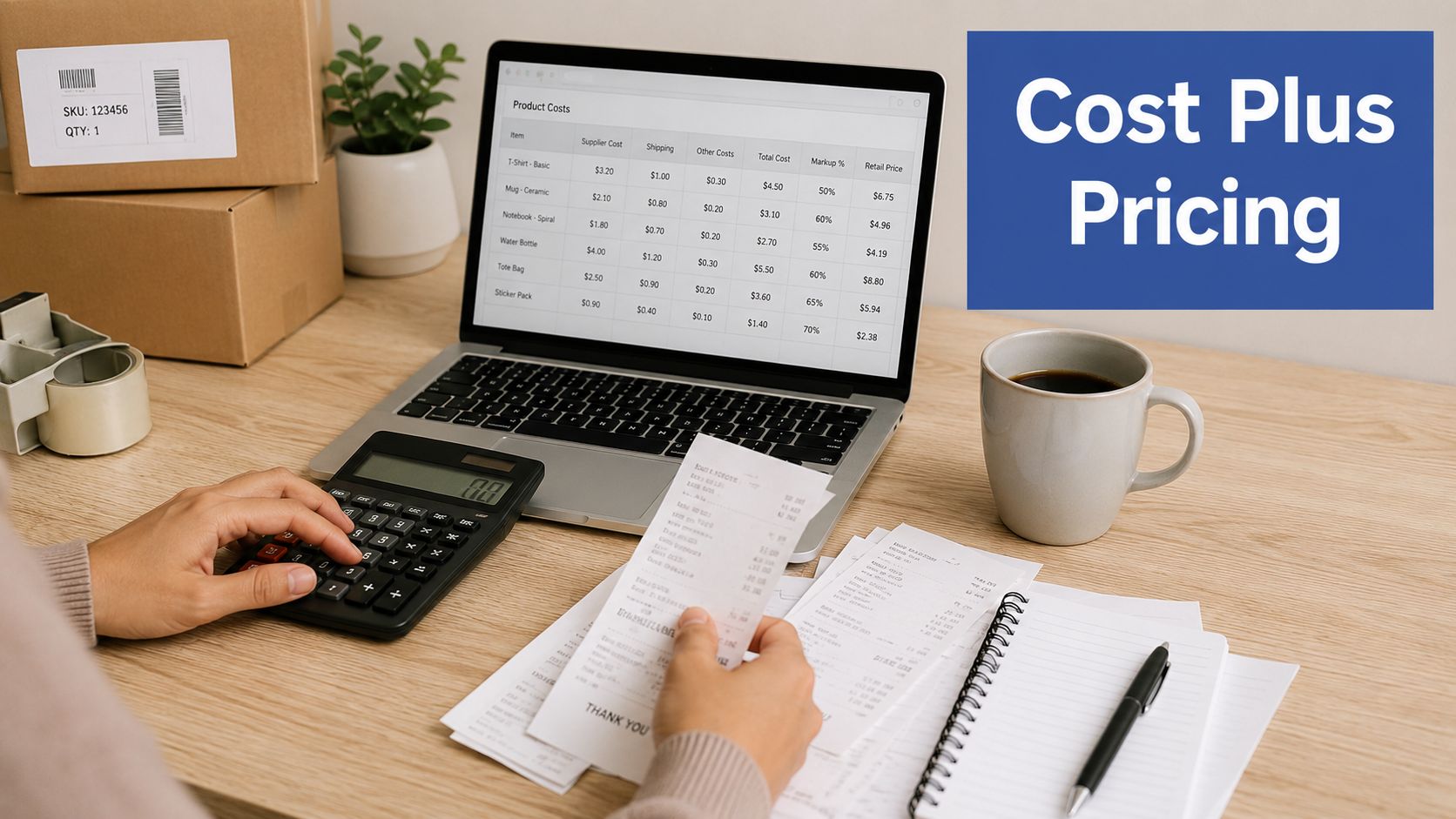
Cost-plus pricing gives you the cleanest starting point. Add every cost connected to a sale, then apply a markup that leaves room for profit. For a POD shirt, that usually means accounting for the blank garment, printing, fulfillment, shipping, payment processing, marketplace charges, and any other per-order expense.
The basic calculation is:
Selling price = total product cost + chosen markup
A seller might price a hoodie at $35 to $40 when the blank and fulfillment cost falls between $12 and $15, or price a T-shirt at $18 to $25 when production costs range from $6 to $8. Those examples aren't universal targets, but they show how a cost-based floor keeps pricing connected to the economics of the product.
Your first job is to calculate actual contribution margin, not just the difference between retail price and garment cost. A useful eCommerce profit calculator can help organize the inputs before you publish listings.
Where cost-plus works
Cost-plus is useful when you're new, your customer data is limited, or your supplier costs are predictable. It removes guesswork and gives every product a consistent starting point. You can test a markup range from 80% to 150%, then compare the result with what shoppers already see in the niche.
Practical rule: Treat cost-plus as your minimum viable price, not proof that the market will accept the price.
Review your inputs whenever supplier rates, shipping charges, or platform fees change. A price that worked last season can become unprofitable when fulfillment costs move.
When to use or avoid it
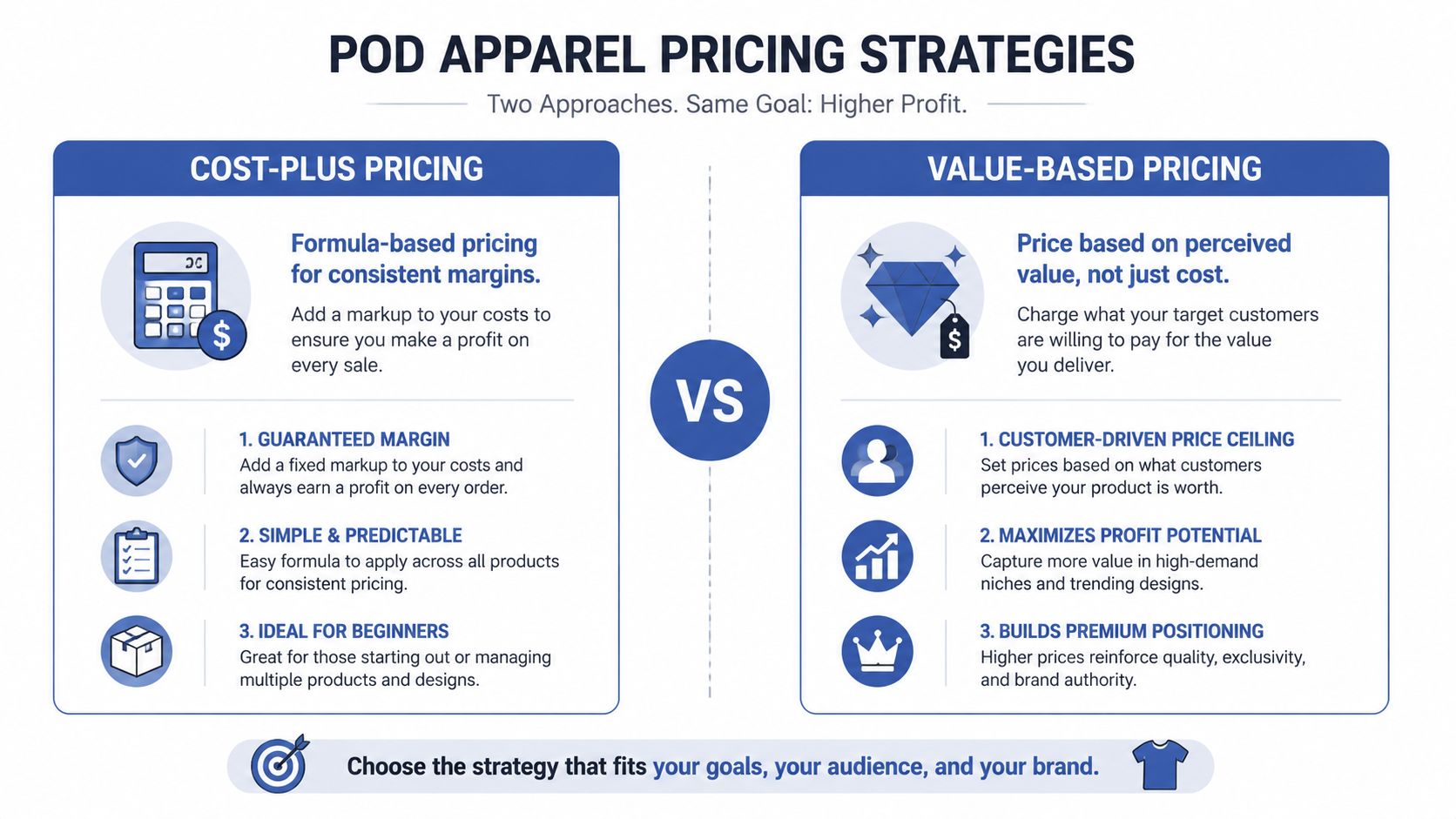
Use this strategy for early listings, standardized products, and baseline planning. Avoid relying on it alone when your design serves a passionate niche or carries strong brand value. Cost-plus can protect margin, but it can also leave money on the table if customers value the product well above its production cost.
2. Value-Based Pricing
Value-based pricing starts with the buyer, not the blank garment. You set the price according to what customers believe the design, identity, usefulness, exclusivity, or emotional connection is worth. The production cost still matters because it protects your margin, but it doesn't define the entire price.
The calculation is less mechanical:
Selling price = perceived customer value, tested against your cost floor
A meditation enthusiast may value a hoodie created specifically for their practice more highly than a generic graphic sweatshirt. A dog owner who finally finds an accurate design for a less common breed may care less about a small price difference than about recognition and identity. The same blank apparel can support different prices when the audience and meaning change.
Research from BDC on common pricing strategies identifies value-based pricing as the most customer-centric major approach because it centers perceived value rather than production cost. It works best when your product has clear differentiation, strong positioning, or scarcity.
Build the value hypothesis
Start by studying the niche's problem intensity, alternative products, audience language, and willingness to pay. Look for signals in reviews, comments, search behavior, and direct customer conversations. Your Apparel Cloning process can help you identify proven demand patterns, then create a distinct design for an audience that already understands the category.
Use this guide to pricing your product to compare your cost floor with the price your positioning may support.
Professional presentation also matters. AvatarIQ can help you create apparel designs and mockups that make the product easier to evaluate, especially when premium presentation is part of the value proposition.
When to use or avoid it
Use value-based pricing for passionate niches, identity-driven apparel, differentiated collections, and products with a clear emotional or practical benefit. Avoid guessing blindly. If shoppers don't understand why your design deserves more, a higher price will look arbitrary rather than premium.
3. Competitive Pricing
Competitive pricing uses the market as a reference point. You examine comparable apparel, then decide whether your product should sit below, near, or above the prevailing range. The strategy works because shoppers often compare similar shirts, hoodies, and sweatshirts before buying.
Suppose comparable niche T-shirts sell at $22.99. Matching that price may make sense for a similar offer. Pricing $2 to $3 lower can create an entry point in a crowded niche, while a range around $27 to $30 may fit a visibly stronger design, better presentation, or more distinctive brand position.
The important distinction is that competitor pricing is a reference, not a business model. Other sellers may have different supplier rates, shipping arrangements, advertising costs, fees, or customer acquisition economics. Copying their price without checking your own numbers can turn a competitive listing into a loss.
Create a useful comparison set
Choose direct competitors rather than large brands with unrelated positioning. Check multiple marketplaces and storefronts, including Amazon Merch, Printful, Teespring, and other relevant channels. Record product type, garment quality, design style, shipping offer, reviews, and price so you're comparing the full offer rather than one number.
A competitor price monitoring guide can help you build a repeatable process instead of checking rivals only when sales slow down.
When to use or avoid it
Use competitive pricing when entering an established niche, validating a new product, or trying to understand shopper expectations. Avoid making it your only strategy. A race to the bottom weakens your margin and makes your store harder to distinguish.
4. Psychological Pricing
Psychological pricing changes how shoppers interpret a price without changing the underlying product. Charm pricing, such as $17.99 instead of $18, can make a listing feel more accessible. Other tactics include bundles, tiers, and a legitimate reference price that helps customers understand the offer.
A POD apparel store might present three options:
- Core design: $19.99 for a straightforward T-shirt.
- Premium design: $24.99 for upgraded artwork or a more specialized niche.
- Collector edition: $29.99 for a limited or highly distinctive variation.
The middle option can become more attractive when customers see a higher-priced alternative beside it. That doesn't mean the top option should exist as a fake decoy. Every tier needs a real difference in design, garment, edition, or included value.
Use price framing honestly
A hoodie bundle priced at $55 can feel more compelling than buying two hoodies separately at $28 each, provided the bundle offers a saving and still protects contribution margin. A “Was $34.99, now $26.99” message should represent a real price reduction, not an invented reference price.
“A psychological tactic can improve presentation, but it can't rescue a price that shoppers already consider unreasonable.”
Test .99 endings against round numbers in the same niche. Watch conversion, refunds, customer questions, and average order value rather than assuming a familiar pricing pattern will work everywhere.
When to use or avoid it
Use psychological pricing after you've established a sensible price range. It's useful for seasonal campaigns, tiered collections, and checkout bundles. Avoid excessive urgency or misleading markdowns because short-term clicks aren't worth weakening customer trust.

5. Dynamic Pricing
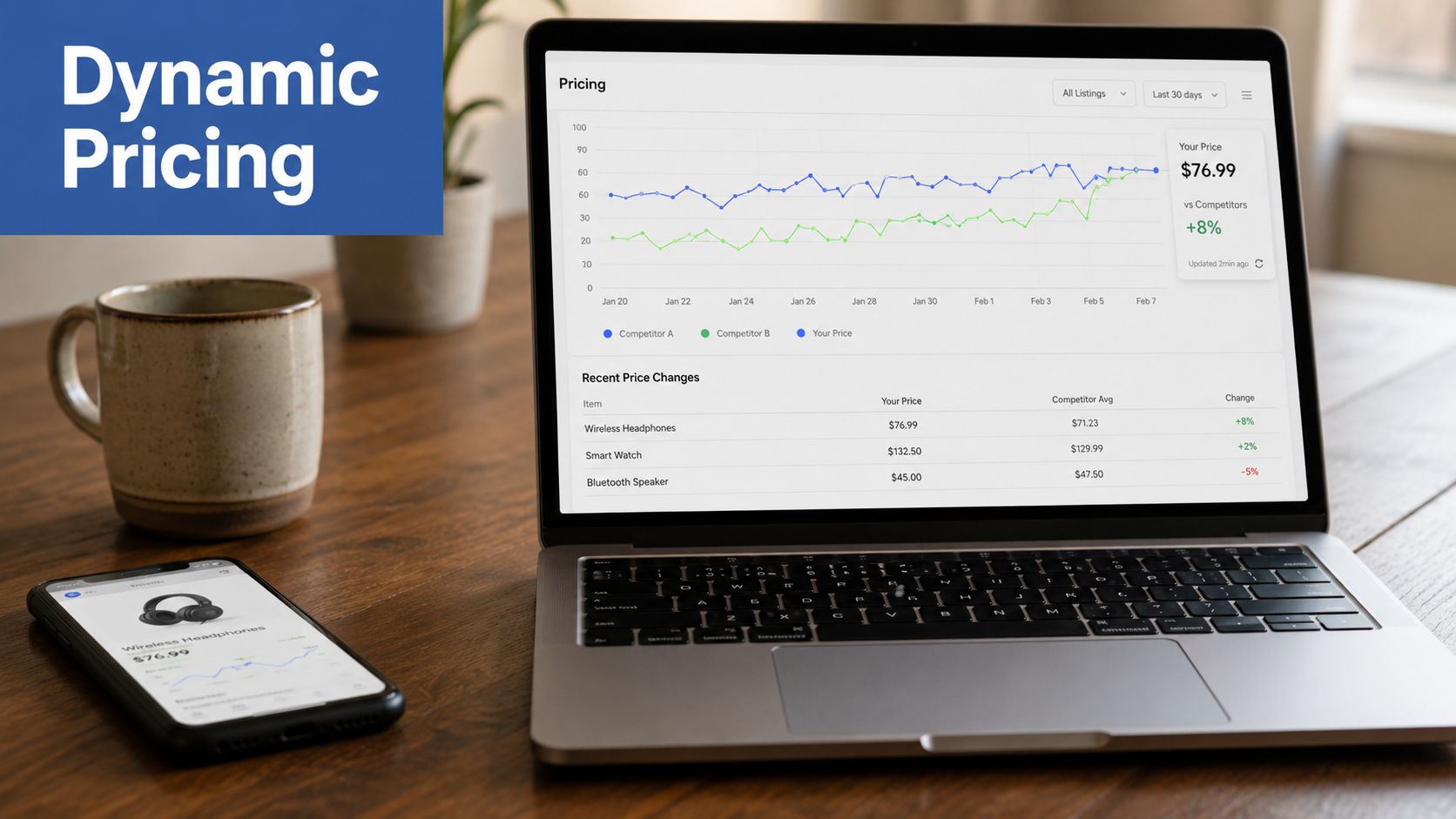
Dynamic pricing changes prices as demand, timing, customer behavior, competition, or market conditions change. The fixed-price assumption disappears. A seasonal teacher design may deserve different pricing during back-to-school demand than during a quiet period, while a trend-led product can support a different price while attention remains high.
The calculation is operational:
Current price = base price adjusted for verified demand and market conditions
A seller might raise a Father's Day design from $22 to $26 during the relevant demand window, or move a teacher design from $24 toward $28 during its seasonal peak. Those are scenario examples, not guaranteed market prices. The decision should come from your own conversion, demand, and margin data.
Dynamic pricing has become a significant commercial infrastructure strategy. A 2025 dynamic pricing market report estimated the global dynamic pricing and yield management market at USD 5.5 billion in 2025, with a projection of USD 10.8 billion by 2034 and a 7.6% CAGR. The same source described expansion across e-commerce, travel, and retail.
Keep the system transparent
POD stores usually don't need constant automated price movements. Start with manual seasonal adjustments, scheduled promotions, or carefully planned changes around demand signals. Monitor search trends, social conversations, sales velocity, and conversion before changing price.
Regulation and customer trust matter. The UK Competition and Markets Authority's dynamic pricing project update says businesses should show the total price, avoid drip pricing and partitioned pricing, and explain when prices can change. The guidance also identifies transparency as a consumer-protection concern.
When to use or avoid it
Use dynamic pricing for seasonal collections, fast-moving trends, and products with clear demand cycles. Avoid rapid, unexplained changes that make shoppers feel targeted or misled. Gradual adjustments and clear communication give you flexibility without sacrificing trust.
6. Penetration Pricing
Penetration pricing starts low to help a new product gain attention in a competitive niche. A POD seller may launch a teacher design at $16.99 when comparable products sell near $22.99, then raise the price after collecting sales feedback, reviews, and evidence that the listing converts.
This is a launch strategy, not a permanent identity. Before publishing, define the conditions that will trigger a price increase. Those conditions might include a set review milestone, consistent sales velocity, improved listing presentation, or a completed introductory period. The exact trigger should come from your business plan rather than a random date.
Protect the launch economics
A low introductory price still needs to cover the costs you can't avoid. Calculate your minimum acceptable contribution before launch, then decide how much acquisition flexibility you're willing to trade for early traction. If the introductory price leaves no room for fulfillment issues, refunds, or advertising, you may be buying activity instead of building a business.
Communicate the offer clearly. Customers who understand that they're receiving an introductory price are less likely to feel surprised when the product later moves into its standard range. Keep the product quality and customer service strong from the first order because early buyers create the foundation for future trust.
When to use or avoid it
Use penetration pricing when entering a crowded niche, introducing a new store, or validating a product that needs initial customer response. Avoid it when your brand is already positioned as premium or when low pricing would attract buyers who don't match your intended audience.
The main risk is dependence on bargain hunters. If customers only buy while the price is low, raising it can slow demand. Build value and collect useful feedback during the introductory period so the next price reflects a stronger offer, not just a higher number.
7. Skimming Pricing
Skimming pricing takes the opposite launch position. You introduce an apparel product at a high price for buyers who care about exclusivity, novelty, creator identity, or a distinctive design, then consider lower prices later for more price-sensitive customers.
A limited-edition artist hoodie at $49.99, a rare hobby design at $32 to $38, or a creator-led collection at $35 to $40 can fit this model when the presentation supports the positioning. The product needs a reason to feel scarce or unusually desirable. A generic graphic printed on a standard blank won't become premium just because the price increases.
Make the premium visible
Skimming demands stronger merchandising. Use polished mockups, clear product photography, compelling product copy, and a design concept that customers can explain to themselves and others. AvatarIQ is relevant here because it can support professional apparel mockups and photoshoot-style presentation without requiring a separate photographer or model workflow.
Plan the price path before launch. Early buyers shouldn't feel punished when you later broaden access, so communicate whether the first release is limited, numbered, exclusive, or an early version. If the price drops without a clear reason, customers may question the original value.
Premium pricing needs premium evidence. The design, story, presentation, and buying experience must all support the price.
When to use or avoid it
Use skimming for creator brands, limited collections, strong personal brands, and underserved premium niches. Avoid it when you haven't established differentiation or when shoppers can find nearly identical products everywhere. High pricing magnifies weak positioning, so validate the audience before investing heavily in the launch.
8. Bundle Pricing
Bundle pricing combines related products into one offer. The shopper receives a reason to buy more in a single order, while you increase order value and connect products that make sense together. A teacher collection could combine two themed T-shirts and a hoodie, while a hobby collection could pair a shirt, sweatshirt, and hat around one identity.
The calculation is:
Bundle price = combined item value minus a controlled discount
A teacher bundle priced at $55 instead of $65 individually can feel useful and economical, but only if the discount leaves enough contribution after fulfillment and shipping. A three-design collection at $65 or a seasonal apparel bundle at $69.99 can work when every item appeals to the same buyer.
Bundle around customer logic
Don't combine slow sellers randomly. Pair designs that a single customer might wear on different days, give as gifts, or use across seasons. Review purchase behavior to identify products that already appear in the same order, then turn that relationship into an intentional offer.
Good, better, and best bundles can serve different budgets. The entry bundle reduces commitment, the middle bundle provides the strongest perceived value, and the premium bundle adds more products or exclusivity. Each option should remain understandable at a glance.
Protect the margin
Keep the discount controlled. A practical starting range is 8% to 15% off, as outlined in the supplied POD planning guidance, but calculate the actual result for your products before publishing. Test the bundle on product pages and at checkout, then compare conversion, average order value, fulfillment complexity, and customer support issues.
Use bundle pricing when products naturally belong together. Avoid it when the offer creates choice overload or forces customers to buy items they don't want.
9. Geographic Pricing
Geographic pricing adjusts prices by market. Shipping costs, taxes, local competition, currency, purchasing power, and demand can make one universal price unsuitable for every country. A US T-shirt at $19.99 may need a different local-currency price in the UK or Europe once fulfillment and customer expectations are considered.
The calculation is market-specific:
Regional price = product economics + local fulfillment costs + market positioning
For example, a seller might set a US price of $19.99, a UK price of £17.99, and a European price of €21.99 after reviewing shipping, taxes, and competition. An Australian price may need to account for longer delivery routes or different fulfillment economics. These are planning scenarios, not universal recommendations.
Build one market at a time
Start with the countries where you already see demand or where your fulfillment partner offers reliable delivery. Check local competitors, currency presentation, taxes, platform fees, return expectations, and shipping promises. A price that looks attractive in one currency can feel expensive in another if you convert it mechanically.
Regional pricing also affects customer trust. Show the relevant currency, make shipping costs clear, and avoid surprising buyers at checkout. EU consumer-protection guidance allows dynamic pricing but requires businesses to adequately inform consumers about the total price, as summarized in this overview of major pricing strategies.
When to use or avoid it
Use geographic pricing when fulfillment economics differ materially by market or when local competition supports different positioning. Avoid launching many regional prices before your store can track the results. Introduce one market at a time, document the outcome, and expand only when the operational details are under control.
10. Loss Leader Pricing
Loss leader pricing uses one product to attract customers, even when that product produces minimal profit. The store aims to recover value through higher-margin purchases, repeat orders, bundles, or upgrades. In POD, a basic T-shirt can introduce a buyer to the brand while hoodies, premium garments, and exclusive designs create more room later.
A simple funnel might place an entry-level design at $12.99, then present a premium hoodie at $34.99. Another store could use a $14.99 introductory product to start the relationship and guide customers toward designs priced above $24.99. The numbers are scenario examples, so your own cost floor must determine whether the offer is viable.
Design the next purchase
The loss leader needs a clear role. Choose a broad-appeal design that attracts the same audience you want for higher-margin products. Connect the product page, post-purchase email, and collection navigation so buyers can discover the better or more specialized offer without feeling pressured.
A first-time customer price can also support email capture and future product launches, but the follow-up must provide genuine relevance. Recommend related designs, matching garments, or seasonal variations based on what the customer purchased.
Know the safeguard
Don't call a product a loss leader without measuring the full customer journey. Track the entry product's contribution, repeat purchases, bundle attachment, refunds, email engagement, and customer acquisition cost. If buyers never move beyond the low-margin offer, the strategy may be subsidizing sales rather than acquiring valuable customers.
Use it when you have a strong product range and a credible upsell path. Avoid it when your store has only one product, your margin is already fragile, or the low price could damage the quality perception of the brand.
Comparison of 10 Pricing Strategies
| Strategy | Implementation Complexity 🔄 | Resource Requirements 💡 | Expected Outcomes 📊 | Ideal Use Cases ⚡ | Key Advantages ⭐ |
|---|---|---|---|---|---|
| Cost-Plus Pricing | Low, formulaic and repeatable | Low, cost tracking, simple spreadsheets | Consistent per-unit profit; predictable margins | Beginners, large SKU POD catalogs, cost-variable products | Guarantees profitability; easy to adjust |
| Value-Based Pricing | Medium–High, requires market insight & testing | High, audience research, branding, surveys | Higher margins where perceived value is strong | Premium niches, unique designs, brand-led offerings | Maximizes revenue per sale; supports premium positioning |
| Competitive Pricing | Medium, ongoing competitor monitoring | Medium, competitor tools, regular updates | Market-rate pricing; steady conversions in crowded niches | Marketplaces and price-sensitive categories | Keeps you competitive; reduces pricing risk |
| Psychological Pricing | Low–Medium, simple tactics with testing | Low, copy/mockup changes, conversion tracking | Improved conversion rates and increased AOV | Promotions, impulse buys, checkout optimization | Boosts perceived value without changing costs |
| Dynamic Pricing | High, real-time rules and automation | High, analytics, automation tools, continuous monitoring | Revenue maximization during demand peaks; flexible yield | Seasonal trends, viral niches, high-traffic marketplaces | Captures peak demand; adapts to market changes |
| Penetration Pricing | Medium, planned low-price rollout | Medium, capital to sustain low margins, marketing | Fast customer acquisition; review and social proof growth | New launches, entering crowded niches | Rapid market-share gain; builds initial traction |
| Skimming Pricing (Premium) | Medium, needs premium positioning & messaging | High, top-tier design, presentation, brand building | High early margins; lower initial volume | Exclusive designs, creator brands, limited editions | Maximizes early profit; builds prestige |
| Bundle Pricing | Medium, bundle design and margin calculations | Medium, product selection, platform support, tests | Higher AOV; moves slower SKUs and increases conversions | Cross-sell opportunities, seasonal promotions | Increases AOV; provides clear customer value |
| Geographic Pricing | High, multi-region price management | High, regional research, currency, shipping adjustments | Optimized local revenue; improved competitiveness abroad | International sellers, varied shipping/tax markets | Aligns price with local purchasing power and costs |
| Loss Leader Pricing | Medium, requires funnel and tracking | Medium, funding low-margin items, upsell systems | Customer acquisition and potential higher CLTV | Building email lists, driving traffic to premium items | Attracts buyers quickly; enables upsell strategies |
Build Your POD Pricing System With Confidence
The best pricing system doesn't ask you to choose one strategy forever. It gives you a reliable starting point, a clear hypothesis, and a disciplined way to learn from customer behavior. For most beginners, that means combining a cost-plus floor with competitive research, then using value and positioning to decide whether the final price should sit at the market midpoint, below it, or above it.
Start by calculating the complete cost of each product. Include the blank, printing, fulfillment, shipping, platform charges, payment processing, refunds, and any other cost that changes with the order. This gives you a floor below which the product shouldn't go unless you have a deliberate loss-leader plan and a measurable path to higher-margin sales.
Next, research the competitive range for the exact niche and product type. Compare similar designs, garment styles, presentation quality, shipping promises, and customer reviews. Don't copy the cheapest listing automatically. A low price may reflect weaker positioning, different economics, or a seller pursuing volume that doesn't fit your store.
Then choose one value and positioning hypothesis. Ask what the customer is buying. Is it a funny design, a professional identity, a gift, membership in a community, a seasonal moment, or a scarce collection? Your answer should influence whether you test value-based pricing, penetration pricing, skimming, bundles, or a straightforward competitive price.
Change one major variable at a time. If you change the price, design, mockup, title, offer, and traffic source together, you won't know what caused the result. Track conversion rate, average order value, contribution margin, refunds, customer questions, and direct feedback. A price that raises conversion but weakens contribution may not improve the business, while a higher price with fewer orders can still work if the economics and customer quality improve.
A practical testing sequence
- Set the floor: Calculate the lowest responsible price from real product costs.
- Map the market: Record comparable prices and the differences in their offers.
- Choose the position: Decide whether the product is accessible, standard, premium, seasonal, or collection-led.
- Run one test: Adjust one price or offer variable for a defined period.
- Document the result: Save the product, niche, price, traffic context, and customer response.
- Review regularly: Revisit pricing when supplier costs, demand, seasons, or positioning change.
Start with one or two strategies instead of changing the entire catalog. A cost-plus baseline plus competitive research is enough to launch intelligently. Once you gather customer response, you can layer in value-based pricing, bundles, psychological framing, or seasonal adjustments.
Your mockup and design presentation can affect the value customers perceive. AvatarIQ is an optional way to strengthen that presentation while testing premium or value-based positioning. If you use a product such as Skup, keep the same discipline: treat calculators, pricing guides, and monitoring resources as inputs to a decision, not substitutes for testing.
Pricing strategy types become useful when they help you make better product decisions. You don't need perfect information before launching. You need a defensible floor, a clear reason for the price, and a process that turns each test into better judgment. With that approach, POD gives you room to build a sustainable, high-margin store while continuing to explore new niches, designs, and offers.
For a broader perspective on how pricing tools are presented in adjacent digital businesses, you can also review pricing for AI video tools, then return to the product economics of your own apparel catalog.
Skup offers practical POD education and resources that help you connect product costs, competitor research, and pricing decisions into a repeatable system. Visit Skup to explore its Apparel Cloning System, pricing resources, and AvatarIQ for apparel design and mockup presentation.