Sourcing of Products: A Practical Guide for POD Brands
You've found a blank garment that looks right, received a quote that fits your target margin, and started planning the product page. Then the first order arrives with inconsistent sizing, weak print adhesion, damaged packaging, or a delivery date that has moved beyond your launch window. The supplier wasn't necessarily fraudulent. The problem was that the decision was made from a catalog and a unit price instead of a controlled sourcing process.
Sourcing of products for a POD brand is more than finding someone who can manufacture or fulfill a blank. It's a repeatable operating system for testing quality, calculating landed cost, managing risk, documenting requirements, and knowing when a supplier has earned a larger purchase order. The encouraging part is that you don't need a giant procurement department to build that system. You need clear gates and the discipline to use them.
Table of Contents
- When a Single Sourcing Decision Makes or Breaks Your Launch
- What Sourcing of Products Really Means for a POD Brand
- The Three Sourcing Models POD Sellers Actually Use
- A Vetting Workflow That Catches Bad Suppliers Early
- Sample Cost and Lead Time Math You Can Run Today
- Legal, IP, and Compliance Basics Most Beginners Skip
- Your First Sourcing Run from Brief to Bulk Order
- Pitfalls That Stall First-Time Sourcers and How to Beat Them
When a Single Sourcing Decision Makes or Breaks Your Launch
A seller I worked with once chose the lowest quote for a 300-unit ceramic mug drop. The artwork looked clean in the digital proof, and the supplier promised a price that made the launch appear comfortably profitable. When the shipment arrived, many prints sat noticeably off-center. The final defect rate was 14%, and the seller had to absorb refunds, replacements, customer-service time, and advertising spend tied to orders that never became profitable.
The launch lost roughly $1,400 after the costs were tallied. The mug itself wasn't the only problem. Every defective unit created a chain reaction:
- Replacement cost: A new mug and another shipment consumed margin from the original sale.
- Refund pressure: Customers who didn't want to wait converted a quality problem into a direct revenue loss.
- Ad inefficiency: The seller continued paying to acquire customers while the product experience damaged repeat-purchase potential.
- Review risk: A manufacturing error became a brand problem because customers judge the store, not the factory.
The mistake happened before the purchase order. The seller treated sourcing as a search for the lowest number instead of an upstream quality and economics decision. A supplier quote can look attractive until freight, packaging, inspection, defects, replacements, payment fees, and delayed inventory are included.
Practical rule: A low unit price is only useful when the supplier can reproduce the approved product at the required quality and arrival date.
The risk isn't limited to small brands. Eurostat has formally measured international sourcing in the European Union since 2007 through its International Sourcing and Global Value Chains surveys, which ran in 2012, 2018, and 2021. Eurostat defines international sourcing as moving business functions previously performed in-house or domestically to external suppliers or affiliated enterprises abroad, and the latest reported period, 2018 to 2020, showed 2.69% of sourcing enterprises reporting international sourcing, down from 3.21% in 2014 to 2017. That percentage is small, but the underlying shift matters because companies are continually deciding which production, procurement, and support functions should sit where. QIMA's overview of global sourcing trends provides the relevant context.
For a POD operator, the lesson is direct. Your supplier affects product quality, customer reviews, available cash, launch timing, and how confidently you can scale a winning design. The answer isn't avoiding sourcing. It's turning each supplier decision into a calculated bet supported by samples, written standards, and a backup plan.
What Sourcing of Products Really Means for a POD Brand
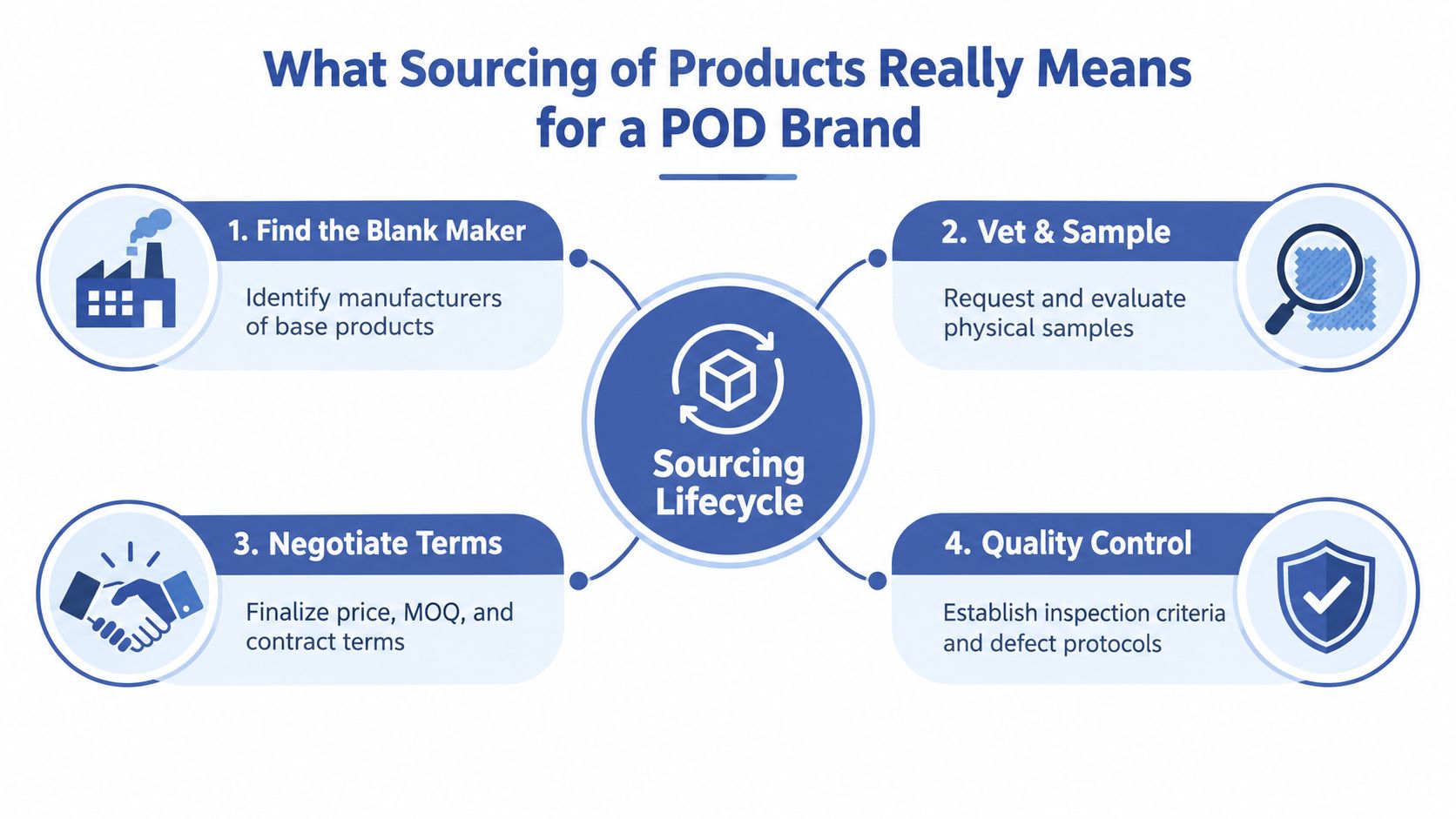
Sourcing starts with identifying who can make or supply the base product. That might mean comparing a Bella+Canvas 3001 with a private-label tee, locating a mug vendor that can reproduce your print consistently, or evaluating whether a fulfillment platform's catalog gives you enough margin and regional coverage. That first search is only the visible part of the work.
The full lifecycle includes supplier discovery, qualification, sampling, negotiation, production control, inspection, replenishment, and performance review. If a supplier's blank changes, if packaging becomes unavailable, or if a new production line introduces color variation, your sourcing system should catch the change before customers do.
Start with the physical product
A product brief should identify the blank, material, dimensions, decoration area, print method, packaging, labeling, expected order volume, and destination market. For a POD seller, “black hoodie” isn't a specification. A usable brief defines fabric weight or composition, size range, tolerance, drawcord or hardware details, decoration placement, and how the finished unit should be packed.
Packaging deserves its own line in the brief. A product can pass inspection and still arrive damaged if the polybag, carton, inserts, or protective material doesn't match the shipping route. Material Handling USA's guide to wholesale shipping supplies is useful when you're comparing the packaging materials and handling supplies that protect finished goods in transit.
Choose the operating model before choosing the supplier
Most POD brands sit within one of three sourcing models:
- Domestic sourcing: You use a supplier or fulfillment partner close to the customer, usually prioritizing speed, easier communication, and simpler returns.
- Overseas sourcing: You work with manufacturers abroad, often pursuing broader customization and lower quoted production costs while accepting longer transit and more complex verification.
- Hybrid sourcing: You combine locations, such as using a domestic blank with overseas packaging, or maintaining a domestic primary supplier with an overseas backup.
Sourcing becomes manageable when you define what “good” means before requesting quotes. A supplier that is excellent for a fast domestic test may be unsuitable for a large custom run. Another that works for a proven bestseller may be too risky for a first launch. The right choice depends on your customer promise, cash runway, product complexity, and tolerance for delay.
The Three Sourcing Models POD Sellers Actually Use
Domestic sourcing usually means buying blanks or finished goods from suppliers serving the US or EU market. The planning assumption in this model is a 3 to 7 day lead time and a unit cost of roughly $4 to $9, as specified in the operating model for this guide. That speed can protect a seasonal launch and simplify returns, but the higher unit cost can narrow contribution margin. You'll still need to verify stock depth, decoration consistency, packaging, and whether the quoted delivery window covers production or only dispatch.
Overseas sourcing can open access to factories listed through Alibaba, industry directories, or vetted networking groups. A common planning range is 25 to 45 days for lead time and $1.30 to $3.50 per unit at an MOQ of 500, before you account for freight, duty, inspection, payment terms, and inventory financing. These figures are useful for scenario planning, not promises. A factory's actual offer depends on product complexity, fabric or substrate, customization, packaging, shipping method, and the clarity of your specifications.
Hybrid sourcing is often the practical middle ground. You might buy a domestic blank for speed, use overseas packaging for a better presentation, or keep a domestic supplier active while qualifying an overseas backup. The trade-off is administrative complexity. You'll manage more than one set of specifications, replenishment schedules, invoices, and quality checks, but you may avoid putting the entire launch behind one location.
| Dimension | Domestic | Overseas | Hybrid |
|---|---|---|---|
| Primary advantage | Shorter replenishment cycle and simpler communication | Lower quoted production cost and wider factory access | Balances speed, cost, and continuity |
| Planning lead time | 3 to 7 days | 25 to 45 days | Depends on the component and route |
| Planning unit cost | $4 to $9 | $1.30 to $3.50 at MOQ 500 | Blended cost requires landed-cost analysis |
| Typical constraint | Higher unit cost or limited customization | Longer transit, verification, and cash commitment | More coordination and documentation |
| Best fit | Fast tests and time-sensitive launches | Proven products with predictable demand | Brands balancing resilience with margin |
Payment terms and sample fees can change the decision as much as the quote. Ask whether the supplier requires a deposit, when the balance is due, whether samples are refundable against production, and what happens if the sample fails. If you're using an agent or need help coordinating factories, this guide to sourcing agents for China can help you understand where an intermediary may fit into the process.
A simple decision prompt works well. Can your margin absorb the higher domestic cost, can your cash runway handle the overseas delay, and can your launch survive a 30-day disruption before a holiday window? If the answer changes by product, use different sourcing models for different SKUs instead of forcing the entire catalog into one system.
A Vetting Workflow That Catches Bad Suppliers Early
A supplier's polished catalog is not evidence of production consistency. Treat vetting as a sequence of gates, and stop when a supplier misses a critical requirement rather than trying to negotiate away an obvious warning.
Gate one starts at the desk
Check the business identity, operating location, product range, export history, references, and stated factory relationships. Ask whether the company manufactures, trades, or coordinates production through another facility. If the answer is unclear, your contract and inspection plan need to account for that risk.
For identity checks inside a procurement or onboarding workflow, TaxID's supplier TaxID verification resource can help structure validation before you share sensitive artwork or release funds.
Build a scorecard before the sample
Use a 25-point scorecard so enthusiasm doesn't replace evidence. Score capacity, MOQ flexibility, quoted quality, response accuracy, documentation, communication, production capability, packaging, and risk controls. Set a pass threshold before reviewing the supplier, and label certain failures as automatic stops.
| Category | Weight | Pass Threshold | Sample Checks |
|---|---|---|---|
| Product capability | 5 points | Meets all critical specifications | Materials, dimensions, decoration method |
| Quality controls | 5 points | Written inspection process and defect handling | Inspection records, defect definitions |
| Delivery capability | 4 points | Clear production and dispatch commitments | Capacity, calendar, escalation contact |
| Commercial terms | 4 points | Terms fit cash plan and landed-cost target | MOQ, deposits, balance, sample fees |
| Communication | 3 points | Accurate, timely answers to the RFQ | Response completeness, clarification quality |
| Compliance and identity | 4 points | Verifiable business and required documents | Registration, audits, traceability evidence |
A Hangzhou apparel maker once scored 22 out of 25 on paper, which looked strong enough to proceed. The paid sample passed the initial review, but a blind reorder produced 14% color drift, costing two weeks and $1,800 in wasted samples before the bulk order. The scorecard didn't fail. The process failed because the team treated one approved sample as proof of repeatability.
Use paid samples and a capped pilot
Order a paid sample, then reorder it without announcing that you're testing consistency. Compare both units against the same measurements, color reference, print placement, seams, labels, packaging, and odor standard. If the supplier changes materials or production location, require written approval before moving forward.
For a first pilot, cap the order at 100 to 200 units, as the operating workflow here recommends. Use that run to evaluate actual production, not just the supplier's ability to make one attractive sample. Ask two prior buyers about defect handling, late shipments, substitution behavior, and communication after payment.
Your final escalation review should answer one question: What evidence justifies the bulk purchase order? If a supplier misses more than one critical criterion, pause. A cheap correction at the vetting stage is far less expensive than a large inventory problem.
For broader supplier selection criteria in a POD context, use this print-on-demand supplier selection guide alongside your own scorecard.
Sample Cost and Lead Time Math You Can Run Today
The first sample isn't a small version of the bulk order. It's a diagnostic expense. Before approving production, calculate the cost of learning whether the product works.
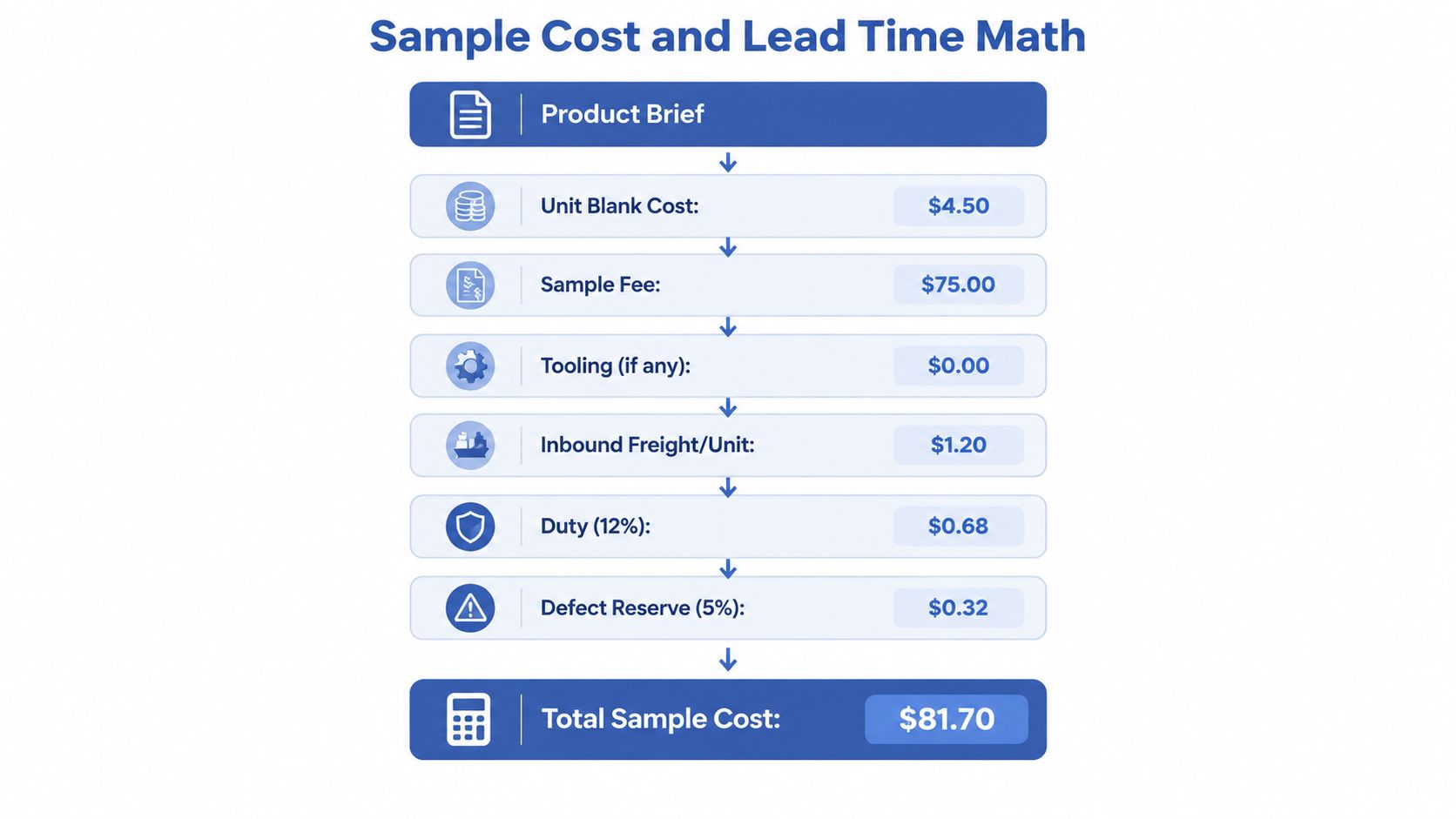
A first-sample P&L should include:
- Unit blank cost: The base garment, mug, or accessory.
- Sample fee: Any development or setup charge.
- Tooling: Screens, molds, plates, or other product-specific setup.
- Inbound freight per unit: The shipment cost allocated to each unit.
- Duty: The applicable import charge for the product classification.
- Defect reserve: A planned allowance for units that fail inspection or arrive unsellable.
The supplied sample-cost example lists a $4.50 unit blank cost, a $75.00 sample fee, $0.00 tooling, $1.20 inbound freight per unit, 12% duty represented as $0.68, and a 5% defect reserve represented as $0.32, for a stated total sample cost of $81.70. Treat that as a template to replace with your actual quote and shipment data. Skup's product-cost calculation guide can support the landed-cost portion of the exercise.
Stack time instead of trusting one promise
Your lead-time model should add production days, sample revisions, transit, customs or deconsolidation, inspection, and receiving. Apparel programs make the danger obvious. A first-time knit program can total about 75 to 110 days from purchase order to ex-factory shipment, including 10 to 15 days for sampling, 5 to 10 days per revision, 20 to 35 days for fabric and trim sourcing, 15 to 25 days for cutting and stitching, 5 to 10 days for finishing and quality control, plus a 7 to 14 day buffer. Mesh Apparel's apparel MOQ and lead-time guide provides those planning ranges.
For a 500-unit blank apparel run headed to a US FBA warehouse, write the timeline as a chain, not a single date: sample approval, production, inspection, transit, receiving, and available-to-sell status. Then apply the two internal go/no-go thresholds from this operating model:
- Landed cost under 28% of retail.
- Total cash-to-shelf under 21 days.
If the overseas production path can't meet the second threshold, it isn't automatically rejected. It may belong in a replenishment plan rather than a launch plan. A domestic source may win the first run even with a higher unit cost because speed protects the launch window and reduces the amount of cash tied up in transit.
Legal, IP, and Compliance Basics Most Beginners Skip
The first legal mistake usually happens before manufacturing. A seller finds a popular phrase, sports reference, character, or logo, places it on a blank, and assumes that changing the artwork makes it original. It doesn't. Clear trademarks and other rights before artwork reaches a supplier, especially when the design resembles licensed entertainment, sports, or branded merchandise.
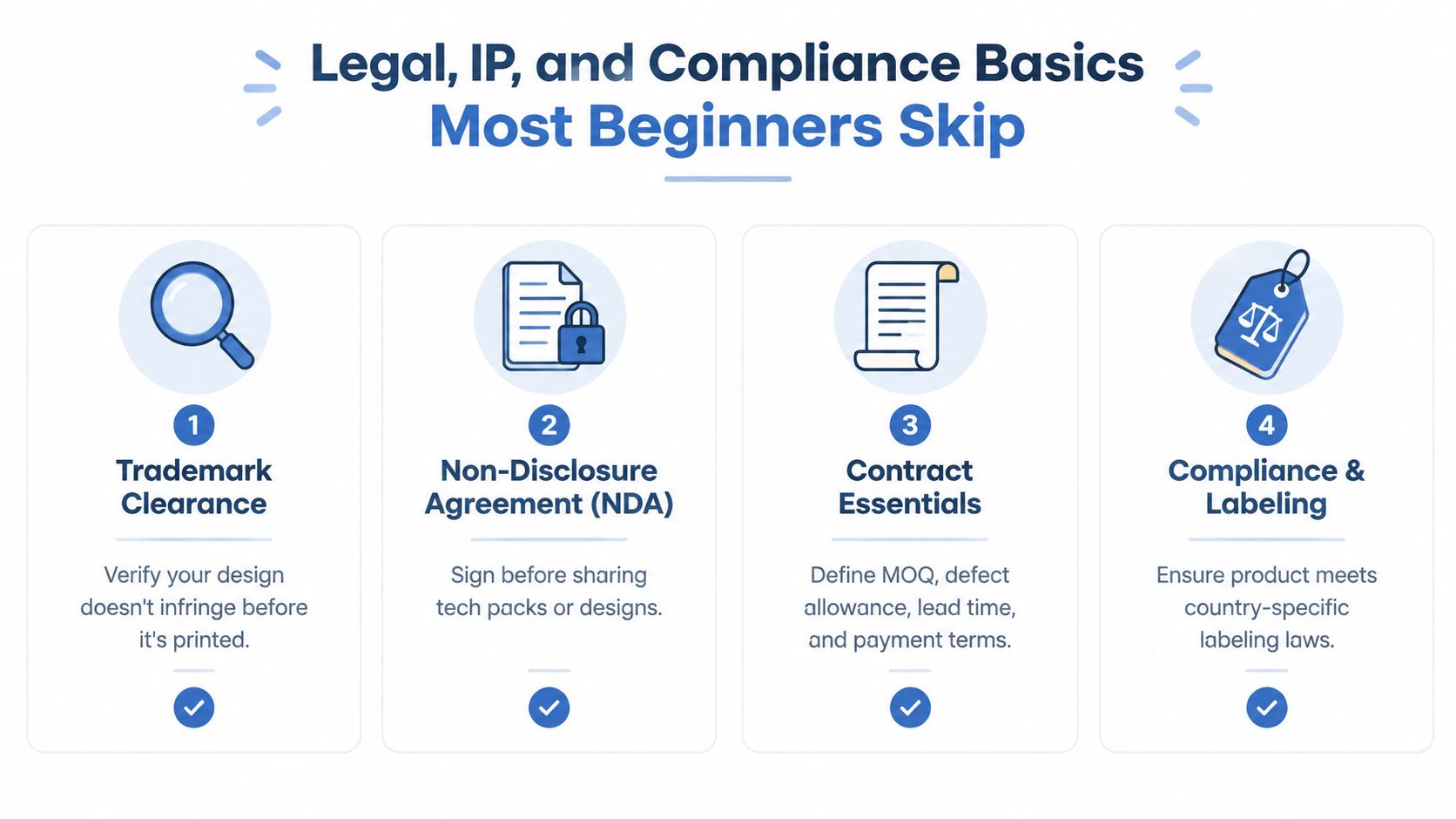
Use four layers of protection:
- Trademark clearance: Search the relevant trademark databases and review conflicts in the product category and markets where you'll sell.
- NDA before disclosure: Sign a non-disclosure agreement before sending tech packs, unreleased artwork, private-label specifications, or packaging concepts.
- A usable supplier contract: Define MOQ, product specifications, lead time, defect allowance, payment milestones, inspection rights, remedies, ownership of artwork, approved substitutions, and jurisdiction.
- Market-specific compliance: Confirm labeling, packaging, materials, traceability, and documentation requirements for each destination.
The contract target in this operating framework includes a defect allowance under 3%, payment milestones tied to inspection, and a clearly stated jurisdiction. Those terms don't replace inspection. They make the result enforceable when the delivered goods fail the agreed standard.
Compliance now belongs in the supplier folder
US importers need to consider the Uyghur Forced Labor Prevention Act and the possibility of detentions at US ports when supply-chain documentation is inadequate. European sellers need to monitor changing sustainability and product-accountability requirements. The operating brief also identifies CBAM carbon reporting for goods over 800 EUR, EPR packaging rules in California and France, and the EU ban on destroying unsold textiles and footwear for large enterprises beginning 19 July 2026, as developments that can affect sourcing decisions. Focalpoint's 2026 procurement trend coverage discusses the broader shift toward traceability and accountability.
Apparel oversight shouldn't stop at a supplier's promise. Industry guidance recommends regular audits for labor, environmental, and regulatory standards, plus traceability audits for raw materials. The apparel ethical supply-chain resource outlines that oversight approach.
Attach a one-page checklist to every onboarding folder: trademark review completed, NDA signed, business identity verified, material origin documented, certifications collected, labeling approved, packaging responsibility assigned, inspection standard attached, and remedy terms accepted.
Your First Sourcing Run from Brief to Bulk Order
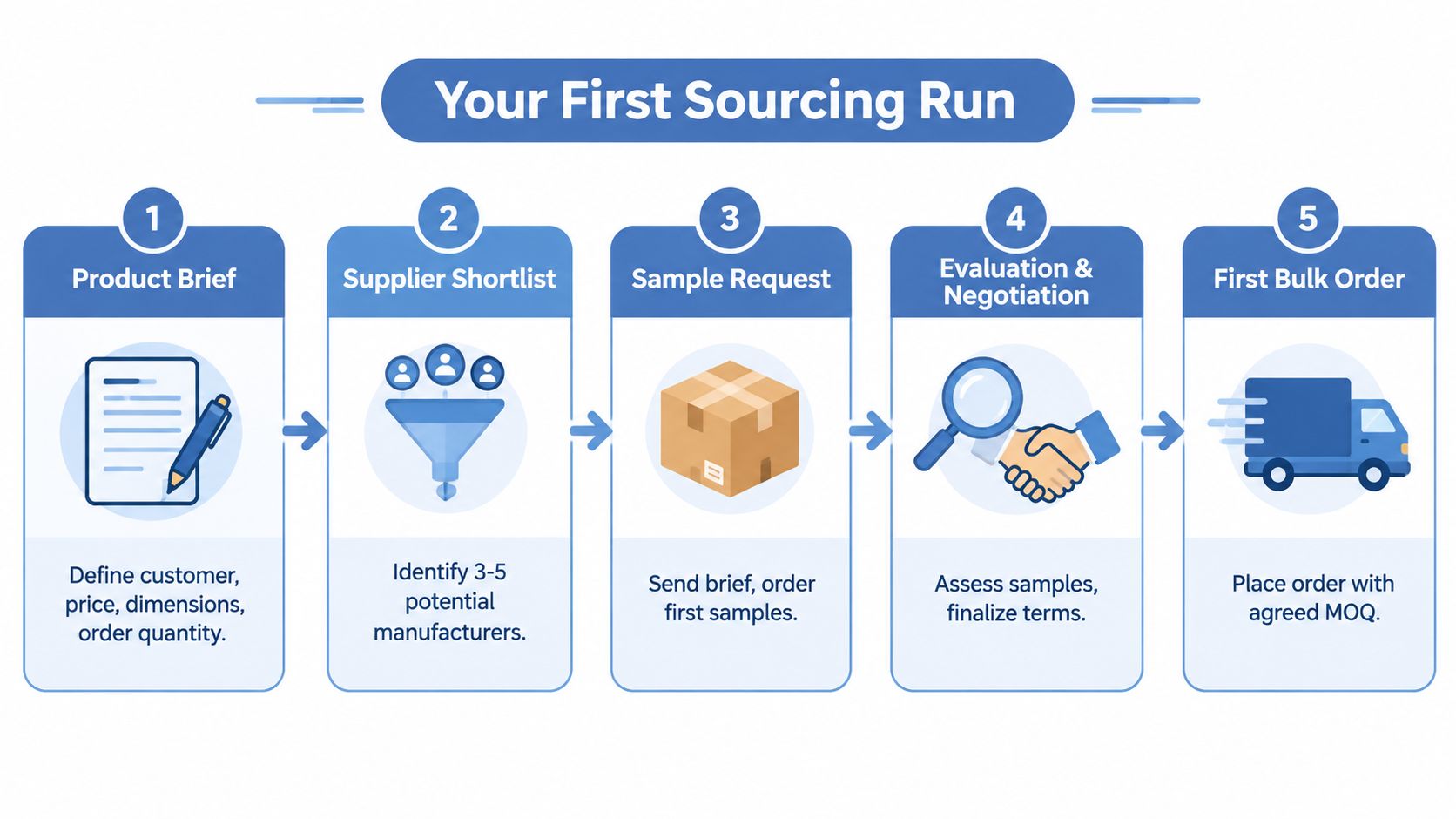
Run your first sourcing cycle like a controlled experiment. Start with a one-page brief that names the target customer, retail price ceiling, blank dimensions, decoration area, order quantity, launch date, shipping target, and required certifications. If the brief doesn't define the product, every supplier will quote a slightly different item.
Shortlist at least three suppliers, including one backup. Send each the same RFQ and ask for unit costs at several quantities, tooling or setup charges, sample fees, production time, transit time, payment terms, defect limits, and packaging details. Paid samples from every finalist create a fair comparison because you're evaluating physical output rather than sales language.
Record the evidence
Give every sample an order number and log the payment term, quoted lead time, received date, and variance. Inspect decoration durability, measurements, color accuracy, seams, hardware, labeling, barcode placement, odor, and packaging performance. For garments, compare measurements against the approved size chart. For mugs and hard goods, inspect alignment, finish, edge protection, and carton damage.
Once one sample wins, create a golden sample. Photograph it from consistent angles and attach written tolerances for placement, color, measurements, seams, packaging, and acceptable cosmetic variation. The golden sample becomes the physical reference for production and inspection.
Release bulk production in controlled stages
Before paying a deposit, reconcile the purchase order, approved artwork, bill of materials, packing method, inspection standard, shipment terms, and payment schedule. Require pre-production approval when the supplier proposes a material, factory, artwork, or packaging change. When volume warrants it, use an AQL-based inspection for finished goods, and release the balance only after quantities and documents reconcile.
Keep the full record in a supplier folder. After delivery, review defects, missed dates, communication accuracy, actual landed cost, packaging performance, and customer feedback. The point isn't to create paperwork for its own sake. It's to make repeat orders faster because the next decision starts with evidence instead of memory.
Pitfalls That Stall First-Time Sourcers and How to Beat Them
The first three sourcing runs usually expose the same errors.
Unit price gets mistaken for total cost. Add tooling, freight, duty, payment fees, defects, replacements, and the inventory required to keep selling. A cheaper quote can become the expensive option after the shipment arrives.
A catalog sample gets treated as production evidence. Request a recent pre-production sample, preserve traceable specifications, and require written approval for substitutions. A factory can change materials, labor, or production location without making the change obvious in a product photo.
Quoted lead time gets confused with available-to-sell time. Sample revisions, inspection, customs, receiving, and peak-season congestion all sit outside many supplier promises. Define the Incoterm and build a buffer.
Design files travel too freely. Use NDAs, controlled artwork access, trademark checks, and ownership clauses. Don't route an unreleased design through an unapproved factory because the supplier claims it can “get a better price.”
Specifications stay vague. Define measurement tolerances, color standards, packaging quantities, labels, barcode placement, defect definitions, inspection rights, and remedies.
One supplier carries the entire business. Once demand is proven, dual-source critical components or products. Don't split tiny orders so much that neither supplier receives enough production data to become reliable.
Track on-time delivery, first-pass yield, defect rate, communication accuracy, and actual landed cost by supplier. ISO 9001:2015 Clause 8.4 requires organizations to evaluate, select, monitor, and re-evaluate external providers based on their ability to meet requirements, while keeping documented evidence of that evaluation. CASRAI's supplier-audit guide explains the practical significance of that controlled process. For product sourcing, defect rate means defective units divided by total units received, and one sourcing KPI reference identifies under 1% as ideal in most industries. This sourcing KPI reference also connects defect tracking with lead-time variability, a useful way to spot suppliers that are inexpensive but unstable.
Sourcing is one of the reasons ecommerce remains exciting. You're not locked into a single supplier, product, or geography forever. Build the evidence, protect your margin, qualify a backup, and let each order make the next one more predictable.
Skup helps POD operators turn product ideas into organized supplier and launch decisions, while AvatarIQ supports the design and mockup workflow that gets products ready for testing. Visit Skup to explore the Apparel Cloning System, AvatarIQ, and practical support for building a repeatable POD business.