How to Start Online Business from Home
You're at the kitchen table with a laptop open, a half-finished store name in a browser tab, and more questions than answers. You want to know how to start an online business from home without filling a spare room with inventory, borrowing heavily, or wasting months building products nobody wants.
The opportunity is real, but the shortcut isn't. E-commerce gives a solo operator access to a mainstream retail channel, while print on demand lets you test apparel without purchasing stock in advance. The practical path is to combine demand validation, disciplined product economics, a fast design workflow, and a back office that keeps small mistakes from becoming expensive ones.
Table of Contents
- Why Starting an Online Business From Home Is the Smartest Move You Can Make in 2026
- The Home Operator's Back Office Setup Most Beginners Skip
- Choosing the Right Online Business Model for a Solo Operator
- Validating a Winning Product Before You Spend a Dollar on Ads
- Building Your Storefront and Turning Designs Into Listings Fast
- Your Starter Marketing Plan That Actually Gets First Sales
- Your 90-Day Launch Calendar and How to Stay Excited
Why Starting an Online Business From Home Is the Smartest Move You Can Make in 2026
Starting at home keeps your fixed costs controlled while you learn the parts of commerce that matter, product selection, positioning, customer acquisition, fulfillment, and cash management. You don't need a warehouse, a long lease, wholesale representatives, or a large inventory order to begin testing a focused apparel offer.
The market is already large enough to support specialized stores. In 2024, online sales represented more than 17% of worldwide retail sales, and global e-commerce sales exceeded seven trillion U.S. dollars, with forecasts exceeding 10.4 trillion U.S. dollars by 2028, according to Statista's worldwide e-commerce retail data. Smartphones generated nearly 80% of retail website visits worldwide in 2024, so a home-based store can reach customers through the mobile browsing and checkout habits they already use.
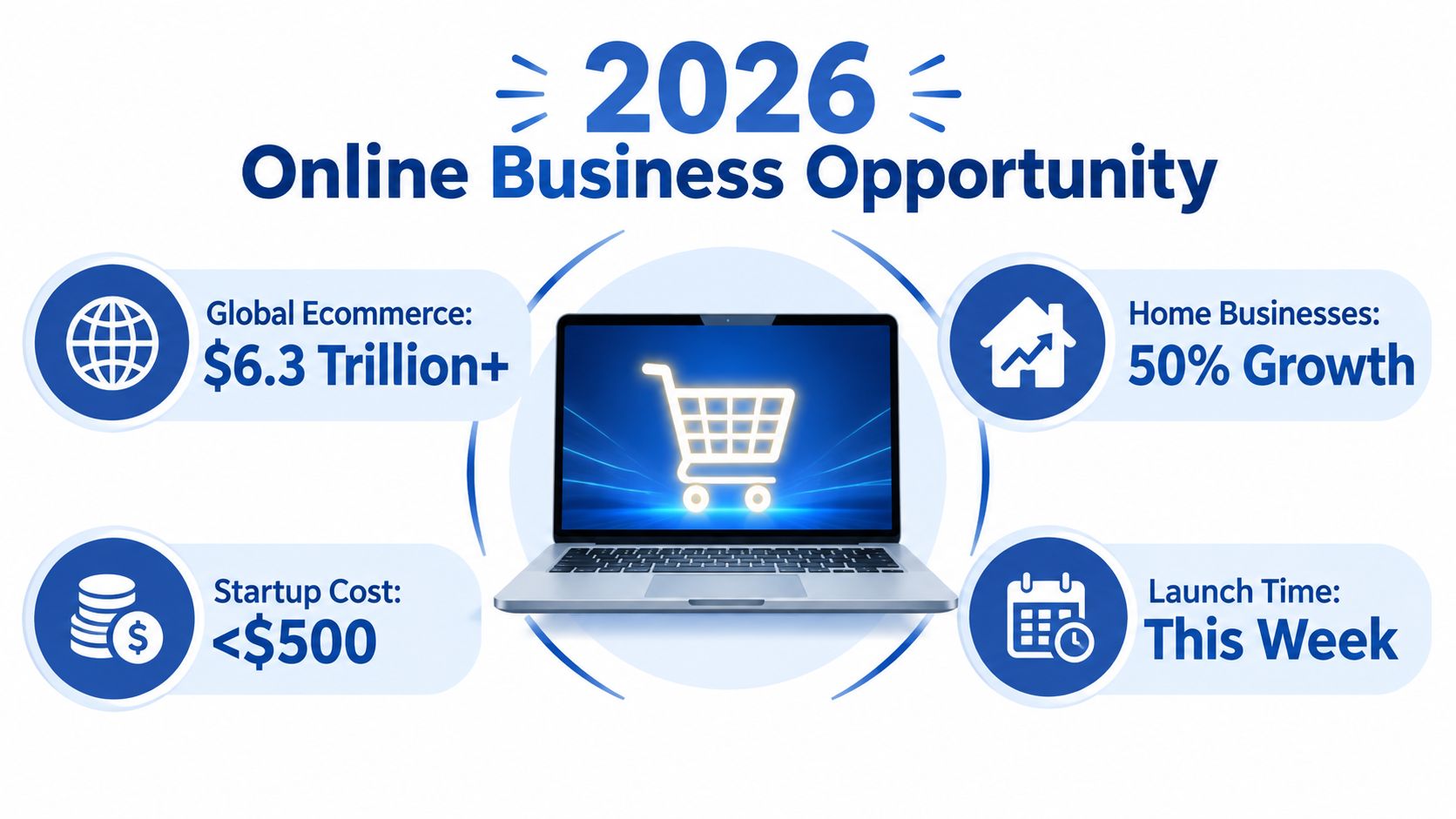
That scale doesn't mean every store wins. It means you can start with a narrow audience instead of trying to serve everyone. A good home operator uses low-overhead tools to test a product, reviews customer behavior, and reinvests only after the offer earns evidence.
Why print on demand fits the home model
Print on demand removes the need to predict every size, color, and design combination before customers buy. A fulfillment partner produces and ships the item after an order comes through, which allows you to spend your early energy on niche research, product presentation, and marketing rather than storage.
Home-based businesses are already a substantial operating model. A summary of home-based business statistics reports 64.9 million U.S. households owned a home-based business in 2023, representing 34.4% of U.S. households, while the number grew 12% between 2019 and 2023. The same summary reports median annual revenue of $50,000, with 30% reporting more than $100,000 and 72% remaining below $50,000, a useful reminder that execution determines the outcome.
If you're comparing this path with other work-from-home business ideas, focus on the model's learning curve and downside, not just its advertised revenue. POD gives you a way to practice real retail skills while keeping inventory exposure low. That's why it's a compelling starting point for a focused solo operator in 2026.
The Home Operator's Back Office Setup Most Beginners Skip
A store can look polished while the business underneath it remains disorganized. Separate finances, basic bookkeeping, and a defined workspace protect your cash and make decisions easier once orders begin arriving.
The legal setup depends on your location and business activity. In most U.S. states, forming a business can cost roughly $50 to $150 in state filing or registration fees, while business licenses commonly cost $20 to $100 per year and home occupation permits can cost $25 to $75 where required, according to this print-on-demand startup cost guide. Check your state and local requirements before selling, especially if your home address, products, or sales activity trigger additional obligations.
Build the foundation before the first sale
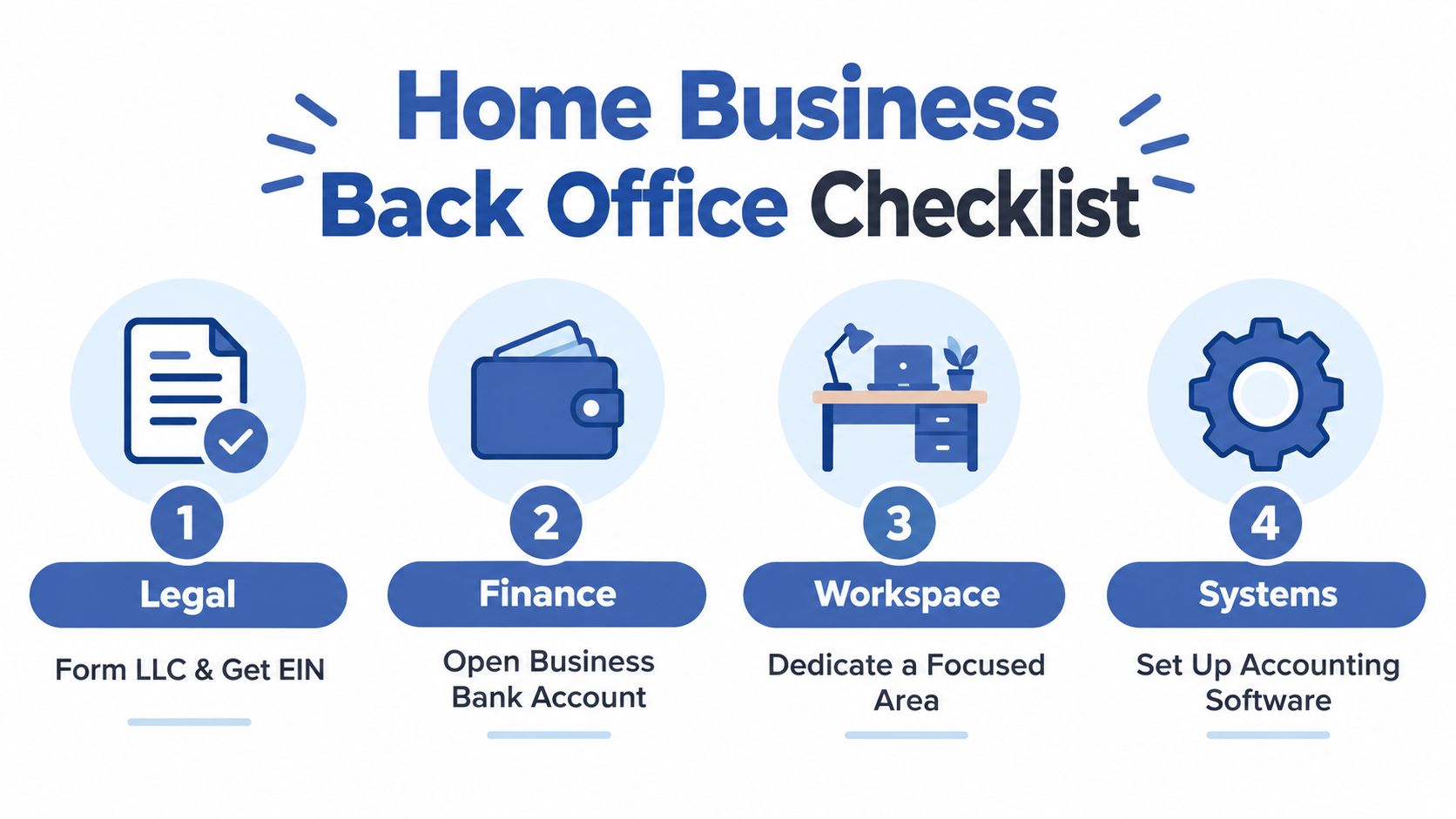
Start with a simple legal and financial stack:
- Business identity: Decide whether an LLC fits your liability and tax situation, then obtain an EIN directly from the IRS where appropriate. Don't treat a formation service as a substitute for professional advice.
- Tax review: Check whether your selling channels create sales-tax obligations in the states where you have nexus. Keep copies of registrations, permits, and platform tax documents.
- Dedicated banking: Open business checking with a provider such as Relay, Mercury, or Chase Business. Use a dedicated card for software, samples, advertising, and operating purchases.
- International payments: If you pay overseas contractors or suppliers, Wise can help you manage international transfers separately from your core operating account.
- Bookkeeping: Wave or QuickBooks Simple Start can support a basic ledger. Record revenue, fees, refunds, fulfillment costs, advertising, and owner contributions consistently.
- Monthly close: On the first day of each month, reconcile the prior month, review profit by product, and move a tax reserve into a separate savings account. A conservative 30% set-aside rule can help create a buffer, but your actual obligation depends on your circumstances.
Your workspace doesn't need to become a warehouse. A dedicated laptop, shipping-station corner, second monitor, and reliable label printer are enough for many early workflows. The Brother QL-820NWB is one practical example, while a second monitor around $120 and that printer around $130 can improve order handling, although exact prices change.
Practical rule: Keep business money, business records, and business equipment visibly separate from household spending.
Before launch, confirm that licenses are filed, the bank account is open, the books are live, and your workspace is ready for focused work. A few hours on a weekend can prevent tax confusion, untraceable expenses, and scaling chaos later.
Choosing the Right Online Business Model for a Solo Operator
The right model matches your available capital, tolerance for customer support, acquisition skills, and desired ceiling. Dropshipping, digital products, affiliate marketing, and POD can all operate from home, but they place pressure on different parts of the business.
Dropshipping can be quick to test, but product quality, shipping speed, supplier reliability, and paid-ad fatigue can damage the customer experience. Digital products offer strong unit economics because there's no physical fulfillment, yet they require useful expertise and ongoing support. Affiliate marketing avoids product operations, but the audience and brand equity belong largely to someone else.
POD apparel gives a solo operator control over the brand while avoiding a warehouse full of unproven stock. Fulfillment can run through Printful or Printify, and the Apparel Cloning method supplies a research process for adapting proven market angles rather than designing in isolation. For a broader comparison of inventory-free models, see this guide to print on demand versus dropshipping.
A practical comparison
| Model | Startup Cost | Time to First Sale | Avg. Margin | Scaling Ceiling | Main Risk |
|---|---|---|---|---|---|
| Dropshipping | Low to moderate | Potentially fast | Varies by supplier and offer | High if acquisition works | Supplier and shipping problems |
| Digital products | Low | Depends on audience and proof | Often high | High with strong distribution | Weak differentiation and support load |
| Affiliate marketing | Low | Usually audience-dependent | Commission-based | Dependent on traffic and programs | Limited brand ownership |
| POD apparel | Low to moderate | Depends on validation and listings | Depends on product and fulfillment economics | Strong for a focused brand | Weak research or undifferentiated designs |
POD works when the product, audience, and presentation reinforce each other. It doesn't work when a founder uploads random graphics, copies a crowded listing without a distinct angle, or treats fulfillment as an afterthought.
The economics also need room for customer acquisition. Your retail price must cover product cost, fulfillment, platform fees, refunds, and marketing while leaving a contribution margin you can reinvest. Etsy's U.S. fee structure includes a $0.20 listing fee, a 6.5% transaction fee, and Etsy Payments processing of 3% plus $0.25, as outlined in this POD cost breakdown. New Etsy shops also face a one-time $15 setup fee in 2026, according to this Etsy fee overview.
For a solo operator seeking a real apparel brand rather than a temporary product test, POD is the strongest starting point of these four options. It combines creative control, flexible fulfillment, and room to improve the offer over time.
If you need a broader content workflow for research, publishing, and promotion, Sight AI's top picks for solopreneur content can help you evaluate supporting tools without confusing content production with product validation.
Validating a Winning Product Before You Spend a Dollar on Ads
Most failed launches begin before the store goes live. The founder picks a broad interest, creates a design based on personal taste, and spends on traffic before checking whether buyers recognize the product's value.
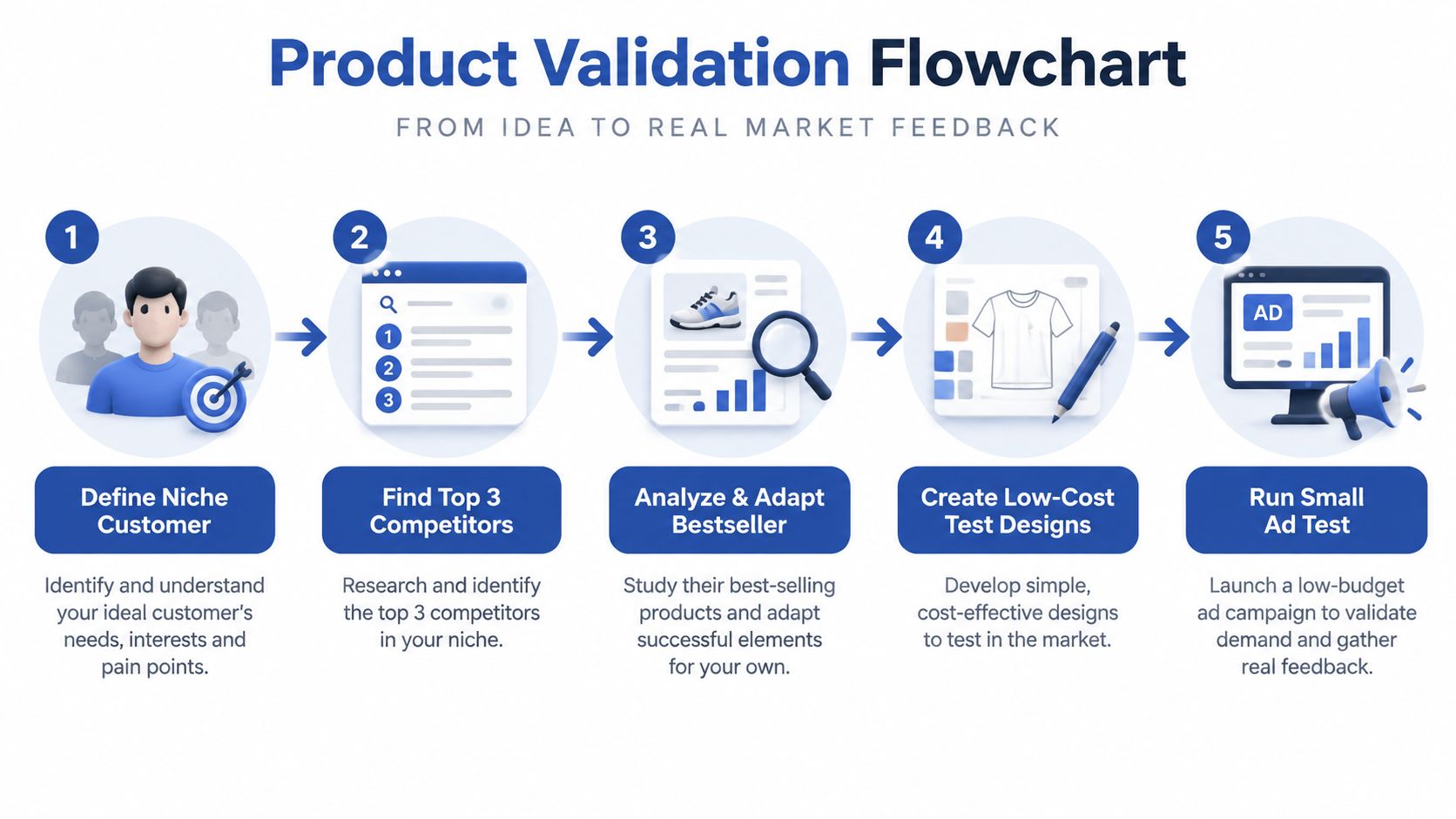
A better process starts with an avatar. Define the customer by age range, hobby, lifestyle, buying context, and styling cues. A niche such as “people who like dogs” is too broad. A more useful direction identifies the type of dog owner, the humor or identity they express, the garments they wear, and the occasions that motivate a purchase.
Use the Apparel Cloning filter
Start your research in Amazon Best Sellers, Etsy top searches, and TikTok Shop listings. Look for repeated demand signals, but don't copy protected artwork, brand identifiers, or another seller's exact creative expression.
Create a spreadsheet of 20 to 30 candidate designs and score each against three questions:
- Shelf competition: Can your version appear distinct beside existing products?
- Price spread: Do comparable products leave room for a sustainable retail price?
- Review gaps: Do customer comments reveal complaints about style, fit, wording, or audience specificity?
The Apparel Cloning workflow then narrows the list:
- Clone the commercial pattern: Identify what makes a proven seller legible, emotional, giftable, or relevant to the niche.
- Swap the angle: Change the audience framing, phrase, illustration direction, or use case so the product becomes your own offer.
- Test micro-variants: Create a small set of related versions on one Etsy or Shopify draft rather than producing an enormous catalog.
You can keep the earliest validation phase at $0 ad spend by reading comment density, save counts, customer questions, and direct order-on-request replies. These signals don't prove profitability, but they help you decide whether the idea deserves a paid test.
Define the green light
A design is ready for the next stage when the audience understands it quickly, the angle differs from nearby products, the expected price leaves room for fees and fulfillment, and real people show a clear behavioral signal. That signal might be an email opt-in, a meaningful click-through rate, a request to buy, or repeated engagement around the same concept.
A practical e-commerce validation framework recommends choosing a narrow niche, comparing at least 10 direct competitors, defining one buyer persona, and testing with a low-cost landing page or ad set before committing to inventory or a full store. The same source notes that widely cited small-business figures place first-year failure at roughly 20%, while e-commerce analyses often estimate much higher failure in saturated categories. Treat paid traffic as a testing instrument until your funnel shows evidence, not as a rescue plan for an unproven product.
Building Your Storefront and Turning Designs Into Listings Fast
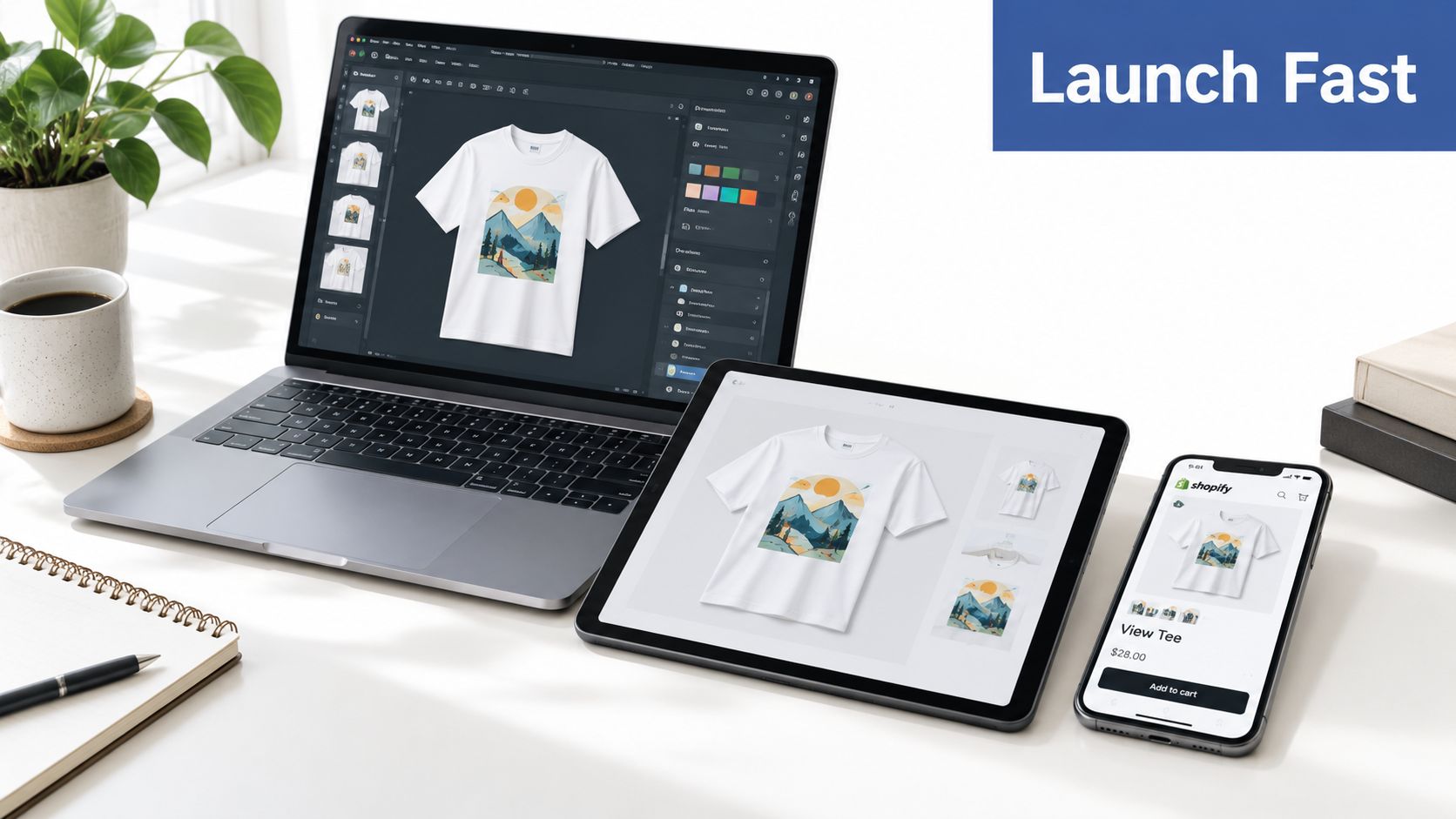
Your storefront should make three things obvious within seconds, what the product is, who it's for, and why the design deserves attention. AvatarIQ can support the production chain by generating apparel designs, mockups, and product imagery without requiring a separate photography setup.
Begin with the validated concept, then prompt the design direction inside AvatarIQ. Produce a clean design file, render a flat lay and a lifestyle mockup, and export a 4500 by 5400 PNG for Etsy listing use. Create a consistent naming system that includes the niche, product angle, garment type, and variant so your files remain searchable when the catalog grows.
Choose the first sales channel deliberately
Etsy gives you marketplace discovery and buyer intent, but the fee stack and listing competition require precise titles, strong images, and clear policies. Shopify gives you more control over the customer journey, email capture, merchandising, and brand presentation, but you'll need to create your own traffic sources.
Shopify's introductory pricing can be $1 for the first three months, while Etsy charges its listing and transaction fees, so compare the immediate cash requirement with the long-term value of owning the customer relationship. Connect Printful or Printify, select a product with dependable quality, and order samples when the design or garment choice needs physical verification.
For the store setup itself, use Shopify's product workflow with this guide to adding products to Shopify. Configure shipping profiles, delivery expectations, exchange and return policies, size guidance, and care instructions before you publish.
Publish seven listings on day one with one coherent niche rather than seven unrelated ideas. Give each listing:
- A title that starts with the buyer's search language.
- A description that explains fit, garment details, use case, and care.
- Multiple mockups that show the design clearly on mobile.
- Descriptive alt text for accessibility and image context.
- A size chart and transparent fulfillment expectations.
- Tags and variants that match the actual product.
Weak titles, missing alt text, vague sizing, and generic mockups reduce trust. Speed matters, but clean merchandising matters more.
Your Starter Marketing Plan That Actually Gets First Sales
Marketing begins with a repeatable message, not a large budget. Use the avatar from your validation work to write the hook, select the visual context, and choose the platform where that audience already pays attention.
For a paid test, use a controlled daily budget of $50 to $100 only when the product page, checkout, fulfillment connection, and tracking are ready. Run two ad sets for a winning design, one broad-interest hook based on the AvatarIQ avatar and one audience built from engaged Etsy visitors when that data is available. Keep the creative consistent enough that you can tell whether the audience or the offer caused the result.
The stop-loss rules should be written before launch. The plan in this workflow is to stop ads that remain below 1.5x ROAS after three days, then scale a winner on the fourth day only after checking contribution margin, refund exposure, and fulfillment costs. ROAS alone can look attractive while the order still loses money.
Pair paid tests with organic repetition
Post daily on TikTok and Pinterest using the same mockups, product angle, and customer language. Organic content can show the design close up, explain the niche reference, demonstrate styling, answer a sizing question, or compare variants. Repetition helps you learn which framing earns attention without changing every variable at once.
Track the funnel in a simple dashboard:
- CTR: Are people responding to the hook and creative?
- Add-to-cart rate: Does the product page match the promise?
- Checkout completion: Are shipping, price, trust, or payment issues blocking the order?
- CPA: Can the sale support the cost of acquiring the buyer?
- ROAS: Does the campaign generate enough revenue relative to ad spend?
| Metric | Kill Below | Watch Zone | Scale Above |
|---|---|---|---|
| CTR | Weak response to the creative | Clicks arrive but lack consistency | Strong click intent with relevant traffic |
| Add-to-cart rate | Product page fails to create intent | Interest exists but objections remain | Buyers show clear product interest |
| Checkout completion | Friction or distrust blocks purchase | Some buyers abandon before payment | Checkout behavior supports more testing |
| CPA | Acquisition exceeds contribution margin | Near the product's sustainable limit | Acquisition leaves room for reinvestment |
| ROAS | Below 1.5x after three days | Revenue covers little beyond spend | Profit remains after all variable costs |
Paid traffic should answer a question. It shouldn't be used to hide the absence of a clear offer.
Customer acquisition is getting harder for small businesses because platforms change, competition increases, and founders face pressure to produce constantly. A recent guide to starting an online business cites 81% of small business owners experiencing burnout in 2025, which is a useful reason to build a schedule you can maintain rather than publishing everywhere without a measurement plan.
Your 90-Day Launch Calendar and How to Stay Excited
A 90-day launch works because it turns a vague ambition into operating blocks. You're not trying to perfect a full brand on the first day. You're building the legal foundation, validating a narrow offer, publishing a coherent catalog, and learning how customers respond.
Weeks 1 to 2
Handle the administrative work first. File required registrations and licenses, open business banking, activate bookkeeping, create a dedicated workspace, and purchase your domain. Write a one-page operating brief that names the audience, product category, fulfillment partner, customer promise, and weekly work schedule.
Weeks 3 to 5
Choose the niche and complete Apparel Cloning research. Compare competitors, record pricing and review gaps, define the customer avatar, and build your candidate spreadsheet. Narrow the research into five to 10 validated designs that meet your differentiation, demand, and margin requirements.
Weeks 6 to 8
Use AvatarIQ to produce the selected designs, mockups, and listing assets. Upload the products to Shopify or Etsy, connect Printful or Printify, set shipping and return policies, and run a soft launch with friends and family for practical feedback on sizing, images, wording, and checkout clarity.
Weeks 9 to 12
Publish consistently on TikTok and Pinterest, then pair the organic work with a $10-per-day Meta test once tracking is functional. Review CPA, ROAS, click behavior, add-to-cart activity, checkout completion, and organic follower growth each week. Don't increase spend because a campaign feels exciting. Increase it because the numbers and customer feedback support the decision.
Use three milestone checkpoints:
- First sale: Confirm that the offer, checkout, and fulfillment process work end to end.
- First $100 day: Study which products, traffic sources, and messages produced the day, then document the pattern.
- First 1,000-email subscriber: Build a permission-based audience you can reach without relying entirely on platform algorithms.
The first month usually feels hardest because every task is unfamiliar and the feedback loop is slow. Keep a daily operating ritual: review the dashboard, answer customer questions, improve one listing, publish one useful piece of content, and record one lesson. Celebrate completed tests, not just revenue.
Consistency becomes easier when every work session produces a visible asset, a better listing, a clearer number, or a customer conversation.
You don't need to predict the entire future of your store. You need to complete the next useful action, protect your cash, and keep learning from the audience you chose.
Skup offers the Apparel Cloning System for learning a structured POD apparel validation and launch process, while AvatarIQ supports AI-assisted design and mockup production for faster listings. Visit Skup to explore the tools and training that can help you turn this home-based operating plan into a working store.