10 Community Building Strategies for POD Sellers
A strong POD community is more than a chat group. It can help beginners make decisions faster, give scaling sellers a safer place to test ideas, and create durable relationships around shared niches, creative goals, and commercial challenges. That matters because online community behavior is far from niche. Pew Research found that 84% of internet users had contacted an online group at some point, while 26% had used the internet to contact or get information about local groups in its 2001 study of online communities (Pew Research). The behavior existed before today's social platforms matured, and it still shapes how people learn, compare options, and build trust.
For POD sellers, the opportunity is practical. A useful community can turn scattered questions into searchable knowledge, isolated experiments into shared learning, and inconsistent effort into a repeatable operating rhythm. It won't replace product quality, customer research, or disciplined execution. It can make all three easier to sustain.
The 10 community building strategies below focus on focused belonging, real-time guidance, peer accountability, collaborative testing, recognition, and transparent learning. Each strategy includes implementation ideas, suitable platforms, and KPIs tied to participation, design output, feedback quality, launches, retention, and sales conversations. If you're designing a broader member experience, this guide for coliving operators also offers useful perspective on creating recurring connection rather than one-off attention.
Table of Contents
- 1. Niche-Based Community Groups
- 2. Live Coaching, Weekly Q&A and Direct Founder Mentorship
- 3. Student Success Stories and Case Studies
- 4. Asynchronous Discussion Forums and Knowledge Bases
- 5. Accountability Partners and Peer Mastermind Groups
- 6. Content Co-Creation and Member Contributions
- 7. Exclusive Member Benefits and Recognition Programs
- 8. Themed Challenges and Design Competitions
- 9. Collaborative Design and Product Testing Sprints
- 10. Supportive Culture and Vulnerability-First Communication
- 10-Point Comparison of Community-Building Strategies
- Turn Conversations Into Consistent Momentum
1. Niche-Based Community Groups
Broad POD groups often produce broad, shallow advice. A focused group built around dog lovers, fitness enthusiasts, gamers, crafters, or sports fans gives members a shared market context and makes feedback far more useful. Someone testing a dog-breed design needs different opinions from someone building motivational gym apparel. The closer the shared interest, the easier it is for members to discuss products, messaging, buyers, and creative decisions in practical terms.
This approach also mirrors the niche-first thinking taught through Apparel Cloning. Members aren't just exchanging generic design inspiration. They're examining how a specific audience responds to concepts, product angles, and variations.
Create a dedicated Slack or Discord channel for every major niche you pursue. Keep each channel active with a recurring discussion, such as what members are testing, which objections they're hearing, or how customers are reacting to a new product idea.
- Use AvatarIQ for variations: Generate multiple apparel design directions quickly, then ask members to compare the strongest concepts.
- Share anonymized sales data: Transparency builds trust when members can see what worked, what failed, and what changed.
- Show the process: Ask sellers to post winning products alongside the research, design iterations, and listing decisions behind them.
Track active participants, useful replies, designs submitted for review, feedback quality, product launches, and sales conversations that begin inside the group. The aim isn't to create the largest audience. It's to build a tight market lab where members help one another make better decisions.

2. Live Coaching, Weekly Q&A and Direct Founder Mentorship
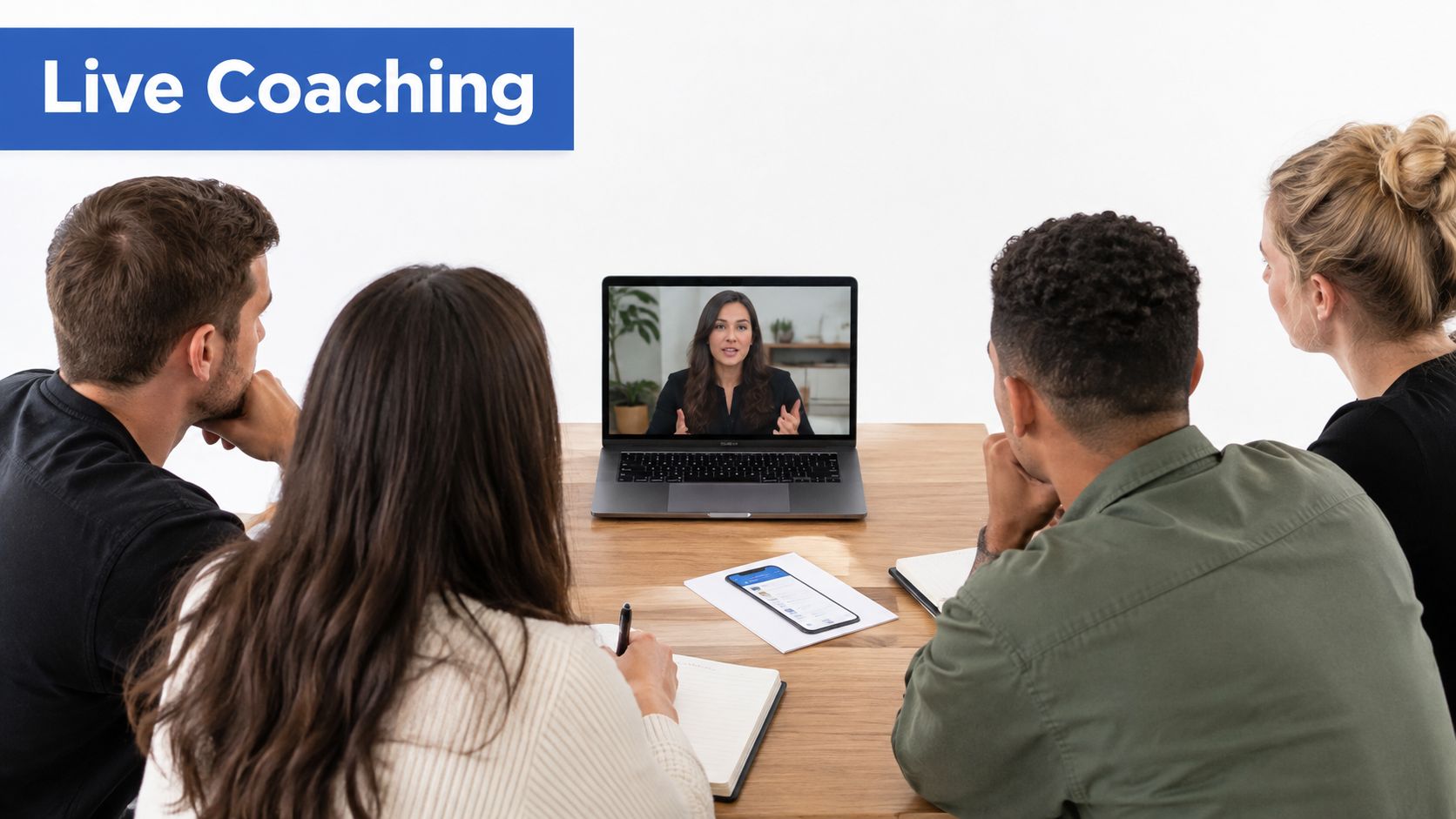
POD questions often lose value when answers arrive days later. A listing problem, design decision, or testing question usually makes more sense while the seller is actively working through it. Weekly live coaching and Q&A sessions create a dependable place for that problem solving, while direct mentorship helps members apply general principles to their own stores.
Use Zoom for live calls, Slack or Discord for questions before and after each session, and a scheduling system for limited one-to-one meetings. Consistency matters more than novelty. Members should know when the call happens, how to submit a question, and what preparation will produce a useful answer.
Practical rule: Every live session should end with a clear action, an owner, and a date for reporting back.
Ask members to submit questions and supporting materials in advance. A screenshot of a product listing, a short description of the niche, or a design variation gives the coach something concrete to evaluate. Use screen sharing, templates, and recorded walkthroughs so one answer can help the wider community rather than only the person who asked.
Skup's Incubator model demonstrates how weekly group coaching, direct access to experienced operators, and one-to-one mentorship can support accountability inside a seller community. The same structure can work at a smaller scale. One recurring group call is enough to begin, with higher-touch access added only when the community has clear demand.
Track attendance, repeat attendance, questions submitted, action items completed, coaching-related launches, and member retention. A busy call isn't automatically a productive call. Look for evidence that members leave with decisions they implement.
3. Student Success Stories and Case Studies
A credible success story shows the decisions behind the result, not only the result itself. For a POD community, that means documenting where a seller started, which niche they chose, how they created and tested products, what failed, and what they changed next. A highlight reel can motivate someone briefly. A detailed timeline gives them a process they can adapt.
Feature members at different stages. A beginner publishing a first product can teach something valuable about overcoming setup friction. A seller maintaining a side hustle can explain how they schedule design work around employment. A scaling operator can show how they organized testing, customer feedback, and product expansion.
Strong case studies should answer practical questions:
- What changed: Explain the niche, product angle, design decisions, and launch sequence.
- What went wrong: Include failed designs, weak messaging, pivots, and uncomfortable lessons.
- What the seller used: Show the actual workflow, including AvatarIQ for design creation and mockups where relevant.
- How progress unfolded: Use a month or quarter timeline without implying that another seller will reproduce the same outcome.
Avoid inventing precision. If a member shares revenue, ad spend, conversion rate, or design volume, publish it with permission and context. If they don't, describe the progress qualitatively.
A useful collection of examples can include POD success stories from Skup, but the editorial standard should remain the same: make the path understandable, include setbacks, and connect the story to decisions a reader can test.
Measure case-study engagement, questions generated, applications of the featured workflow, and whether members publish their own follow-up experiments. The best story creates another conversation.
4. Asynchronous Discussion Forums and Knowledge Bases
Live sessions create energy, but they can't answer every question at the moment a member needs help. An asynchronous forum gives sellers a place to ask about niche selection, product listings, ads, Printful integration, Shopify setup, mockups, and scaling. A searchable knowledge base turns repeated answers into durable infrastructure.
Use a forum platform such as Discourse for structured discussions, or organize Slack and Discord carefully if your members already use them. Real-time chat is useful for quick interaction, but important answers disappear easily when channels become noisy. Pin essential resources, apply consistent tags, and link related discussions so members can find context without asking the same question again.
Build categories around the member journey:
- Starting: Niche research, product discovery, store setup, and first listings.
- Testing: Design feedback, mockup comparisons, offer angles, and campaign observations.
- Scaling: Creative production, customer experience, retention, and operational bottlenecks.
- Troubleshooting: Platform connections, rejected listings, fulfillment questions, and technical fixes.
Invite experienced members to answer, then have coaches validate advice and add nuance when needed. Recognition can encourage quality contributions, but speed shouldn't outrank accuracy. A confident wrong answer can create more work than no answer.
Track searches, unanswered questions, accepted answers, repeat visitors, time to first useful response, and the percentage of new members who find an existing answer before posting. Measure knowledge contribution as seriously as message volume. A quiet library that solves real problems can be healthier than a loud feed full of repeated questions.
5. Accountability Partners and Peer Mastermind Groups
Most sellers don't struggle because they lack another idea. They struggle because design work, testing, listings, and analysis compete with everything else in life. Accountability partners create a simple external commitment, while small mastermind groups provide a deeper setting for troubleshooting and honest review.
Keep groups to four to six people so everyone has time to speak and receive useful feedback. Match members by experience level, niche, or current business challenge. Three sellers working on related apparel audiences may understand one another's feedback more quickly than three people at completely different stages.
A Google Sheet can track weekly commitments without adding software overhead. Each member records what they planned, what they completed, what they learned, and what they'll do next. Meetings should happen through Zoom or phone, not only through asynchronous messages. Live conversation exposes uncertainty that short text updates often hide.
A practical meeting format is:
- Progress: Each member reports the previous commitment.
- Evidence: Members show designs, listings, test results, or customer feedback.
- Blocker: Each person names one problem the group can help solve.
- Commitment: Everyone leaves with a specific next action.
Set expectations around meeting frequency, confidentiality, preparation, and respectful critique. Rotate the meeting lead so responsibility doesn't rest with one person. Don't turn the group into a competition over revenue. The useful comparison is effort, learning quality, and follow-through.
Track completed commitments, meeting attendance, design output, experiments launched, peer introductions, and retention within the mastermind. The strongest signal is not constant enthusiasm. It's members returning with evidence that they did the work they promised.
6. Content Co-Creation and Member Contributions
A community becomes more valuable when members teach one another. A seller who has developed a fast AvatarIQ workflow, solved a niche research problem, or improved a product listing can turn that experience into a tutorial, walkthrough, case study, or design showcase. The contributor gains ownership and recognition. The wider group gains practical knowledge that staff alone couldn't produce at the same pace.
Make contributions easy. Start with five-minute videos, short written posts, annotated screenshots, or a simple before-and-after explanation. Provide templates that ask for the problem, the process, the result, and the lesson. Members shouldn't need to become professional educators before sharing useful work.
Good contribution formats include:
- Workflow walkthroughs: Show how a member moves from idea to design variation to mockup.
- Niche research guides: Explain what signals influenced product discovery.
- Campaign lessons: Describe a testing approach and what the seller changed.
- Portfolio reviews: Display apparel mockups with context around the intended buyer.
Compensate contributors with membership discounts, AvatarIQ credits, or coaching time where appropriate. Also feature their work prominently, add a monthly Member Spotlight, and let coaches review the material for accuracy. Editorial review should improve clarity, not erase the contributor's real voice.
A strong user-generated content strategy from Skup can help operators think beyond promotional posts. Community content should teach, document, and invite response.
Track contributions published, views, saves, replies, follow-up questions, member-generated launches, and the number of contributors who participate again. One valuable tutorial can outperform a long sequence of generic announcements.
7. Exclusive Member Benefits and Recognition Programs
Recognition works best when it reinforces the behavior your community needs. If you celebrate only revenue, beginners may assume they have nothing to contribute. If you recognize consistency, helpfulness, experimentation, and progress, more members can see a path toward meaningful participation.
Create tiers around progress milestones, but don't make every tier dependent on sales. A framework might include Apprentice for early progress, Builder for developing sellers, Scaled for established operators, and Expert for advanced contributors. Those labels should reflect the actual purpose of the community, not imply guaranteed outcomes.
Add badges for behaviors such as:
- Consistent Creator: Recognizes a regular design habit.
- Community Helper: Rewards thoughtful answers and useful feedback.
- Experiment Leader: Highlights transparent testing and documented learning.
- Constructive Reviewer: Celebrates feedback that improves another member's work.
Celebrate soft wins too. A first design published, first sale, first product feedback request, or first honest post about a failed test can mark important progress. Members should be able to opt in or out of public recognition. Privacy and dignity matter more than public display.
Perks can include premium discussion access, coaching opportunities, AvatarIQ credits, member features, or invitations to focused testing groups. Let members earn access through contribution as well as commercial progress.
For ideas on using badges within social communities, see Skup's guide to Facebook badges. Track contributor participation, badge activity, repeat contributions, peer responses, and retention by recognition level. Recognition should create belonging, not pressure.
8. Themed Challenges and Design Competitions
A time-bound challenge gives members a reason to act now. It turns vague ambition into a defined brief, a deadline, and a shared conversation. Challenges can also surface natural case studies because participants document their decisions, obstacles, and results while the work is happening.
A 30-Design Sprint can ask members to create 30 unique designs in one niche over 30 days using AvatarIQ. A Launch Challenge can focus on choosing one audience and publishing a small product set within two weeks. A Revenue Sprint can organize teams around a shared sales objective, provided the rules emphasize learning and responsible execution rather than unrealistic promises.
Make the challenge accessible to beginners while giving experienced sellers enough room to stretch. Use separate participation tiers, such as first launch, active tester, and advanced operator. Celebrate completion, useful experiments, strong feedback, and helpful peer support, not only the top commercial result.
“The best challenge result is a better decision-making habit, not a leaderboard position.”
Publish a clear brief, example deliverables, judging criteria where relevant, and a reporting format. Ask participants to share the design, intended audience, mockup, launch status, and lesson learned. Announce the next challenge before the current one ends so momentum has somewhere to go.
Track registrations, active participants, designs completed, launches, feedback exchanges, challenge completion, and post-challenge retention. A competition that generates activity but leaves members exhausted won't build a durable community. Keep the rhythm energetic and sustainable.

9. Collaborative Design and Product Testing Sprints
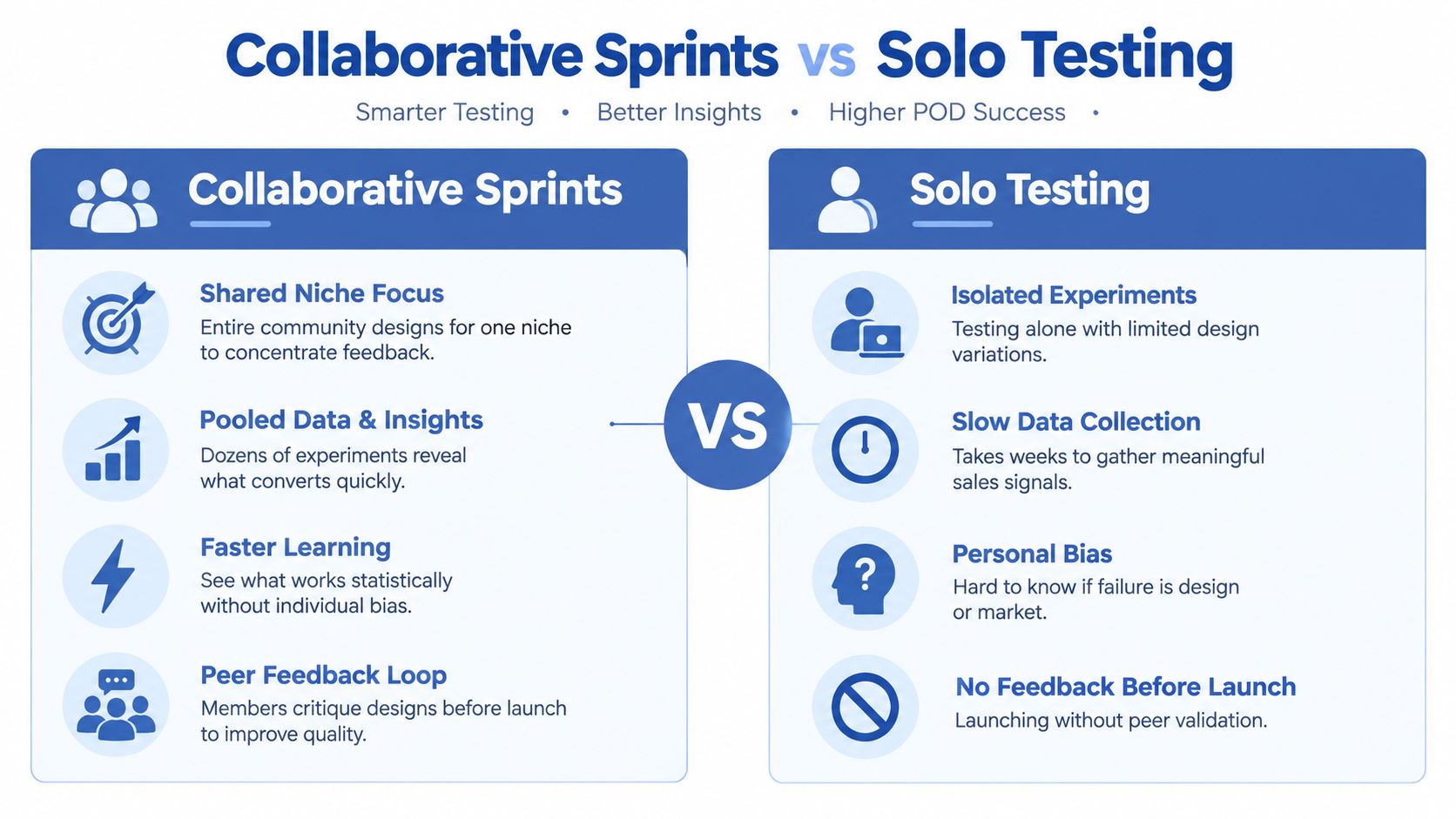
A testing sprint turns community activity into shared evidence. Choose one niche, define a test window, standardize member reports, and review the combined learning afterward. The goal is faster, better decisions, not certainty or a promise that one seller's result represents the market.
A dog-lovers sprint could examine breed-specific apparel. A gaming sprint might compare design variations and advertising angles. A fitness apparel sprint could collect feedback before launch, then follow the listing and early customer response. Members retain control of their stores and commercial choices, while the group gains a consistent way to exchange observations.
Use AvatarIQ to prepare mockups quickly, then record each test in a shared spreadsheet. Useful fields include the design, mockup link, niche angle, launch status, sales, ad spend, and conversion rate, when members choose to share them. Set clear permissions and offer anonymized reporting so participation does not require exposing private business details.
Set a small operating system:
- Choose one niche: Focused feedback is more useful than scattered opinions.
- Set one question: Test a specific design, message, or product decision.
- Check in daily: Brief updates maintain momentum without creating meeting overload.
- Share aggregate findings: Publish patterns while protecting individual members.
- Separate signal from noise: Treat early results as directional, not definitive proof.
Measure designs submitted, feedback quality, tests launched, product output, repeat participation, and sales conversations generated by the sprint. Compare each seller's results with their own historical baseline, since community benchmarks can vary too widely to guide decisions reliably (ASAE Center).
10. Supportive Culture and Vulnerability-First Communication
Members won't share useful learning if they expect embarrassment after a failed test. A seller who spent money promoting a design that received no orders may have the most valuable lesson in the room, but only if the culture allows them to explain the targeting, creative, offer, and next move without shame.
Create a dedicated channel such as The Pivot Zone for setbacks, failed designs, confusing customer feedback, and experiments that didn't meet expectations. Ask members to structure posts around what they tried, what happened, what they think caused it, and what they'll change. That format turns vulnerability into analysis.
Leaders need to model the behavior. A coach can explain that a niche test underperformed, show the product decisions involved, and invite members to challenge the assumptions. Members should see that the community values thoughtful learning, not only screenshots of wins.
Use clear community rules covering respectful feedback, confidentiality, harassment, promotional behavior, and moderation decisions. Research on moderation supports this operational focus. One paper describes rule-based frameworks that integrate community rules into content moderation, while another found that stronger moderation policies and enforcement correlated with greater civility in subreddit discussions (rule-based moderation research).
Culture standard: Critique the decision, not the person. Ask curious questions before assigning blame.
Track the number of setback posts, substantive replies, follow-up experiments, moderation incidents, sentiment, and whether members continue participating after sharing a failure. A positive culture isn't permissive chaos. It combines psychological safety with clear standards, timely moderation, and honest commercial analysis. This building positive team cultures guide provides additional perspective on the conditions that help people contribute openly.
10-Point Comparison of Community-Building Strategies
| Strategy | Implementation Complexity 🔄 | Resource Requirements ⚡ | Expected Outcomes & Use Cases 📊 | Key Advantages ⭐ | Tips 💡 |
|---|---|---|---|---|---|
| Niche-Based Community Groups | Moderate, needs curation and segmentation | Low–Moderate, community manager, niche channels | High relevance & engagement; ideal for testing niche products and targeted feedback | Deep peer insight, higher retention, organic ambassadors | Start with 1–2 niches; use AvatarIQ; host weekly niche talks |
| Live Coaching, Weekly Q&A & Direct Founder Mentorship | High, scheduling, prep, and coordination | High, expert time, booking system, recordings | Rapid skill growth and accountability; best for members needing hands‑on support | Personalized acceleration, real‑time problem solving | Fix schedules, collect questions in advance, record sessions |
| Student Success Stories & Case Studies | Low–Moderate, collect, edit, and verify stories | Low, interviews, content production | Strong social proof and replicable roadmaps; useful for onboarding and marketing | Builds credibility, provides concrete playbooks | Include setbacks, metrics, timelines; be transparent |
| Asynchronous Discussion Forums & Knowledge Bases | Moderate, taxonomy, search, moderation | Moderate, platform, moderators, tagging | 24/7 support and searchable knowledge; suited for scaling communities | Evergreen resource, reduces duplicate questions | Pin key resources, organize categories, assign moderators |
| Accountability Partners & Peer Mastermind Groups | Moderate, matching and facilitation | Low, meeting tools, simple tracking sheets | Improved follow‑through and peer learning; good for consistent practice | Higher commitment, deeper peer feedback | Limit groups to 4–6, set clear expectations, use shared tracker |
| Content Co‑Creation & Member Contributions | Moderate, curation and quality control | Low–Moderate, templates, editing, incentives | Sustainable content pipeline and increased member ownership | Diverse perspectives, lowers coach workload | Offer templates, compensate contributors, feature work prominently |
| Exclusive Member Benefits & Recognition Programs | Moderate, define tiers and reward rules | Moderate, perks, tracking, admin overhead | Increased retention and aspirational progression; fits retention strategies | Clear progression, motivates desired behaviors | Base tiers on milestones, celebrate soft wins, allow opt‑out |
| Themed Challenges & Design Competitions | Moderate, rules, tracking, judging | Moderate, organizers, prizes, leaderboards | Engagement spikes and rapid iteration; great for ideation bursts | Generates content, builds momentum and camaraderie | Offer tiers, celebrate participants, time challenges well |
| Collaborative Design & Product Testing Sprints | High, coordination, data collection, transparency | High, shared tracking, analysis, facilitation | Fast, statistically meaningful market signals; ideal for validating designs | Pooled data, removes individual bias, accelerates learning | Run one niche per sprint, use shared spreadsheet, daily check‑ins |
| Supportive Culture & Vulnerability‑First Communication | High, sustained leadership modeling and moderation | Low–Moderate, coach time, moderation | Deeper trust, more experimentation; suited for long‑term learning communities | Encourages risk‑taking, accelerates shared learning | Leaders model failures, create dedicated setbacks channel, publish values |
Turn Conversations Into Consistent Momentum
You don't need to launch every community building strategy at once. Start with one audience, one platform, one recurring interaction, and a short KPI dashboard. For a POD seller, that might mean a focused dog-lover group on Discord, a weekly design feedback thread, a searchable collection of the best answers, and a simple record of active participants, designs reviewed, launches, and sales conversations.
Choose metrics that show whether the community is creating business value without reducing every interaction to revenue. A practical framework tracks engagement, growth, retention, and contribution, then adds sentiment so behavioral activity has context (ASAE Center's community measurement framework). Engagement can include replies, feedback, call attendance, and sprint participation. Growth can include qualified new members. Retention can show whether members return and continue contributing. Contribution can include answers, tutorials, design reviews, and shared experiments.
Platform-style dashboards can go further by combining ROI, operating cost, support cost, CAC, lead generation, conversion rate, DAU/MAU, stickiness, event attendance, referral rate, NPS, churn, knowledge-base contributions, and community-generated content. Discourse's community metrics overview outlines this broader product-style approach. You don't need every metric on day one. Pick the few that connect directly to the behavior you're trying to improve.
Email digests can keep members connected when they miss live conversations. Benchmark reporting has found community digest open rates ranging from 44% to 56%, while another report cited an average of 43% and personalized digests reaching 59%, compared with a 36% industry benchmark (Higher Logic's association community benchmarks). Use a digest to surface unanswered questions, useful tutorials, member wins, and upcoming sprints, not just announcements.
The long-term opportunity is especially promising for smaller, high-value communities. Recent trend reporting points toward micro-communities built around deeper engagement, membership value, rituals, retention, and monetization rather than maximum audience size (Circle's 2025 community trends report). Durable communities also compound through repeated participation. Communities older than five years in one benchmark averaged 673 logins and about 203 new threads per month, which reinforces the value of consistency over campaign spikes (Circle's community trends reporting).
For your first operating cycle, pair a niche group with accountability partners, searchable answers, and a periodic design or testing sprint. Use AvatarIQ when faster design variations and mockup creation help members run more experiments without adding unnecessary production friction. If you want structured POD guidance, Skup's Apparel Cloning System and Incubator offer relevant next steps, with the former focused on a systematic approach to discovering and replicating winning product ideas through unique designs, and the latter built around coaching, mentorship, and community accountability.
The opportunity in POD is real, but sustainable progress still comes from disciplined work. Every useful answer reduces friction for another seller. Every honest experiment improves the group's judgment. Every shared win gives members a reason to return and contribute again. Build that rhythm carefully, and your community can strengthen both the people inside it and the businesses they're building.
Skup offers POD-focused education, community accountability, live coaching, mentorship, and tools such as AvatarIQ to help sellers turn ideas into tested apparel products. Visit Skup to explore the Apparel Cloning System and Incubator, then choose the level of support that matches where you are in your POD journey.