Is Polyester Stretchy: A POD Seller’s Fabric Guide
100% polyester on its own has very little stretch, roughly 1% to 5%, and the give you feel almost always comes from knit construction or an elastane blend, not the polyester fiber itself. A polyester knit can feel flexible, while a polyester-spandex fabric can provide substantial stretch and recovery.
You're probably asking this while comparing blank apparel that looks nearly identical on a supplier page. One tee seems smooth and structured, another looks softer and more flexible, and you're trying to predict whether customers will find the fit comfortable, restrictive, clingy, or loose after washing. For a POD seller, that small fabric detail can affect sizing charts, mockups, product descriptions, and return conversations.
The useful question isn't only “is polyester stretchy?” It's also: where does the stretch come from, and does the garment recover its shape afterward? Fiber content, fabric construction, and recovery behavior work together. Once you understand those three levers, polyester blanks become much easier to evaluate.
Table of Contents
- What the Stretch Question Really Means for Your Apparel
- How Stretch Is Measured and Why Numbers Vary
- Knit vs Woven Construction and Why It Changes Everything
- How Polyester Compares to Cotton, Spandex, and Common Blends
- Stretch vs Recovery and Why Recovery Matters More
- Choosing Polyester Blanks That Fit Your POD Designs
- Key Takeaways and Common Polyester Stretch Questions
What the Stretch Question Really Means for Your Apparel
The short answer is straightforward. 100% polyester has very little natural stretch, generally around 1% to 5% depending on how the fabric is made, as described in this polyester stretch guide. Polyester was engineered for durability, wrinkle resistance, and shape retention. It behaves more like a strong, stable filament than a rubber band.
That doesn't mean every polyester garment feels rigid. A polyester jersey tee can flex when you pull it across the chest. A polyester athletic top may move easily during exercise. In those cases, the flexibility usually comes from the loops in a knitted fabric or from elastane, also called spandex, added to the blend.
Start with the garment's intended fit
Suppose you're choosing between a relaxed polyester tee and a fitted performance shirt. If you assume both have the same behavior because both say “polyester,” you may create a mismatch between the product, the size chart, and the customer's expectations.
A low-stretch woven garment needs enough room in its cut for movement. A knitted garment can conform to the body more easily. A polyester-spandex style may fit close to the body while still allowing the wearer to bend, reach, and sit comfortably.
That distinction matters in POD because buyers make decisions from limited information. They see your product images, read the description, check the measurements, and decide whether the garment matches the way it looks. If a mockup suggests a flexible athletic fit but the blank is a rigid woven polyester item, the buyer may describe the order as inaccurate even if the printed design is perfect.
Practical rule: Treat stretch as a product specification, not as a vague fabric personality.
Use three checks before you list
When you research a blank, check these details in order:
- Fiber content: Is it 100% polyester, or does it include elastane or spandex?
- Construction: Is it jersey, rib, interlock, French terry, twill, oxford, or another structure?
- Recovery: Does the material return to its original shape after tension, washing, and heat exposure?
This kind of product research fits naturally into a wider POD research knowledge base, especially when you're comparing blanks rather than choosing only by color or wholesale price. A clear understanding of fabric behavior helps you select products that support the design instead of forcing the design to compensate for the wrong garment.
How Stretch Is Measured and Why Numbers Vary
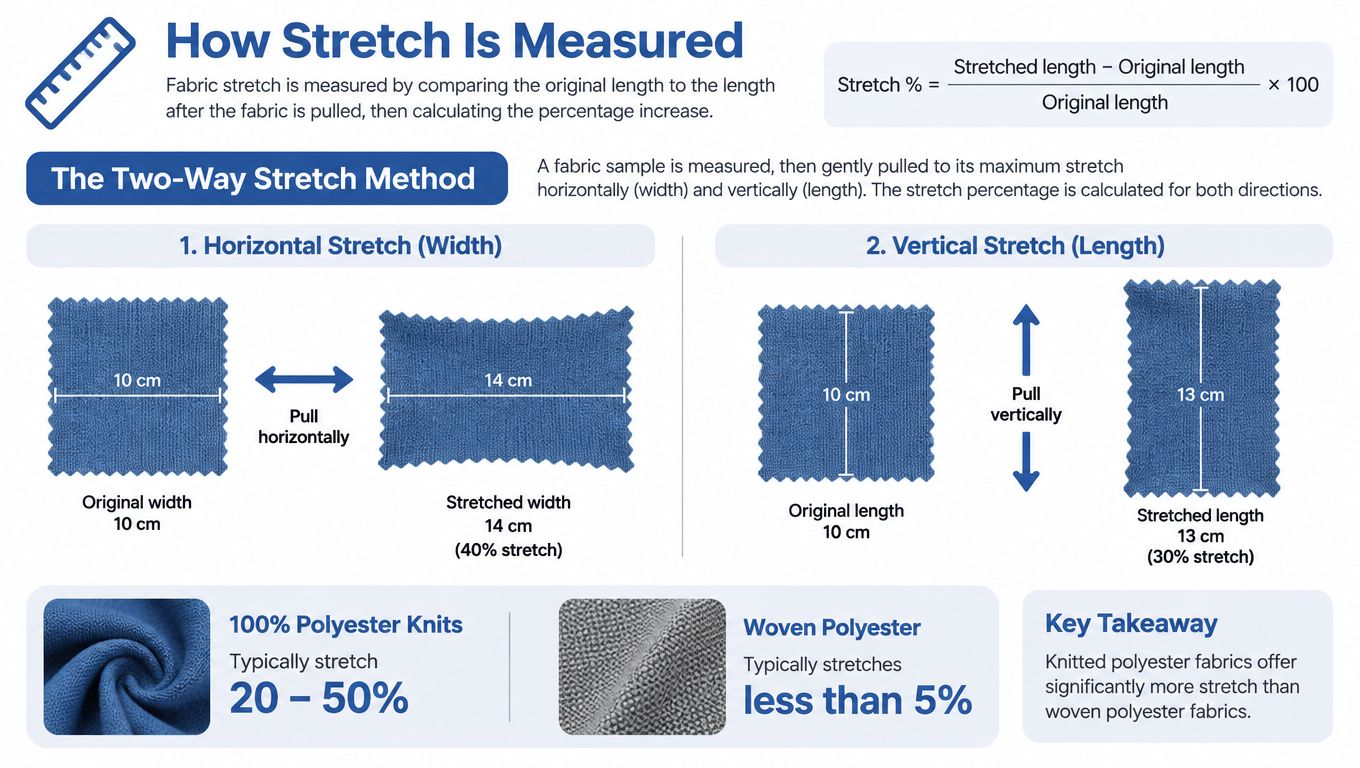
Fabric suppliers don't measure stretch by pulling a garment with their hands and describing it as “very stretchy.” A standard approach begins with a fabric sample. The sample is marked at a known distance, pulled in one direction with controlled force, and measured again. The increase in length is compared with the original length to produce a stretch percentage.
For example, if a marked section becomes longer under tension, the difference between the first measurement and the second represents elongation. Testing may also be performed in both directions, usually across the fabric and along its length. That's why product pages may mention two-way stretch or four-way stretch rather than giving one general description.
The important detail is that the result describes the finished fabric construction, not an isolated polyester filament. A knitted structure can create mechanical give even when the polyester fiber itself has low elasticity. A woven structure can restrict movement even when the garment feels lightweight.
Read ranges as clues, not promises
Supplier language often groups materials into practical categories such as:
- Low stretch: under 15%
- Mid stretch: 15% to 30%
- High stretch: above 30%
Those ranges can help you compare products, but they don't tell the whole story. The test force, direction of pull, fabric weight, finishing process, and recovery standard can all influence how the number translates to everyday wear.
A supplier may list two garments as 100% polyester while reporting very different stretch values. One might be a tightly woven outer layer. The other might be a loose jersey knit with mechanical give. The label is the same, but the construction is doing different work.
Ask what the number represents
Before relying on a stretch figure, look for the test direction and composition. A product page that says “stretch” without explaining whether the material stretches across the body, vertically, or both leaves an important question unanswered.
For POD decisions, pair the stretch figure with the cut and use case. A casual tee doesn't need the same behavior as an athletic top. You're not searching for the highest number. You're looking for a predictable relationship between fabric movement, garment shape, and the customer's intended use.
Knit vs Woven Construction and Why It Changes Everything
The easiest way to understand polyester construction is to compare a woven fabric with a knitted one.
A woven fabric resembles a tight grid. Threads cross over and under each other at fixed angles, like a window screen. That structure is stable, which makes woven polyester useful for garments that need shape, coverage, or resistance to movement. It generally offers little give unless the fabric includes elastane or has been specially engineered.
A knit fabric works more like a chain of connected loops. Pull the loops sideways and they open; release them and they can move back toward their original arrangement. The polyester yarn itself may not elongate much, but the loop structure creates mechanical stretch.
Construction changes the feel
Weft knits, including jersey, rib, and interlock, usually provide the most familiar apparel stretch. Jersey often gives across the body, rib knit can expand noticeably around the wearer, and interlock offers a denser, smoother structure with controlled flexibility.
Warp knits use a different loop arrangement and often provide more controlled movement. They can feel stable while still allowing useful flexibility, which is valuable in performance garments and fitted products.
Most woven polyester products, including oxford, twill, and chiffon constructions, sit close to minimal stretch unless another feature adds flexibility. The exact behavior depends on the supplier's specification, but the construction gives you a strong starting clue.
| Construction | Typical Polyester Stretch | Common POD Use |
|---|---|---|
| Woven polyester | Near 0% to 5% | Windbreakers, outerwear, structured panels |
| Polyester jersey knit | Roughly 20% to 40% | T-shirts, casual tops, sports jerseys |
| Engineered stretch polyester | Up to 500% of original size in some constructions | Performance apparel and specialized fitted garments |
The ranges in this comparison reflect the construction examples described by Printful's polyester stretch guide. They're useful for orientation, but always confirm the exact blank specification before listing it.
Map construction to the product
A polyester jersey tee can work well for a relaxed graphic design because the fabric has enough mechanical give for ordinary movement. A woven polyester windbreaker lining may feel smooth and durable, but it won't behave like a stretch shirt. A polyester-spandex athletic top combines the knit structure with elastic fiber, making it a better match for fitted designs and active movement.
For a seller comparing several garment categories, POD product research resources can support the sourcing process. The central lesson remains simple: fiber content tells you what the yarn is made from, while construction tells you how the garment moves.
How Polyester Compares to Cotton, Spandex, and Common Blends
Polyester makes more sense when you compare it with fibers customers already recognize. Cotton can feel soft and comfortable, but it doesn't provide the same shape retention as polyester. Spandex can extend dramatically and recover its shape, but it usually appears as a supporting fiber rather than the main material in everyday POD apparel.
A 100% woven polyester fabric is generally around 1% to 5% stretch, while a 100% cotton woven fabric is often around 3% to 10% and tends to have weaker recovery. By contrast, 100% spandex or elastane may stretch around 500% to 700% of its original length, according to this fabric blend guide.
The comparison becomes more useful when you consider blends. A polyester-cotton garment may feel softer and more breathable than plain polyester, but the blend doesn't automatically become highly elastic. The construction still determines much of the day-to-day give.
| Fabric Type | Typical Stretch % | Recovery | Best POD Use Case |
|---|---|---|---|
| 100% woven polyester | 1% to 5% | Strong shape retention | Structured apparel and outerwear |
| 100% cotton woven | 3% to 10% | Weaker recovery | Relaxed, natural-feel products |
| 100% spandex or elastane | 500% to 700% | Very high when properly made | Specialized stretch garments |
| Polyester-spandex blend | Varies by construction and blend | Generally strong | Athletic, fitted, and movement-focused apparel |
Choose the blend for the job
A poly-cotton tee can be a sensible choice for everyday fashion designs. It can combine polyester's durability and shape retention with a softer hand feel. A tri-blend may add a lighter, more lived-in feel through the use of cotton, polyester, and rayon, but it doesn't change the basic principle that construction and elastic content control stretch.
Poly-spandex blends are the better fit for garments that must move with the body. Even a modest amount of elastane can change how a shirt responds to tension because elastane supplies the elastic behavior while polyester contributes structure, durability, and other performance characteristics.
A 5% spandex jersey can feel like a flexible performance tee without feeling like a compression garment. The dominant fiber still influences the surface, weight, moisture behavior, and hand feel, while the elastane percentage affects the stretch ceiling and recovery potential.
The right blend isn't the one with the most stretch. It's the one that supports the way your customer intends to wear the product.
For POD, use the design's role as your filter. Athletic graphics and fitted silhouettes benefit from elastic content. Casual fashion tees can work well with polyester-cotton or knitted polyester. Heavyweight blanks can remain mostly cotton when stretch isn't central to the product promise.
Stretch vs Recovery and Why Recovery Matters More
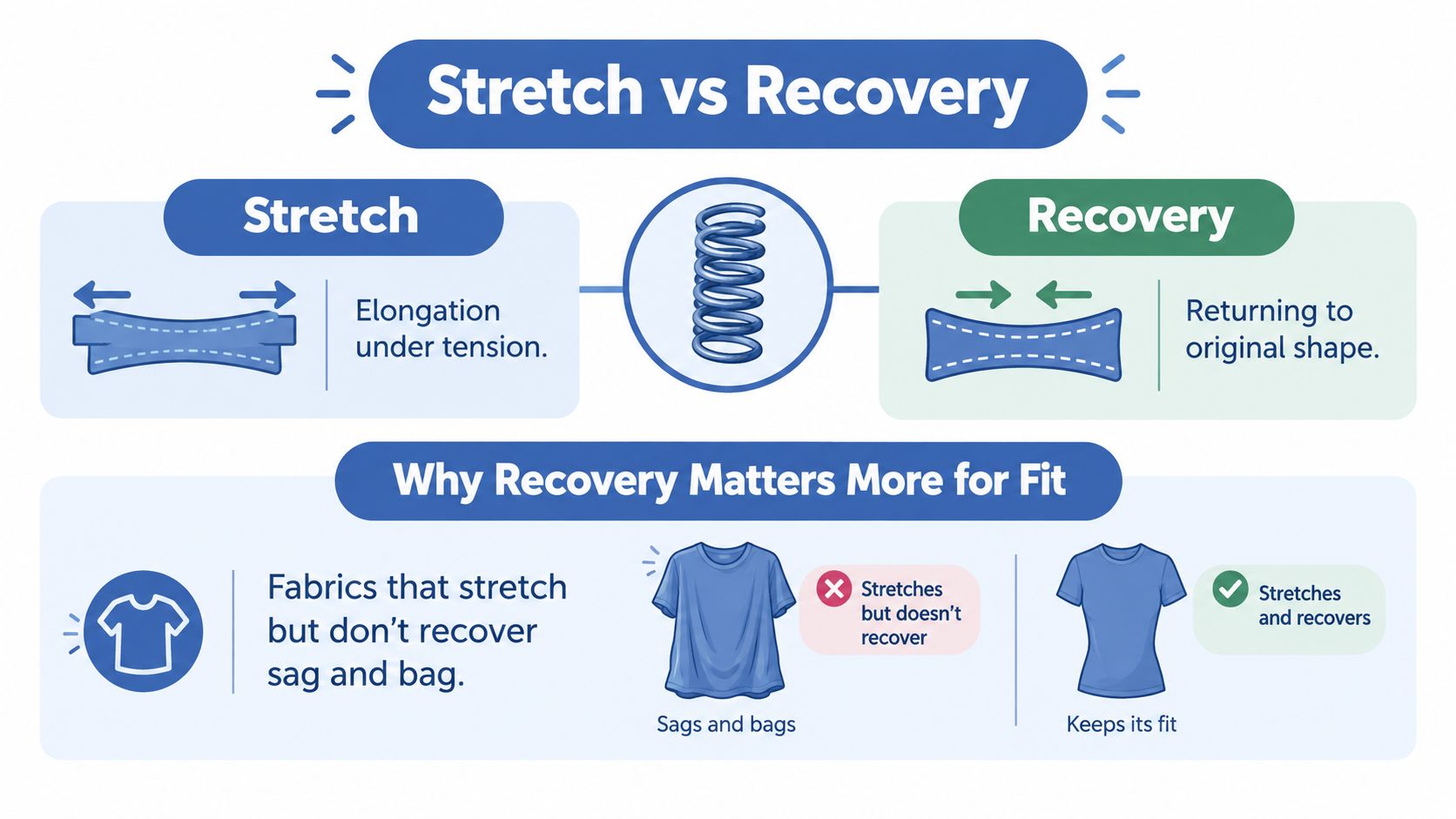
Stretch tells you how far a fabric can extend under tension. Recovery tells you how well it returns to its original shape after the tension disappears. Those are related qualities, but they aren't interchangeable.
A fresh rubber band demonstrates strong recovery. It stretches and then returns close to its starting form. An old rubber band may still extend a long way, but it can remain loose and distorted afterward. Clothing behaves in a similar way. A garment can offer impressive initial stretch and still lose its fit if the fabric doesn't recover well.
This distinction matters for product quality because buyers notice sagging quickly. A waistband that stays loose, a hem that twists, or fabric that bags at the elbows can create more dissatisfaction than a garment that feels firm at first.
Why elastic blends help
A polyester-spandex garment can combine substantial elongation with strong recovery. The exact result depends on the blend, knit, finishing, and care, but elastane is the component that gives the fabric its elastic response. Polyester alone can flex through its construction, yet it doesn't provide the same elastic memory as a dedicated elastane fiber.
Cotton can also stretch during wear, but it generally has weaker recovery. Repeated tension and washing can change its shape, particularly when heat or rough care adds more stress. Polyester's shape retention often makes it a more predictable base, while elastane improves movement and return.
Apply recovery to return prevention
For a POD seller, recovery is a practical sizing signal. If a fitted product relies on stretch to fit across the body, it also needs enough recovery to stay consistent after repeated wear. If it doesn't recover, the customer may describe the garment as stretched out or poorly sized.
Care and finishing influence this result. High heat can distort polyester, while heat-set synthetics resist both shrinking and stretching. Guidance from this polyester care and stretch resource also emphasizes that two garments with similar fiber content can behave differently after washing, heat exposure, and repeated tension.
That gives you a better product description angle. Don't promise only “stretchy.” Explain whether the fabric is designed for relaxed movement, close fit, or shape retention, and support the claim with the supplier's construction and care information.
Choosing Polyester Blanks That Fit Your POD Designs
Fabric selection becomes easier when you begin with the design's intended fit instead of the garment label. A bold oversized graphic, a fitted gym top, and a lightweight fashion illustration can all be printed successfully, but they shouldn't necessarily use the same blank.
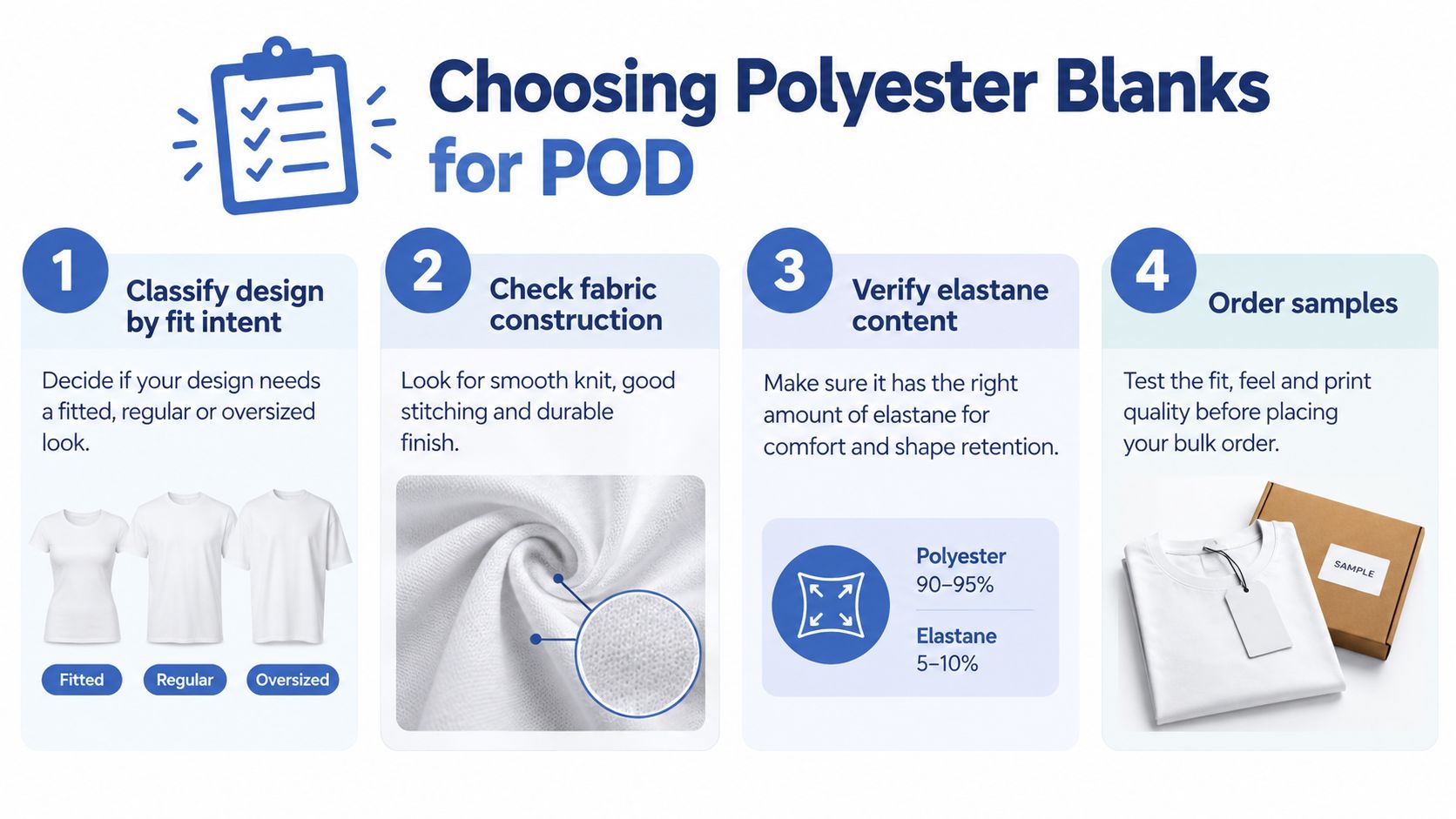
Use a four-step selection process
1. Classify the fit intent. Decide whether the product should feel relaxed, fitted, drapey, or structured. A casual slogan tee can tolerate limited stretch, while an athletic design needs movement and recovery.
2. Match the construction. Choose jersey knit for a familiar relaxed tee, interlock or rib knit for a more fitted feel, and French terry when you want a midweight product with a softer structure. Reserve woven polyester for items such as outerwear, panels, or garments where stability matters more than body-hugging movement.
3. Verify elastane content. If the product needs real elasticity, check whether the blank includes spandex or elastane. Don't infer stretch from the word “performance” alone. The fiber percentage and construction should support the fit you're presenting.
4. Order samples and wash-test them. Try the actual size range, move in the garment, inspect the print area, and follow the care label. A sample can reveal drape, cling, seam tension, and recovery issues that a supplier photograph won't show.
Match sizing and mockups to reality
Stretchy poly-spandex blanks may fit closer to the customer's usual size because the fabric can accommodate movement. Woven polyester items usually need more ease in the cut, and customers may prefer additional room for bending and reaching. Don't automatically tell buyers to size up or down. Compare the garment measurements with the fit your listing promises.
Your mockup also needs to show the correct behavior. A flowing image can make a rigid woven product look softer than it is. A sharply fitted mockup can make a relaxed knit look more compressive than the actual blank. AI-generated mockups should reflect the actual garment's drape, surface, and silhouette, not an idealized version that sets the wrong expectation.
Tools such as AvatarIQ can help create apparel designs and product mockups, but the source garment still determines whether the final listing feels accurate. For an additional product-checking step, you can use Skup's Product Grader to evaluate product decisions before publishing.
A reliable sample process protects more than the first sale. It helps reduce “item not as described” complaints, makes your size guidance more credible, and gives you confidence when building a larger collection around a successful blank.
Key Takeaways and Common Polyester Stretch Questions
The answer to is polyester stretchy depends on what you mean by polyester. The fiber itself has very little stretch. Knit construction creates mechanical give, elastane adds true elasticity, and recovery determines whether the garment keeps its fit after tension and care.
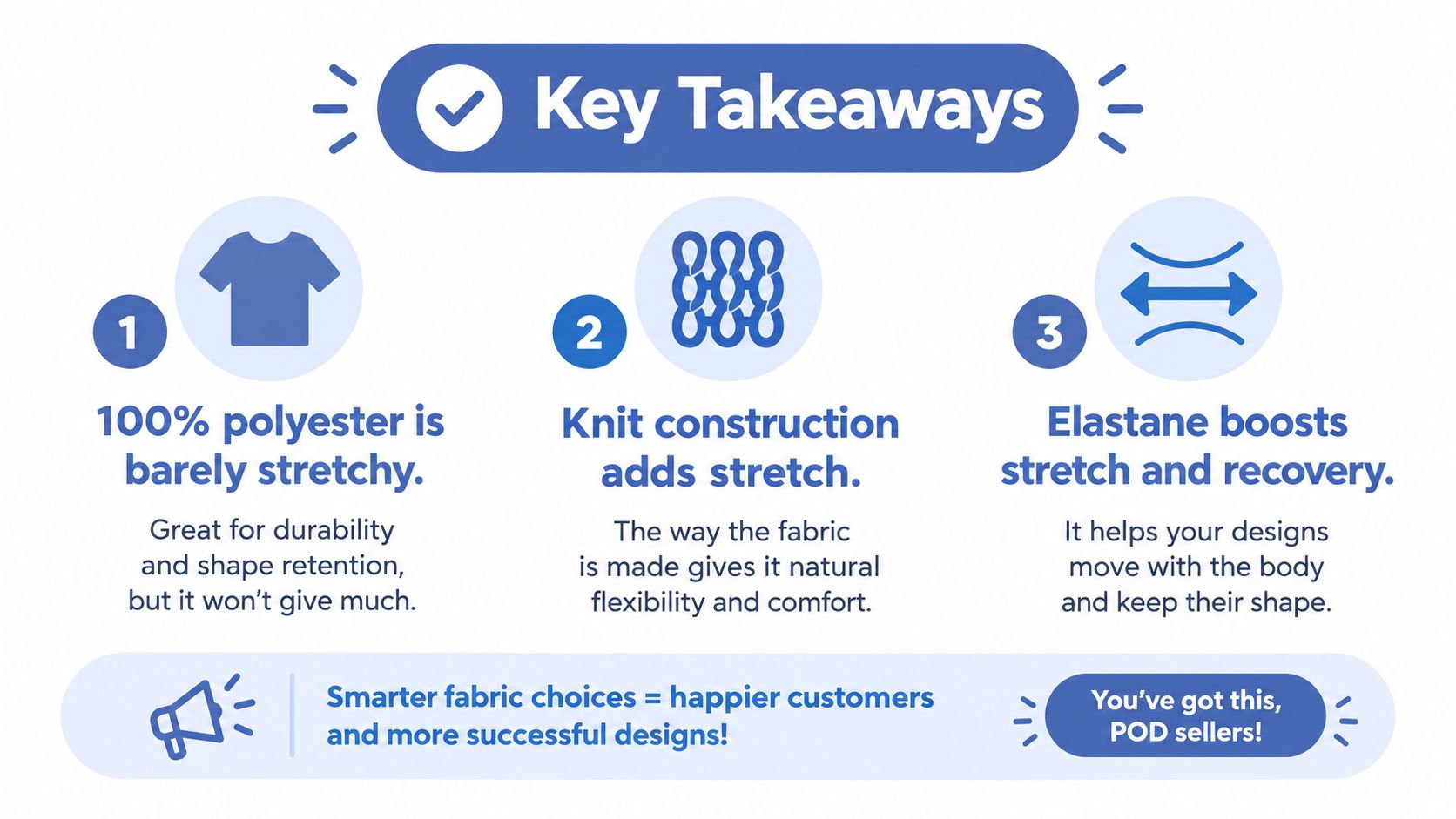
Keep these three points in mind:
- 100% polyester has limited stretch: Expect stability rather than natural elasticity from the fiber alone.
- Knit construction adds movement: Loops can flex more readily than the fixed grid of a woven fabric.
- Elastane improves stretch and recovery: A small amount can transform how a fitted polyester garment feels and performs.
Does polyester stretch when wet?
Plain polyester generally stays dimensionally stable through ordinary washing, but heat and finishing affect the result. A knitted garment may relax under tension, while high heat can distort polyester. Follow the care label and test the actual blank before making a strong fit promise.
Does polyester shrink in the dryer?
Polyester resists shrinking and stretching, but high heat can distort synthetic fibers. Use the supplier's care instructions, and avoid presenting a heat-sensitive blend as completely maintenance-free.
Is polyester suitable for plus-size apparel?
It can be, provided the cut, measurements, and recovery suit the intended fit. A low-stretch woven blank may feel restrictive if the pattern doesn't allow movement. A knitted or elastane-containing garment can offer more flexibility, but you still need accurate garment measurements and a representative sample.
Does a polyester-spandex tee feel like compression wear?
Not automatically. A polyester-spandex tee can stretch and recover well while remaining comfortable and moderate in fit. Compression depends on the fabric, blend, garment cut, and construction, not just the presence of spandex.
You've now got a practical way to evaluate polyester blanks. Start with the fit, inspect the construction, confirm the fiber blend, and test recovery before you build the listing. That process turns fabric selection into a confident product decision, and it gives you more room to create POD products customers will enjoy wearing.
Skup helps POD sellers research products, evaluate apparel choices, and build stronger print-on-demand brands with practical systems and tools. Visit Skup to explore resources that can help you turn better fabric decisions into clearer listings and a more confident eCommerce workflow.