Custom Cropped Hoodie Guide: Design to Sales
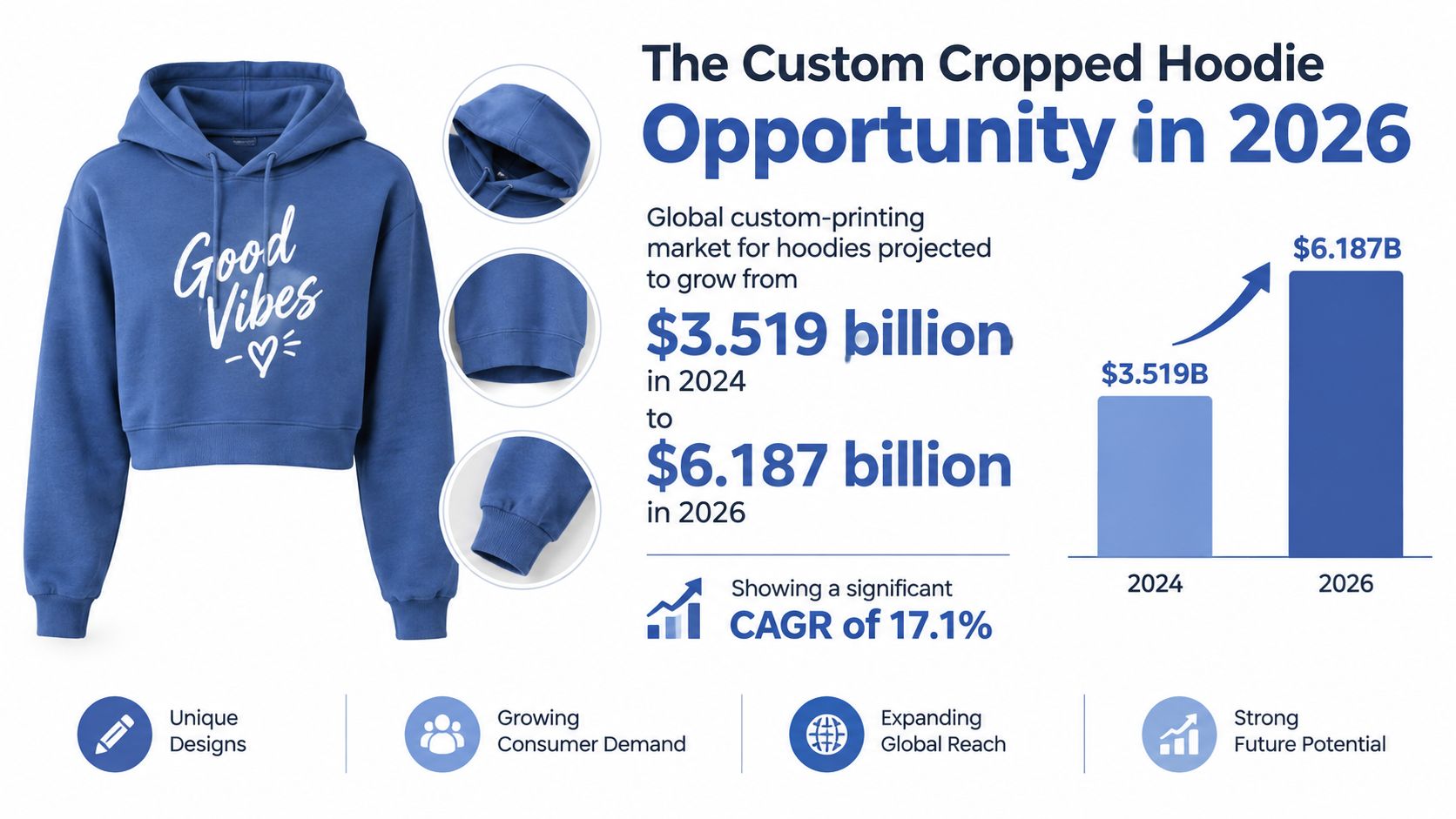
The global custom-printing market for sweatshirts and hoodies was valued at approximately US$3.519 billion in 2024 and is projected to reach US$6.187 billion by 2030, an increase of roughly 75.8% over six years, according to market data on custom-printed hoodies. That growth doesn't make every hoodie idea commercially viable, but it does confirm that personalized hoodies belong to a substantial apparel-decoration category.
A custom cropped hoodie gives you a sharper product angle inside that category. The silhouette carries the comfort and utility people already associate with hoodies, while the shorter body creates a fashion-led canvas for compact graphics, community identity, athletic branding, and niche apparel collections. The opportunity is real, but the sellers who win won't rely on attractive artwork alone. They'll control the fit, fabric, print placement, wash behavior, listing quality, and customer expectations.
Table of Contents
- The Custom Cropped Hoodie Opportunity in 2026
- Designing Eye-Catching Custom Cropped Hoodies with AI
- Mastering Fit and Sizing for Cropped Hoodies
- Choosing the Right Supplier and Fulfillment Partner
- Crafting High-Converting Listings and Ad Copy
- Launching and Scaling Your Custom Cropped Hoodie Business
The Custom Cropped Hoodie Opportunity in 2026
The strongest opportunity is product positioning. A custom cropped hoodie combines a familiar garment with a sharper proportion, so shoppers understand the category while still seeing a distinctive piece for an outfit, group, or identity. That makes the silhouette useful for focused product lines rather than generic hoodie catalogs.
The modern hoodie already carries decades of cultural meaning. The history of the hoodie and its changing cultural role traces the garment to the 1930s, when the Knickerbocker Knitting Company added a hood to a sweatshirt for worker warmth. Military use reinforced its practical reputation, while colleges and universities popularized hooded sportswear during the 1950s and 1960s. Skaters, surfers, and hip-hop culture then pushed it into streetwear during the 1970s, followed by major mainstream exposure from Rocky in 1976.
Cropped silhouettes gained wider visibility through crop-top and streetwear movements, particularly in the early 2000s and later through celebrity-driven social media fashion. The result is a product with several recognizable associations: workwear, athletics, collegiate style, streetwear, and personal expression.
Why the silhouette creates room for niche brands
A standard hoodie can target almost any audience, but that broad appeal also creates heavy competition. The cropped cut gives a brand a clearer starting point and helps shape the design, styling, photography, and customer promise around one recognizable product.
- Fitness communities: Compact chest graphics and sleeve branding suit gym, dance, yoga, and training identities.
- Campus and club culture: A short, boxy shape with a compact emblem can resemble retail apparel more closely than ordinary event merchandise.
- Fan and group apparel: The garment can express belonging without looking like a basic uniform.
- Fashion-led microbrands: Horizontal typography, upper-back graphics, and restrained branding work well on a shorter print canvas.
Category-level forecasts place Asia-Pacific among the largest regional markets in 2024 and identify China as a high-growth country through 2030, according to the market outlook cited earlier. Those figures cover sweatshirts and hoodies collectively, not cropped hoodies alone. Use them as a directional reference when assessing international demand, not as a valuation for this specific silhouette.
Commercial rule: Treat the cropped cut as a product strategy, not a decorative variation. Design, fabric, audience, photography, and size guidance should all reinforce the silhouette.
Fit and shrinkage deserve the same attention as artwork. A cropped body can change noticeably after washing, and small differences in torso length, sleeve volume, or hem position can make the same design feel athletic, relaxed, or overly short. Test the blank, wash it, measure it again, and show those measurements clearly before scaling a listing.
Online selling gives small brands room to test focused concepts without committing to a traditional retail rollout. U.S. e-commerce sales reached an estimated $340.2 billion in the second quarter of 2026, representing 17.1% of total retail sales, while quarterly online sales increased 3.8% from the first quarter, according to the U.S. Census Bureau's e-commerce report. Those figures do not guarantee demand for a particular design. They support a practical process: publish focused concepts, set expectations about fit and wash behavior, monitor customer response, and expand the designs that earn attention.
Designing Eye-Catching Custom Cropped Hoodies with AI
A cropped garment gives artwork less vertical space, so the design has to be composed for the product rather than pasted onto it. Tall illustrations often lose their balance near the hem. Wide wordmarks, compact symbols, sleeve details, and upper-back graphics usually make better use of the available canvas.
A practical AvatarIQ workflow
Start with one audience and one visual promise. “Women's fashion” is too broad to guide a design. A better starting point might be a minimalist dance-studio community, a nostalgic campus audience, or a streetwear customer who prefers understated sleeve branding. The narrower the audience, the easier it is to choose language, symbols, color, and styling.
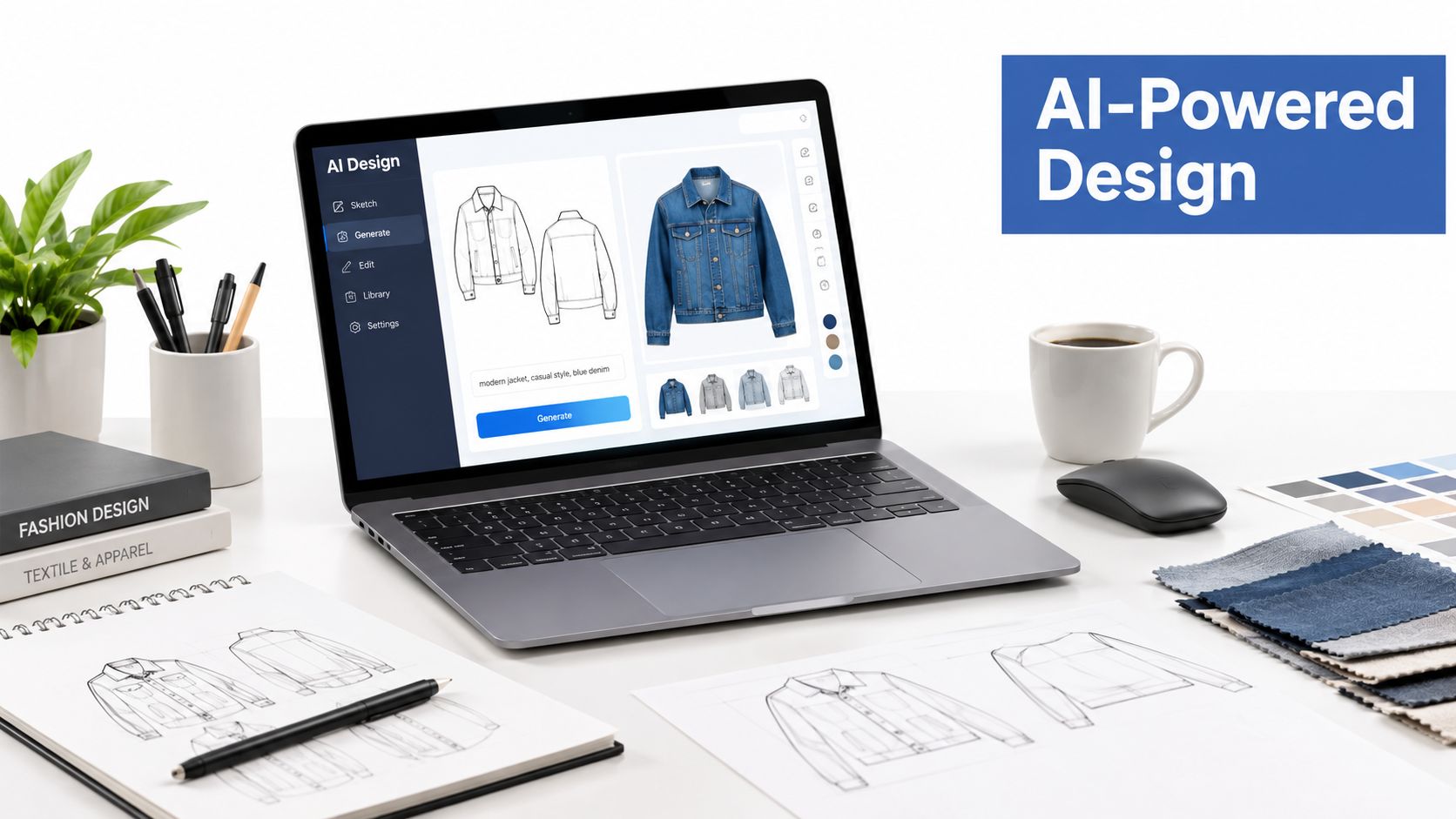
Generate several directions in AvatarIQ. Use the tool to explore distinct concepts rather than asking for endless variations of one weak idea. Test a compact chest mark, a wide front composition, an upper-back graphic, and a sleeve-led treatment. AvatarIQ is useful here because it can support both AI apparel design creation and the mockup stage without requiring you to hire separate creative resources.
Check the print area before approving the artwork. A design may look balanced on a square artboard but crowd the cropped body once placed on the garment. Keep important text away from the hem, allow the hood and neckline to breathe, and inspect how the graphic sits on fitted versus boxy blanks. The RushOrderTees guide to logo placement on cropped apparel offers useful practical context on why cropped garments favor compact, horizontal compositions.
Build a truthful product image. Your mockup should show the actual proportions, print location, garment color, and intended fit. Create a front view, a back or sleeve view where relevant, and at least one lifestyle image that helps shoppers understand the hem position. A beautiful mockup that hides the short body creates avoidable disappointment.
For fan-led products, studying the buying journey in a resource such as how to order custom fan hoodies can help you think beyond the artwork. Fans need clarity around who the product represents, where the design appears, what the garment feels like, and how ordering works. Those same questions matter for every niche.
You can also use Skup's guide to AI clothing design to organize a repeatable design-to-listing workflow. The point isn't to publish every AI output. Generate broadly, reject aggressively, and keep only concepts that remain legible, emotionally relevant, and commercially coherent on the actual hoodie.
Mastering Fit and Sizing for Cropped Hoodies
Fit uncertainty is a major source of friction in online apparel. Size and fit account for roughly 52–58% of apparel returns, while online apparel return rates often reach 20–30%, according to return-reason research from Corso. Cropped hoodies add another decision: shoppers need to know whether the hem will meet the intended waistband, whether the sleeves stay full length, and whether sizing up adds useful coverage or only extra width.
Build guidance around proportions
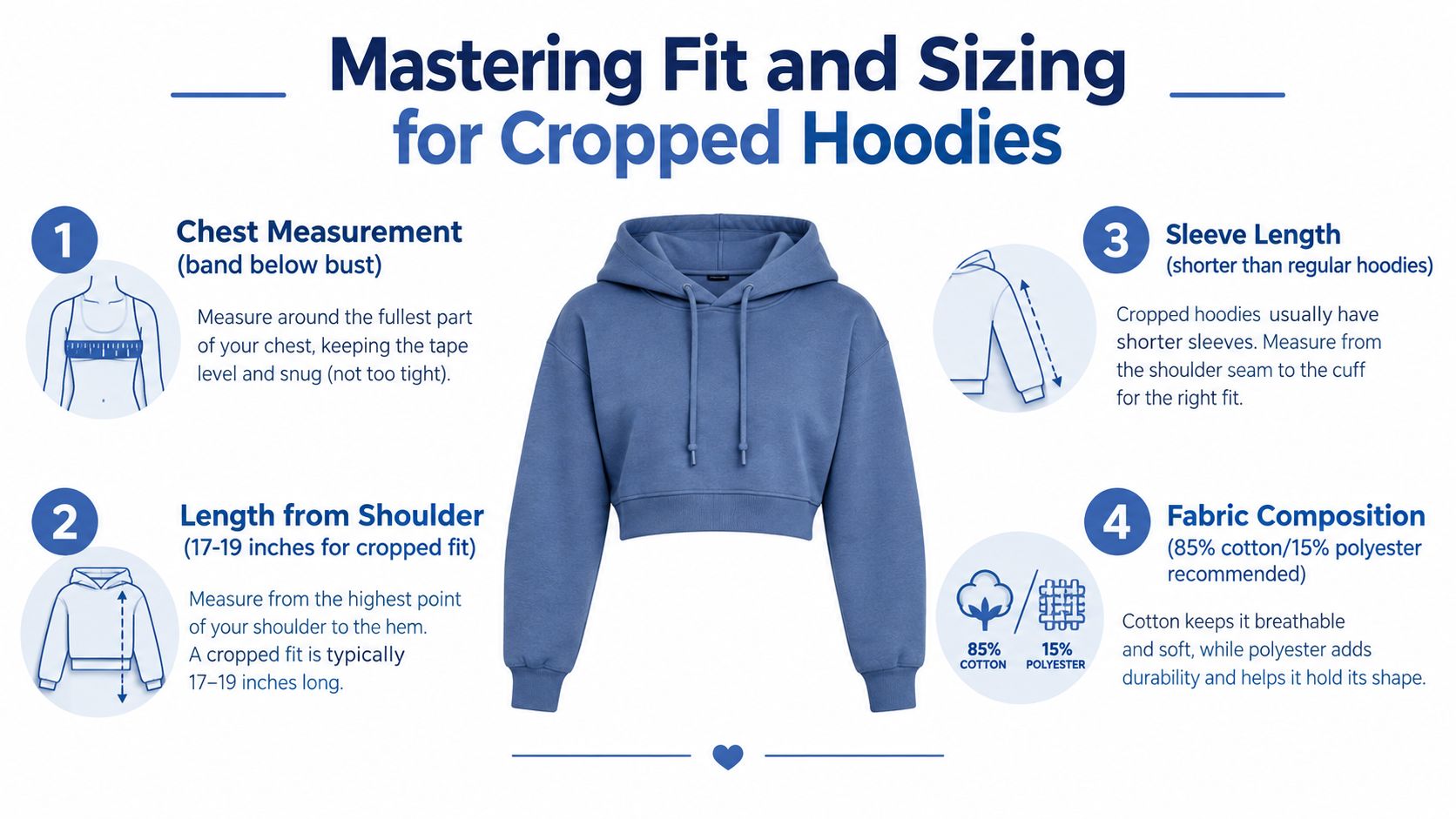
A generic S–XXL chart cannot explain a cropped silhouette. Sizing up may add shoulder and sleeve volume while leaving the torso too short for a long-torso customer. Show both body measurements and finished-garment measurements, including chest, hem, body length, sleeve length, shoulder width, and hood opening.
State the intended waistband position in plain language, then explain how the garment may sit across different bodies:
- Petite customers: Clarify whether the sleeves remain full length and whether the hem may sit near the natural waist.
- Tall or long-torso customers: Show the center-back length and explain that more width does not necessarily provide more torso coverage.
- Fuller bust or broader shoulders: Separate chest and shoulder room from the way the hem fits.
- Relaxed and boxy shoppers: Distinguish a deliberately roomy silhouette from a garment that runs large.
Photographing multiple body types makes the guidance easier to trust. The practical question is: Will this look cropped on me, or will it just look too short? Tools such as how virtual fitting room technology reduces fit uncertainty can help shoppers preview fit before ordering.
Test the garment before production
A “pre-shrunk” label does not guarantee zero dimensional change. Start with a conditioned sample and record the chest, hem, body length, sleeve length, shoulder width, and hood opening. Wash and dry it according to the intended care label, then measure those same points again.
Dimensional change % = (postwash measurement minus prewash measurement) divided by prewash measurement, multiplied by 100.
Use ISO 6330 or AATCC 135 laundering conditions and ISO 5077-style dimensional calculations, as recommended in this hoodie manufacturing and shrinkage guide. A practical benchmark is under 3% shrinkage for standard production and under 2% for premium positioning. Shrinkage above 3–5% can make the hoodie visibly shorter or tighter after purchase.
Check length and width independently. Then inspect side-seam twisting and hem distortion. Knit spirality, panel grain, and seam tension can change the final shape even when overall shrinkage looks acceptable.
Practical rule: For a cropped hoodie, body length and hem width need tighter control than a generic size chart. Small changes in either measurement can alter the entire visual proportion.
Choosing the Right Supplier and Fulfillment Partner
A supplier should earn approval through evidence, not a low blank-garment price. For a custom cropped hoodie, compare the partner's sample quality, decoration consistency, wash performance, fulfillment reliability, integration options, and support process. A cheap product that arrives with inconsistent sizing or weak print coverage can cost more through replacements and customer service.
The Chicago Brandstarters sourcing of products guide is useful background for evaluating suppliers systematically. Apply that mindset to every shortlisted partner, including the one you already prefer.
Compare partners by operational fit
| Evaluation area | What to verify | Why it matters |
|---|---|---|
| Blank specification | Fiber content, conditioned GSM, measurements, construction, and available colors | Product pages need accurate claims, and customers feel differences in weight and hand feel |
| Decoration quality | Physical preproduction sample, artwork scale, placement, coverage, and curing | A sharp digital file doesn't guarantee a clean finished print |
| Postwash behavior | Shrinkage, twisting, hem distortion, cracking, and color change | Cropped proportions are especially sensitive to dimensional movement |
| Fulfillment process | Order routing, tracking, packaging, and support response | Smooth delivery protects the customer experience |
| Scalability | Consistent stock and repeatable production across sizes | A winning design is difficult to grow if the blank disappears from availability |
Select fabric by conditioned GSM using ASTM D3776/D3776M. A commonly cited heavyweight hoodie range is approximately 300–400 GSM, but GSM alone doesn't prove warmth, softness, durability, or finished-garment weight, as explained in this textile inspection checklist. Treat it as one specification, not a quality verdict.
For decoration approval, request a physical sample that shows artwork scale, centerline, vertical placement, and color. Look for smearing, bleeding, incomplete coverage, ghosting, cracking, and curing defects. A practical placement control is about 2 cm or less of variation, while more demanding internal standards may target ±3 mm.
You can compare a fully integrated POD partner with a supplier that offers more manual control. The integrated option generally reduces operational work and supports automated order routing. A more hands-on supplier may provide deeper blank or decoration choices, but you'll need stronger quality-control records and clearer communication. Skup's guide to choosing a POD supplier provides a useful framework for making that comparison.
Record every rejection by defect type and production lot. Require corrective action before scaling. That turns supplier selection into an operating system rather than a one-time guess.
Crafting High-Converting Listings and Ad Copy
A cropped hoodie listing must remove uncertainty before asking for the sale. Show shoppers how the garment looks, where the print sits, how the shortened body fits, what the fabric feels like, and how to care for it. Personalization attracts attention, but precise product information earns confidence.
Lead with the outcome your audience wants. A dance community may value identity and freedom of movement. A streetwear customer may care about proportion, fabric weight, and restrained branding. A fan audience may want a visible sign of belonging. Connect the design to a real wardrobe use, then support the promise with measured details.
Write from the garment outward
A useful title names the garment, silhouette, audience, and customization angle without forcing every keyword into one line. Open the description by confirming the cropped shape and intended fit. Follow with fabric composition, artwork placement, care instructions, and sizing information.
Fit language needs extra care with cropped styles. State the finished body length, chest measurement, and sleeve dimensions, then explain where the hem is expected to sit. If washing can change those measurements, say so plainly. A design that looks balanced in a mockup may feel too short after shrinkage, especially across different body types. Use a model image plus a measurement chart rather than relying on labels such as “true to size.”
Make only claims you can support. If the blank is cotton-heavy, state its verified fiber composition. If it is a blend, explain the trade-off directly. Cotton may feel soft and breathable, while polyester can support shape retention and print performance. Neither fiber choice suits every customer.
Fabric communication deserves space because Cotton Incorporated's global lifestyle research identifies comfort, quality, and durability as leading apparel purchase drivers. The research reports that 75% of surveyed consumers preferred cotton, cotton blends, or denim, while 59% were willing to pay more for natural-fiber clothing. Use those findings to explain the material, not to promise performance your supplier has not tested.
Build ads around specific tensions
Turn verified garment details into a clear reason to click:
- For identity: “A cropped layer for your training crew, studio, or community.”
- For styling: “A shorter body, compact graphic, and streetwear-ready shape.”
- For fit confidence: “Finished measurements and postwash fit shown before you order.”
- For gifting: “Personalized fan apparel made for repeat wear.”
Keep the garment angle and scale consistent across the creative set. Show a close view of the print, a full-body fit image, and a detail that makes the hem position clear. Avoid poses that conceal the crop. A customer should understand the silhouette before delivery, not discover it from the parcel.
Labeling compliance checklist
For U.S. sales, confirm that fiber content, country of origin, and responsible business information appear correctly on the garment label under the Federal Trade Commission's clothing and textile guidance. For European Union sales, list every constituent fiber and its percentage by weight in descending order, using durable, legible, visible, and accessible labeling under the EU textile labeling rules.
For garments with a neck, place the U.S. origin label at the inside center of the neck, midway between the shoulder seams, or very near another label in that position. Apply the FTC Made in USA labeling rules covered in the launch section below. Accurate labeling may not sell the hoodie by itself, but it prevents avoidable customer confusion and protects the brand.
Launching and Scaling Your Custom Cropped Hoodie Business
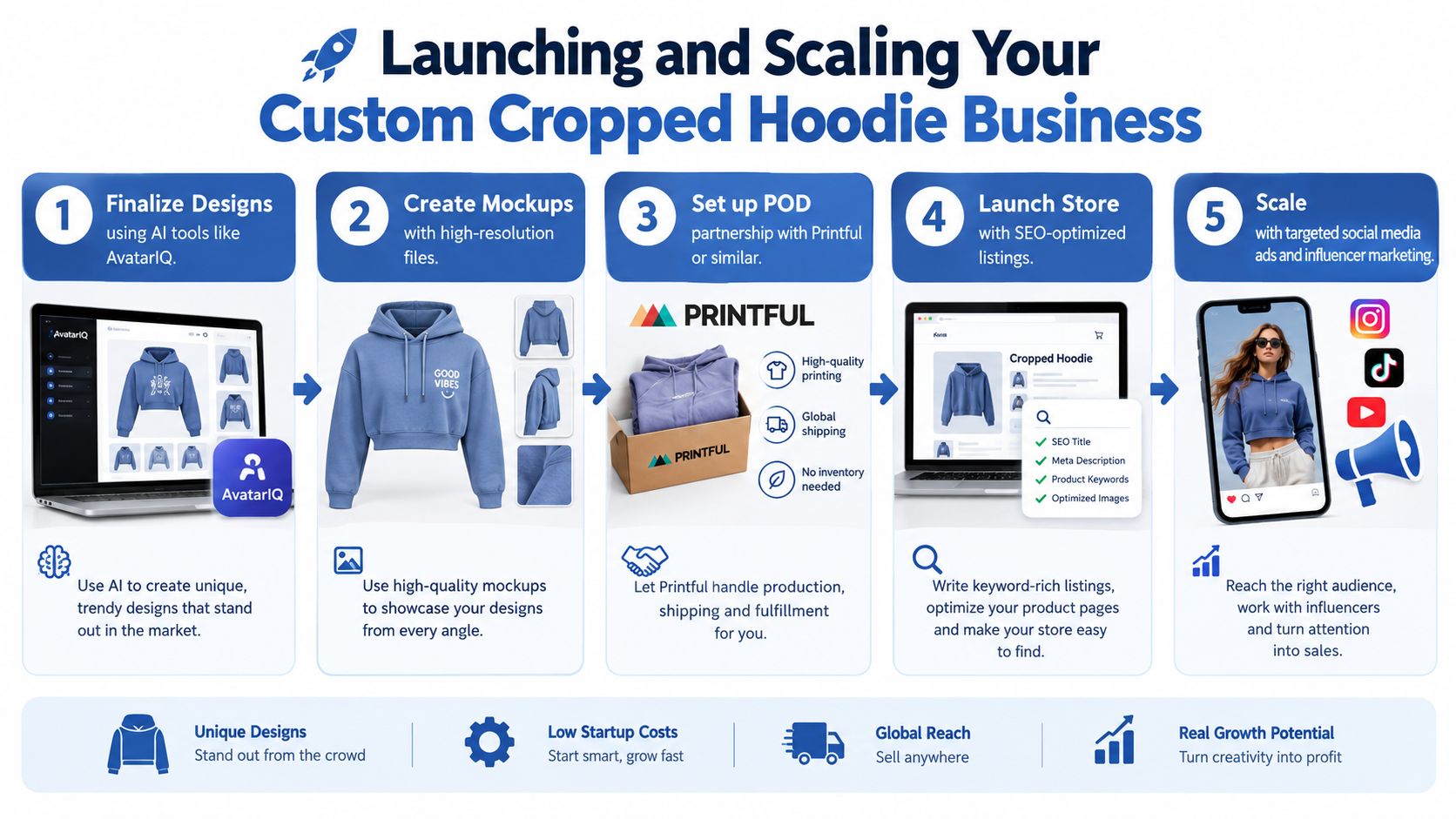
A focused launch gives you cleaner evidence than a large catalog built before you know who responds. Start with designs for one audience, one visual language, and one fit promise. Order a sample before increasing ad spend, then record the garment's measurements before and after washing. Shrinkage and hem movement can change whether a cropped hoodie matches its product photos.
Use a controlled launch sequence
- Finalize the designs: Use AvatarIQ to develop concepts and reject artwork that does not suit the cropped print area.
- Approve the sample: Measure the garment before and after washing, then inspect print quality, proportions, and hem position.
- Build the listing: Add finished measurements, body-type guidance, fiber details, care instructions, and accurate mockups.
- Test the message: Match ad angles to specific audiences instead of promoting a generic “custom hoodie.”
- Scale what earns evidence: Review customer questions, cancellations, fit issues, reviews, and repeat interest before expanding.
For U.S. sales, state clearly in online catalogs and promotional materials whether the product is made in the United States, imported, or both. Follow the FTC origin-disclosure rules and add the wording to your launch checklist before publication.
Use reviews to improve the product page. Repeated questions about sleeve length, hem position, or fabric feel show where the listing needs clearer evidence. Complaints about shrinkage, print quality, or inconsistent sizing point to a supplier or approval-process problem. Update the relevant photos, measurements, or production settings rather than merely collecting more reviews.
This video provides another visual perspective on building a POD apparel workflow:
Your first ninety days should center on one silhouette, one audience, and a measured postwash fit you can prove in listing photos. That evidence gives customers a reason to trust the crop, while repeated fit feedback shows whether the product is ready to scale.
Skup offers print-on-demand training through its Apparel Cloning program and provides AvatarIQ for AI-assisted apparel design and mockup creation. Visit Skup to explore systems and tools for turning a custom cropped hoodie concept into a focused, testable e-commerce product.