How to Launch Print on Demand Socks and Scale to Real Sales
You've got a sock design saved on your phone, a storefront idea taking shape, and one uncomfortable question: will anyone buy it? That hesitation is normal. Socks look small, but the right design turns them into a gift, a conversation starter, a community signal, or a daily piece of identity.
The opportunity is real, but it isn't automatic. You need a niche with a clear buyer, artwork that survives a curved product, a supplier you've physically tested, pricing that protects margin, and listings that answer fit and delivery questions before customers ask them. This guide takes you from the first idea through validation, design, sampling, launch, marketing, fulfillment, and repeatable growth.
Table of Contents
- Why Print on Demand Socks Are a Real Opportunity Right Now
- Validating a Winning Sock Niche Before You Design Anything
- Designing Socks That Sell Using AI-Powered Workflows
- Choosing Suppliers and Running Real Quality Checks
- Pricing, Margins, and the Numbers That Actually Matter
- Listings, Marketing, and Channels That Drive First Sales
- Fit, Returns, and Fulfillment Without the Headaches
Why Print on Demand Socks Are a Real Opportunity Right Now
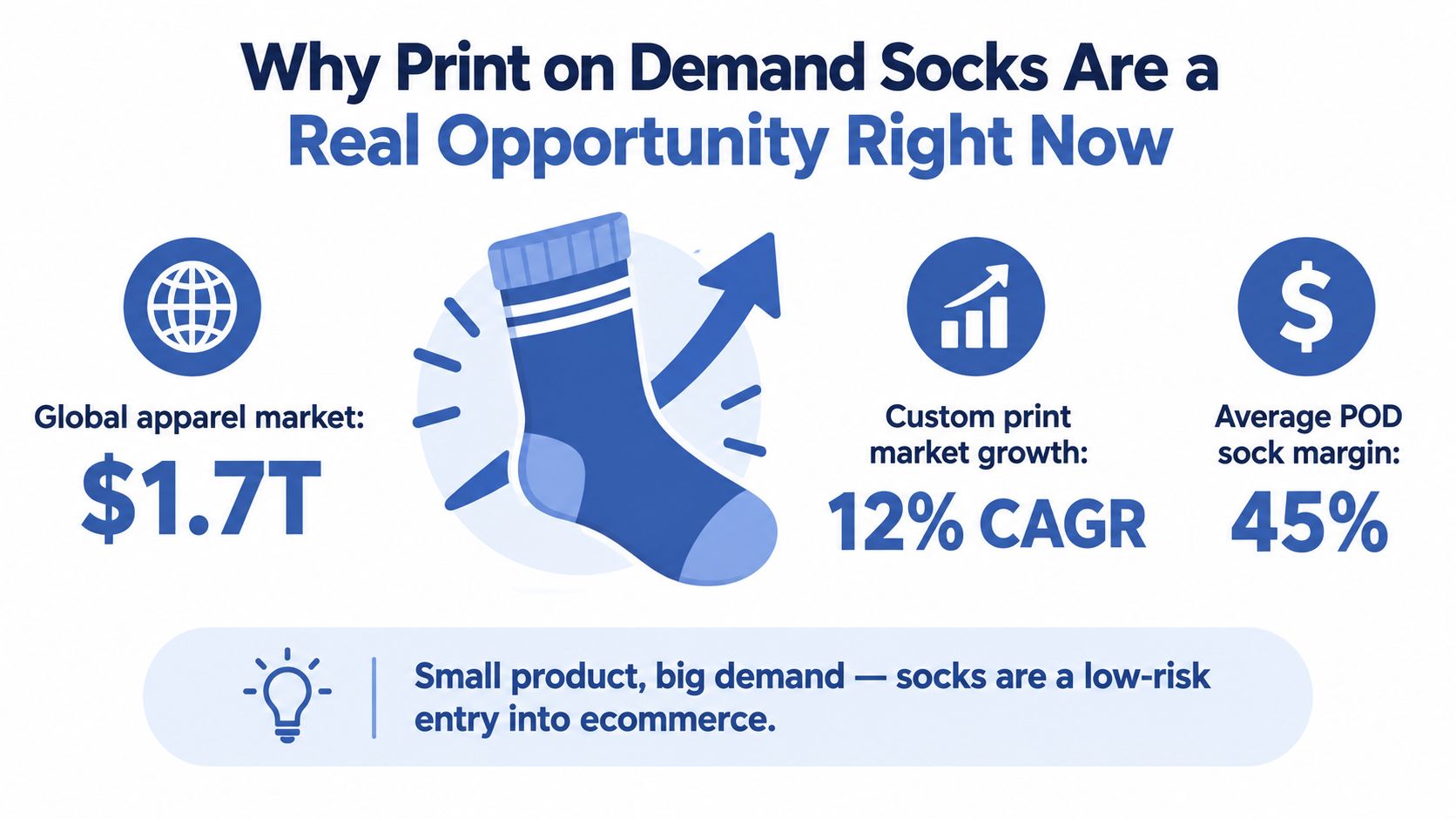
Socks belong to a broad, established product category, not a tiny novelty corner. An estimated 6.5 billion pairs of socks were sold worldwide in 2024, while more than 50 million pairs annually feature unique prints and designs, according to this global socks market estimate. The same source estimates that roughly 52% of custom-sock purchases happen through online platforms, which fits the strengths of print on demand socks: they're lightweight, visual, easy to demonstrate, and suitable for made-to-order fulfillment.
That scale doesn't mean every design will sell. It does mean you're entering a product class with habitual demand, established buying behavior, and room for personalization. A good pair can sell because it reflects a profession, hobby, pet, joke, identity, or occasion. The design gives an ordinary product a reason to be chosen.
What makes the model attractive
Print on demand removes the need to purchase a warehouse of unproven designs before you know what customers want. Some providers support single-pair orders, allowing you to test concepts with far less inventory exposure than traditional manufacturing. That gives a new seller room to explore, learn, and build around evidence instead of making one expensive bet.
The operating sequence is straightforward:
- Validate the audience. Find a specific group with a recognizable reason to buy.
- Create focused designs. Build artwork for the sock template, not just a square graphic.
- Order samples. Test fit, color, placement, washing, packaging, and labeling.
- Build the listing. Show the product clearly, publish measurements, and set delivery expectations.
- Launch controlled traffic. Use one organic channel and one paid channel so you can read the data.
- Scale the winners. Expand the strongest theme, improve the offer, and build repeatable creative production.
The best part is the feedback loop. A weak design can be retired quickly, while a promising concept can become a collection, a gift bundle, or a broader apparel brand. You're not treating socks as a side experiment. You're using a compact product to learn the core skills of e-commerce, design, conversion, and customer retention.
Validating a Winning Sock Niche Before You Design Anything
A promising sock idea usually starts with a group that already knows what it wants to express. “People who like funny socks” is too broad to guide product decisions. Veterinary nurses, dachshund owners, remote workers, teachers, and gamers offer clearer language, visual references, gifting occasions, and communities to study.
Start with market signals, not artwork. Search marketplaces and social platforms for recurring phrases, repeated themes, requests for variations, and designs receiving visible engagement. Read competitor reviews for complaints about fit, clarity, quality, or limited choice. The opportunity sits where buyers are active and existing products leave a practical or visual gap.
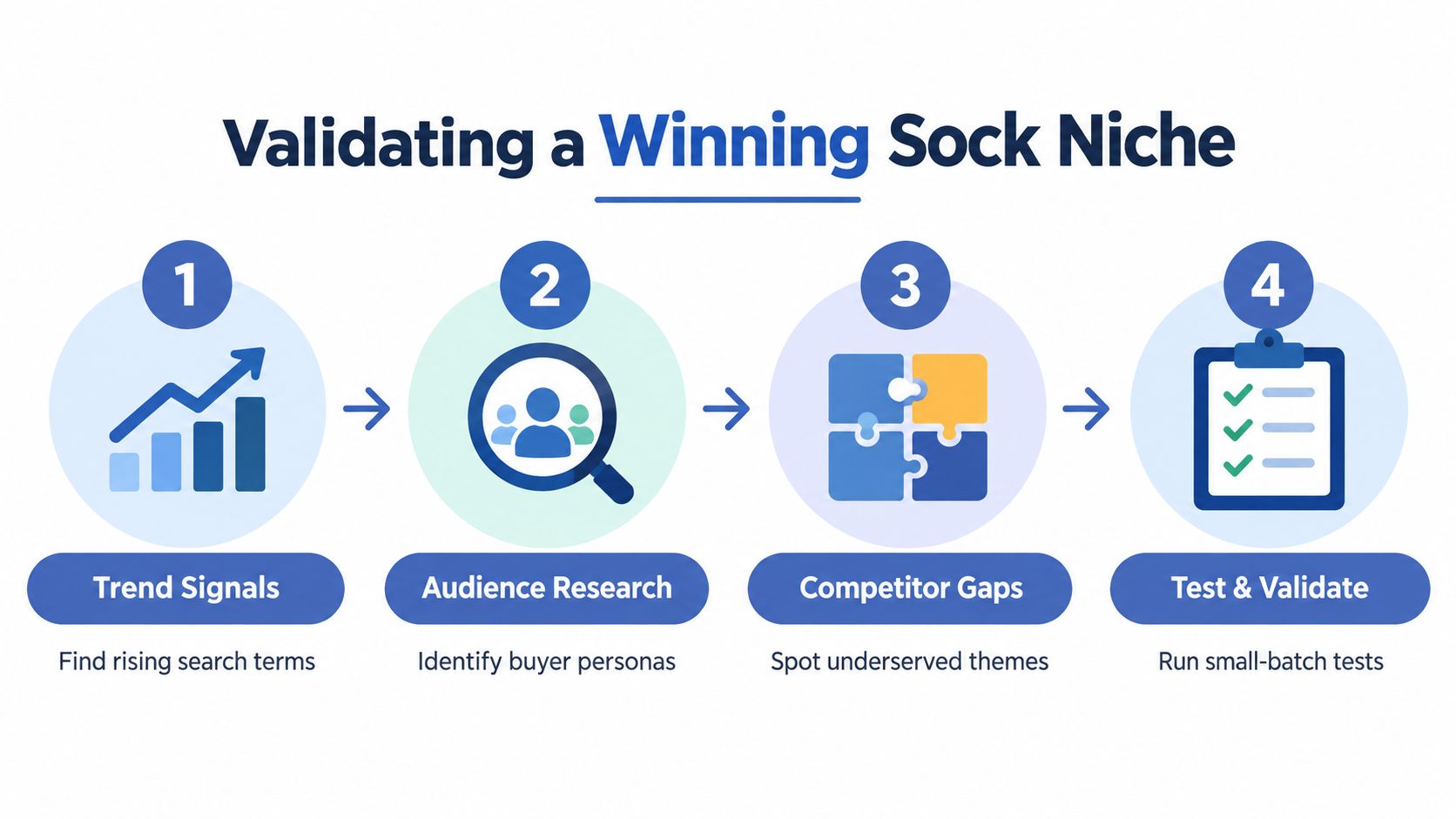
Build a short list of two or three niches, then pressure-test each one:
- Identity: Does the audience strongly identify with the profession, pet breed, hobby, or lifestyle?
- Collection potential: Can you name several distinct design angles without repeating the same joke or image?
- Buying occasion: Are gifts, team events, holidays, workplace recognition, or personal milestones clear reasons to purchase?
- Visual opening: Do competitors rely on the same typography, colors, or humor, leaving room for a different style?
A niche should also support the operating choices that protect margin. Designs that need tiny details may demand more sampling and create weaker thumbnails. A complicated fit or labeling promise can increase support requests. Record those risks beside the creative opportunity before committing.
Dog lovers show how this works. Possible directions include breed-specific illustrations, “dog hair” humor, rescue adoption messages, matching owner-and-pet themes, and personalized portrait socks. The strongest first test is not automatically the most sentimental. Compare search language, listing quality, review complaints, image clarity, and how quickly the concept reads at thumbnail size.
AvatarIQ can help turn a validated audience into several design directions, while the Apparel Cloning System gives a winning concept a repeatable route from first order to consistent sales. The tools work best after the audience and buying occasion are clear.
Choose a lane when you can explain who buys, why they buy now, what current products miss, and how your first collection will look different. You do not need certainty. You need enough evidence to test one focused offer, inspect the result, and improve the next version. For a deeper research workflow, use this guide on how to find niches for print on demand.
Designing Socks That Sell Using AI-Powered Workflows
A sock design can look sharp on a monitor and fail on the product itself. Stretching, wrapping, seams, and toe and heel zones can break up lettering or hide the focal point. Thumbnail clarity matters just as much. If shoppers cannot identify the idea quickly, better production will not rescue the listing.
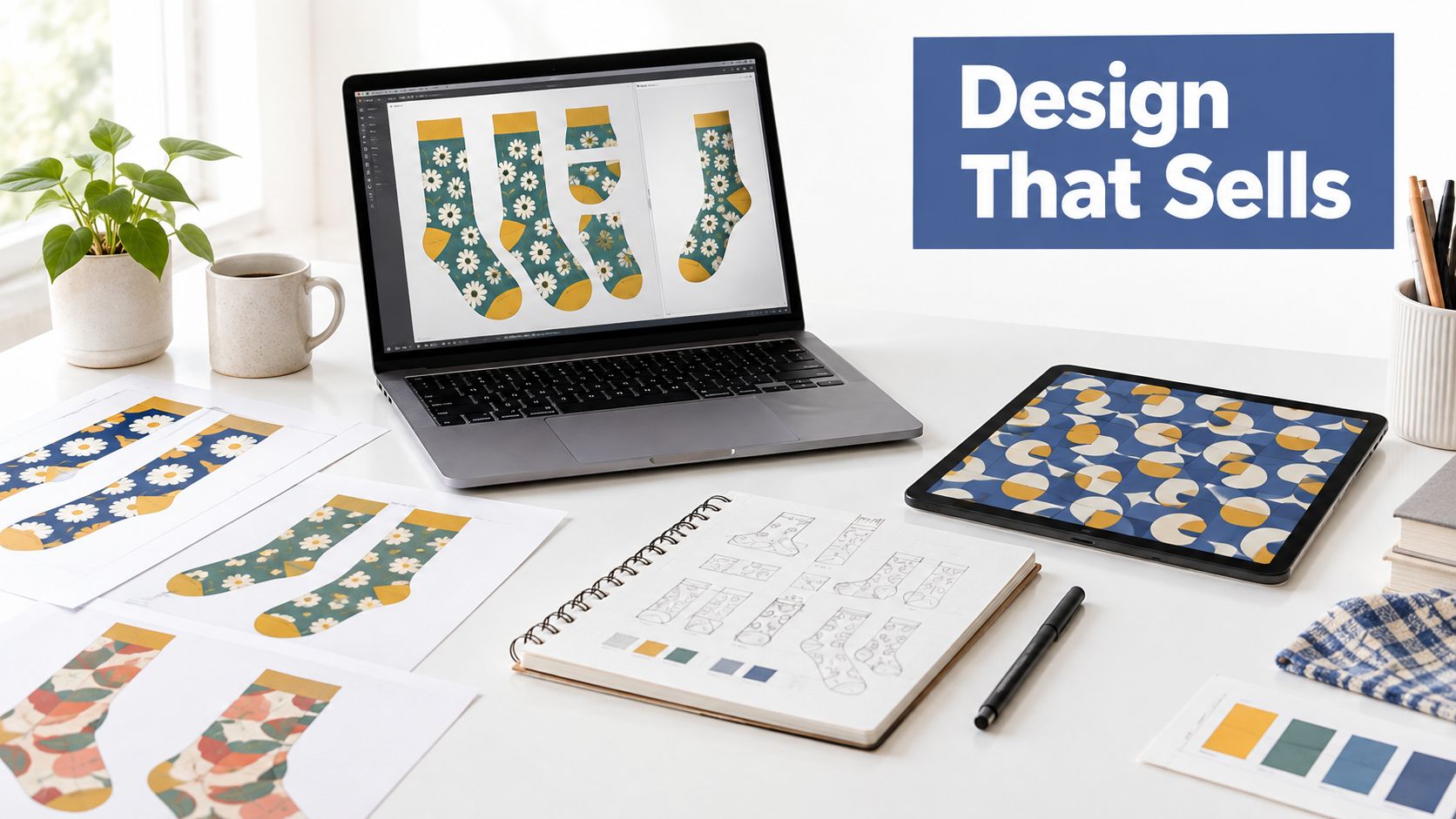
Build a design system before producing a collection. Set a palette, illustration style, repeat structure, and detail limit that can work across several products. Create a few directions around the validated niche, then remove concepts that become muddy at thumbnail size or lose their focal point once wrapped around the sock. Fit and labeling choices belong in this review too, because a clever pattern can still create avoidable returns or support work.
For dye-sublimation production, artwork is printed onto transfer paper and pressed onto a sock blank at around 400 degrees Celsius. Each side is often pressed separately in roughly 10 minutes of total production time, according to this custom sock production workflow. The process supports vivid, detailed artwork, while placement and physical testing still determine whether the finished design works.
From design test to repeatable collection
Use AvatarIQ to produce prompt variations around one validated niche, explore colorways, and create mockups that show the socks worn. Treat those outputs as a filter, not a publishing queue. The useful gain is faster comparison, which leaves more time to reject weak concepts and refine the strongest one.
A practical review can follow this order:
- Generate several interpretations of one theme.
- Remove designs with poor contrast, crowded details, or weak recognition.
- Check the artwork stretched and wrapped around the sock.
- Create consistent mockups for the remaining concepts.
- Prepare a close-up and a worn view for each listing.
- Publish a small collection built around the strongest designs.
This workflow keeps creative speed tied to operating discipline. Compare the broader best AI design tools when choosing software, but keep one visual direction per test so the result is easier to judge. Once a design earns orders, the Apparel Cloning System can help reproduce its visual rules across new products and support a consistent path from first order to repeat sales.
Adjacent decoration methods can sharpen design judgment too. Guidance on personalized embroidery techniques offers useful ideas about texture, placement, personalization, and gift value, even when the sock itself uses sublimation. The winning design is the one that remains recognizable on the screen, on the stretched product, and in the customer's hand.
Choosing Suppliers and Running Real Quality Checks
A supplier should earn approval through physical evidence, not a polished mockup. Before sending traffic, order samples in every advertised size and include at least one dark or high-contrast design. Dark artwork exposes dye transfer, fading, and color changes that a white sample can hide.
Record the fiber content, dimensions, cuff recovery, toe and heel placement, print registration, packaging, and any visible seam issues. Then wash the samples according to the care label and inspect them again. The AAFA legwear and hosiery testing guidance emphasizes fit evaluation before and after laundering and colorfastness testing for crocking, perspiration, and accelerated laundering. It also cautions that general apparel dimensional-change methods aren't automatically suitable for legwear because sock boarding affects results.
Supplier Decision Comparison
| Factor | What to Ask | Red Flag |
|---|---|---|
| Materials | What fiber blend does each style use, and does it vary by size? | The supplier cannot provide a precise composition. |
| Print method | How does the process handle dark artwork, curved surfaces, and stretch? | The answer focuses only on the mockup. |
| Sizing | What are the foot-length measurements and regional size conventions? | One universal size is listed without measurement guidance. |
| Production | What happens after an order is placed, and when does production begin? | No written production window exists. |
| Shipping | Are domestic and international delivery estimates separated? | The listing promises delivery without distinguishing production time. |
| Defects | How are misprints, seam failures, and wrong sizes documented and replaced? | The policy shifts every claim back to the seller. |
One major provider states that custom socks can be ordered without a minimum quantity, with production generally taking 2 to 7 business days, followed by 2 to 8 business days for U.S. domestic standard shipping and 10 to 30 business days for international standard shipping. Verify the current terms for the exact style you choose before publishing them.
You can also compare print on demand vendors when building your shortlist. Use a written checklist, and review how to choose the right print on demand supplier before approving a partner.
Pricing, Margins, and the Numbers That Actually Matter
Pricing starts with the full delivered order, not the blank sock. Your worksheet should include product cost, inbound or production shipping, customer shipping, platform fees, payment processing, advertising allowance, expected replacements, and the amount left after all of them.
Use a simple contribution-margin formula:
Selling price minus product cost, fulfillment, fees, advertising, and expected service cost equals contribution profit.
For an example, suppose a pair sells for $24. Your actual supplier invoice, shipping, platform fees, and advertising allowance must be entered from your own account data. If those costs total $15, the contribution profit is $9, or 37.5% of the selling price. That is a planning example, not a universal benchmark. The useful habit is to change one input at a time and see whether the order still works.
Protect the order, not just the product
A low price can create more pressure than it removes. It leaves less room for paid acquisition, replacements, discounts, and customer support. Test price points with different bundles or offers, then watch contribution profit and average order value rather than celebrating revenue alone.
Returns deserve their own line in the model. A replacement pair may appear inexpensive, but shipping can consume the profit from the original transaction. Clear fit information and a precise defect policy protect the economics better than hoping every buyer interprets a generic size label correctly.
The manufacturing choice also changes your risk. One custom-sock manufacturer lists a 200-pair minimum per design, color, and size, while made-to-order providers can produce a single pair after an order. That contrast, documented by this custom sock manufacturing comparison, makes on-demand testing the sensible starting point for unproven designs. Once demand becomes predictable, bulk production can deserve a fresh calculation.
For a broader view of offer structure and pricing insights for retailers, focus on the relationship between price, perceived value, order size, and repeat purchase potential. A winning sock business doesn't need the cheapest offer. It needs an offer that remains profitable after real operating costs.
Listings, Marketing, and Channels That Drive First Sales
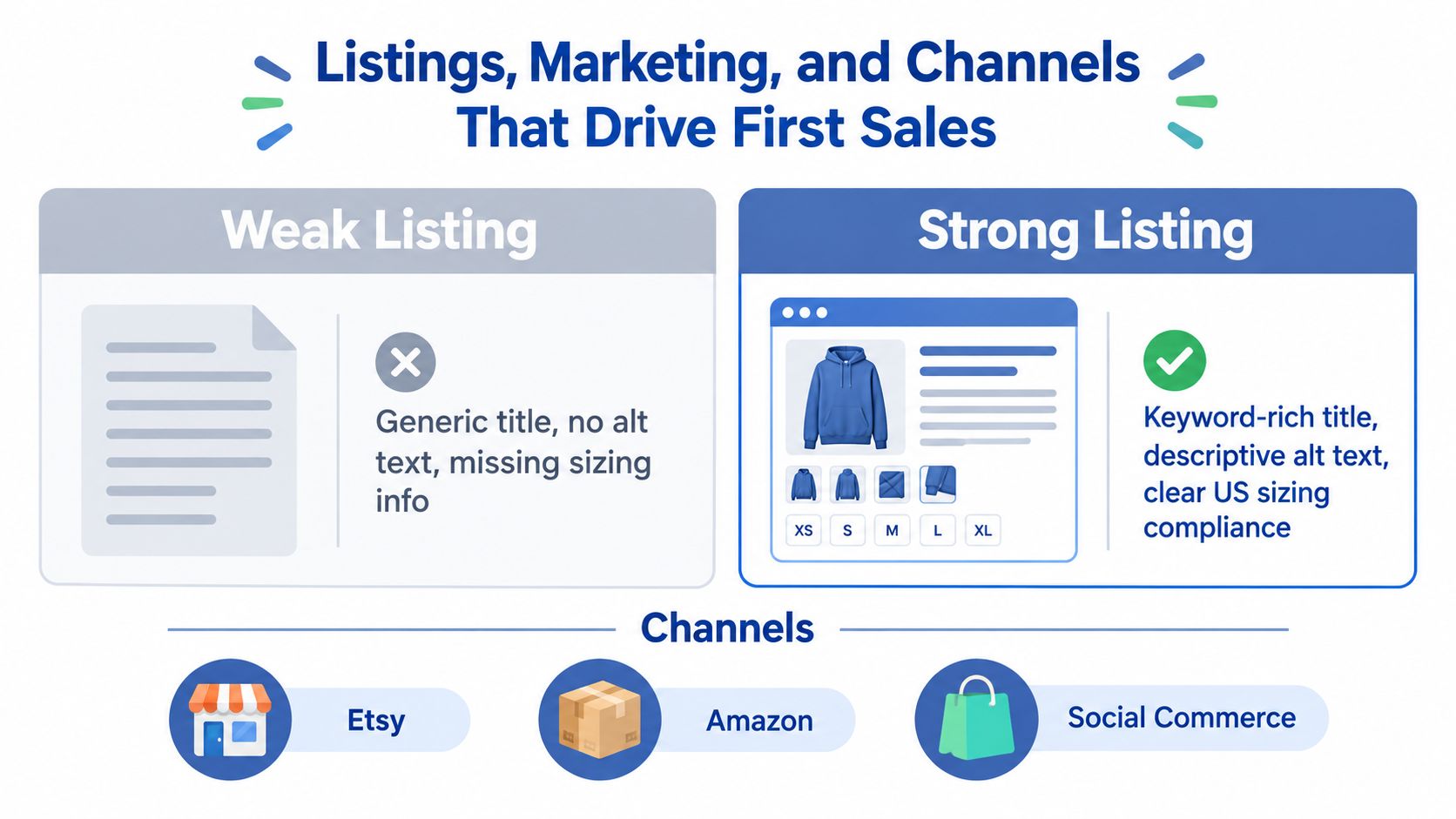
A shopper should understand the offer before opening the full description. Put the sock on a foot, show the pattern close up, state the fit and material accurately, and give clear production and delivery windows. The first line should make the design's purpose obvious, whether it serves a profession, hobby, community, or gift occasion.
Build the listing around one audience and use case. A strong title names the audience, product, and reason to buy without stuffing unrelated phrases. The description should cover the design, measurements, stretch, care instructions, and what arrives in the package. Write distinct alt text for each image so it describes the pictured product rather than repeating a vague keyword.
Treat compliance as part of production setup. For U.S. consumers, sock labels must disclose fiber content, country of origin, and either the company name or the FTC Registered Identification Number. The country of origin belongs on the front of the package or hangtag, according to the Federal Trade Commission textile-labeling requirements. Confirm the supplier's packaging and connect that check to your listing workflow before launch.
Choose channels by the job they can perform:
- Organic social shows the design, niche, and sock being worn.
- TikTok gives a recognizable joke or visual reveal room to spread.
- Meta ads offer a more predictable scaling route after a design has earned evidence.
- Influencer seeding introduces the product to a trusted niche audience.
- Marketplaces capture existing shopping intent when titles, images, and attributes are complete.
Start with one paid channel and one organic channel. AvatarIQ can refresh ad creative and product imagery quickly, helping you compare a lifestyle photo, pattern close-up, and short unboxing clip. The Apparel Cloning System can then help turn a proven visual direction into consistent listings instead of treating every new design as a fresh experiment.
Track clicks, saves, add-to-carts, purchases, questions, and complaints across a small launch set. Attention without purchases usually points to the offer or product-page clarity. Little attention calls for a stronger thumbnail, audience, or opening hook. Fix the weakest stage before adding another platform.
Fit, Returns, and Fulfillment Without the Headaches
Fit isn't a footnote. It affects conversion before the purchase and margin after delivery. Customers want to know whether the sock will feel tight, slide down, stretch over the calf, fit a larger foot, or place the artwork correctly when worn.
Publish foot-length measurements in centimeters or inches, not only S/M/L. State the regional sizing convention, explain the stretch range, describe the cuff, arch, heel, and toe fit, and show the same design on different foot sizes when possible. A buyer who understands the product is more likely to complete the order and less likely to feel surprised when it arrives.
Online fashion commonly sees 25% to 40% return rates, according to the cited research summary, and an e-commerce A/B test found that clearer size advice reduced the overall size-related return rate by 3.8% relative, including reductions of 4.3% for items flagged too small and 6.6% for items flagged too big. Those results aren't specific to print on demand socks, but they support a practical conclusion: fit education deserves testing before you spend heavily on traffic.
Build fit confidence into the product page
Use a short fit block near the purchase button. Include:
- Foot measurement: Tell shoppers where to measure and which unit to use.
- Stretch explanation: Say how the fabric behaves around the foot and calf.
- Visual proof: Photograph the design stretched and unstretched.
- Size context: State whether sizing is unisex and provide regional conversions.
- Expectation setting: Explain thickness, cuff height, toe placement, and design wrapping.
A footwear dataset covering more than 46,000 scans reported a 78% conversion increase when shoppers used foot scanning and a 58% reduction in online returns, according to the cited footwear fit analysis. Socks don't use the same scanning experience, so don't copy those figures into a promise. Apply the underlying lesson instead: remove uncertainty with tangible measurement guidance and visual evidence.
Tag every customer-service ticket by issue type: too tight, too loose, wrong size selected, shrinkage, fading, pilling, seam problem, toe or heel placement, print misregistration, or preference. After the first 50 to 100 delivered orders, review the pattern and revise the chart, images, or policy based on what customers report. This is a practical sample size for internal decision-making, not a guaranteed statistical threshold.
Fulfillment needs a written response plan
Separate manufacturing defects from preference-based fit complaints. A misprinted pair, damaged seam, or wrong item requires a different response from a customer who ordered the wrong size. Your policy should explain the evidence needed, the replacement process, and how made-to-order products are handled.
Keep delivery expectations visible at checkout and in confirmation emails. Production time comes before shipping time, so customers shouldn't have to ask whether the stated window includes both. If an order is delayed, communicate early and provide a clear next step.
The first-50-orders review should cover:
- Order accuracy: Did the customer receive the right design, size, and quantity?
- Physical quality: Did the pair survive transit without packaging or seam damage?
- Fit feedback: Which sizes generate tightness or looseness complaints?
- Artwork placement: Does the design remain readable on the foot and leg?
- Expectation gaps: What did customers ask that the listing failed to explain?
- Economics: Did replacements, support, or shipping change the contribution margin?
That review turns scattered customer messages into operating improvements. It also protects the excitement of the business because you're fixing the system, not reacting emotionally to every individual complaint.
Print on demand socks give you a practical path into a design-led e-commerce business. Validate a specific audience, create a focused collection, sample every important variation, publish honest fit and labeling information, and use early orders to sharpen the offer. Then turn the strongest design into a repeatable acquisition and fulfillment process.
The Apparel Cloning System gives beginners a structured path from a first product idea toward consistent monthly revenue by teaching a systematic approach to finding proven product concepts and adapting them for new niches. Take action this week: choose one audience, generate a small design set with AvatarIQ, order samples, and write the listing before you talk yourself out of starting.
Skup offers practical print-on-demand education and tools for building custom product businesses, including supplier selection, design workflows, and selling systems. Visit Skup to explore the Apparel Cloning System and turn your first print on demand sock idea into a focused launch plan.