What Is Product Differentiation for POD Sellers
Product differentiation means creating variations within a product category that at least some buyers regard as imperfect substitutes, through preference-based horizontal differences, objective vertical quality differences, or a mix of both. You're probably staring at a product feed right now, thumb hovering between two shirts that cost about the same and sit on the same kind of blank.
One listing is a random joke on a flat mockup. The other names a specific crew, shows the print on a real body, and makes the next click feel obvious. That gap is where a beginner store stops blending in.
Table of Contents
- What Product Differentiation Means for Apparel
- Horizontal Vertical and Mixed Differentiation
- Why Differentiation Helps POD Brands Grow
- Apparel Examples Buyers Can Feel
- Practical Ways to Differentiate Your Store
- Pitfalls and Metrics That Prove It Works
- Your Next Step to a Distinct POD Brand
What Product Differentiation Means for Apparel
Put yourself in that feed for a second. Tee A is a generic punchline, centered on a ghost mannequin, with a title that could belong to any shop. Tee B speaks to a weekend running group, shows the graphic across a chest at a scale you can judge, names the fabric, and puts size and care where you don't have to hunt.
You don't run a spreadsheet. You pick Tee B because it feels addressed to someone you recognize. The shirt category is crowded, and the blank may be shared with thousands of sellers. The buyer still chooses on a niche promise, a visual language, a perceived identity, a material story, or a buying experience that feels thought through.
Sameness is the default grid. A clear point of difference is how a new store becomes the one people screenshot and send to a friend.
What a shopper can point at in under a minute usually falls into a few felt differences:
- Community language: The headline talks to one group, not to "fans of funny shirts."
- Body proof: The art is on a person, so placement and scale stop being a guess.
- Material honesty: Fabric and wash notes quiet the "will this pill after two washes" worry.
- A faster yes: Occasion, fit help, or a tighter collection makes the product feel relevant before the add-to-cart button.
Practical rule: If a buyer can't explain why your tee isn't a swap for the cheaper one beside it, you don't have a difference yet. You have a new graphic.
From here the work gets specific. You'll see the three forms buyers respond to, why they give a young brand room to breathe, and apparel pages where the difference shows up in the product, the photos, and the unboxing. Then you'll practice the moves: design, niche, quality, branding, price, mockups, limited runs, and service. eCom stays exciting because you can sharpen that reason this week, on a product you already believe in, without rebuilding the whole catalog.
Horizontal Vertical and Mixed Differentiation
Preference and proof do different jobs, and most POD winners use both. Economists split the idea into horizontal differentiation, vertical differentiation, and mixed differentiation, a map laid out in research on product differentiation.
Horizontal differentiation is taste without a universal winner. Color, humor, subculture, theme, and art direction live here. A buyer who wants a dry running-club joke isn't "wrong" for skipping a pastel teacher gift. Nobody has to agree that one style beats the other for every person.
Vertical differentiation covers attributes shoppers can rank more objectively: durability, print reliability, fabric, and fit. More of the good attribute is broadly better, and people still differ on what they'll pay for it. A heavier fleece isn't a personality. It's something a buyer can compare with their hands and with your care notes.
Mixed differentiation is the usual POD reality. A niche design and a better-made garment travel together. The joke gets them to stop. The fabric story and the honest size chart get them to stay when a lookalike shows up cheaper.
Four levers beyond the art file
The same framework points to four practical dimensions: physical characteristics, selling location, intangible attributes, and consumer perceptions. A listing can change where the shirt is found, how the brand feels, and what the buyer believes about who it's for. The PNG is only one lever.
Chamberlin's model puts this in store-owner language. Your demand curve slopes down. A small price increase doesn't lose every buyer, because some of them aren't treating you as a perfect swap. A small price cut doesn't have to buy the whole market either. You get many sellers, lots of choice, and limited firm-level pricing power. That's not a monopoly, and it's not a race where every tee must share one price.
Three forms of product differentiation in apparel
| Form | What changes | Apparel example | Buyer question |
|---|---|---|---|
| Horizontal | Taste, theme, humor, subculture, art direction | A trail-crew tee versus a classroom-gift tee on a similar blank | "Is this my people?" |
| Vertical | Durability, fabric, print reliability, fit | A heavier fleece with clear care versus a thin layer with none | "Will this hold up?" |
| Mixed | Identity plus a rankable quality cue | A niche hoodie with a specific fleece and a photo that proves scale | "Is this for me, and is it worth it?" |
Many sellers can share one market by serving different people. You don't have to win every shopper. You have to be the imperfect substitute the right shopper refuses to swap out.
Why Differentiation Helps POD Brands Grow
You don't need a monopoly to stop living inside a price sort. You need enough distinction that the right buyer stays when a cheaper tee appears one row down. That's limited pricing power used on purpose, and it's available to a first store, not only to a giant brand.
The commercial upside shows up in ordinary operator moments:
- A clearer audience: Ads stop talking to "people who wear shirts" and start talking to one identity, which makes creative and targeting feel relevant.
- Room for a healthy margin: When the offer isn't a pure commodity, you can price for a real business instead of shaving cents until the order isn't worth packing mentally.
- Fewer refund surprises: Honest expectations about fit, fabric, and care mean the unboxing matches the page.
- Repeat purchases: People come back when the product felt made for them, not scraped from a trend list.
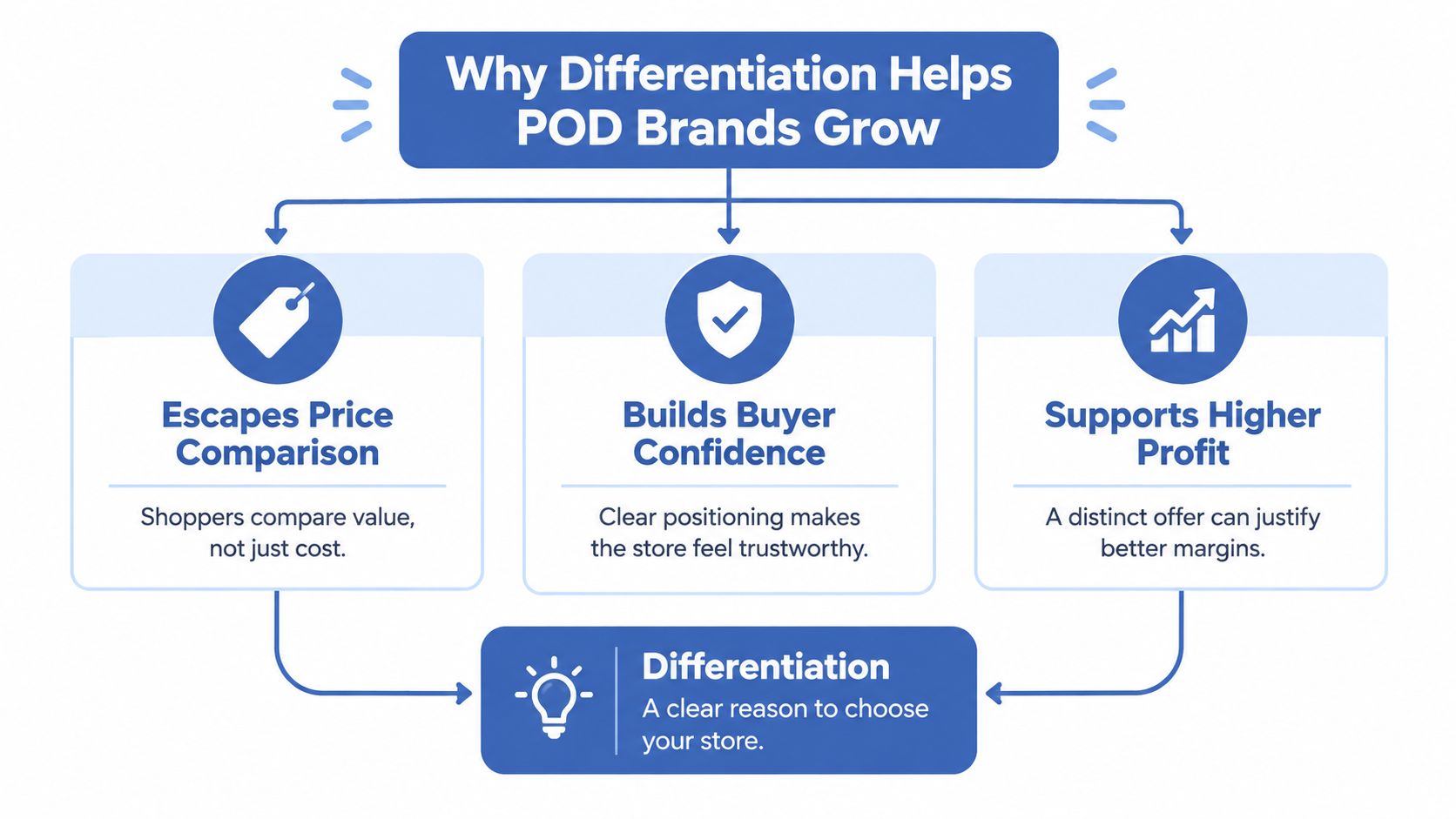
Short-term novelty fades after the scroll. A brand people remember keeps a promise they can retell. Apparel Cloning starts from proven demand, then earns a defensible edge through a sharper audience promise, a better buying experience, or a stronger identity. A carbon copy of a winning layout can be a sensible starting format. It isn't the edge.
Parents fitting store work around school pickup, career-switchers testing a first offer after hours, and complete beginners all get the same advantage from POD: you can change the promise, the photos, and the page without holding a warehouse of identical blanks.
That staying power is the beginning of a competitive advantage built from choice, not from owning a factory. Differentiation is a growth skill. Every clearer niche, better photo, and more useful product page makes paid traffic and organic discovery work harder for the same visit. The work is real. The opportunity is that a small store can be chosen on purpose.
Apparel Examples Buyers Can Feel
A shopper doesn't feel a strategy deck. They feel a page, a photo, and a label. Three listings can share a similar price and still do different jobs.
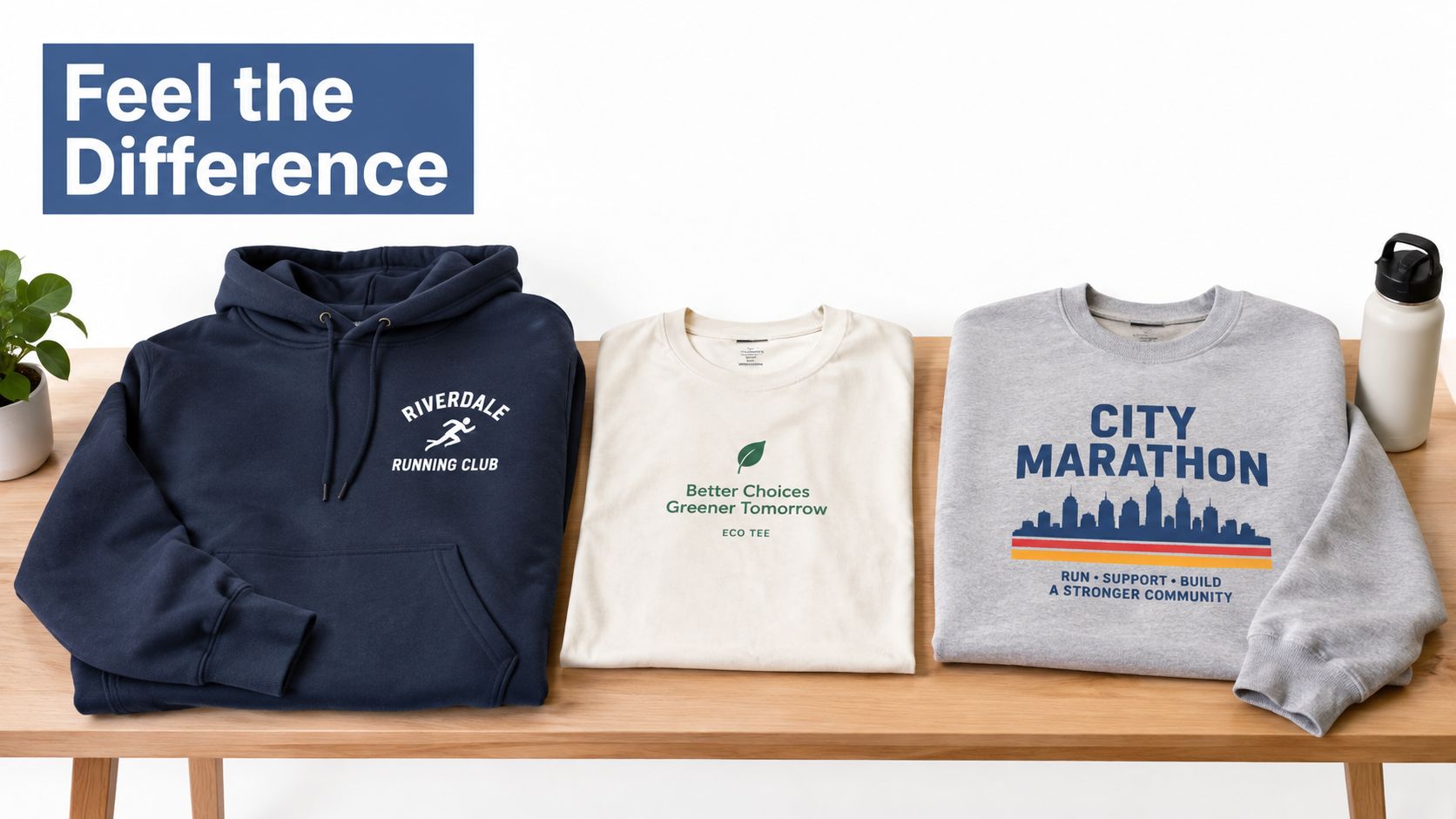
The running-club hoodie speaks in insider language: mile markers, early alarms, the group chat name. That's taste. The heavier fleece and a wash note you can find without zooming into a blur are the rankable part. Together they answer "my people" and "this will survive Tuesday."
The teacher appreciation tee wins on occasion. Gift-ready framing, a short note about who it's for, and a size chart that kills the guesswork. The buyer isn't comparing punchlines. They're trying not to send the wrong size to a coworker.
The limited colorway is planned scarcity plus a visual system you could recognize on a second product. It isn't a copy of another brand's look. The drop says "this palette, this season, this crew," and the next product echoes the same type, trim, and photo style.
The same standard shows up off the apparel feed. Golfers who want performance golf wear with personality are really asking a shirt to signal both function and taste. Your hoodie should pass that same two-part test.
Labels, care, and photos as felt quality
In the United States, most textile and wool products must disclose fiber content, country of origin, and the manufacturer, importer, or other business responsible for the product, which the FTC's clothing and textiles guidance treats as core label facts. Cotton claims have to match the fabric. For a POD seller, artwork can't carry the whole difference. Truthful composition, fit, and sourcing, stated in plain words, make a similar sweatshirt feel more dependable than a listing that hides the blank. If you're choosing that blank, a practical look at shirt materials that change hand-feel keeps the claim tied to a real garment.
Care is part of the product, not a footnote. Under the Care Labeling Rule, covered textile apparel sold to consumers needs regular care instructions, visible or easy to find, and also on the outside or a hang tag if packaging hides the label. Ordinary care generally means washing or dry-cleaning guidance, and washing directions need hand or machine plus a usable temperature such as cold, warm, or hot. You don't invent a "lasts forever" claim. You put the correct wash path where the buyer can see it, on the page and in the insert.
Photos are the other proof. Baymard Institute research on image resolution and zoom found that 56% of users' first actions on a product page were to explore images, that 25% of ecommerce sites offered images too weak for evaluation, and that shoppers need no fewer than three to five images. Show the design on the actual garment, several angles, print placement and scale, and enough resolution to inspect the art. A sharp joke still gets abandoned when the buyer can't tell what will arrive.
Audit one live listing tonight. Name three differences a buyer would notice before the fold: who it's for, what the fabric is, and where the print sits.
Practical Ways to Differentiate Your Store
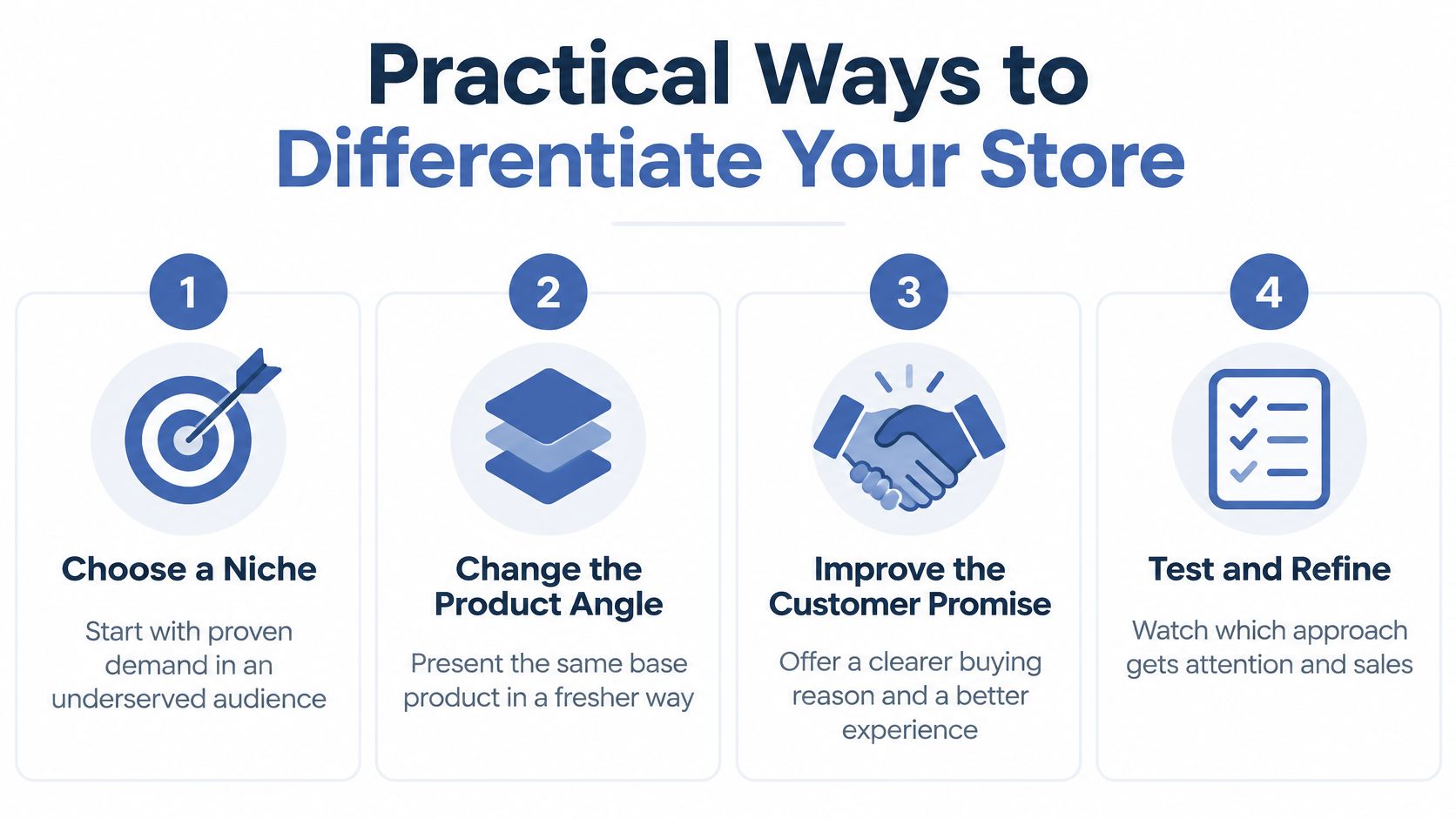
Pick one product with demand you trust, then change the reason, not just the pixels. The moves below aren't equal. Some take an afternoon. Some take a season of repetition.
Niche and design with a point of view
Start by cloning proven demand into an underserved audience promise. The format can be familiar. The person, occasion, and sentence on the shirt should not be a photocopy. A tight pass at niche market research for apparel keeps you from guessing which community already buys.
Give the art a point of view, cultural care, and type a buyer can read on a phone. AvatarIQ is the in-house way to generate original designs and professional mockups or photoshoots for $97 a month, which fits a beginner workflow that needs speed without a studio day. Speed isn't the brand. You still choose what ships.
AI can flood a shop with lookalikes that feel anonymous. Deloitte's 2025 connectivity and mobile trends survey found that 74% of consumers familiar with or experimenting with generative AI, and 62% of regular users, said its popularity makes it harder to trust what they see online. In a separate US study, 15% said they would stop using a product or service if it began using generative-AI capabilities, while 38% said they would try or continue when it saved time. Use the tool to cut production friction. Keep authorship, inspiration, and community fit in human hands. Explain the spark, check references and lettering, disclose meaningful AI use when it matters, and leave room for personalization the buyer controls.
Quality, name, price, and the page
Quality here means truthful fabric, fit, and care, pulled forward as covered above, not a new superlative. Branding is the slow layer: an original name, logo, packaging, and a visual system people start to associate with you. Product-design trade dress and product-packaging trade dress only work as source identifiers when buyers read them as "this business," which the USPTO trademark examining guidance treats as a distinctiveness question, not as a reward for a pretty layout. Clear the name, logo, slogan, and any unusually distinctive presentation before you print a run. Don't borrow another brand's look and hope taste counts as ownership.
Price should match the promise. A premium fleece story with a bargain-bin price reads confused. A simple tee with luxury copy reads the same way, in reverse. You're signaling who the product is for, not winning a race to the bottom.
Mockups earn trust when they show placement and scale on the actual garment type. Limited editions work as planned excitement, a real end to a color or a season, not a fake countdown on a design you can reprint forever.
Customer experience is a differentiator you can ship this week. Clearer size guidance, useful bundles, plain fulfillment timing, and a headline that makes personal relevance instant all cut search effort. Occasion products in other categories already teach this. Custom stole buying tips from Stoles.com® show how a buyer relaxes once fabric, personalization, and the moment are spelled out. Your teacher tee or race-day hoodie can do the same job.
Apparel Cloning is the beginner path that takes a proven format and rebuilds it with an original promise, from a first product toward a real monthly business. When you're ready to scale, coaching on that same path keeps the offer sharp instead of merely busier.
Checklist for the one product: who it's for, what proof is on the page, what you won't claim, and what you'll watch after the next ten visitors.
Pitfalls and Metrics That Prove It Works
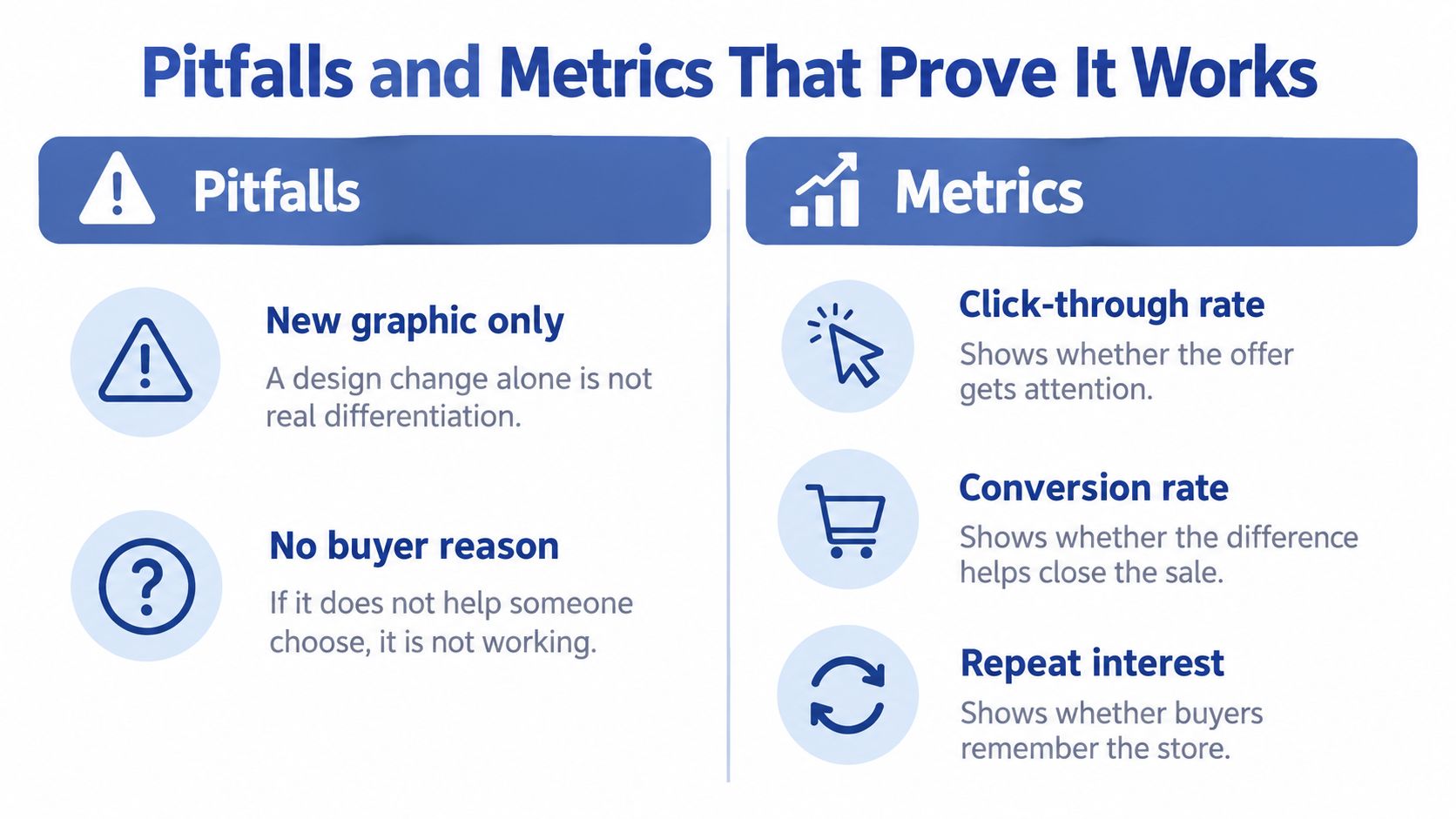
A new graphic is not automatically differentiation. The test is whether a buyer has a reason to choose you when similar products sit side by side, and whether that reason survives the comparison.
The usual misses are fixable, and POD makes the test cheap:
- Superficial cloning: The layout matches a winner, and the promise doesn't. Shoppers feel the copy.
- Unsupported quality talk: "Premium" with no fiber, fit, or care proof trains people to doubt the next claim.
- Confusing presentation: A look that echoes another brand's trade dress creates risk, not recognition.
- Hidden care: If maintenance only appears after the order, the confident buyer never saw it.
- Anonymous AI volume: Fifty variations with no taste, provenance, or community point of view make the shop feel interchangeable.
Decision support is a real edge, not a soft extra. In recent ecommerce research, 55% of surveyed US and European shoppers said they would pay more for the right item to avoid scrolling through several pages, 41% felt like strangers to their favorite retailers, and only 20% experienced frequent personalization, according to the 2025 state of ecommerce findings. Relevance and less hunting are things you can see in behavior, not slogans.
A one-edge test
- Name one claimed edge. Clearer size guidance, a tighter niche headline, one limited color, or a better photo set. Not all four at once.
- Watch the path. Click-through rate shows attention. Add-to-cart rate shows interest after the page. Conversion rate shows the difference helped close. Repeat purchase shows memory. Refund rate shows whether the promise matched the parcel. Willingness to pay shows up when the price holds and people still buy.
- Read a weak result as a revision. Adjust the promise or the proof. Don't abandon a niche after one creative.
A scorecard for the week: one sentence reason, one proof on the page, six numbers above, and a note on what you'll change if click-through moves and conversion doesn't. Novelty can spike a click. A real edge changes what happens after the click.
Your Next Step to a Distinct POD Brand
Choose a single product you already believe has demand. Write one sentence that is not the word "unique." Name the person, the occasion or identity, and the proof on the page. That proof might be fabric clarity, a photo set, a care note, or a tighter collection. If the sentence could sit on a competitor's listing unchanged, it isn't ready.
Then rebuild, don't remix blindly. Use Apparel Cloning to find a proven format and replace the thin promise with one you can defend. Use AvatarIQ on skup.net to speed original designs and believable mockups while you keep the taste and the community point of view. Devin and Matt teach from POD businesses they still run, which is why the advice stays tied to live stores instead of theory. The work is real. That's exactly why the opportunity feels exciting: a beginner can build something people choose on purpose, with more control over their time and a brand that feels like theirs.
Ship a first test this week. One product, one sentence, one proof, one metric you'll check after real visitors. You don't need a perfect rebrand to become the shirt someone refuses to swap.
Skup teaches print-on-demand sellers how to turn a proven apparel idea into a buyer-specific offer through Apparel Cloning, with AvatarIQ for original designs and believable mockups while you keep the point of view. If you want that path from a crowded tee to a store people pick on purpose, visit Skup and start with one product this week.