How to Do Niche Market Research for POD Apparel
You can burn a week making shirts nobody wants, or you can spend a few hours picking a niche that has a real audience, a real buying trigger, and enough margin to justify the launch. That's the difference between a ghost-town store and a POD business that has a shot.
If you've already uploaded a pile of generic designs and the traffic is dead quiet, you don't need more designs first. You need a tighter niche, better demand signals, and a cleaner way to test whether people will pay for the idea before you sink time into the store.
Table of Contents
- Finding Your First Winning Niche in POD Apparel
- Sizing Demand the Bottom-Up Way
- Validating Demand With Real Signals
- Reading Competitors for Gaps and Priceability
- Estimating Margins and Audience Size
- Prioritizing and Testing Opportunities on a Budget
- Turning Research Into a Profitable POD Launch
Finding Your First Winning Niche in POD Apparel
A lot of beginners start the same way. They drop 40 generic t-shirt designs, wait two weeks, see a handful of visits, and get zero sales. That problem is almost always a niche problem, because the store never gave a specific buyer a reason to care.
A niche in POD isn't just a topic like dogs, coffee, or golf. It is the tight intersection of audience, identity, and occasion. The buyer, the reason they wear it, and the moment they buy it all line up. Start with niche selection for custom apparel and pressure-test the idea against real buyer behavior instead of vibes.
Three places good ideas usually come from
First, reverse-engineer Amazon bestsellers. Look at what is already moving, then ask what micro-audience is being served and what is missing. Second, mine Etsy category gaps, because Etsy often shows you where buyers are already searching but the listings are thin, generic, or badly presented. Third, pull pain-point language from Reddit threads and niche Facebook groups, because people in those spaces tell you exactly what frustrates them and what they want to wear as a signal.
Practical rule: if the idea only sounds clever but does not connect to a buyer's identity or an occasion, it is not a niche yet.
A quick filter saves wasted effort. Skip ideas that are too small to support demand, and skip ideas already dominated by giant brands and review-heavy incumbents. You want a pocket where people care, competitors are weak, and the purchase feels natural.
Good niche work is a filtering game, not a brainstorming contest. The next pass is to check whether the audience is large enough to justify a launch budget and still leave room for margin after ads, samples, and the first round of creative tests. If the numbers do not support a $100 to $200 test, the niche is not ready.
Sizing Demand the Bottom-Up Way
Top-down market estimates sound impressive, but they can fool you fast. In POD, you don't care whether a category is huge in theory. You care whether enough interest exists for a specific message, often enough to support a profitable launch.
Start with the main keyword, then widen the net
Begin with the niche's main keyword and check monthly search volume. Then layer in long-tail variants from tools like Ahrefs or Semrush, because the opportunity usually lives in the phrase clusters around the core idea. A workable POD niche usually has a strong core term and a tail of related search phrases that show the audience is active in more than one way.
My cut line: if the niche can't support a clear search base and related variants, it's probably too narrow for a first launch.
Google Trends helps separate durable demand from a one-off spike. Use a 5-year window first, then a 12-month window to catch seasonal patterning and short-lived meme energy. A niche that holds its baseline, trends upward, and doesn't look like it collapsed after a spike is usually worth deeper work.
| Demand Sizing Benchmarks for POD Apparel Niches | ||
|---|---|---|
| Signal | Pass Threshold | Red Flag |
| Core monthly search demand | Strong enough to support a niche launch | Tiny volume with no buyer intent |
| Trend shape | Non-volatile over 5 years | One spike, then decay |
| Long-tail depth | Clear supporting variants | No meaningful related phrases |
| Buyer behavior | Signs of ongoing interest | Meme-only attention |
A simple example makes this easier to feel. Plant mom apparel can show strong monthly searches, a steady upward trend, and a healthy set of related long-tail phrases. Cactus Friday, by contrast, can look like a meme cycle with no sustained demand after the joke fades. That difference matters because you're not looking for temporary attention, you're looking for a repeatable buyer pool.
If you're evaluating multiple ideas, keep the standard high. Pass only niches that clear a meaningful demand base and show a stable trend profile. The goal is to launch where interest looks durable enough to survive your first test window, not where a flash of curiosity makes the chart look pretty.
Validating Demand With Real Signals
Search volume alone doesn't pay you. People search for plenty of things they never buy, and POD gets expensive when curiosity clicks eat your budget. You need signs that people are primed to purchase, not just browsing.
Five questions that tell you whether demand is real
Ask these before you spend a dollar.
- Buying intent: Are people searching in a way that suggests they want to wear or gift the item, not just read about it?
- Competitor activity: Are stores selling, or are they just publishing listings with weak traction?
- Community motion: Are groups, subreddits, or niche pages active week after week?
- Price tolerance: Does the market support a retail price above $24.99 without feeling absurd?
- Occasion hooks: Is there a gift, event, milestone, season, or identity moment tied to the purchase?
Those five questions keep you from mistaking noise for demand. If the niche has no occasion, no visible buyer behavior, and no active community, it usually needs more work before it deserves a test budget.
The cleanest cheap test is a landing page with one product and one promise. Keep the page simple, run a small ad test in a tight geo or interest pocket, and watch the behavior that matters. For a practical breakdown of demand filtering, I'd also look at products with high demand because the same logic applies when you're deciding whether a niche deserves traffic.
Free signals help too. Etsy save counts can show whether shoppers are bookmarking, Pinterest pin velocity can hint at repeatability, and Reddit comment depth can reveal whether the topic has enough emotional friction to trigger action. They're early signals, pointing to where curiosity is turning into intent.
If the niche clears two of the three signal groups, it can move forward. If it doesn't, stop treating it like a launch candidate. The goal is evidence, strangers clicking, saving, signing up, or buying, not proving your favorite idea is clever.
Reading Competitors for Gaps and Priceability
Competitor research is where many people waste time. They scroll listings, copy what looks decent, and miss the part that matters: where the market is already paying, but still unsatisfied.
Compare price, quality, and weakness side by side
Open Etsy, Amazon Merch, and Redbubble for the main search terms in your niche. Then compare three things on every major listing: design quality, price position, and weakness gaps. Design quality covers resolution, color limits, mockups, and whether the piece looks polished or rushed. Price position shows whether the market is clustered, underpriced, or stretched.
| Competitor Gap Analysis Framework | ||
|---|---|---|
| Competitor Factor | What to Check | What a Gap Looks Like |
| Design quality | Resolution, mockup quality, color limits | Blurry art, weak mockups, generic layouts |
| Price points | Cheapest, priciest, cluster range | Room to charge more for a sharper offer |
| Weakness gaps | Sizes, inclusivity, descriptions, sub-niches | Obvious buyer need left untouched |
| Review pattern | Review quality and count | Buyers asking for improvements |
| Ad presence | Running ads or organic only | They rely on luck, not scale |
A buyer segment will often pay more when the product shows better fit, clearer identity, or a more polished presentation. A listing with 4-star reviews under 200 reviews often signals room for a better version, because interest is already there and satisfaction is still incomplete. That gives you a real wedge.
Look for what competitors ignore. They may sell a broad version of the niche but skip a specific sub-group. They may price too low and look cheap. Their descriptions may be flat, their sizes limited, or their SKU count so bloated that none of the items feel focused. Focus on where competitors are weak and buyer interest remains, rather than trying to out-design the entire category.
Useful lens: don't ask, “Can I make a similar shirt?” Ask, “What buyer do they leave behind?”
If you can name the ignored buyer, the ignored price band, or the ignored product type, you have a real entry point. Start there instead of trying to out-design the whole category at once.
Estimating Margins and Audience Size
A niche can look exciting and still be a bad business if the math is thin. I treat this part like a money decision, because that's what it is. If the margin is weak or the reachable audience is tiny, the niche doesn't deserve a launch.
Work backward from landed cost
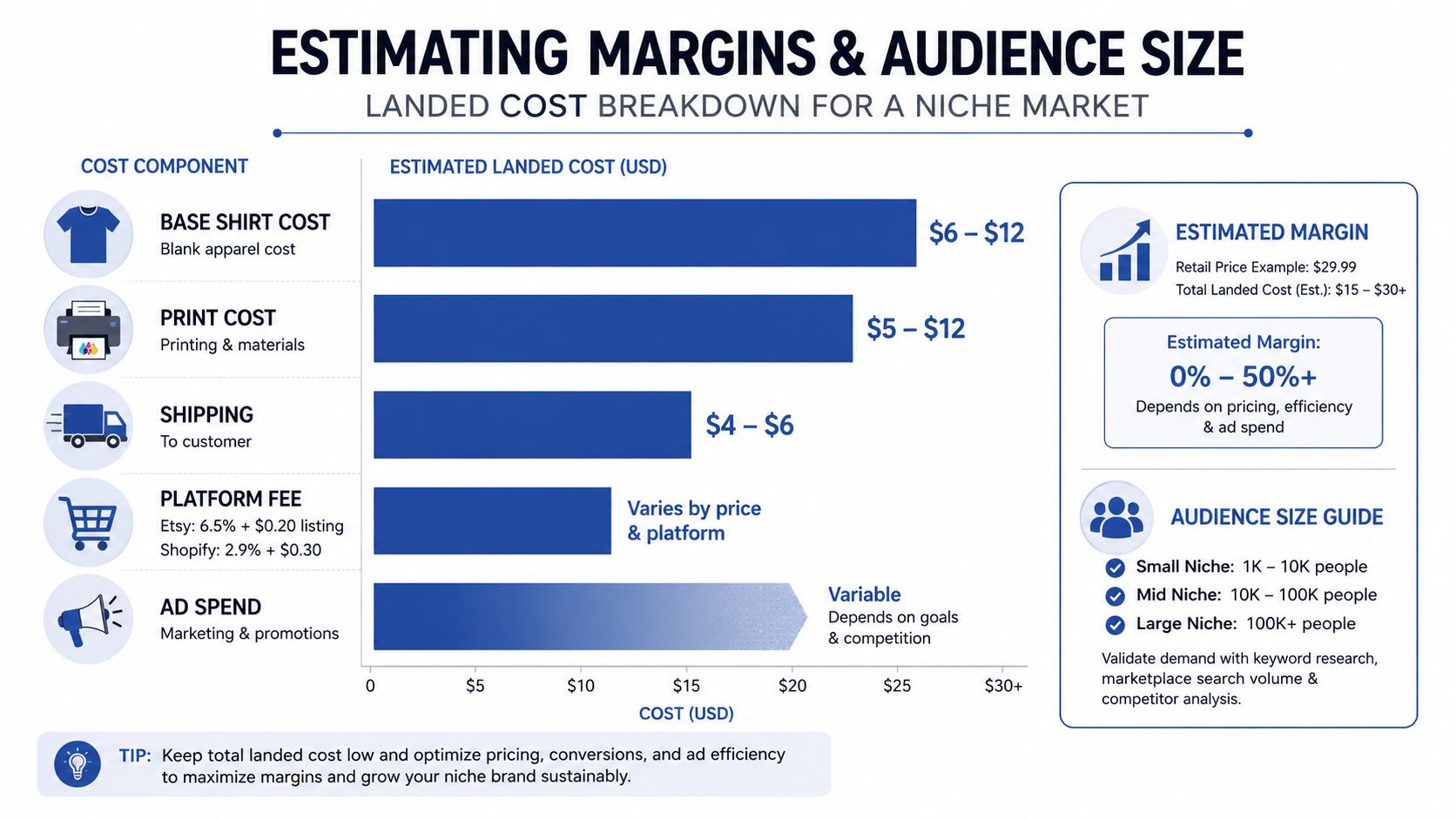
Start with landed cost, not selling price. That means base shirt, print cost, shipping, platform fees, and ad spend if you're using paid traffic. A shirt priced at $24.99 can leave very little after production and fees if your cost structure is sloppy, so you need to know the spread before you commit.
The simplest way to estimate audience size is to combine visible signals. Look at Reddit subscriber counts in niche subs, Facebook group memberships, hashtag follower counts on Instagram, Etsy traffic estimates from tools like eRank, and keyword impression ranges in Google Keyword Planner. You're trying to estimate the pool of people who might realistically buy a $24 to $32 niche tee, not the total number of people who've ever heard of the topic.
How to calculate product costs is worth reading if you want a cleaner way to handle the math, because margin errors compound fast once ads enter the picture.
A useful ranking method is simple. Estimate net margin per sale, then multiply it by reachable buyers per month. That gives you a rough business score. If a niche falls below $3 net margin or has fewer than 1,000 reachable buyers, I cut it.
Reachable audience is not total audience
Don't confuse visible interest with reachable buyers. A huge subreddit doesn't matter if nobody there buys apparel. A tiny group can matter more if the identity is strong, the occasion is clear, and the buying trigger is repeated.
That's why I focus on the slice of the audience that is willing to pay for the message on a shirt. In POD, that slice is usually much smaller than the total crowd, but it can still be enough if the fit is tight and the competition is weak.
Prioritizing and Testing Opportunities on a Budget
Once you've got a few surviving niches, stop overthinking and rank them. A simple score keeps emotion out of the decision and helps you spend your test budget where it has the best shot of paying back.
Use one score, then buy proof
Score each niche on four dimensions, each from 0 to 3.
- Demand strength: Does the niche show real search and behavior signals?
- Margin potential: Does the math leave room after costs and fees?
- Competition gap: Is there clear room to win against current listings?
- Personal expertise: Do you understand the audience enough to move fast?
Anything scoring near the top moves into testing. Then the test itself stays tight. Build a single-product landing page or a simple storefront with one mockup, set a $19 to $29 price point, and run a short ad test. Keep the spend controlled and watch what people do, not what they say.
A separate Etsy listing can confirm whether the market responds in a marketplace context. The point is to see whether real shoppers click, favorite, add to cart, or start checkout. If you want a buyer-smart mindset while running tests, the practical shopping habits covered in ClothME tips for smarter shopping are a useful reminder that buyers compare quickly and react to clarity.
Your budget cap should stay around $200 per niche across both tests. If the niche can't generate enough intent at that level, it probably won't get easier later. If it does perform, you've bought evidence instead of guesses.
My rule: kill weak tests fast, then put the next dollar behind the clearest buyer signal.
A niche that wins on add-to-cart behavior, favorites, or pre-orders deserves more attention. A niche that gets polite traffic and no action gets cut. That discipline protects your cash and keeps you focused on the niches that can turn into a store.
Turning Research Into a Profitable POD Launch
Research is only useful if it gets you to launch. The goal isn't to keep collecting signals until the idea feels perfect, because perfect never shows up. The goal is to make a clean decision, then move.
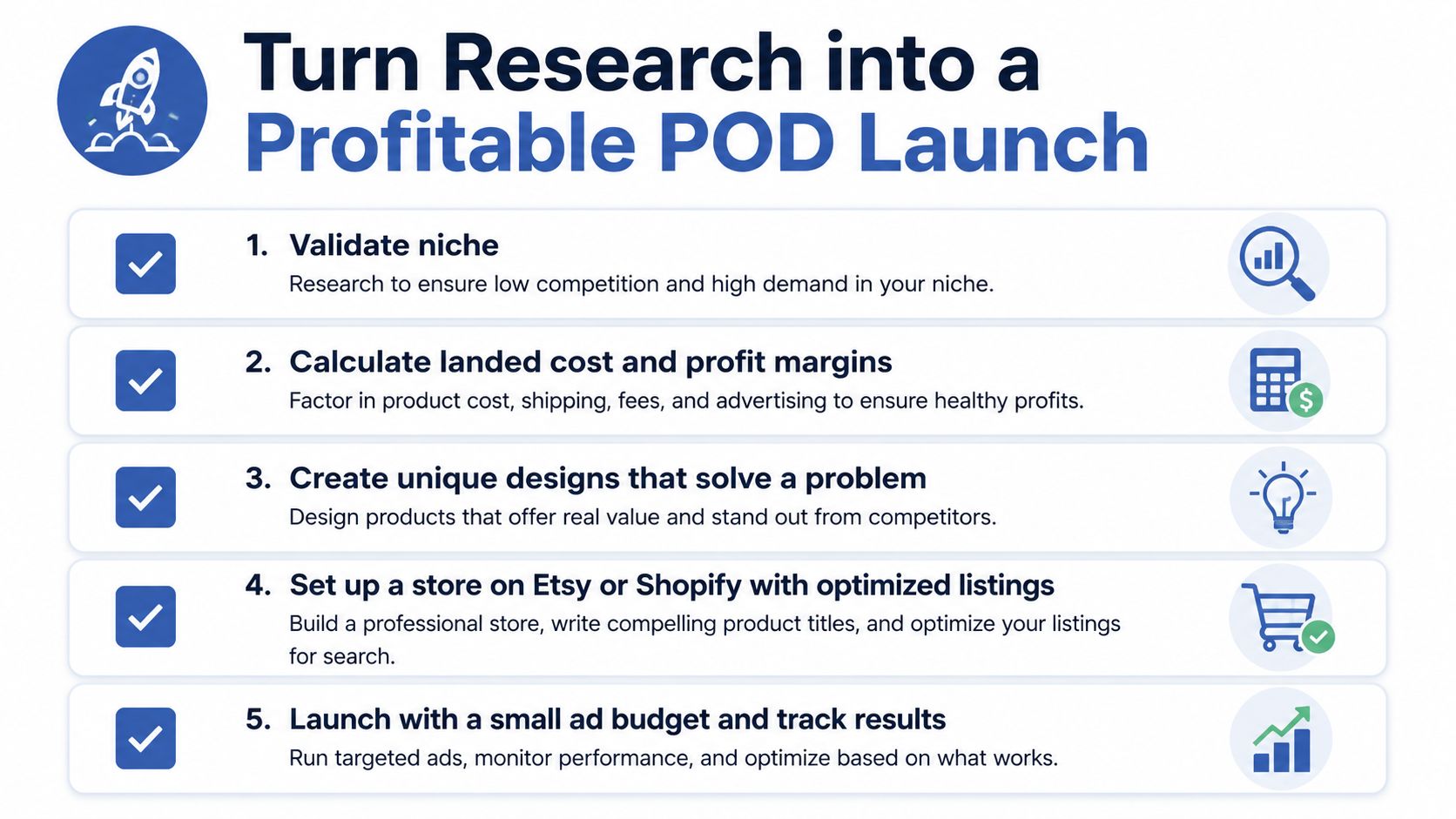
Pick the top scorer from your stack, then lock the design direction to the gap you found in competitor analysis. Build a starter set of five to ten SKUs, not fifty. That gives you enough breadth to test without turning the launch into a production mess.
Configure your print-on-demand partner, stand up a Shopify or Etsy store, and keep the first spend inside the same $100 to $200 test envelope. Put a 30-day decision window on the launch so you're not sitting in limbo while the data ages out. Define the kill metric before the first ad runs, whether that's cost per purchase, conversion rate, or margin after fees.
The best operators move from research to execution fast because the market tells the truth once a real offer is live. You don't need more notebooks, more tabs, or more opinions. You need a niche with a buyer, a margin, and a clear reason to exist.
For design speed, the Apparel Cloning system is the cleanest next step when you want to turn a validated niche into a product set without wasting time. For ongoing audience refinement, AvatarIQ can help you generate apparel designs and mockups faster, which makes it easier to move from idea to listing while the niche is still hot.
Start with the niche, prove the demand, then launch like an operator. The opportunity is there, and the people who win are usually the ones who test first and iterate quickly.
If you want a faster path from niche idea to validated product, visit Skup and use the systems built for POD operators who'd rather make decisions with data than guess their way through a launch. You'll find practical training and tools that fit this exact process, from niche selection to design acceleration.