How Does the Cloning Process Work in Apparel
You're probably here because you've seen stores crank out shirt ideas at a pace that feels unfair.
One minute you're scrolling Etsy, TikTok Shop, or Amazon Merch, and the next you're wondering how some sellers always seem to land on designs people want. That's usually when the word cloning comes up, and beginners get confused fast. They think it means copying artwork, ripping someone off, or using some shady shortcut.
In apparel, that's not what smart cloning means.
The better way to think about it is this: you study a product that's already proving demand, then you rebuild the idea around a fresh angle, a different niche, and original design work. You're not stealing the meal. You're noticing what kind of dish people keep ordering, then making your own version with your own flavor.
Table of Contents
- A Beginner Picture of What Apparel Cloning Really Means
- The Core Idea Behind Skup's Cloning Method
- How the Apparel Cloning Process Works End to End
- Why This Approach Works for New POD Sellers
- A Real Example and the Timeline You Can Expect
- Implementation Tips and Beginner Mistakes to Skip
- Your Exciting Next Step Into POD Cloning
A Beginner Picture of What Apparel Cloning Really Means
A new seller usually starts in the same spot. Laptop open. Ten tabs full of shirts. A notebook with random niche ideas like nurses, dog moms, camping, grandpas, and teachers. Then the questions start. Why does that design have traction? Why does that store look so polished? And what does cloning even mean in this business?
In apparel, cloning means taking the proven structure of a winning product and rebuilding it with your own original execution.
That's a lot simpler than it sounds. Say you notice funny retirement shirts are moving well. You don't copy the art, the exact phrase, or the brand identity. You notice the pattern instead. The market likes a bold text shirt, with a joke, aimed at a specific life event, sold to a clear audience. That pattern is the useful part.
Think like a cook, not a copier
A restaurant owner might notice that one dish across town always has a line. That doesn't mean they steal the recipe word for word. They look at what makes it work. Maybe it's comfort food, fast prep, strong presentation, and a flavor people already love. Then they create their own version.
Apparel cloning works the same way.
- The format is proven: The style of product already connects with buyers.
- The demand is visible: People are already spending money in that theme.
- The twist is yours: You change the phrase, art direction, niche angle, layout, or gift occasion.
That last part matters. This method isn't art theft, and it isn't about copying logos, trademarks, or celebrity likenesses. It's a repeatable POD strategy for reducing guesswork.
Practical rule: Clone the market signal, not the protected design.
If you want a better feel for how apparel brands position products and messages in competitive categories, it helps to look at broader retail examples too. A page like Adwave for fashion retail can give you useful context on how apparel offers get framed in everyday practice.
Why beginners like this method
Most beginners don't fail because they can't make a shirt. They fail because they guess at all the hard parts at once. They guess the niche, the offer, the angle, and the design style. Cloning removes some of that fog.
It gives you three moving parts to focus on instead of one giant mystery. Once those are clear, the whole workflow starts to make sense.
The Core Idea Behind Skup's Cloning Method
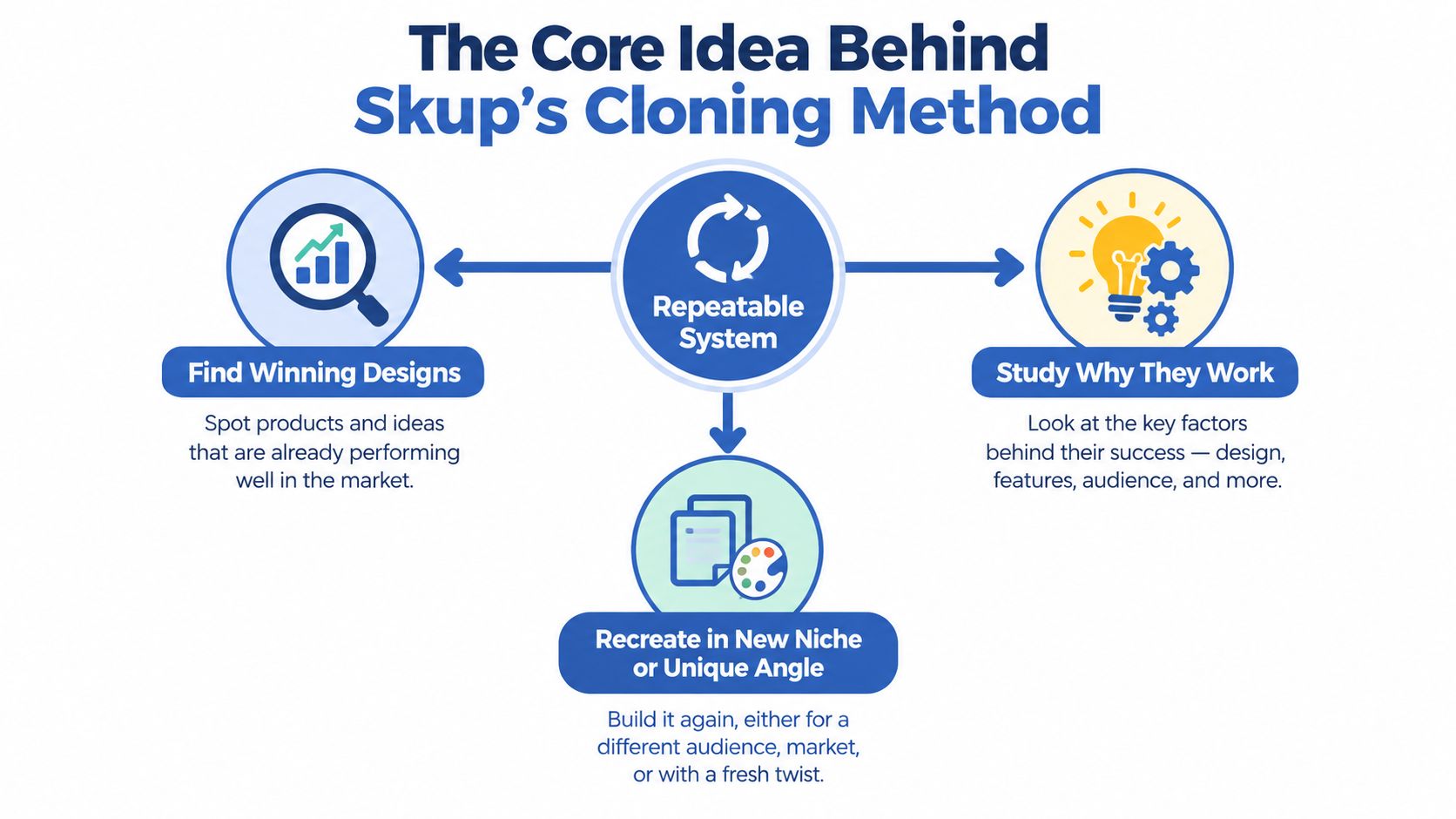
Skup's cloning method is a repeatable system. You find a design that's already winning, study why it's working, and then rebuild that idea for a different audience or with a fresh visual identity.
That's what people mean when they ask, how does the cloning process work in apparel. It isn't random inspiration. It's pattern recognition plus original execution.
The street-level analogy
Think of a sharp business owner walking a crowded street. One burger place has a line out the door. They don't stand there complaining that the market is saturated. They study the line.
Maybe the menu is simple. Maybe the branding is clear. Maybe the offer speaks to one type of customer. Then they open a similar concept nearby, but with a different theme, better packaging, or a stronger hook for a new crowd.
That's the engine behind apparel cloning.
If you want a broader look at how Skup frames beginner POD coaching and where this method fits in, their complete guide to print-on-demand coaching adds useful context.
The three moving parts
Most beginners get stuck because they hear terms like winner, niche, and angle without understanding how they connect. Here's the plain-English version.
The winner
A winner is the starting signal. It's a design concept that already appears to be selling or attracting buyer interest.
You're not married to the exact artwork. You're studying the commercial proof behind it. A winner gives you a clue that buyers respond to that message style, gift angle, topic, or visual format.
The niche
A niche is the group you reposition the idea for.
That could be occupation-based, hobby-based, family-role based, pet-based, faith-based, seasonal, or event-driven. A niche keeps your listing from feeling generic. “Funny shirt” is broad. “Funny dog mom gift shirt” is much clearer.
The unique design element
The work becomes yours.
Your unique element could be:
- A fresh phrase: Same emotional category, different wording.
- A new visual style: Typography instead of illustration, vintage instead of cute, minimal instead of loud.
- A sharper audience angle: Not just dog lovers. Senior rescue dog moms. Not just fishing. Grandpa retirement fishing.
A cloned product should feel familiar to the market and new to the buyer.
How the pieces combine
A winner without a niche is too vague.
A niche without a winner can turn into blind guessing.
A niche and winner without a unique angle can drift into copying.
When the three parts lock together, the process becomes teachable. You're not hoping a random design works. You're building from evidence, then adding originality where it counts.
How the Apparel Cloning Process Works End to End
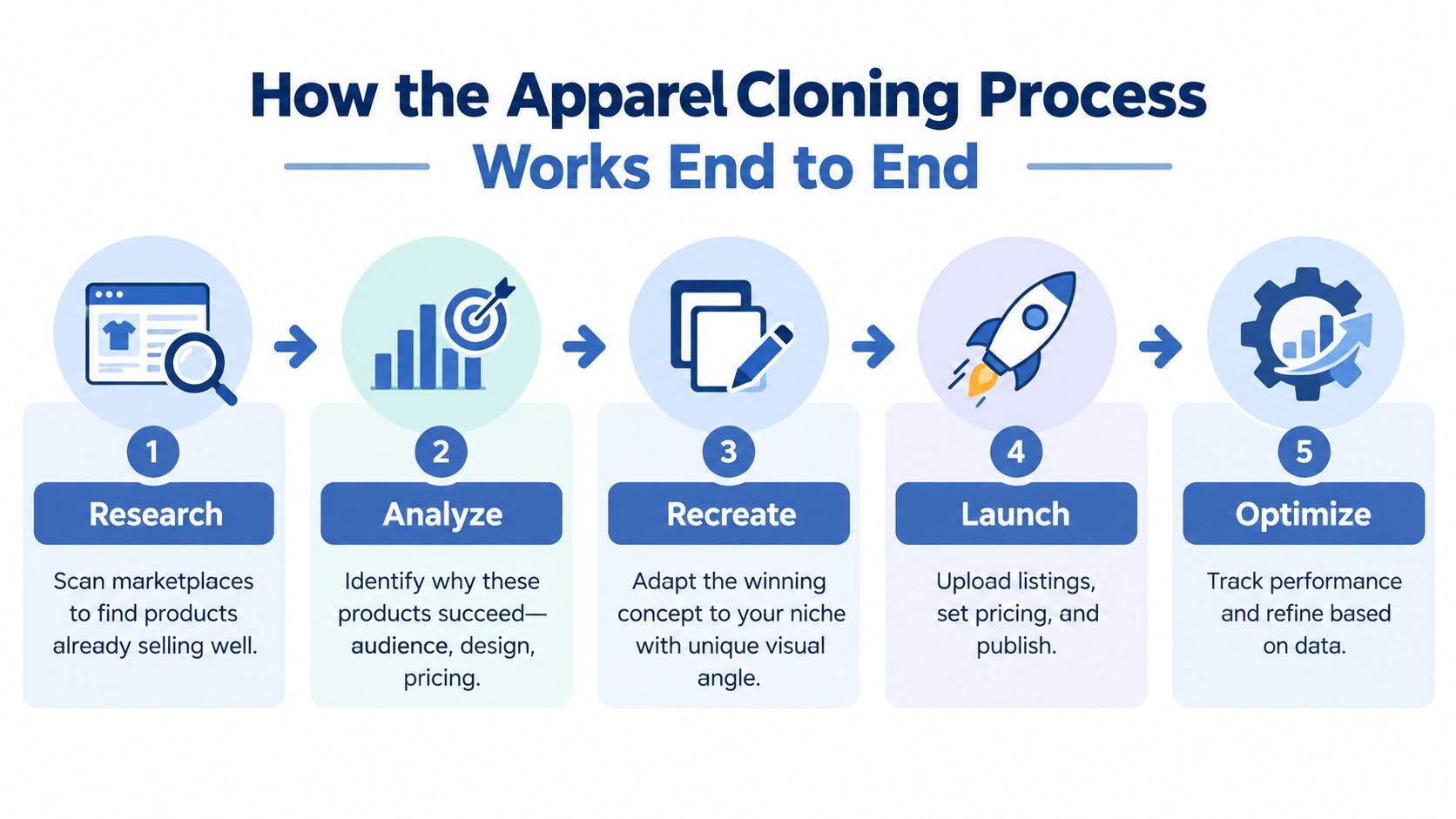
The easiest way to understand this process is to walk through what a beginner is doing from first idea to first live listing.
Research starts with pattern hunting
At the beginning, you're not designing anything yet. You're scanning marketplaces and social platforms for products that already show signs of life. The point is to gather references, not chase perfection.
You might notice the same ingredients showing up again and again:
- Repeated themes: birthdays, pets, jobs, hobbies, holidays
- Common design structures: center chest text, distressed fonts, retro sunset layouts, simple icon plus phrase
- Buyer intent angles: gifts, identity statements, humor, pride, emotional connection
This is also where many beginners connect their store setup so they can move faster once they're ready. If you're building on Shopify, a walkthrough like how to add print on demand to Shopify helps tie the product side to the store side.
Evaluation keeps you out of trouble
Once you have candidates, the next job is filtering.
You want concepts that fit a reachable niche and don't depend on protected names, trademarked phrases, sports teams, famous faces, or copied art. A design can look exciting and still be a bad business decision if it leans on someone else's intellectual property.
This stage also helps you ask a better question: is the product winning because of the exact art, or because of the audience and message? If it's mostly the message, that's good news. It means you have room to reinterpret it.
Design creation is where originality enters
Now you create something new that carries the same market energy without mirroring the source.
Some sellers sketch rough concepts themselves. Some hire a freelancer. Some use AI-assisted design workflows. If you're working with AI-generated concepts and mockups, AvatarIQ is one tool built for that design-to-listing workflow.
Your job here is simple. Keep the emotional hook. Change the execution.
That can mean swapping a sarcastic line for a sweeter gift angle. It can mean replacing a cartoon illustration with bold vintage typography. It can mean taking a general camping idea and making it speak directly to moms, veterans, nurses, or dachshund owners.
Setup and launch are practical, not glamorous
After the design is ready, you pair it with the product itself. You choose the garment, color options, mockups, and listing presentation. Then you write a title and description that match how real shoppers search.
A good launch isn't fancy. It's clear.
- Use clean mockups: Buyers should understand the product at a glance.
- Match the niche language: The title should sound like something the shopper would type.
- Stay aligned: If the design is for a gift buyer, the listing should read like a gift listing.
Tracking turns one listing into a skill
The first version rarely comes out perfect. That's normal.
Once the product is live, you watch what happens. Which mockup gets more clicks? Which title feels tighter? Which design angle gets saved, shared, or purchased? That feedback loop matters more than your first draft.
A beginner who treats each listing like a test will improve quickly. A beginner who expects every launch to be a home run usually quits too early.
Why This Approach Works for New POD Sellers
A lot of beginner strategies fail for one reason. They ask you to invent demand from scratch.
Apparel cloning starts from a stronger position because it begins with demand signals that already exist. If a concept is already getting attention in the market, you're not forcing buyers to care about a completely cold idea. You're entering a conversation buyers are already having.
Demand proof lowers the guessing
This is the part that makes the model attractive to new sellers. You aren't trying to become a trend prophet on day one. You're looking for signs that shoppers already respond to a theme, a gift angle, or a style of message.
That changes your job from “invent something brilliant” to “interpret something proven well.”
New sellers usually move faster when they reduce the number of guesses inside one launch.
Margin room makes testing possible
The numbers also matter. In many POD setups, a shirt priced in the $20 to $28 range can often leave room after production and shipping costs for testing and iteration. If production and shipping land around $9 to $13, that leaves about $7 to $15 per sale before ad spend, based on the range used in this apparel model.
That doesn't guarantee profit. It does mean beginners can test without needing a giant budget or a warehouse full of inventory.
Cloning narrows the risk
Instead of guessing on design, audience, and product direction all at once, you anchor one variable in something already validated by the market. That shortens the learning loop.
Here's the simplest way to compare it.
| Factor | Cloning vs. Original Design: Risk and Reward Comparison |
|---|---|
| Source Mechanism | Cloning starts from a proven market pattern. Original design starts from the seller's own concept. |
| Demand Proof | Cloning uses visible buyer interest as a starting clue. Original design has to discover that proof from zero. |
| Avg. Time to First Sale | Cloning often gives beginners a shorter path because the angle is already market-tested. Original design can take longer because more variables are unknown. |
| Ad Test Budget | Cloning can be easier to test efficiently because the message already has a benchmark. Original design may need more rounds of testing to find fit. |
Platforms tend to favor early traction
Marketplaces and discovery-driven platforms usually respond better when a listing starts converting. A fresh design built on a proven angle has a better chance of collecting those early signals than a totally random idea.
That's the quiet advantage here. Every cloned listing teaches you what buyers react to. Over time, your decisions get faster, your niche instincts get sharper, and launching stops feeling like a blind leap.
A Real Example and the Timeline You Can Expect
Let's make this real with a beginner scenario.
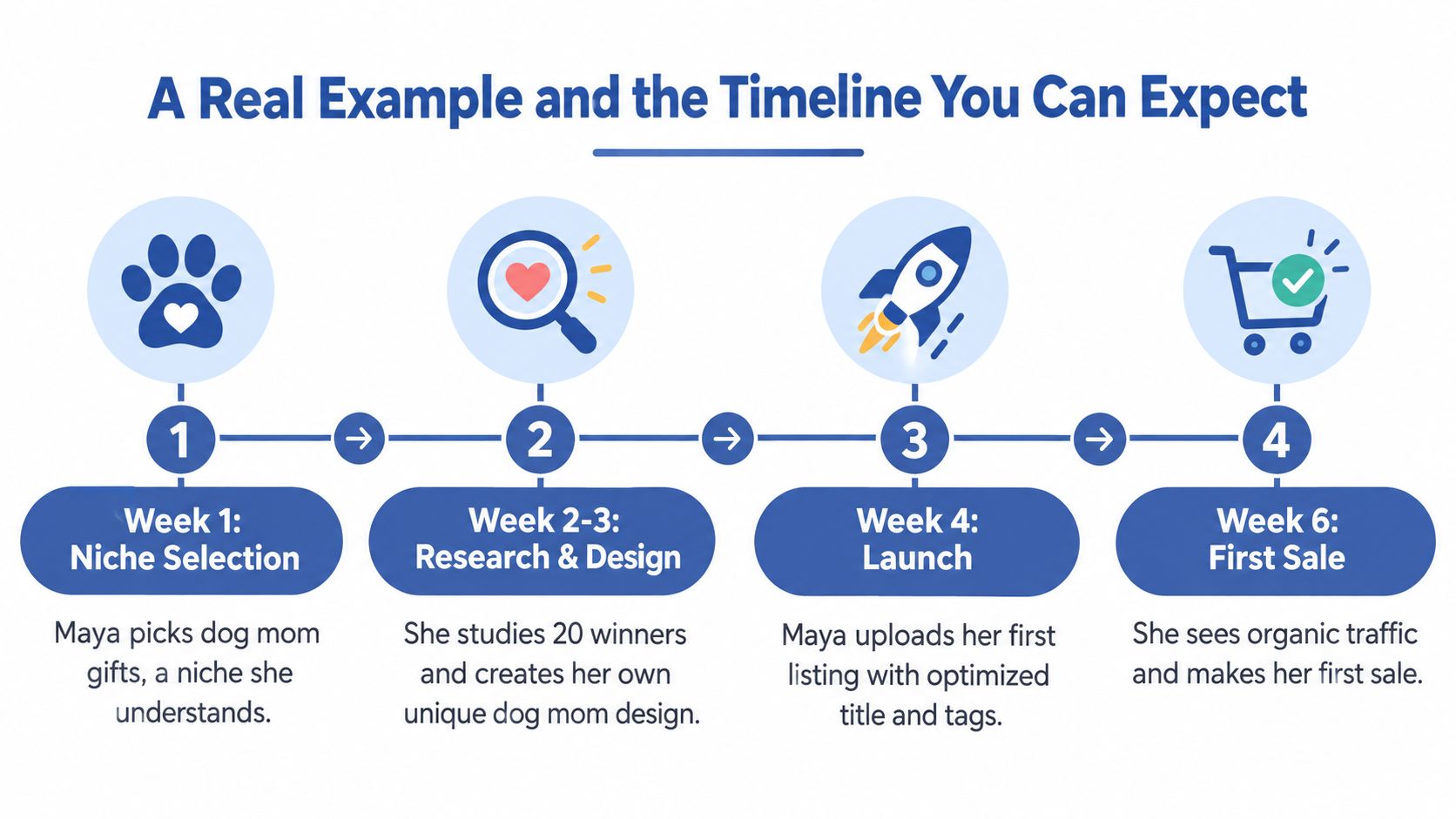
Maya is a first-time seller. She doesn't start with a giant store or a deep design background. She picks dog mom gifts because she already understands the audience and can spot the difference between a generic pet shirt and one that feels giftable.
Days 1 through 7
Her first week is all research.
She bookmarks ten listings that keep showing up with angles she likes. A few are humorous. A few are breed-specific. A few lean hard into Mother's Day and birthday gifting. She doesn't design yet. She writes down the repeated hooks and starts noticing that the good listings usually feel focused, not broad.
Days 8 through 21
Now Maya builds.
She creates three original concepts using templates and simple reference notes from her research. One is playful. One is sentimental. One is more retro and typography-driven. She lists them on Etsy and TikTok Shop with clean mockups and direct titles.
If you're wondering how long production and fulfillment can affect momentum during this stage, a guide on production timeline planning helps set expectations.
The first big shift for a beginner is emotional, not technical. Once one listing goes live, the business stops being an idea and starts being real.
Days 22 through 45
Doubt usually shows up.
One design gets ignored. One gets a little engagement. One starts pulling attention, so she puts a $5 daily ad set behind two listings, then cuts the weaker one and raises the better performer to $20 a day if it keeps responding.
That decision matters more than the first draft of the design. She's learning to follow feedback instead of forcing a favorite.
Days 46 through 90
This is when beginners start seeing the compounding effect.
A realistic range for this scenario is roughly 60 to 120 sales and about $700 to $1,400 in revenue over that stretch, while rebuilding the store into six listings and a small buyer list. Just as important, Maya no longer feels confused by the process. She can see patterns now.
Her first sale feels exciting. Her later sales feel instructive. By the end of the cycle, she hasn't just launched products. She's built a repeatable habit.
Implementation Tips and Beginner Mistakes to Skip
The biggest beginner mistake isn't lack of talent. It's lack of structure.
When people ask how does the cloning process work, they usually need a better operating rhythm, not more motivation.
What to do instead
Use these as your beginner guardrails.
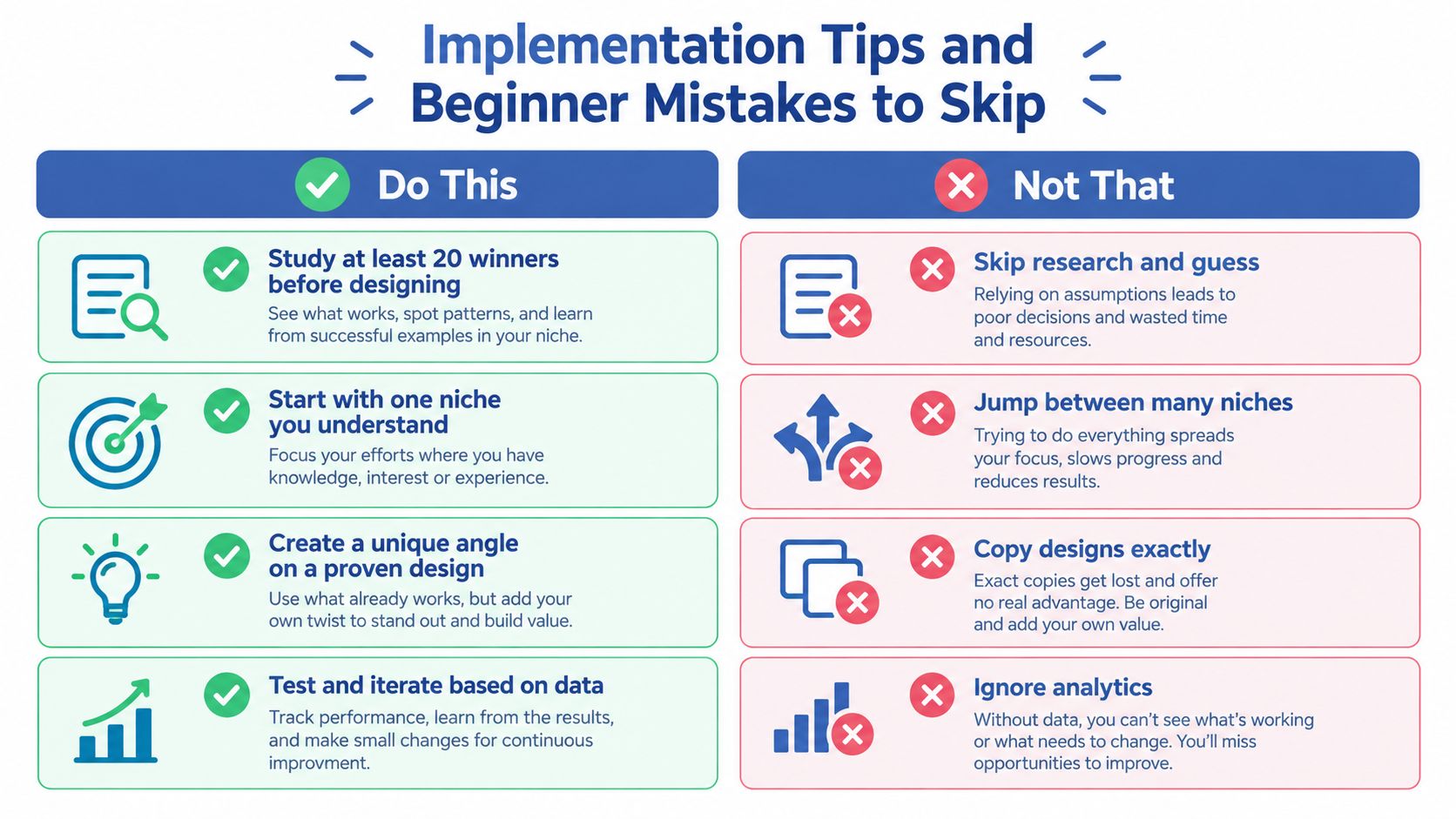
- Study at least 20 winners: Don't start designing after two good listings. Volume helps patterns stand out.
- Track what repeats: Save phrases, layout types, colors, and gift angles in a simple sheet.
- Stay in one niche first: Depth beats randomness. You'll learn faster when the audience stays consistent.
- Rebuild, don't trace: Make the angle original through new wording, art, typography, and presentation.
Mistakes that slow people down
A lot of frustration comes from avoidable moves.
| Do This | Not That |
|---|---|
| Launch two focused designs | Upload ten unrelated ideas |
| Build niche depth | Bounce between niches every day |
| Give ads time to breathe | Turn everything off after one bad day |
| Master one main platform first | Scatter your attention across every channel at once |
Good cloning is disciplined. It looks boring at first, then it starts paying you back.
Pricing discipline matters too. If proven products in your category tend to sit in a familiar retail band, don't race to the bottom just because you're new. Low pricing often signals low confidence, not smart strategy.
The goal isn't to look busy. The goal is to collect clean lessons from each launch.
Your Exciting Next Step Into POD Cloning
Apparel cloning works because it gives beginners a cleaner path into eCommerce.
You don't need to be a master illustrator. You don't need to predict trends from thin air. You need research discipline, a clear niche, and the willingness to turn a proven market idea into something original and useful.
That's why this method keeps pulling people in. It's not a one-time trick. It's a skill. The more cycles you run, the faster you get at spotting winners, shaping angles, and launching with confidence.
If you want momentum today, keep it simple.
Pick one niche you understand. Find three listings that clearly show buyer interest. Write down what they have in common, then sketch one original design angle that fits the same emotional lane.
That's enough to move from browsing to building.
Skup teaches the apparel cloning method through its Apparel Cloning training and supports the design side with tools built for POD workflows. If you want to see how that system fits together and explore the next step for your own store, visit Skup.