The Complete Seasonal Strategy Guide for Print on Demand: How to Maximize Sales Year-Round (2026)
Table of Contents
- Quick Overview
- Why Timing Matters in Print on Demand
- Q1: The Fresh Start (January-March)
- Q2: Spring Momentum (April-June)
- Q3: The Preparation Phase (July-September)
- Q4: The Main Event (October-December)
- Evergreen vs Seasonal: Building a Balanced Portfolio
- Budget Allocation Throughout the Year
- Building Your Annual Content Calendar
- Common Seasonal Mistakes That Kill Profits
- Real Examples from Skup Students
- Frequently Asked Questions
- The Bottom Line
Quick Overview
Seasonal strategy in print on demand means understanding when your customers are most likely to buy, what they’re looking for at different times of year, and how to position your products and advertising accordingly. The most successful POD sellers don’t just react to seasons—they plan months ahead, building inventory and testing designs before peak buying periods hit. This guide covers exactly how to structure your year for maximum sales, including specific timing for each quarter, budget allocation strategies, and the evergreen-seasonal balance that keeps cash flow steady year-round.
Why Timing Matters in Print on Demand
Most new POD sellers make the same mistake: they treat every month the same. They run the same ads, push the same products, and wonder why some months crush it while others barely cover ad spend.
Here’s the reality: consumer buying behavior follows predictable patterns. People aren’t shopping for Father’s Day gifts in October. They’re not thinking about Halloween costumes in February. And they definitely aren’t in “buying mode” during the post-holiday hangover of January.
Understanding these patterns gives you an unfair advantage. While your competitors are scrambling to create Halloween designs on October 15th (way too late), you’ll have yours tested and scaling by September. While they’re burned out from Q4 and taking January off, you’ll be positioning for Valentine’s Day.
The Compound Effect of Planning Ahead
In print on demand, you need time to:
- Create designs — Quality takes time, especially if you’re using AvatarIQ to generate variations
- Test what works — You need 2-4 weeks of data before scaling
- Build social proof — Reviews and engagement take time to accumulate
- Optimize your ads — Facebook’s algorithm needs learning phase data
This means if you want to maximize Valentine’s Day sales (February 14th), you should start testing in early January. If you want to crush Q4, your preparation should begin in August at the latest.
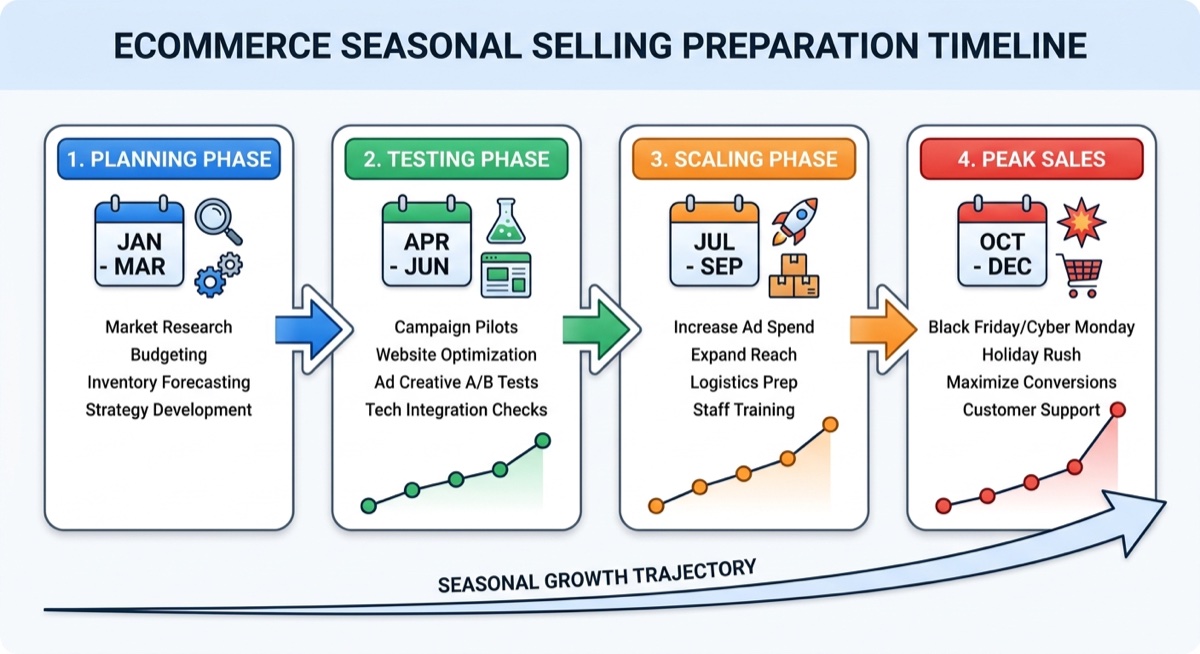
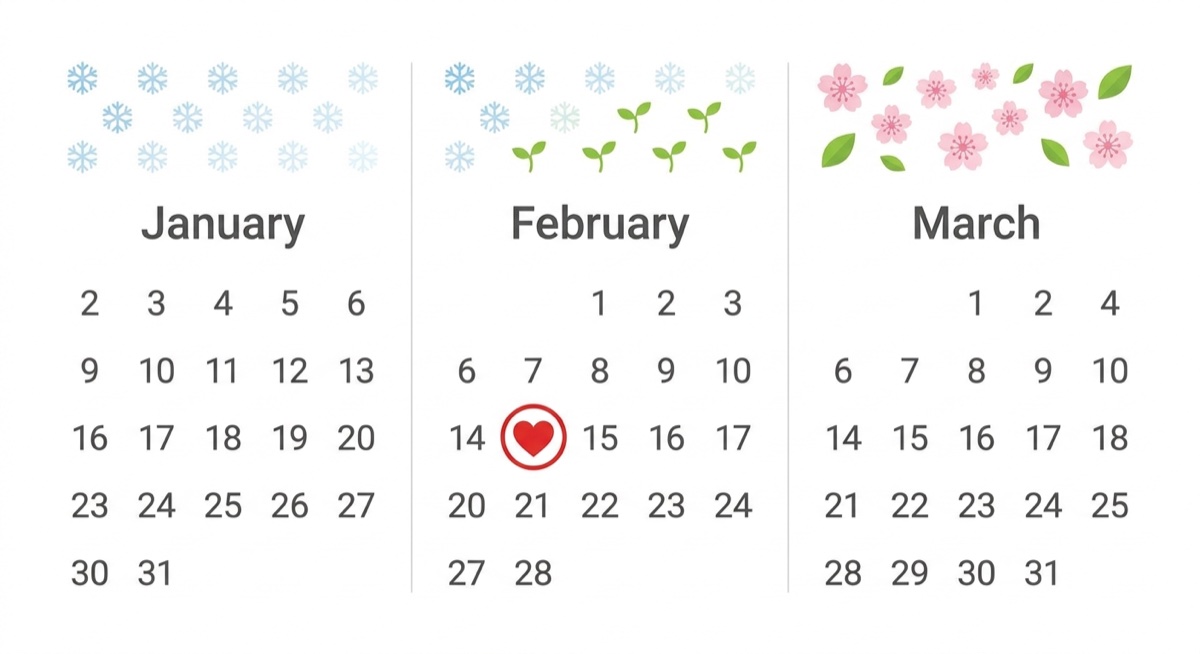
Q1: The Fresh Start (January-March)
Q1 is where most POD sellers lose momentum. They’re exhausted from Q4, their ad accounts need recovery, and general consumer spending is down. But this is also an opportunity if you approach it correctly.
January: The Reset Month
January is historically the slowest month for e-commerce. People are recovering from holiday spending, dealing with credit card bills, and focused on New Year’s resolutions rather than buying apparel.
What to do in January:
- Analyze your Q4 data — which designs performed best and why?
- Refresh your best-performing evergreen designs with 2026 updates
- Begin Valentine’s Day testing (ideally by January 10th)
- Clean up your product catalog — remove underperformers
- Plan your Q2 product lineup
Many successful sellers use January for testing new niches at lower budgets. Ad costs are typically lower because fewer advertisers are competing, making it a smart time to find what resonates.
February: Valentine’s Day Push
Valentine’s Day is underrated in the POD world. While it’s not as massive as Q4, it’s a concentrated buying period with clear intent. People are actively shopping for gifts, and apparel with romantic, funny, or couples-themed designs sells well.
Key Valentine’s niches:
- Couples matching apparel (“I love my crazy husband/wife”)
- Pet lover Valentine’s themes
- Anti-Valentine’s humor for the single crowd
- Galentine’s Day (friends celebrating together)
Timing: Start ads by January 15th. Peak buying happens February 1-12. After February 14th, pivot immediately.
March: Spring Transition
March is about transitioning from winter to spring themes. St. Patrick’s Day (March 17th) offers a small spike, but the bigger opportunity is positioning for the spring selling season ahead.
March priorities:
- Test Easter designs (Easter moves each year—check the date)
- Begin Mother’s Day design creation
- Refresh product mockups with spring/outdoor settings
- Plan graduation season products if you serve that niche
Q2: Spring Momentum (April-June)
Q2 is packed with gift-giving holidays and tends to outperform Q1 significantly. This is when your planning from earlier pays off.
April: Easter and Spring Sales
Easter’s date varies (it can fall anywhere from late March to late April), so check the calendar and plan accordingly. Easter isn’t a massive apparel holiday, but spring-themed products see a bump as people emerge from winter.
More importantly, April is your final prep time for the Mother’s Day rush.
May: Mother’s Day Gold Rush
Mother’s Day (second Sunday of May) is one of the best holidays for POD apparel. Why? Because:
- It’s a universal holiday — almost everyone has a mom
- Apparel is a popular gift category
- Personalization themes work extremely well
- The emotional appeal drives higher purchase rates
Winning Mother’s Day angles:
- “Best Mom” superlative designs
- Specific hobby + mom combinations (“Dog Mom,” “Plant Mom”)
- Grandmother variations
- Funny/sarcastic mom humor
- From children perspective (“My Mom is My Hero”)
Critical timing: Start running ads by April 20th at the latest. Peak buying is the week before Mother’s Day. Ship time matters — promote early to ensure delivery.
June: Father’s Day and Graduation
Father’s Day (third Sunday of June) follows quickly after Mother’s Day. Many of your Mother’s Day designs can be adapted with minimal changes.
Graduation season (May-June) also creates demand for celebratory and milestone-themed apparel. “Class of 2026” and achievement-focused designs perform well in specific niches.

Q3: The Preparation Phase (July-September)
Q3 is the most strategic quarter. Summer selling is moderate, but the real focus should be preparing your Q4 assault. Sellers who use Q3 wisely dominate Q4. Those who coast through summer scramble in October.
July: Summer Sales and Q4 Planning Begins
July typically sees a summer slowdown as people vacation and spend less time online shopping. Use this wisely:
July priorities:
- Run your evergreen campaigns at maintenance levels
- Begin Q4 design ideation — research what worked last year
- Audit your supplier relationships and fulfillment times
- Test new summer/outdoor niches if relevant to your audience
This is also a good time to build out your design library using AvatarIQ. The 275 monthly credits can be stockpiled into Q4-ready designs.
August: Back-to-School and Q4 Design Creation
Back-to-school season creates a small bump for teacher and education-related niches. But August’s primary focus should be Q4 preparation:
August checklist:
- Create your Halloween design lineup (at least 10-15 designs)
- Begin Thanksgiving/fall themes
- Plan your Black Friday/Cyber Monday promotions
- Test your checkout flow and ensure site speed is optimized
- Review and update your return/refund policies
September: Test and Refine Before Q4
September is your final testing window before the Q4 rush. By September 15th, you should be actively testing Halloween designs. By September 30th, you need to know which designs are winners.
Why testing in September matters:
- Ad costs are still relatively low (they spike in October)
- You have time to iterate on designs that show promise
- You can identify and kill underperformers before wasting Q4 budget
- Facebook’s algorithm can optimize during learning phases before the rush

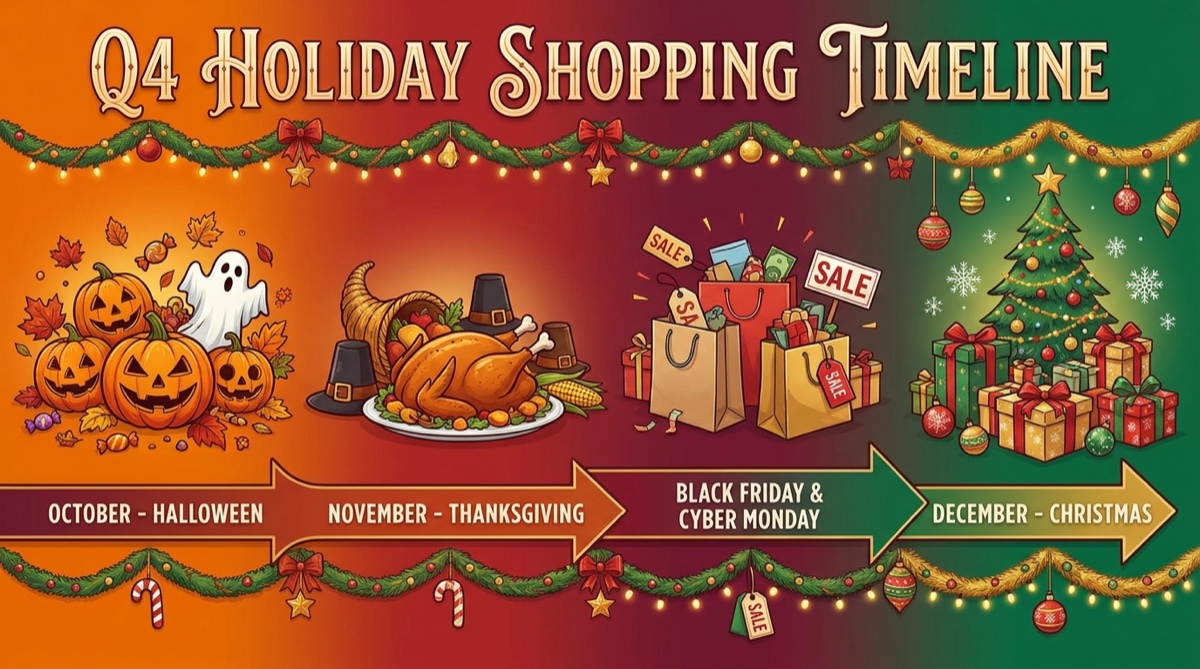
Q4: The Main Event (October-December)
Q4 is when print on demand businesses make or break their year. Some sellers generate 50-70% of their annual revenue in these three months. The combination of multiple holidays, gift-buying intent, and increased consumer spending creates the perfect storm for sales.
October: Halloween and the Q4 Kickoff
Halloween (October 31st) marks the official start of the holiday buying season. Unlike other holidays, Halloween buying extends throughout the entire month:
Halloween timeline:
- Early October: Start scaling proven designs
- October 1-15: Peak testing and optimization period
- October 15-25: Maximum scale on winners (shipping deadlines matter)
- October 25-31: Late buyers willing to pay for rush shipping
Hot Halloween angles:
- Costume-alternative apparel (“This IS my costume”)
- Horror/spooky themes for enthusiasts
- Pet Halloween content
- Family/group matching Halloween themes
- Occupation + Halloween mashups (nurse, teacher, etc.)
November: The Biggest Month of the Year
November contains Black Friday, Cyber Monday, and the start of Christmas shopping. Ad costs spike, but so does purchase intent. This is when your Q3 preparation pays off.
Key November dates:
- November 1-15: Transition from Halloween to fall/Thanksgiving
- Thanksgiving week: Family themes, gratitude messaging
- Black Friday (day after Thanksgiving): Consider discounts on slow movers
- Cyber Monday: All-time high online shopping day
- Post-Thanksgiving: Full Christmas mode begins
November advertising strategy:
CPMs (cost per thousand impressions) increase 30-50% in November compared to September. This means your winners need to REALLY win. Don’t test new designs in November — scale what’s already proven.
December: The Christmas Sprint
December is a race against shipping deadlines. As December progresses, buyers become increasingly anxious about delivery times, making clear shipping messaging crucial.
December phases:
- December 1-10: Peak Christmas buying (guarantee delivery messaging)
- December 10-15: Last-chance messaging (“Order by X for delivery”)
- December 15-20: Only buyers willing to pay expedited shipping
- December 21-25: Sales drop dramatically — most POD can’t guarantee delivery
- December 26-31: Gift card spenders and self-purchasers
Pro tip: Don’t forget about non-Christmas buyers. Not everyone celebrates Christmas, and some buyers specifically seek non-holiday products in December.
Evergreen vs Seasonal: Building a Balanced Portfolio
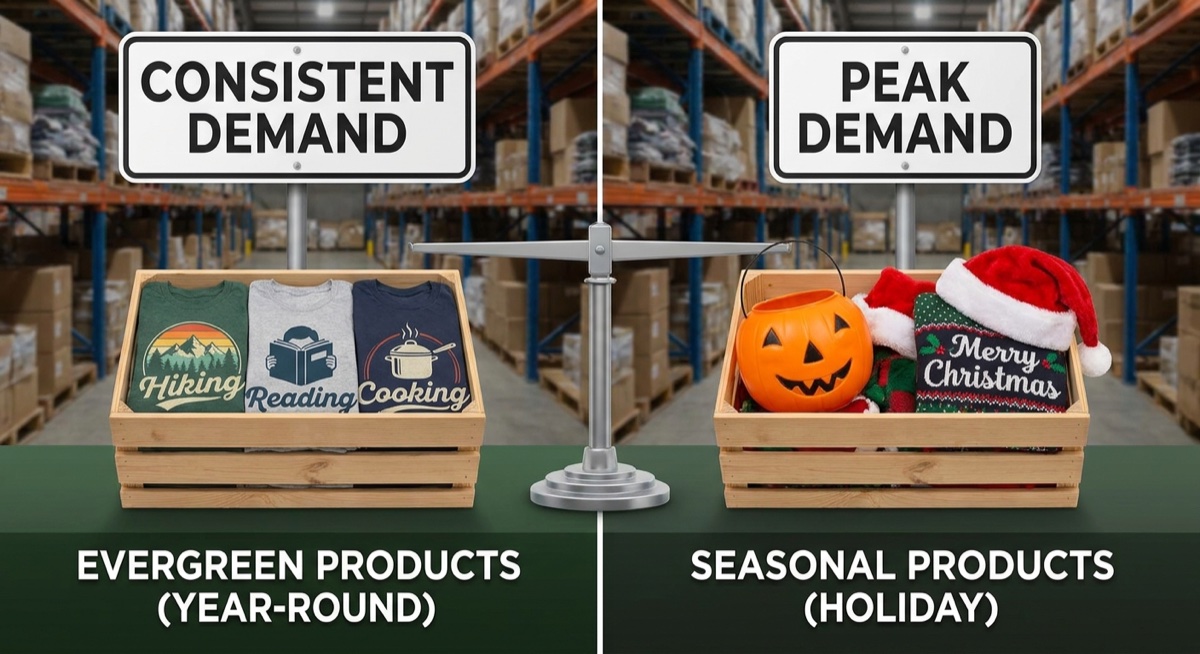
One of the biggest mistakes new sellers make is going all-in on seasonal products without building an evergreen foundation. When the season ends, so does their income.
The 70/30 Rule
Successful POD businesses typically maintain roughly:
- 70% evergreen products — sell year-round, provide consistent baseline revenue
- 30% seasonal products — capitalize on holiday spikes and trends
This balance ensures you’re never starting from zero when a season ends.
What Makes a Good Evergreen Product?
Evergreen designs tap into permanent identity markers:
- Professions (nurse, teacher, firefighter, etc.)
- Hobbies and passions (fishing, gaming, gardening)
- Family roles (dad jokes, grandparent pride)
- Pet ownership (dog mom, cat dad)
- Location/regional pride
- Personality types (introvert, sarcasm, coffee addiction)
These designs sell in January and July just as well as October — people’s identities don’t change with the seasons.
Seasonal Overlays on Evergreen Foundations
Smart sellers create seasonal variations of their evergreen winners. If “Dog Mom” sells year-round, then “Spooky Dog Mom” sells in October, “Thankful Dog Mom” in November, and “Dog Mom Claus” in December.
This approach:
- Reduces design creation time (you’re modifying, not starting fresh)
- Leverages proven messaging
- Targets the same audience with seasonal relevance
- Builds on existing social proof
Budget Allocation Throughout the Year
Your advertising budget shouldn’t be the same every month. Strategic allocation follows buying patterns and competition levels.
Monthly Budget Framework
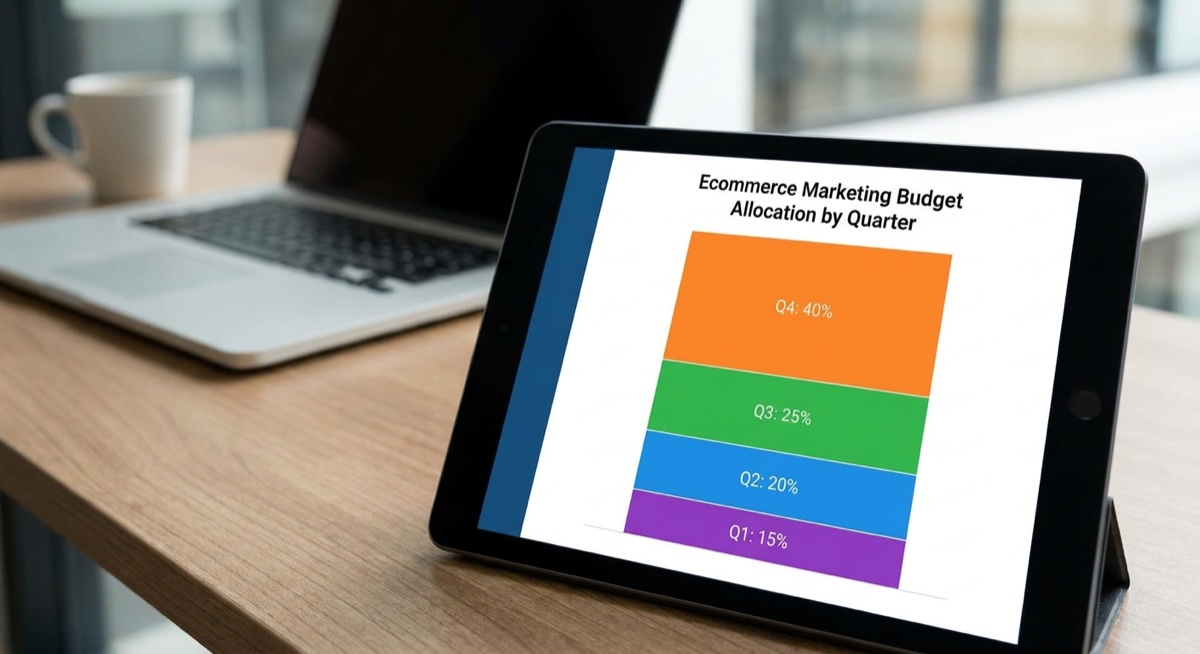
Here’s a general framework for allocating a $24,000 annual ad budget (adjust proportionally for your actual budget):
| Month | % of Budget | Focus |
|---|---|---|
| January | 4% | Testing, Valentine’s prep |
| February | 6% | Valentine’s Day push |
| March | 5% | Easter, spring transition |
| April | 6% | Spring sales, Mother’s Day prep |
| May | 10% | Mother’s Day peak |
| June | 8% | Father’s Day, graduation |
| July | 5% | Maintenance, Q4 planning |
| August | 5% | Back-to-school, testing |
| September | 7% | Q4 testing phase |
| October | 12% | Halloween, Q4 scale begins |
| November | 18% | Peak Q4, Black Friday |
| December | 14% | Christmas final push |
Notice Q4 (October-December) receives 44% of annual budget. This reflects the reality of consumer spending patterns.
Adjusting for Your Niche
These percentages shift based on your specific niche:
- Gift-heavy niches (family, pets): Even more Q4 weighted
- Professional niches (nurse, teacher): More evergreen, less seasonal swing
- Hobby niches (fishing, gaming): Follow hobby seasonality patterns
The Testing vs Scaling Split
Within each month’s budget, maintain a testing allocation:
- Slow months (January, July): 40% testing, 60% scaling winners
- Moderate months: 25% testing, 75% scaling
- Peak months (Q4): 10% testing, 90% scaling proven winners
Never stop testing entirely, but shift dramatically toward scaling during peak periods.
Building Your Annual Content Calendar
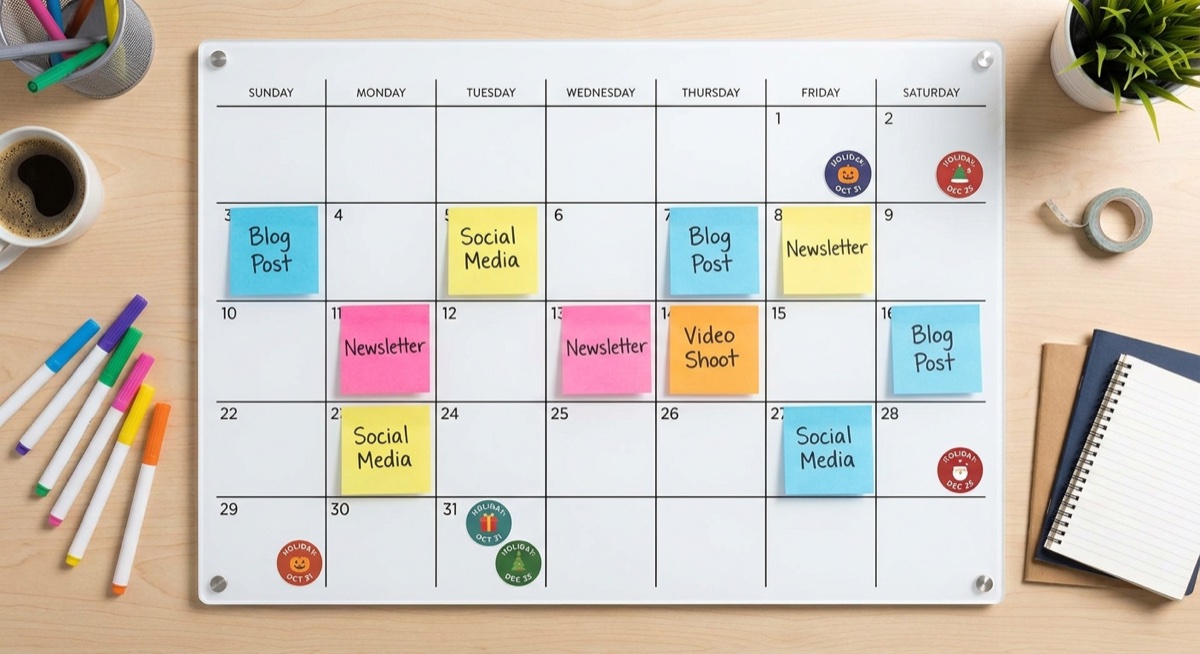
A content calendar keeps you ahead instead of reactive. Here’s how to build yours:
Step 1: Mark All Fixed Dates
Start with holidays that don’t move:
- Valentine’s Day — February 14
- St. Patrick’s Day — March 17
- Independence Day — July 4
- Halloween — October 31
- Veterans Day — November 11
- Christmas — December 25
Then add floating holidays (check dates each year):
- Easter
- Mother’s Day (second Sunday of May)
- Father’s Day (third Sunday of June)
- Thanksgiving (fourth Thursday of November)
Step 2: Add Preparation Deadlines
For each major selling event, work backward:
- 6 weeks before: Designs should be created
- 4 weeks before: Testing begins
- 2 weeks before: Scaling proven winners
- Shipping deadline: Last day to ensure delivery
Step 3: Include Niche-Specific Dates
Every niche has its own calendar. Examples:
- Nursing niche: Nurses Week (May), graduation season
- Teacher niche: Teacher Appreciation Week (May), back-to-school
- Pet niche: National Dog Day (August), Adopt a Shelter Pet Day
- Fishing niche: Opening day of fishing season varies by region
Step 4: Schedule Review Points
Build in monthly and quarterly reviews:
- Monthly: What sold? What didn’t? Adjust next month’s plans.
- Quarterly: Are you on track for annual goals? Major strategy shifts needed?
- Post-season: Full analysis after each major holiday — document lessons.
Common Seasonal Mistakes That Kill Profits
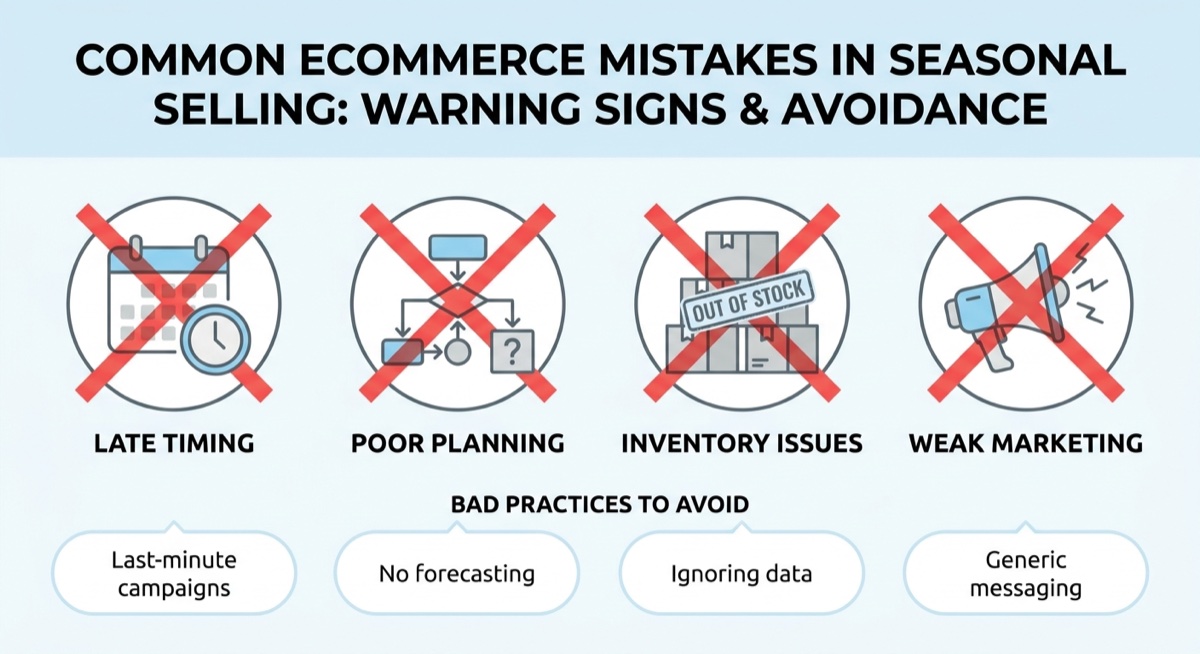
After working with thousands of students in the Skup Incubator, we see the same seasonal mistakes repeatedly. Here’s what to avoid:
Mistake #1: Starting Too Late
The number one killer. Creating Halloween designs on October 10th means:
- No time to test what works
- Launching into peak CPMs without optimization
- Shipping may not arrive in time
- Competitors already have pixel data and social proof
Fix: Follow the 6-week rule minimum. For Q4, aim for 8+ weeks.
Mistake #2: All Seasonal, No Evergreen
Going all-in on holidays means feast-or-famine income. After Christmas, these sellers have nothing and must rebuild from zero.
Fix: Maintain that 70/30 evergreen-to-seasonal ratio. Your evergreen products are your floor.
Mistake #3: Not Adjusting Ad Strategy
Running the same daily budget in July as December ignores reality. Ad costs, competition, and buyer intent all shift dramatically.
Fix: Use the budget allocation framework above. Be willing to spend more when ROI justifies it.
Mistake #4: Ignoring Shipping Deadlines
Nothing kills customer satisfaction like a Christmas gift arriving December 28th. And refund requests eat into profits.
Fix: Know your supplier’s shipping times. Communicate deadlines clearly. Update messaging as deadlines pass.
Mistake #5: Design Fatigue
Recycling the exact same designs year after year leads to declining performance. Audiences evolve, trends change, and Facebook penalizes repetitive creative.
Fix: Refresh successful designs each year. Keep the winning concept, update the execution.
Mistake #6: Post-Q4 Burnout
Taking all of January off means missing Valentine’s Day setup. Momentum dies.
Fix: Take a few days off, then get back to testing. January’s lower ad costs are an opportunity.
Real Examples from Skup Students
Seasonal strategy isn’t theoretical — it’s proven by real results. Here’s how some Skup students have leveraged timing:
Adam Schneider: Q4 Mastery
Adam’s results show what’s possible with proper Q4 execution. After preparing throughout Q3 and entering Q4 with tested designs, Adam achieved $179K in 90 days and eventually reached $500K total with over 1,000 orders. His success came from starting his Q4 prep in August, not October.
Ede Sartori: December Momentum
Ede demonstrated that December success isn’t accidental. With 55 sales in just a couple weeks during December 2025, Ede had positioned products for the Christmas rush well before December arrived.
Sean Young: Building Through the Seasons
Sean’s journey shows the compound effect of seasonal consistency. Starting with a first sale, then building to $1,000, then reaching $10K total — each season added to his foundation. By maintaining evergreen campaigns while capitalizing on seasonal spikes, Sean built sustainable momentum rather than one-time wins.
Ernso Marcelin: Consistent Volume
Ernso’s pattern of 13 sales in 4 days, 18 orders in another 4-day period, and consistent multi-sale days throughout various months shows what happens when you combine evergreen foundations with seasonal optimization. The baseline never drops to zero.

Frequently Asked Questions
When should I start preparing for Q4?
August at the absolute latest, ideally July. You need time to create designs (July), test them (August-September), and identify winners before October’s increased ad costs. Sellers who start in October are already behind.
Should I pause ads completely in January?
No — but you should reduce spend on underperforming campaigns and shift focus to testing. January’s lower CPMs make it an excellent testing month. Maintain your evergreen winners at lower budgets while exploring new opportunities.
How do I know which seasonal products to create for my niche?
Look at what successful sellers in your niche did last year. Search Etsy, Amazon, and competitor stores for seasonal variations. If “dog mom” sells year-round in your niche, test “Halloween dog mom,” “Christmas dog mom,” etc. The audience already exists — you’re just adding seasonal relevance.
What if I’m just starting and Q4 is approaching?
Focus on one holiday rather than trying to cover everything. If it’s September and you’re new, go all-in on Halloween with 10-15 designs. Test aggressively, learn from the data, and apply those lessons to future holidays. One strong holiday is better than five weak attempts.
How do I handle the post-Christmas slowdown?
Pivot immediately. December 26-31 attracts gift card spenders and self-purchasers. January brings New Year’s resolution themes in relevant niches (fitness, self-improvement). Start Valentine’s Day testing by January 10th. Keep momentum rather than stopping completely.
Should I offer Black Friday discounts?
Only on products that are already profitable at the discounted price. Don’t discount winners that are selling at full price. Consider discounts for moving slow inventory or introducing new customers to your brand. Calculate margins before committing to discounts.
How far ahead should I create designs for the whole year?
Create in quarterly batches. During each quarter, create designs for the next quarter. This keeps you consistently 2-3 months ahead without overwhelming your creative process. Annual planning happens at a high level; execution happens quarterly.
The Bottom Line
Seasonal strategy isn’t about working harder during holidays — it’s about planning smarter throughout the year. The sellers who win Q4 prepared in Q3. The sellers who crush Mother’s Day started designing in March. The sellers with consistent income built evergreen foundations before chasing seasonal spikes.
Here’s your action plan:
- Audit your current portfolio — what’s evergreen, what’s seasonal?
- Build your calendar — mark every major date and work backward
- Allocate your budget — shift spending toward peak periods
- Start earlier — whatever you think is early enough, go earlier
- Document everything — your 2026 data informs your 2027 strategy
The best time to start seasonal planning was yesterday. The second-best time is right now.
Want a complete system for building your POD business with proven strategies? The Apparel Cloning System covers design creation, testing methodology, and scaling systems that work year-round. And for hands-on coaching with weekly calls, the Skup Incubator gives you direct access to coaches who’ve helped students like Adam, Sean, and Ernso achieve their results.
Your competitors are already planning next quarter. Are you?