What Is Meta Advertising? a Guide for eCom Sellers
Why might a seller spend a few hundred dollars promoting a good hoodie and get clicks but no orders? The answer often starts with a mistaken picture of advertising: choose interests, set an age range, upload a mockup, and wait for sales. Meta ads work more like a paid auction paired with a prediction system. Your settings matter, but so do the ad itself and the results Meta can learn from.
The audience spans billions of people across Meta's apps, and advertising brings the company more than $190 billion a year. That scale gives apparel sellers a large pool of potential customers, but it does not guarantee that a campaign will reach the right buyers or make a profit.
For a print-on-demand hoodie, the goal is not to collect clicks. It is to find buyers at a cost that leaves room for production, shipping, and profit. The steps ahead explain how the auction and prediction system shape that outcome, from choosing an objective to judging results and planning a first test.
Table of Contents
- What Meta Advertising Actually Is
- Why Meta Still Anchors Online Sales
- How the Auction Picks Which Ads Get Shown
- Ad Objectives and Formats to Choose From
- Targeting From Broad to Detailed Audiences
- Measuring Results Without Fooling Yourself
- Budgets and the Learning Phase in Practice
- Plan Your First Meta Test Before You Scale
What Meta Advertising Actually Is
Picture a shop on a busy street. A painted sign above the door faces everyone who walks past, and the owner pays for it whether or not a single person comes inside. A shop window works differently. The owner arranges it, lights it, puts the product people want at eye level, then watches who stops and who keeps walking.
Meta advertising sits closer to the window than the sign, with one upgrade. You arrange the display and you also choose which passers-by see it, and you pay toward a result you picked rather than for the space itself. Meta's own framing is that it's the paid-advertising system across its platforms, primarily Facebook and Instagram, combining audience targeting, ad creative, delivery optimization and performance measurement so a business can put a message in front of selected groups and optimize toward purchases, leads, site visits or app activity. The 2007 launch announcement shows the idea from its first day.
That date answers the "is this a fad" question. Facebook Ads launched on November 6, 2007, when the platform reported nearly 50 million active users and more than 100,000 Pages were created on the announcement date. The original system had three connected pieces: Pages for building an audience, an ad system that spread brand messages through the social graph, and an insights interface for marketers.
Here's the concept map, four parts and nothing else.
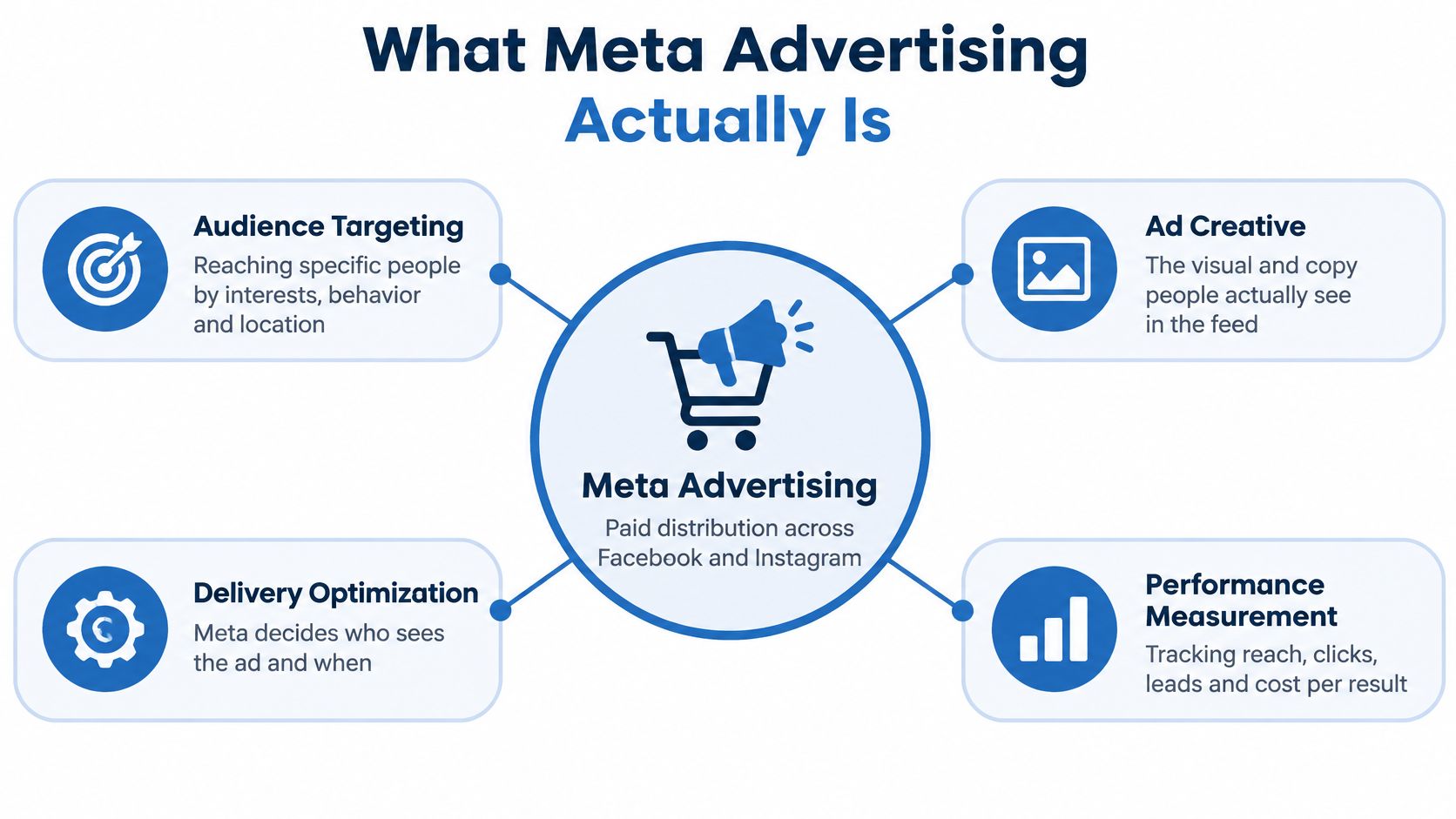
Four parts, one hoodie
Take a single product, a heavyweight hoodie with a back print, and follow it through the system.
- Audience targeting decides who may see it. Country, age and gender first, then interests or behaviours if you want them. Outside that boundary, the ad doesn't exist.
- Ad creative is what they see. The accurate mockup, the short video of the fabric moving, the first line that stops a thumb mid-scroll.
- Delivery optimization spends toward people the model expects to take your chosen action. Bid for purchases and it hunts buyers. Bid for clicks and it hunts clickers.
- Measurement records what happened. A purchase event fires on the thank-you page, and that signal shapes the next round of delivery.
Read top to bottom, the sequence is simple. Define the audience, launch the creative, let Meta test delivery, and let the recorded purchase teach the next impression. A hoodie becomes a measurable ad, and every number in your dashboard traces back to one of those four parts. Posting a product is not advertising it; distributing it through a system that learns is.
Why Meta Still Anchors Online Sales
Meta doesn't sell attention by the billboard. It runs the largest auction most apparel sellers will ever enter, and the size of that auction is why brands keep coming back to it even when their first campaigns disappoint.
Meta's 2025 annual results reported average Family daily active people of 3.58 billion in December 2025, up 7% from 3.35 billion in December 2024, alongside advertising revenue of $196.175 billion for 2025 against $160.633 billion in 2024, an increase of roughly $35.54 billion, or 22%. Meta attributed that growth to increases in both ad impressions delivered and the average price per ad. The Q3 2025 results show the same curve inside a single quarter, at $50.082 billion of advertising revenue against $39.885 billion in Q3 2024.
Meta's scale in recent reporting periods
| Metric | Period | Figure |
|---|---|---|
| Average Family daily active people | December 2025 | 3.58 billion |
| Average Family daily active people | December 2024 | 3.35 billion |
| Advertising revenue | Full year 2025 | $196.175 billion |
| Advertising revenue | Full year 2024 | $160.633 billion |
| Advertising revenue | Q3 2025 | $50.082 billion |
| Advertising revenue | Q3 2024 | $39.885 billion |
What the scale does and doesn't buy you
Growing revenue from both more impressions and a higher average price per ad tells you something practical. The inventory is expanding, and more advertisers are competing for the same eyeballs, so an ad that people ignore gets expensive fast while an ad that earns attention and purchases gets cheaper.
None of that guarantees profit for any individual store. Meta's own framing leaves results dependent on offer quality, creative performance, targeting, landing-page conversion and measurement. A brilliant audience with a weak product page still loses money, and a great product page with no purchase tracking can't teach the system anything.
For apparel and print-on-demand operations, the value is narrower and more useful. Meta is where you test a design against cold buyers in days, find which audience responds, and scale past the ceiling of organic reach. Judge the channel on reach plus profitable conversions together, never on audience size alone.
How the Auction Picks Which Ads Get Shown
Most beginners read the auction as a bidding war, where whoever offers Meta the most money takes the impression. That model would make budget the only lever, and it's exactly why so many sellers assume they can't compete with bigger brands. Meta's Marketing API bidding documentation describes something different: delivery runs on an effective bid, which combines your bid strategy or bid amount with Meta's estimate of how likely your ad is to produce the event you chose.
Here's how one auction resolves.
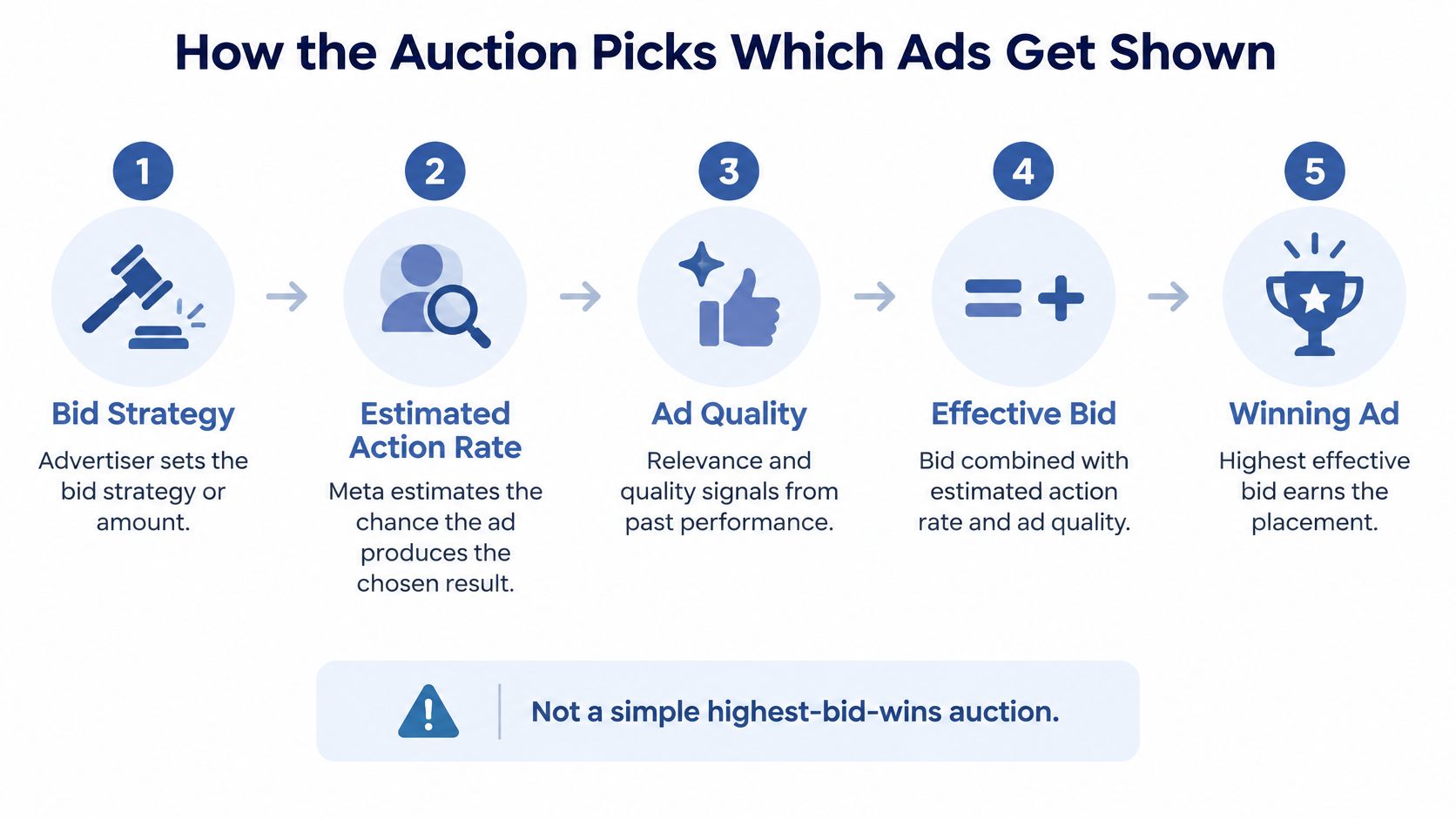
- You set a goal and a bid approach. Purchase, lead or landing-page view, paired with highest volume, a cost cap or a ROAS floor.
- Meta estimates the action rate. For each person it could serve, the model produces a probability that this particular ad triggers your chosen event.
- Quality and relevance get scored. How people have responded to your creative and your page feeds into the same calculation.
- The effective bid is assembled. Your bid, the predicted action rate and quality signals combine into the number that competes.
- The strongest effective bid wins and pays the price needed. A higher nominal bid doesn't automatically take the placement.
Why the smaller bid sometimes wins
Say two stores target the same buyer with a similar hoodie. Store A bids $12 per purchase on a flat grey mockup people scroll past, and the model estimates a 0.8% purchase rate. Store B bids $7 with a video that shows the print, the fit and the fabric, and its estimate is 2.1%. Store B's effective value is stronger despite the lower bid, so it takes the impression.
Meta says the same thing more plainly in its auction guidance for advertisers: ads with higher relevance can win auctions at lower costs, because the system balances advertiser objectives against the user experience. That's why creative quality moves your cost per purchase and not just your click-through rate. It also explains why the performance goal you select matters so much, since the goal is the result the system bids toward.
Cost-per-result, ROAS and bid-cap controls are inputs to that calculation, not promises. They change how Meta bids; they don't guarantee every impression lands at your target price.
The short version: a purchase goal teaches the system who buys. A traffic goal teaches it who clicks.
That's the whole lesson of the auction. A purchase-optimized campaign returns conversion feedback that sharpens audience selection, while traffic optimization can pour budget into inexpensive clickers who never check out. Preserve enough budget and event volume for the algorithm to find a pattern, and compare creative and offer quality rather than chasing the lowest cost per click.
Ad Objectives and Formats to Choose From
An objective is an instruction, not a label on a report. Choose Sales and you're telling the prediction system to find people who buy. Choose Traffic and you're asking for people who click. Same product, same audience, a different group of humans gets served.
Run one clear objective per campaign. Mixing goals inside one campaign splits the learning and leaves you unsure which signal produced the result.
That's the strategic layer visualized below, the funnel view most sellers picture when they plan a campaign.
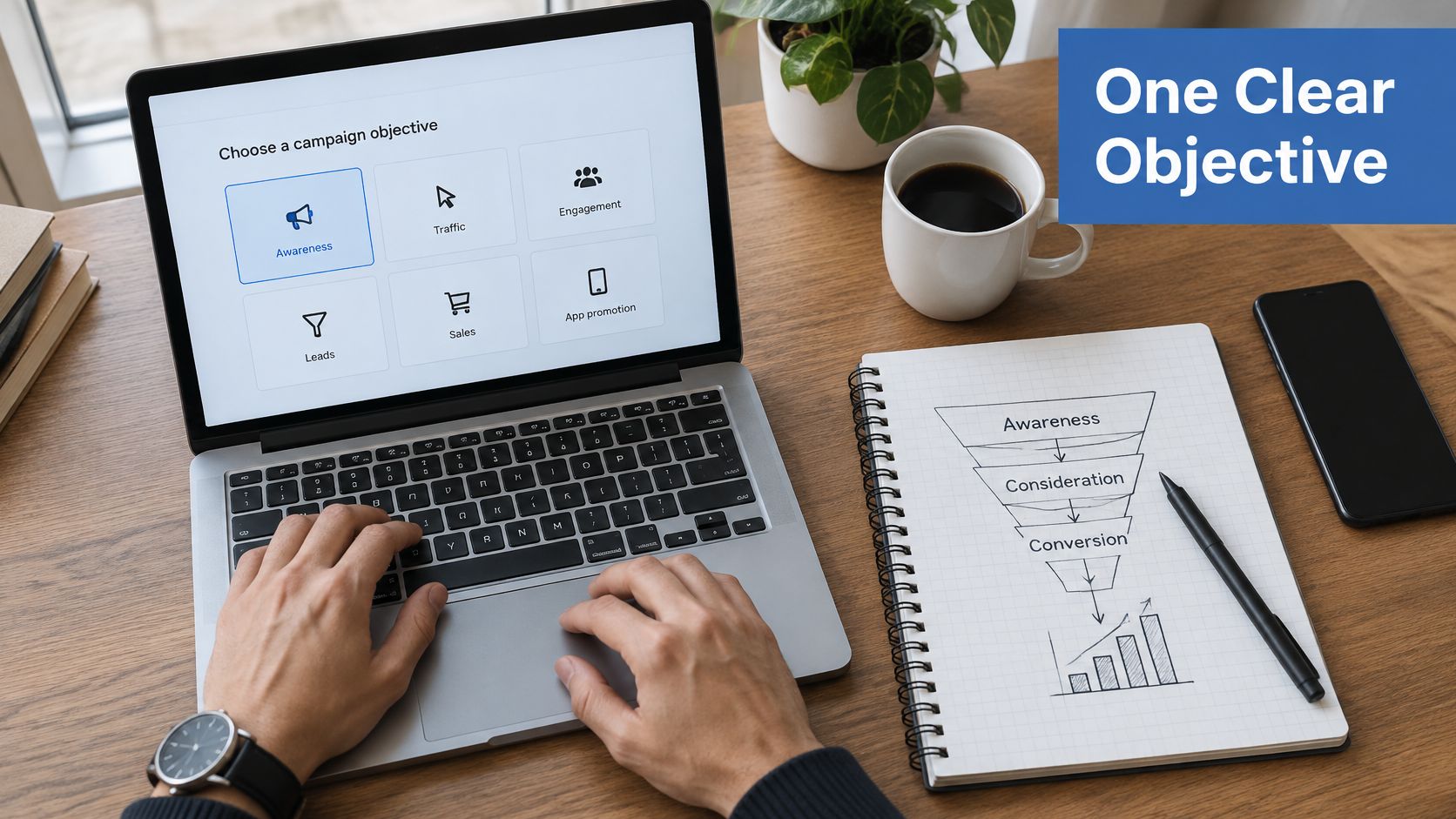
What each objective tells the system to find
| Objective | What Meta optimizes for | Best used when |
|---|---|---|
| Awareness | People likely to see and remember the ad | A brand-new store or niche needs visibility |
| Traffic | People likely to click through to the site | You are testing creative cheaply and need clicks |
| Sales (Purchase) | People likely to buy | A product has proven demand and purchase tracking works |
| Leads | People likely to submit a form or sign-up | You are building a waitlist, bundle or email list |
The trade-off worth naming is traffic. Cheap clicks are easy to buy, which makes traffic campaigns feel productive while your order count stays flat. Use them to test whether a hook earns attention, then move the winner into a purchase campaign.
Formats and the accuracy test
- Single-image ads carry one garment, one angle and one hook, which makes a win or a loss attributable to something specific.
- Video earns its place when motion is the selling point, a print catching light, a fit check, fabric drape across a shoulder.
- Carousel packs several colourways, or the front, back and print detail, into one unit without extra editing time.
- Placements across Facebook Feed, Instagram Feed, Stories and Reels each crop your image differently, so check the mockup inside each frame before you launch.
Accuracy decides whether any of it converts. A product image is honest creative only when it depicts the garment you'll ship, in the print, colour and cut the buyer receives. A mockup that flatters the design into something different buys you a sale and a return in the same week, and returns eat the contribution margin you were advertising against.
Match the objective to the stage of the store and the format to the question you're asking. A new shop with no data wants awareness or cheap traffic to learn which hook lands, while a proven design with working purchase tracking should be running Sales and nothing else.
Targeting From Broad to Detailed Audiences
The most expensive assumption in Meta advertising is that a narrow audience is a cheap audience. It sounds logical: fewer people, less competition, lower costs. It breaks down because the delivery system learns from volume, and a small pool starves it.
Targeting is one lever. The auction, the creative and the amount of conversion data you supply decide your cost per purchase at least as much as the interest list does. Squeeze the audience small enough and the same people see the ad repeatedly, stop responding, and your frequency climbs while your results sink.
If your answer to what is Meta advertising is a list of interest categories, the auction will humble you quickly. Broad targeting can outperform detailed interest targeting when Meta has enough purchase signals to learn from, and it does so regularly, as 42st's 2025 review of small-business Facebook and Instagram ads sets out alongside a median lead cost of $27.66, up from $22.87 the year before, with wide differences by industry.
The four ways to find people
| Targeting type | How it finds people | Best when |
|---|---|---|
| Broad | Age, location and gender only, letting Meta find buyers | You have enough purchase data for Meta to learn from |
| Detailed interests | Interests and behaviours you select | You are testing a clearly defined niche with little data |
| Lookalike audiences | People similar to your existing customers or buyers | You have a customer list or purchase history to seed it |
| Custom audiences | People who already visited your site or engaged with you | You want to retarget warm shoppers |
A sequence that works
Start narrow in the sense that matters, meaning one product for one clear type of buyer, and let the audience be wider than your instinct suggests. Once real buyers exist, export that list and build a lookalike from it, which is the step where most stores get cheaper cold traffic. Our walkthrough on how to use Facebook lookalike audiences for print on demand covers the seeding details. When you want warm shoppers who already viewed a product page, retarget them as a custom audience instead of rebuilding interests from scratch.
What to avoid is layering. Three interests plus two behaviours plus a narrow age band plus a single city produces a tiny pool, slow learning and a frequency graph that looks like a wall.
Let your purchase data decide how broad to go. Twenty verified orders a week earns you the right to test broad. Zero orders means you need a sharper promise and a better mockup, not a longer list of interests.
Measuring Results Without Fooling Yourself
Before you judge a single campaign, run this check. It takes twenty minutes and saves months of arguing with a dashboard.
- Fire a test purchase through your own thank-you page in a private browser window and confirm the purchase event appears in Events Manager with the right value.
- Match order counts against payment records for the last 14 days, so you know how many sales happened.
- Calculate contribution profit per order before you read ROAS, subtracting product cost, shipping and platform fees from revenue.
Two systems carry the data behind that check. Meta describes the Pixel as website code that measures actions such as purchases, and the Conversions API as a direct connection between your marketing data and Meta's optimization systems. Meta recommends running both together and notes that the Conversions API isn't intended to bypass privacy requirements such as Apple's App Tracking Transparency framework or European privacy rules, per Meta's Conversions API guidance. Our Facebook Pixel guide covers the setup order if you're wiring this for the first time.
Which metric to trust, and for what
| Metric | What it tells you | Its limit |
|---|---|---|
| CTR | How often people click after seeing the ad | Clicks can be cheap and still not buy |
| CPM | Cost per 1,000 impressions | Says nothing about sales |
| Cost per purchase | What one sale costs in ad spend | Needs reliable purchase tracking |
| ROAS | Revenue returned for each ad dollar | Ignores returns, fulfilment and product cost |
| Contribution profit | Money left after product, shipping, fees and ad spend | Takes more work to calculate |
CTR and CPM can both look healthy while your sales stay flat, which is why they belong in diagnostics rather than in decisions. Treat platform-reported conversions as a reporting convention, not proof that Meta caused every sale, and reconcile them against your payment processor, analytics and profit figures. Attribution tells you what Meta is willing to claim, and your bank account tells you what happened.
AI adds a second layer to that caution. Meta says AI-generated or significantly AI-edited creative can carry an AI information label, and its advertising systems use AI for delivery decisions as well as content, as Meta's AI transparency guidance explains. Use AI to produce variations faster, then check each one against the actual garment, because a repeating template, an inaccurate print or a misleading mockup costs you twice, first in weak clicks and again in returns.
The number to trust is the one that matches your bank account.
Budgets and the Learning Phase in Practice
Money spent before the system has learned anything is money you're donating. Meta's learning phase is tied to conversion volume, and structure decides how fast you get through it.
Meta recommends consolidating similar ad sets because an ad set generally needs around 50 optimized conversion events before it can exit the learning phase, according to Meta's guidance on the learning phase. While it's learning, delivery and cost per result swing as the system explores who responds, where they respond and which ad earns the action.
Auction overlap makes that worse. When several ads from your own account compete for the same impression, an ad set can fail to spend its full budget or collect enough results to graduate. Five nearly identical ad sets on a $40 daily budget is the fastest way to guarantee none of them learn.
Two rules that decide when to judge
Daily budget isn't a hard daily ceiling. Meta may spend up to 75% over the daily budget on a strong day and less on a weak one, while weekly spend stays within seven times the daily budget, so a $20 daily budget could put $35 into one day but shouldn't exceed $140 across the week, per Meta's explanation of budget pacing. Campaigns using cost-per-result or ROAS controls, especially when reaching iOS 14.5-or-later users, should run at least three full days before you evaluate them, as Meta's bidding overview notes.
Practical rule: one creative set, one audience, seven days, then a decision you can defend with numbers.
Build the budget from the order, not a benchmark
Start with contribution margin per order, meaning what's left after product, shipping and fees. That figure caps what you can pay to acquire a customer. Say a hoodie leaves $18 of contribution and you want to keep $4 of it, so your allowable cost per purchase is $14. If your page converts 2% of visitors, you need about 50 clicks per order, which means your cost per click has to land under roughly 28 cents to hit the target. That arithmetic, not a universal budget number, tells you whether the test is viable.
If you're still choosing a starting figure, our guide to what Facebook ad budget to start with for print on demand runs the same math with worked examples. Manual campaign setup is usually better for beginners too, because it gives you direct control over configuration and lets you test specific placements rather than accepting every default.
The decision rule is unglamorous. Wait out the week and the learning window, then keep the creative that produced profitable purchases and cut the rest.
Plan Your First Meta Test Before You Scale
What can one focused ad test teach you about selling a print-on-demand product? Paid ads can bring early sales, while SEO, newsletters, Instagram and Pinterest tend to build awareness more slowly. A concentrated test gives you a clearer read on demand.
Start with one product, such as a hoodie designed for a specific buyer. Check that its contribution margin can cover the cost of acquiring a customer, then build the test:
- Choose one product and a clear offer. A design made for a defined audience gives the ad a concrete reason to catch someone's attention.
- Set up one purchase-optimized campaign for one audience. Use two or three creatives that show the garment accurately from different angles.
- Write the copy before opening Ads Manager. Draft hooks, headlines and calls to action so the creative work is ready when you build the campaign.
- Give the test time to collect purchase events. Avoid changing the budget while the campaign is still in its learning window.
- Compare ad results with actual orders and contribution profit. Increase spend only on a creative that earns it.
Spreading across several niches at the start is a common mistake. It can make designs generic and ads expensive. One focused niche also gives Meta clearer purchase signals and helps keep the store recognizable when shoppers see its ads again.
A first test is a learning tool, not a guarantee of sales. One product, an accurate mockup and a focused campaign can show whether the offer is attracting buyers. Use the results to decide what to keep, what to change and whether the product's margin can support more advertising.
Skup teaches print-on-demand apparel sellers how to take a product from idea to advertising, and the Apparel Cloning System guides beginners through finding proven designs and running a focused first test. Explore Skup to find the training that fits your store.