10 Good Facebook Ad Examples for POD Apparel
A polished image can attract a click and still produce a weak campaign. The most useful good Facebook ad examples aren't valuable because they look attractive. They're valuable because they reveal the job the ad performs, the audience it addresses, and the next action it makes feel natural. You can find useful visual guidance in these Facebook cover photo and ad tips, but a swipe file becomes much more powerful when you annotate the strategy behind every example.
For each pattern below, look at the creative format, hook, copy angle, offer structure, audience stage, targeting hypothesis, and practical test. That framework helps beginners avoid copying surface details that worked for another brand, niche, or customer. A design that performs for a humor shirt may not work for a meaningful gift, even if both ads use a carousel.
POD apparel offers plenty of room to test. It also demands patience, clear positioning, and honest claims. Consistent testing creates stronger opportunities than hype, rushed launches, or changing every part of an ad at the same time. When an idea reaches the production stage, AvatarIQ can simplify design creation and mockup production so you can spend more time improving the message and less time getting the listing ready.
Table of Contents
- 1. Before-and-After Transformation Ads
- 2. Educational Value-First Ads
- 3. Founder Authority and Behind-the-Scenes Ads
- 4. Student Success Story Case Study Ads
- 5. Product Mockup and Design-Focused Visual Ads
- 6. Quick-Win Tips and Actionable Advice Ads
- 7. Risk Reversal and Money-Back Guarantee Ads
- 8. FAQ and Objection-Handling Carousel Ads
- 9. Video Testimonial and Student Review Ads
- 10. Limited-Time Offer and Urgency-Driven Ads
- Comparison of 10 Facebook Ad Types
- Turn These Ad Patterns Into Your Next Test
1. Before-and-After Transformation Ads
Transformation ads connect a product or business model with a meaningful change in someone's life. For POD apparel education, that might mean moving from an exhausting work routine toward more control over time, or replacing uncertainty with a repeatable creative process. The strongest version doesn't promise that a shirt store will instantly change someone's life. It shows a believable journey, including the work involved.
A split-screen image can show the contrast clearly. The first panel might feature a tired parent answering emails after work. The second could show that person packing orders, designing from home, or spending more intentional time with family. A carousel can tell the same story in stages, from frustration to learning, testing, and progress.
Build the story around the lifestyle shift
Creative: Use real customer-approved photos, a simple split layout, or a short vertical video with visual contrast.
Hook: “Building a business shouldn't mean giving up every evening.”
Copy angle: Focus on flexibility, confidence, and ownership rather than guaranteed income.
Offer: Invite the viewer to learn about the Apparel Cloning System or download a useful beginner resource.
Audience stage: This suits people who recognize the problem but haven't yet committed to a specific solution.
Targeting hypothesis: Test broad audiences interested in entrepreneurship, side businesses, apparel, or ecommerce against warm viewers who have already engaged with educational content.
Practical rule: Show the work between the before and after. A transformation feels credible when the creative includes learning, product research, design decisions, and iteration.
Test the emotional angle first. Compare a family-time narrative with a career-control narrative while keeping the visual format and offer consistent. Don't use stock photography as if it represents a real student, and don't imply that a lifestyle outcome is typical for everyone.

2. Educational Value-First Ads
Value-first ads earn attention by teaching something useful before asking for a purchase. A POD beginner may not be ready to buy training, but they may want help choosing a niche, evaluating a product idea, or creating a stronger listing. Give them a clear lesson they can use immediately, and the ad can introduce your brand without forcing a hard sell.
An educational carousel could explain a simple method for comparing apparel ideas. Each card might cover the audience, emotional appeal, design direction, competition, and product presentation. A short video could demonstrate how to move from a vague idea to a focused concept. The content should remain useful even if the viewer never clicks.
Turn knowledge into a clear next step
Creative: Use a carousel, screen recording, talking-head video, or document-style graphic.
Hook: “Before you design another shirt, check these signals.”
Copy angle: Teach a process, not a collection of disconnected tips.
Offer: Provide a free guide, workshop, email lesson, or introduction to Apparel Cloning.
Audience stage: This is especially useful for cold audiences who know they want an ecommerce opportunity but lack a working process.
Targeting hypothesis: Compare interest-based prospecting with retargeting for people who watched or saved previous educational content.
Skup's guide on writing Facebook ad copy that converts for print on demand can help you turn an educational idea into a clearer ad message. Keep the CTA soft and specific. “See the framework” is often a better fit for a lesson than “Buy now.”
Test the lesson topic before testing clever wording. One ad can teach niche selection, another can teach design evaluation, and a third can explain product presentation. Use the same landing page at first so the content topic remains the clearest variable.
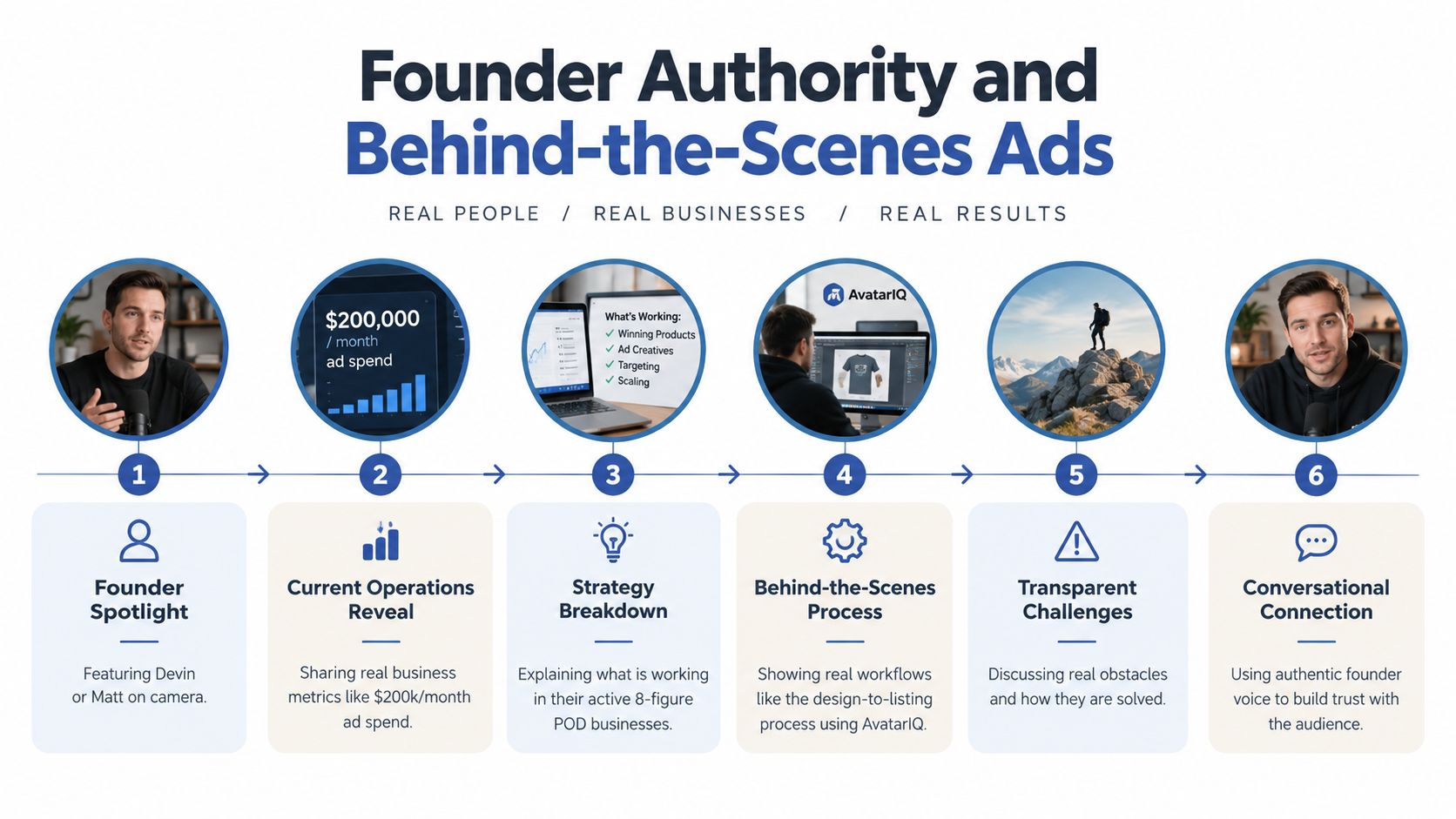
3. Founder Authority and Behind-the-Scenes Ads
People who are considering POD education want to know whether the advice comes from current practice or recycled theory. Founder-led ads answer that concern by showing the person, decisions, and trade-offs behind the business. A founder doesn't need a studio, dramatic music, or a perfect script. A direct explanation filmed during real work can feel more credible than a polished commercial.
A useful example would show Devin reviewing a design concept and explaining why he would test the audience angle before investing in more creative. Another could show Matt walking through a product listing, pointing out where the design, mockup, title, and offer need to work together. The viewer sees a decision being made, not just a claim that the system works.
Make the process visible
Creative: Film a founder speaking to camera, reviewing a live workflow, or annotating a mockup.
Hook: “This is the decision I make before putting a POD design in front of buyers.”
Copy angle: Explain what you're testing, what can fail, and what you change next.
Offer: Invite viewers to watch a longer training, join a workshop, or explore Apparel Cloning.
Audience stage: Founder content works across the journey, from building initial trust to supporting a warmer purchase decision.
Targeting hypothesis: Test founder videos with cold prospecting audiences and with people who visited product pages but didn't take action.
Use natural language and leave in a reasonable amount of imperfection. The message should be specific enough to teach something, but not so detailed that the viewer loses the central point.
A strong test compares authority angles. Try a design breakdown, a product research explanation, and a candid discussion of a failed idea. Keep the opening visual and CTA consistent, then measure which topic earns the most meaningful engagement.
4. Student Success Story Case Study Ads
A case study gives a potential buyer a character, a problem, a process, and an outcome to evaluate. That structure is more useful than a vague testimonial because it explains how the person moved forward. For a beginner-focused POD offer, choose a student whose starting point resembles the audience you want to attract.
The ad might open with a student describing uncertainty about ecommerce. It can then show the obstacle, the Apparel Cloning method they followed, the product decisions they made, and the practical changes in their routine. The story should include only results the student has agreed to share and that the business can substantiate.
Build proof without turning it into a promise
Creative: Use an interview, a narrated screen recording, a timeline graphic, or a document-style case study.
Hook: “She had no clear product process. This is how she built her first repeatable workflow.”
Copy angle: Explain the decisions and lessons, not just the final outcome.
Offer: Send interested viewers to the relevant training or a case-study landing page.
Audience stage: Case studies are strongest for people already comparing solutions and looking for evidence that the process can apply to someone like them.
Targeting hypothesis: Retarget content viewers, email subscribers, and product-page visitors with different student profiles.
Get written permission before using a student's name, image, dashboard, review, or business details. Crop sensitive information from screenshots and label any illustrative material clearly. Avoid presenting an individual result as a normal expectation.
The best test is often narrative, not cosmetic. Compare a student focused on confidence, a parent focused on flexibility, and a career changer focused on building a new skill. Keep the claims accurate and let the viewer decide which story feels most relevant.
5. Product Mockup and Design-Focused Visual Ads
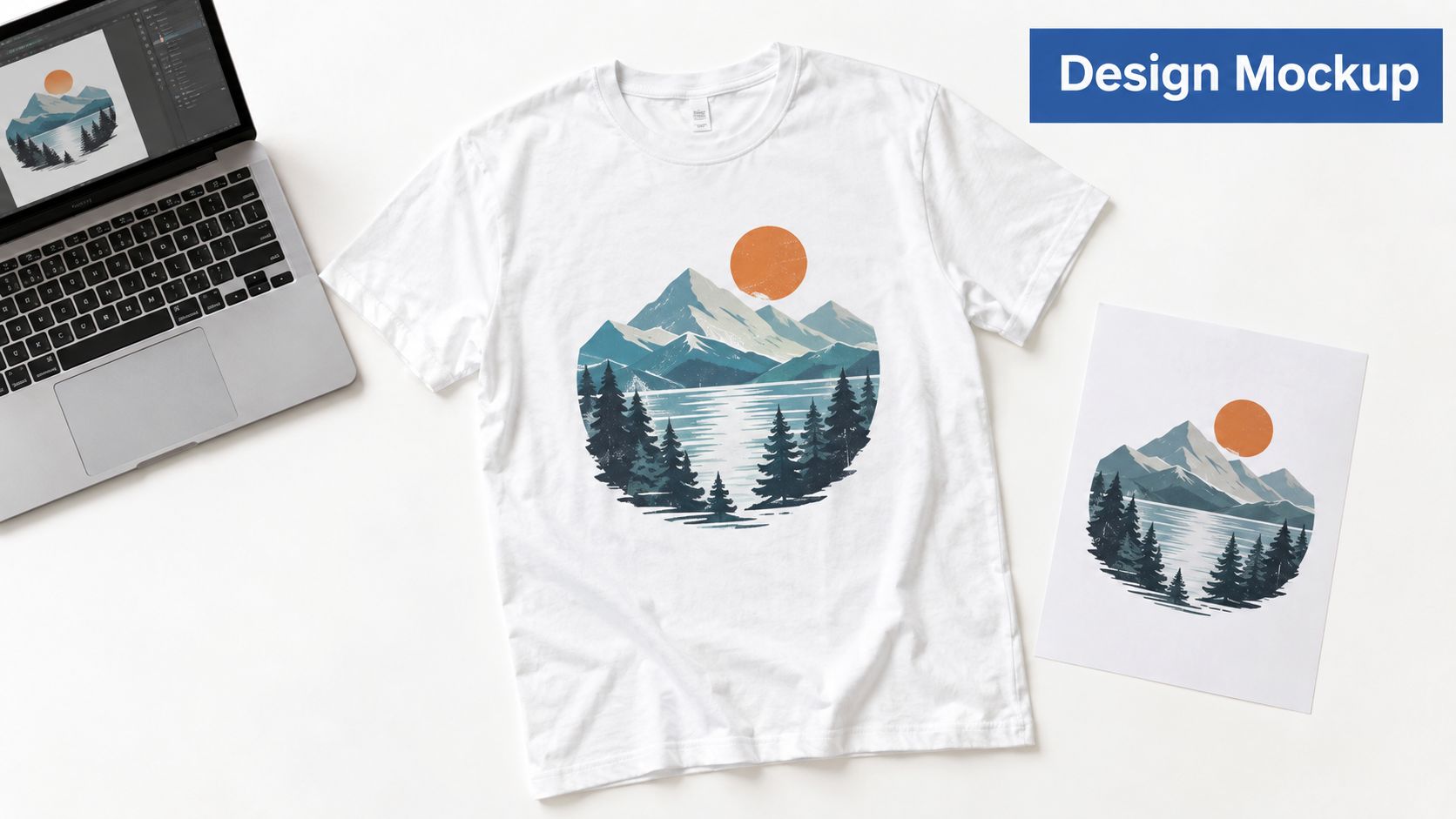
POD buyers make fast judgments about the design, garment presentation, and imagined experience of wearing the product. A design-focused ad earns attention by showing the concept clearly rather than burying it beneath a long explanation. It can also reduce a common beginner concern, namely the belief that creating a presentable product requires a complex production setup.
A carousel works well when each card shows a different design direction for the same audience. A short video can begin with a blank apparel mockup, move through the design process, and finish with a product listing that looks ready for review. The creative should make the product the hero, while the copy explains the use case or audience emotion.
Create a repeatable visual system
Creative: Use a carousel of mockups, a product close-up, or a short design-to-listing video.
Hook: “Start with the audience, then let the design make the idea obvious.”
Copy angle: Show how a focused concept becomes a wearable product.
Offer: Invite the viewer to explore AvatarIQ, review a design lesson, or learn the Apparel Cloning workflow.
Audience stage: Visual ads can introduce the opportunity to cold audiences and help warm viewers evaluate the practical experience.
Targeting hypothesis: Test niche-specific creative against broader design-led creative, while keeping the product category consistent.
AvatarIQ can help create apparel designs and mockups without requiring a separate photographer or model for every concept. For more guidance, use Skup's article on creating Facebook ad images that sell for print on demand.
Don't claim that a mockup is a customer photo if it isn't. Test a clean product image against a lifestyle presentation, and compare a single strong design with a carousel of related variations. The winning version should make the intended buyer and product benefit clear within a quick scroll.
6. Quick-Win Tips and Actionable Advice Ads
A quick-win ad solves a small problem immediately. It doesn't attempt to explain an entire POD business or push a complex offer. Instead, it gives the viewer a useful observation they can apply to a niche, design, listing, or campaign.
For example, a short video could explain why a generic audience often produces generic designs. A carousel could show a weak product title, then improve it by adding the audience and occasion. The advice should be narrow enough to understand quickly and concrete enough to act on after the ad ends.
Make the lesson easy to repeat
Creative: Record a direct-to-camera clip, screen capture, or swipeable before-and-after carousel.
Hook: “Your shirt idea may be too broad. Try this audience check.”
Copy angle: Present a mistake, correction, and simple action.
Offer: Send viewers to a useful article, email list, or free resource.
Audience stage: Quick tips are effective for awareness and engagement, especially before a viewer is ready for a paid program.
Targeting hypothesis: Test strategy tips against design tips and technical tips to learn which problem attracts the most qualified attention.
Keep production simple, but don't confuse casual presentation with careless teaching. Captions, readable text, and a clear opening still matter. Skup's Facebook ads guide for ecommerce can support the wider campaign planning around these smaller creative ideas.
Test the problem statement rather than adding more advice. A tip about niche selection should compete with another niche-selection tip before you compare it with an offer ad. That approach helps you understand which customer problem deserves more creative development.
7. Risk Reversal and Money-Back Guarantee Ads
A guarantee addresses hesitation directly. Someone may like the Apparel Cloning System but still worry about wasting money, failing to follow the process, or discovering that the offer isn't suitable. Clear terms can make the decision feel safer, but a guarantee isn't a substitute for a strong product, honest expectations, or appropriate support.
Lead with the reassurance only when the terms are easy to understand. The ad might explain who the offer is for, what the buyer receives, how to request a refund, and where the full conditions appear. Pairing that information with a founder video can make the message feel more human than a large guarantee badge alone.
Keep the promise precise
Creative: Use a founder explanation, a clean offer graphic, or a landing-page preview.
Hook: “You shouldn't have to guess what happens if the program isn't right for you.”
Copy angle: Remove uncertainty by explaining the guarantee and the work the buyer still needs to do.
Offer: Present the Apparel Cloning System with its current guarantee terms.
Audience stage: This pattern belongs later in the journey, after the viewer understands the product and remains concerned about risk.
Targeting hypothesis: Retarget product viewers, checkout visitors, or engaged video viewers rather than leading with the guarantee to everyone.
Write the terms in plain language and keep the ad consistent with the landing page. Don't imply that a refund policy guarantees a business result. The honest trade-off is simple: risk reversal may reduce hesitation, but unclear conditions can damage trust.
Test a guarantee-led ad against an education-led ad for the same warm audience. If the educational version wins, the audience may still need clarity about the method before they need reassurance about the purchase.

8. FAQ and Objection-Handling Carousel Ads
Beginners often have several unanswered questions before they click. A well-made FAQ carousel turns those questions into the creative structure. Each card handles a single concern, such as design ability, platform choice, product selection, time commitment, or the practical work involved in running a store.
The format works because viewers can scan it at their own pace. The first card should address the strongest objection, not introduce a minor feature. Later cards can explain what the buyer needs, what the program teaches, and where the process requires effort.
Answer questions the audience actually asks
Creative: Build a question-and-answer carousel with large, readable text and supporting product imagery.
Hook: “Thinking about POD but still have these questions?”
Copy angle: Be encouraging without making the process sound effortless.
Offer: Invite the viewer to learn more about Apparel Cloning or speak with the team.
Audience stage: This is useful for cold audiences with multiple concerns and warm audiences close to a decision.
Targeting hypothesis: Create separate carousels for beginners, existing sellers, and people interested in design tools.
Use questions from support conversations, comments, sales calls, and community discussions. Don't invent certainty where the honest answer is conditional. If a question depends on the person's budget, niche, skills, or consistency, say so.
Test the order of the cards. A creative that begins with “Do I need design experience?” may attract a different audience from one that begins with “What does the weekly workflow look like?” Keep the answers short and send deeper questions to a relevant page.
9. Video Testimonial and Student Review Ads
A student review becomes more persuasive when it explains what changed in the learning experience, not just whether the student liked it. Short, informal videos can show a real person discussing their initial concern, the part of the process that helped, and the next step they're taking.
The best prompts are open-ended. Ask what surprised the student, which task became easier, what they misunderstood at first, and what they would tell someone considering the program. These questions produce useful detail without forcing a script into the student's mouth.
Preserve authenticity while improving clarity
Creative: Use a vertical student video with captions, a simple interview, or a voiceover paired with approved screen footage.
Hook: “I thought I needed design experience. The real challenge was choosing a focused audience.”
Copy angle: Highlight the learning process, confidence, and practical progress.
Offer: Direct viewers to the Apparel Cloning System or a page where they can understand the program.
Audience stage: Testimonials are strongest for people who already know the offer and want reassurance from another learner.
Targeting hypothesis: Match different student stories to different audiences, such as parents, career changers, or existing sellers.
A testimonial should sound like a person explaining an experience, not a brand reciting a sales page.
Get permission for recording, editing, names, images, results, and any business screenshots. Caption the video for sound-off viewing, but don't rewrite the student's meaning. If the review includes a result, make sure the business can substantiate it and frame it as that individual's experience rather than a promise.
Test raw footage against a lightly edited version. Keep the same student and message so the production style, rather than the story, becomes the variable.
10. Limited-Time Offer and Urgency-Driven Ads
Urgency gives a motivated buyer a reason to act instead of postponing the decision. It only works sustainably when the deadline, bonus, enrollment window, or price condition is real. A countdown that resets repeatedly may create short-term clicks, but it can weaken trust with the audience you want to serve over time.
For an Apparel Cloning promotion, the creative might feature a genuine enrollment window or a time-bound AvatarIQ bonus. State the deadline clearly on the ad and landing page, explain what changes after it ends, and remove the promotion when the period closes. The message should be direct rather than dramatic.
Make the deadline verifiable
Creative: Use a founder announcement, a clean deadline graphic, or a short video explaining the reason for the window.
Hook: “Enrollment closes soon, and this bonus won't remain part of the offer.”
Copy angle: Explain the offer, deadline, and next step without inflated language.
Offer: Present the current Apparel Cloning terms and any legitimate AvatarIQ inclusion.
Audience stage: Use urgency with warm prospects who already understand the product and need a reason to decide.
Targeting hypothesis: Retarget engaged viewers, email subscribers, and checkout visitors while keeping cold prospecting more educational.
Test urgency against a non-urgent offer for the same audience. If the deadline creates clicks but poor-quality purchases, the audience may need better product education or clearer qualification before seeing the promotion.
Comparison of 10 Facebook Ad Types
| Ad Format | 🔄 Complexity | 💡 Resources | ⚡ Speed/Efficiency | 📊 Expected Outcomes | ⭐ Key Advantages |
|---|---|---|---|---|---|
| Before-and-After Transformation Ads | Medium, needs authentic testimonials & quality visuals | Student photos, permissions, editing | Moderate, quick if assets ready | High engagement & conversion via emotional story | Strong relatability and social proof |
| Educational Value-First Ads | High, requires well-researched, actionable content | Research, data, lead magnets, longer copy | Slow conversion path (nurture required) | Higher-quality leads; lower CPL over time | Builds trust and positions brand as authority |
| Founder Authority & Behind-the-Scenes Ads | Medium, founder time and candid filming | Founder availability, simple production setup | Moderate, frequent short content possible | Strong credibility; deeper audience trust | Massive credibility and clear differentiation |
| Student Success Story Case Study Ads | High, in-depth interviews and documentation | Student cooperation, metrics, editing resources | Slow to produce but high payoff | Very high conversion; proof-driven persuasion | Provides clear roadmap and strong social proof |
| Product Mockup & Design-Focused Visual Ads | Medium, needs high-quality mockups/photography | Design tools, AvatarIQ assets, photo resources | Fast with AI/design tools | Strong CTR; reduces design anxiety for buyers | Visually compelling; demonstrates product quality |
| Quick-Win Tips & Actionable Advice Ads | Low, simple short-form content | Founder insights, phone video, templates | Very fast to create and scale | High engagement; builds audience over time | Scalable, consistent value that trains algorithm |
| Risk Reversal & Money-Back Guarantee Ads | Low, clear messaging plus legal clarity | Legal terms, clear refund process, testimonials | Fast to launch | Increased conversions; lowers purchase hesitancy | Removes financial risk and signals confidence |
| FAQ & Objection-Handling Carousel Ads | Medium, research + concise card-by-card copy | Customer questions, copywriting, carousel design | Moderate, needs iteration and updates | Reduces barriers; improves time-on-ad and clarity | Proactively addresses top buyer objections |
| Video Testimonial & Student Review Ads | Medium, coordinate recordings and permissions | Student volunteers, basic video editing, releases | Moderate, batchable but depends on supply | High trust and relatability; strong social proof | Authentic emotion that's hard to fake |
| Limited-Time Offer & Urgency-Driven Ads | Low, deadline-based copy and visuals | Countdown timers, offer management, landing pages | Fast to implement; short-lived impact | Conversion spikes during genuine offers | Drives immediate action when scarcity is real |
Turn These Ad Patterns Into Your Next Test
Good Facebook ad examples become useful when you turn them into controlled decisions. Start with the customer problem, not the format. A beginner who doesn't know how to choose a niche needs a different ad from a warm prospect who understands the method but worries about taking the first step.
Choose a single audience problem, then match the pattern to the job. Use a value-first ad when the audience needs education. Use a founder ad when trust is the obstacle. Use an FAQ carousel when several practical questions are slowing the click. Use a design-focused ad when the buyer needs to see what the workflow produces. Save stronger case studies, guarantees, and urgency for people who already understand the offer.
Write one clear hook and build one offer around it. Then create several creative variations without changing every variable at once. You might keep the copy and offer consistent while testing a talking-head video, carousel, and product mockup. After that, keep the strongest format and test a new hook. This sequence gives you a better chance of learning why an ad works instead of discovering that one version received attention.
Don't judge a concept only by cheap engagement. Look at whether the viewer takes the intended next step, understands the offer, and fits the customer you want to serve. A highly entertaining video can attract the wrong audience. A quieter educational ad can produce fewer reactions but better conversations and more useful prospects.
Use this launch checklist
- Permission: Confirm that every testimonial, student image, dashboard screenshot, and quoted experience is approved for advertising.
- Substantiation: Keep records for every result, comparison, guarantee statement, or product claim used in the creative.
- Honest terms: Make the landing page, checkout, guarantee, bonus, and deadline say the same thing.
- Mobile readability: Check text size, captions, contrast, cropping, and the first frame on a phone.
- Clear next step: Tell the viewer exactly whether to watch, learn, download, apply, or buy.
- Consistent positioning: Make sure the audience, product, design, and copy all point toward the same customer problem.
The Apparel Cloning System can provide the business framework for researching and developing POD apparel offers. AvatarIQ can help you move faster when you need to create designs and mockups for new creative variations. Neither removes the need to learn your audience, review your numbers, or improve weak ideas. They can support a disciplined process, while the quality of your decisions still determines what you test next.
Start with the pattern that matches your current bottleneck. Create a small batch of clear variations, document the hypothesis behind each one, and give the campaign enough room to produce useful feedback. POD is a practical, creative opportunity for beginners who are willing to learn the customer, improve the product, and keep testing without relying on unrealistic promises.
Skup offers the Apparel Cloning System for building a POD apparel business and AvatarIQ for creating designs and mockups more efficiently. Visit Skup to explore the framework and tools that can help you turn these Facebook ad patterns into your next practical test.