Word of Mouth Marketing for POD Brands: A Playbook
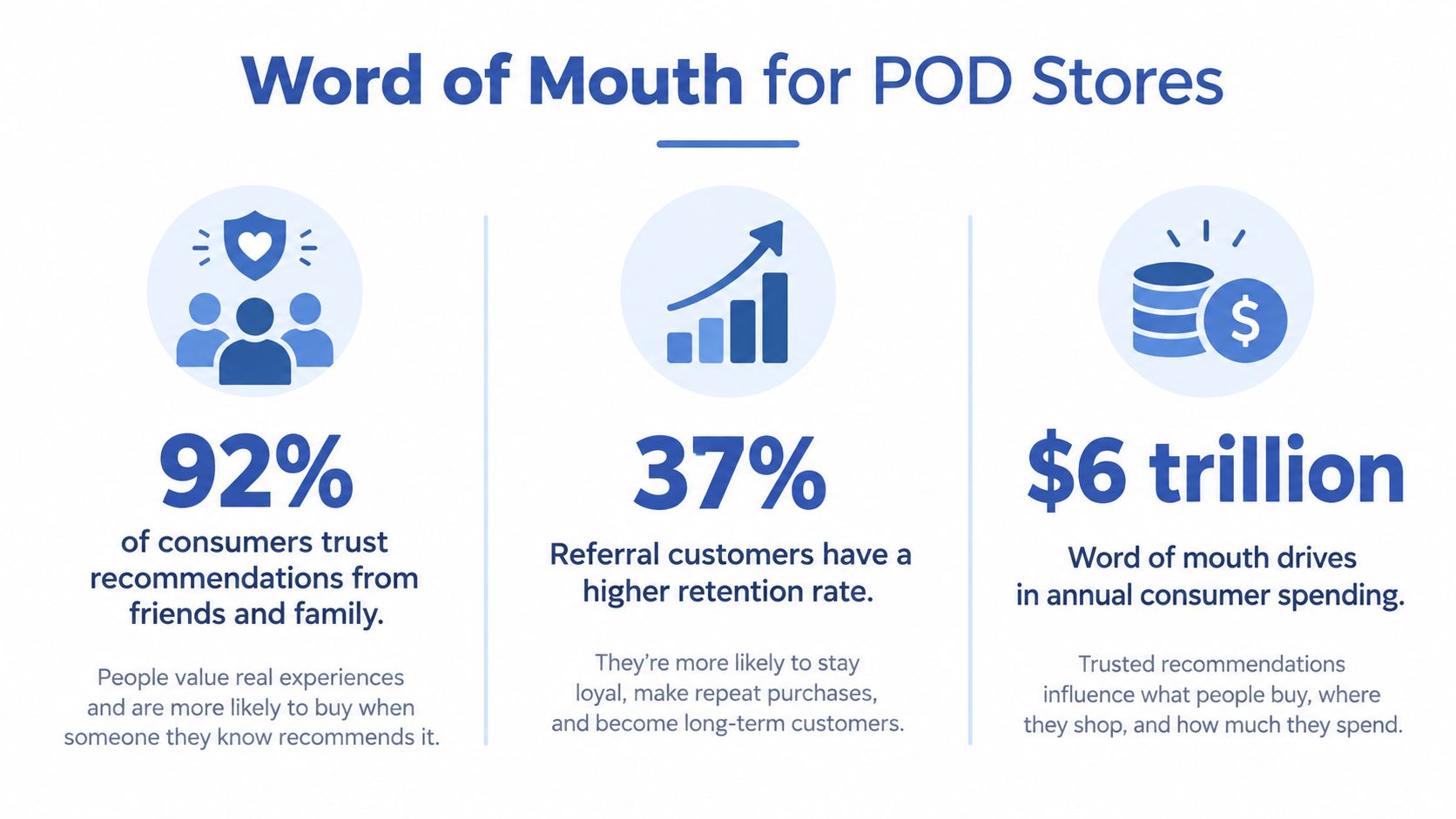
83% of consumers trust recommendations from friends and family, and marketing-induced word of mouth has generated more than twice the sales of paid advertising in some categories. For a print-on-demand store, that makes customer recommendations more than a feel-good bonus: they can be a trackable way to help shoppers choose a design, trust what they can't touch, and find your products.
Word of mouth works especially well when a buyer can show a friend how a shirt fits, explain why a design feels personal, or share an honest review. You can't force that recommendation, but you can make it easier to give and easier to measure. The practical playbook is to build trust through the product and customer experience, prompt sharing at the right moment, and track whether referrals lead to profitable purchases.
Table of Contents
- What Word of Mouth Marketing Actually Means for a POD Store
- The Five Levers POD Sellers Actually Control
- How to Build a Referral Program That POD Customers Use
- Designing Unboxing and Post-Purchase Flows That Get Photographed
- Turning UGC, Community, and Micro-Creator Seeding into a Loop
- Measuring Word of Mouth Without Fooling Yourself
- Scaling Word of Mouth and Avoiding the Common POD Pitfalls
What Word of Mouth Marketing Actually Means for a POD Store
Nielsen's global survey found that 83% of consumers completely or somewhat trusted recommendations from friends and family. McKinsey's analysis found that marketing-induced consumer-to-consumer word of mouth generated more than twice the sales of paid advertising in categories including skincare and mobile phones. The figures describe different findings, not a promise that every apparel store will get the same result. They do show why a genuine recommendation can carry weight that another brand-controlled ad may not. (Nielsen's Global Trust in Advertising survey, McKinsey's analysis of word-of-mouth marketing)
For a POD apparel business, word of mouth marketing includes more than a friend sharing a referral code. It can be a customer posting a photo of a shirt, answering a sizing question in a comment, leaving a review, or recommending a design in a private group chat. Each interaction helps another shopper judge a product they can't inspect in person. A candid note about fit, fabric feel, or when someone wears the design may answer a question that a polished product image doesn't.
Not every mention is equally useful. McKinsey's concept of word-of-mouth equity accounts for both the number of messages and their average sales impact. A passing mention from someone with no connection to the buyer isn't the same as a recommendation from a trusted friend that answers a real question. For your store, the useful distinction is whether a message reaches someone who's considering a purchase and gives them credible, relevant proof.
Think of the system as a funnel: a customer sees a prompt, shares a recommendation, and sends someone to your store. That person may browse, sign up, purchase, and later return. Measure the steps instead of treating a rising number of mentions as proof of revenue. For practical examples of how social proof can appear in customer-facing content, explore social proof examples for Instagram growth.
The Five Levers POD Sellers Actually Control
Word of mouth doesn't begin with a referral code. It begins with an experience a customer is comfortable describing to someone else. For a POD store, five practical levers shape that experience.
Product and design. A strong design gives the buyer a reason to wear the shirt and talk about it. Make the niche clear, show the design at a useful scale, and keep the product description honest about fit and materials. A quick win is to check that the design still reads well in a customer photo, not just in a close-up mockup.
Packaging. The parcel is a chance to make the order feel considered. A simple insert can thank the customer, explain how to share a review, and point to a page where they can find the brand again. Keep the message useful rather than making every inch of the package a sales pitch. For visual inspiration on arranging products in a retail setting, browse these display ideas for shops.
Post-purchase email. A thoughtful follow-up helps after the customer has had time to receive and wear the item. Ask about the experience, invite an honest review, and make the next action obvious. Don't ask for a recommendation before the buyer can reasonably judge what arrived.
Customer service. A clear, respectful reply can turn a question or problem into a moment of confidence. Make it easy for customers to get help with an order, explain what you can do, and follow through. A quick win is to add a short, human referral invitation to a support reply only when it fits the conversation.
Social proof and community. Reviews, customer photos, and helpful answers in comments let new shoppers learn from existing buyers. Ask permission before sharing a customer's photo, and respond to questions in public when the answer could help others. A useful customer post can keep working long after its original audience has seen it.
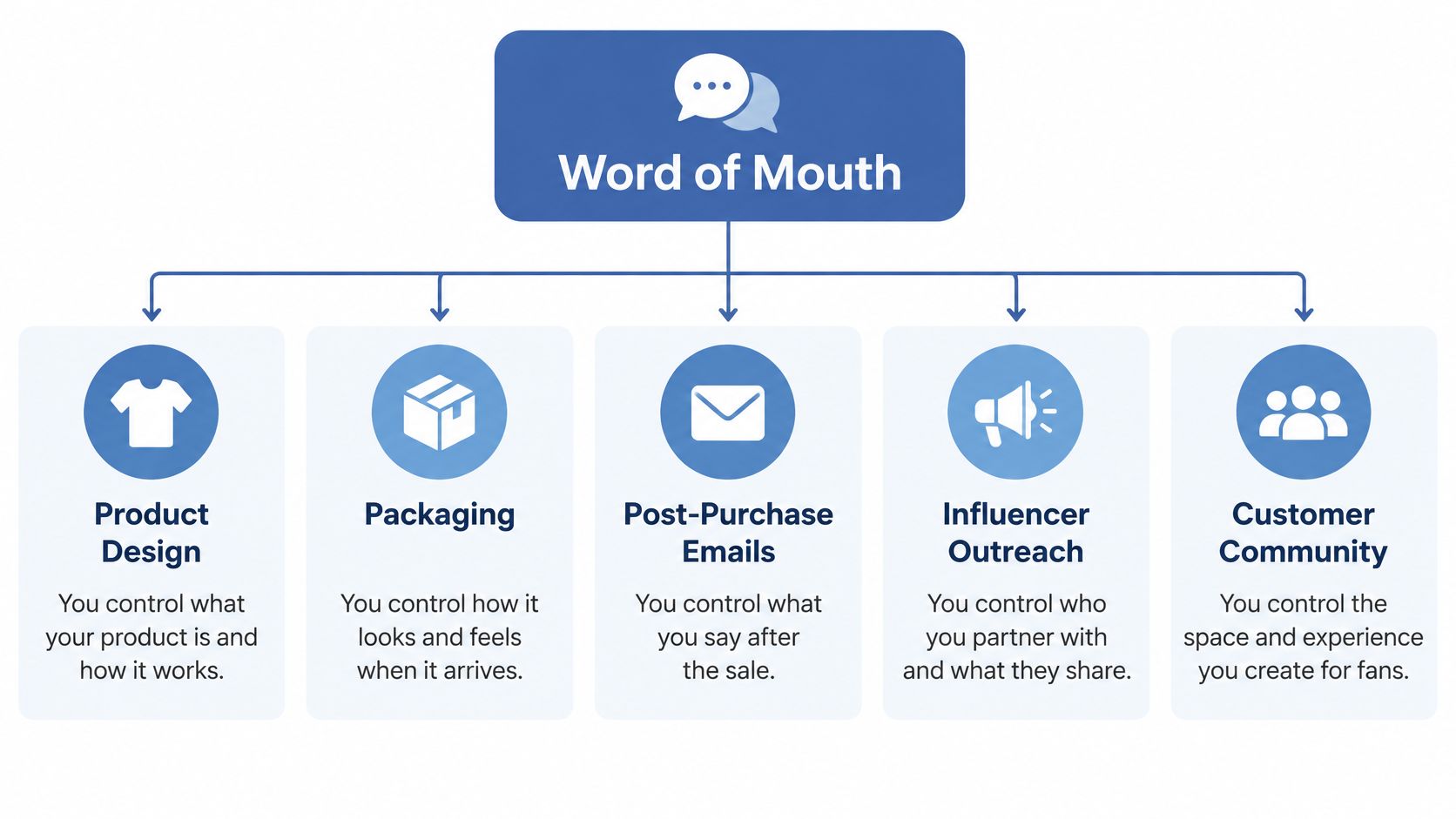
Treat these as connected parts of one experience, not separate campaigns. A clear product page sets expectations; the parcel and follow-up reinforce them; customer service and public reviews help shoppers decide whether to trust the brand. If one lever needs attention first, start where buyers currently ask the most questions or hesitate most often.
How to Build a Referral Program That POD Customers Use
Referral programs turn a satisfied customer's recommendation into a trackable action. 83% of consumers are willing to refer a trusted brand, while 29% do so without prompting, according to referral-program benchmarks and measurement guidance. For a POD store, the practical question is how to make sharing easy without paying more than a referred order is worth.
Define the conversion event. Choose one outcome to measure, such as a completed purchase, rather than treating a link click as a successful referral. For apparel, count an order only after it is completed and not refunded. Give each advocate a unique link or code, and state clearly what the referred customer receives when they use it.
Set a reward your margins can support. A two-sided incentive can give both customers a reason to participate, but the discount is only one part of the cost. Compare the expected contribution margin from an incremental order with the reward, refunds, fraud, and platform fees. Store credit or a design-related benefit may cost less than a deep discount. Test an advocate-only reward and a no-incentive version against the two-sided offer before settling on a structure.
Ask after the customer gets value. A request sent at checkout arrives before the customer has worn the product or judged the experience. Send it after successful delivery or a positive review, when there is a real reason to recommend the design. Apparel and accessories programs report a 5.2% share rate, 15.2% signup rate, and 15.8% referred conversion rate. Treat these figures as directional benchmarks, since program rules and measurement definitions vary. They can help identify where a funnel loses participants, not dictate targets for a small store.
Give customers copy they can send as written:
Email: Thanks for sharing your experience with us. If you know someone who'd like this design, send them your personal link: [referral link]. They'll see the offer before they order.
Social message: Found a design I love. If it sounds like your kind of thing, here's the link: [referral link].
Place the referral link in post-purchase email, the order-status page, and relevant support interactions. Keep the invitation visible, but don't crowd each message with competing offers. For a comparison with affiliate arrangements, join the affiliate program. For store-specific setup considerations, consult Skup's affiliate program setup guide.
Designing Unboxing and Post-Purchase Flows That Get Photographed
The package and the inbox are two surfaces you control after checkout. Use them to make the customer feel informed and appreciated, then offer a simple way to share their experience. A referral request shouldn't be the first or only thing they hear from you.
An insert card can thank the customer, point to support, and invite an honest review. If you include a QR code, make sure it leads directly to the relevant review or customer-care page. Avoid packing in multiple competing calls to action. A single clear request is easier to act on than a card crowded with discount offers and social handles.
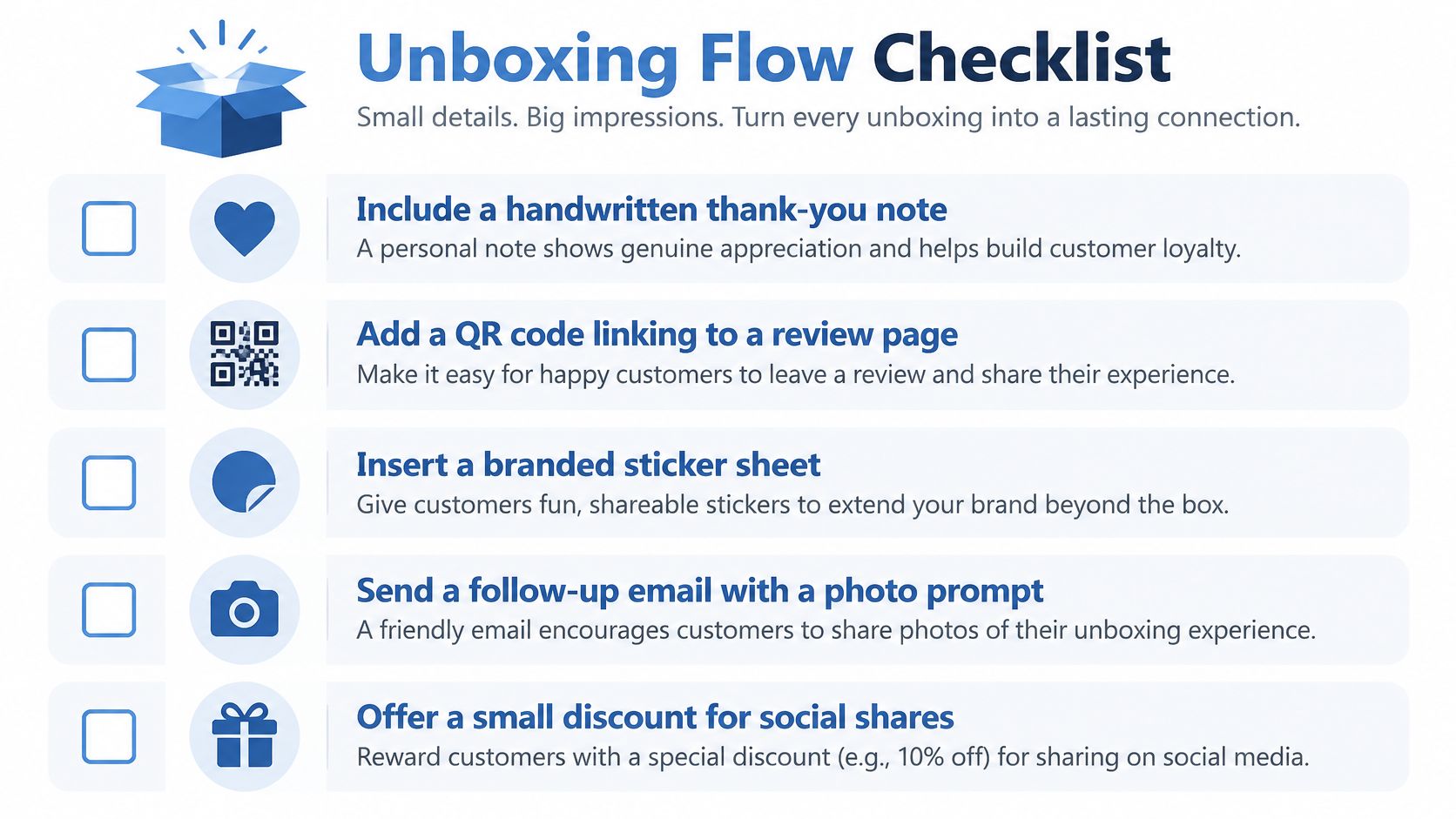
After delivery, give the buyer time to open and wear the product before requesting feedback. A review prompt can ask what they liked and whether they have a sizing note that could help another shopper. If you request a photo, explain where you'd like them to share it and ask permission before featuring it in your marketing. Don't require a positive review or imply that only praise is welcome.
Use separate messages for separate purposes:
Thank-you and review: Your order has arrived. When you've had a chance to try it, would you share an honest review? Your notes can help other shoppers decide.
Photo request: If you've worn your new shirt, we'd love to see how you styled it. Share a photo and tag us, or reply to this email. We'll ask before featuring your image.
Referral invite: Glad the design found its way to you. If a friend would enjoy it too, share your personal link: [referral link].
Send the referral invitation after a positive customer signal, not as an automatic follow-up to every delivery. A photo that shows how a design looks in everyday life can answer questions a studio image can't. So can a straightforward sizing note. Both make your social proof more useful because they help shoppers picture the actual product experience, rather than just the brand's preferred presentation.
Turning UGC, Community, and Micro-Creator Seeding into a Loop
People increasingly use social platforms to look for product recommendations. In a 2025 survey of more than 2,200 social users in the United States, United Kingdom, and Australia, 37% said they preferred social platforms first when searching for product reviews and recommendations. For POD apparel, that makes searchable customer photos, helpful comment threads, and clear answers part of discovery, not just post-purchase engagement. (Sprout Social's 2025 research on social search)
Build a repeatable loop: customers share photos or feedback, you respond and ask permission to feature useful contributions, and new shoppers find those contributions while researching. Keep criticism visible and answer it constructively. Shoppers are assessing whether the brand responds like a real business, not whether every comment is glowing.
Micro-creators can add reach and product demonstrations, but a large audience alone doesn't make someone a good match. Start with a small list of creators whose audience overlaps with your niche. Assess each candidate on audience fit, the relevance of their past content, and the quality of their engagement. Then offer a clear collaboration: what product you'll send, what you're asking them to do, whether they'll be compensated, and how you'll track visits or orders.
If you provide free products, discounts, payment, or another benefit, tell creators to disclose that connection clearly alongside their endorsement. The FTC says endorsements must disclose material relationships when audiences wouldn't reasonably expect them. It also says endorsers shouldn't discuss products they haven't tried or make unsupported claims. (FTC guidance on endorsements and disclosures, FTC guidance on bloggers and online endorsements)
Get written permission before reposting customer or creator content, and confirm where you can use it. Track referral visits, purchases, and repeat orders rather than judging a collaboration by likes alone. This user-generated content strategy guide can help you build a process for collecting and using customer content. Keep the loop ethical and useful: genuine product experience first, clear disclosure where there's an incentive, and no pressure to publish praise.
Measuring Word of Mouth Without Fooling Yourself
A referral program needs a measurement plan before more promotion. Choose one conversion event, create unique links or codes, and put them where customers will see them, such as post-purchase email, order-status pages, and relevant support replies. Set attribution rules in advance, especially when another channel also influenced the order.
Track the journey from prompt to profit: prompt viewed → share action → referred visit → signup or trial → purchase → repeat purchase. Apparel referral benchmarks cited earlier can serve as a comparison point, not a forecast. If your share rate trails that reference, test where and when the prompt appears before changing the reward. The benchmark definitions and your customer mix may differ.
| Funnel stage | Benchmark | What to track | What good looks like |
|---|---|---|---|
| Share action | Reference cited earlier | Prompt views and completed shares | Customers can find and use the share option |
| Signup or trial | Reference cited earlier | Referred visits and completed signups | The page explains the offer clearly |
| Referred purchase | Reference cited earlier | Referred visits and completed orders | Orders are valid and meet your conversion definition |
A dashboard should include reward cost, refunds, fraud losses, platform costs, and repeat purchases, not just revenue. Calculate incremental contribution by subtracting those costs from referral revenue, then comparing the result with program costs. This shows whether referrals add margin or mainly shift existing purchases into a discount.
Attribution rules determine which channel gets credit. Set a lookback window that fits your buying cycle, and define how to handle multiple clicks, shared devices, and repeat orders. Deduplicate purchases across email, paid social, and referrals so one order is not counted more than once. Keep the rules consistent when comparing campaigns; changing the window can change reported results without changing customer behavior.
Two reporting traps deserve attention: crediting referrals for buyers who already intended to purchase, and optimizing for shares instead of completed, profitable orders. Review disputed or overlapping orders, and check whether referred customers return. Pair those results with customer feedback loops to connect what buyers say with the parts of the experience you can improve.
Scaling Word of Mouth and Avoiding the Common POD Pitfalls
Build the system in stages so you can learn from each part before adding complexity:
- Weeks 1–2: Improve the delivery follow-up, review request, and customer-support touchpoints. Make sure the message matches the actual buying experience.
- Weeks 3–4: Launch a small referral test with one conversion event, one incentive structure, and a defined attribution window.
- Weeks 5–8: Seed products to a carefully selected group of relevant creators. Get permissions and disclosure expectations in place before content goes live.
- Weeks 9–12: Develop a customer-content and community routine. Compare results by product, incentive, and customer type, then put more effort into the sources bringing valuable customers.
Keep five failure modes in view. Don't ask for a referral before the customer has had time to trust the product. Don't reward self-referrals or other low-quality activity. Avoid training buyers to wait for a discount by making every recommendation a coupon event. Don't treat high trust as proof that a shopper will purchase. And don't assume a free product or store credit makes an endorsement exempt from disclosure requirements.
Before you launch: Confirm the conversion event, test the referral link, check the reward against your margin, set attribution rules, and prepare clear disclosure guidance for anyone receiving an incentive.
You don't need a viral post to make this worthwhile. A well-run referral system gives customers a direct way to share, helps new shoppers find credible product proof, and lets you see which recommendations lead to profitable orders. Start with one flow this week, learn from the purchases it generates, and improve the next step based on what customers do.
Skup offers the Apparel Cloning System for learning how to build a POD apparel business, along with AvatarIQ for creating designs and product mockups. If you're ready to build your store and put a practical word-of-mouth system to work, visit Skup.