Running Quarter Zip Guide: Fabric, Fit and How to Choose
You leave home feeling comfortably covered, then reach the first hill and wish you'd worn less. If you're choosing a running quarter zip for yourself or a print-on-demand collection, that's the problem worth solving: enough coverage at the start, enough ventilation once you're moving. The best choice starts with the runner's conditions and effort, not the most impressive fabric name on a product page.
Table of Contents
- What a Running Quarter Zip Is and Why the Zip Matters
- Quarter Zip Versus Full Zip and Pullover at a Glance
- Fabric Choices and What Moisture Regain Means
- Fit, Weight and Features That Decide Comfort
- When a Quarter Zip Helps and When It Overheats
- Layering, Care and Testing on the Road
- Confirm Blank Specs and Labels Before You List
What a Running Quarter Zip Is and Why the Zip Matters
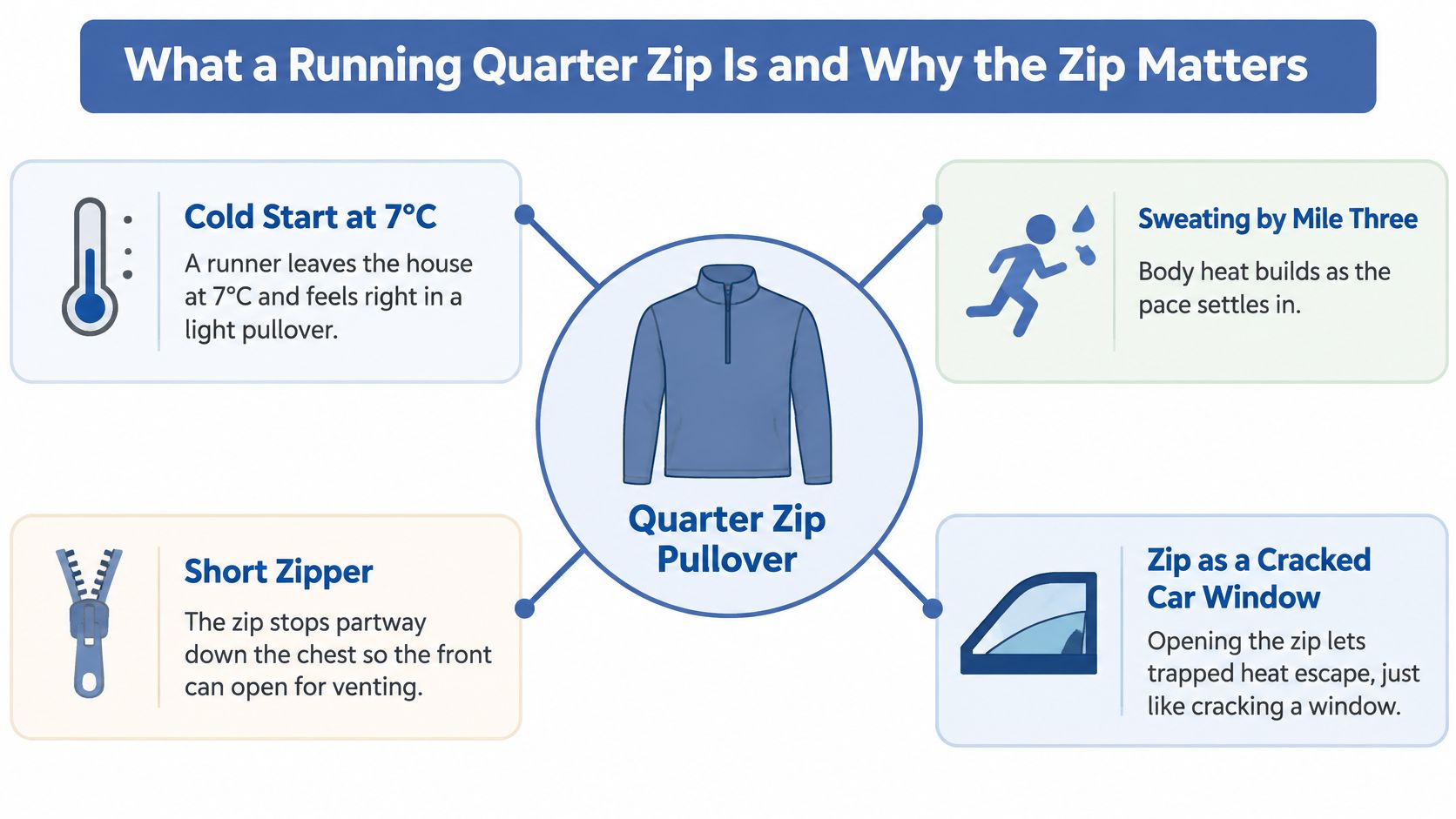
Say you leave the house at 7°C and you're sweating by mile three. A running quarter zip is a pullover with a short zipper that stops partway down the chest, letting you adjust coverage without taking the whole garment off. Opening that zip is like cracking a car window rather than opening a door: useful relief, but not unlimited airflow.
The garment has a straightforward construction:
- Short front zip: Creates an adjustable opening across the upper chest.
- Closing collar: Covers the neck when the air feels sharp.
- Layerable body: Fits over a base layer or beneath an outer shell without requiring a full-length front fastening.
That combination suits cool starts that develop into steady efforts. You can begin with the collar closed, then lower the zipper before you become uncomfortably hot. The practical advantage is adjustment while moving, rather than stopping to rearrange your outfit.
Function came before fashion
Cenwild's quarter-zip history places the silhouette's emergence in the mid-1970s, serving runners, skiers and mountaineers who needed quick ventilation, and identifies Malden Mills' introduction of Polartec fleece in 1979 as a milestone in synthetic insulation. Those origins explain why the same outline can appear on both a thin training top and a substantial outdoor layer.
For a POD brand, the appeal is easy to communicate. Buyers recognize the silhouette, understand the zipper's purpose and can picture where they'd wear it. Its largely uninterrupted body also provides usable decoration space, provided the design respects the garment's performance features.
Sell the intended run, not just the outline. A lightweight training quarter zip and a fleece-backed recovery layer can look similar in a mockup while serving very different needs.
Quarter Zip Versus Full Zip and Pullover at a Glance
Quarter zip, full zip and pullover compared
| Feature | Quarter zip | Full zip | Pullover |
|---|---|---|---|
| Zipper length | Partway down the chest | Collar to hem | No zipper |
| Vent points | One short opening | Full front opening | None |
| Warmth when closed | High, holds heat at the chest | Moderate, the front opens to cool | High, no openings |
| Quick removal mid-run | Unzip partway, then pull over head | Unzip in seconds | Pull over head |
| Layering under a shell | Sits flat, easy to layer | Works, zip can bunch | Works, but no vent |
Zipper length determines how much of the front you can open. A quarter zip offers a localized adjustment. A full zip lets you separate the entire front, while a plain pullover leaves you adjusting sleeves, hem or neckline instead.
The vent-point row describes openings you control, not total breathability. Air can still pass through a suitable knit, but you can't turn that property up and down like a zipper. That distinction matters when a sheltered route turns into an exposed climb.
Read warmth as a structural comparison
The warmth row assumes broadly comparable garments and describes their coverage, not a laboratory insulation ranking. A thick full-zip fleece can be warmer than a thin quarter zip. Closing a zipper doesn't make different fabrics thermally equivalent.
The collar is another useful distinction. A quarter zip can close around your neck, then fold or open away from it. A plain crew-neck pullover can't offer that adjustment, although a high-neck pullover can still provide fixed neck coverage.
Buying rule: Compare opening design separately from fabric weight. Neither tells you the whole story alone.
Removal is where the full zip has the clearest practical advantage. You can open it fully without pulling fabric over your head, which is easier when you're wearing a cap or carrying a hydration vest. A quarter zip still needs to come overhead if ventilation isn't enough.
Under a shell, a well-fitted quarter zip can sit neatly against the torso. A full-length zipper adds another strip of hardware that may buckle at the waist, though careful fit can prevent this. Use the table to understand construction, then inspect the product's measurements, textile and intended use before choosing.
Fabric Choices and What Moisture Regain Means
Why do most running quarter zips use synthetic fibers instead of cotton?
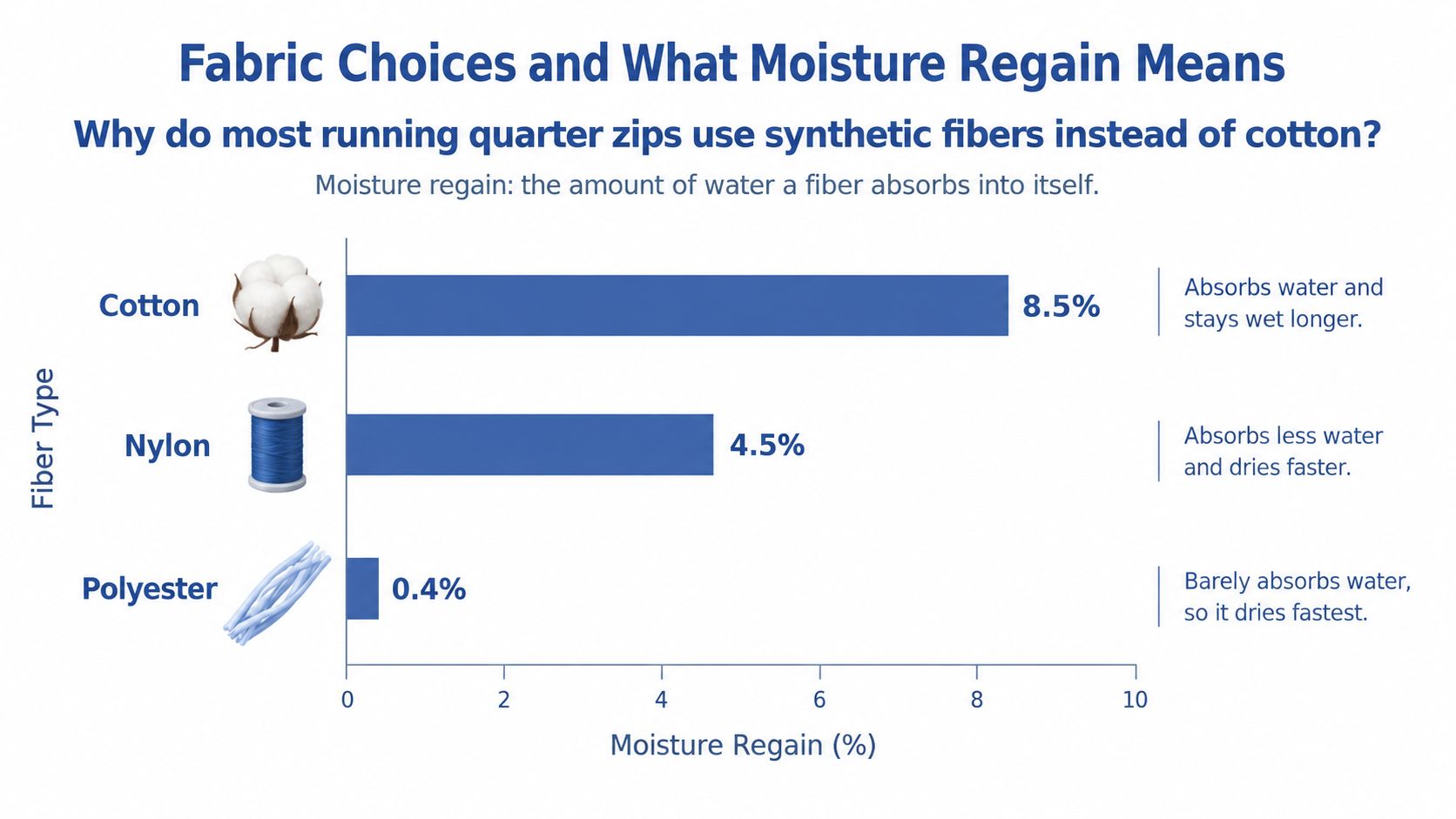
The useful starting point is moisture regain, meaning the amount of water a fiber absorbs into itself. Fashionista's performance-fabric explainer cites American Chemical Society educational values of approximately 8.5% for cotton, 4% for nylon and 0.4% for polyester; it also dates Coolmax to 1986 and describes Nike Dri-FIT, Adidas ClimaLite and Reebok PlayDry becoming established category offerings by the early 2000s.
Fiber moisture regain and what it means on a run
| Fiber or blend | Moisture regain | What it means on a run |
|---|---|---|
| Cotton | About 8.5% | Absorbs sweat into the fiber and can feel heavy and cold when wet |
| Nylon | About 4% | Absorbs less than cotton, offering a durable middle ground |
| Polyester | About 0.4% | Supports surface moisture transport and fast drying, a common base for running tops |
| Warm-weather blend, 86–88% polyester with 12–14% elastane | Low, polyester dominant | Combines fast-drying potential with four-way stretch for arm swing |
A lightweight blend around 86–88% polyester and 12–14% elastane is a useful warm-weather reference point, consistent with performance-top specifications represented by REI's Nike Swift quarter-zip listing. Treat that as a construction example, not a formula every supplier must copy.
Absorption isn't the same as wicking
Cotton takes more moisture into the fiber, which helps explain why a soaked cotton top can remain clammy against your skin. Polyester absorbs much less internally, allowing an appropriately constructed fabric to move liquid across its surface for evaporation. Low absorption helps drying, but it doesn't guarantee excellent sweat transport.
Wicking also depends on yarn structure, knit construction and finishing. A fabric can spread sweat effectively yet still feel wet when the surrounding air can't accept much more moisture. Don't translate a polyester label into a promise that the wearer will stay dry.
Elastane contributes a different benefit: recovery and freedom of movement. It helps the top accommodate reaching, arm drive and getting dressed, but stretch alone says nothing about ventilation. For broader blank-selection decisions, this guide to the best shirt material provides useful context.
Judge the finished fabric
Run your hand across the inside, stretch the sleeve and hold the fabric toward a light. Look for changes in density around mesh zones and decoration areas. A dense panel, heavy seam or substantial print can alter the experience even when the fiber blend looks ideal.
The practical buying decision is therefore broader than cotton versus polyester. Composition is a checkpoint, not a comfort certificate.
Fit, Weight and Features That Decide Comfort
A product page should help you answer a physical question: can you move naturally in this top without constantly adjusting it? Start with the size chart, but don't stop at the size label. Compare garment measurements with a training layer you already like, making sure you're comparing the same measurement method.
A product-page checklist
- Sleeves: Look for raglan or articulated construction that allows arm swing without pulling across the chest. Lift your arms during a sample fitting and check whether the hem climbs.
- Fit: An athletic cut should leave usable space for the intended base layer, not compress it. A relaxed cut offers room, but excess fabric can fold beneath a vest or shell.
- Weight: Choose a lightweight knit when coverage matters more than insulation. A midweight garment with brushed-back fleece belongs in a colder-weather assortment.
- Seams: Flatlock or low-bulk seams are worth inspecting where pack straps and vest edges contact the garment. Check the inside, not just the exterior product photograph.
- Zipper: A zipper garage should shield your chin from the pull and top stop. Test whether you can grip and operate the pull with gloved fingers.
- Collar: Close it completely and turn your head. The edge shouldn't scrape your jaw or press against your throat.
- Ventilation: Inspect where mesh panels and underarm openings sit. A ventilation panel hidden beneath a tight pack won't deliver the same experience as an exposed one.
- Pocket: A zipped chest or back pocket can secure a key or gel. Load it during the fitting so you can assess bounce and access.
- Durability: Ask whether the blank has an anti-pilling finish, then inspect the sample after washing. Look closely at the underarms and other friction areas.
Check stretch without confusing it with fit
A garment that stretches enough to get onto your body isn't necessarily the right size. If the chest remains under tension at rest, the collar distorts or the sleeves twist, choose a different fit rather than relying on elasticity.
The distinction between fiber stretch and stretch created by knit construction is useful when evaluating supplier descriptions. This explanation of whether polyester is stretchy can help you interpret those claims.
A lightweight blank with a stiff collar and bulky seams is still an uncomfortable running top. Buy the whole construction, not the best feature in the description.
For a POD collection, photograph the details buyers can't assess from a front-facing mockup. An inside-seam view and a close-up of the collar can make your listing more useful without adding exaggerated performance language.
When a Quarter Zip Helps and When It Overheats
A quarter zip is the right answer for many runs, not every run. Choose according to the effort you'll sustain after warming up, rather than how the air feels while you're standing at the door.
Choosing a zip style by conditions and effort
| Conditions | Best zip style | Why it works |
|---|---|---|
| Cool start, easy pace | Lightweight quarter zip | Zip opens as you warm up, collar closes against wind |
| Steady moderate effort, mild weather | Quarter zip with underarm or mesh vents | Vents release heat before it builds |
| Intervals, hills or racing | Full zip or pit zips | Heat rises fast, and a full opening can be vented in seconds |
| Humid heat | Full zip with breathable panels, light layer underneath | Sweat evaporates slowly, so extra insulation traps it |
| Very cold, long easy runs | Midweight quarter zip with brushed-back fleece | Holds heat when closed, zip opens as the run warms up |
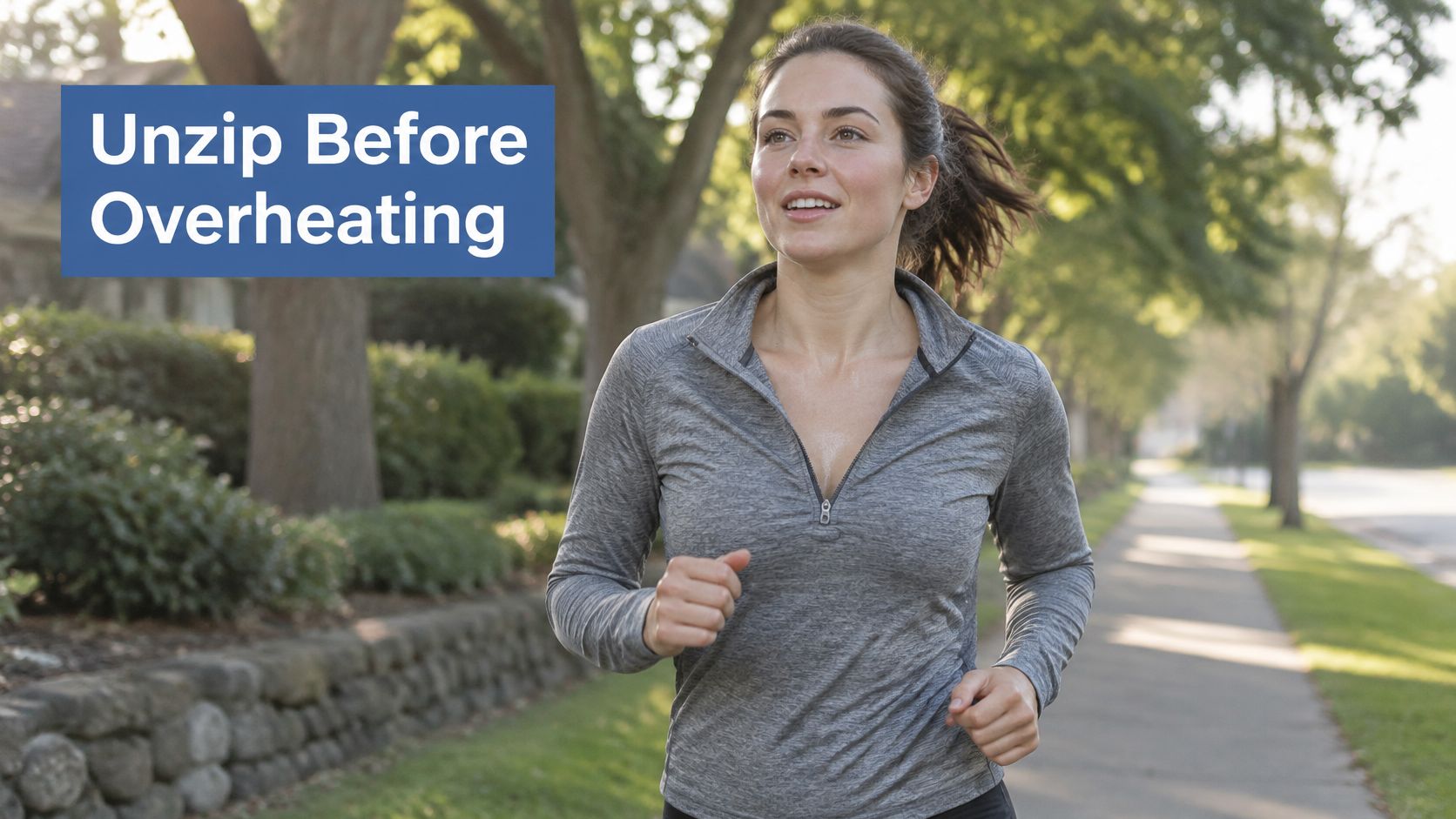
For a cool, easy start, keep the garment light enough that you won't immediately want to remove it. Close the collar while exposed to wind, then open it as you settle into the run. You're managing a changing situation, not choosing a fixed comfort setting.
At a steady moderate effort, additional ventilation can make the quarter-zip format more useful. Mesh and underarm openings give air routes that don't rely entirely on the chest opening. Pay attention to whether your vest or outer layer covers them.
Choose for the hardest sustained effort
Intervals, hills and racing leave less margin for excess clothing. Prioritize a larger opening or a layer you can remove and carry without interrupting the session. A short chest zipper can't compensate indefinitely for an overly insulated body.
Humid heat requires particular restraint. Don't assume adding a technical long-sleeve top will improve comfort just because its description says moisture-wicking. If you need coverage, favor an airy construction and an easy removal plan.
For very cold, long easy runs, a brushed interior becomes a more sensible choice. Route exposure, precipitation and time away from shelter also matter; the winter running advice from Swift Running offers useful context for planning that broader outfit. When comparing blank thickness, this guide to T-shirt weights helps explain why a weight specification needs context.
Expensive fabric isn't a heat-management guarantee
A controlled study described in sports-clothing research on ScienceDirect involved 20 trained athletes running for 60 minutes at 35°C and 30% relative humidity, with different upper-body garment technologies producing no significant differences in running speed, physiological heat strain or overall perceptual responses. That finding doesn't make every garment interchangeable, but it does challenge the idea that an upgraded fabric automatically improves running performance.
Match the garment to the work. Price and technical branding can't make an unsuitable layer appropriate for the day.
Layering, Care and Testing on the Road
Think in roles rather than just adding garments. A base layer handles moisture next to the skin, the quarter zip provides adjustable mid-layer coverage, and an appropriate shell protects against wind or rain. A wind-resistant shell isn't automatically waterproof, so check that distinction before relying on it in wet weather.
Adjust the mid-layer opening first when it's accessible, then vent or remove the shell as conditions allow. Avoid putting a heavy fleece beneath a lightweight quarter zip and expecting the outer knit to cancel the insulation underneath. Each layer needs a clear purpose.
Run a repeatable home test
- Check drying: Wash the sample, record when you hang it up and note when the body, collar and cuffs feel dry. Use the same drying location when comparing blanks.
- Assess damp comfort: Wear it slightly damp on a short walk. Notice whether the fabric clings, feels abrasive or becomes unpleasant when you stop.
- Test moving adjustments: Operate the zipper and collar while walking, including with the gloves you intend to wear. Make sure opening it doesn't require holding the hem with your other hand.
- Record the context: Note wind, humidity, effort and the layers underneath. A verdict without those details is hard to use for either buying or product copy.
These checks distinguish a pleasant local sensation from a broader physiological benefit. A 2024 treadmill study discussed in the Human Factors and Ergonomics in Manufacturing review found that enhanced-breathability fabric lowered chest skin temperature by 2°C compared with conventional polyester, without changing rectal temperature, mean skin temperature, sweat rate or heart rate.
Testing principle: Describe what the garment actually did during your test. Don't turn a cooler-feeling chest panel into a claim about lower core temperature.
Protect the garment after testing
Unless the garment's care instructions specify otherwise, wash cold, close the zipper and turn the top inside out. Skip fabric softener, which can leave deposits that interfere with moisture management. Air-dry or use an allowed low-heat setting, avoiding unnecessary heat exposure to stretch fibers, fleece and decoration.
Treat recycled content as a separate purchasing attribute, not evidence of running performance. Ask for documentation before making an environmental claim, then evaluate comfort and durability on the finished sample. A credible sustainability description and a useful wear test can support the same product without pretending they prove the same thing.
Confirm Blank Specs and Labels Before You List
A strong running quarter zip listing starts with a verified blank and a clear use case. Treat the following checks as launch preparation, not paperwork to fix after orders arrive.
- Collect the supplier specifications. The Federal Trade Commission's textile-labeling guidance explains that US labels generally need fiber content, country of origin and the responsible business's identity, while care instructions fall under a separate rule. Performance fabric isn't a substitute for composition information.
- Check your destination markets. The EU textile-labeling summary requires constituent fibers and their percentages by weight in descending order, with durable, legible, visible and accessible composition information, and covers products containing at least 80% textile fibers.
- Approve decoration placement. Keep prints away from mesh, underarm vents and awkward seam intersections. Confirm the decorator's process is compatible with the blank, then inspect the decorated sample rather than approving only an undecorated garment.
- Position the price deliberately. A 2026 Klarna listing priced the Nike Men's Stride Dri-FIT Quarter-Zip Running Top at $53.99, according to Klarna's Nike quarter-zip comparison page. That's a market reference, not a ceiling or a substitute for calculating your own costs.
A running quarter zip gives a focused apparel brand a useful product story: a recognizable garment serving a specific kind of run. This week, order a suitable sample, choose the conditions it's intended for and draft a listing around features you can verify.
Skup offers Apparel Cloning training for building a POD apparel business and AvatarIQ for creating apparel designs and product mockups. Visit Skup to turn your running quarter zip concept into a practical design test, then pair your mockups with a wear-tested sample before launch.