Best Tee Shirts for Printing in 2026: Which Blank to Pick
Screen printing accounted for 56% of global custom T-shirt printing revenue in 2024, according to Grand View Research. That single figure reframes how you should shop for blanks. The best tee shirts for printing aren't the most popular brand names or the softest shirts in a sample pack. They're the blanks that match your print method, your artwork, and the way your customer will wash the shirt.
Pick by brand alone and you'll end up forcing great designs onto the wrong fabric. Pick by print method first, verify the specs, then wash-test the winner, and you've got a product you can scale with confidence. That's the exciting part of print on demand. You don't need a warehouse full of guesses. You need one proven blank and a repeatable decision rule.
Table of Contents
- Best Tee Shirts for Printing at a Glance
- Match Your Print Method and Store Type
- Screen Printing Weight and Blend Targets
- Compliance Checks Before You Order
- Durability and Sustainability Trade-offs
- Budget Math for Cost per Sellable Shirt
- Test the Blank Before You Scale
Best Tee Shirts for Printing at a Glance
The global custom T-shirt printing market was valued at $7.61 billion in 2024, according to ResearchAndMarkets.com, as reported by Yahoo Finance, and there's strong room in it for sellers who choose their blanks well. Read the table by finding your print method first, then checking the weight range and the one trait that makes that blank win.
| Blank | Best print method | Fabric weight | Why it works |
|---|---|---|---|
| 100% combed ring-spun cotton | DTG and detailed full-colour art | 4.2–5.5 oz/yd² | Smooth surface keeps fine detail, gradients and edges sharp |
| 100% cotton, heavyweight | Screen printing | 4.5–6.1 oz/yd² | Predictable ink surface and strong colour saturation |
| 50/50 cotton-polyester | Screen printing with reduced shrinkage | 5.0–5.5 oz | Lower cost and less shrink, dark colours need low-bleed inks |
| Cotton-dominant blend | DTF transfers | 4.2–5.5 oz/yd² | Transfers work across fibres, with temperature and adhesion settings still key |
| 100% polyester performance tee | Dye-sublimation | 4.5–6.1 oz/yd² | Dye bonds with polyester fibres for vivid, lasting prints |
How to Use These Quick Picks
Each row is a starting point, not a guarantee. Fabric weight tells you how the shirt will handle ink pressure, drape on the body, and feel after curing. Fibre content tells you whether ink will absorb, sit on top, or bond chemically. Together they explain why a blank that sings under one method can look dull or crack under another.
Don't shop the other way around. Sellers who fall in love with a blank first often discover too late that their artwork needs a smoother surface or a different fibre. Decide how you're printing, use the matching row to shortlist, and then prove it with a sample.
That sequence, method first and blank second, is what separates a store that reprints and refunds from a store that builds repeat buyers. The detail behind each row matters, and it's simpler than most blank rankings make it sound.
Match Your Print Method and Store Type
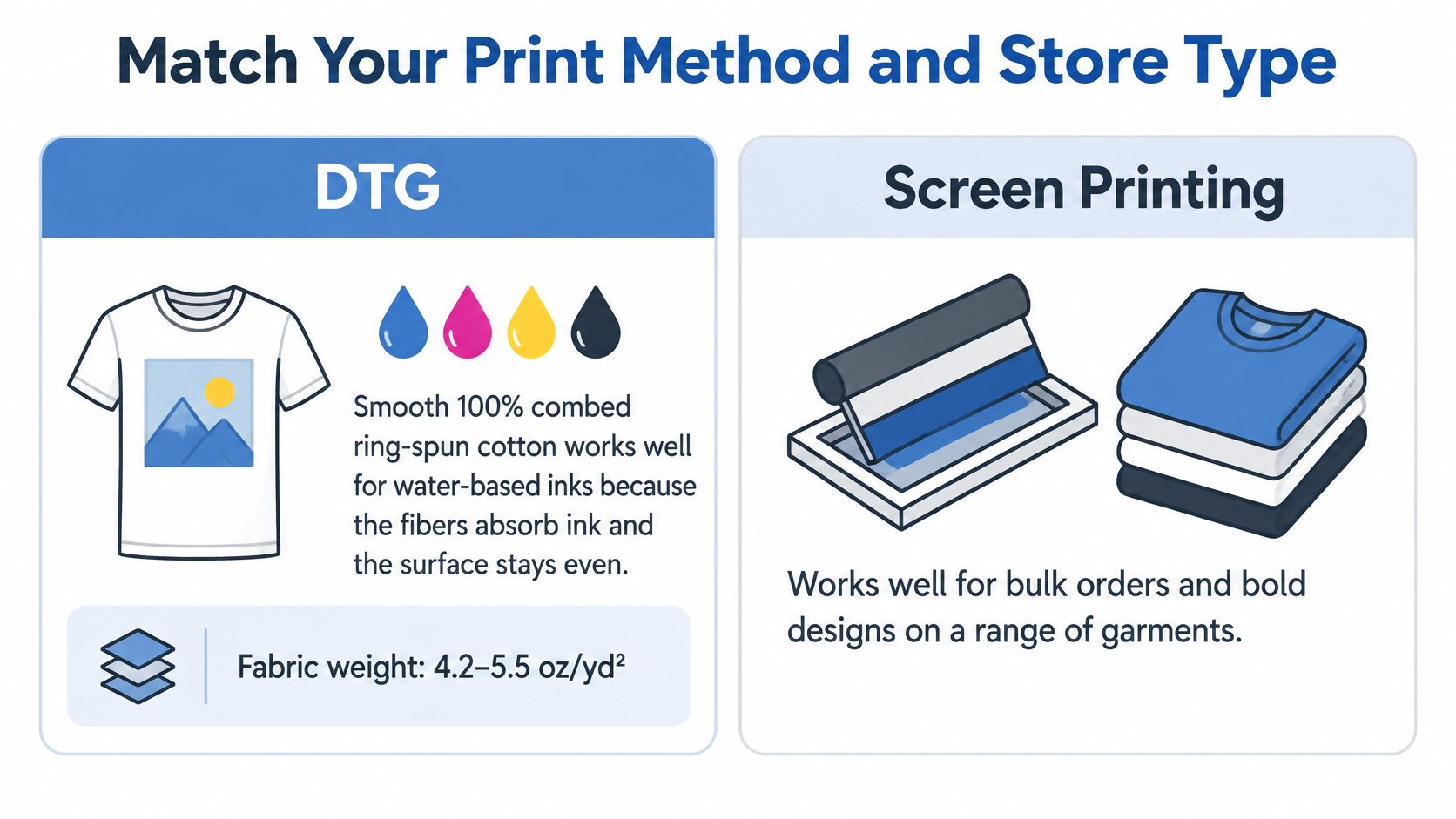
Start with the chemistry of your print method, because it dictates the fibre. For DTG and other water-based digital printing, 100% combed ring-spun cotton in roughly the 4.2–5.5 oz/yd² range is the strongest general-purpose choice, and this DTG and screen printing guide explains that its smoother surface reduces fiber interference during inkjet deposition, helping preserve fine detail, gradients, and edge definition. Cotton-rich blends can also work, but print consistency generally declines as synthetic content increases.
Standard DTG chemistry is poorly suited to 100% polyester without specialised pretreatment and ink systems. Polyester is better matched to dye-sublimation, where dye bonds into the fibres, or to suitable screen printing inks. DTF sits in the middle. The design transfers from film, so it works across cotton, polyester, and blends, though your temperature, pressure, and adhesion settings still decide whether it lasts.
If you're still weighing methods, our breakdown of the different types of t-shirt printing walks through how each one handles colour, quantity, and fabric.
Five Store Situations, Five Starting Blanks
First-time seller with one niche design. Start with a cotton-dominant or 100% combed cotton blank matched to your planned artwork method. Check garment colour first, because white ink and pretreatment behave differently on dark shirts.
Bulk drop of text-led designs. A 50/50 blend for screen printing protects margin with less shrinkage and lower cost. Bold lettering doesn't need a premium print surface, so spend on consistency instead.
Detailed full-colour illustration brand. Choose 100% combed ring-spun cotton for DTG. Your gradients and fine lines need that smooth, absorbent surface more than they need a bargain blank.
Sportswear or performance niche. Consider 100% polyester with dye-sublimation. Check expected washing first, since performance shirts take frequent, hot cycles.
Tight budget. Test two blanks in small batches before committing. A tiny sample run is cheaper than a catalogue built on the wrong shirt.
A cheaper or softer shirt is not the best commercial choice if it creates rejected samples, muddy colours, cracking, or complaints.
Presenting the Winner Beautifully
Once you've shortlisted, your listing images sell the decision. With AvatarIQ, the mockup tool creates custom product mockups with one click, based on a product type and the kind of person or place to showcase it, so you can show your exact tee on the right customer fast. Content made with AvatarIQ can be used on Etsy, through social media, or with friends and family, and running paid ads is not required.
Do one thing today. Write down your print method and artwork style in a single line, then shortlist the two blanks that match them. Everything else in your store gets easier from that shortlist.
Screen Printing Weight and Blend Targets
For screen printing, aim for a blank of approximately 4.5–6.1 oz/yd², and Custom Ink's fabric guide for custom apparel sets that range out as the practical target. It's the sweet spot between a shirt that holds up under the press and a shirt someone wants to wear.
Go below 4.5 oz/yd² and the fabric is more vulnerable to ink bleed-through, puckering, and distortion under squeegee pressure. Go above 6.1 oz/yd² and the garment can feel stiff or uncomfortable under heavy plastisol ink. Weight isn't a vanity spec. It's the difference between a crisp print and a wavy one.
Cotton Versus the 50/50 Blend
Within that range, 100% ring-spun cotton gives you the most predictable surface. Its smoother construction supports sharper ink edges and stronger colour saturation. If your design has tight detail or bold colour blocks that must pop, I would start there.
A 5.0–5.5 oz 50/50 cotton-polyester blend is the sensible alternative when reduced shrinkage and lower cost matter. The trade-off is dye migration. On dark blends, polyester dye can migrate into lighter ink colours and contaminate them, so you'll need low-bleed or blocker-compatible inks. Budget for the right ink or pick a different blank. Don't discover pink-tinged white lettering on a finished run.
Our guide to t-shirt weights breaks down how these numbers translate into drape and hand feel across styles.
A Worked Example Worth Copying
Say you're printing a 50-piece order of dark 5.5 oz 50/50 tees with white ink. Print one sample on the exact garment, in the exact colour, with your low-bleed white. Cure it to the ink supplier's profile, let it sit, then inspect for ghosting, that faint dye shadow creeping into the white. Wash it once and check again.
If the sample stays clean, run the order with confidence. If it ghosts, you've spent the cost of one shirt to save fifty. That's not caution slowing you down. That's how you protect margin and reviews at the same time.
Two Buying Steps Before You Commit
- Specify a pre-shrunk blank: Shrinkage after printing distorts your design and your size chart.
- Verify the actual weight: Ask for the number in oz/yd² instead of trusting words like heavyweight, which mean different things to different suppliers.
Lock those two specs, run the sample, and your screen printing blank becomes a known quantity. The final scorecard later in this guide turns that sample check into a full test.
Compliance Checks Before You Order
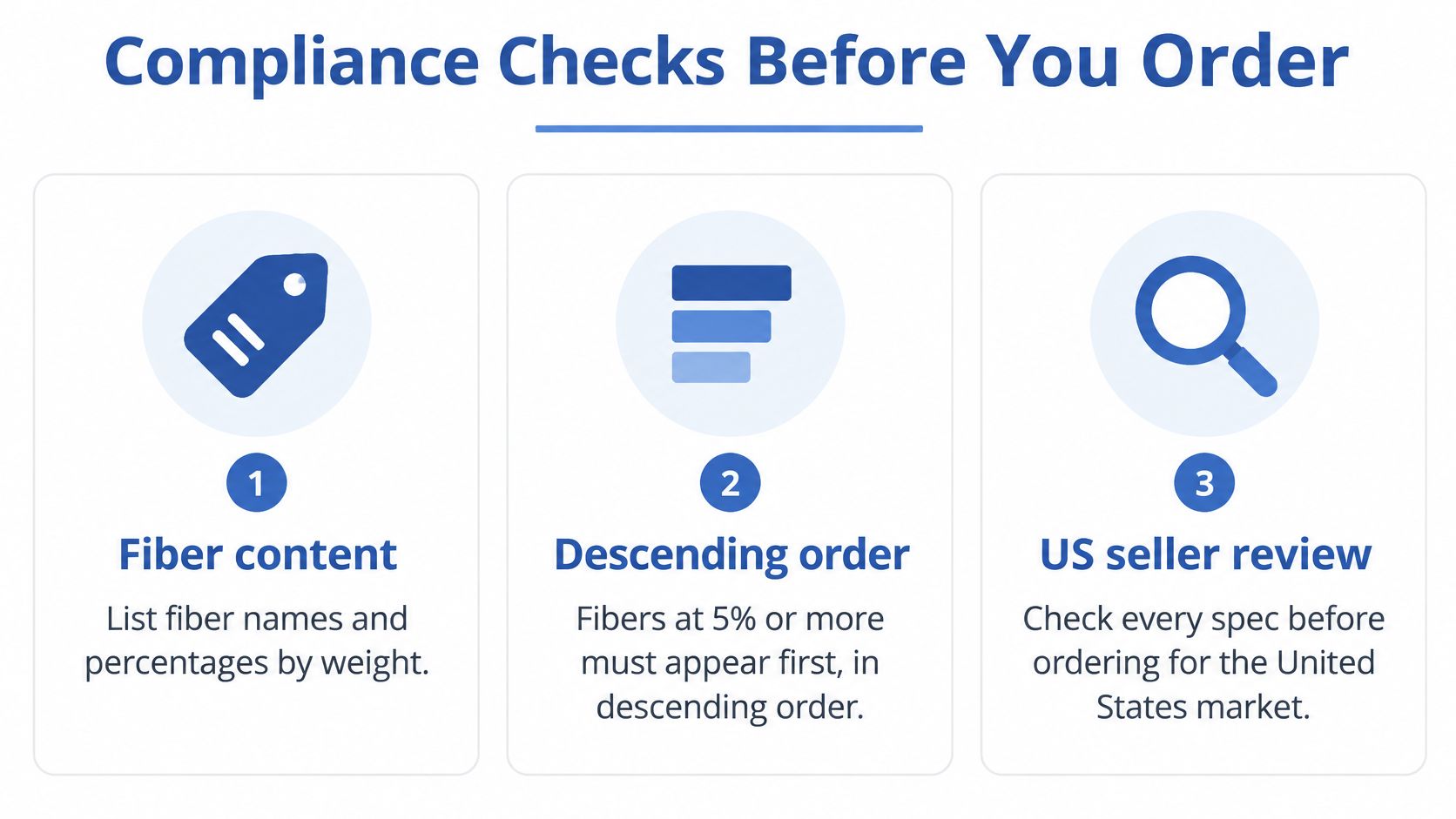
Great print quality gets you the sale. Correct paperwork keeps the listing up and the customers confident. If you're selling into the United States, the Federal Trade Commission's guidance on labeling and advertising cotton products explains that the Textile Fiber Rule requires the generic names and percentages by weight of constituent fibers, with fibers representing 5% or more generally listed in descending order of predominance. A label such as 85% Cotton, 15% Polyester must reflect the actual proportions, not a vague phrase like cotton blend, and the rules also apply to advertising claims.
Flammability has its own thresholds. The Consumer Product Safety Commission's clothing flammability guidance identifies plain-surface fabrics weighing at least 2.6 ounces per square yard, equivalent to 88.2 grams per square meter, as one covered category, and the rules also cover plain- and raised-surface fabrics made from acrylic, modacrylic, nylon, olefin, polyester, wool, or blends of those fibers regardless of weight.
Under that standard, the CPSC's 16 C.F.R. Part 1610 classification guidance places fabrics into Class 1, normal flammability and acceptable for apparel, Class 2, intermediate flammability in raised-surface fabrics that should be used with caution, and Class 3, dangerously flammable textiles that must not be used in wearing apparel. Ordinary jersey knits are straightforward. Brushed, fleece-like, or textured surfaces deserve documentation.
Safety certification is a separate check. OEKO-TEX STANDARD 100 divides products into four classes, and Product Class 2 covers products with direct skin contact, which describes a T-shirt. It tests for harmful substances. It does not measure print sharpness, fabric weight, shrinkage, or durability.
| Check | What it covers | Why it matters for your listing |
|---|---|---|
| Fibre content label | Fibre names and percentages by weight, fibres at 5% or more in descending order | Listing copy must match the real blend, not a vague term |
| Flammability classification | Plain-surface fabrics at 2.6 oz/yd² or more, and raised or synthetic fabrics regardless of weight | Raised surfaces need documentation and caution |
| OEKO-TEX Standard 100 Product Class 2 | Harmful substance testing for products with direct skin contact | A verifiable safety claim for tees worn against the skin |
| Fabric weight specification | Actual oz/yd² or GSM from the supplier sheet | Turns heavyweight marketing into a number you can check |
Your Four-Step Document Request
- Request the technical sheet with fibre percentages and weight.
- Ask for flammability documentation on any raised or textured surface.
- Ask for the OEKO-TEX certificate and class if the supplier claims it.
- Match your listing copy to the label, word for word on fibre content.
While you're clearing a design for listing, it's worth running the artwork wording through Trendlytic's trademark checking tool, since a compliant blank won't save a design that steps on someone else's mark.
The FTC and CPSC rules above apply to products sold into the United States, so check your own market's labelling and flammability rules if you sell elsewhere. Verified paperwork lets you list with confidence and build a catalogue customers can trust.
Durability and Sustainability Trade-offs
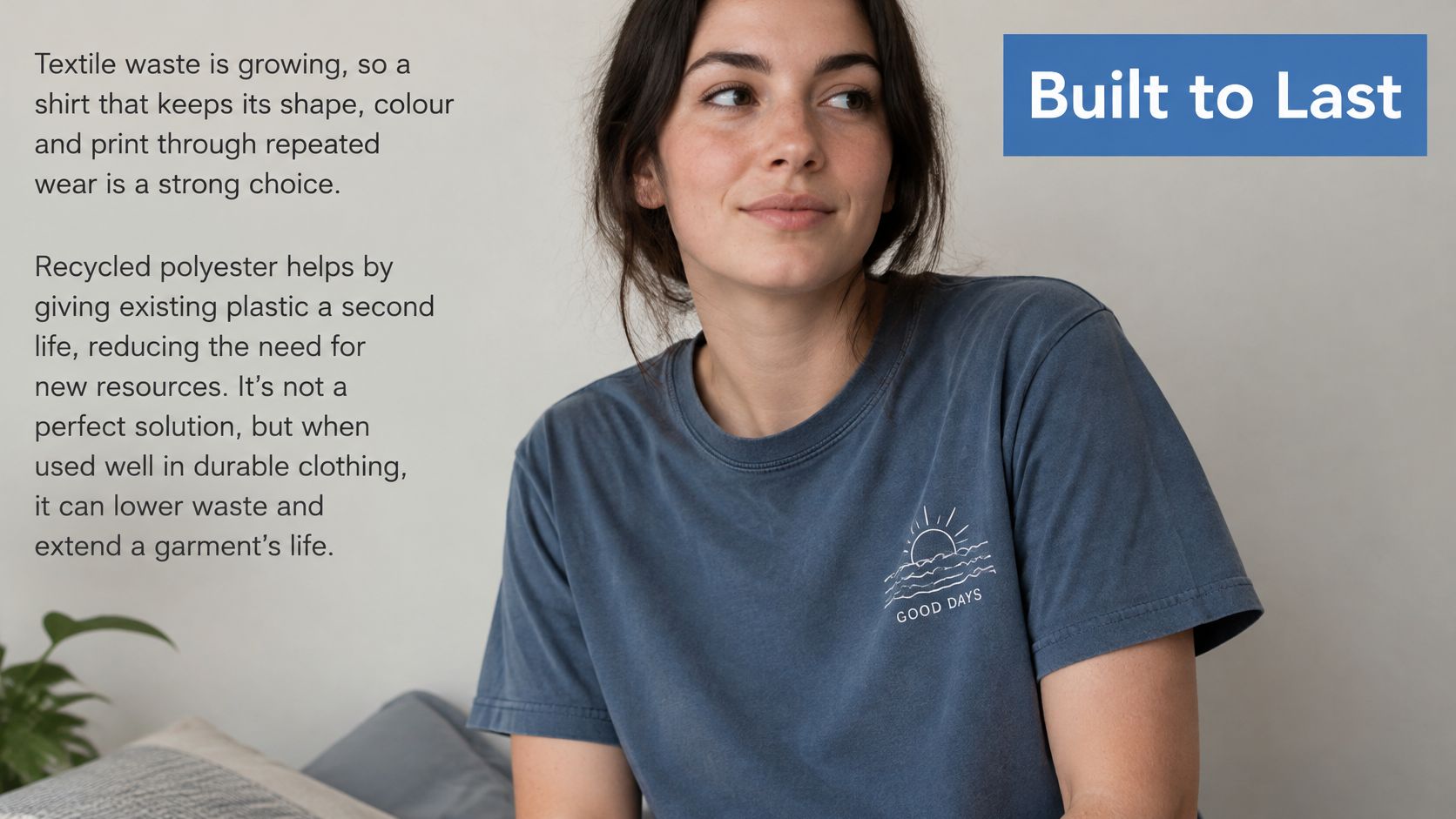
Textile waste is growing, and the U.S. Environmental Protection Agency's textiles data estimated that 17.03 million tons of textile materials entered the municipal solid-waste stream in 2018, equal to 5.8% of total municipal solid-waste generation. Only 14.7% of all textile waste was recycled that year. A shirt that keeps its shape, colour, and print through repeated wear is a stronger choice, for your customer and for your returns rate.
Read Recycled Claims Carefully
Recycled polyester sounds like an easy win. The numbers are more nuanced. Polyester represented 59% of global fiber production in 2025, and 88% of that polyester was virgin material, according to Textile Exchange reporting covered by Resource Recycling. Recycled use is growing, but only about 1.5% of recycled polyester used by benchmark participants came from recycled textiles, with most sourced from non-textile materials such as PET bottles.
A recycled label alone doesn't prove a lower footprint. Weigh these criteria instead:
- Fibre origin and certification scope: What's verified, and by whom?
- Recycled content: How much, and recycled from what?
- Expected lifespan and shrinkage: Will it stay wearable and true to size?
- Print durability and return risk: A returned or reprinted shirt doubles the material used.
An eco label is a starting point to verify, not an automatic advantage.
A heavier premium shirt uses more material per unit, but if it lasts twice as long and rarely comes back, it can offset that input. A flimsy eco-labelled tee that cracks after three washes helps nobody.
That's where print on demand shines. Made-to-order production means you print what sells rather than holding unsold stock that risks ending up as waste. Pair that model with a durable, well-documented blank and accurate care instructions, and you give customers a shirt they'll keep, wear, and reorder. That's sustainability you can stand behind and a business that grows on repeat buyers.
Budget Math for Cost per Sellable Shirt
The cheapest blank is not always the cheapest product. Your real unit cost is the blank price plus ink or transfer cost, plus the cost of rejects, reprints, and returns. Calculate cost per sellable shirt, and the comparison changes completely.
A Simple Illustrative Example
Say Blank A costs less per unit but, in your test run, produces a 15% reject rate from bleed-through and misprints. Blank B costs slightly more and rejects at 3%. Print 100 shirts of each and Blank A gives you 85 sellable shirts while Blank B gives you 97. Divide your total spend by sellable shirts, not by shirts printed, and Blank B often wins despite the higher sticker price.
Use the reject rate from your own test samples, not guesses. Your press, your ink, and your artwork produce your numbers. A supplier's promise doesn't.
Your Costing Checklist
- Request the unit price at your actual order quantity.
- Include shipping and any minimum order in the per-shirt figure.
- Estimate the reject rate from your test run.
- Add ink or transfer cost for your chosen method.
- Set a target margin per sellable shirt before you price the listing.
Run that math on your top two blanks and the decision usually makes itself. Once the numbers are clear, you can price with confidence, hold your margin through supplier wobbles, and reinvest profit into new designs. That's how a print on demand store grows, one proven, profitable product at a time. It's exciting when the spreadsheet and the sample agree, because you've found a shirt you can scale without crossing your fingers.
Test the Blank Before You Scale
Approve one blank and ink or transfer combination only after a test. Washability depends on complete curing or correct transfer application, and Custom Ink's guidance on screen printed apparel specifically recommends testing before production. Fabric composition alone doesn't guarantee the result. Your settings complete it.
This is the step most blank rankings skip, and it's the step that protects everything you've built so far. It takes a few shirts and a few wash cycles. It saves you from scaling a problem.
The Six-Step Blank Qualification Test
- Order three to five samples of each of your top two blanks, in the colours you'll sell.
- Print the exact artwork on each, including a dark garment if your range includes one, because dark shirts expose pretreatment and white ink problems.
- Cure or press to the supplier's profile and record the settings, so a good result is repeatable rather than lucky.
- Run several wash cycles and inspect for cracking, fading, and edge breakdown after each one.
- Score each blank on print sharpness, colour strength, shrinkage, hand feel, and wash durability.
- Approve only the blank that passes on all five, and scale from that exact combination.
Our walkthrough of quality assurance procedures shows how to formalise checks like these as your catalogue grows.
Turn the Test Into a System
Keep the scorecard. It becomes your repeatable blank qualification step for every new product, so your second launch starts from proven ground instead of fresh guesswork. When a supplier changes a spec or you add a new garment colour, run the same six steps and compare against your recorded settings.
That habit is what experienced sellers rely on. Not brand loyalty. Not whoever's trending this season. A tested blank, a clear spec, and verified documents give you a product you can stand behind, photograph proudly, and advertise without worrying about the reviews. Build your store on shirts that have earned their place, and you'll feel the momentum that makes print on demand such an exciting business to grow.
Ready to turn a tested blank into a store full of designs customers love? At Skup, the Apparel Cloning System shows you how to find proven product ideas and launch them on the right garments, while AvatarIQ helps you create designs and polished mockups in minutes. Visit us today, pick your first winning blank, and start building the print on demand brand you're excited to own.