How to Find Trending Keywords for POD Apparel
Most keyword advice starts with a number. Find the highest search volume, target the biggest niche, and hope demand turns into sales. That approach can keep a POD seller busy competing for generic phrases that already attract established brands, while the more interesting apparel opportunities are still forming in smaller communities, conversations, and search patterns.
The better question is how to find trending keywords that reveal durable buyer interest, not merely how to find the most searched terms. A rising phrase can point to a fresh identity, hobby, occasion, or cultural moment, but only if you validate it across search behavior, audience language, commercial intent, and product fit. That combination gives you a practical advantage without relying on viral luck.
Table of Contents
- Why Raw Search Volume Misleads Beginners
- Building a Reliable Trend Validation Workflow
- Discovering Visual and Conversational Trends Early
- Scoring and Prioritizing Your Keyword Shortlist
- Turning Validated Trends into High-Converting Designs
- Scaling Your Research into a Sustainable Brand
Why Raw Search Volume Misleads Beginners
Raw volume answers one question, how often people search for a term. It doesn't answer the questions that matter most to an apparel seller: Are these people buyers? Can your design stand out? Will interest last long enough to support a product line?
A permanently popular subject may have plenty of searches and still be a difficult starting point. Broad terms attract mature competitors, established products, and buyers with many choices. A more specific phrase with modest demand can be more useful when it connects directly to an identity or purchase occasion, such as a community reference, a recurring hobby, or a giftable interest.
Google's Year in Search methodology illustrates this distinction. Google identifies queries with the highest increase in traffic during a defined period, rather than just listing the terms with the greatest total popularity. That method surfaces topics distinctive to a particular period, which is exactly the mindset needed for trend-led POD research.
Acceleration creates room to compete
A keyword with sharply increasing interest may signal that an audience is forming before the market becomes crowded. It might not have the largest absolute demand yet, but it can reveal language that buyers are beginning to adopt. For apparel, that language can become the foundation for a design concept, a collection, or a niche-specific product page.
This doesn't mean every rising phrase deserves a shirt. Some increases come from news, curiosity, or a short-lived online joke. The useful distinction is between acceleration and intent. Acceleration tells you that attention is changing. Intent tells you whether that attention could support a product.
Practical rule: Treat high volume as a starting clue, not a launch decision.
Search terms need a buyer behind them
Add modifiers that reveal commercial context. Terms connected to “shirt,” “gift,” “for women,” a profession, a hobby, or a specific occasion often tell you more about product potential than a broad topic alone. Then inspect the results. Are people discussing the idea, looking for products, comparing options, or searching for an explanation?
Your research should also protect you from emotional decisions. A phrase may feel exciting because it is everywhere in your feed, but your store needs an audience with a clear reason to buy. Use SEO strategies for print-on-demand to connect keyword selection with product positioning, page structure, and long-term discoverability.
The goal isn't to avoid popular niches. It's to find a sharper entry point inside them. A broad interest can support several audience identities, occasions, and design angles. Your advantage comes from identifying the specific group that wants to express that interest through apparel.
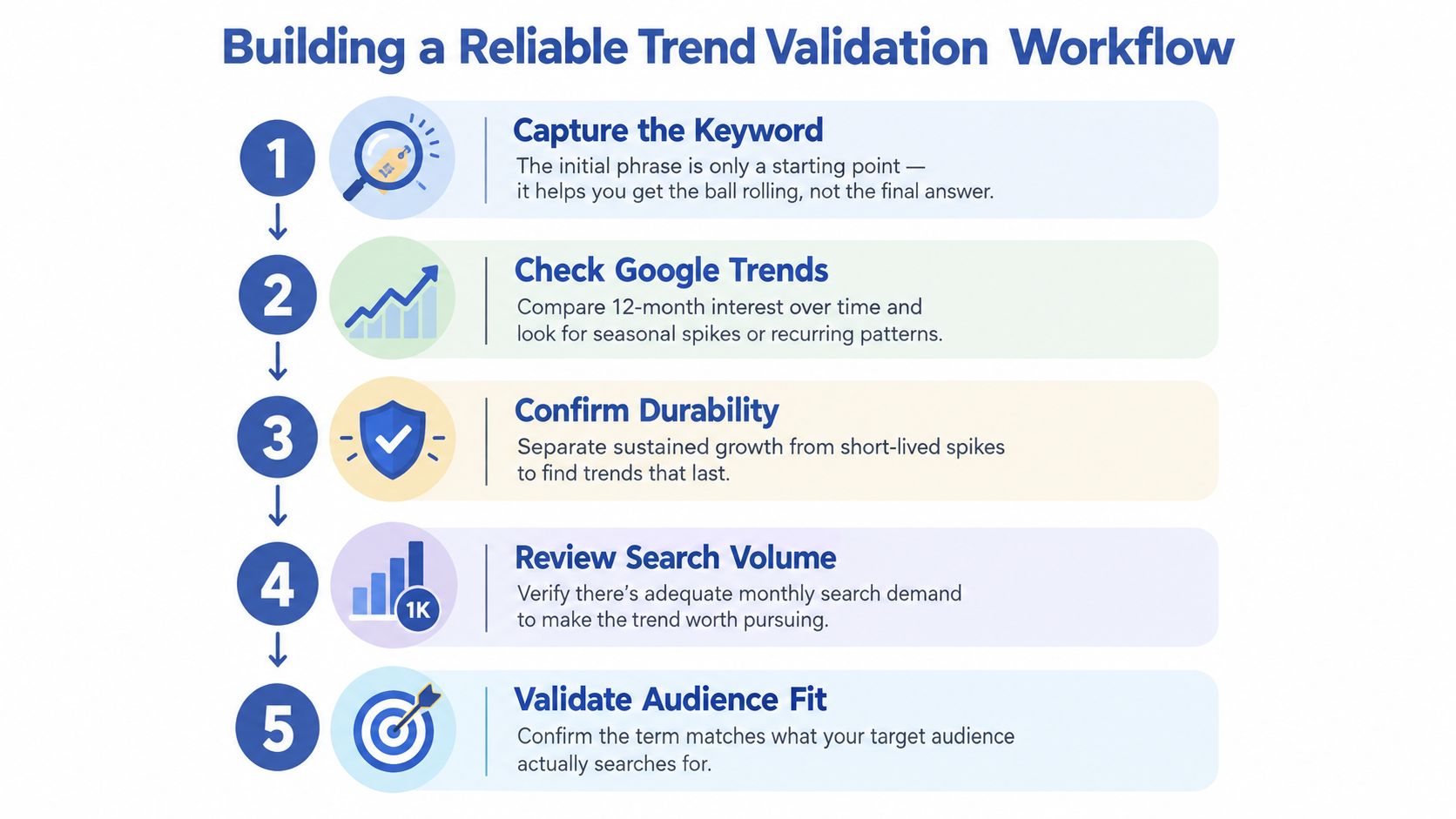
Building a Reliable Trend Validation Workflow
A promising phrase is only a hypothesis until it survives a repeatable validation process. Google Trends is useful because it shows how interest changes across time, locations, and related topics, but its chart isn't an absolute sales forecast.
Start with a controlled Trends search
Begin with a broad seed connected to a customer identity, occasion, hobby, or product attribute. Enter it into Google Trends, then set the country or region, category, and time range that match your intended market. A phrase can behave differently across locations, so a global chart may hide the opportunity or create a false impression of relevance.
Use the past 12 months to check current momentum. Then expand to the full historical view beginning in 2004 to understand whether the movement is durable, recurring, or just a temporary spike. Google Trends normalizes results on a 0–100 scale. A score of 100 represents the highest relative interest for the selected term, location, and period, while lower values represent proportions of that peak. It does not represent a fixed number of searches.
That normalization matters. Google divides each data point by total search volume for the relevant location and period, then scales the result. A rising line means the phrase is gaining interest relative to all searches, not necessarily that its absolute search count has increased. Low-volume terms may also appear as zero, so never interpret a zero as proof that nobody wants the product.
Expand the language around the seed
Open both Related topics and Related queries. The “Top” view shows established associations, while “Rising” can reveal phrases gaining attention against the previous comparable period. These variations often contain the specificity that turns a broad concept into an apparel opportunity.
Compare several adjacent terms rather than reading one chart in isolation. Google recalculates normalization for the selected location and time range, so raw scores from unrelated charts aren't directly interchangeable. Keep the same market and timeframe while comparing candidates.
A “Breakout” label means growth exceeded 5,000%, but that is a discovery signal rather than proof of commercial demand. The Google Trends validation workflow recommends inspecting related topics and queries across a 5-year history to distinguish lasting growth from a short-lived spike.
Stress-test seasonality before you design
A seasonal idea can be excellent for POD when you understand its rhythm. A short recent window may make a holiday or event keyword look like a breakthrough, while a longer view reveals a recurring pattern. That doesn't disqualify it. It tells you when to prepare products, listings, creative, and promotion.
Use Google Keyword Planner as a second lens. Its average monthly searches metric averages a keyword and close variants over the selected month range, location, language, and Search Network settings. The default uses a 12-month period, which can conceal sharp seasonal peaks and declines. Compare that default with custom monthly ranges before calling demand consistent.
Historical estimates and advertising forecasts also serve different purposes. Historical data describes past search behavior. Forecasts estimate potential advertising outcomes and use recent data with seasonal adjustments. Use the former to understand recurring or rising interest, and reserve the latter for campaign planning.
For a broader research stack, you can also review niche research tools alongside Trends, Keyword Planner, marketplace autocomplete, product listings, and ad-library activity. The strongest candidate is the one that remains credible after several independent checks.
Discovering Visual and Conversational Trends Early
Search data often arrives after a trend has already developed in public conversation. A phrase may begin as a creator catchphrase, a community joke, a visual motif, or a repeated identity statement on TikTok, Instagram, Pinterest, Reddit, or YouTube. If you wait for that idea to become a large Google keyword, competitors may already be building products around it.
The answer isn't to copy whatever is going viral. It's to monitor repeated language and recurring audience behavior, then translate those observations into an original product concept.
Watch for repetition, not isolated virality
A single post can generate attention without creating a market. Look for the same idea appearing across multiple communities, formats, or creators. Note the words people use in comments, captions, search suggestions, and questions. Those phrases can become seed terms for Google Trends even when the original signal is visual.
Reddit is especially useful for discovering how people describe their interests in their own language. TikTok and Instagram can reveal visual identities and creator-led phrases. Pinterest often exposes themes connected to occasions, aesthetics, and products. YouTube comments can show recurring frustrations, affiliations, and inside references.
Use Instagram engagement ideas to think beyond passive trend watching. Engagement reveals whether an audience is responding to a concept, not merely viewing it. Save recurring terms, group similar expressions, and separate audience language from the names of specific creators or protected properties.
Convert social signals into safe product research
Create a simple signal log with four fields:
- Exact language: Record repeated phrases without assuming they are permanent keywords.
- Audience identity: Describe who uses the phrase and what they share.
- Visual direction: Note colors, symbols, moods, and references without copying protected artwork.
- Purchase context: Look for gift occasions, apparel mentions, product requests, or marketplace behavior.
That last field keeps social research connected to commerce. A phrase may be culturally relevant but unsuitable for apparel if people don't use it to express identity or give gifts. Conversely, a modest conversation around a clear community identity may offer excellent design potential.
AI-powered search deserves attention as well. HubSpot's consumer research reported that 72% of consumers planned to use generative-AI search for shopping according to its consumer-trends report. Google Trends also excludes searches made within Google products such as AI Mode and AI Overviews, so traditional trend data doesn't capture every emerging conversational discovery path.
Use AI search as a language source, not as a replacement for validation. Ask how shoppers might describe the product, audience, or occasion in a natural conversation. Then test those terms through search trends, marketplace suggestions, and product evidence. Your designs should remain original, and your research should never depend on another brand's protected character, logo, slogan, or artwork.
Scoring and Prioritizing Your Keyword Shortlist
Research tends to create abundance. After reviewing search suggestions, social conversations, marketplaces, and competitor products, you may have more ideas than you can responsibly launch. A scoring model gives every candidate the same evaluation instead of allowing the most exciting idea to win by instinct.
Use a simple worksheet with five categories. The exact weighting can reflect your store, but keep the criteria consistent across every candidate.
Score momentum and persistence separately
Momentum measures recent movement. Compare a recent 30-day or 90-day period with the preceding equivalent period. A candidate that is gaining interest deserves attention, but momentum alone can describe a news cycle or a short-lived meme.
Persistence comes from the longer historical view. A steady climber, a recurring seasonal phrase, and a one-time spike should not receive the same priority. The longer baseline helps you decide whether to build a focused test, a seasonal collection, or a deeper brand direction.
Market breadth asks whether the concept fits your target geography and whether related markets show similar behavior. A trend with narrow geographic relevance can still work, but your product, messaging, and fulfillment strategy should match the audience rather than assume universal demand.
Add intent and competition to the decision
Intent becomes stronger when a phrase includes apparel, gift, audience, or occasion modifiers. A specific phrase can be more valuable than a broad term because it gives your design and product page a clear job.
Competition requires more than counting results. Review the quality, originality, positioning, and audience specificity of existing products. A crowded broad term may contain an underserved sub-niche, while a phrase with few results may have weak demand rather than easy opportunity.
Google's structured trend analysis guidance supports evaluating momentum, persistence, market breadth, intent modifiers, and competition together. It also recommends requiring at least two independent signals before launching a design, which helps prevent a news-driven spike from becoming a product with no sustained buyer demand.
A practical shortlist can look like this:
| Evaluation area | Strong signal | Caution signal |
|---|---|---|
| Momentum | Recent interest improves against a comparable period | One isolated peak |
| Persistence | Growth or repeat seasonality appears in the longer history | No interpretable history |
| Breadth | Target markets show related interest | Audience is unclear or geographically mismatched |
| Intent | Search language points toward apparel, gifts, or identity | Interest remains purely informational |
| Competition | Existing products leave room for a sharper angle | Strong brands dominate the exact concept |
Keep a notes column for evidence. Save the Trends comparison, related phrases, marketplace observations, and the reason you believe someone would buy. If you create content to document your research process or build audience interest, you can browse Linkboost's content tool for ideas that turn raw observations into useful posts.
Decision rule: Don't launch because a keyword is exciting. Launch because the keyword has momentum, a persistent or explainable pattern, a defined audience, and commercial evidence.
Turning Validated Trends into High-Converting Designs
Research creates an opportunity, not a finished product. A validated keyword still needs a design that communicates the audience identity quickly, looks strong in a product image, and gives buyers a reason to choose your interpretation over a generic alternative.
The fastest path isn't careless production. It is a focused creative process that protects originality while reducing technical friction. Start by translating the keyword into a design brief before generating variations.
Write down:
- Who wears it: Define the identity, community, profession, hobby, or occasion.
- What the buyer wants to express: Pride, humor, belonging, expertise, celebration, or a shared reference.
- What the garment must communicate: Keep the central idea recognizable at a glance.
- Where it will be worn: Consider everyday use, events, gifts, teams, or gatherings.
- What makes the angle yours: Use original wording, composition, illustration direction, and positioning.
Build variations around one validated concept
Don't create a random collection of designs for every related phrase. Build controlled variations around the strongest idea. Test different typographic treatments, visual metaphors, audience-specific wording, and garment placements while keeping the underlying buyer insight stable.
An AI-powered design and mockup workflow
AvatarIQ fits this execution stage because it helps generate original apparel designs, create product mockups, and produce photoshoot-style assets without hiring photographers or models. That matters when a trend is validated but the opportunity window is moving. You can explore several creative directions, remove weak concepts, and prepare listings without allowing traditional production bottlenecks to consume the entire research cycle.
Match the listing to the keyword's intent
A design can look attractive and still fail if the product page targets the wrong language. Use the validated phrase naturally in the title, description, tags, collection name, and supporting content where appropriate. Don't force every related query into one listing. Assign each important variation to the page or product that best answers it.
Your mockup should also reflect the buyer. A gift-oriented phrase needs an occasion-aware presentation. A community identity may perform better when the imagery shows the garment in a relevant setting. The goal is to make the product feel immediately understood, not to decorate a generic listing.
Quality control remains essential. Check readability at thumbnail size, spelling, cultural context, garment contrast, print placement, and originality. Search for protected phrases, logos, characters, and recognizable brand references before publishing. Trend speed gives you a reason to work efficiently, not permission to skip review.
Scaling Your Research into a Sustainable Brand
Raw search volume can produce a product test. A repeatable research habit builds something more valuable: a clear understanding of how an audience talks, celebrates, identifies itself, and buys. Those insights compound into stronger collections because each validated concept reveals adjacent identities, occasions, design preferences, and language.
A durable POD brand grows through connected decisions. Observe a signal, validate it across platforms, create an original product, measure the response, and use the result to form the next hypothesis. Over time, your catalog becomes a recognizable world for a specific customer instead of a pile of unrelated shirts.
Turn every launch into audience intelligence
Record the phrase, source platforms, trend window, related queries, product angle, creative variations, and customer response. A design may attract attention while another converts better. That difference can shape the next collection and show which audience promise your store delivers most clearly.
This process supports healthier brand building. Develop recurring collections around hobbies, identities, professions, celebrations, or communities without requiring every product to become a viral hit. A focused catalog also makes future research faster because you know which audiences fit your voice, pricing, fulfillment, and creative standards.
The technical barrier is smaller when the workflow is organized. Start with one audience, keep a manageable shortlist, require evidence from more than one platform, and test original designs in batches. This approach lets you build from customer understanding without committing to a large inventory, then expand when the signals justify it.
The Apparel Cloning System provides structured training for finding proven product patterns and applying them to unique designs in focused niches. It can help entrepreneurs follow a guided path from research to launch. A separate design workflow tool can support mockup and production tasks. Neither replaces judgment. Your advantage comes from choosing the right audience, protecting originality, and learning from each test.
Long-term advantage: The strongest stores do not chase every trend. They develop a repeatable way to recognize which trends belong to their audience.
Start with a small research session this week. Choose a broad seed, compare related phrases in Google Trends, inspect the longer history, review marketplace language, and score the strongest candidates. Create a focused design batch for the idea that combines audience clarity with commercial intent. That workflow turns keyword research into a practical foundation for a flexible, scalable apparel business.
Skup offers practical POD education through the Apparel Cloning System, along with tools and coaching for entrepreneurs moving from niche research to original product launches. Visit Skup to explore a structured path for turning validated trends into a sustainable apparel brand.