How to Make 2000 a Month
The average side hustle earns far less than many expect. One U.S. survey found average monthly side-hustle income of $553, with 39.2% of respondents earning less than $250 and only 26.6% earning more than $1,000 per month, according to side-hustle income statistics from Self. In another 2025 survey, the average was $885, but the median was only $200, meaning half of respondents earned $200 or less from extra work.
That's why learning how to make 2000 a month deserves a better answer than another list of random gigs. $2,000 per month equals $24,000 per year, placing the target well above the typical side-hustle result. Print-on-demand apparel gives you a practical route because you can build around repeatable products, a focused niche, and a store that can sell without matching every hour you work.
Table of Contents
- Why $2000 a Month Is the Side Hustle Milestone That Matters
- The Revenue Math Behind Netting $2000 Monthly From POD Apparel
- Finding Winning Niches and Products With the Apparel Cloning Method
- Creating Professional Designs and Mockups Without Hiring Anyone
- Driving Consistent Traffic Through Organic and Paid Channels
- Your Realistic Timeline and Next Steps to $2000 a Month
Why $2000 a Month Is the Side Hustle Milestone That Matters
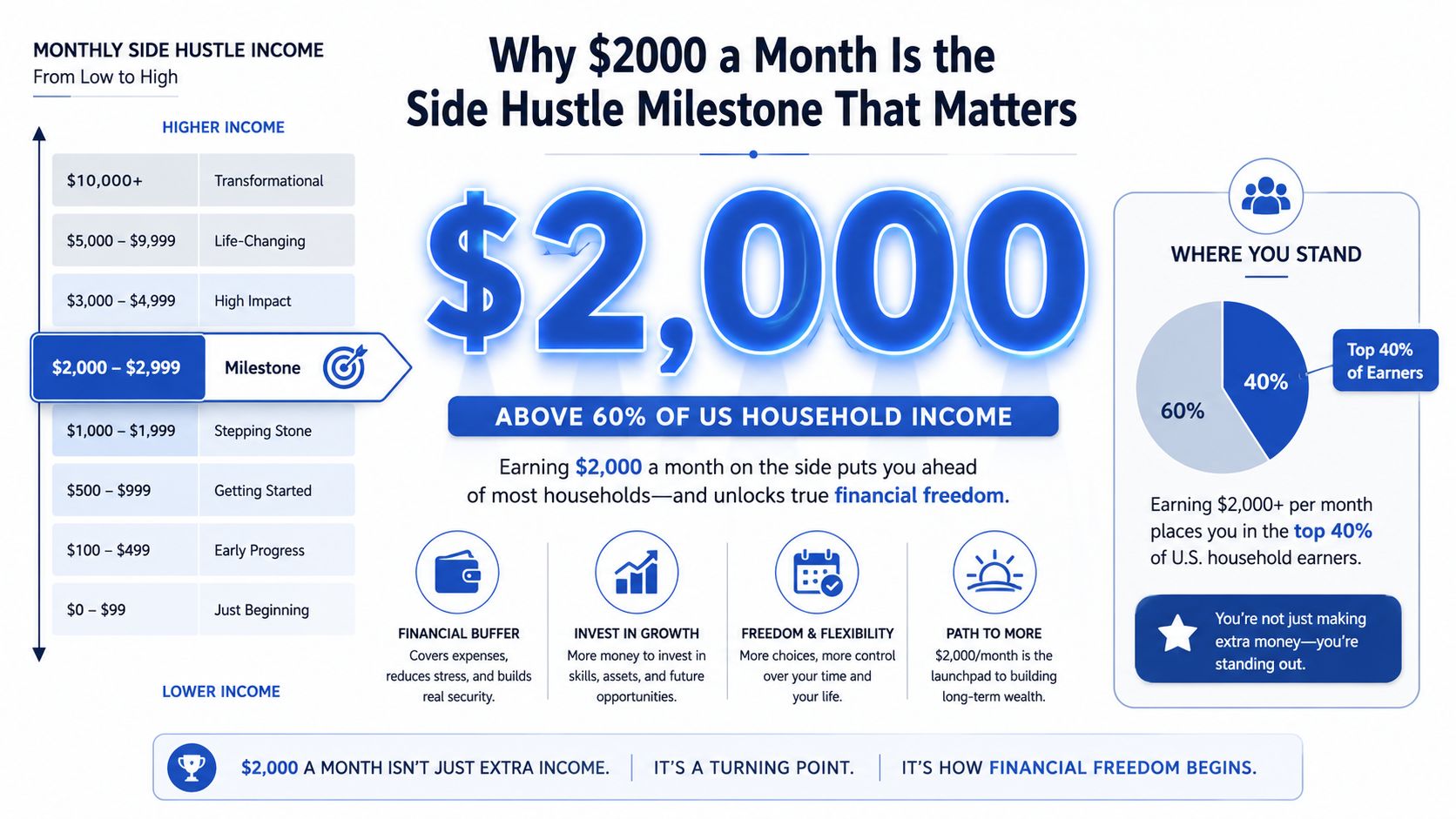
$2,000 per month is a meaningful dividing line between occasional side income and a business with enough output to matter. The Self survey shows that many participants remain below this level, while the reported 2025 median of $200 makes the gap clear. Reaching $2,000 usually requires more than sporadic tasks. You need stronger pricing, repeat demand, or a way to sell beyond your immediate network.
The market supports that opportunity. A 2024 estimate valued the global side-hustle market at $556 billion, while World Bank estimates placed online gig work at approximately 4.4% to 15% of the global labor force and described supplemental income as important to around 40% of workers, as summarized by Whop's side-hustle statistics overview. Recent U.S. surveys have also reported side-hustle participation between 33% and 39%. Marketplaces, social platforms, remote services, and ecommerce now give independent sellers more ways to reach customers.
Why POD apparel fits the target
Print on demand lets you test apparel without purchasing inventory upfront. After an order arrives, a supplier produces and fulfills it. Your work centers on niche research, product positioning, creative testing, and customer acquisition.
The low operating barrier still demands disciplined execution. Gig work generally pays for completed time. A POD store can retain listings, customer data, brand recognition, and repeat buyers, giving each successful product a chance to generate future orders. That changes the model from selling isolated effort to building an asset with several products working at once.
The milestone matters because it forces better business decisions. Margin, product demand, and traffic all need attention. Occasional sales and optimism cannot carry the store to a consistent target.
Treat $2,000 as an operating plan, not a promise. A focused apparel brand needs a defined buyer, products that speak to that buyer, and enough contribution per order to fund testing and growth. The practical setup principles in this guide to starting a side business can help when choosing a structure that grows beyond one-off work.
The Revenue Math Behind Netting $2000 Monthly From POD Apparel
Start with the number that matters most: net profit, not sales. If your business keeps a 20% net margin, it needs approximately $10,000 in monthly revenue to produce $2,000 in profit. At a 30% net margin, the required revenue falls to about $6,700, based on the POD profit-margin benchmark from Podvector.
| Net Margin | Monthly Revenue Needed | Daily Sales at $30/shirt |
|---|---|---|
| 20% | $10,000 | 11.1 shirts |
| 30% | $6,700 | 7.4 shirts |
The daily sales column is a planning illustration based on the specified $30 shirt price. It doesn't represent profit per shirt, because supplier charges, marketplace fees, payment processing, advertising, refunds, and other costs still come out of revenue.
Typical apparel economics show why pricing discipline matters. A shirt with a $10 to $15 base cost and a $25 to $35 retail price can produce roughly 45% to 55% gross margin and approximately 20% to 35% net margin, according to Printful's POD profitability guide. Independent guidance places realistic apparel net margins around 15% to 35% after production, shipping, marketplace fees, and marketing, with beginners often closer to the lower end, as explained by Merch Titans' profit-margin guidance.
Calculate contribution before publishing
For every product, list the retail price, base product cost, shipping responsibility, platform fees, payment processing, refunds, and expected acquisition cost. On Etsy, the platform charges a $0.20 listing fee, a 6.5% transaction fee, and a 3% plus $0.25 payment-processing fee, according to this Etsy POD integration fee breakdown.
Gross margin can look attractive while take-home profit remains thin. Paid traffic can reduce operating margins sharply, and the Podvector guidance notes that many sellers operate around 5% to 10% after advertising and operating costs. That's why this contribution margin calculation guide is worth using before you scale a listing. The number you need is the amount left after variable costs, not the difference between retail price and garment cost.
A practical target is to raise contribution per order without damaging conversion. Test a stronger product concept, improve the offer, bundle where appropriate, and avoid spending aggressively on designs that haven't shown buyer interest. More orders won't rescue negative unit economics. They'll multiply the problem.
Finding Winning Niches and Products With the Apparel Cloning Method
The fastest way to waste time in POD is to start with artwork instead of demand. A polished design can still fail if the niche is too broad, the message is generic, or the product doesn't give a specific buyer a reason to choose it.
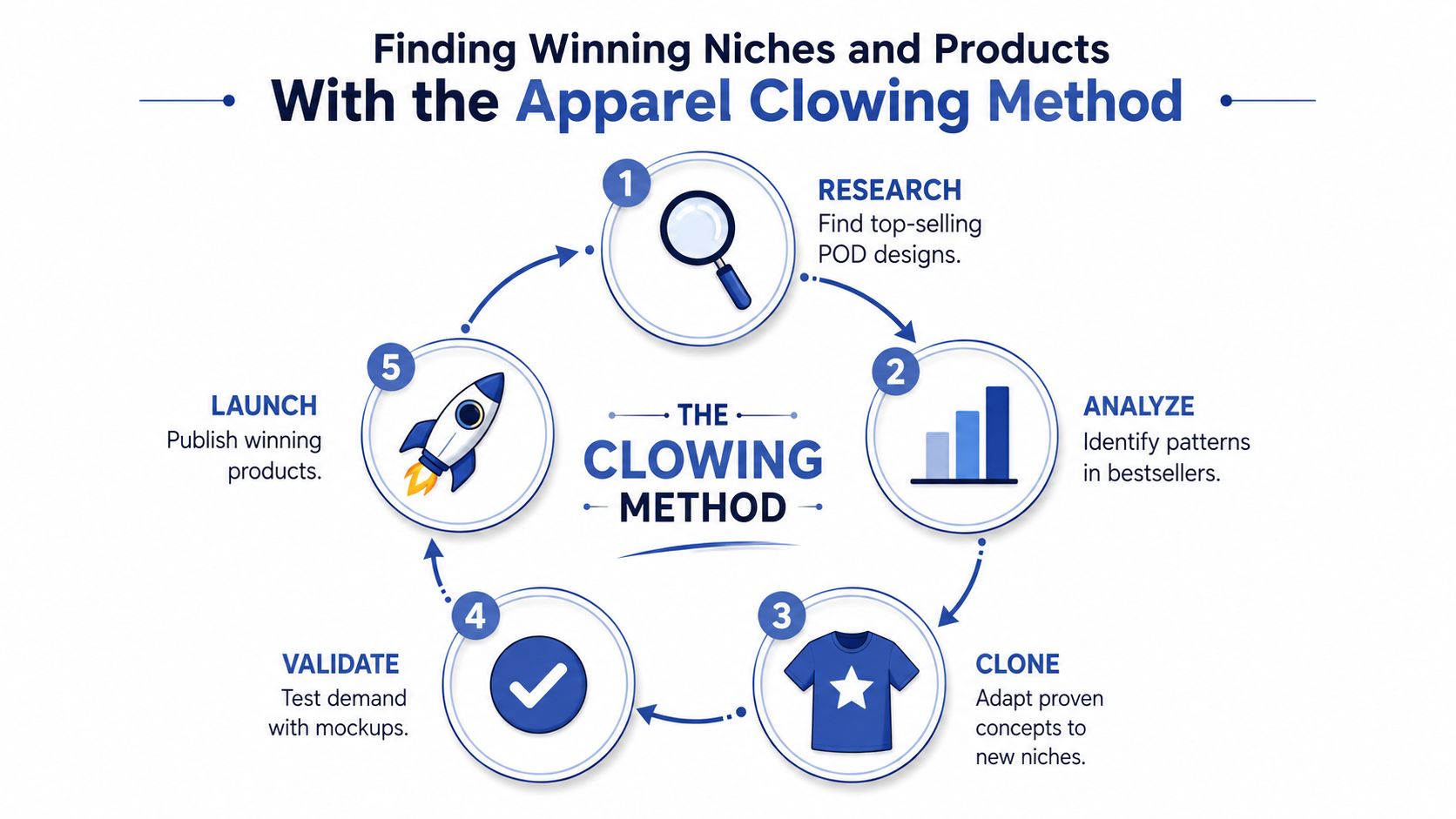
The Apparel Cloning Method starts with proven market behavior and then adapts the underlying concept for an underserved audience. Skup's method has generated over $50 million in combined sales, according to the company information provided for this article. The point isn't to copy protected artwork, brand names, or another seller's exact expression. It's to study what makes a product compelling, then create an original version for a distinct niche.
Read the market before designing
Begin by collecting successful apparel examples in a category you understand. Look for repeated signals:
- Specific identity: The product speaks to a recognizable job, hobby, lifestyle, belief, or community.
- Emotional clarity: The buyer immediately understands whether the design is funny, proud, supportive, rebellious, or celebratory.
- Merchandising fit: The concept works on a shirt, sweatshirt, hat, or related product without requiring a long explanation.
- Room for variation: You can create original versions for adjacent professions, interests, age groups, events, or personality types.
- Buyer intent: The audience has a reason to wear the item publicly or give it as a gift.
Patterns matter more than isolated winners. If several successful products use a similar emotional angle, layout, or buyer promise, that's a clue about demand. You can then move into a narrower niche where the message feels more personal.
The validation stage should happen before you build a large catalog. Create several original concepts, place them in credible mockups, and assess whether the niche, message, and product presentation work together. This guide to finding winning products offers a useful framework for organizing that research.
Clone the demand pattern, not the design. Your advantage comes from understanding why buyers respond and expressing that insight in original creative work.
The method creates because one validated concept can inspire a family of related products. That gives your store more chances to win while keeping the brand coherent. It also makes testing less emotional. You're not asking whether you personally like a design. You're asking whether a defined buyer recognizes the product as something made for them.
Watch the practical walkthrough here:
Creating Professional Designs and Mockups Without Hiring Anyone
Design quality affects both clicks and trust. Customers can forgive a simple graphic when it feels intentional, but they won't overlook poor typography, weak contrast, awkward placement, or a mockup that makes the garment difficult to judge.
You don't need to hire a photographer or become a software specialist to build a credible listing workflow. AvatarIQ generates unique apparel designs with AI and creates professional mockups and photoshoots, allowing a solo seller to move from niche idea to listing-ready product without coordinating models, photographers, and separate production steps.
Use a repeatable design workflow
Start with the buyer and the product promise, not a prompt. Write down the audience, the emotion you want to trigger, the garment color, the wearing context, and the visual style. Then generate multiple directions and select the concepts that communicate clearly at thumbnail size.
A useful workflow looks like this:
- Define the brief: Identify the niche, buyer identity, occasion, and message.
- Generate variations: Explore different compositions, lettering treatments, illustrations, and levels of visual complexity.
- Edit for readability: Remove clutter, check spelling, inspect spacing, and confirm that the design still works on the chosen garment.
- Build mockups: Show the product in a context that matches the buyer, while keeping the apparel graphic visible.
- Prepare the listing: Use a direct title, descriptive copy, accurate garment details, and consistent images.
Speed matters during validation because you need enough creative range to learn what buyers prefer. AvatarIQ reduces the production bottleneck, but it doesn't replace judgment. AI-generated work still needs a human review for originality, legibility, composition, and marketplace compliance.
Make the store look like a brand
Consistency creates recognition. Choose a controlled visual language across related listings, including garment colors, photography style, typography choices, and the emotional tone of the copy. Don't publish every experiment under one storefront if the products appeal to unrelated audiences. A focused catalog gives shoppers a clearer reason to trust the store.
Keep a simple record of each concept and its result. Track the niche, message, garment, mockup style, title, traffic source, and sales outcome. Over time, that record becomes a creative decision system. You'll know which angles deserve more variations and which ideas should be retired instead of repeatedly redesigned.
The best advantage here isn't making more artwork for its own sake. It's reducing the delay between an idea and a market test, so you can invest your time in decisions that affect revenue.
Driving Consistent Traffic Through Organic and Paid Channels
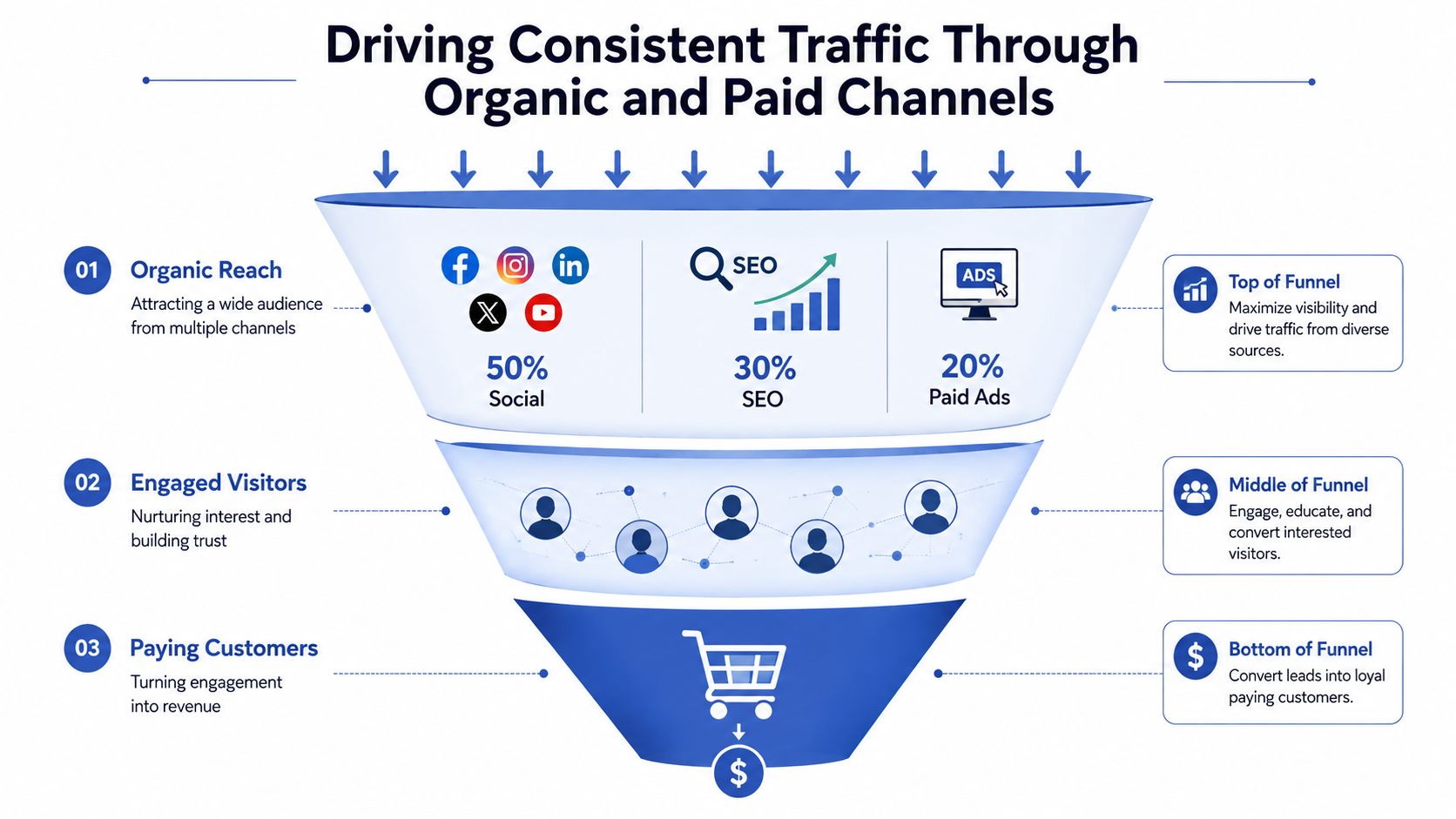
A product can be well designed and still produce no revenue if qualified shoppers never see it. Traffic should match the stage of your business. Beginners need low-cost learning opportunities, while stores with proven conversion behavior can consider paid acquisition more confidently.
Organic traffic begins with discoverability and repetition. Build marketplace listings around the language buyers use, not internal creative jargon. On social platforms, publish content that shows the product in context, explains the niche joke or identity, or demonstrates the design process. Short videos, collection posts, seasonal angles, and customer-focused hooks give people a reason to click instead of just displaying a product photo.
Build organic demand deliberately
Prioritize channels where your buyers already search or share ideas. Optimize product titles and descriptions, create multiple content angles for strong listings, and connect every post to a relevant product page. Email capture can also turn one-time visitors into future buyers, especially when your niche supports gifting, seasonal purchases, or repeat apparel.
Organic content takes consistency. It also gives you useful feedback. Comments, saves, clicks, and customer questions reveal language you can use in future listings and ads.
Add paid traffic after the offer earns attention
Facebook advertising can accelerate testing, but it shouldn't be used to hide weak economics. Start with a clear product, a credible landing experience, and a defined acquisition limit. Test creative that highlights the buyer identity or use case, then compare the quality of traffic and resulting orders rather than celebrating cheap clicks alone.
Paid channels require disciplined measurement. Your allowable acquisition cost must leave enough contribution margin to cover overhead and profit. If the product only works when every assumption goes perfectly, increase the price, improve the offer, lower variable costs, or return to product validation.
For a practical overview of campaign structure and ecommerce planning, the Shopping and Performance Max playbook provides useful channel context. Use it to understand how shopping-focused campaigns fit into a broader acquisition system, then adapt the approach to your catalog and economics.
Traffic is an input, not a strategy. The strategy is matching the right buyer, offer, creative, and acquisition cost.
Avoid spreading a small budget across every platform. Choose one organic channel and one paid channel that fit your audience, document what happens, and improve the system before adding complexity. Sustainable traffic comes from repeatable processes, not platform luck.
Your Realistic Timeline and Next Steps to $2000 a Month
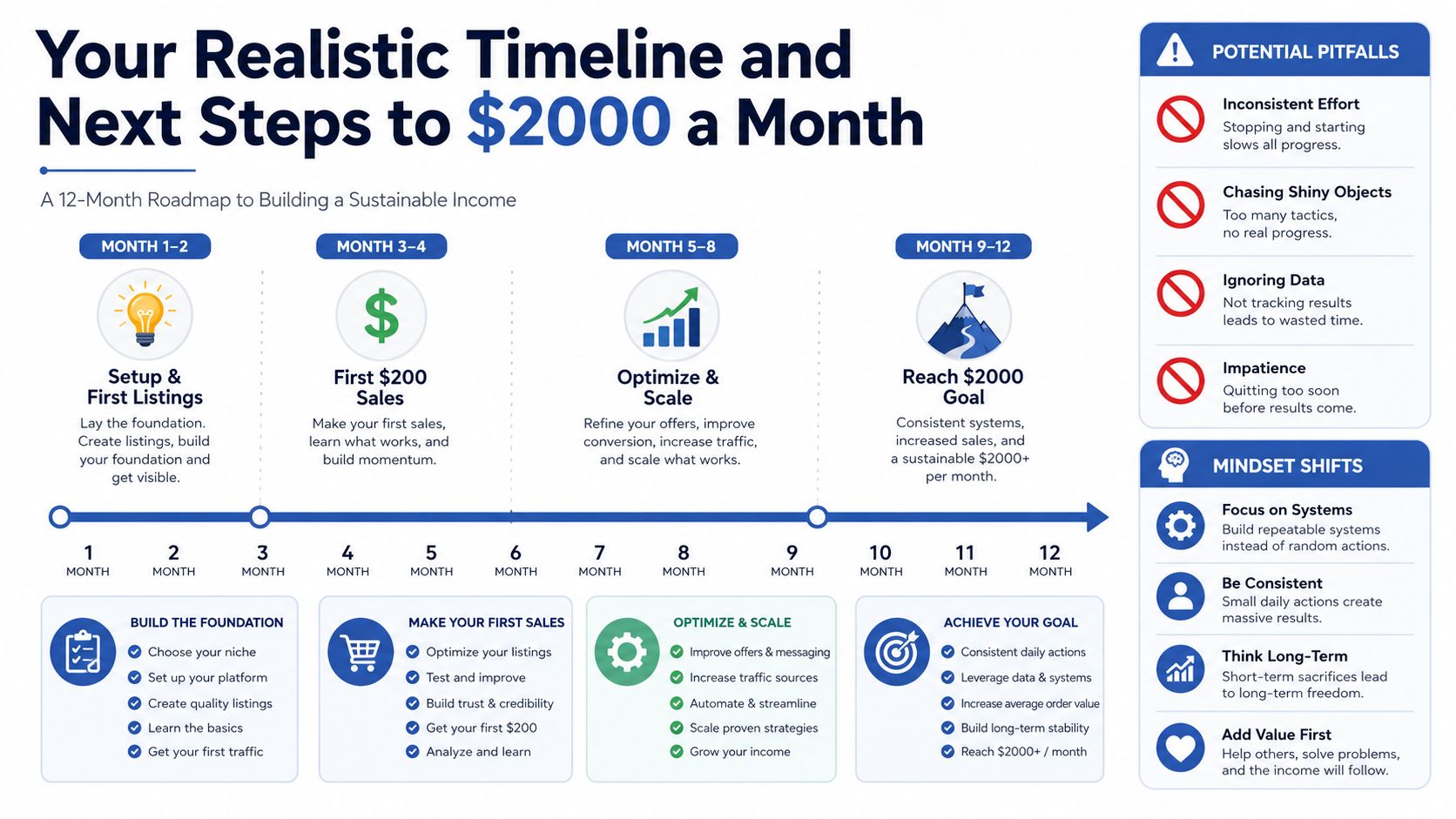
Reaching $2,000 per month usually requires a build phase. You'll set up the store, publish initial products, test niches, improve listings, and identify the concepts that deserve more attention. Some designs won't sell, and that's useful information when you record the result instead of treating it as a personal failure.
A practical roadmap is:
- Setup and first listings: Establish the storefront, product standards, fulfillment process, and initial niche direction.
- Early validation: Watch for signs of buyer interest and improve the concepts that earn attention.
- Optimization and scale: Expand winning product families, strengthen organic content, and introduce paid traffic only when the numbers support it.
- Profit control: Review contribution margin, refunds, fees, and acquisition costs regularly.
The income distribution makes patience important. A 2025 survey found median side-hustle income of $200 and average income of $885, while another report placed median freelancer income at $2,800 per month, with the largest freelancer segment earning between $1,000 and $3,000, according to Bankrate's side-hustle survey. Established operators reach the target by building repeatable offers and client or customer acquisition systems, not by adding random tasks.
The common traps are inconsistent effort, underpricing, uncontrolled ad spend, and publishing products without validation. Replace them with systems. If order volume starts taking time away from research and optimization, resources such as Hire Virtual Assistants can help you evaluate delegation for repeatable operational tasks.
Start with one defined niche, calculate your required margin, create original products with AvatarIQ, and publish enough variations to learn. The opportunity is real because ecommerce lets a focused seller reach buyers beyond a local market, but the path becomes exciting only when every creative and traffic decision connects to profitable unit economics.
Skup offers the Apparel Cloning System for learning its product-research framework, AvatarIQ for creating apparel designs and mockups, and the Skup Incubator for hands-on coaching and scaling support. Visit Skup to choose the practical next step for building your POD apparel business toward $2,000 per month.