How to Start an Online Business While Working Full Time (2026)
How to Start an Online Business While Working Full Time: A Realistic 2026 Guide
You’re not alone if you’re reading this from your cubicle, dreaming about building something that’s actually yours. Millions of people are searching for ways to start an online business while keeping their day job — and for good reason. The bills don’t stop just because you have entrepreneurial ambitions.
The good news? It’s absolutely possible to build a profitable side business in 10-15 hours per week. The key is choosing the right business model and being strategic about your time.
Quick Answer
The best online business to start while working full time is one with low startup costs, flexible hours, and no inventory requirements. Print on demand meets all three criteria — you can build and run a profitable apparel business in evenings and weekends without quitting your job first.

Why Most Side Businesses Fail (And How to Avoid It)
Let’s be honest about what you’re up against. Most people who try to start a business while employed give up within 90 days. It’s not because they’re lazy or unmotivated — it’s because they pick the wrong model.
Here’s what kills side businesses:
- Inventory headaches — Storing products in your garage, dealing with suppliers, managing stock levels. After a full workday, who has energy for that?
- Customer service demands — Traditional ecommerce means handling returns, shipping issues, and support tickets. This is impossible to manage from your desk job.
- High upfront investment — Dropping $10K on inventory before you’ve made your first sale is terrifying when you have a mortgage.
- Fixed schedules — Businesses that require you to be available during business hours don’t work when you already have a 9-5.
The solution is choosing a model designed for flexibility from the start.
Why Print on Demand Works for Full-Time Employees
Print on demand flips the traditional business model. Instead of buying inventory upfront, you create designs and list products. When a customer orders, a print partner produces and ships directly to them. You never touch inventory.
This matters for people with day jobs because:
- Work whenever — Design research at 6 AM before work. Upload listings during lunch. Check ads at 9 PM. Your business adapts to your schedule.
- No inventory risk — You don’t pay for a product until it’s already sold. Zero capital tied up in unsold stock.
- Start for under $500 — All you need is a Shopify store, a print partner connection, and ad budget. Compare that to the $50K+ for a franchise.
- Location independent — Run everything from your laptop. Office, coffee shop, hotel room — doesn’t matter.

The 10-Hour-Per-Week Schedule That Works
Here’s how real people balance POD with full-time jobs:
Weekday mornings (30 min, 5x week = 2.5 hours)
- Check ad performance from previous day
- Review any customer messages
- Quick design research during coffee
Weeknight sessions (1.5 hours, 3x week = 4.5 hours)
- Create new designs
- Upload products to store
- Test new ad creatives
Weekend block (3 hours, 1x week)
- Deeper research and strategy
- Launch new campaigns
- Analyze what’s working
Total: 10 hours per week. That’s enough to build real momentum without burning out.
Real Results from People Who Started Where You Are
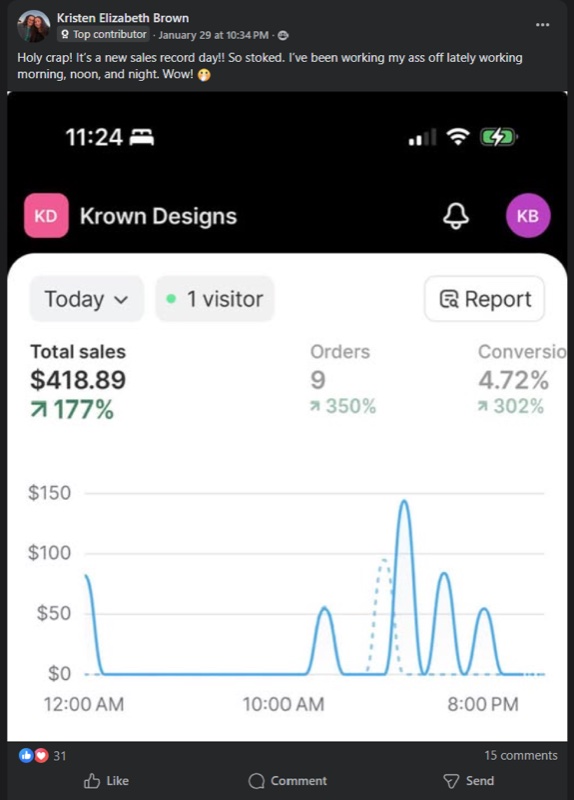
Students in the Skup Incubator coaching program regularly build profitable POD businesses while keeping their day jobs. Here’s what’s possible:
- Adam Schneider built his store to $179,000 in 90 days while still employed — hitting $5,000+ single days
- Sean Young crossed $10,000 total sales milestone working evenings and weekends
- Holly Mitchamore got her first sale the night after launching ads — proof you don’t need months to see results
- Thomas Skrodzki hit $750 in a single month working part-time on his store
These aren’t people who quit their jobs to go all-in. They built momentum gradually while employed.
When to Quit Your Day Job (And When to Wait)
Don’t rush to quit. The smart approach is building your side income to replace your salary before making the leap. Here’s the framework:
Keep your job when:
- You’re still learning the fundamentals
- Monthly revenue is inconsistent
- You haven’t hit 3 consecutive profitable months
- Side income is less than 50% of your salary
Consider leaving when:
- You’ve had 6+ months of consistent profit
- Side income matches or exceeds your salary
- You have 6 months expenses saved
- More time would clearly mean more revenue
Your day job provides stability while you build. Use it strategically.
Getting Started Without Overwhelm
The biggest mistake is trying to learn everything at once. Focus on these three things first:
- Pick one niche — Don’t try to serve everyone. Pick a passionate audience you can understand.
- Master design research — Your designs determine your success. Learn to find what’s already selling and put your own spin on it.
- Start with Facebook ads — Organic traffic takes months. Paid ads let you test and learn immediately.
Programs like the Apparel Cloning System teach this exact sequence — niche selection, design research, ad launch — in a step-by-step format designed for beginners.
FAQ
How much money do I need to start a side business while employed?
For print on demand, plan for $300-500 to start. That covers your Shopify subscription ($39/month), initial ad testing budget ($150-300), and design tools. You don’t need to buy inventory upfront.
How many hours per week do I realistically need?
10-15 hours per week is enough to build a real business. Most successful POD sellers split this between early mornings, evenings, and one weekend work session.
Should I tell my employer about my side business?
Check your employment contract for any non-compete or moonlighting clauses. Most companies don’t restrict side businesses that don’t compete with them. When in doubt, keep it quiet until you’re ready to leave.
The Bottom Line
Starting an online business while working full time isn’t just possible — it’s the smart approach. Your day job provides stability and funding while you build something that could eventually replace it.
Print on demand is the ideal model for this transition because it works around your schedule, requires minimal upfront investment, and scales as you have more time to give it.
The question isn’t whether you have enough time. It’s whether you’ll use the time you have.