Names of Medical: What They Are and How They Work
You hear a clinician say costochondritis, or you pick up a prescription labeled metformin hydrochloride, and you nod even though the term feels unfamiliar. That reaction is common. Medical names can look like passwords when you haven't learned the system behind them.
The good news is that medical vocabulary isn't a random collection of difficult words. It combines historical roots, formal naming authorities, and ethical decisions about clarity and respect. Drugs, diseases, body structures, and clinical findings each follow different conventions, but they connect through one central purpose: helping professionals identify the same thing accurately.
This guide treats names of medical conditions and products as one connected language. We'll move from classical roots to drug naming, disease classification, anatomy, structured searching, regulated product names, and responsible communication.
Table of Contents
- Why Medical Names Sound So Unfamiliar
- The Classical Roots Behind Most Medical Terms
- How Drug Names Get Created and Approved
- How Disease Names Are Chosen and Organized
- Anatomical and Clinical Terminology Explained
- How to Search Medical Terms the Right Way
- The Full Regulated Name vs the Short Brand Name
- Using Medical Names Accurately and Ethically
Why Medical Names Sound So Unfamiliar
Medical terminology feels distant from everyday speech because it solves a different problem. Everyday language values speed and familiarity. Clinical language must also support precision, consistency, and communication between people working in different countries, specialties, and institutions.
Three categories create most of the confusion:
- Drug names can include a chemical name, an international generic name, and a manufacturer's brand name.
- Disease and condition names change according to whether a clinician is treating a patient, an epidemiologist is recording population data, or a researcher is describing an emerging biological pattern.
- Anatomical and clinical terms identify body structures, directions, symptoms, and processes with standardized building blocks.
Historical roots add another layer. A term may combine Greek, Latin, and modern scientific elements. An eponym may refer to a person associated with a discovery or description. A medication may have a short brand name for public recognition but a longer regulated identity for prescribing and labeling.
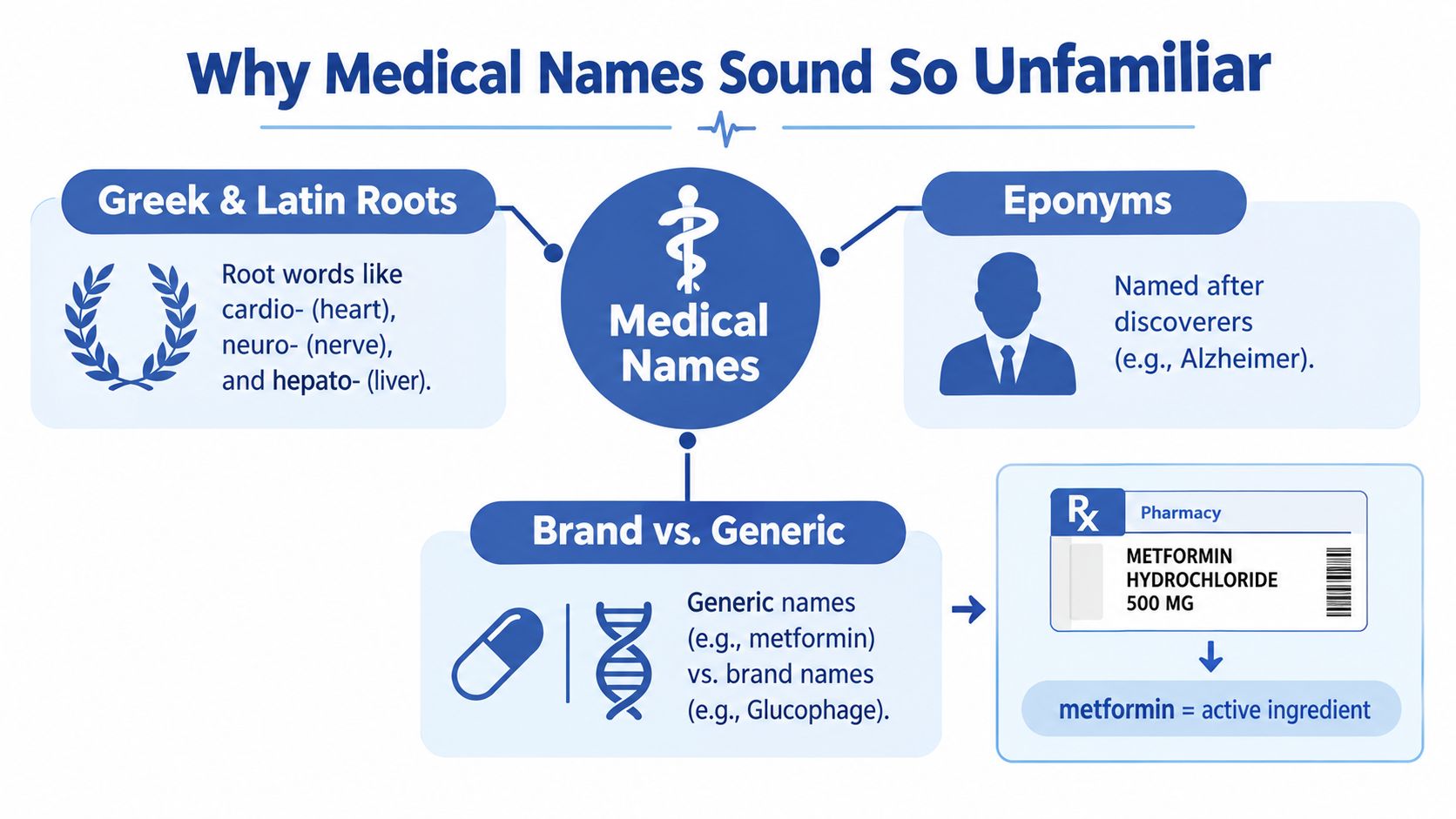
The tradeoff behind unfamiliar words
A familiar phrase such as “heart attack” is easy to understand, but myocardial infarction gives medical writers a more specific term for literature, records, and classification. Neither expression is automatically wrong. The useful choice depends on the audience and purpose.
Medical nomenclatures are deliberately created by specialists and approved by scientific authorities. Their design supports monosemy, the aim of giving a term one defined meaning within its domain. Anatomical nomenclature covers structures such as bones, organs, and cells, while nosological nomenclature covers diseases and symptoms. Research on medical nomenclature describes this standardizing role.
That doesn't mean every term is perfectly transparent. It means the apparent complexity usually reflects a compromise between brevity, unambiguity, history, and international safety. Once you learn to spot roots, naming layers, and context, unfamiliar terms become more like labeled parts of a map than a wall of jargon.
The Classical Roots Behind Most Medical Terms
Greek and Latin dominate medical vocabulary because those languages supplied a stable scholarly foundation across generations of physicians and scientists. Their roots can combine with prefixes and suffixes to create related terms, so one learned element can open up an entire family of words.
One of the clearest examples is cardio-, from the Greek word associated with the heart. Instead of memorizing each term as an isolated item, separate the word into parts.
| Term | Root Breakdown | Meaning |
|---|---|---|
| Cardiology | cardio + -logy | Study of the heart |
| Cardiologist | cardio + -logist | Specialist who studies or treats the heart |
| Myocardial | myo + cardio + -al | Relating to the heart muscle |
| Pericardium | peri + cardio + -ium | Membranous structure around the heart |
| Tachycardia | tachy + cardio + -ia | Fast heart rate |
| Bradycardia | brady + cardio + -ia | Slow heart rate |
| Electrocardiogram | electro + cardio + -gram | Recorded electrical activity of the heart |
| Endocarditis | endo + cardio + -itis | Inflammation involving the inner lining of the heart |
| Cardiomyopathy | cardio + myo + -pathy | Disease of the heart muscle |
| Cardiac arrest | cardiac + arrest | Sudden stopping of effective heart activity |
Read the word from the edges inward
Prefixes often tell you where, how, or in what direction. Suffixes frequently indicate a condition, process, study, or measurement. In tachycardia, tachy- means fast, cardio- points to the heart, and -ia forms a condition or state.
The same decoding approach works across body systems. Neuro- relates to nerves, derm- to skin, osteo- to bone, and hepato- to the liver. A reader who recognizes those roots doesn't need to memorize every complete term before beginning to understand it.
Practical rule: Look for the root first, then identify the prefix and suffix. You may not know the whole diagnosis, but you'll often know what body system or process it concerns.
Classical roots also provide continuity across countries and specialties. A cardiologist, radiologist, pharmacist, and researcher may use different abbreviations or levels of detail, but shared roots help them recognize related concepts. For a more extensive vocabulary-building reference, this medical terms study guide can help you practice breaking words into components.
How Drug Names Get Created and Approved
A medicine can carry several names because each name answers a different question. The chemical name describes molecular structure. The generic name, often an International Nonproprietary Name or INN, identifies the active substance in a standardized way. The brand name is selected by the manufacturer for a particular product.
Consider metformin. A chemical description can refer to its molecular structure, while metformin is the standardized generic name used across medical communication. Glucophage is a brand name associated with a marketed product. The names point to related layers of identity, but they aren't interchangeable in every context.
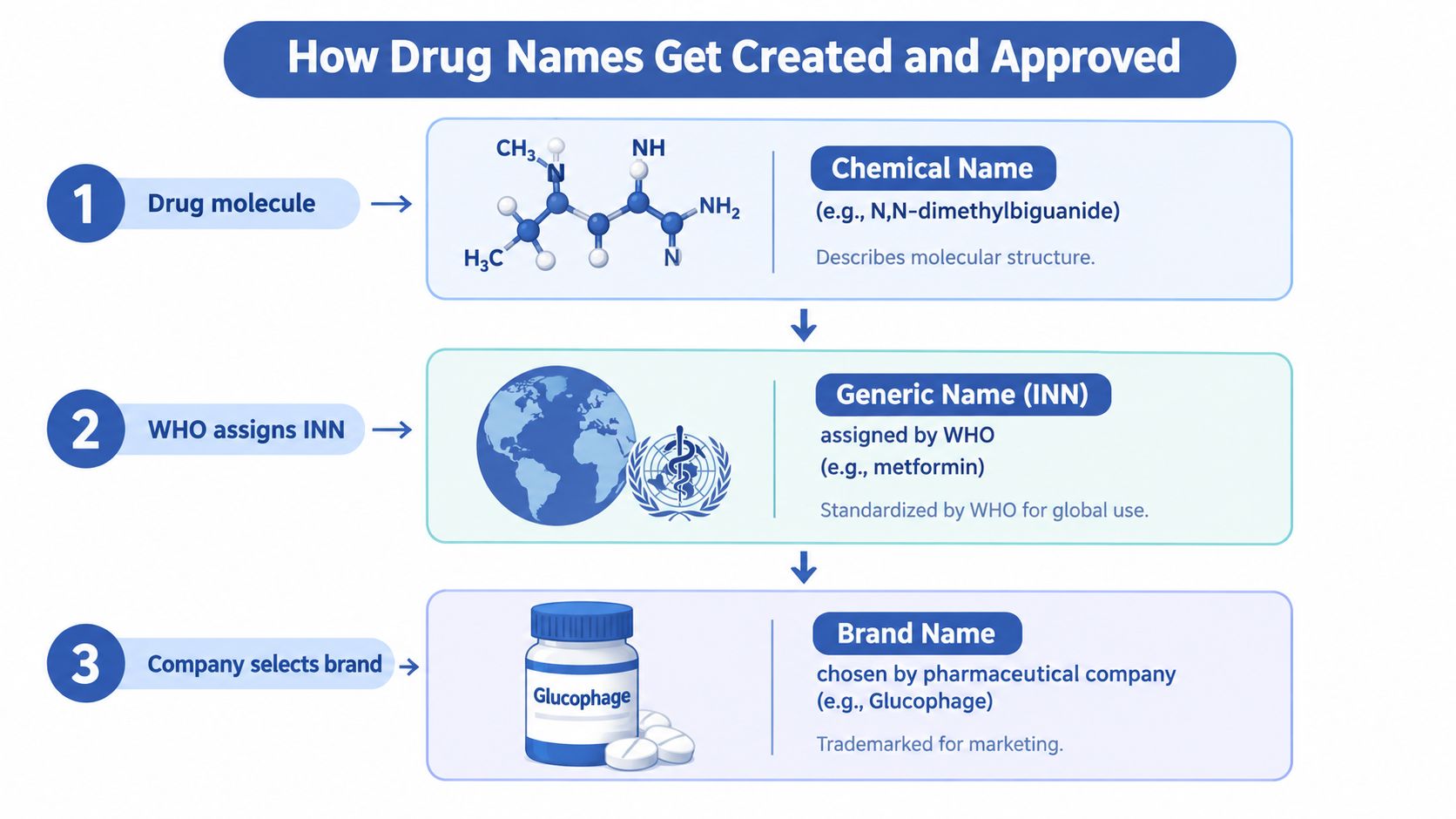
The naming layers have different jobs
A chemical name is usually too cumbersome for routine prescribing, but it can communicate structural information important to chemists and researchers. A generic name is shorter and standardized for medical use. A brand name helps distinguish a manufacturer's product in the market, but it can vary between countries and products.
Generic names may also contain stems that suggest a pharmacological family. For example, -pril appears in names of ACE inhibitors, while -statin appears in names of medicines used to lower lipid levels. These stems don't replace label checking, but they give readers a useful first clue about a drug's class.
The regulatory history explains why this system has international reach. The World Health Organization created the International Nonproprietary Name system in 1953. The U.S. Adopted Names Council was formed in 1961 by the American Medical Association, U.S. Pharmacopeial Convention, and American Pharmacists Association, and the FDA joined in 1967. Since these systems began, more than 10,000 drugs have received nonproprietary names, and the USAN program named 198 substances in 2018. These milestones are summarized in the history of drug nomenclature.
For readers who want a broader explanation of medication categories and naming layers, this ultimate medical reference on drugs offers additional background.
How Disease Names Are Chosen and Organized
A disease name can change depending on who is using it and what they need it to accomplish. A clinician needs a useful patient-level diagnosis. An epidemiologist needs a consistent label for counting illness, deaths, or trends. A researcher may need a provisional term for a biological pattern that is still being investigated.
Type 2 diabetes mellitus illustrates the difference. A clinician may write T2DM in a patient record. A population-data specialist may use an ICD code such as E11.9 when the coding context calls for it. A researcher may discuss insulin-resistance phenotypes or other biological subgroups rather than treating the common clinical label as the final explanation.
| Naming Track | Example Label | Governing Body | Primary Use |
|---|---|---|---|
| Clinical nomenclature | Type 2 diabetes mellitus or T2DM | Clinical and professional authorities | Patient assessment and treatment |
| Epidemiologic nomenclature | ICD classification and applicable code | World Health Organization | Population statistics, morbidity, and mortality reporting |
| Investigative nomenclature | Insulin-resistance phenotype | Research communities and evolving evidence | Biomedical investigation and hypothesis testing |
One condition, several valid contexts
These labels aren't necessarily competing diagnoses. They may represent different levels of detail. Disease naming systems are stratified in this way because a term that works well in a consultation may be too detailed for a national database, while a research designation may change as evidence develops. The distinction is described in this analysis of disease nomenclature.
The World Health Organization maintains the International Classification of Diseases, which supports a shared framework for epidemiologic reporting. Clinical language can remain more descriptive, while investigative language continues to evolve.
Ethical naming also matters. Medical communities have moved away from some eponyms and stigmatizing expressions when more descriptive or respectful alternatives are available. Reactive arthritis, for example, replaced the eponym Reiter syndrome in many modern sources. Terms associated with people or groups can carry historical baggage, so recognized authorities help determine which names should be preferred.
A name can be clinically useful, statistically necessary, or scientifically provisional. Always ask which job the name is doing.
Anatomical and Clinical Terminology Explained
Anatomical terminology turns the body into a shared coordinate system. Instead of relying on everyday phrases such as “near the top” or “toward the back,” clinicians use terms such as superior, inferior, anterior, posterior, proximal, and distal.
This precision prevents misunderstandings during examinations, imaging, surgery, and documentation. Superior indicates a position toward the head, while inferior indicates a position toward the feet. Anterior refers to the front and posterior to the back. Proximal means closer to the point of attachment, while distal means farther away.
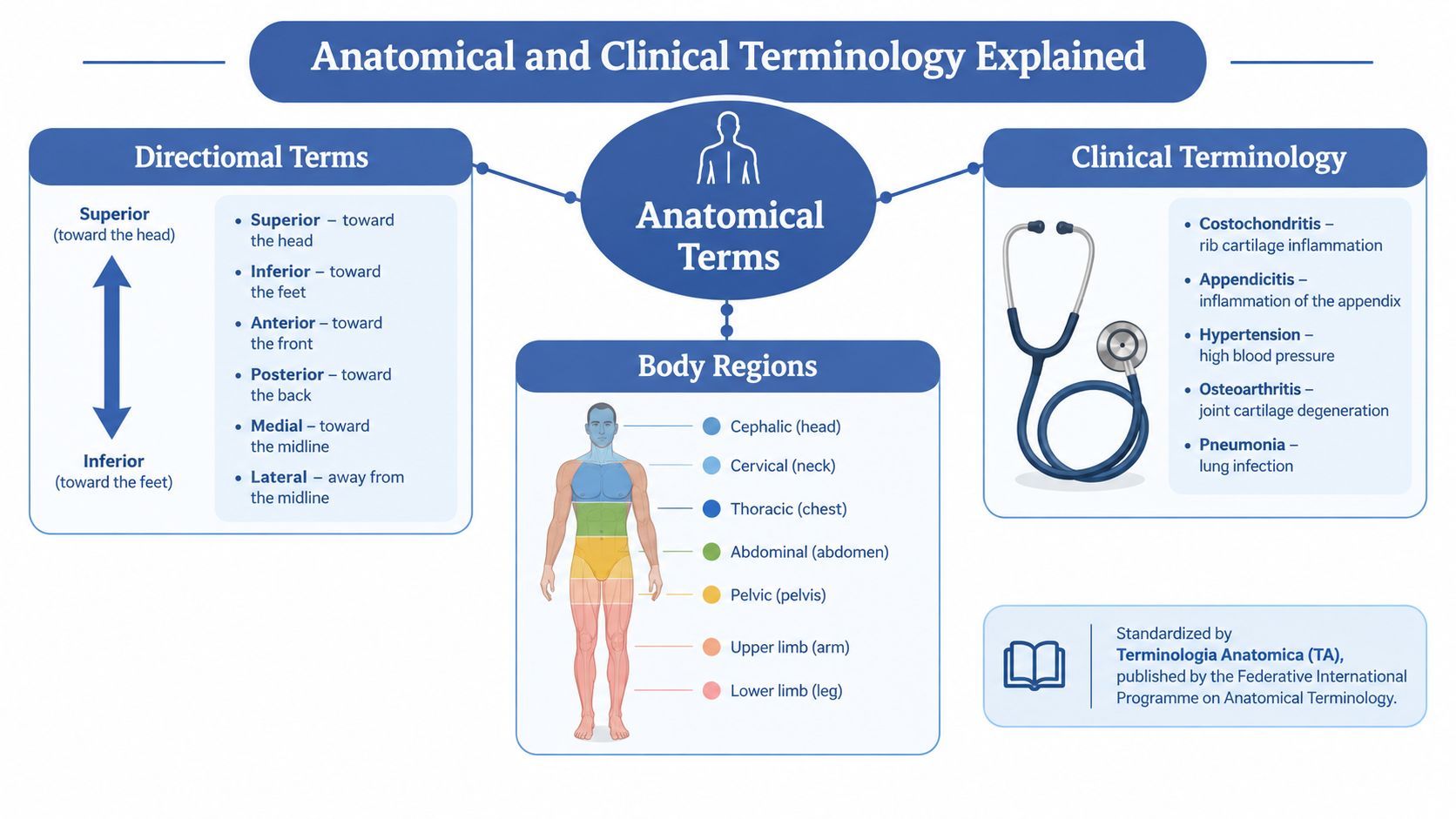
The grammar of clinical terms
Many clinical words combine a body-part root with a process suffix. Hepato- refers to the liver, nephr- to the kidney, -itis to inflammation, and -ology to the study of something. Therefore, hepatitis can be read as inflammation involving the liver.
This logic is descriptive rather than branded. A left atrium has the same anatomical identity in Tokyo as it does in Toronto. Standardization allows clinicians to discuss body structures without depending on local slang or translation choices.
An international reference known as Terminologia Anatomica, published under the Federative International Programme on Anatomical Terminology, supports this shared approach. Latin remains visible because it provides a stable naming base even when the surrounding clinical conversation takes place in English. Readers who want a gentler introduction can consult this guide to human anatomy basics.
Descriptive names and eponyms coexist
Not every anatomical term follows a root-based formula. Fallopian tube and circle of Willis are eponymous labels, meaning they are linked to people associated with their descriptions or history. Such terms coexist with more descriptive terminology because medical language changes gradually rather than all at once.
For patients, decoding the pieces is often enough to begin. If a report contains costochondritis, costo- points to the ribs, chondr- to cartilage, and -itis to inflammation. That doesn't replace a clinician's explanation, but it gives the word a recognizable shape.
How to Search Medical Terms the Right Way
A general search engine starts with popularity and language matching. Medical databases start with controlled concepts. If you enter “pain in my chest,” you'll encounter a wide range of pages using different terms, levels of accuracy, and assumptions. A structured vocabulary helps connect everyday wording to the concept a database is designed to retrieve.
Three systems serve different purposes:
- MedDRA supports standardized coding and retrieval of adverse events in regulatory and safety contexts.
- SNOMED CT organizes detailed clinical concepts used in patient care and electronic health records.
- MeSH supplies the controlled subject headings used to index biomedical literature, including PubMed content.
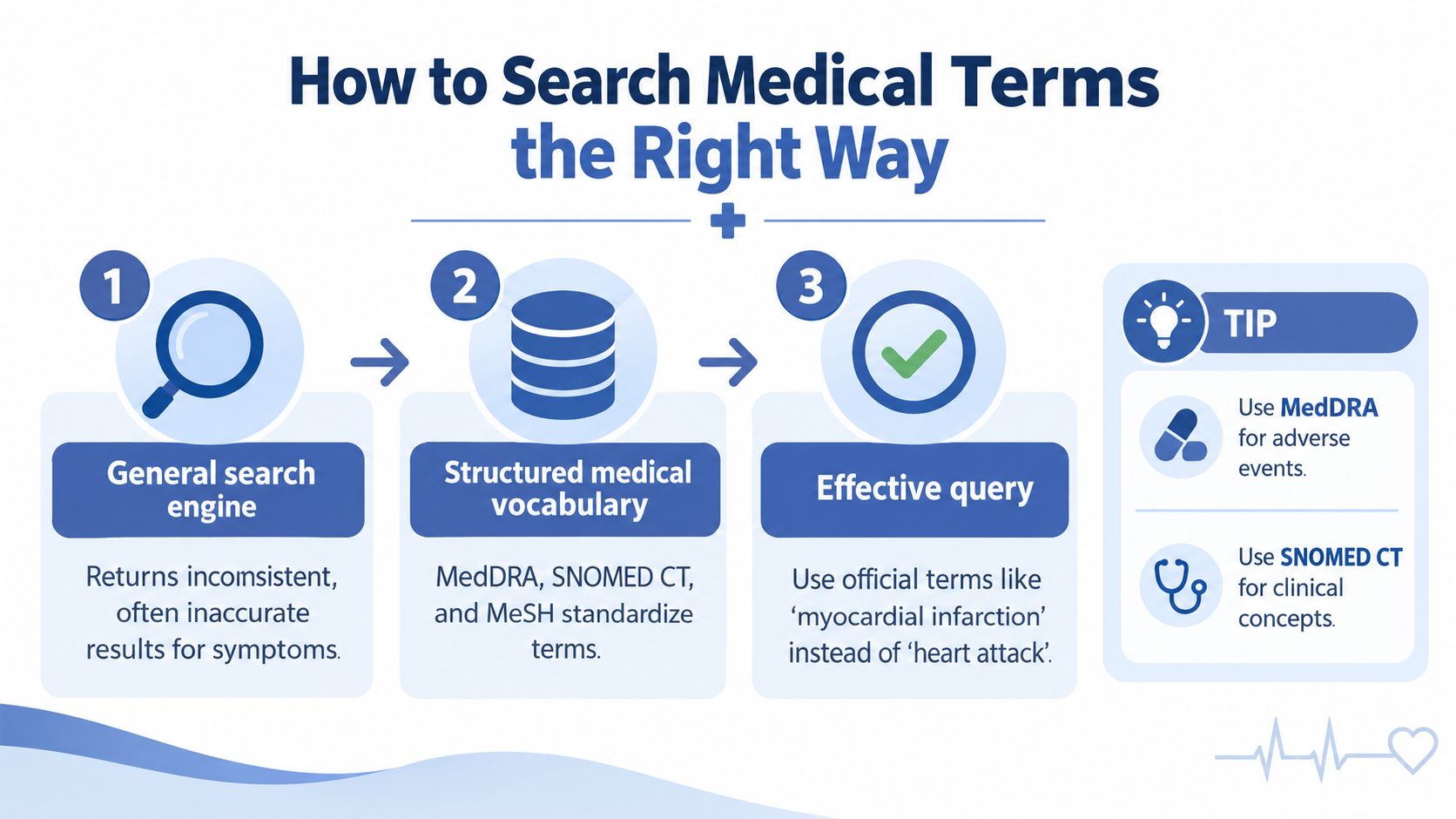
Match the vocabulary to the question
Start with the language you have. A symptom, a phrase from a patient, or a term from a product complaint may be incomplete, but it gives you a starting point. Then choose the system that matches the task.
- For literature searching, map the everyday phrase to a MeSH concept and examine related indexing terms.
- For safety data, verify the MedDRA preferred term rather than relying on a casual synonym.
- For clinical concepts, check SNOMED CT when you need a detailed patient-care meaning.
- For population coding, cross-check the relevant ICD context.
MedDRA guidance emphasizes broad and inclusive retrieval, consideration of neighboring terms and multi-axial relationships, and careful handling of lower-level terms. In some queries, excluding LLTs, or Lowest Level Terms, can prevent over-narrow or inconsistent retrieval. The MedDRA query guidance explains why keyword matching alone isn't enough.
A search for myocardial infarction may retrieve more precise medical literature than a search for “heart attack,” but patient education may appropriately use both. Search discipline isn't about rejecting plain language. It's about translating plain language into the controlled terms needed for reliable validation.
The Full Regulated Name vs the Short Brand Name
A short invented name is not the complete regulated identity of a medicine. Ozempic is a recognizable brand name, but the product identity also includes semaglutide, its dosage form, strength, route, formulation details, and the approved information that governs its use.
That distinction matters because a brand name hides information. The full regulated name may communicate the active ingredient, salt form, stereochemistry, therapeutic class, and administration details. Product labeling and prescribing information carry these details because clinicians and pharmacists must identify the exact product, not merely recognize a familiar marketing name.
| Attribute | Brand Name, for example Ozempic | Full Regulated Name, semaglutide injection |
|---|---|---|
| Main purpose | Product recognition | Exact identification for prescribing and dispensing |
| Active ingredient | May not be obvious from the name | Semaglutide is stated directly |
| Dosage information | Appears elsewhere on the label | Paired with strength and dosage form |
| Route | Not reliably communicated by the brand alone | Injection route is identified |
| Regulatory context | Manufacturer-selected product name | Label, prescribing information, and applicable coding |
| Safety value | Easy to say, but incomplete | Supports reconciliation and verification |
Why label precision protects patients
Regulatory guidance says a full medicinal-product name must combine the product name, strength, and dosage form. It also warns that even a two-letter similarity between names can make them unacceptable. That sensitivity reflects a practical risk: similar-looking or similar-sounding names can contribute to selection and prescribing errors.
Pharmacists may use Tall Man lettering to highlight differences between look-alike, sound-alike names. They also consult look-alike, sound-alike lists and reconcile a verbal prescription against the official label. These practices become especially important when generic medicines, biosimilars, salt forms, or international equivalents appear in the same conversation.
Label-reading habit: Treat the brand name as an entry point, not the entire identity. Confirm the generic ingredient, strength, dosage form, and route before acting on medication information.
The regulatory guidance for medicinal-product naming makes the safety logic clear. A familiar name may help communication, but a regulated name supports the precision that dispensing and prescribing require.
Using Medical Names Accurately and Ethically
Accurate naming isn't pedantry. It supports patient safety, informed consent, research retrieval, and respectful communication. A person can't make a confident decision about treatment if a brand name, abbreviation, diagnosis, or research label obscures what the clinician means.
Use a few practical rules consistently:
- Pair brand and generic names: When discussing a branded therapy, include its generic ingredient so readers can identify the active medicine.
- Expand abbreviations: Write the full term on first use, followed by the abbreviation, such as type 2 diabetes mellitus, or T2DM.
- Check controlled vocabularies: Verify disease terminology against ICD classifications or SNOMED CT when preparing patient education, records, or structured content.
- Prefer current respectful language: Avoid stigmatizing, outdated, or deprecated labels when recognized authorities recommend a clearer alternative.
- Separate context from identity: Explain whether a term is clinical, epidemiologic, investigative, anatomical, or regulatory.
- Verify digital content: Don't copy AI-generated medical text without checking it against authoritative terminology systems, medication references, and peer-reviewed sources.
Clear language serves more than one audience
Patients need understandable explanations. Clinicians need unambiguous documentation. Researchers need searchable concepts. Caregivers need medication information they can compare with a label. One sentence can serve all four groups when it introduces the plain-language term and then supplies the recognized medical name.
For example, “A heart attack, medically called a myocardial infarction, occurs when…” gives a reader an accessible entry point and a precise term for further research. Similarly, “The brand Ozempic contains the active ingredient semaglutide” connects a familiar product name with the identity that matters for medication discussions.
Medical naming also carries an ethical obligation. A diagnosis is attached to a person, not merely stored in a database. Respectful terminology reduces stigma, while accurate terminology reduces confusion. Together, they support shared decisions between clinicians, patients, and caregivers.
The most useful mindset is curiosity rather than intimidation. Once you recognize roots, naming tracks, and regulated layers, the names of medical conditions and products become tools you can question, verify, and explain confidently.
Skup helps aspiring entrepreneurs build practical print-on-demand apparel businesses through its Apparel Cloning System, while AvatarIQ speeds up original design and mockup creation for product listings. Visit Skup to explore a structured path toward building an exciting, flexible eCommerce business with clear guidance and hands-on tools.