Product Launch Planning: A POD Playbook
You've found a promising apparel niche, created a handful of designs, and opened your store. Then launch day arrives. The product page is live, the ads are running, and the first few hours feel exciting, but the orders aren't coming in consistently. That situation isn't a sign that print on demand doesn't work. It usually means the launch was treated as an event instead of an operating system.
Product launch planning gives you a way to validate demand, control creative costs, prepare fulfillment, and improve the offer after customers start buying. For POD apparel, the process has to account for design testing, contribution margins, supplier reliability, shipping expectations, and the reality that a winning brand is built through repeated learning. The opportunity is still wide open, but profitable launches come from disciplined execution rather than launch-day hype.
Table of Contents
- Rethinking the Apparel Launch Timeline
- Building Your Pre-Launch Validation Phase
- Accelerating Design and Mockups with AvatarIQ
- Executing a Multi-Channel Marketing Calendar
- Finalizing Conversion and Fulfillment Readiness
- Tracking KPIs and Scaling Post-Launch
Rethinking the Apparel Launch Timeline
The overnight launch is mostly a myth. A store can go live in an afternoon, but a profitable apparel offer usually needs research, creative testing, audience development, operational checks, and post-launch iteration before it earns dependable momentum.
Historical launch benchmarks make the risk clear. About 40% of developed products reach the market, and roughly 60% of those generate any revenue, according to historical product launch statistics and summaries. The same research line commonly cites an estimated 95% commercial failure rate for new products, which reinforces a practical point for POD sellers: a finished design isn't the same thing as a validated offer.
For apparel, rushing creates several expensive mistakes at once. You may pay to promote a design that appeals to you but not to the niche, send traffic to a weak product page, or discover after launch that your supplier's delivery expectations don't match your promise. An early launch can create useful feedback, but an unprepared launch turns that feedback into refunds, confused support tickets, and wasted ad spend.
Practical rule: Treat launch day as the midpoint of a launch season, not the finish line.
Replace the switch with phases
A sustainable POD launch has three operating phases:
- Validation: Identify a specific audience, study existing demand, test the concept, and collect language from real prospects.
- Activation: Build the catalog, landing pages, email list, creative library, campaigns, and fulfillment workflow.
- Optimization: Read purchase and customer feedback data, improve the offer, and decide which designs deserve more attention.
The timeline should work backward from the date you want customers to receive and enjoy the product, not just from the date you want to publish the listing. A widely cited product launch roadmap spans about six months, with early planning and research followed by execution stages, as outlined in this product launch plan roadmap. POD brands don't always need that full runway, but the principle holds. Give research and readiness their own space instead of compressing everything into launch week.
Your fulfillment calendar matters just as much as your marketing calendar. Use the POD production timeline to map design completion, product setup, supplier processing, shipping windows, and seasonal deadlines before you promise availability.
The payoff is control. A phased approach lets you test a small number of assumptions before scaling the next one. You can adjust the design, audience, price presentation, creative angle, or product selection while the cost of learning is still manageable. That's how a longer runway can shorten the path to consistent profitability.
For additional perspective on choosing and testing a clothing concept, this clothing startup validation advice is useful because it keeps the focus on customer demand before inventory or promotion decisions take over.
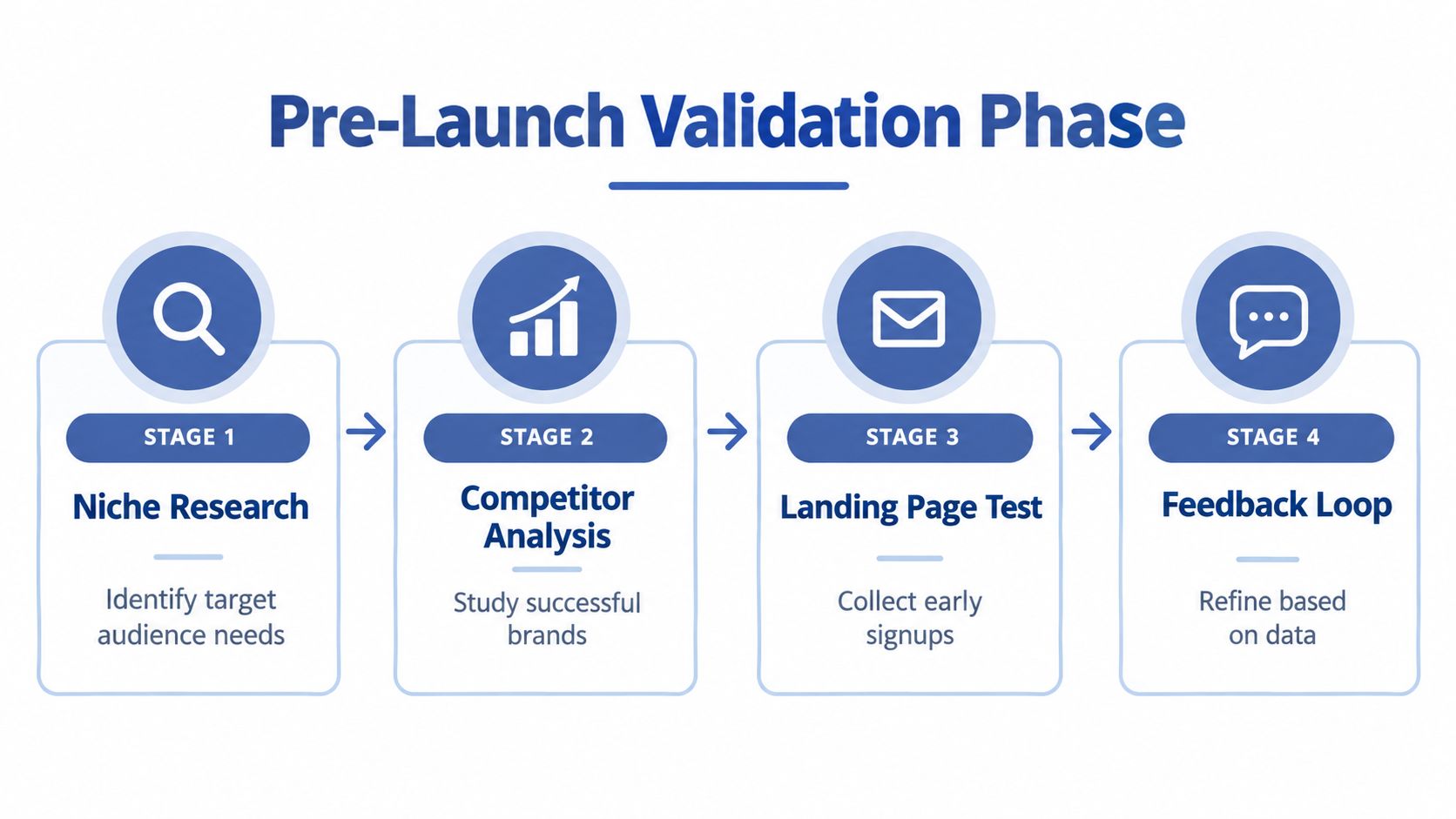
Building Your Pre-Launch Validation Phase
Before spending on ads, establish evidence that a defined group of people cares about the problem, identity, humor, hobby, or lifestyle your apparel represents. You don't need perfect certainty. You need enough real-world signal to avoid building an entire catalog around an untested assumption.
A practical pre-launch window can begin 8 to 12 weeks before release for research and validation, then shift into demand-building 4 to 6 weeks before launch, followed by launch execution and a post-launch optimization window through day 30, as described in this product launch strategy timeline. Another framework allocates roughly 3.5 months to pre-launch, about one week to launch, and about one week to evaluation, which is a useful reminder that the visible launch moment is only one part of the work.
Start with a narrow buyer
Choose a buyer with a recognizable identity and a reason to wear the product. “People who like funny shirts” is too broad to guide design or messaging. A more useful audience has a shared vocabulary, recurring conversations, recognizable occasions, and places where members already gather.
Study competing apparel brands without copying their artwork. Record the themes they repeat, the products they feature, the comments customers leave, and the objections that appear under their posts. Look for gaps in tone, audience specificity, garment choice, or occasion. The goal is to understand the market's existing language, then create something distinct inside a proven demand pattern.
The Apparel Cloning method supports this process by starting with product concepts that already show signs of commercial interest, then adapting the underlying appeal for a different niche or point of view. It doesn't mean duplicating another seller's intellectual property. It means identifying why an offer resonates and rebuilding the concept with original creative work, a sharper audience, and a legitimate brand identity.
Warm the audience before opening the store
Create a simple landing page around one clear promise. Ask visitors to join a waitlist for early access, a first-release notification, or a limited color selection. Keep the page focused on the buyer and the product idea, not on a long explanation of your business.
Then use organic content to test reactions:
- Publish concept variations: Show different phrases, visual directions, or garment colors and track which ones generate meaningful comments and saves.
- Ask specific questions: Invite people to choose between two relevant options rather than asking whether they “like” the brand.
- Collect exact language: Save comments and replies that describe identity, frustration, pride, humor, or purchase motivation.
- Reward useful feedback: Give early subscribers access to previews or launch updates, but don't confuse attention with purchase intent.
A waitlist isn't proof of product-market fit. It's a permission channel and a source of feedback. Pair signups with qualitative evidence, such as repeated questions about sizing, garment quality, shipping, or when the design will be available.
Use this step-by-step guide to testing print-on-demand designs to turn early reactions into a repeatable testing process. By launch week, you should know which concept gets the strongest response, what language buyers use, and what concerns your product page must answer.
Accelerating Design and Mockups with AvatarIQ
Creative production often becomes the bottleneck after an idea has been validated. A seller may understand the audience and have several promising concepts, but still spend too much time coordinating design revisions, requesting mockups, and waiting for assets before testing anything.
AvatarIQ changes that workflow by connecting design creation and apparel presentation in one process. Instead of treating every design as a large production project, you can create a controlled batch of original concepts, place them into lifestyle scenes, and prepare listing assets quickly enough to compare ideas while the audience insight is still fresh.
Turn one validated idea into a testing set
Suppose your research identifies a niche of recreational runners who enjoy dry, self-aware humor. You don't want one generic shirt. You want a focused set of original directions that explore different motivations:
- A design for people who identify with early-morning training.
- A design built around race-day nerves.
- A design that celebrates slow but consistent progress.
- A design aimed at the social side of running clubs.
AvatarIQ can help you develop those directions without immediately committing to a costly photo production process. Generate the artwork, choose appropriate apparel formats, and create lifestyle mockups that show how the product fits the buyer's world. The mockup should make the garment easy to understand, not distract from it with an unrelated scene.
That speed matters because design testing is a portfolio decision. You're not trying to crown a winner based on personal taste. You're giving several strong, audience-relevant concepts a fair chance to earn attention and sales.
Keep speed from becoming sameness
AI can compress research and creative production cycles, but faster output creates a new risk. If every seller uses broad prompts and generic visual language, products become interchangeable. Strong launch planning uses AI to increase iteration while keeping the human decisions focused on niche specificity, originality, and trust.
The emerging buyer journey makes that distinction more important. Recent 2026 guidance reports that 45% of B2B buyers use generative AI during purchase research, while 69% still validate with sales representatives, and 84% of marketers say AI video tools reduced production time, according to this AI-focused product launch guidance. Apparel buyers aren't identical to B2B buyers, but the broader lesson applies: people may discover products through automated systems, then look for proof that the offer is relevant and credible.
Use AvatarIQ for volume, then apply a human filter:
- Does the design speak to one identifiable audience?
- Is the artwork original and legally safe to use?
- Does the mockup show the product clearly on a believable person?
- Does the product page explain why this garment belongs in the buyer's life?
- Can the design stand apart from the references that inspired the research?
For teams evaluating mockup quality, this overview of AI-powered mockup analysis offers a useful way to think about visual clarity, hierarchy, and user interpretation. You can also use an apparel mockup generator to systematize the asset stage without booking models or a photoshoot for every test.
The best workflow is simple: validate the audience, generate several original creative directions, produce consistent mockups, publish only the strongest candidates, and let customer behavior decide what deserves expansion.
Executing a Multi-Channel Marketing Calendar
A launch calendar should coordinate messages, not merely fill social feeds. Each channel needs a job. Email converts existing intent, organic content demonstrates identity and product context, partnerships provide borrowed credibility, and paid media expands reach and supplies retargeting audiences.
Avoid assigning budget percentages without knowing your contribution margin, average order value, shipping cost, and break-even acquisition cost. A CBO campaign can distribute spend across ad sets, but it can't repair weak economics or unclear positioning. Set a total test budget you can afford to lose while learning, then increase spend only after the purchase data supports it.
A reusable launch-week sequence
A coordinated seven-day sequence might look like this:
| Day | Primary action | Message angle |
|---|---|---|
| 1 | Teaser campaign | Show the problem, identity, or inside joke without revealing every detail |
| 2 | Email sequence begins | Explain who the product is for and why it exists |
| 3 | Organic social push | Demonstrate the design, garment, fit, and use context |
| 4 | Partner outreach | Give relevant creators or community owners a clear reason to share |
| 5 | Launch day promotion | Make the offer, availability, sizing, and shipping expectations obvious |
| 6 | Customer engagement | Answer comments, objections, and product questions publicly |
| 7 | Review collection | Ask early buyers for honest feedback and usable product imagery |
Your email sequence should reflect buyer readiness. The first message can introduce the concept, the next can show the product and address objections, and the launch message can provide a direct purchase path. Don't bury the offer beneath a dramatic story. Apparel buyers need to understand the design, garment, size range, delivery expectations, and return policy quickly.
Connect paid and organic signals
For Meta, separate creative angles rather than producing minor variations of the same ad. One ad can lead with identity, another with humor, and another with a lifestyle use case. CBO can help allocate delivery across ad sets, but review the results against profit, not just clicks or cheap traffic.
Retarget people who engaged with the product page or watched creative, but change the message. A retargeting ad can answer a sizing concern, show a close-up of the garment, or explain the product's shipping timeline. Repeating the same announcement to every audience creates fatigue and wastes the advantage of sequential messaging.
Influencer outreach works best when the creator already speaks to the niche. A large but unrelated audience may produce attention without qualified buyers. Give partners a clear brief, original assets, and a way to describe the product naturally. Don't script every word. Their credibility depends on sounding like themselves.
Launch calendars should also account for scaling lag. G2 launch summaries report that reaching 75% of a new product's highest distribution takes an average of 28 weeks, as included in this McKinsey launch analysis. The apparel version of that lesson is straightforward. Keep publishing, testing, and following up after the first week instead of assuming the initial promotion determines the entire product's potential.
Finalizing Conversion and Fulfillment Readiness
Traffic exposes operational weaknesses quickly. Before launch, place test orders, inspect the customer experience on mobile, and confirm that your supplier workflow matches the promise on the product page.
Use a conversion checklist
A high-converting apparel page doesn't need excessive decoration. It needs clear answers in the order a buyer asks for them:
- Product promise: State who the design is for and what makes it worth wearing.
- Visual proof: Show front, back, detail, and lifestyle views where they help the buyer judge the product.
- Garment information: Explain fabric feel, fit, sizing, care, and available colors accurately.
- Trust elements: Display the return policy, secure checkout information, customer support path, and honest delivery expectations.
- Purchase clarity: Keep the variant selector, quantity choice, add-to-cart button, and shipping information easy to find.
- Mobile usability: Tap every control on a phone, check image loading, and remove popups that block the buying path.
Don't use trust badges as a substitute for useful information. A buyer who is uncertain about sizing needs a reliable size guide and fit explanation, not another decorative icon.
Protect the backend
Set up order routing before paid traffic begins. Confirm that orders flow to the correct POD supplier, variants map correctly, addresses pass through cleanly, and tracking information returns to the customer communication system. Run a complete test order from product page to fulfillment confirmation.
Write shipping copy that reflects the actual process. POD fulfillment includes production time and transit time, so separate those expectations rather than presenting one vague delivery promise. If seasonal demand or supplier capacity could affect processing, communicate that before checkout.
Quality control also needs a repeatable standard. Order samples of the products and colors you plan to emphasize, inspect print placement and garment feel, and document what passes. If a supplier changes a blank garment or print method, review the result instead of assuming the old sample represents the new output.
Operational rule: Your ad can create the sale, but your fulfillment system determines whether that sale becomes a refund, a complaint, or a repeat customer.
Keep customer support templates ready for sizing questions, address changes, delayed tracking, damaged items, and returns. Fast, accurate answers protect your brand while giving you a useful source of post-purchase insight. Those conversations often reveal the next product-page improvement before analytics can explain it.
Tracking KPIs and Scaling Post-Launch
Launch performance becomes useful only when you connect each metric to a decision. A dashboard full of numbers can still leave you guessing if it doesn't tell you whether to change the design, audience, offer, page, or fulfillment process.
Track the economics at the order level first. Cost per acquisition, return on ad spend, and average order value belong together because one metric can look healthy while the total order remains unprofitable. Include product cost, fulfillment, shipping subsidy, discounts, transaction fees, and refunds when calculating the contribution left after the sale.
Read the first signals without overreacting
Early data is directional. A design with strong clicks but weak purchases may have an attractive hook and a disappointing product page. A design with low click-through but strong conversion among visitors may need a better creative angle rather than a new product.
Use a simple diagnostic table:
| Signal | Likely issue | First action |
|---|---|---|
| Attention without add-to-carts | The creative promise and product page don't match | Rewrite the opening copy and improve product context |
| Add-to-carts without purchases | Buyers have checkout, shipping, sizing, or trust objections | Test the checkout path and surface answers earlier |
| Purchases with weak margin | The offer or acquisition cost is too expensive | Review pricing, bundles, discounts, and targeting |
| Orders with support complaints | The product or expectation wasn't explained clearly | Update sizing, shipping, and post-purchase communication |
| Repeat interest without repeat orders | The brand lacks a reason to return | Build related drops, replenishment prompts, or loyalty content |
Shopify can show product and order behavior, while Meta Ads Manager can show how creative and audience combinations are delivering. Don't let a platform's reported result replace your own margin calculation. The decision to scale belongs to the business, not to a single dashboard column.
Build the post-launch feedback loop
The post-launch period is where a POD brand becomes more durable. Send a useful order confirmation, a shipping update, and a post-delivery message that invites honest feedback. Ask customers what they liked, what confused them, how the fit felt, and what related design they'd actually wear.
Create a small learning record for every design. Note the audience, creative angle, landing-page version, acquisition cost, order value, refund or support themes, and customer language. When a design earns profitable demand, expand around its underlying identity with new original variations. When it attracts attention but fails to convert, identify the broken step before abandoning the niche.
The retention gap deserves deliberate attention. Launch-failure summaries commonly cite 35% to 45% failure rates among products that reach market, with 25% failing by the end of year one and 40% by the end of year two, as discussed in this post-launch retention analysis. Those figures are a reminder to plan for adoption, replenishment, and iteration rather than treating the first purchase as the whole business.
AI can help you maintain the loop by organizing customer feedback, generating creative variations, and reducing repetitive production work. One Airtable guide notes that many launches need 3 to 6 months of preparation and cites 31% of extensively AI-using product teams reporting faster speed to market, as described in this product launch planning guide. Faster production only helps when your decisions remain specific and your quality bar stays intact.
For teams managing multiple campaigns and audiences, a streamlined ad workflows playbook can help organize the handoffs between creative testing, reporting, and optimization. The operating principle remains the same: scale the designs that produce healthy contribution after all costs, cut weak offers without emotional attachment, and keep the winners fresh with new relevant products.
A product launch is successful when it creates a repeatable system for finding, presenting, fulfilling, and improving products customers want to wear. Build that system and every launch gives the next one better research, stronger creative judgment, cleaner operations, and a more valuable customer base.
Skup gives POD entrepreneurs practical training through the Apparel Cloning System, AI-assisted design and mockup production through AvatarIQ, and coaching support for sellers who are ready to scale. Visit Skup to build your product launch planning system around validated apparel concepts, faster creative testing, and sustainable store operations.