Rules for Facebook Marketplace Every POD Seller Must Know
You've uploaded a fresh POD shirt to Facebook Marketplace, written what feels like a solid description, and hit publish. Then the listing disappears, your buyer messages stop, or Marketplace asks you to review a policy you never knew applied to apparel. That experience is avoidable.
The rules for Facebook Marketplace aren't difficult because Meta expects every seller to be a legal expert. They're difficult because a compliant product can still create problems when the title, artwork, image, category, condition, or fulfillment promise sends the wrong signal. Treat every listing like a product application, not a casual social post, and you'll build a much more dependable sales channel.
Table of Contents
- Why Facebook Marketplace Rules Matter for Apparel Sellers
- What You Can and Cannot List Under Commerce Policies
- Listing Quality Standards Every POD Seller Should Follow
- Payments, Shipping, and Local Pickup Policies Compared
- Safety, Ratings, and Fraud Prevention Habits That Build Trust
- How Enforcement Works and How to Appeal a Decision
- Your Facebook Marketplace Seller Compliance Checklist
Why Facebook Marketplace Rules Matter for Apparel Sellers
Facebook Marketplace works on a trust contract. You receive access to a buyer-facing commerce surface, and Meta expects you to offer legitimate physical products, describe them accurately, communicate responsibly, and follow its Commerce Policies and Community Standards. Meta's Marketplace safety guidance confirms that the service is available through the Facebook app on iPhone, Android, iPad, and desktop, so your listing may reach buyers across several devices and commerce experiences. Meta's Marketplace safety guidance also makes clear that the rules apply broadly across Meta's commerce environment.
For a POD seller, that contract starts before the upload. It affects how you source artwork, how you describe a shirt, which category you choose, whether you offer shipping, and what evidence you retain if Meta questions a listing. Meta's Marketplace feature dates back to 2016, making it a nearly decade-old selling surface by 2026, while its current policy language has become more explicit about prohibited products and enforcement. Meta's Commerce Policies should be part of your product research routine, not something you open only after a takedown.
Practical rule: If you wouldn't confidently explain where the design came from, what the customer receives, and why the item belongs in its selected category, don't publish the listing yet.
A compliant catalog gives you room to build. You can test original typography, hobby niches, seasonal concepts, and different garment styles without constantly rebuilding your storefront after avoidable removals. A careless catalog creates operational drag. You spend time answering confused buyers, correcting inaccurate details, and trying to recover listings that should never have been uploaded.
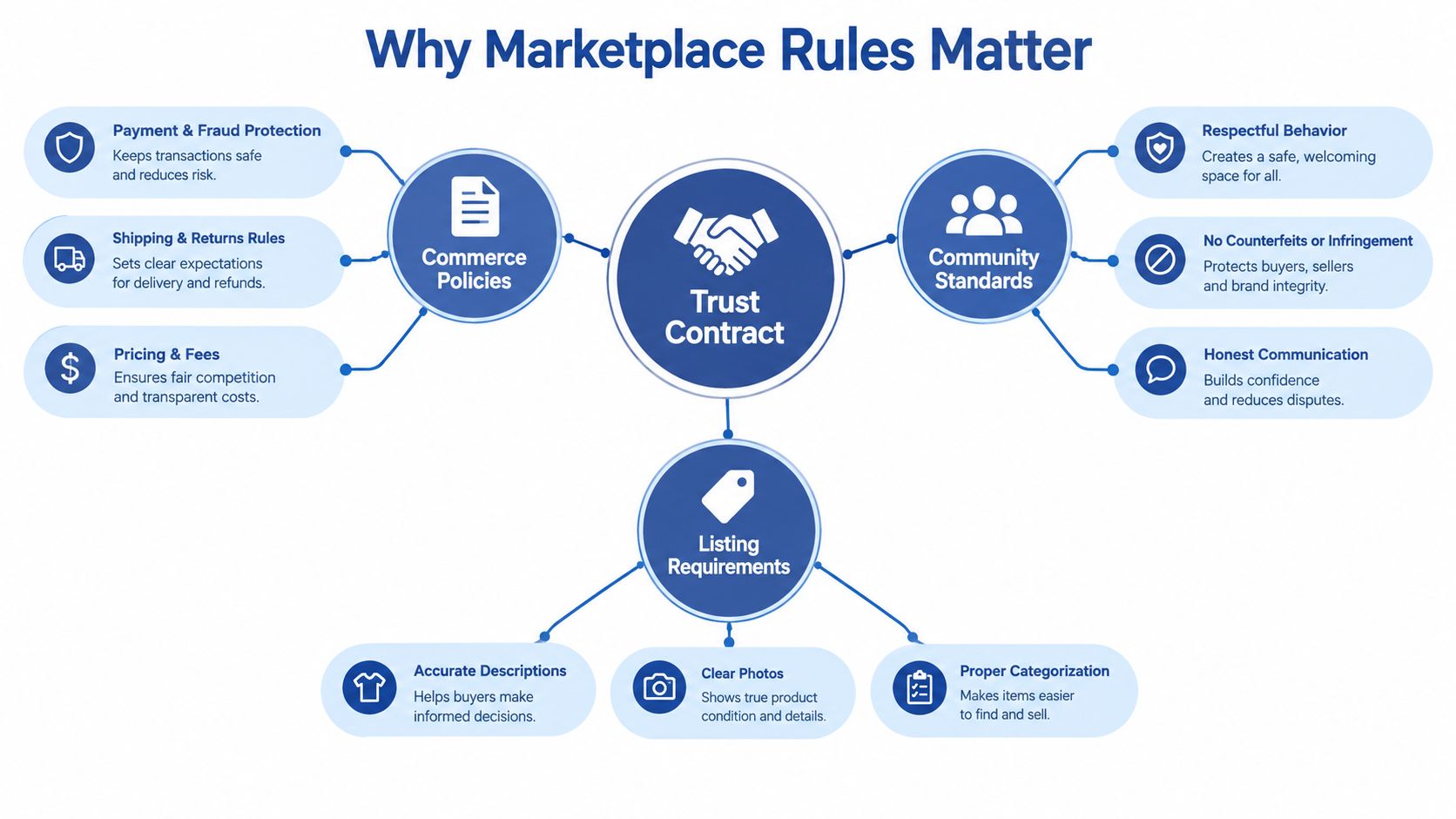
The contract has three working parts
Commerce Policies determine whether the physical product itself is eligible. A printed shirt is physical, but the artwork, claims, and subject matter can still create a problem.
Community Standards influence how your language and imagery are interpreted. Offensive, misleading, exploitative, or sexually explicit positioning can create risk even when the garment itself is tangible.
Listing requirements determine whether the offer is represented clearly. A vague title, inaccurate condition, or misleading mockup can undermine buyer trust and invite reports.
Use this practical guide to selling on Facebook as a workflow reference, then apply the same discipline to every Marketplace listing. The stable storefront is the seller who checks compliance before publication, not the seller who waits for Meta to identify the mistake.
What You Can and Cannot List Under Commerce Policies
Start with the product, then inspect the design. Meta wants a real physical item, so POD apparel fits the platform in principle. Services, subscriptions, digital products, and other non-physical offers do not qualify. The policy also excludes weapons, drugs, tobacco, adult products and services, animals, hazardous materials, counterfeit products, and misleading items. Use Meta's commerce policy guidance before you publish a new collection.
For apparel sellers, intellectual property is usually the first failure point. Do not upload trademarked logos, copyrighted characters, sports team marks, celebrity likenesses, unlicensed band merchandise, or designs that imitate a recognizable brand identity. A shirt that says “inspired by” a famous franchise can still create trouble if the artwork, wording, or visual treatment looks close enough to imply an unauthorized connection.
Regulated imagery needs the same restraint. Weapon graphics, drug-related imagery, adult positioning, medical claims, and references to prohibited goods can turn a normal garment into a policy problem. Keep those references out of both the graphic and the listing copy.
Use a strict sourcing test
Your design is in the safer zone when you can answer yes to each question below:
- Ownership: Did you create the artwork, commission it with clear commercial rights, or obtain a license that covers this use?
- Originality: Does the design stand on its own rather than imitate a protected character, logo, team, musician, or celebrity?
- Physical offer: Are you selling an actual garment rather than a design file, subscription, service, or promise of future digital access?
- Accurate presentation: Do the photos and words describe the shirt buyers will receive?
- Clean positioning: Does the design avoid prohibited, deceptive, sexually explicit, or regulated subject matter?
Original typographic designs, original artwork assisted by AI, niche hobby tees, and seasonal graphics can fit a sensible POD catalog when the seller owns the necessary rights and describes the physical product accurately. AI assistance does not transfer someone else's trademark or character to you. Review every output for recognizable protected elements before it reaches Marketplace.
Meta reviews signals from listing content, including the relationship between images, words, and product claims, as described in its commerce policy guidance. A mockup that shows a larger print than the fulfilled garment is exactly the kind of mismatch that draws attention. Meta's Commerce Policies also say that listings can be reviewed when a potential violation is detected or when someone files a report, so do not assume a design is safe because it passed an earlier upload.
| Listing Category | Compliance Status | Risk Note |
|---|---|---|
| Original typography on a physical shirt | Generally suitable | Keep the phrase original and avoid protected slogans or brand references. |
| Original niche hobby artwork | Generally suitable | Describe the garment clearly and do not imply affiliation with an organization. |
| AI-assisted original artwork | Potentially suitable | Review the output for trademarked, copyrighted, or recognizable protected elements. |
| Seasonal original graphic | Generally suitable | Avoid copying a known character, logo, or branded holiday campaign. |
| Trademarked logo or sports team mark | Prohibited or high risk | Commercial apparel use requires authorization that many sellers do not possess. |
| Copyrighted character or celebrity likeness | Prohibited or high risk | A modified version can still resemble protected creative work or a person. |
| Unlicensed band merchandise | Prohibited or high risk | Names, lyrics, album artwork, and logos may all create intellectual property exposure. |
| Weapon or drug-related graphic | High risk | Subject matter and positioning can trigger restrictions even on a physical garment. |
| Shirt offered as a digital download or subscription | Prohibited | Marketplace is for physical goods, not digital products or recurring access. |
If you are comparing channels for pre-owned inventory alongside new POD products, choosing a resale marketplace helps you separate resale rules from new-goods expectations. Keep that distinction clear in your own catalog. A new made-to-order tee should not be presented like a secondhand item, and a resale platform's norms do not override Meta's requirements.
Listing Quality Standards Every POD Seller Should Follow
A compliant shirt can still underperform if the listing looks careless. Buyers need to understand what they're buying without opening a message thread to ask basic questions.
Build the title in a predictable order: brand or collection name, garment type, size range, color, and a short design hook. “Retro Camping Tee, Unisex Cotton Shirt, Black, Sizes S to 3XL” gives the buyer useful information. “Funny Shirt Gift Cool Trending Viral Must Have” gives them noise.
Your description should answer the questions that affect the purchase decision:
- Material: State the fabric information you can verify.
- Fit: Explain whether the garment is standard, relaxed, oversized, or otherwise shaped.
- Print placement: Say whether the design appears on the front, back, sleeve, or another location.
- Care: Include the care guidance supplied for the actual garment.
- Fulfillment: Give a realistic shipping timeline and don't promise a dispatch speed your POD partner can't meet.
- Condition: Mark the item accurately. A made-to-order new shirt isn't the same as a used garment.
Photos should support the same promise. Use a clean flat lay on a neutral background, a modeled view when you can provide one accurately, and a close-up that lets buyers inspect the design. Avoid text overlays, stock watermarks, and inconsistent lighting across the collection. Your mockup should represent the garment's proportions and print placement rather than making the design appear larger or more detailed than it is.
Make the creative workflow defensible
An AI-assisted workflow can help you create original artwork and product mockups faster, but speed doesn't replace review. Keep the prompt history, source files, approved exports, and licensing records associated with each design. If a listing is questioned, organized documentation gives you something factual to submit instead of a vague explanation that the design “looked original.”
AvatarIQ is a practical option for generating original apparel concepts and product mockups without relying on generic design software or borrowed assets. Use it as part of a review process: remove trademark cues, inspect lettering, check character-like details, and compare the final garment image against the product you fulfill.
Category and condition matter as much as the image. Put apparel in the most relevant clothing category available to your account, select the correct condition, and set a price that makes sense beside comparable garments. Don't anchor a low-quality blank or an inaccurate mockup against a premium product. Clear inputs help buyers make a confident decision and reduce unnecessary questions.
Payments, Shipping, and Local Pickup Policies Compared
Choose the fulfillment route before you write the listing. A POD operator shipping made-to-order shirts to buyers in different locations needs a different workflow from a seller meeting someone at a local event with a limited drop.
Facebook Checkout is the cleaner fit when the transaction needs an on-platform purchase path and shipment. Check whether checkout and shipping are available for your account, region, category, and listing. Confirm the carrier and label process shown in your own seller interface, because Meta's available features can vary. Keep your order records, shipment evidence, and buyer updates organized.
Local pickup can work for a local launch, pop-up meetup, or limited collection where the buyer and seller want an in-person handoff. It creates more coordination work, and Meta's public guidance states that returns and refunds aren't available for items purchased with local pickup on Marketplace. Meta's returns guidance explains that checkout returns follow the seller's stated return policy, and after a return is approved, the buyer generally has 3 business days to print the label, attach it, and hand the package to the carrier.
| Policy Area | Facebook Checkout | Local Pickup |
|---|---|---|
| Best use | Made-to-order shirts that need delivery | Local drops and planned in-person handoffs |
| Buyer path | Purchase follows the checkout availability shown in the account | Buyer and seller coordinate the handoff |
| Shipping evidence | Retain order, label, and delivery records | No shipment record exists for the handoff |
| Returns | Governed by the seller's stated policy and applicable checkout process | Meta says returns and refunds aren't available for local-pickup purchases |
| Seller decision | Use when you need a documented shipping workflow | Use only when the buyer can reasonably collect the item |
| Listing clarity | State production and shipping expectations | State the pickup location approach without exposing your home address |
Don't enable local pickup by accident on a shipping-only POD listing. Buyers may assume they can collect the shirt immediately, while your production partner still needs time to make and dispatch it. That mismatch creates disappointment before your fulfillment process has even started.
Write your shipping policy in plain language, then align the Marketplace listing with it. This sample shipping policy resource can help you organize the details buyers need, including production expectations, dispatch information, and what happens when an order needs attention.
Safety, Ratings, and Fraud Prevention Habits That Build Trust
Safety isn't administrative overhead. It protects your time, your buyer conversations, your inventory decisions, and the reputation attached to your seller profile.
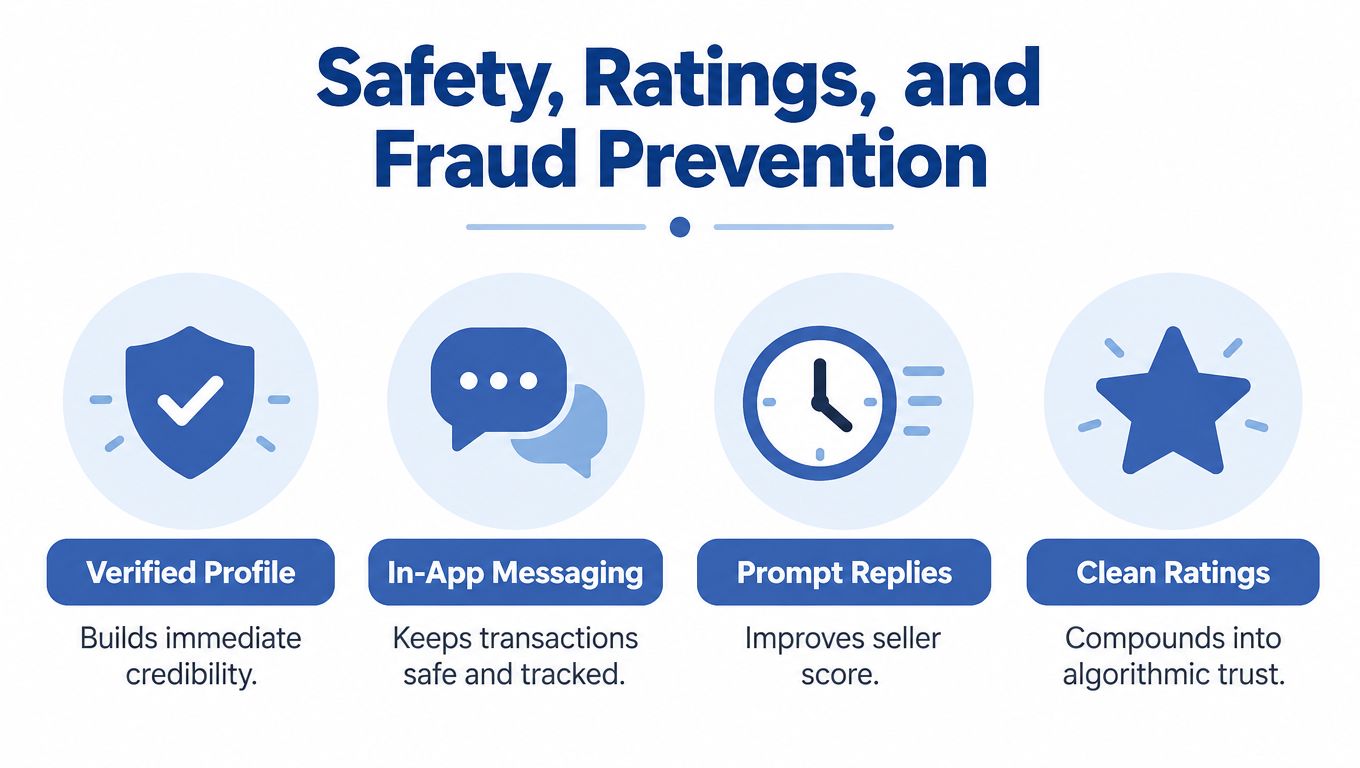
Keep negotiations inside Messenger. Don't move buyers to an external payment link because they claim the checkout is broken, and don't send sensitive account information in response to a suspicious message. For local pickup, review the profile before agreeing to meet, choose a public location, and avoid sharing your home address as a default meeting point.
For shipped orders, retain the tracking information and carrier evidence connected to the transaction. A clear record helps you answer a dispute with facts. For pickup, keep the handoff details in Messenger so the agreed item, location, and timing aren't scattered across private text messages.
Understand what ratings actually show
Facebook has a specific Marketplace rating mechanic. Buyer and seller ratings can be given only in the Facebook app for iPhone or Android. Buyer ratings remain private, while seller ratings become public once the seller has received five or more ratings. Meta's Marketplace ratings guidance explains those mechanics directly.
That means you shouldn't chase ratings with pressure or artificial requests. Deliver the listed shirt, communicate clearly, and resolve legitimate issues before they become reports. A clean catalog and accurate expectation-setting do more for trust than a desperate message asking a buyer to leave praise.
Treat reports as signals you must answer
Meta says users can report suspicious buyers, sellers, or listings, and it may review messages and take action. Meta's reporting guidance doesn't publicly explain the evidence threshold for every decision, how often reports lead to removal, or how appeals work in every case. You should therefore operate as though every message, image, and claim needs to stand on its own.
Reply promptly because buyers often contact several sellers at once. Set a response routine you can sustain, keep answers factual, and tell a buyer when you need to verify a garment detail. Speed helps the buyer feel looked after, but accuracy keeps the conversation from creating a second problem.
How Enforcement Works and How to Appeal a Decision
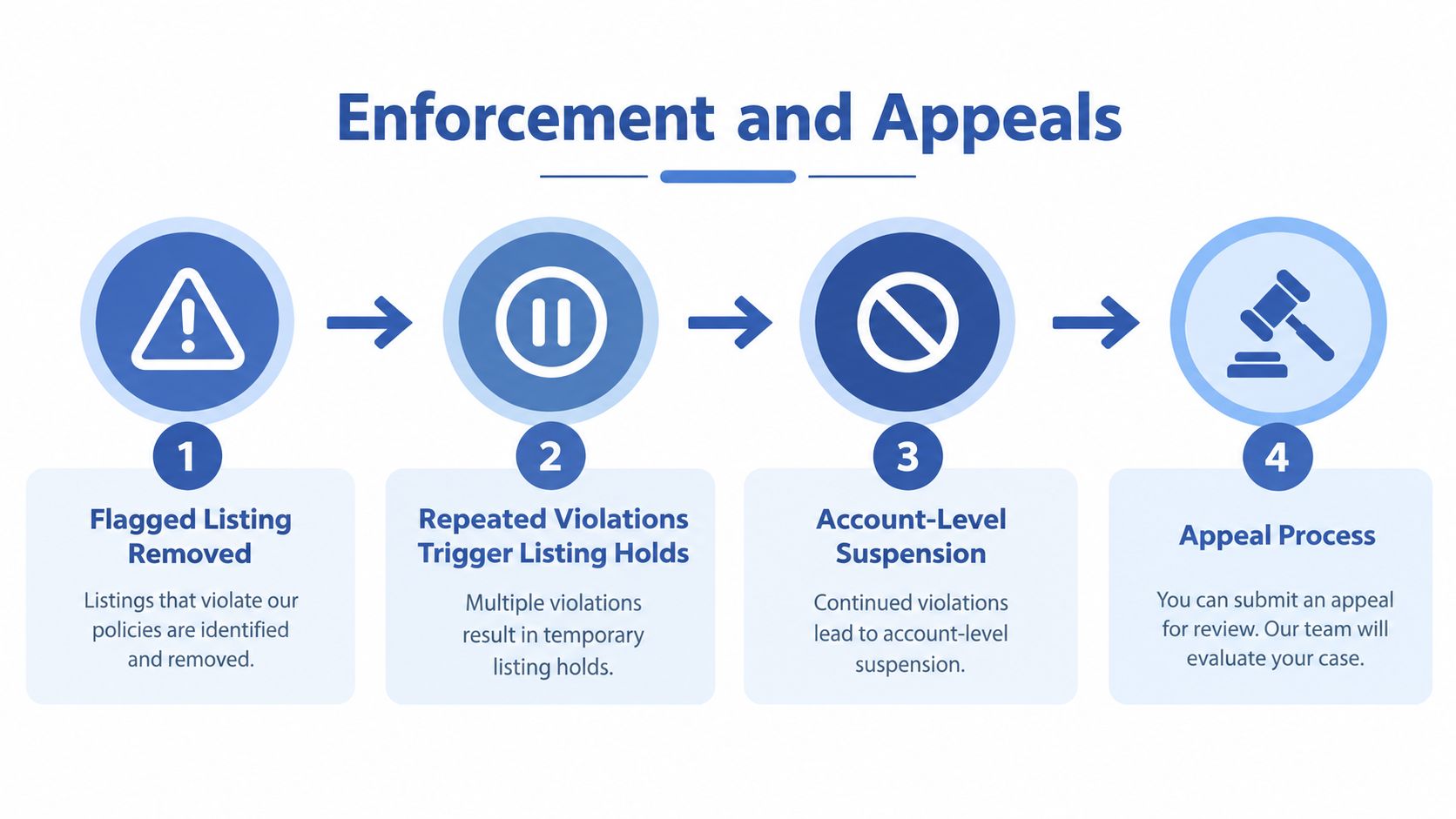
A single flagged shirt can cause more than one problem. Meta can reject the listing, remove it, limit Marketplace access, or restrict commerce surfaces across Facebook, Instagram, WhatsApp, or Messenger when a violation shows up in review or through a report. Treat every listing like it will be read by a reviewer who cares about the image, the copy, and the rights behind the product.
For POD apparel, the central mistake is usually not one bad graphic. It is the mismatch between the design, the title, the description, the category, and the photos. A shirt that looks harmless in isolation can still read as a trademark issue, a misleading offer, or a prohibited item once the rest of the listing is in view.
Follow a calm appeal process
- Read the notice closely. Find the exact policy reason or product issue Meta gives you.
- Pause similar listings. Stop any design that uses the same artwork, phrasing, or visual treatment until you know what triggered the action.
- Gather proof. Keep source files, prompt history for AI-assisted artwork, licenses, purchase records, and the final mockup ready.
- Write a direct explanation. State what the item is, how the design was made, what rights you hold, and what you changed.
- Check the rest of the catalog. If one listing caused trouble, search for related versions before you upload again.
- Use the appeal route given in the notice. Keep it factual and short. Leave out emotional language and arguments.
A useful reference for the behavior Meta expects after a policy hit is this terms of service violations guide. It is not Meta's decision notice, but it reinforces the right response, identify the specific issue, stop repeating it, and document the fix.
Rebuild with fewer variables
If access comes back after a restriction, do not dump your whole catalog back into Marketplace. Start with a small set of designs that have clear ownership, accurate images, plain descriptions, and no regulated themes. Watch the account notices, keep buyer replies consistent, and make sure every relisted item matches what the page promises.
If a buyer dispute becomes part of the problem, document the timeline and use a structured dispute resolution process instead of improvising inside the message thread. Your job is simple, show that the product, the communication, and the fulfillment steps all line up with the listing.
Meta does not publish every evidence threshold or appeal outcome, so you need every listing to stand on its own. Clean source files, clear rights, and conservative claims give reviewers less reason to doubt the post.
Your Facebook Marketplace Seller Compliance Checklist
A checklist only works if you use it before every upload, not after a policy flag.
Design and product review
- Verify original artwork: Confirm that you created the design, commissioned it with appropriate rights, or obtained a valid license.
- Sweep for trademarks: Search the graphic, wording, symbols, and references for brand names, logos, team marks, and protected slogans.
- Check copyright risks: Remove recognizable characters, album artwork, celebrity likenesses, and copied illustrations.
- Review prohibited categories: Reject weapon, drug, adult, hazardous, counterfeit, recalled, and other restricted concepts before they reach the listing page.
- Confirm the physical product: Make sure the offer is for an actual shirt or garment, not a digital file, subscription, service, or virtual item.
Listing and creative review
- Write an accurate title: Include the garment type, relevant collection information, color, size range, and a concise design description.
- Describe the item: Verify material, fit, print location, care information, condition, and production expectations.
- Check every image: Use accurate mockups or product photos with no misleading text overlays, borrowed watermarks, or exaggerated print scale.
- Select the right category: Use the most relevant apparel category available to your account and avoid stuffing unrelated keywords into the listing.
- Set a defensible price: Compare similar products and make sure the price reflects the actual garment, fulfillment process, and customer promise.
Fulfillment and trust review
- Confirm the delivery route: Decide whether the item ships, uses local pickup, or supports both. Disable pickup when your workflow is shipping-only.
- Check carrier requirements: Use the shipping and label options available in your account, then retain tracking and delivery evidence.
- State the return policy clearly: Align the Marketplace wording with the policy buyers receive during the transaction.
- Keep communication in Messenger: Don't accept requests to bypass the normal payment or communication flow.
- Protect rating quality: Resolve questions, deliver what you showed, and don't pressure buyers into artificial reviews.
- Complete your profile: Use accurate profile and business information so buyers can identify who they're dealing with.
- Verify payment settings: Check the payment and checkout details in your own account before publishing a collection.
- Use a 24-hour cooldown for bulk uploads: Review the first listings, confirm there are no policy warnings, and only then continue adding a larger batch.
The Apparel Cloning training path becomes much more valuable when compliance is built into the creation system. Find a proven product direction, create an original design variation, document the source, produce a truthful mockup, and run this checklist before publication. That process lets you scale systematic listing creation without bringing the same policy mistake into every new niche.
A steady POD business on Marketplace doesn't require timid design choices. It requires clear ownership, accurate product information, disciplined fulfillment, and a repeatable review habit. Follow those rules, and you can keep building exciting apparel collections with far less operational friction.
Skup helps POD sellers build practical apparel businesses with training, coaching, and systems for creating and scaling original product listings. Visit Skup to explore the Apparel Cloning program and choose a structured next step for your Marketplace workflow.