Facebook Ads for Ecommerce: The POD Playbook
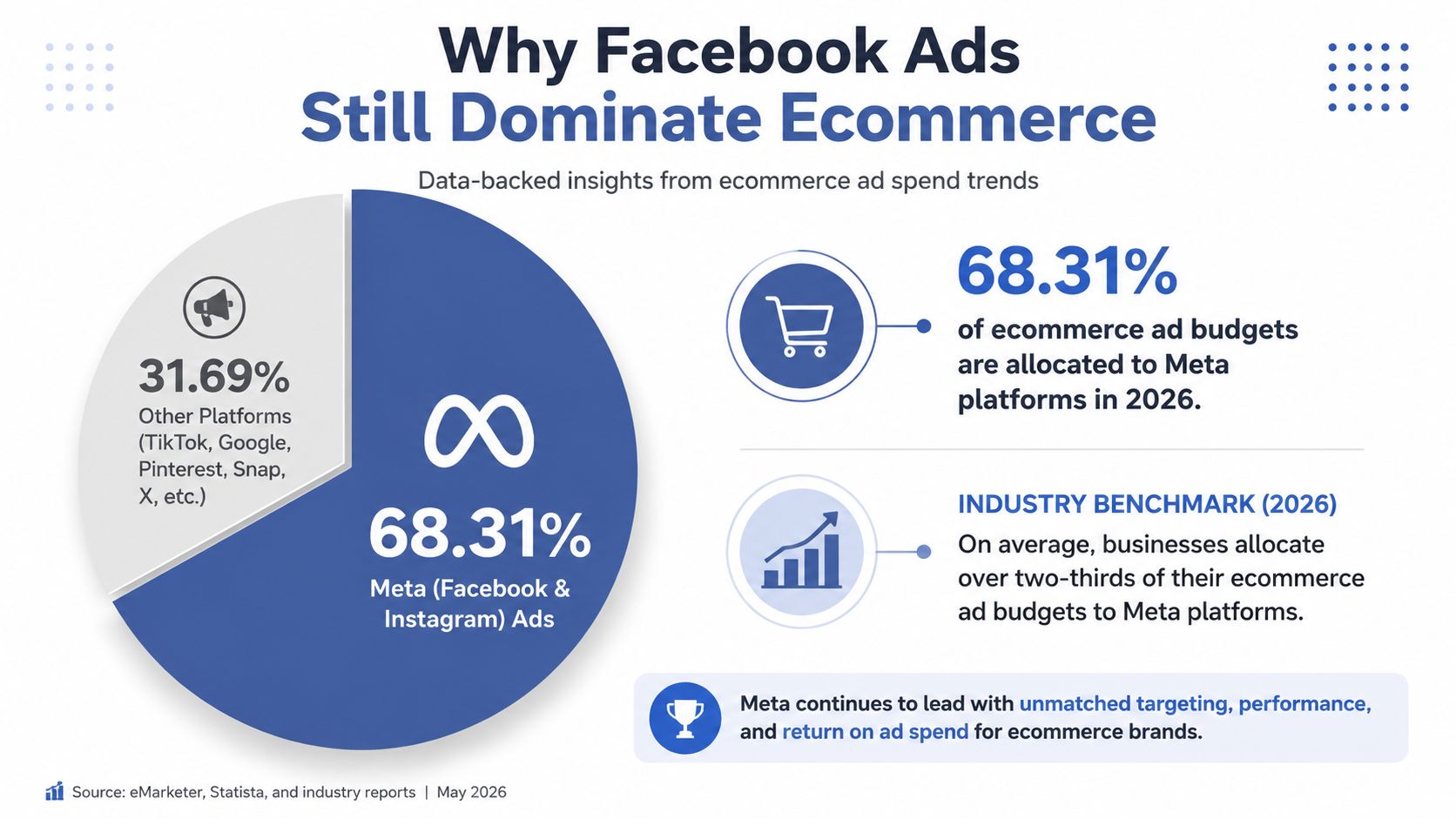
Meta commands 68.31% of all ecommerce advertising budgets, making Facebook ads for ecommerce a essential channel for serious POD advertisers in 2026. For print-on-demand apparel, the opportunity is especially practical because you can test designs, offers, and audiences without committing to large inventory purchases.
That market share matters, but it doesn't mean every campaign works automatically. The gap between an account that generates purchases and one that produces expensive clicks usually comes from campaign structure, creative volume, margin discipline, and measurement quality.
Meta generated $200.97 billion in full-year 2025 revenue, with advertising representing 97% of total revenue. In Q4 2025 alone, Meta produced $58.1 billion in advertising revenue, up 24% year over year, while ad impressions rose 18% and average ad prices increased 6%. Independent ecommerce benchmark coverage places Meta at the center of paid customer acquisition, not at the edge of the marketing mix.
I manage $200k per month in Meta ad spend across active 8-figure POD businesses, and the lesson is consistent: Facebook ads reward advertisers who build systems. The following playbook shows how to build that system around POD apparel, from account setup and audience design to AvatarIQ creative production, budget allocation, tracking, and controlled scaling.
Table of Contents
- Why Facebook Ads Still Dominate Ecommerce
- Building Your Campaign Foundation
- Audience Strategy for Print on Demand
- The Creative System That Scales POD Ads
- Budget and Bidding Strategy for POD Stores
- Tracking, Measurement, and Scaling
- Common Mistakes and How to Avoid Them
Why Facebook Ads Still Dominate Ecommerce
Meta's 68.31% share of ecommerce advertising budgets reveals how heavily online sellers rely on its ecosystem. That figure isn't just a media-buying statistic. It reflects the platform's combination of broad inventory, purchase signals, retargeting options, and automated delivery. The 2026 benchmark reporting also connects Meta's scale with the reason ecommerce brands use it to test products and expand winning offers across markets.
POD apparel fits this environment well. A store can launch a design, observe how people respond, and adjust the product page or creative without tying up cash in bulk stock. That flexibility doesn't remove the need for strong economics, but it lets advertisers learn faster than businesses that must first manufacture and warehouse every product variation.
The performance gap is actionable
A benchmark dataset covering about 35,000 ecommerce brands reported a median CTR of 2.19%, median purchase conversion rate of 1.57%, median CPM of $14.19, median CPA of $38.19, and median ROAS of 1.86x. The benchmark source also shows that results vary substantially according to creative, audience quality, offer strength, and tracking.
Another benchmark view reports median ecommerce performance at 1.6% conversion rate, 1.86x ROAS, 2.19% CTR, and $14.19 CPM. Rule1's funnel-focused analysis supports a practical evaluation order: inspect the ad's ability to earn attention, then the landing page's ability to convert, then the business's blended return.
A separate 2026 ecommerce benchmark reports median CPC of $0.87, CTR of 1.93%, CVR of 2.7%, and CPA of $32.22, while top-quartile accounts reached $0.61 CPC, 2.78% CTR, 4.1% CVR, and $22.15 CPA. The comparison from MHI Growth Engine makes the important point clear: strong accounts don't improve one isolated metric. They align the design, audience, offer, and post-click experience.
Practical rule: Treat benchmark data as a diagnostic range, not a promise. Your product margin decides whether a benchmark CPA is acceptable.
POD gives you room to compete because creative differentiation can happen at the design level. A niche-specific shirt with a clear identity can outperform a generic apparel ad even when both target similar users. The rest comes down to giving Meta enough clean purchase data and enough creative variation to find the right buyers.
Building Your Campaign Foundation
A production-ready account starts with a simple hierarchy. Complexity can seem impressive, but fragmented campaigns divide data and make it harder to identify what drives purchases.
Start with the purchase signal
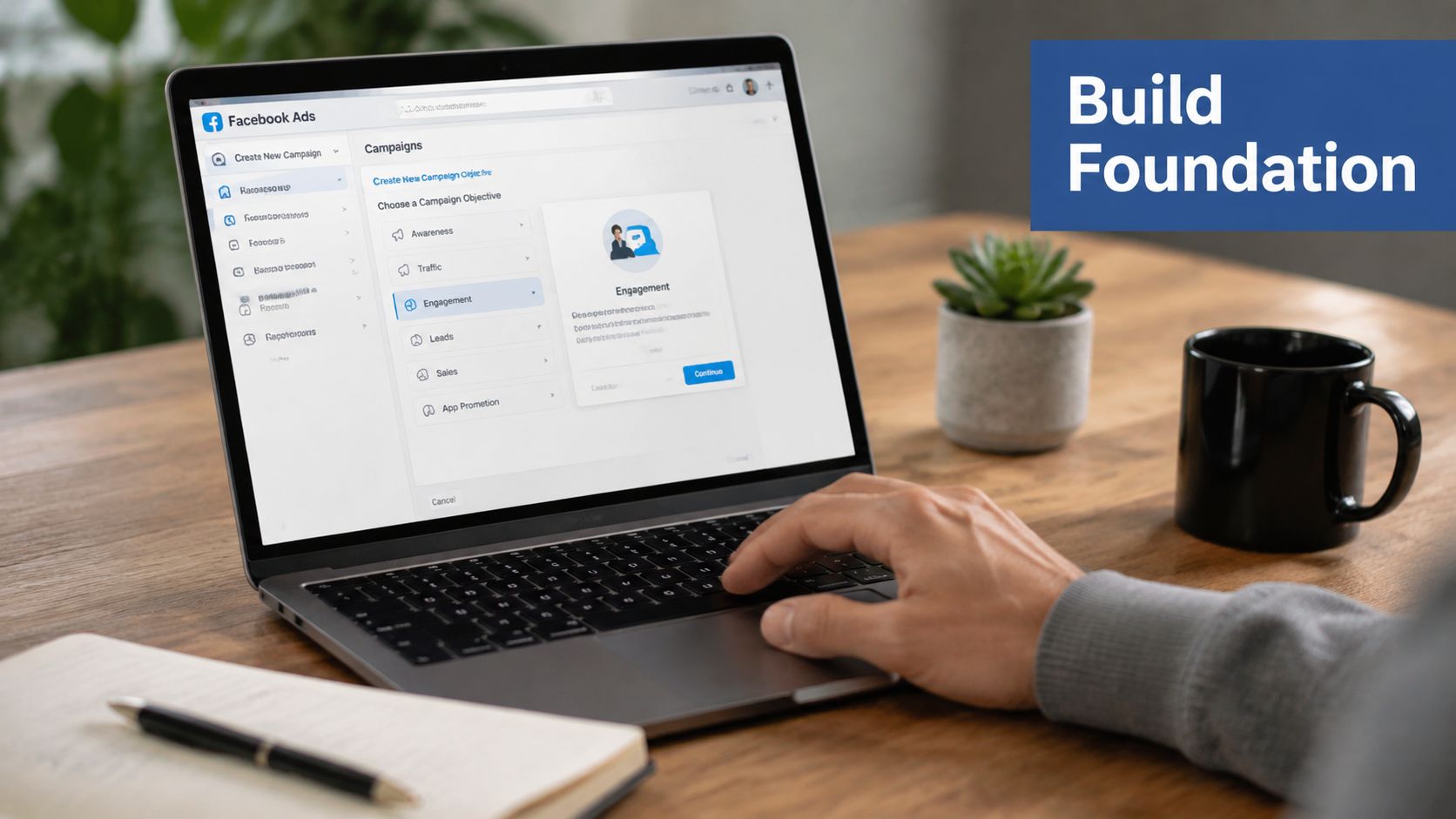
Choose the Sales or Purchase objective when your store can receive purchases and pass the relevant events back to Meta. Traffic and engagement objectives can generate activity, but they ask the system to find people likely to click or interact, not necessarily people likely to buy.
Before spending, confirm that your Business Manager, ad account, domain, pixel, product catalog, and store integration connect correctly. Test the full customer path, including product view, add to cart, checkout initiation, and purchase. A campaign can't optimize around an event your setup doesn't record reliably.
For POD, organize campaigns around meaningful product groups rather than every individual design. A category such as niche t-shirts, seasonal hoodies, or accessories gives Meta enough creative and product context without creating an ad set for every SKU.
A workable launch structure
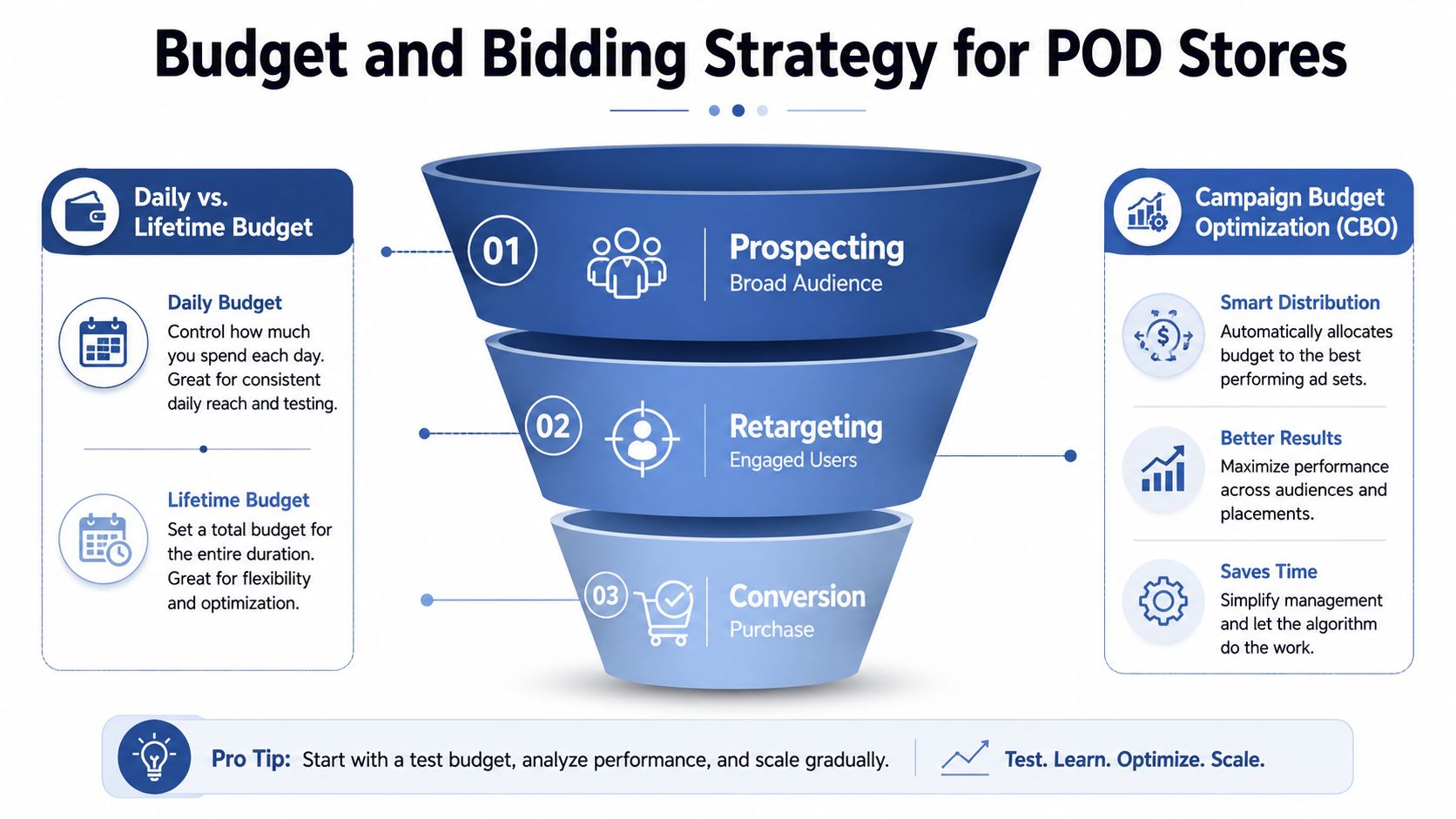
Use a broad prospecting campaign for new buyers, a separate retargeting campaign for people who engaged with your store, and a testing structure when you need to evaluate fresh concepts. Existing customers deserve their own retention logic when repeat purchases make sense for your catalog.
Advantage+ Shopping campaigns are automated, purchase-focused campaigns. You provide the objective, product catalog, creative, and budget, while Meta handles audience selection, placement allocation, bid management, and budget distribution across creatives. This Advantage+ Shopping guide explains the division of responsibility clearly.
Start broad when your product has an obvious audience and your pixel has useful purchase history. Start with a focused interest cluster when the niche is specific, such as a distinct occupation, hobby, or community. Don't combine unrelated themes just to make an audience appear larger.
Keep the first build clean:
- Connect the store and catalog: Make sure product names, images, prices, and availability match the landing pages.
- Install and test the pixel: Verify browser events before interpreting campaign performance.
- Create a small number of ad sets: Give each one a clear audience hypothesis rather than stacking random interests.
- Load varied creative: Include different hooks and visual treatments, not minor changes to the same image.
- Optimize for purchases: Let the campaign gather the signal that reflects your business goal.
The minimum viable setup isn't the smallest possible account. It's the simplest structure that gives Meta a clear objective, enough audience room, and multiple creative options.
Audience Strategy for Print on Demand
POD advertisers often make one of two mistakes. They either target a narrow collection of interests until delivery struggles, or they go broad without creating a compelling reason for the right person to stop scrolling. The strongest approach compares audience types while keeping the creative and offer aligned with the identity of the niche.
Broad audiences
Broad targeting works when the product and creative communicate the buyer clearly. A shirt for a recognizable community can signal its audience through language, visual style, and context, allowing Meta's system to find likely purchasers without a long list of interests.
Broad is usually the cleanest starting point for a store with reliable purchase data or a product with wide appeal. It can also reduce the temptation to make demographic assumptions that don't match real buyers.
Interest-based audiences
Interest targeting still has a role when you're validating a sharply defined niche. Use interests tied to the culture surrounding the product, such as a hobby, profession, lifestyle, or community, rather than relying only on age and gender.
The trade-off is control versus scale. Interest groups can help a new advertiser form a hypothesis, but excessive segmentation spreads budget across too many small pools. Merge audiences when the creative and offer are the same. Separate them only when the buyer motivation or product message changes.
Lookalikes and customer data
Lookalike audiences can help you reach people who resemble purchasers, high-value customers, or qualified site visitors. The source quality matters more than the label. A list of buyers with clear purchase intent is more useful than a large audience built from casual engagement.
For a detailed POD-specific process, use this guide to Facebook lookalike audiences for print-on-demand.
| Metric | Median | Top Quartile |
|---|---|---|
| CPC | $0.87 | $0.61 |
| CTR | 1.93% | 2.78% |
| CVR | 2.7% | 4.1% |
| CPA | $32.22 | $22.15 |
These figures come from the 2026 ecommerce Meta benchmark comparison. The gap isn't solved by audience selection alone. Better creative can improve click quality, while a stronger product page can turn that interest into purchases.
During testing, avoid launching a dozen audience variations at once. Give each meaningful hypothesis enough room to collect signal, then consolidate when multiple ad sets pursue the same buyer with the same message. Expand when a winning concept needs new creative angles, not because delivery feels slow.
The Creative System That Scales POD Ads
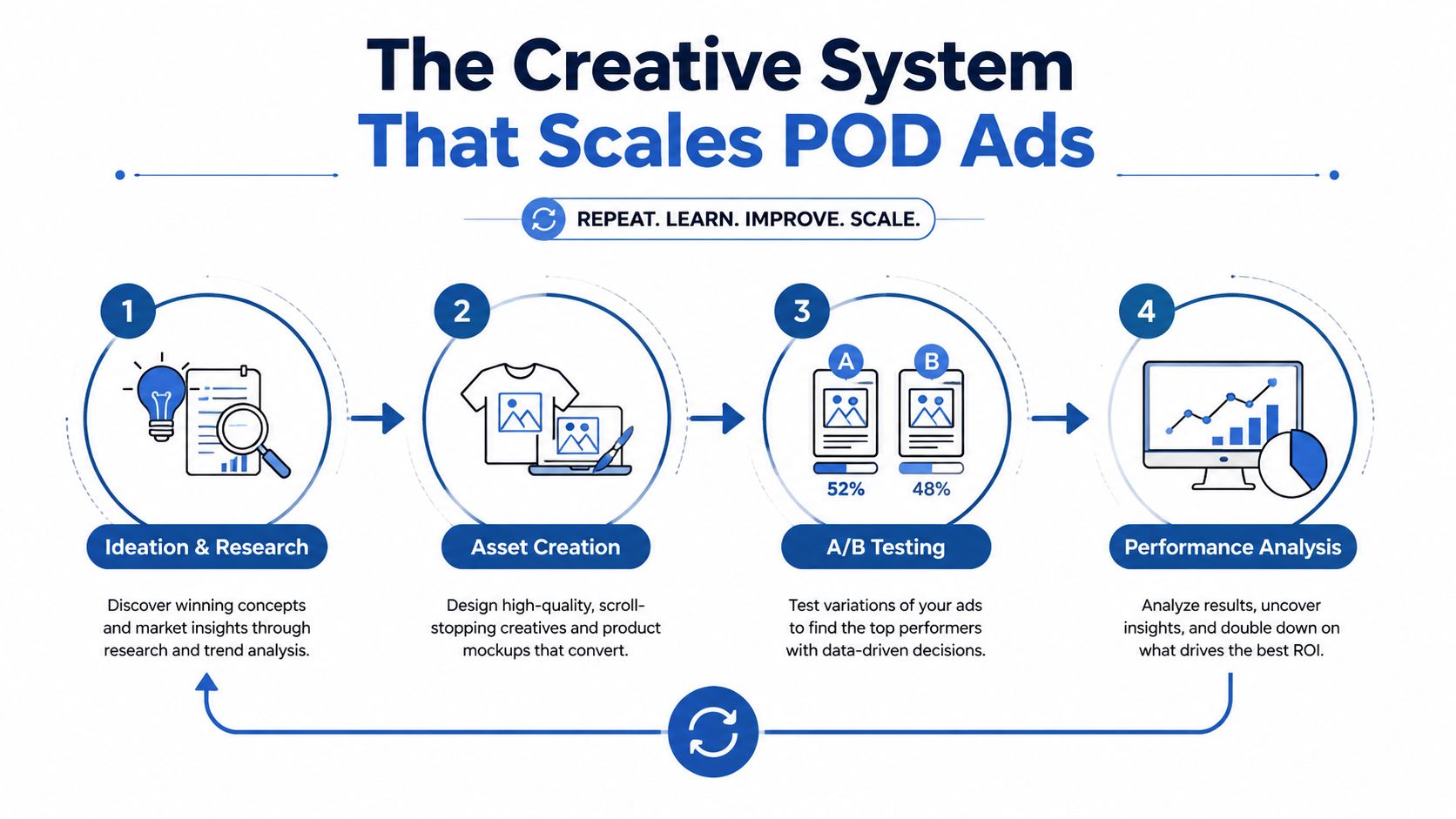
Creative is where POD advertisers can build an advantage without competing on inventory depth. The process starts with research, moves through fast asset production, and ends with disciplined analysis.
Build concepts around identity
Start with the buyer's identity, not the garment blank. A strong concept might use a typography-led statement, niche-specific humor, a seasonal reference, or a visual symbol that members of a community recognize immediately.
Then create variations around the same core idea:
- Static apparel image: Show the design clearly, add a short headline, and make the product context obvious.
- Carousel: Present the front design, close-up details, color options, and a lifestyle frame.
- Short-form video: Open with the niche statement, reveal the garment, show how it looks in use, and finish with a direct purchase prompt.
AvatarIQ gives POD operators a repeatable production layer for this workflow. It can generate unique apparel designs, create product mockups and photoshoot-style assets without hiring photographers or models, and shorten the distance between an idea and a live listing.
A practical workflow begins with several design directions, turns the strongest directions into mockups, and adapts each winner into multiple ad formats. That process creates more useful tests than producing one polished image and waiting for the account to decide its entire future.
Test the message, not just the file
A weak test changes the background color and calls the result new. A useful test changes the reason someone should care:
- Belonging angle: “For people who understand the reference.”
- Gift angle: “A wearable idea for someone who lives this lifestyle.”
- Humor angle: Lead with the joke, then reveal the shirt.
- Seasonal angle: Tie the product to a relevant event or buying moment.
Use this POD Facebook ad image guide for additional production principles.
The best creative system isn't the one that produces the prettiest mockup. It's the one that gives you a steady stream of distinct reasons to buy.
Review performance by hook, concept, format, and product. Pause ads that consistently attract low-quality traffic or fail to move beyond the click stage. Keep promising concepts alive long enough to judge them fairly, then turn winners into new hooks instead of cloning the exact same ad indefinitely.
For a POD business, this is exciting because each niche can generate a broad creative universe. You don't need one perfect design. You need a process that helps you discover which identity, joke, visual, or offer creates genuine purchase intent.
Budget and Bidding Strategy for POD Stores
Set the budget from contribution margin. If an item sells for $35 and costs $12 to produce, $23 remains before other operating expenses. A target CPA below $15 leaves room for those costs and profit. A CPA close to the available margin leaves little protection when conversion rates or fulfillment costs shift. Treat these figures as planning inputs, not market benchmarks.
Choose the budget structure
Daily budgets provide tighter control during testing or periods of changing demand. Lifetime budgets suit promotions with a defined schedule, allowing Meta to distribute spend across the campaign period.
Use Ad Set Budget Optimization when a specific audience or test needs protected spend. Use Campaign Budget Optimization when you want Meta to move budget toward ad sets producing stronger purchase signals. The trade-off is direct. Ad set budgets give you control over learning allocation, while campaign budgets give the platform more freedom to pursue efficient delivery.
Advantage+ Shopping campaigns fit advertisers focused on automated purchase delivery. Meta handles audience selection, placements, bids, and budget distribution, while you provide the catalog and creative. This reduces manual decisions, but it increases the impact of weak creative, poor product feeds, and inaccurate purchase events. For POD apparel, automated delivery cannot compensate for a design that attracts clicks without purchase intent.
Match scaling to evidence
With a smaller daily budget, keep one clear prospecting structure and a limited set of strong creative concepts. At higher spend, separate testing from the main acquisition campaign so new concepts do not interrupt proven delivery. Judge budget capacity by purchase volume and margin, not by spend alone.
Increase budgets gradually. A 20% increase is a useful operating rule for protecting stability, not a guarantee of performance. After each change, review CPA, purchase volume, conversion rate, and blended results before making another adjustment.
When an ad stalls, identify the failing layer:
- Low CTR: The hook, design, or opening frame is not earning attention.
- Healthy CTR but weak purchases: Check the product page, price, sizing details, shipping expectations, and offer.
- Purchases but poor margin: Change the product mix, bundle structure, pricing, or promise made by the creative.
- Uneven ad set delivery: Consolidate overlapping audiences or let CBO redistribute spend.
Do not bid aggressively to force volume. The bid strategy must protect product economics. POD gives you room to change designs, offers, and product combinations, so use those levers before accepting margin loss from a campaign that cannot support itself.
Tracking, Measurement, and Scaling
Meta Ads Manager is useful for optimization, but it is not the complete financial record. Privacy changes and cross-device shopping can prevent Meta from connecting every purchase to an ad interaction. Industry commentary estimates that Meta-reported ROAS may be understated by 30% to 50% for brands with heavy iOS traffic, as discussed in this eMarketer coverage of Meta ecommerce KPIs.
Use the benchmark comparison above for directional context, not as a substitute for your store's economics. A platform dashboard may miss revenue, while its attribution can also claim purchases influenced by other channels. Compare Meta-reported performance with store revenue, payment data, new-customer acquisition, and total advertising spend.
Build a reliable signal
Install the Meta Pixel and verify the event sequence from product view through purchase. Add the Conversions API so your server can send eligible conversion events independently of browser-only signals. Deduplicate events correctly, keep event names consistent, and confirm that purchase value and currency match the order record. Skup's Facebook Pixel resource provides a practical reference for pixel setup.
A GA4 connection supplies another view of traffic paths and assisted behavior. It will not create perfect attribution, but it helps compare sessions, landing pages, campaign parameters, and purchase behavior outside Meta's reporting view.
Your operating dashboard should separate:
- Platform ROAS: Revenue Meta attributes to its ads.
- Blended ROAS: Total store revenue divided by total ad spend.
- New-customer CPA: Acquisition cost measured against first-time buyers.
- Contribution margin: Revenue after product, fulfillment, transaction, and advertising costs.
For advertisers using advertorial or educational pre-sell pages, how listicle advertorials perform offers useful context for evaluating the post-click path. The ad earns attention, but the page must carry the argument through to the product.
Scale by milestones
Validate a product with controlled spend, then confirm that purchases remain economically viable across a sustained observation period. Increase budget in measured steps only after the same tracking system shows acceptable contribution margin. Expand audiences after the creative and landing page can convert the existing audience.
When results weaken, check event quality, creative fatigue, offer clarity, product-market fit, and blended profitability in that order. For POD apparel, tracking design-level performance matters because a profitable campaign can hide weak products beside strong sellers. Scaling becomes easier to control when every budget increase follows evidence from clean events, store records, and margin data.
Common Mistakes and How to Avoid Them
POD advertisers don't usually fail because they lack effort. They fail because they interpret incomplete signals too quickly.
Killing campaigns after the first day
A campaign can need time to stabilize, especially when the purchase event is less frequent than clicks or content views. Don't judge a product solely from day-one activity. Use a defined observation window, review the funnel in sequence, and make changes when the evidence points to a specific bottleneck.
Optimizing for clicks instead of customers
Clicks can make a weak campaign look busy. The useful question is whether those visitors view the product, add it to cart, complete checkout, and produce acceptable contribution margin. If CTR looks healthy but purchases don't follow, improve the landing page or offer before celebrating the top-of-funnel number.
Testing too little creative
One design and one hook can't tell you whether the niche is unprofitable or the message is underdeveloped. Establish a weekly rhythm that introduces new concepts, formats, and openings while preserving enough consistency to learn what changed.
These mistakes are normal, and none of them closes the door on the opportunity. Print-on-demand apparel still gives entrepreneurs a flexible way to develop products around real communities, and a disciplined Facebook ads system can turn creative ideas into measurable tests instead of expensive guesses.
Skup offers the Apparel Cloning System for learning a structured approach to finding and developing POD apparel products, while AvatarIQ supports AI-assisted design creation and mockup production. Visit Skup to explore the training and tools that can help you turn this Facebook ads for ecommerce playbook into an operating system for your store.