Print on Demand Shirts: A Beginner Guide to POD Apparel
You've got a notebook full of shirt ideas, a few niche concepts saved on your phone, and no desire to fill a spare room with boxes of inventory. That's exactly where print on demand shirts become interesting. You can build a focused apparel brand, publish designs, and let a fulfillment partner produce each item after a customer places an order.
The opportunity is substantial. One market estimate valued global print on demand at $11.4 billion in 2022 and projected 21.1% annual growth through 2030. Apparel represented 45% of global POD revenue in 2022, while the custom t-shirt market was estimated at about $9.8 billion in 2024 and forecast to reach $18.6 billion by 2030. See the print-on-demand industry market data for the underlying estimates.
The exciting part isn't that every shirt will sell. It's that you can test ideas without making a large inventory bet. The durable businesses come from combining a strong niche and clear designs with disciplined pricing, quality control, customer service, and repeatable marketing.
Table of Contents
- What Print on Demand Shirts Actually Are
- How the POD Shirt Business Model Works
- Real Costs and Margins on POD Shirts
- Designing Shirts and Building Mockups
- Where to Sell Your POD Shirts
- Marketing and Scaling Your POD Shirt Store
- Common Pitfalls and Smart Next Steps
What Print on Demand Shirts Actually Are
A beginner usually starts with a simple question: “How can I turn this design into a shirt without buying a pile of shirts first?” With print on demand, the answer is to list the design on a blank garment and have it produced only after a shopper buys it.
You don't purchase a warehouse of finished products. A POD provider keeps blank apparel available, receives the order through an integration, prints your artwork, packs the garment, and sends it to the customer. You pay the provider's production and shipping costs as the order moves through fulfillment, rather than committing your cash to every size and color in advance.
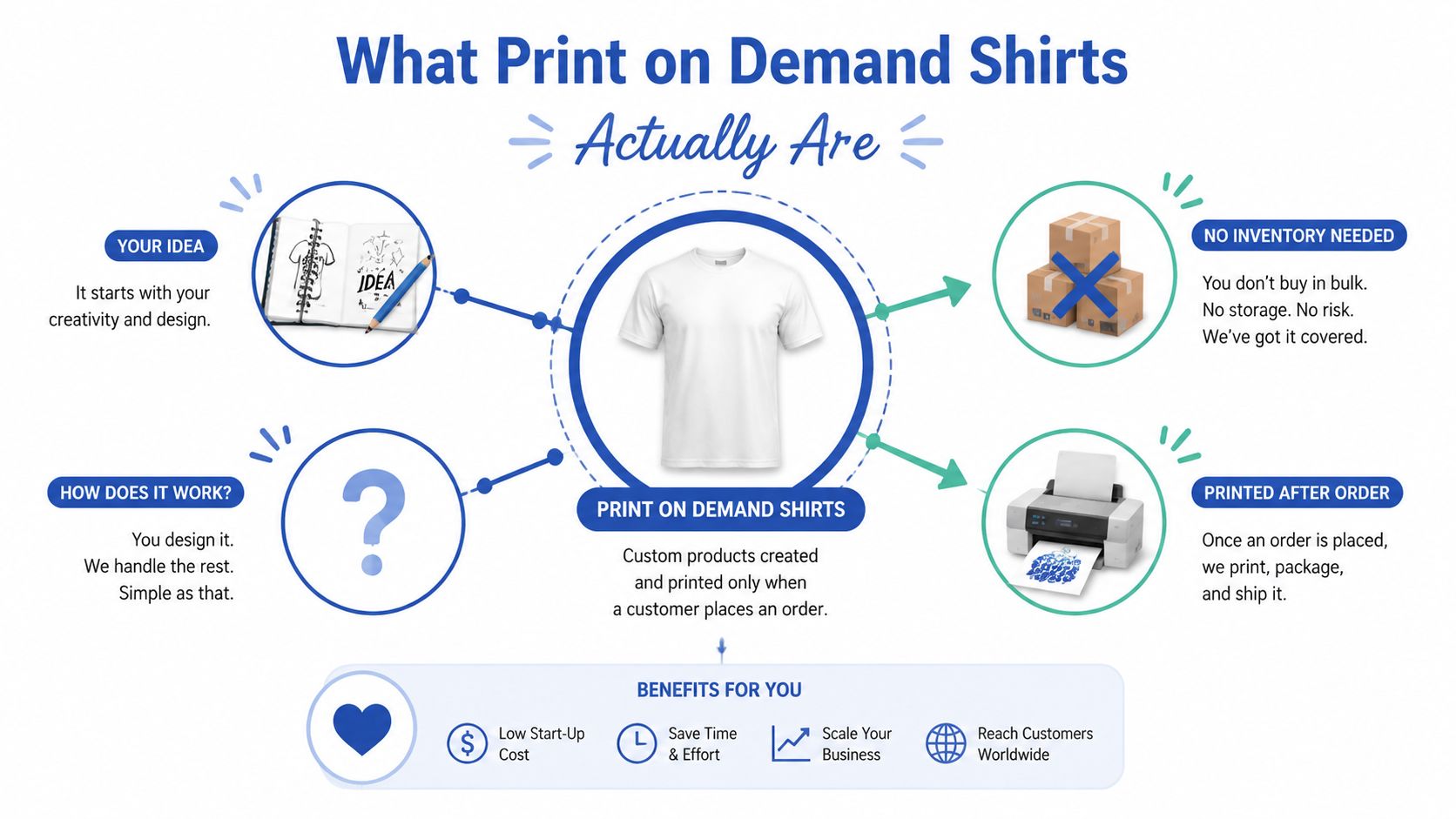
For a fuller foundation, this guide to what print on demand means explains how the broader model fits together.
How shirts differ from other apparel models
POD shirts differ from traditional custom screen printing because screen printing commonly makes a planned batch, while POD production starts with an individual customer order. POD also differs from ordinary dropshipping. With dropshipping, a seller usually forwards an order for an already manufactured physical product. With POD, the garment is a blank product that gets customized during fulfillment.
The product range can include:
- T-shirts: The familiar starting point for graphic designs and niche apparel.
- Tank tops: Useful for warm-weather or fitness-oriented collections.
- Hoodies: A natural extension for colder seasons and higher-priced bundles.
- Long sleeves: Helpful when a design concept needs more coverage or seasonal relevance.
Cotton and cotton-blend garments dominate because they're comfortable, familiar to shoppers, and suitable for common decoration methods. Direct-to-garment printing sprays ink onto fabric, direct-to-film transfers a prepared design onto the shirt, and sublimation works particularly well with polyester because the dye bonds with the synthetic fibers.
That flexibility makes the model useful for solo creators, community brands, and founders testing a new concept. You can start with a small collection, watch which ideas attract attention, and expand the winners without guessing how many garments to buy.
How the POD Shirt Business Model Works
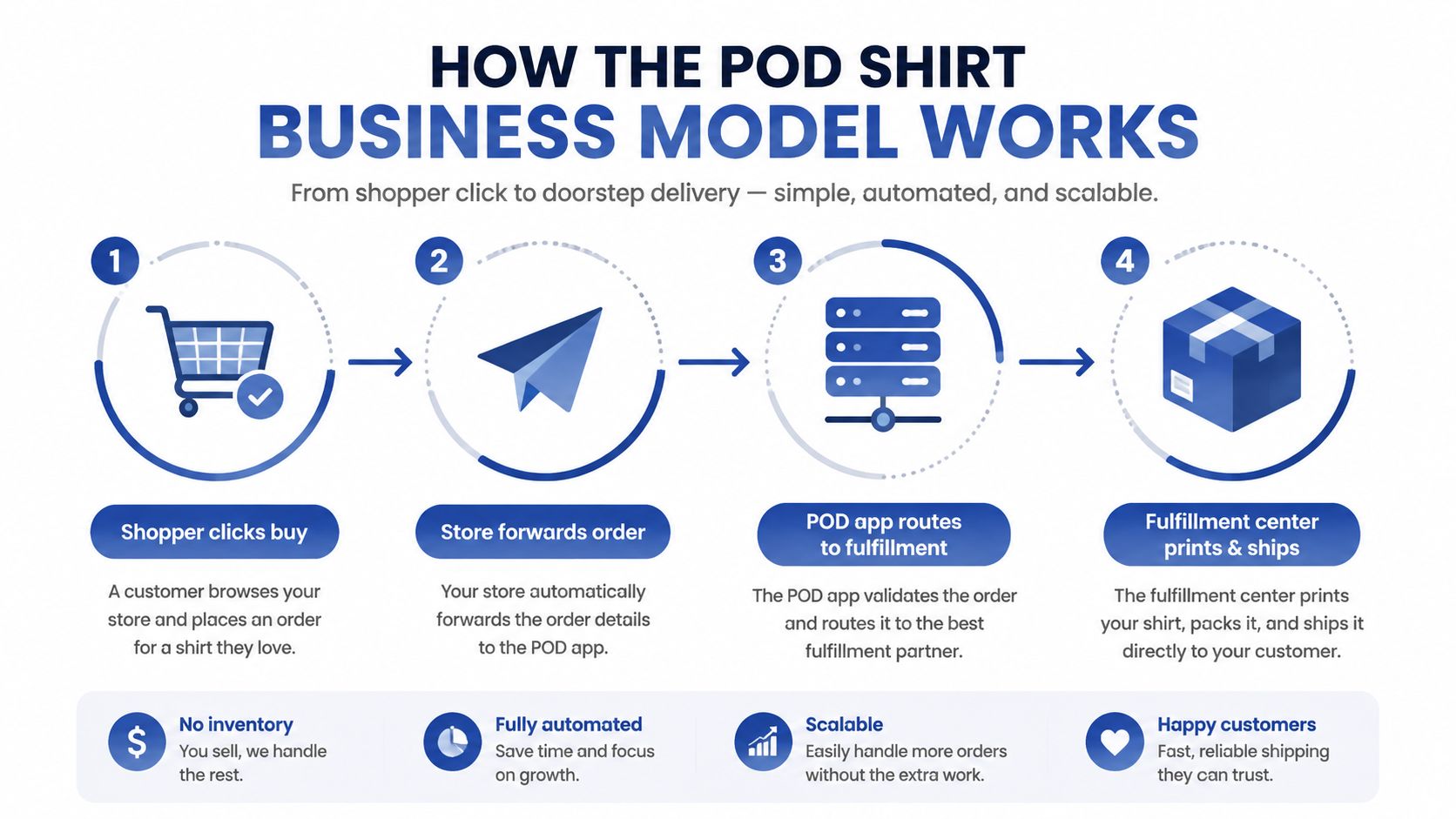
The easiest way to understand fulfillment is to follow one order from checkout to delivery. A shopper sees your listing, chooses a size and color, and clicks buy. Your storefront records the purchase and sends the order details to the connected POD application.
The application routes that order to a suitable fulfillment center. The center selects the blank shirt, applies your design, cures or sets the print according to the production method, checks the item, and prepares it for dispatch. Packaging may be a poly mailer or a box, depending on the garment and provider.
Who handles each part
Your job is to create the offer around the shirt. That includes:
- Product pages: Show the design clearly, describe the garment, and provide measurements.
- Pricing: Set a price that accounts for production, shipping, selling fees, marketing, and customer support.
- Marketing: Bring the right audience to the listing through search, content, partnerships, or paid advertising.
- Customer care: Answer questions, investigate delivery issues, and resolve legitimate production problems.
The POD provider handles the physical work. It supplies the blank, prints the artwork, packs the item, and passes tracking information back to the store. The customer then receives an order email and later a shipment update without you manually printing labels.
Practical rule: Treat automation as a workflow, not a promise that the business runs itself. You still control the product page, expectations, pricing, and customer experience.
This separation helps with cash flow because you aren't buying finished inventory before you know whether customers want it. It also gives you access to fulfillment across regions, which can make international selling more practical than shipping every order from your home.
The process is straightforward, but provider selection still matters. Compare garment availability, print consistency, delivery coverage, tracking, support, and how the provider handles reprints. A low base cost won't help if defects create refunds and replacement orders.
Watch the process visually before you connect your store and publish products.
Real Costs and Margins on POD Shirts
A shirt's selling price isn't its profit. Margin forms after the blank garment, decoration, shipping, selling fees, marketing, refunds, and other operating costs have been accounted for.
A simple illustration makes the logic clear. If a shirt has a $9 base cost and $4.50 shipping, then sells for $24.95, removing an approximately $2 marketplace fee leaves a single-digit to low-double-digit amount before advertising, returns, taxes, and other expenses. This is an example of how the calculation works, not a guaranteed result.
| Cost Component | Typical Amount | Notes |
|---|---|---|
| Blank garment and printing | Varies by provider | The product and decoration method determine the production charge. |
| Shipping | $4.75 for one U.S. t-shirt | Printful's pricing table lists $2.20 for each additional item in the same U.S. shipment. Review the current POD shipping pricing context before publishing delivery promises. |
| Marketplace or platform fee | Varies by channel | Transaction and payment fees reduce the amount you keep from each sale. |
| Advertising | Varies by campaign | Paid traffic can become the largest variable expense if targeting or creative is weak. |
| Returns and replacements | Varies by issue | Size confusion, print defects, and shipping damage can erase otherwise healthy orders. |
| Packaging extras | Varies by provider | Branded inserts, packing slips, and special packaging may add cost. |
POD unit economics usually don't improve through bulk purchasing in the same way traditional apparel manufacturing can. That means your advantage comes from a sound retail price, strong conversion, relevant products, repeat buyers, and careful control of avoidable expenses.
Shipping deserves special attention because rates change by destination. Printful's table lists regional rates for the United States, Europe, the United Kingdom, Canada, Australia and New Zealand, Japan, Brazil, and worldwide orders. Build shipping into your pricing decision instead of treating it as a final checkout surprise.
You'll also want to track expenses that are easy to ignore, including branded packing materials, replacement orders, payment processing, ad spend, subscriptions, and time spent handling support. The POD profit margin guide can help you map revenue and costs in one view.
Designing Shirts and Building Mockups
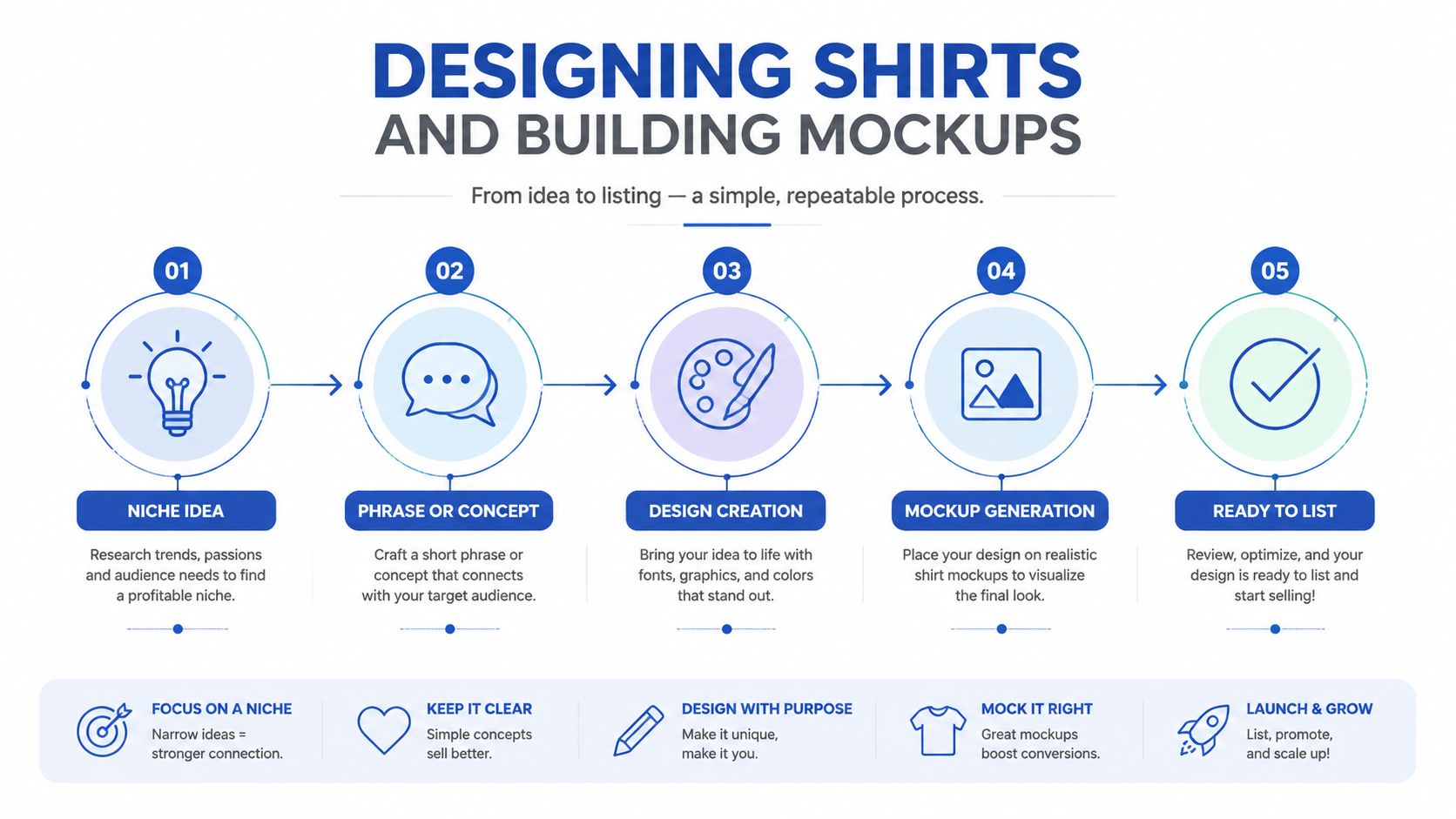
A sellable shirt starts with a specific person, not an empty canvas. Choose a narrow audience, identify a phrase or visual idea that belongs to that group, and decide what the garment should communicate at a glance.
You can use AI image tools such as Midjourney or DALL-E to explore artwork directions, then prepare the final assets in AvatarIQ, which is built for apparel design creation and product mockups. The important workflow is to move from rough exploration to a clean, legally usable production file rather than uploading the first image an AI tool generates.
Prepare the file for the garment
For DTG production, beginners commonly prepare a PNG at 300 DPI in RGB color mode, with a transparent background when the design needs to sit directly on the shirt. Confirm the provider's required dimensions before exporting because chest prints, full-front placements, and all-over-print files use different working areas.
Typography needs the same attention as illustration. Check that text remains readable at a distance, that thin lines don't disappear against the garment color, and that the design still makes sense when viewed as a small product thumbnail.
Commercial rights also matter. Don't use trademarked characters, team logos, protected slogans, or artwork you can't license for commercial use. An attractive design can still become a costly problem if you can't prove you have permission to sell it.
Build the listing visuals
A mockup places the design on a model or garment image so shoppers can understand the product before ordering. Use a clean hero image first, then add a lifestyle view, a close detail crop, and a size chart. A short video mockup can show movement and fabric placement in social ads.
The apparel mockup generator workflow is useful when you need consistent visuals across several designs. Keep the shirt color, print placement, and proportions accurate. A dramatic mockup that doesn't resemble the delivered product creates the exact expectation gap that leads to complaints.
Before publishing, check four things:
- Artwork: The background, edges, colors, and text look intentional.
- Placement: The design sits where the provider's template indicates.
- Listing media: The hero image, lifestyle image, detail view, and size chart agree.
- Rights: Every commercial asset has a clear usage basis.
Where to Sell Your POD Shirts
Your first sales channel shapes how customers find you and how much control you keep. Marketplaces provide an existing shopping environment, while standalone stores give you more ownership but require you to create demand.
Marketplaces such as Etsy, Amazon Merch on Demand, and eBay can expose a new listing to shoppers who already have buying intent. They can be a practical starting point for testing a niche, but you'll work within platform policies, product restrictions, search competition, and account rules.
A standalone store on Shopify, WooCommerce, or BigCommerce gives you greater control over branding, pricing presentation, customer relationships, email collection, bundles, and upsells. The tradeoff is that you must generate more of the traffic yourself and take responsibility for a larger portion of the customer journey.
| Factor | Marketplace Storefront | Standalone Shop |
|---|---|---|
| Discovery | Built-in search can help shoppers find products. | You create discovery through content, search, partnerships, or ads. |
| Brand control | Store presentation follows platform limits. | You control the storefront and buying experience. |
| Customer relationship | Platform rules shape access to customer information. | You can build owned email and retention channels within applicable laws. |
| Competition | Similar listings may appear beside yours. | Your store can focus attention on your own collection. |
| Setup effort | Faster to begin, with marketplace policies to learn. | More setup, payment, analytics, and merchandising decisions. |
| Long-term value | Useful for reach and validation. | Better suited to developing a distinct owned brand. |
Hybrid selling often makes sense. A marketplace can help you validate a design angle, while your own site gives loyal buyers a place to explore the wider collection.
If you choose Shopify, creative testing becomes part of the operating system. A resource such as this Shopify creative testing platform can help organize the process of comparing product content and advertising creative rather than relying on one favorite image.
Marketing and Scaling Your POD Shirt Store
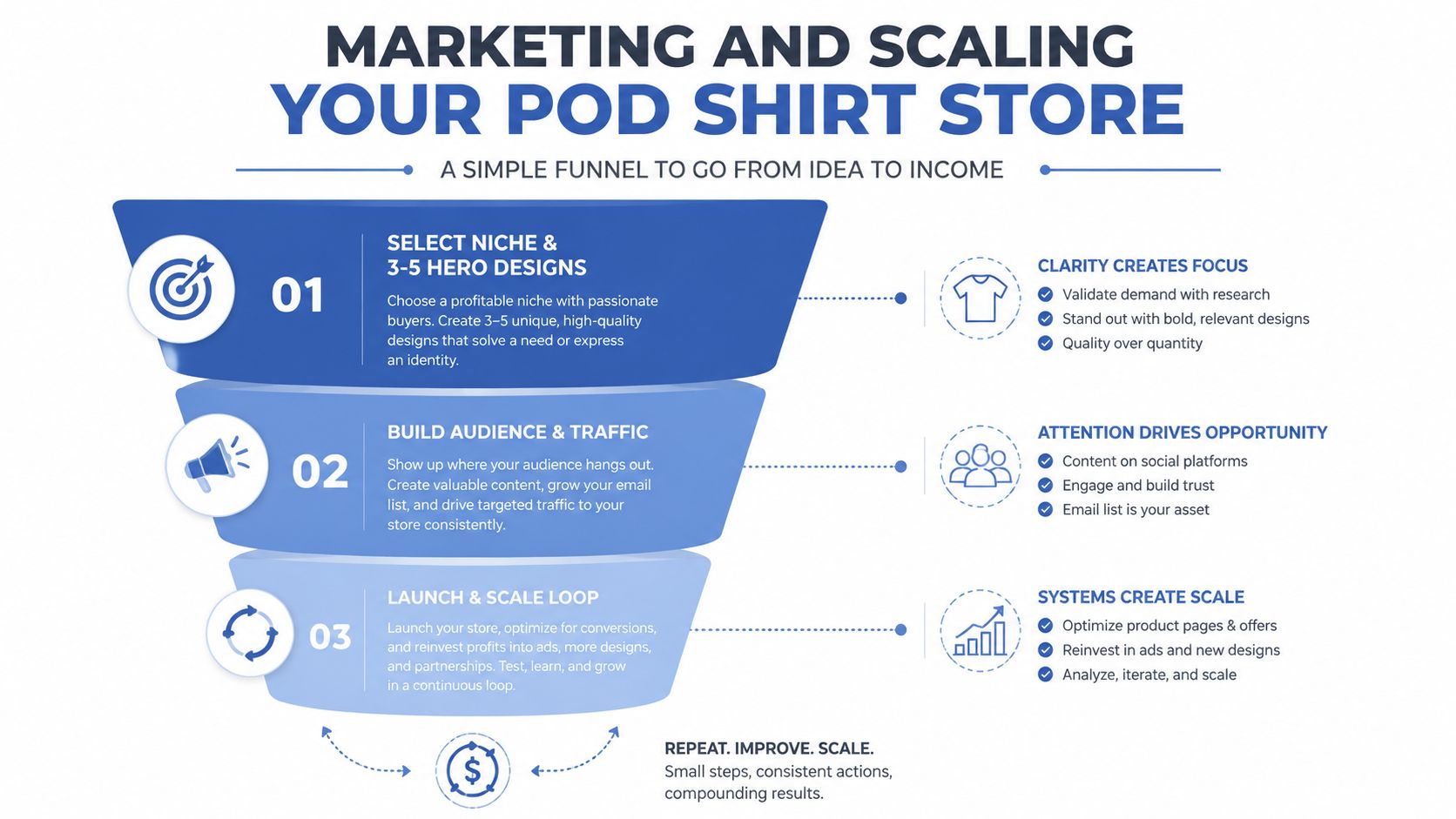
A strong marketing loop connects three pieces: a defined audience, a small group of relevant products, and a traffic source you can measure. Start with one tight niche and three to five hero designs, not a huge catalog of unrelated graphics.
Your first month should create evidence. Publish the initial collection, make short videos that explain the design story, create Pinterest pins that lead to the listings, and use Instagram Reels or TikTok to show the garment, the concept, and the person who would wear it. A simple welcome email flow can offer a 10 percent first-order discount to new subscribers, provided your store's terms and local marketing rules support that offer.
A practical launch loop
Use organic content to learn which messages attract attention before spending heavily. One video might focus on the niche identity, another on the artwork process, and another on how the shirt looks when worn. Keep the product consistent enough that you can tell whether the creative or the offer is changing the result.
Paid traffic can then amplify the strongest ideas. The plan described here uses $5 to $20 daily for initial testing and three creatives per ad set, with each amount and testing choice treated as a working framework rather than a promise of performance. Stop an ad when its cost per purchase moves above the margin your order can support, then diagnose the problem before increasing spend.
Retargeting can bring back shoppers who viewed a product or abandoned a cart. Dynamic product ads can show relevant items again, while lookalike audiences can help you reach people who resemble past buyers once your store has enough suitable customer data.
Scaling discipline: Increase budget only after the campaign has held its target return on ad spend for 7 days. Add designs weekly when they support the same audience, and use post-purchase offers to encourage a second item or a complementary garment.
Creative production can become a bottleneck as your catalog grows. An unlimited design resource for marketing teams may help when you need a steady flow of campaign assets, product graphics, and social variations.
The best scaling decisions come from a weekly review. Check which designs attract clicks, which listings convert, which messages generate replies, and where customers abandon the journey. Then improve one part of the loop instead of changing everything at once.
Common Pitfalls and Smart Next Steps
Most beginner problems with POD shirts aren't caused by the business model. They come from small operational decisions that compound, such as publishing weak artwork, guessing at fit, or spending on traffic before the offer is ready.
A saturated trend can still work when you add a clear audience angle. “Funny shirt” is broad. A design built around a specific hobby, profession, local identity, or seasonal moment gives the shopper a stronger reason to choose your product.
Fix the mistakes that create refunds
Low-resolution artwork can look acceptable in a tiny preview and fail when printed large. Review the final file at its intended size, inspect transparent edges, and order a sample before building a campaign around a design.
Pricing also needs more than adding a markup to the blank garment. Include production, delivery, platform fees, advertising, refunds, and support when deciding whether the offer has room to grow.
Size confusion is especially avoidable. Put the measurement chart beside the product information, describe the fit plainly, and make sure the mockup doesn't imply a fit that the chart contradicts.
Use returns as a diagnostic system rather than an emotional scorecard. Independent POD guidance says well-run stores usually see return rates in the 1% to 2% range, while 2% to 3% or higher should prompt investigation. The POD returns and quality-control guidance highlights common causes such as incorrect uploads, poor provider selection, wrong sizes, faded prints, misalignment, and shipping damage.
Track each return by cause. If the same design produces repeated print complaints, pause it. If a particular garment creates fit issues, revise the description or switch blanks. If damage happens during delivery, investigate packaging and carrier handling.
Your next 14 days
Use a short operating sprint to replace guessing with evidence:
- Choose one niche: Write down the audience, its shared interest, and the reason it would wear the shirt.
- Publish five listings: Give each design accurate mockups, readable descriptions, and a visible size chart.
- Drive targeted impressions: Put the collection in front of 1,000 targeted impressions, focusing on relevance rather than random reach.
- Collect three customer messages: Ask what shoppers understand, what they question, and what almost stopped them from buying.
- Make a decision: Double down, pivot, or pause based on the responses, listing behavior, and order quality.
The objective is a repeatable weekly routine and a return rate near 1% to 2%, not a rushed upload marathon. The broader market supports continued experimentation. One recent report valued global POD at $10.8 billion in 2025 and projected $57.5 billion by 2033, with apparel holding 39.5% of market share in 2025, as reported by Grand View Research. Another projection puts the market at $57.49 billion by 2033, with a 23.6% CAGR from 2026 to 2033, which supports infrastructure that reduces dead stock and lets sellers test designs efficiently, according to Grand View Research's market announcement.
The opportunity is real, but the advantage goes to the founder who treats design, fulfillment, margins, and customer feedback as one connected system.
Skup offers practical print-on-demand apparel education through its Apparel Cloning System, while AvatarIQ helps create apparel designs and product mockups for a faster listing workflow. Visit Skup to explore a structured path for turning your first shirt ideas into a focused ecommerce brand.