Email Marketing Strategy for eCommerce Growth
At roughly 392.5 billion emails sent and received worldwide each day in 2026, the inbox is one of the most crowded places in commerce. Yet email remains a durable owned channel, with the global email marketing market valued at $13.72 billion in 2026 and projected to reach $22.93 billion by 2031, according to Email Vendor Selection's email marketing statistics.
For a print on demand apparel brand, that scale creates both pressure and opportunity. A generic broadcast can disappear quickly, while a useful message triggered by a viewed design, recent purchase, or fading interest can feel perfectly timed. The difference isn't sending more email. It's building an email marketing strategy around buyer behavior.
Table of Contents
- Why Email Is Your Highest-ROI Channel in eCommerce
- The Customer Lifecycle That Powers Your Store
- Building and Growing a Qualified Email List
- Segmentation That Actually Drives Repeat Sales
- Automation Flows That Print Revenue on Autopilot
- Campaign Planning and the Monthly Send Rhythm
- Measuring What Matters and Lifting Lifetime Value
- Your 30-Day Email Strategy Launch Plan
Why Email Is Your Highest-ROI Channel in eCommerce
Email's financial appeal comes from ownership. You pay to acquire attention through advertising, but once a shopper gives permission to hear from your brand, you can nurture that relationship without purchasing every future visit again.
Benchmarks vary by business model and measurement method, but email marketing has historically produced roughly $38 to $42 in revenue for every $1 spent, while another benchmark places the average at about $36 per $1. The figures are summarized in Rox's email marketing ROI benchmark. That range makes the strategic point clearly. Small improvements in list quality, relevance, and automation can have a meaningful effect on a store's economics.
Paid social still plays an important role in discovery. Search captures existing demand. Email does something different. It gives you a direct way to educate, sell, follow up, and bring previous buyers back without depending entirely on an auction or algorithm.
| Metric | Paid Social | |
|---|---|---|
| Ownership | You build a permission-based audience | You rent access to an audience |
| Main strength | Lifecycle messaging and repeat revenue | Discovery and demand generation |
| Cost pattern | Infrastructure and creative costs, with reusable automations | Ongoing spend tied to impressions or clicks |
| Best POD use | Welcome, cart recovery, post-purchase, and win-back | Testing niches and acquiring new shoppers |
| Main risk | Poor relevance can damage engagement and deliverability | Rising costs or changing delivery can reduce efficiency |
The compounding advantage
An email program gets stronger when every buyer contributes useful first-party data. A customer who buys a fishing hoodie tells you something about category interest. A subscriber who clicks a cap collection gives you another signal. A customer who ignores several campaigns may need reduced frequency rather than another discount.
Automations turn those signals into repeatable actions. In the ROI benchmark cited above, automated campaigns generated about $3.41 per send, compared with $0.155 for regular campaigns, alongside a 1.49% conversion rate for automations. Those figures aren't a promise for every store, but they show why lifecycle automation deserves priority over endless newsletter production.
The practical lifecycle is straightforward: acquire permission, activate interest, convert the first order, encourage the second purchase, recognize loyal buyers, and reactivate people before they disappear. A focused list with strong behavioral signals can produce more useful revenue than a much larger list that receives the same message every time.
The Customer Lifecycle That Powers Your Store
A niche fishing streetwear brand launches a bass-themed hoodie. An angler sees a short-form video, visits the product page, and joins the drop list after seeing a lure-related incentive. That subscriber hasn't earned a sales-heavy message yet. They need to understand the brand, the niche, the product quality, and what makes the drop worth watching.
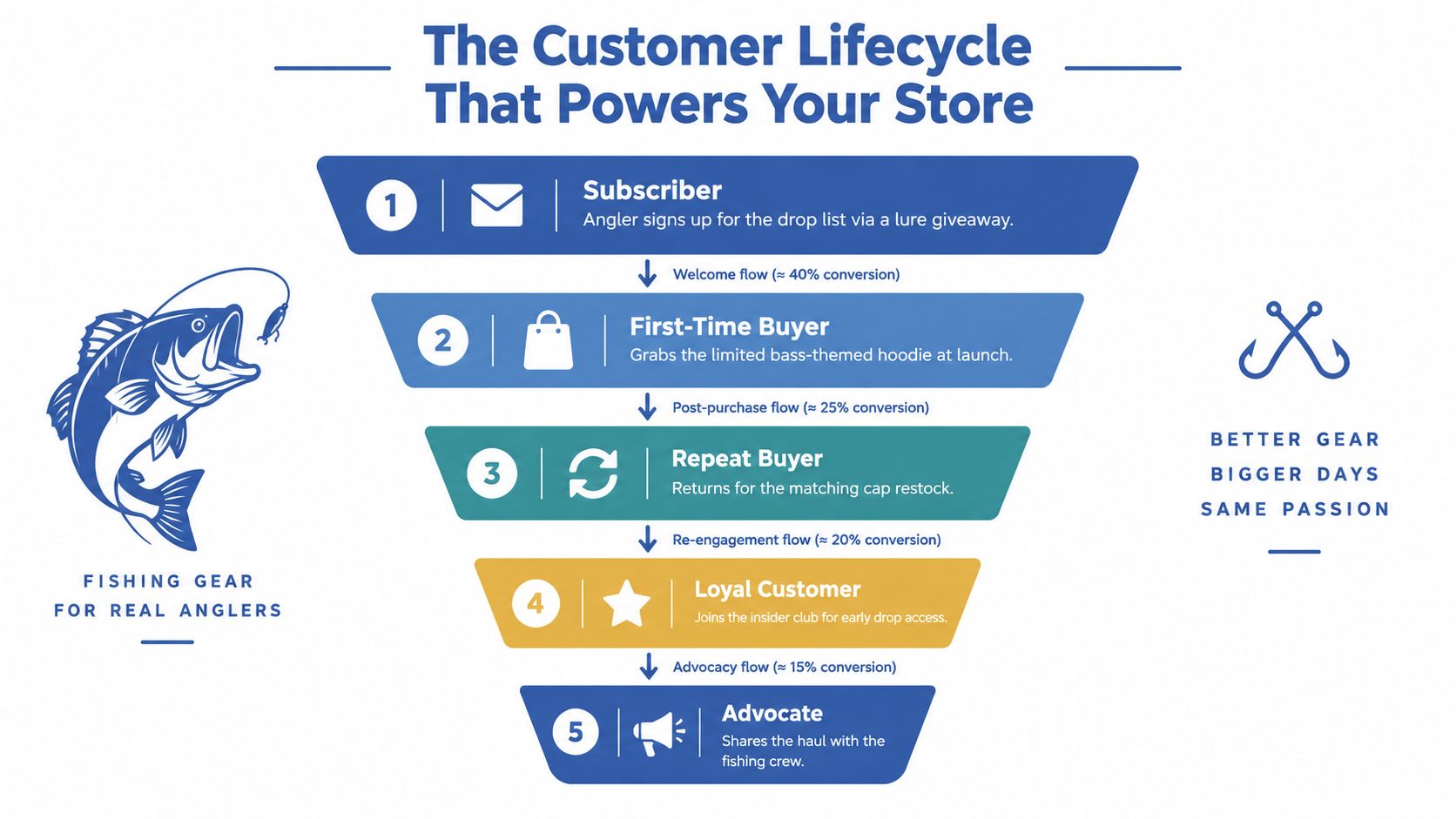
Five moments, five revenue jobs
Subscriber: The job is trust and activation. Send the promised incentive, introduce the brand's point of view, and show related designs without forcing an immediate purchase.
First-time buyer: The job is confidence. Confirm the order, explain what happens next, answer sizing and care questions, and make the customer feel good about the decision.
Repeat buyer: The job is discovery. Recommend a complementary product based on the first purchase, such as a matching cap for someone who bought the bass hoodie. The message should feel like a relevant next step, not a random catalog blast.
Loyal customer: The job is recognition. Give engaged buyers early access to a new drop, invite their preferences, and let them feel closer to the brand than a casual subscriber.
Advocate: The job is participation. Ask for a photo, a review, or a share that fits the community. A buyer who posts the haul with their fishing crew can introduce the brand to people who already understand the niche.
POD apparel supports this model because collections and designs create visible intent. A buyer can self-identify through a product category, theme, or drop. That behavior is more actionable than a broad demographic label.
Practical rule: Every lifecycle stage needs a different message objective. If the same promotion reaches a new subscriber, a recent buyer, and a dormant customer, the segmentation problem is already costing you sales.
A useful reference for mapping these stages is lifecycle marketing by Sprints & Sneakers. The value isn't in copying another brand's sequence. It's in viewing the customer relationship as a progression, with a specific next action at each point.
Many POD operators focus heavily on getting the first sale and then return to acquisition. That leaves the most controllable part of the relationship underdeveloped. The second purchase, early access, and win-back stages deserve the same operational attention as the first checkout.
Building and Growing a Qualified Email List
A list grows profitably when the opt-in matches the visitor's intent. A generic discount can create volume, but a design preview, preference quiz, or restock alert often tells you more about what the subscriber wants.
Start with the highest-intent placements. Put a design-preview waitlist near a product page for shoppers waiting on a drop. Route a style quiz from niche landing pages so the answer becomes a useful preference signal. Use an exit message to address shipping or value concerns, not just to repeat the same discount.
| Lead Magnet | Placement | Conversion Rate | Quality Benchmark |
|---|---|---|---|
| Design-preview waitlist | Product page before checkout | Measure against the page baseline | Product clicks and launch purchases |
| Style quiz | Niche landing page | Compare by traffic source | Category preference and click activity |
| First-order offer | New-visitor popup | Track by audience and device | Purchase behavior after signup |
| Shipping incentive | Exit-intent message | Compare with other exit treatments | Completed orders and low complaint activity |
| Niche giveaway | Social campaign landing page | Evaluate by source quality | Engagement with the promised category |
The quality signal matters more than the raw signup count. A subscriber who joins for a fishing collection and clicks fishing-related products is more useful than someone who enters a broad giveaway and never engages again. The same principle applies to a popup. Judge it by downstream behavior, not just by how many addresses it collects.
A cleaner acquisition system
Use clear consent, set expectations, and make the first message arrive while the visitor remembers why they subscribed. Keep the form simple, then learn more through clicks and preference prompts. You can also build the program around the practical recommendations in Skup's email list-building guide.
Don't buy lists or scrape addresses. Those contacts lack permission, weaken engagement signals, and can create deliverability problems. A smaller, self-selected audience gives your flows better behavioral data and makes campaign decisions easier.
The list-growth playbook should also connect to the store's creative workflow. A niche collection built with AvatarIQ can support a preview sequence, a preference quiz, and a launch alert without requiring the brand to treat every subscriber as interested in every design. The strongest list is not the one with the most names. It's the one where each name carries a useful reason for being there.
Segmentation That Actually Drives Repeat Sales
Demographics can describe a customer, but behavior tells you what message to send next. Someone who bought a streetwear hoodie recently should not receive the same email as someone who browsed feminist graphic tees yesterday or someone who hasn't clicked in months.
Begin with a small operating system rather than dozens of complicated rules. The core segments below cover the most important revenue decisions for a POD apparel store.
| Segment | Filter Logic | Primary Offer | Expected Revenue Share |
|---|---|---|---|
| First-time buyers | One completed purchase and no subsequent order | Complementary product and helpful ownership content | Prioritize for second-purchase development |
| Repeat buyers | More than one completed purchase | Early access and collection recommendations | Prioritize for retention |
| High-value customers | Strong order value or repeated purchasing | Recognition, exclusivity, and previews | Prioritize for margin protection |
| Browse abandoners | Viewed a category without purchasing | Objection handling and relevant products | Prioritize for conversion recovery |
| Dormant subscribers | Extended inactivity or no recent purchase | Preference reset, reactivation, or suppression | Prioritize for list health |
The filters that matter
For a first-time buyer, filter by one purchase and no later order. The offer angle is a related product, not an aggressive discount. Watch second-purchase rate and revenue per recipient.
For a browse abandoner, filter by the category viewed and exclude anyone who already purchased that product. Show the design they considered, answer a likely objection, and measure clicks through to the relevant collection.
For a high-value customer, use purchase frequency and order value together. Don't reduce the relationship to a coupon. Early access, limited previews, and recognition can protect margin while giving the buyer a reason to return.
Dormant subscribers need a decision, not endless reminders. Offer a clear way to update preferences, invite them back with a relevant collection, and suppress people who continue to show no interest. This email segmentation strategy guide from Netco Design LLC is a useful resource for thinking through behavior-based audience rules.
The segment definitions should stay understandable to the team running the store. If an operator can't explain why a person entered a segment, the rule is probably too complicated. Relevance comes from a few reliable signals applied consistently, not from building an elaborate database nobody maintains.
Automation Flows That Print Revenue on Autopilot
Automations make email responsive. Instead of asking what to send to the entire list, you define what should happen after a subscriber takes a meaningful action.
Welcome flow
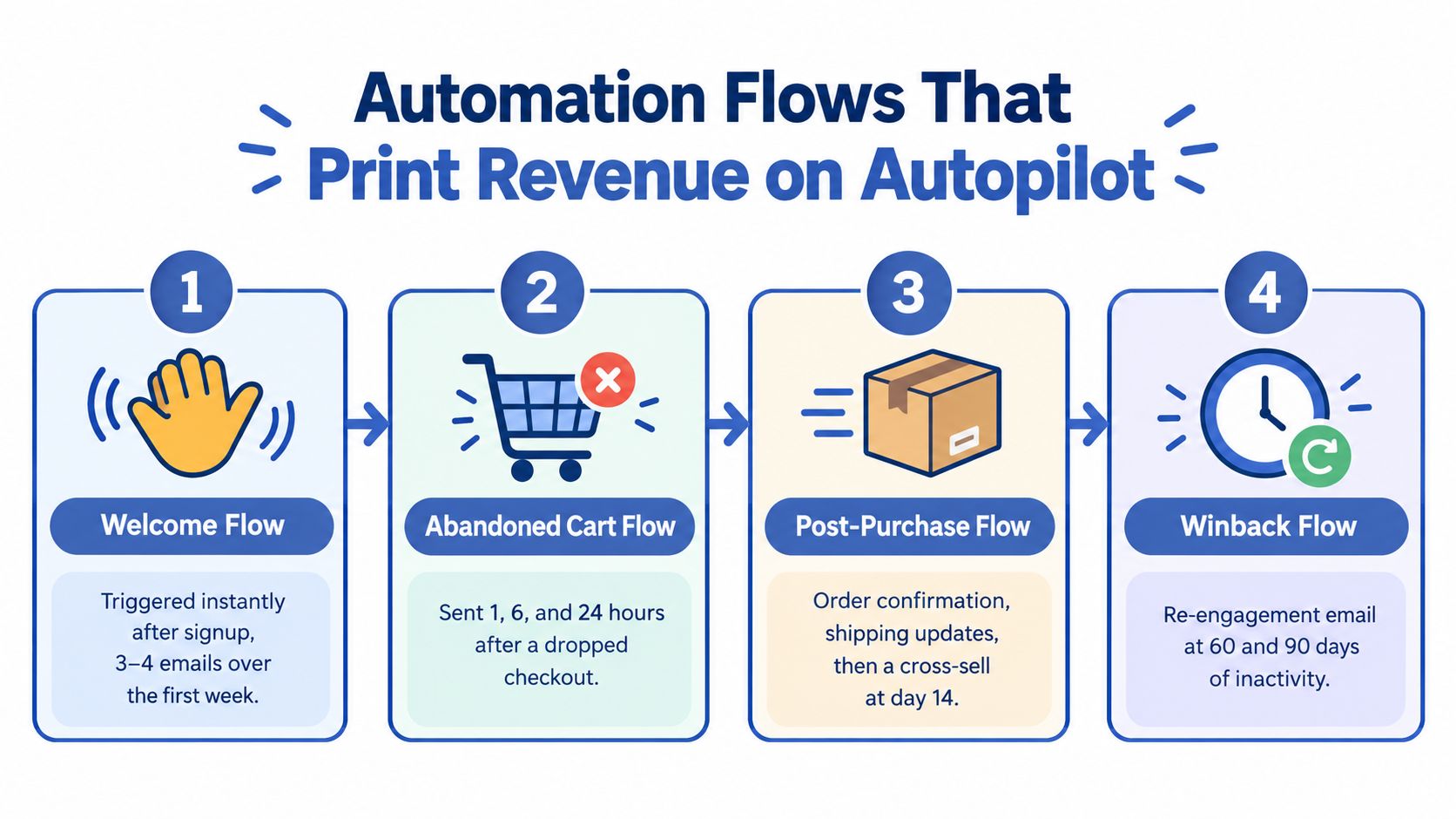
The welcome sequence begins immediately after signup. The first message delivers the promised value and sets expectations. The next message can explain the brand's niche, show best-selling design themes, and help the subscriber choose a collection. A later message can present the first-purchase offer, but it should support the buying decision rather than train people to wait for constant discounts.
The strongest welcome flows sound like the brand. A fishing apparel store can talk about the culture around the water, the humor behind the designs, and why a particular drop exists. That context gives a new subscriber a reason to remember the store beyond the coupon.
Cart and browse recovery
An abandoned-cart flow should first remind the shopper what they selected. A later message should handle practical friction, such as sizing, shipping expectations, or product details. Keep the path back to checkout direct and make sure the customer doesn't receive a conflicting broadcast at the same time.
Browse recovery works earlier in the journey. If someone views a category but never adds a product, show the relevant category and a small set of alternatives. Don't pretend that a casual view means the shopper wants the entire catalog.
Post-purchase and win-back
The post-purchase sequence starts with reassurance. Order information, care guidance, fit education, and a thoughtful product suggestion can create a better ownership experience. The cross-sell should connect to what the buyer purchased, such as a cap, sweatshirt, or related niche design.
A win-back flow targets people whose behavior has gone quiet. Lead with relevance, give them a reason to return, and make the final message an honest preference or unsubscribe choice. Re-engagement should protect the active list, not keep every inactive address alive forever.
Triggered messages have a substantial performance advantage over mass sends in the 602.2-million-email benchmark from Selzy. Automated messages recorded a 31.4% open rate and 6.4% click-through rate, compared with 11.0% opens and 1.2% click-through rate for mass sends. Results differ by audience, but the behavioral gap is hard to ignore.
For implementation details, use Skup's guide to cart abandonment emails for print on demand, then review the broader recommendations on how to optimize email campaigns for real growth. The sequence should be tested as a revenue path, not left untouched after launch.
Campaign Planning and the Monthly Send Rhythm
Automations capture behavior-driven opportunities. Campaigns create momentum around drops, restocks, customer stories, and seasonal moments. The mistake is treating campaigns as a replacement for lifecycle messaging. A broadcast should add context and demand, while flows continue to respond to individual actions.
A practical monthly rhythm includes four campaign roles:
- Product promotion: Announce a new collection or drop to the segment most likely to care.
- Reminder send: Give interested shoppers another clear path to the product without resending the same message to everyone.
- Value send: Share styling ideas, customer photos, behind-the-scenes production, or niche education.
- Seasonal send: Tie the message to the apparel calendar, such as holiday gifting, warm-weather restocks, or back-to-campus buying.
Use your own engagement data to choose send times rather than treating a universal schedule as law. The research guidance on campaign planning from Litmus's email campaign strategy resource supports that approach. A Tuesday or Thursday test can be useful, but the winning window depends on the audience, product, and prior behavior.
Protecting the inbox
Campaigns should respect flow volume. Exclude recent purchasers from an acquisition-focused discount. Suppress people currently moving through a win-back sequence. If a subscriber has reduced engagement, offer fewer messages rather than adding urgency.
One campaign can become several pieces of distribution. Turn the main idea into an SMS prompt, a push notification, a social post, and a short product-page update. That keeps the message consistent while reducing the creative workload.
Consistency beats random bursts. A predictable calendar gives the team time to plan around product launches and gives subscribers a clear expectation of what the brand sends. The best campaign is often the one that fits the store's operating rhythm and doesn't damage the flows already producing revenue.
Measuring What Matters and Lifting Lifetime Value
A POD operator should be able to open a dashboard and answer one question first: did the message reach the right people? Deliverability sits beneath every other metric. If the email lands in spam or gets rejected, stronger copy won't solve the immediate problem.
Inbox placement varies sharply by benchmark. One recent report found only 63% of tested email reached the primary inbox, while another placed the global average around 83.1%, as detailed in Unspam's email deliverability report. That spread is why sender reputation, authentication, list hygiene, and engagement need to be managed as part of the email marketing strategy.
The metric hierarchy
Deliverability: Monitor inbox placement, bounces, spam complaints, and authentication. SPF authorizes sending servers, DKIM adds a cryptographic signature, and DMARC provides policy and reporting, as explained in Salesforce's email deliverability guide.
Engagement: Open rate is a directional relevance signal, not a complete verdict. Benchmark variation makes that clear. Brevo's benchmark report reports a 44.02% open rate for top performers and a 19.09% average unique open rate across industries.
Cash: Click rate, conversion rate, and revenue per recipient tell you whether the message created commercial value. If opens look healthy but clicks are weak, inspect the offer and content. If clicks are strong but purchases are weak, inspect the product page, pricing, fit information, and checkout.
The same logic applies to industry context. HubSpot's benchmark overview reports a 42.35% all-industry average open rate, with examples ranging from 38.58% in retail to 46.49% in nonprofit, while another benchmark places ecommerce and retail around 35.66%. Don't use one universal target to judge every send.
Monday-morning diagnosis: Fix the earliest broken step in the path. Delivery problems come before engagement problems, and engagement problems come before conversion problems.
Email lifts lifetime value through repeat purchase rate, relevant cross-sells, and dormant reactivation. Track those outcomes by segment, then use the framework in Skup's LTV-to-CAC ratio guide to connect retention work with acquisition economics.
Your 30-Day Email Strategy Launch Plan
A working email engine doesn't require an enormous project. It requires the right order of operations and a willingness to launch useful versions before polishing every detail.
Week one builds the foundation
Choose the email service provider, authenticate the sending domain, define the core behavioral segments, and record baseline deliverability metrics. Confirm that marketing consent is clear and that transactional messages remain distinct from promotional communication.
Review the store's signup sources. If a giveaway attracts broad curiosity but a style quiz attracts category clicks, that difference should shape future list growth. Clean hard bounces and identify inactive subscribers before increasing volume.
Week two activates the flows
Build the welcome flow first because it receives the earliest signal. Then build cart recovery, post-purchase messaging, and win-back. Each flow needs one clear trigger, one primary conversion event, and copy that answers the buyer's actual question.
Don't launch every possible branch at once. A simple sequence that fires correctly gives you better information than a complex workflow with unclear logic. Test the links, exclusions, product data, mobile rendering, and customer experience before sending traffic into it.
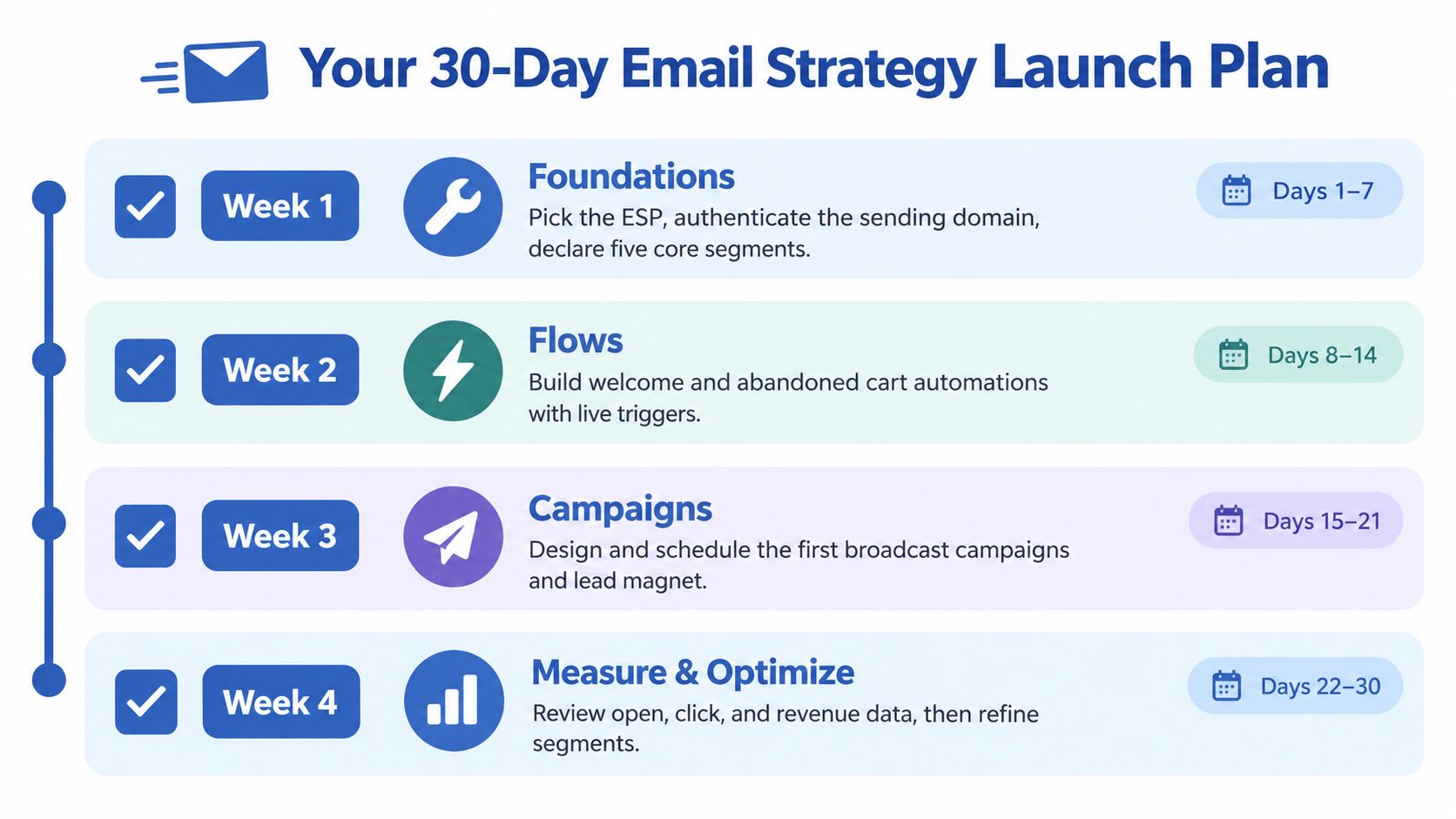
Week three adds campaigns
Create a calendar around drops, restocks, social proof, and useful niche content. Assign each campaign a specific audience and commercial goal. A collection announcement should not automatically reach dormant subscribers who haven't engaged with the brand.
Use existing creative efficiently. A design preview can support a waitlist email, a social post, a product-page update, and a follow-up to people who clicked but didn't purchase. The goal is coordinated distribution, not repetitive inbox volume.
Week four measures and improves
Review inbox placement, complaints, clicks, conversions, and revenue per recipient. Compare first-time buyers with repeat buyers, browse abandoners with cart abandoners, and active subscribers with dormant contacts. Suppress or revise segments that create noise, then invest more attention in the flows producing real dollars.
Build order: Foundation first, lifecycle system second, optimization third. More creative can't compensate for poor delivery or an undefined audience.
The opportunity in POD apparel is still wide open because niche buyers respond to identity, community, and timely product relevance. A durable store doesn't depend on finding another spike in ad performance. It builds a brand that acquires attention, earns permission, and gives customers a compelling reason to return.
Use Skup to strengthen the operating system behind your POD brand, from the Apparel Cloning method for finding proven niche opportunities to AvatarIQ for creating designs and mockups faster. Visit Skup to explore the resources, tools, and coaching available for turning a focused email marketing strategy into repeat eCommerce revenue.