Fourth of July Shirt Ideas That Actually Sell
The fastest way to lose money on Fourth of July shirts is to make the shirt everyone already owns. A Northwestern and Medill survey found that 52.0% of respondents already owned patriotic apparel, while the average planned holiday spend was $87.53 and had risen by an average of $2.85 per year over the previous eight years. The opportunity is real, but it isn't hiding in another bald eagle over a waving flag. It sits in the buyer's identity, occasion, and personal style.
The winning approach is a niche-stacking sprint. Start with a specific person, layer on a July 4 use case, build a design that feels wearable beyond one photo, then publish early enough to capture the seasonal buying window. AvatarIQ gives you the speed to create, test, and mock up those concepts without spending an afternoon rebuilding every variation manually.
Table of Contents
- Why Generic Patriotic Shirts Are Already Saturated
- Mapping the July 4 Buying Window
- Niche Clusters That Beat the Flag Tee
- Designing Fast With AvatarIQ Prompts
- Mockups and Listings That Match the Vibe
- Shipping Realities That Protect Your Reviews
- Your Four-Week Sprint to Launch Day
Why Generic Patriotic Shirts Are Already Saturated
A flag graphic is recognizable. That's exactly why it's crowded.
The Northwestern and Medill survey found that 52.0% of respondents already owned patriotic apparel, including items such as T-shirts and hats. That means the casual buyer isn't starting from zero. They may already have a flag tee in the drawer, an old parade shirt, or a generic red-white-and-blue top bought for a previous cookout.
The mistake is treating broad demand as proof that broad designs will win. Patriotic apparel has a dependable seasonal audience, but generic concepts force sellers into the same visual lane. Flags, fireworks, eagles, stars, and oversized “USA” lettering are easy to understand, easy to copy, and difficult to defend.
Operator's rule: Don't ask, “Would someone wear a patriotic shirt?” Ask, “Why would this person choose this patriotic shirt over the one already in their closet?”
Generic versus niche patriotic tee economics
| Design Type | Avg. Etsy Price | Amazon Royalty | Competition Level | Differentiation |
|---|---|---|---|---|
| Generic flag tee | Not specified | Not specified | High | Low |
| Eagle and fireworks tee | Not specified | Not specified | High | Low |
| Occupation-based patriotic tee | Not specified | Not specified | More focused | Strong |
| Family-role patriotic tee | Not specified | Not specified | More focused | Strong |
| Regional Americana tee | Not specified | Not specified | More focused | Strong |
Don't invent pricing assumptions just because another seller lists a shirt at a certain amount. Build your margin model around actual product cost, marketplace fees, advertising, refunds, and shipping. For a practical overview of the operational side, review this guide to selling apparel on Amazon profitably, then compare the economics of a general tee against a design aimed at one clearly defined buyer.
The useful shift is simple: patriotism becomes the setting, not the entire product. “Proud American” is a theme. “Firefighter family fireworks crew” is a buyer. “Dog mom's backyard freedom tour” is a buyer. “Texas lake weekend, red-white-and-blue edition” is a buyer.
That distinction gives you room to create multiple listings without cloning the same artwork. It also gives shoppers a reason to identify with the shirt, instead of treating it as a disposable holiday basic.
Mapping the July 4 Buying Window
July 4 apparel is a short-season business. The retail window typically runs from June 1 through July 4, according to RetailMeNot's July Fourth shopping survey. The survey also found that 30.9% of consumers planned to buy additional patriotic merchandise within 30 days of the holiday, while summer apparel was a planned purchase for 24% of shoppers.
That creates a clear operating rhythm. Your designs need to be live before shoppers enter active planning mode, your promotion should intensify as the holiday approaches, and your campaigns need a hard stop once delivery relevance disappears.
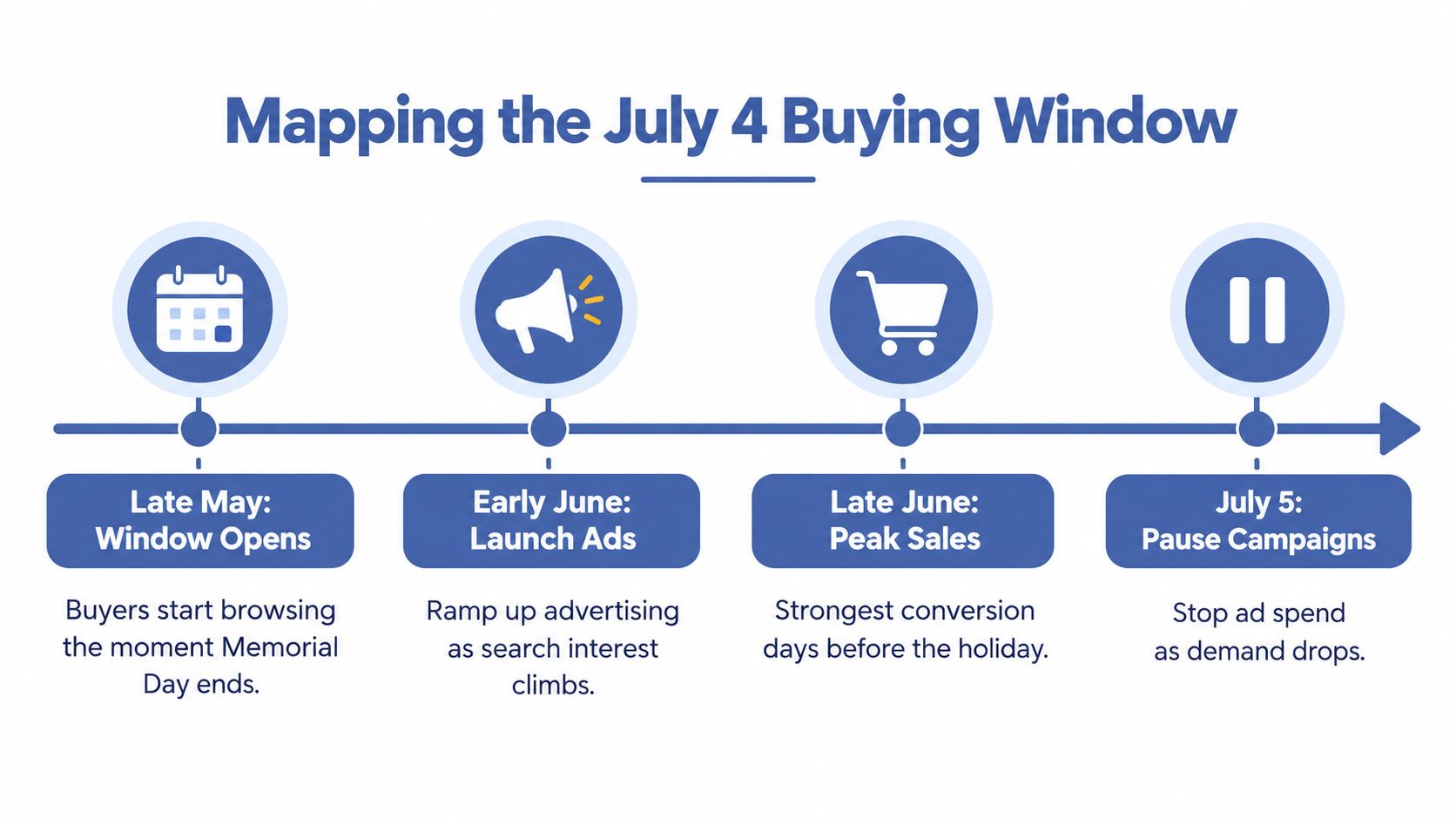
Use the window in four moves
- Late May: Finish your initial catalog and check that your product pages, size charts, mockups, and fulfillment settings are ready.
- June 1 through June 7: Publish the core designs. This is when shoppers begin looking for apparel tied to cookouts, parades, family gatherings, and summer trips.
- June 15 onward: Increase promotional attention around the listings that receive clicks, saves, add-to-carts, or early sales. Don't spread your budget evenly across weak concepts.
- June 28 through July 3: Treat this as the critical conversion sprint. Campaign guidance identifies this period as the key July 4 conversion window, with most purchases happening before the holiday and patriotic apparel among the peak categories. The Busylike Amazon growth playbook is useful for thinking through channel execution, catalog organization, and marketplace timing.
The worst launch date is early July. You'll be asking a seasonal product to earn attention after much of the audience has already bought, received, or abandoned the idea.
Use this print-on-demand seasonal marketing calendar to build the campaign backward from the holiday. The calendar isn't the strategy by itself, but it keeps design, listing, promotion, and fulfillment work from colliding at the last minute.
Niche Clusters That Beat the Flag Tee
The best Fourth of July shirt ideas attach a familiar holiday moment to a specific identity. That combination gives the buyer both a reason to wear the product and a reason to choose it.
Occupation pride
Start with nurses, teachers, firefighters, linemen, military families, and other professions with strong community identity. A nurse-themed design can use a small medical symbol, a shift-related phrase, and restrained Americana colors. A firefighter concept can pair a station-inspired badge layout with fireworks or a cookout reference.
These designs work because the buyer isn't merely celebrating a holiday. They're representing a role, a family connection, or a group they already care about.
Family and pets
Family-role designs should be built as systems, not isolated shirts. Create coordinated versions for mama, papa, grandma, grandpa, children, dog moms, and first-time fathers. The design language stays connected, while the wording gives each person a reason to buy their own version.
Pet themes deserve the same treatment. “Fireworks crew” can become a dog-mom shirt, a rescue-dog shirt, or a backyard companion concept without relying on a generic flag.
Party humor and regional pride
Funny cookout, barbecue, and casual drinking themes target the occasion rather than abstract patriotism. Keep the wording short and make the visual readable from a distance. Humor should support the scene, not require a paragraph to understand.
Regional concepts let you stack location with lifestyle. Texas lake weekends, Florida beach gatherings, Southern cookouts, Midwest family reunions, Pacific Northwest summer trips, and beach-town parades all give you distinct visual directions. The red-white-and-blue palette can stay present without making every design look identical.
Micro-trend styling
Trend-aware buyers respond to a look, not just a symbol. Current coverage highlights pastel palettes, vintage wash and distressed Americana, oversized typography, and Western Americana as distinct directions. Faire also reported that TikTok-driven interest in mock-neck sweatshirts pushed searches to more than nine times the normal pace, while U.S. order share reached 11.5 times its previous level for that category during the trend period. See the niche research guide for print-on-demand before you commit to a cluster.
The takeaway is practical: build occupation, family, regional, and trend layers into separate testable collections. Don't launch one broad “America” design and hope the marketplace finds the right audience.
Designing Fast With AvatarIQ Prompts
Speed matters because seasonal products lose value every day they remain unpublished. AvatarIQ should function as your design engine, but the quality still comes from the prompt structure and the decisions you make after generation.
Begin with one base direction that controls the visual system:
- Palette: navy, cream, and soft red.
- Typography mood: varsity, distressed retro 70s, or hand-drawn sketch.
- Composition: left-chest badge, centered front graphic, or full-bleed back print.
- Audience: one occupation, family role, region, or occasion.
- Wear context: parade, backyard cookout, beach trip, fireworks night, or casual summer styling.
Then create focused prompt variations instead of asking for “a cool Fourth of July shirt.” That broad instruction produces broad output.
Five prompt directions worth testing
- Dog-mom fireworks: A playful dog silhouette, small fireworks, cream lettering, and a distressed navy badge for a backyard celebration.
- Nurse-shift independence: A clean medical symbol combined with a subtle star motif and a confident shift-themed phrase.
- Teacher summer break: Varsity typography, a school-inspired badge, and a relaxed vintage palette that feels wearable after July 4.
- Grill-master dad: Bold lettering, a compact grill illustration, and a cookout-focused composition designed for a family gathering.
- Coastal patriotic: Soft red, cream, and faded blue with simple coastal elements, restrained typography, and a beach-town mood.
Run batch generations for each direction. Review the variants together, reject anything with weak hierarchy or unreadable text, and keep two finalists per niche. Your goal isn't to publish every output. It's to create a manageable set of strong candidates that can receive distinct mockups and listings.
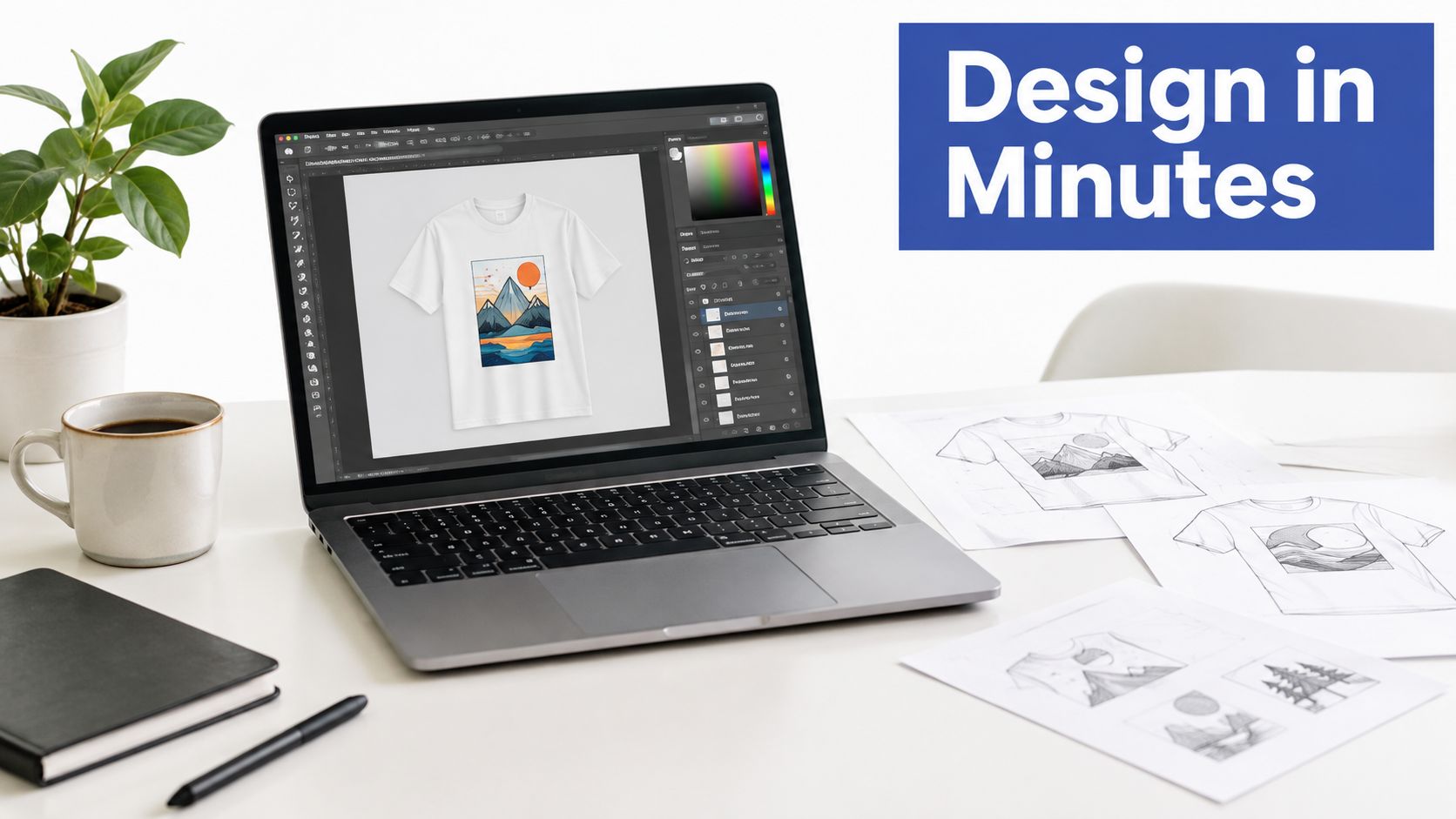
Export the approved designs as PNG files with transparent backgrounds and maintain a 4500 by 5400 master for production flexibility. Iterate the prompt when the problem is structural, not after you've already accepted a weak concept. AvatarIQ's advantage is the speed of those cycles, especially compared with rebuilding every composition manually in Photoshop.
Use a dedicated apparel mockup generator workflow after design approval. Keep the source files organized by niche, garment color, and listing name. That small discipline prevents the classic seasonal mess where the design, thumbnail, and product description no longer match.
Mockups and Listings That Match the Vibe
A strong design can still lose if the listing looks like it belongs to a different buyer. A coastal patriotic shirt needs a beach or boardwalk context. A grill-master design belongs in a backyard cookout. A family collection should show coordination without making the image feel like a staged catalog photo.
AvatarIQ mockup presets let you build those contexts quickly. Create multiple scenes for each viable niche, then select the image that communicates the use case within a second of the shopper seeing it.
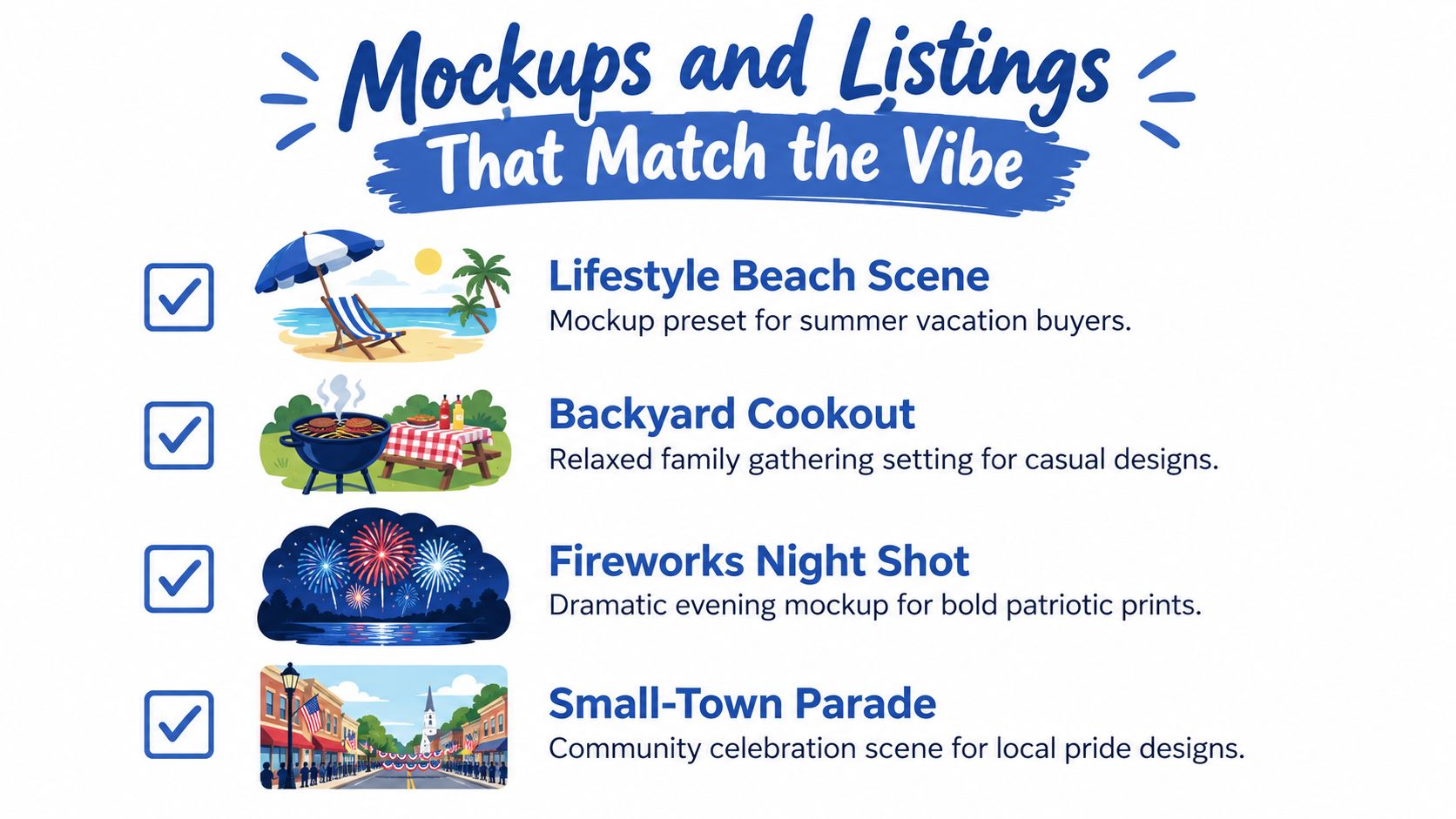
Match the scene to the buyer
- Lifestyle beach scene: Use for coastal, Florida, beach-town, and pool-party concepts.
- Backyard cookout: Use for grill-master, family, funny food, and casual party designs.
- Fireworks night shot: Use for bold graphics and high-contrast typography.
- Small-town parade: Use for regional pride, occupation groups, and community-centered collections.
Titles should lead with the actual search intent. Put the primary phrase near the beginning, then add the niche and garment details. A title structure such as “Fourth of July Dog Mom Shirt, Fireworks Crew Tee, Patriotic Summer Top” communicates occasion, audience, and product in one line.
Build the description around the purchase decision:
- Lifestyle benefit: Explain where the shirt fits, such as a parade, cookout, beach trip, or family photo.
- Sizing clarity: Point shoppers to the size chart and explain the intended fit.
- Garment details: State the available colors, print placement, and relevant fabric information.
- Delivery context: Use a calm urgency line tied to the holiday delivery window, without promising an arrival date you can't support.
The thumbnail and the lifestyle mockup shouldn't be identical. Use a clean, readable product-forward image as the first thumbnail, then use the beach, cookout, fireworks, or parade scene deeper in the image set. For broader conversion-page thinking, Wojo Media's landing page guide offers useful principles for aligning the first visual, message, and buyer action.
Shipping Realities That Protect Your Reviews
Production and shipping are separate stages. Production runs from order acceptance to carrier handoff. Shipping begins after that handoff, so the customer-facing promise must account for both, as explained in this print-on-demand fulfillment overview.
Major POD providers commonly quote about 2 to 5 business days for T-shirt fulfillment, and one provider says that more than 50% of orders ship within 3 days. Those figures describe fulfillment, not the complete journey to the customer's door. Conventional decorated-apparel workflows can also take 3 to 10 business days after artwork approval, with a typical turnaround of 7 to 10 business days, according to 4imprint's custom T-shirt turnaround guidance.
| Provider | Production Days | Transit Days | Ship-By Cutoff |
|---|---|---|---|
| Major POD provider, average | 2 to 5 business days | Check destination and service | Use the provider's live estimate |
| POD provider, faster-shipping share | More than 50% ship within 3 days | Check destination and service | Confirm before advertising delivery |
| Conventional decorated apparel | 3 to 10 business days | Check destination and service | Allow for the longer production range |
Don't write “arrives by July 4” unless your fulfillment partner and carrier data support that promise for the buyer's location. State the order cutoff, show the estimated range, and adjust campaigns as the holiday gets close. If the product is no longer likely to arrive in time, pause the ad rather than buying an expensive refund.
Accurate delivery language protects more than the transaction. It reduces avoidable customer-service issues and gives buyers a reason to trust the rest of your catalog.
Your Four-Week Sprint to Launch Day
Treat the launch as a production schedule, not a brainstorming exercise. You need a deliverable at the end of every week.
Week 1, choose the buyer and lock the prompts
Select occupation, family, regional, and style clusters with a clear reason to exist. Study marketplace results, review customer language, and identify which designs are generic clones. Finish 8 to 10 AvatarIQ prompts that specify audience, occasion, palette, typography, and composition.
Your deliverable is a prompt sheet and a short list of niches. If a prompt could apply to every patriotic shirt in the marketplace, rewrite it.
Week 2, generate and select
Run batch generations, compare variants, and remove weak typography or cluttered compositions. Choose two finalists per viable niche, then create the first mockups in beach, cookout, fireworks, or parade settings.
Your deliverable is a clean folder of approved production files and matching mockups. Don't carry weak designs forward because you already spent time creating them.
Week 3, publish the catalog
Build the listings, place the main keyword early in each title, and layer in the buyer identity and occasion. Add size information, garment details, color options, and delivery guidance. Preload your Etsy or Shopify catalog so your traffic isn't arriving at unfinished product pages.
Your deliverable is a live, reviewable catalog. Open every listing on mobile and verify that the first image, title, price, variants, and description agree.
Week 4, push attention where it counts
Use email, Pinterest, organic social content, and targeted advertising to drive attention toward the designs that earned early signals. Feature collections rather than random individual shirts. Family-role designs can be shown together, while occupation designs can be grouped by profession or community.
Concentrate your strongest promotion around June 28 through July 3, the critical conversion window identified in Independence Day campaign guidance. Monitor delivery estimates every day and stop spending when the offer no longer makes logistical sense.
The July 4 opportunity is bigger than a generic holiday roundup suggests because buyers aren't only shopping for flags. They're shopping for identity, belonging, humor, family photos, regional pride, and a shirt that fits the event. A niche-stacked catalog built with AvatarIQ gives you more shots on goal, more relevant listings, and a far clearer edge than uploading another bald eagle in May.
Skup helps POD sellers turn focused apparel concepts into organized product listings, and its AvatarIQ software supports fast design and mockup creation for seasonal collections. Visit Skup to build your July 4 catalog around specific buyers instead of generic patriotic graphics.