Best Practices for Content Marketing: POD Guide 2026
Online retail represented roughly 17.1% of total U.S. retail sales in the second quarter of 2026, when the Census Bureau's ecommerce and total-retail estimates are compared in the official quarterly ecommerce data. That's a substantial opportunity for print-on-demand entrepreneurs, but opportunity alone doesn't create a durable apparel brand. Useful content, clear positioning, and disciplined promotion do.
For POD brands, strategic content marketing is one of the strongest paths to consistent traffic, higher conversions, and sustainable growth. The best content teaches before it sells, answers questions buyers already have, shows how products are made and tested, and gives every reader a sensible next step.
This guide breaks down 10 best practices for content marketing with POD-specific workflows, examples, templates, and practical trade-offs. You'll see what works, what tends to waste time, and how to build a content engine that supports niche research, design testing, email growth, paid advertising, community, and sales.
Table of Contents
- 1. Value-First Content Strategy That Teaches Before Selling
- 2. AI-Powered Design and Content Creation Without Sacrificing Quality
- 3. Niche Selection Through Data Analysis and Testing
- 4. Email Marketing Sequences That Build Direct Relationships
- 5. Paid Advertising Strategy For Facebook and Meta
- 6. Content Repurposing That Extends Every Strong Idea
- 7. Community Building That Creates Belonging Around Your Brand
- 8. Social Proof and Case Studies That Respect the Evidence
- 9. Educational Content Formats Beyond the Blog
- 10. Conversion Optimization Through Continuous Testing
- 10-Point Content Marketing Best-Practices Comparison
- Next Steps to Supercharge Your POD Content Marketing
1. Value-First Content Strategy That Teaches Before Selling
A POD entrepreneur earns attention by helping people make better decisions before asking them to buy. A niche-selection guide can explain how to identify a passionate audience. A design article can show how to translate an inside joke or identity marker into apparel. A scaling piece can explain how to evaluate a winning product before investing more heavily in promotion.
This approach builds authority because readers can test your thinking immediately. They don't need to trust a vague promise. They can apply the framework, compare the result with their own research, and decide whether your brand understands the work.
The Content Marketing Institute and MarketingProfs' 2025 B2B benchmark collected 1,186 global responses between June 25 and August 16, 2024. Only 29% of respondents considered their documented content strategy extremely or very effective, while 58% rated it moderately effective, 12% not very effective, and 1% not effective at all in the published benchmark. Among marketers whose strategies were moderately effective or worse, 42% cited unclear goals as a contributing problem, and 55% struggled to create content that prompts a desired action.
Give every asset a job
Before drafting, define four things:
- Audience: A beginner exploring POD, a designer validating a niche, or an operator scaling a store.
- Awareness stage: Unaware, problem-aware, solution-aware, or ready to evaluate.
- Primary action: Email signup, AvatarIQ trial, product view, or coaching application.
- Measurement method: Organic impressions, qualified subscribers, assisted conversions, or sales.
A strong Skup article about niche research might invite a reader to learn the Apparel Cloning method. A design tutorial can direct the reader toward an AvatarIQ trial. A scaling guide can lead an experienced operator toward coaching. The content remains useful even when the reader isn't ready to buy.
Practical rule: If you can't explain what the reader should understand, feel, and do after consuming a piece, the idea isn't ready to publish.
Document actual workflows rather than idealized ones. Show how you review competitors, how you decide whether a design deserves another variation, and where a product can fail. Transparent discussion is more persuasive than polished generalities, especially for beginners who need to see the decisions behind the result.
2. AI-Powered Design and Content Creation Without Sacrificing Quality
AI can reduce repetitive work in a POD content system, but faster production does not guarantee better output. Use it for ideation, design variations, mockups, and repurposing. Keep decisions about audience fit, brand character, and the product promise with a human reviewer.
That distinction shows up quickly in apparel. A polished mockup may still look artificial, use awkward styling, or fail to reflect the buyer's identity. A design variation may change the colors and layout while offering no new reason to buy. AI increases volume. Taste, positioning, and customer knowledge determine whether that volume becomes useful content.
The 2025 B2B benchmark reported that 81% of B2B marketers used generative-AI tools in 2025, up from 72% the previous year according to the benchmark's technology findings. As adoption grows, review standards need to rise with it. More drafts mean buyers have greater reason to value recognizable expertise, original observations, and product scenes that feel credible.
Run each asset through a human review loop
Set the creative direction before opening AvatarIQ. Define the niche, emotional hook, garment type, and visual treatment first. Then use this working sequence:
- Generate several compositions, typography treatments, and visual angles. The first output is a starting point, not a finished asset.
- Inspect hands, garment placement, lighting, proportions, text accuracy, and the realism of the product scene.
- Select the strongest version for the listing, then adapt its core idea into an educational post, email, or short demonstration.
- Save effective prompts, style choices, and review criteria so later batches stay consistent.
In our own workflow, AvatarIQ handles variation and mockup production, leaving review time for checking hands, lighting, garment fit, and whether the image reads as a real product scene. Skup's proprietary software supports automated design creation and product mockups, which can help entrepreneurs manage design-to-listing work without arranging separate photography or models for every concept.
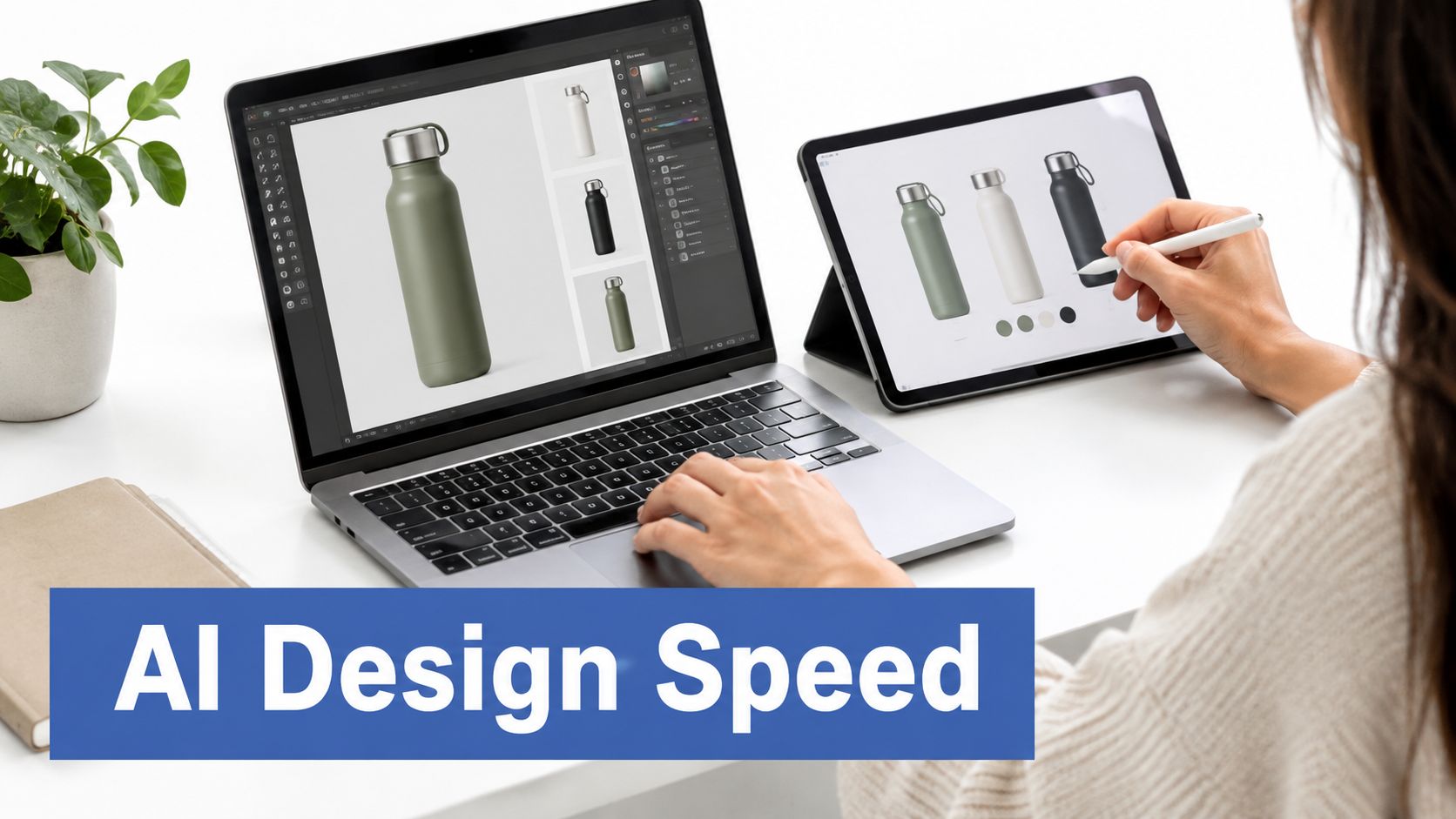
Use AI to create more time for research, customer conversations, creative direction, and marketing decisions. Avoid filling a site with interchangeable articles or unreviewed claims. The tool should increase production capacity while keeping judgment at the center.
3. Niche Selection Through Data Analysis and Testing
A POD niche earns attention when people recognize themselves in it and can see how its products fit their lives. Evaluate the audience, buying context, design language, competition, and room for a distinct brand position before building a catalog.
Start with conversations rather than broad category labels. Review community posts, comments, product reviews, and competitor listings. Record repeated frustrations, rituals, affiliations, humor, and life events. Those patterns can reveal sharper apparel ideas than categories such as fitness, pets, or outdoor recreation.
Apparel Cloning offers beginners a practical way to study products that already communicate with buyers, then develop original designs for underserved micro-segments. The method is research-led, not a request to copy another seller's creative work. Examine the concept, audience, wording, garment choice, and apparent buying context, then apply those lessons to a differentiated niche.
A useful test is to write one sentence that completes this statement: “This product helps [specific audience] express [specific identity or feeling] in [specific situation].” If the sentence stays vague, the niche needs more work.
Check five signals before investing heavily:
- Audience identity: Who wears the product, and what does it express?
- Buying context: Is it for daily wear, an event, a profession, a hobby, or a gift?
- Competitive pattern: Which phrases, colors, products, and garment types recur?
- Margin logic: Can the expected selling price cover fulfillment, platform fees, promotion, refunds, and profit?
- Content depth: Can the niche support useful answers, stories, examples, and product education beyond promotion?
A hobby-focused audience may support content about beginner mistakes, gear, community traditions, event preparation, and gift ideas. Those subjects attract prospective buyers before purchase and can guide product concepts without forcing every post to sell.
Use this guide to niche market research to organize the research, then test a small product set alongside content using the audience's own language. Compare design themes, product-page engagement, email-link clicks, and responses to content. Search interest can show attention, while these actions provide stronger evidence of apparel intent.
A strong niche with average execution can outperform a perfect niche that you never validate, publish, or promote.
Choose the segments showing the clearest response, document what changed between tests, and develop the winning angle before expanding the catalog.

4. Email Marketing Sequences That Build Direct Relationships
Email turns useful content into an ongoing relationship. It gives a POD business a direct channel after a reader leaves a blog post, social feed, or product page, while creating room to teach, test interest, and make relevant offers.
Build the welcome sequence around the subscriber's next decision. Set expectations, deliver a practical lesson, explain how the brand approaches POD, and offer one clear action. A beginner might receive a niche-research exercise. An intermediate seller could get a product-testing framework. A scaling operator may be ready to explore coaching.
Skup's email marketing strategy guidance can help connect educational emails with launches, product education, and community activity.
Match the sequence to the reader's stage
A five-email workflow can follow this progression:
- Welcome: Explain what subscribers will receive and provide one useful insight.
- Education: Teach audience research, design positioning, or another decision that affects the store.
- Proof: Show how a student or business applied the process, with enough context to avoid presenting one result as universal.
- Action: Invite the reader to use AvatarIQ, explore Apparel Cloning, or complete another relevant step.
- Follow-up: Address objections, answer common questions, and point to the next lesson.
Segmentation makes this sequence more useful. Separate people who are discovering POD from sellers managing an active catalog, then refine groups by topic and behavior. Someone clicking niche-research content should receive more validation material. A subscriber repeatedly engaging with scaling topics needs a different offer and a more advanced example.
Keep the teaching ahead of the sale. A launch email can make a direct request, but the surrounding messages should connect that offer to the reader's progress. For example, explain how a product-testing workflow works before inviting subscribers to try a related tool. That structure protects trust while still giving engaged readers a clear path to purchase.
Review clicks, replies, unsubscribes, purchases, and assisted conversions together. An open shows attention, not business impact. Use the results to adjust subject lines, examples, segment rules, and the next sequence.
5. Paid Advertising Strategy For Facebook and Meta
Paid promotion gives a validated POD offer faster access to a defined audience, while organic content builds reach over time. Meta ads perform when the product, message, audience, and unit economics support one another. Advertising cannot compensate for weak positioning or an unclear offer.
Set the financial limits before launching. Calculate contribution margin after product cost, fulfillment, transaction fees, refunds, discounts, and advertising. Then set the highest customer acquisition cost the business can accept while preserving profit and allowing for future retention.
The Facebook ads for ecommerce playbook offers a useful testing structure across creative, audience, landing page, and conversion data. Begin with clearly different messages rather than minor design variations. Keep the combinations that attract qualified buyers, and increase budget only when the economics remain healthy.
Test the message before increasing spend
A POD ad must communicate the product's identity quickly. Test a niche-specific design through a lifestyle mockup, close product view, brief founder explanation, or customer-centered problem statement. Each format presents a different reason to care, so compare the response rather than treating every creative change as cosmetic.
Track the path from attention to business value:
- Message fit: Does the ad attract the intended audience?
- Landing-page behavior: Do visitors continue to product details?
- Conversion quality: Do purchases support the target margin?
- Post-purchase value: Do buyers return, refer others, or join the email audience?
- Disclosure and accuracy: Does the ad represent the product and customer experience truthfully?
AI-assisted creative requires an additional review. Meta says it labels ad images created or significantly edited with its generative-AI features, along with qualifying images made with third-party AI tools, with an “AI info” label, generally available through the ad's “About this ad” screen in its advertising guidance. Record how each asset was produced so the team can review claims, edits, and disclosures before launch.
Build the campaign around the buyer's next decision. Educational content can introduce the niche or explain the product choice, product-focused creative can support evaluation, and retargeting can address objections. Use a simple testing sheet with columns for audience, message, creative format, spend, landing-page behavior, purchases, and margin. That record makes it easier to identify a repeatable workflow instead of scaling a single lucky result.
6. Content Repurposing That Extends Every Strong Idea
A strong, well-researched idea can support buyers at several stages of their journey. A guide on niche validation might become a video lesson, email sequence, short-form series, product-research worksheet, and live discussion. For a POD business, one useful framework can also supply the content needed to test a design concept without creating five unrelated topics.
Start with the format that demands the clearest thinking, then adapt its parts for each channel:
- Long-form guide: Document the process, examples, limitations, and next steps so readers can apply it.
- Video demonstration: Show one decision with a real screen recording, design comparison, or product example.
- Email lesson: Give subscribers one practical action they can complete quickly.
- Social series: Turn specific mistakes, decisions, or examples into short posts.
- FAQ content: Convert recurring questions from comments and support conversations into searchable answers.
The formats should change with the audience's task. A blog post can explain the full framework. A video can demonstrate how to compare two audiences. An email can clarify the difference between interest and buying intent, then direct the reader to a worksheet. A social post can highlight why a broad category may need a sharper identity.
For example, a niche-selection guide could produce a screen-recorded audience comparison, an email about buying signals, and a social post showing how a POD brand narrowed its design direction. The central lesson remains consistent, while the proof, length, and call to action fit the channel.
Build distribution into production. Record the primary asset, derivative formats, publishing dates, calls to action, and review points in one content calendar. Update the source when product information, audience evidence, or platform guidance changes.
Repurposing cannot rescue a weak idea. If the source lacks evidence, a defined audience, or a useful conclusion, improve it before creating additional formats. Quality at the source makes every derivative asset easier to produce and easier to trust.
7. Community Building That Creates Belonging Around Your Brand
A POD business grows when customers and learners feel connected to a shared purpose. That purpose may be building a flexible business, spotting product opportunities, or developing a brand for an audience they understand well.
Community requires more than publishing posts and waiting for comments. Members need clear ways to ask questions, show progress, receive feedback, and meet people working through similar decisions. Skup Incubator's weekly group coaching calls give scaling entrepreneurs space to discuss implementation, while direct access to coaches helps them address problems in context.
Set a rhythm that gives people a reason to return:
- Weekly implementation prompt: Ask members to share one niche observation, product test, or content result.
- Member spotlight: Recognize a specific action and lesson, rather than only celebrating sales.
- Office-hours discussion: Reserve time for live questions about designs, listings, ads, or operations.
- Behind-the-scenes post: Explain a decision, failed test, or adjustment made during production.
- Peer connection: Introduce members whose experience or interests could support one another.
The founder should guide the conversation without taking it over. Answer directly when possible, state uncertainty plainly, and invite members to contribute solutions. A beginner who watches another member solve a similar POD problem may gain more confidence than one who sees another polished promotion.
Share setbacks with care. Sensitive business information can remain private, while the useful lesson stays public. Explain why a design failed, why an ad was paused, or how a content idea changed after feedback. Specific context makes the work feel achievable without presenting it as effortless.
A well-run community also improves the content workflow. Member questions can reveal article topics, recurring objections can shape email lessons, and member wins can become case studies after permission is granted. Track these themes in a simple editorial log, then turn the strongest ones into practical templates or demonstrations. The audience shows which problems deserve attention next.

8. Social Proof and Case Studies That Respect the Evidence
A POD case study earns trust by documenting decisions, constraints, and evidence. Readers need the starting point, the niche, the product, the research method, the creative direction, the traffic sources, and the tests that shaped the launch. An impressive result without that context offers little guidance.
Use a simple evidence record before publishing:
- Starting position: Describe the entrepreneur's experience, available assets, audience, and initial problem.
- Test setup: State which niche, product, offer, content, or campaign was tested, and why.
- Execution: Show the research, designs, listings, content, and distribution used.
- Observed result: Report the available outcome, including the measurement period and relevant limitations.
- Next decision: Explain what changed after the evidence arrived and what remains unproven.
Revenue, profit, advertising spend, and timelines should be confirmed with the customer before publication. Label the period clearly. A single successful launch can illustrate a process, but it cannot establish what every POD seller should expect. If the result is incomplete, say so. An early milestone is more useful when readers can see what happened afterward.
The FTC requires influencers and endorsers to disclose material connections with a brand when those relationships could affect how audiences evaluate an endorsement. Payment, employment, family or personal relationships, free products, discounted products, and other benefits can qualify. Place the disclosure with the endorsement, using clear wording such as “Ad,” “Paid ad,” “#ad,” and “Advertising” in its social-media disclosure guidance.
The same guidance applies to online content, podcasts, social media, reviews, television, radio, and print. Testimonials can mislead if they imply results consumers generally should expect. Give readers context when an individual outcome is unusual or not representative under the FTC's endorsement guidance.
Permission also matters. Confirm approval before using names, images, results, or identifiable details. If a customer or student is still working toward a goal, update the case study rather than presenting an unfinished result as a final outcome. The strongest stories show the workflow clearly enough for another entrepreneur to adapt it, while keeping the evidence within its proper limits.
9. Educational Content Formats Beyond the Blog
A buyer researching print-on-demand may need a reference article, a visual demonstration, or a direct answer from an experienced operator. Choose the format that removes the specific learning barrier.
A screen recording can show an Apparel Cloning workflow more clearly than several paragraphs. A podcast or live call can examine why a product test failed, while a short article or email can define a term without adding production work. Start with the question, then select the medium.
Video remains a practical channel for POD education, as reflected in its channel investment findings. That does not mean every brand needs studio production. A searchable article paired with a clear screen recording can teach more effectively than polished footage with no useful process.
Match the format to the learning task
- Podcasts: Founder conversations, decision breakdowns, and operating lessons.
- Webinars: Structured teaching, live questions, and demonstrations.
- Video series: Sequential lessons covering research, design, listings, or promotion.
- Recorded coaching discussions: Real questions, relevant context, and follow-up.
- Transcripts: Searchable text that extends the reach of audio and video.
Build each episode or lesson around one question. “How do I compare two niche angles?” gives viewers a concrete result. “Everything about ecommerce” creates a vague production brief and a weak takeaway.
Use audience questions as editorial input. Answer specific comments, correct misunderstandings, and record recurring phrases for future titles. Those phrases often reveal the language beginners use when searching for help, which makes them useful for video topics, article headings, and email subjects.
One focused lesson can become a repeatable workflow: record the demonstration, publish the transcript, extract a short email, and turn a key step into a social post. This approach gives a POD entrepreneur several assets without forcing the team to invent separate ideas for every channel.
Begin with the format you can maintain. Add another medium only after the first workflow produces useful, repeatable material. Consistent instruction and clear outcomes matter more than elaborate production.
10. Conversion Optimization Through Continuous Testing
A visitor can understand your niche strategy and still leave before buying. The cause may be a vague call to action, a landing page that breaks the article's promise, or a product description that leaves a basic objection unanswered. Conversion work connects those gaps to specific changes.
Start by tracing one complete path: search result or social post, article, email signup, product page, checkout, and post-purchase follow-up. At each stage, ask what the visitor should do, why the offer matters, and what will happen next. Confusion at any point can stop progress.
Use these questions to choose a test:
- Headline clarity: Does the title promise a specific outcome to a defined audience?
- Call-to-action relevance: Does the next step fit the reader's awareness stage?
- Product explanation: Can a buyer understand the design, garment, fit, and use context?
- Design presentation: Does the mockup help the buyer picture wearing the product?
- Message consistency: Does the landing page keep the promise made in the ad or article?
A POD example makes the workflow concrete. If an article about niche selection sends readers to a shirt collection, compare a page that leads with the niche benefit against one that leads with product details. Keep the audience and offer stable, then change one meaningful variable where possible. Changing the headline, page structure, offer, and creative together may produce movement without showing which change caused it.
Record each experiment in a simple log: hypothesis, change, audience, dates, result, and decision. This prevents repeated guesses and gives future launches a usable reference.
Numbers show where visitors stop. Customer replies often explain why. A reply such as “I wasn't sure whether this was for beginners” identifies a positioning problem that a dashboard may miss. Pair analytics with interviews, support messages, and checkout feedback before choosing the next test.
A failed result still has business value. It can stop you from scaling a weak message or show that buyers care about another benefit. The aim is a clearer path for the intended audience, not a lift from every experiment.
10-Point Content Marketing Best-Practices Comparison
| Approach | Complexity (🔄) | Resources & Speed (⚡) | Expected Impact (📊⭐) | Ideal Use Cases (💡) |
|---|---|---|---|---|
| Value-First Content Strategy: Teaching Before Selling | High 🔄, long ramp, continuous effort | Low monetary, high time & expertise; slow to monetize ⚡ | Builds authority, organic traffic, higher-quality leads 📊⭐ | Brand-building, long-term SEO, educating prospects 💡 |
| AI-Powered Design and Content Creation | Low–Medium 🔄, setup & prompt refinement | Low cost per asset, very fast iterations ⚡ | Rapid product launches, scalable catalog, variable quality control 📊⭐ | Fast design testing, scaling listings, beginners needing pro mockups 💡 |
| Niche Selection Through Data Analysis and Testing | Medium 🔄, systematic research & validation | Moderate tools & analyst time; medium speed ⚡ | Higher hit-rate, reduced wasted spend, predictable niches 📊⭐ | Market entry, validating product ideas, targeting underserved segments 💡 |
| Email Marketing Sequences | Medium 🔄, strategy, segmentation, automation | Low recurring cost, automated time-savings; steady cadence ⚡ | High ROI, repeat purchases, improved LTV & measurable funnels 📊⭐ | Nurturing leads, product launches, retention & reactivation campaigns 💡 |
| Paid Advertising Strategy: Facebook/Meta Ads | High 🔄, continual optimization & monitoring | High budget & expertise; fast feedback and scaling ⚡ | Predictable, scalable revenue when profitable; rapid validation 📊⭐ | Quick testing, scaling winners, acquiring targeted customers at scale 💡 |
| Content Repurposing: Maximizing Reach From Single Ideas | Low–Medium 🔄, planning and format adaptation | Efficient use of existing assets; multiplies output speed ⚡ | 3–5x reach, improved SEO, lower marginal content cost 📊⭐ | Amplifying pillar content, multi-platform distribution, resource-limited teams 💡 |
| Community Building and Engagement | High 🔄, ongoing moderation and culture work | Time-intensive, low direct spend; slow growth but durable ⚡ | Strong retention, UGC, referrals, brand moat 📊⭐ | Building loyalty, feedback loops, long-term customer advocacy 💡 |
| Social Proof and Case Studies | Medium 🔄, data collection and storytelling | Moderate time to gather/produce, one-off but high leverage ⚡ | Significant trust boost and conversion uplift with specific metrics 📊⭐ | Sales pages, overcoming objections, testimonial-driven funnels 💡 |
| Educational Content Formats: Podcasts/Webinars/Video Series | Medium–High 🔄, production & consistency required | Equipment/time investment; slower audience build but high engagement ⚡ | Deep audience connection, long-term traffic, repurposing potential 📊⭐ | Teaching complex topics, live Q&A, high-touch onboarding & credibility 💡 |
| Conversion Optimization: Testing and Refining | Medium 🔄, disciplined testing framework | Requires traffic & analytics; iterative cadence yields quick wins ⚡ | Small % lifts compound into large revenue gains; data-driven improvements 📊⭐ | Maximizing ROI on existing traffic, landing pages, product pages, emails 💡 |
Next Steps to Supercharge Your POD Content Marketing
The strongest content systems don't begin with a huge publishing schedule. They begin with a useful idea, a specific audience, and a clear next action. Pick one audience you understand or want to understand better, then choose the content format that can answer that audience's most urgent question.
If you're starting from scratch, build a simple foundation. Write one research-led guide, connect it to an email signup, create a short educational follow-up sequence, and turn the guide into several platform-specific pieces. Use the responses, clicks, questions, and product interest to decide what deserves a deeper article or video.
If you already publish regularly, audit the relationship between content and business outcomes. Which articles attract the right readers? Which pages lead to meaningful product exploration? Which emails generate replies or qualified clicks? Which topics produce useful questions from your community? A smaller library of well-connected assets can serve your brand better than a larger collection of disconnected posts.
Your content should also reflect the way discovery is changing. Recent McKinsey research found that half of surveyed consumers intentionally seek out AI-powered search engines, and a majority of those users say AI search is their top digital source for buying decisions in its research on the new front door to the internet. That doesn't mean abandoning traditional SEO. It means making every important answer clear, original, verifiable, and easy for systems and people to understand.
For a POD brand, publish the evidence behind your thinking. Explain how you validate a niche. Show the product-development process. Compare options in plain terms. State limitations. Document customer questions and first-party observations. Generic volume may earn temporary visibility, but identifiable expertise gives your content a stronger reason to be found, trusted, and cited.
Use a practical weekly workflow:
- Research: Collect customer questions, community language, product objections, and market observations.
- Plan: Assign each idea an audience, awareness stage, primary action, and measurement method.
- Create: Produce one authoritative asset with human review for accuracy, originality, and brand voice.
- Repurpose: Adapt the idea into email, video, social content, and FAQ answers without copying blindly.
- Distribute: Promote the asset through owned channels, community conversations, and carefully tested paid campaigns.
- Review: Record what attracted attention, what created action, and what questions remain unanswered.
Keep compliance inside the workflow. If an influencer, affiliate, student, or creator has a material relationship with your brand, make the disclosure visible alongside the recommendation. If you use AI-generated creative in paid campaigns, retain production records and review platform labeling requirements before publication. Trust grows when your marketing explains both the opportunity and the conditions attached to it.
The U.S. Census Bureau estimated $340.2 billion in U.S. retail ecommerce sales in the second quarter of 2026, adjusted for seasonal variation but not price changes. The estimate was 3.8% higher than the first quarter, within a margin of error of plus or minus 0.4 percentage points in the agency's quarterly ecommerce release. Online retail is a substantial channel, and POD entrepreneurs can build meaningful businesses by combining focused products with content that earns attention before the sale.
You don't need to master all 10 practices this week. Choose value-first education and email if you need an owned audience. Choose niche research and conversion testing if your catalog lacks focus. Choose AvatarIQ-supported production and repurposing if creative output is slowing you down. Choose community and case studies if prospects need more confidence.
Skup combines POD education, AI-powered design and mockup software, and coaching for entrepreneurs who want a practical path from research to execution. The Apparel Cloning System can help beginners learn a structured approach to identifying proven product opportunities and building unique designs for underserved niches. AvatarIQ can support the design-to-listing workflow, while Skup Incubator provides group coaching, mentorship, and accountability for entrepreneurs ready to scale.
Start with one audience, one useful asset, and one measurable action. Publish it, promote it, listen closely to the response, and improve the next version. That cycle is how content becomes authority, authority becomes trust, and trust gives your POD brand more opportunities to grow.
Skup helps print-on-demand entrepreneurs connect niche research, Apparel Cloning education, AvatarIQ design and mockup creation, and practical coaching into a focused ecommerce workflow. Visit Skup to explore the resources and support available for building a content-led POD business.