Facebook Ads vs Google Ads Which Is Better
You've got a handful of POD designs ready, a tight test budget, and two ad dashboards offering completely different stories. Facebook is showing activity from people who discovered your products in their feed. Google is reporting purchases from people who searched for something you sell. Which one should get the next dollar?
For Facebook Ads vs. Google Ads, which is better isn't the decision that'll move your business forward. The better question is which channel fits the job you need done, and whether your tracking can tell you if the spend is generating profit. For most POD apparel operators, the practical answer is to use Meta to create demand and Google to capture it, then judge both by their contribution to the business.
| Primary Goal | Stronger Channel | Why |
|---|---|---|
| Test visually distinctive designs | Facebook/Meta Ads | Feed ads can introduce designs to people who weren't searching for them. |
| Reach shoppers searching for a known product or gift | Google Search and Shopping | Search captures people expressing a need through their queries. |
| Build awareness around a niche apparel idea | Facebook/Meta Ads | Interest and behavioral targeting can help find potential buyers. |
| Evaluate whether ads add profitable sales | Both, measured together | Platform dashboards can claim overlapping credit, so use business-level results and incrementality tests. |
Table of Contents
- Why This Question Trips Up Most eCom Founders
- The Real Difference Is Intent Versus Interest
- Targeting, Creative, Costs, and Scale Mechanics
- Why Reported ROAS Lies and How to Measure Real Profit
- How to Pick by Business Stage
- Best Use Cases for Each Platform in POD
- Your Practical Decision Checklist
Why This Question Trips Up Most eCom Founders
A beginner opens Meta Ads Manager and Google Ads side by side. One dashboard shows purchases attributed to social ads, while the other reports sales from search. With a limited budget and a new store, it's tempting to search for a universal winner, copy someone else's channel split, and avoid the uncomfortable work of testing.
That's the trap. The dashboards describe different parts of the buying journey, and each platform measures its own campaigns using its own attribution settings. A sale that follows a social impression and a later Google search may appear in both systems. Choosing the platform with the prettier ROAS number can send your budget toward credit-taking rather than genuine growth.
Start with the decision you need to make
Before launching another campaign, name the question you're trying to answer. Are you testing whether people want a design, whether a gift theme has search demand, whether a product page converts, or whether paid traffic can bring in profitable new customers? Those are different tests, and each calls for a different channel and success measure.
For example, a witty shirt aimed at a tightly defined hobby audience may need a strong visual introduction. A shirt for a recognizable occupation or gift occasion may already have shoppers searching for it. The first problem is discovering an audience; the second is meeting existing demand.
Practical rule: Don't compare channels by cost per click alone. Compare what each campaign contributes after product and fulfillment costs, and account for whether the customer is new.
This guide is for POD apparel operators who are planning paid traffic or already running campaigns and want a workable decision framework, not cherry-picked screenshots. Treat the channel choice as a funnel-stage and measurement decision: identify the job, select the channel suited to it, define the purchase signal, then evaluate profit. That approach makes the next test clearer, even if you're still working with a small budget.
The Real Difference Is Intent Versus Interest
Google Search Ads reach shoppers who type a need into a search bar. Facebook and Meta Ads reach people while they browse social content, using signals such as demographics, behavior, interests, and lookalike audiences. One channel catches an expressed demand; the other can introduce a product before someone knows to search for it.
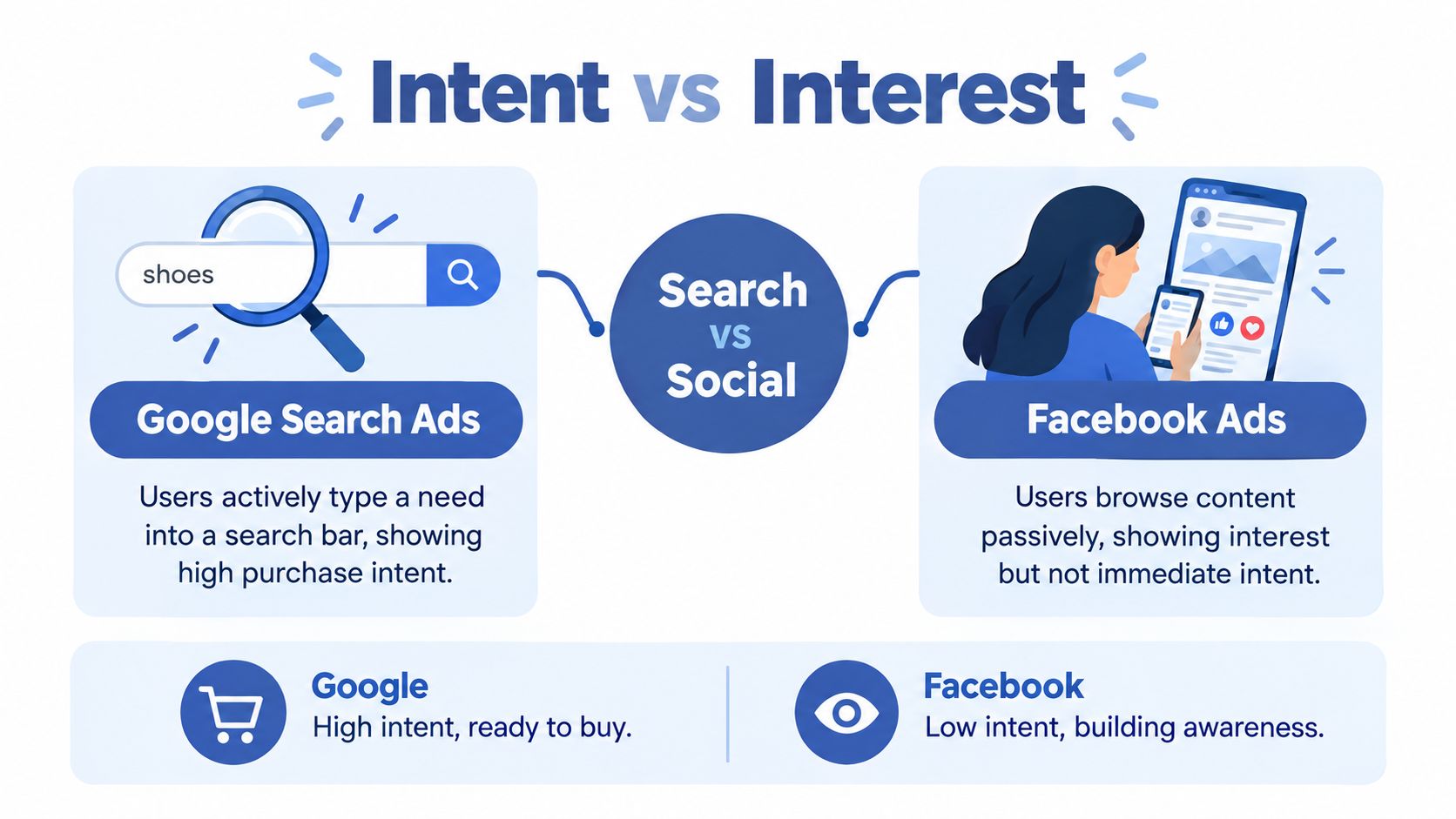
The distinction matters in POD because apparel often sells through either a specific need or a visual reaction. Someone searching for a gift for a particular occupation, hobby, or seasonal occasion is giving Google a clear signal. A person who laughs at a niche design while scrolling may not have been looking for a shirt at all. Meta's job is to make that design feel relevant enough to stop the scroll.
Search advertising can also add visits that wouldn't otherwise have occurred. A meta-analysis of several hundred Google search-ad experiments found that more than 89% of ad clicks were incremental, meaning those visits would not have happened without the search campaigns (Google's research on incremental search-ad clicks). Academic research published in 2019 also found that search intention significantly affects search-ad click-through rate and cost per click, with informational, transactional, and navigational queries producing different outcomes.
Match the demand pattern to the ad
Use Google when shoppers are likely to describe the product or occasion in a query, such as an occupation-themed gift or an established hobby design. Use Meta when the artwork, message, or audience connection does the selling and the customer needs to see the idea before wanting it.
That distinction isn't an argument for keeping the channels separate forever. A person can discover a design on social, search for the brand later, and then buy through a search ad. The useful starting point is knowing which channel is creating awareness and which is collecting demand, so you can interpret results without mistaking one role for the other.
If your marketing spans other paid channels, Boocoo's LinkedIn ad expertise offers a useful point of comparison for thinking about how platform and audience context shape campaign strategy. For POD, keep the core rule simple: Google captures explicit demand; Meta creates discovery.
Targeting, Creative, Costs, and Scale Mechanics
A channel only works when its targeting, ad format, costs, and scaling behavior suit the product. Meta gives you tools to reach people through interests, behaviors, demographics, and lookalike audiences. Google lets you match to search terms and Shopping intent, while automation such as Performance Max can extend delivery across Google's properties.
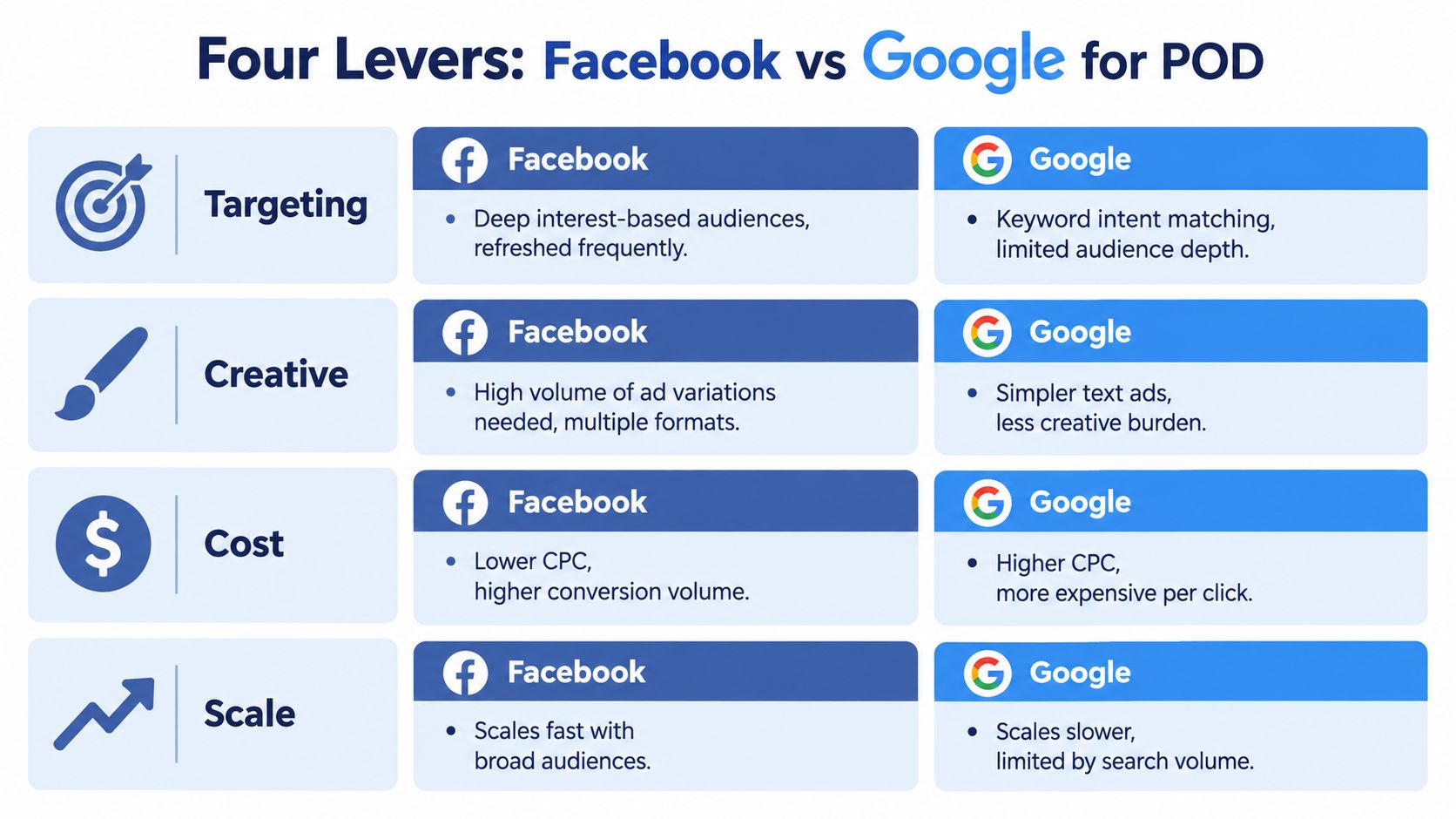
The four levers that shape results
Targeting: Meta's audience signals are useful when you know the interests or behaviors that might connect with a design. Google's advantage is a shopper's query or product-search context. Neither is automatically better. The question is whether your buyers are easier to identify by what they do online or by what they're actively seeking.
Creative: Meta depends heavily on the visual idea and the range of ad variations you can test. A strong design can earn attention, but creative fatigue means you need a continuing supply of fresh concepts and presentations. Google Search puts more weight on the relationship between the keyword, ad copy, and landing page. Google says Ad Rank incorporates the bid, auction-time ad quality, expected click-through rate, relevance, landing-page experience, search context, device, location, and other user signals. A higher bid alone doesn't guarantee placement.
Google's Quality Score is a diagnostic measure displayed on a 1–10 scale, but Google says the score itself isn't a direct auction input. Improve the underlying relevance, expected click-through rate, and landing-page experience instead of trying to raise the displayed number (Google's explanation of Ad Rank and Quality Score).
Costs: One ecommerce benchmark reports Google Search conversion rates around 3.49%, compared with approximately 1.6% for Meta, and apparel ROAS near 3.98 for Google versus 2.18 for Meta (ecommerce advertising benchmarks). Treat those figures as directional, not as a forecast for your store. Search and social often reach people at different stages, and campaign structure, attribution windows, geography, creative, and offer can all affect the outcome.
Scale: Meta can expand discovery when creative and audience signals are working, but scaling depends on continued creative testing and reliable conversion data. Google can grow with search and Shopping campaigns when shoppers are searching, but demand for a specific query can limit available traffic. Automation on both platforms makes clean purchase signals and sound landing pages more important, not less.
| Lever | Facebook/Meta Ads | Google Ads |
|---|---|---|
| Audience signal | Interests, behaviors, demographics, and lookalikes | Search terms, Shopping intent, and automated campaign signals |
| Main creative demand | Fresh visual concepts and formats | Relevant copy and a well-matched product page |
| Main scaling constraint | Creative quality and dependable conversion signals | Search demand and campaign relevance |
| Best first question | Which audience might respond to this design? | Are shoppers already searching for this product? |
To improve the cost side, focus on product-page fit, offer clarity, and what happens after the click. This practical guide to reducing customer acquisition cost is a useful reference when you're reviewing the full path to purchase. If producing and testing video concepts is a bottleneck, ShortGenius's AI ad creative tool is one option to explore for generating ad variations.
Why Reported ROAS Lies and How to Measure Real Profit
A platform's reported ROAS is not the same as incremental profit. Meta may credit a purchase after an eligible click or view, while Google can distribute credit across interactions through data-driven attribution. When the same customer sees a social ad, later searches a brand, and buys after clicking a search ad, both platforms may report a role in the sale.
That overlap isn't a reason to stop advertising. It's a reason to use consistent definitions and look beyond each platform's own dashboard. Google says data-driven attribution is the default for most conversion actions and estimates the contribution of interactions using historical conversion data. Advertisers can compare models such as last-click and data-driven attribution in the Model Comparison report (Google's attribution model guidance).
Build a measurement habit before increasing spend
A cited ecommerce study found a Meta campaign with 481 platform-attributed purchases generated 171 incremental purchases, meaning about 64% of reported conversions weren't additional sales caused by the campaign. An apparel example reported a decline from 4.0x attributed ROAS to 2.5x incremental ROAS (analysis of platform ROAS and MER). Those examples show why an attractive dashboard can overstate the business impact of ads.
Set up purchase conversion actions deliberately on both platforms. Google requires a defined conversion action and a Google tag or Google Tag Manager setup to record website activity; it also supports importing offline conversions when sales happen outside the website (Google Ads conversion tracking setup). Use a consistent purchase event where possible, and check that your reporting windows and attribution settings are understood before comparing channel results.
Then pair channel ROAS with blended MER or contribution margin, new-customer rate, and total profit after product, fulfillment, payment, and creative costs. Exclude existing customers from prospecting comparisons when appropriate. As volume allows, run an audience or geographic holdout, withholding ads from a comparable group and comparing outcomes against the exposed group. For broader context on how advertisers discuss returns in another consumer-product category, Reddog Consulting Group's Facebook ads ROI benchmarks for CPG may help, but your own margins and incrementality should guide your decisions.
The business metric is the additional contribution your ads create, not the conversion credit a platform assigns itself.
Use a break-even ROAS calculation as a starting point, then account for whether the campaign is acquiring new customers and adding sales that wouldn't otherwise have happened.
How to Pick by Business Stage
Your best starting channel changes as your store moves from testing designs to scaling a proven offer. Don't copy a budget split from another business. Pick a channel mix that answers the question you're facing now, and keep enough budget available to read the result.
Beginner, prove that a design connects
Start with Meta if your first designs rely on visual discovery and you don't yet know which audiences respond. Make a small, controlled creative test rather than dividing a limited budget across many unrelated products. Your primary KPI is purchase conversion and contribution after costs, not cheap clicks or reactions. First test whether distinct design concepts earn attention and purchases from a relevant audience.
If people already search for the product or gift theme, include a focused Google Search or Shopping test instead of assuming discovery is the only path. The point is to match the first campaign to the demand your product has, not to follow a fixed platform rule.
Growth, add the channel that fills the gap
When a design is producing sales and you can describe its buyer or use case clearly, check whether shoppers search for it. If there's recognizable query demand, add Google Search or Shopping to capture it. Keep Meta working on discovery and creative testing; use the search campaign to evaluate whether people already looking for that product can convert profitably.
Set the initial budget according to your test capacity and margins, then increase only when tracking is sound and the campaign is contributing. Your main KPI is incremental contribution, with new-customer rate as a useful check on whether you're reaching beyond existing buyers. The first test is a tight set of relevant search terms or Shopping listings for products with explicit demand.
Scaling, give each channel a defined role
Operators with proven products can run both: Meta for new-audience discovery and creative testing, Google Search and Performance Max for demand capture. Protect your brand in search where buyers may look for your store after seeing an ad elsewhere. The first test is to separate prospecting from retargeting and compare the channels against a shared business-level scorecard.
If you're increasing your design output, AvatarIQ is Skup's AI-powered software for creating apparel designs and product mockups. More design concepts can give Meta more material to test, but only if each creative has a clear audience and a measurable purchase goal.

There's no universal budget split that beats your own test results. Start with the channel suited to your product's demand, define the KPI before launch, and move budget only after the numbers show a useful contribution.
Best Use Cases for Each Platform in POD
A buyer looking for an established gift theme, occupational shirt, hobby design, or seasonal item may search directly for it. That makes Google Search and Shopping a natural place to test products with clear query demand. Meta is a stronger starting point for designs whose humor, visual style, or niche identity creates interest as someone scrolls.
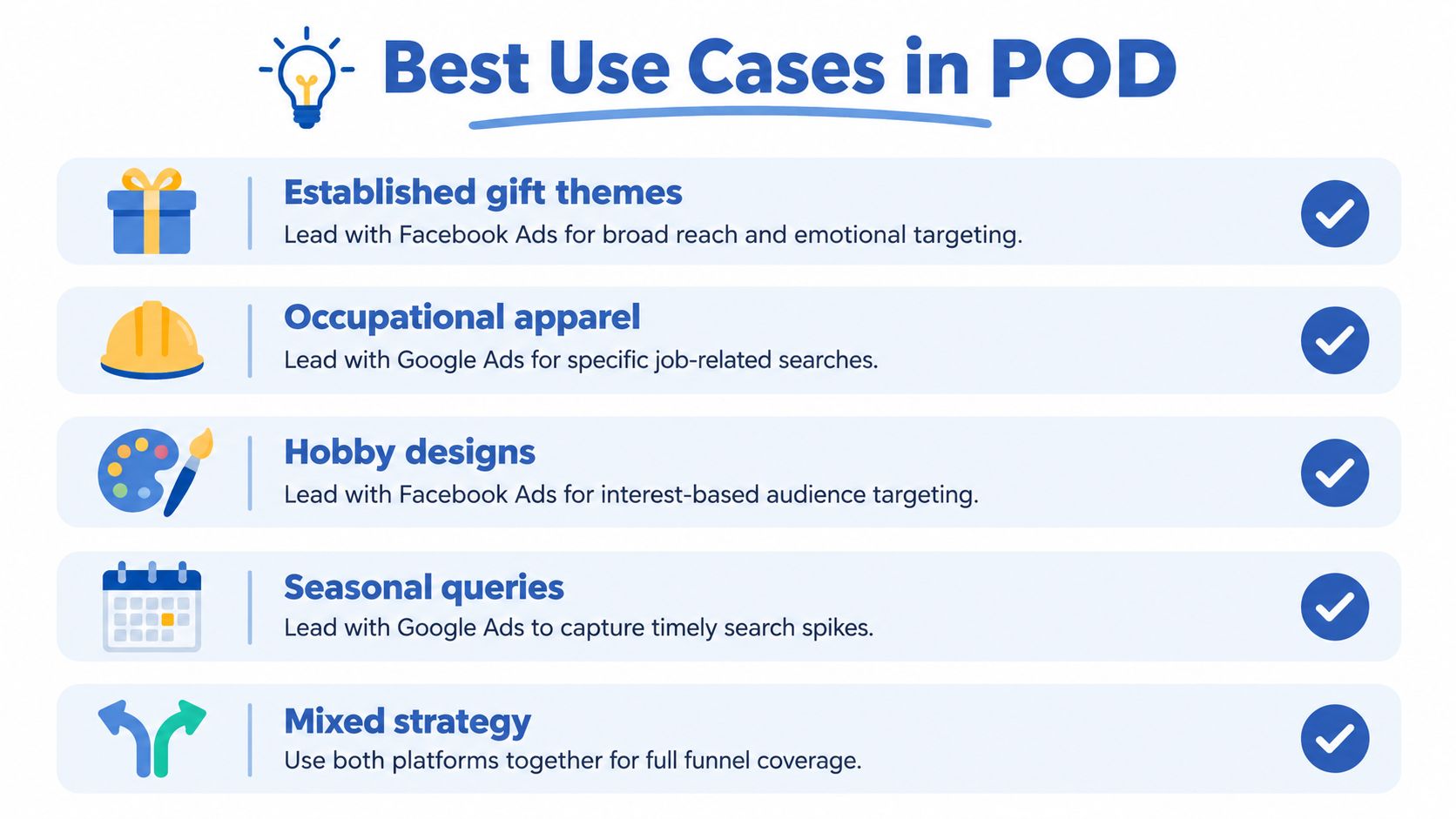
Choose by what the shopper already knows
| POD scenario | Lead with | Reason |
|---|---|---|
| Established gift themes | Google Search and Shopping | Shoppers may search for a specific recipient or occasion. |
| Occupational apparel | Google Search and Shopping | Job-related searches can express explicit product intent. |
| Hobby designs | Meta, then test Google if search demand appears | Interest targeting can help introduce a design to the right community. |
| Niche humor or visually distinctive statements | Meta | The creative itself can create the reason to buy. |
| Seasonal queries | Google Search and Shopping | Search campaigns can meet time-sensitive demand. |
| Branded apparel | Google Search, alongside Meta | Search can capture people looking for your brand, while social can support discovery. |
| Retargeting | Test both | Meta and Google can re-engage people who have already encountered the store. |
A practical progression is to test a new design on Meta when its appeal depends on a visual reveal, then evaluate Google Shopping or Search if customers begin looking for that product or brand. That's a testing sequence, not a promise that every design will generate search demand. Keep the landing page consistent with the ad, and measure the new campaign on its own contribution.
For tactical setup ideas, use this Google Ads guide for print-on-demand as a companion when a product has a clear search opportunity. The key is to make the platform choice product-specific. A design that needs an audience introduced to its idea calls for a different opening move than a gift buyers already know how to describe.
Your Practical Decision Checklist
Before your next campaign, answer these questions:
- What am I testing? Choose between design appeal, audience fit, search demand, landing-page conversion, or incremental customer acquisition.
- Where is the demand? Use Google when shoppers are likely to search for the product. Use Meta when the product needs a visual introduction.
- Is purchase tracking clean? Confirm both platforms record the purchase action you care about.
- What counts as a win? Look at contribution after product, fulfillment, payment, and creative costs, alongside blended results and new-customer rate.
- What will I test next? Add Google when search demand becomes clear. Add Meta when a proven product needs more discovery or fresh creative tests.
If Meta reports a sale and Google reports the same one, don't choose a winner from those dashboards alone. Check your consistent reporting view, compare total business results, and use holdouts when your conversion volume makes a fair test practical.
POD gives you room to test products, audiences, and creative angles without having to make every channel decision permanent. This week, choose one product, define one purchase-focused test, verify tracking, and write down the contribution metric you'll use before spending. Disciplined testing beats guessing, and every clean result gives you a better next move.
Skup offers the Apparel Cloning System for learning a structured approach to finding and developing POD apparel products, and AvatarIQ for creating designs and mockups. Visit Skup to explore the resources and tools that can help you put your next product and advertising test into action.