How to Increase Shopify Sales with Actionable Growth Strategies
Growing your Shopify store isn't about finding a single magic bullet. It's about building a sustainable growth engine. The whole game boils down to a simple, three-part formula: attract the right kind of visitors, convert them into paying customers once they're on your site, and keep them coming back for more.
Nail these three pillars—acquisition, conversion, and retention—and you've got a direct path to scaling your store into a brand that lasts.
Your Roadmap to Explosive Shopify Growth
So, you've built your Shopify store. Congratulations! Now comes the truly exciting part: actually making sales and watching that revenue number climb. This guide is your personal playbook, filled with actionable strategies that we've seen work time and time again for real store owners. Forget the generic advice; we're diving straight into what moves the needle.
This is about more than just flipping a few switches in your Shopify admin. It's about building a real, thriving business you can be proud of. We'll cover battle-tested techniques for pulling in new customers, optimizing your site so they actually buy, and creating loyalty that lasts.
The process is straightforward, as you can see below. It's a flywheel—each stage feeds the next.
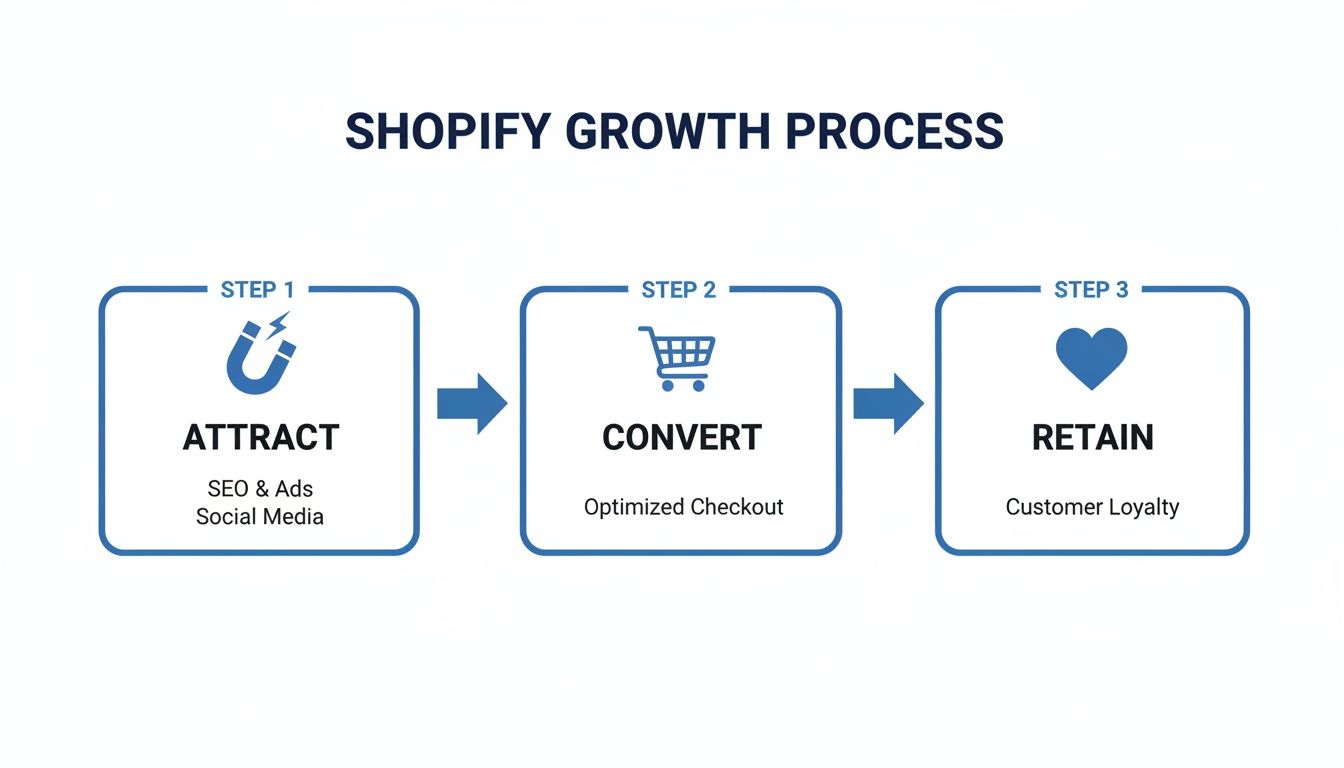
A successful store doesn't just get one of these right. It builds a system where great acquisition leads to seamless conversions, which in turn fuels powerful retention efforts.
Building a Sustainable Growth Engine
To really succeed, you need a plan that covers the entire customer journey. It's about creating a repeatable system that brings in new business while making the most of the customers you already have. This is the secret that separates aspiring stores from the seven-figure success stories.
Here’s what that looks like in practice:
- Attracting Ideal Customers: This means getting strategic about your traffic. We're moving beyond random visitors and focusing on channels that deliver people who are genuinely looking for what you sell.
- Optimizing for Conversion: Once they land on your site, you need a well-oiled machine. Your store has to build trust and make buying not just easy, but an absolute breeze.
- Fostering Long-Term Loyalty: The real magic happens when a one-time buyer becomes a repeat customer. This is how you dramatically increase customer lifetime value (LTV) and build a profitable brand.
To flesh out a truly solid growth plan, you’ll want to explore the full range of available e-commerce solutions that can help you execute.
The journey from your first sale to consistent, predictable revenue is built on a clear, strategic framework. It’s not about a single "hack," but about systematically improving every part of your business—from the ad creative to the checkout flow to the thank you email.
If you're ready to go deeper, our guide on proven ecommerce growth strategies offers more frameworks you can put into action right away. Now, let's get into the specifics.
Mastering Customer Acquisition to Drive Traffic
You could build the most incredible Shopify store in the world, but without visitors, it's just a billboard in the desert. The first real step to increasing your Shopify sales is getting a steady stream of the right people—your ideal customers—to your digital doorstep. This is the art of customer acquisition, and it's the first giant leap toward explosive growth.
The goal here isn't just about clicks or vanity metrics. It's about attracting shoppers who are genuinely excited about what you're selling. Your store is the stage, your products are the main event, and customer acquisition is handing out golden tickets to an audience that's already eager for the show.
Forget about just driving traffic. We're focused on what actually fuels your business: a profitable Cost Per Acquisition (CPA) and a healthy Lifetime Value (LTV).
Fueling Your Store with Paid Advertising
For a lot of Shopify merchants I talk to, paid advertising is the jet fuel for rapid growth. It's hands-down the most direct and scalable way to put your products in front of thousands of potential buyers, almost instantly. Platforms like Facebook, Instagram, and TikTok have become absolute powerhouses for e-commerce, especially for incredible models like print-on-demand.
Paid acquisition is still the dominant way to drive incremental sales. When your campaigns are dialed in and optimized for LTV, the ROI is undeniable. Industry reports back this up, showing that a huge chunk of merchant growth comes from paid channels. Just look at the record sales during peak seasons—it's all driven by coordinated paid media that delivers high traffic and high conversion at scale. For a deeper dive, check out these eye-opening Shopify statistics.
The key to winning with paid ads is to stop thinking like an advertiser and start thinking like your customer. What problem are you solving? What desire are you fulfilling? Your ad creative needs to answer that question in a split second.
Your ads have to do more than just show a product; they have to stop the scroll. This means compelling visuals and copy that speak directly to a very specific audience. A generic ad targeting "everyone interested in t-shirts" is just burning cash. But an ad targeting "dog moms who love hiking and witty sayings" with a design that nails that identity? That's how you win.
Creating Ad Creatives That Convert
This is where so many store owners feel stuck. I've seen it time and again. Creating professional, eye-catching mockups and ad visuals can feel like a massive hurdle, but with the right tools, it becomes your secret weapon and a source of incredible creative energy.
This is exactly why we built AvatarIQ. It lets you generate stunning, lifelike product mockups and ad creatives without needing a lick of design skill. You can spin up an endless variety of visuals that look like they came from a professional photoshoot, making your print-on-demand products look absolutely irresistible.
Here’s how you can use this to your advantage:
- Generate Diverse Mockups: Showcase your designs on a wide range of models and settings to resonate with different segments of your audience.
- Test Different Ad Angles: Quickly create visuals for various marketing angles. One ad might highlight the soft fabric of a shirt, while another focuses on the bold, unique design.
- Create Video and Lifestyle Ads: Go beyond static images. Use AvatarIQ to produce simple video ads or lifestyle shots that show your products in real-world scenarios, which can dramatically boost ad performance.
The ability to rapidly produce high-quality creative gives you a massive edge. It means you can test, find winning ads, and scale faster than your competition.
Building a Foundation with Organic Growth
While paid ads give you speed, organic strategies deliver sustainability. These methods take more time and effort to build momentum, but they create long-term, "free" traffic streams that become the bedrock of your business.
Search Engine Optimization (SEO) is all about getting your store to show up on Google when people search for products like yours. It’s an incredibly powerful way to increase Shopify sales for the long haul.
Focus on these SEO fundamentals:
- Keyword-Rich Product Titles and Descriptions: Think like your customer. What would they type into Google? Instead of "Cool Graphic Tee," try something like "Vintage Sunset Graphic Tee for Nature Lovers."
- Optimized Collection Pages: Don't just dump products into a generic "T-Shirts" collection. Create specific collections for different niches, like "Funny Cat Shirts" or "Minimalist Mountain Hoodies." Each one is a new opportunity to rank on Google.
- Blogging for Your Niche: Writing blog posts that answer your audience's questions builds authority and brings in traffic. If you sell fishing-themed apparel, a post on "The Top 10 Gift Ideas for Fishermen" can attract the perfect customers before they even know they want a t-shirt.
The strategies we teach in our Apparel Cloning course are designed to plug right into these acquisition methods. We show you how to identify proven, in-demand niches and then use that knowledge to create product listings and ads that are perfectly optimized from day one. When you combine potent paid strategies with a solid organic foundation, you create a powerful, multi-channel acquisition engine that continuously floods your store with customers ready to buy.
Optimizing Your Store for Maximum Conversions
Look, getting traffic is only half the battle. We can pour money into ads all day long, but the real magic happens when we turn those hard-won visitors into paying customers.
This is where Conversion Rate Optimization (CRO) comes in, and frankly, it’s the most powerful lever you have for boosting revenue without spending another dime on advertising. It’s time to stop thinking of your store as a digital window display and start treating it like a well-oiled sales machine.
Every single element on your store—from the homepage headline to the checkout button—is part of a conversation with your customer. Our job is to make that conversation smooth, convincing, and trustworthy. Let's break down your on-site experience and turn every click into a confident step toward a purchase.

Making Your Products Impossible to Ignore
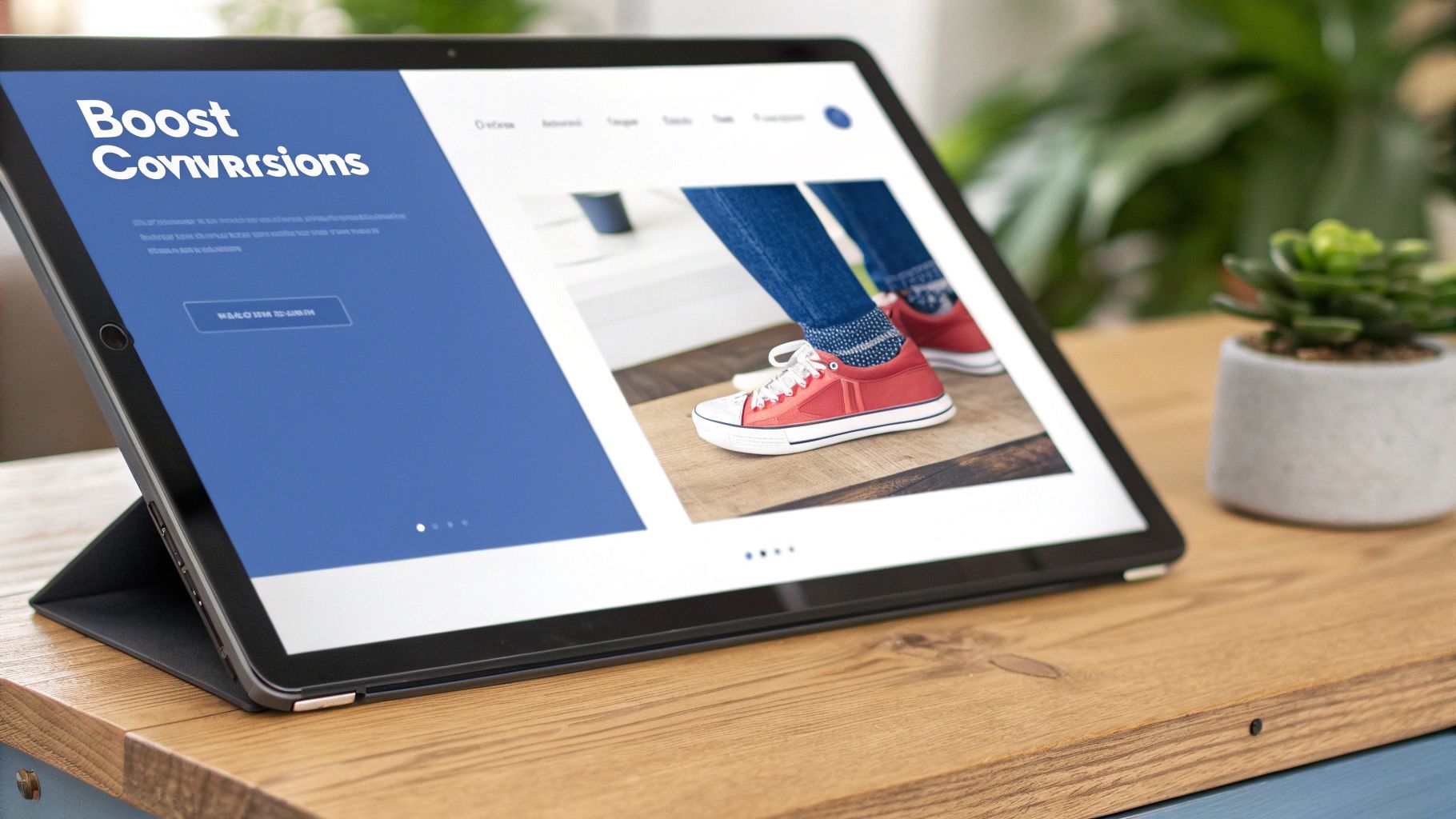
Your product page is your final pitch. It's the moment a casual browser decides to become a buyer, and the single biggest factor in that decision is your product imagery. For print on demand, this is non-negotiable. Customers can't touch or feel the product, so your mockups are the product in their minds.
This is where a tool like AvatarIQ gives you a massive edge. It was built to solve this exact problem, letting you create stunning, hyper-realistic mockups that make your designs look like premium retail apparel. Forget those flat, boring images everyone else uses. You can generate an endless variety of professional-grade photoshoots on demand.
- Showcase Variety: Display designs on different models and in diverse lifestyle settings. This helps shoppers actually see themselves wearing your gear.
- Highlight Quality: Use close-up shots to show off texture and small design details. This builds perceived value instantly.
- Create Ad-Ready Visuals: Generate visuals that are perfect for social media ads right out of the gate, making your creative process way faster and more effective.
When you present your products in the best light possible, you eliminate doubt and create real desire.
The Power of Persuasive Product Pages
Once your visuals grab their attention, your words have to seal the deal. Your product description isn't just a list of specs; it’s your chance to tell a story and connect with your customer on an emotional level.
A great product description nails three things:
- It speaks to the customer's identity. You're not just selling a t-shirt with a mountain graphic; you're selling a badge for "the weekend adventurer." It's about the feeling, not just the fabric.
- It solves a problem or fulfills a desire. This could be as simple as the desire for a comfy hoodie, the need for a funny gift, or the want to express a personal passion.
- It answers questions before they're asked. Be upfront about materials, fit, and care instructions. This builds confidence and crushes hesitation.
If you really want to dial this in, check out this excellent AI content optimization for e-commerce guide. It’s packed with actionable tips for improving product descriptions and your store’s overall appeal.
Building Unshakeable Trust and Credibility
In ecommerce, trust is everything. A new visitor needs to feel completely safe and confident before they'll even think about pulling out their credit card. This is where social proof becomes your best friend.
Social proof is the modern-day word-of-mouth. When potential customers see that other people have bought from you and loved their experience, their purchase anxiety melts away.
Start actively encouraging and displaying customer reviews. Use an app to automatically send review requests after a purchase and make sure to showcase them—with photos!—on your product pages. User-generated content (UGC), like real customers wearing your products on social media, is pure gold. It’s authentic, relatable, and one of the most powerful trust signals you can possibly send.
Our deep-dive on how to increase your eCommerce conversion rate gets into even more of these trust-building tactics.
Streamlining the Path to Purchase
Even with incredible products and tons of social proof, you can still lose sales if the shopping experience is clunky. Every unnecessary click or confusing step adds friction and gives customers a reason to leave.
Your goal is a frictionless path from product discovery to the "thank you" page.
- Simplify Navigation: Your menu has to be intuitive. A customer should be able to find what they're looking for in three clicks or less.
- Optimize for Mobile: Most of your traffic will come from mobile. Period. Your store must look and function flawlessly on a small screen. Test it on your own phone!
- Speed Up Your Site: Slow-loading pages are conversion killers. A one-second delay can gut your conversions by 7%. Compress your images and use a fast, reliable theme.
By meticulously optimizing every step, you ensure the traffic you worked so hard to get actually turns into sales. This is how you build an exciting and seriously profitable business.
Crafting Irresistible Offers and Pricing Strategies
A powerful offer can single-handedly turn a window shopper into a paying customer. The real secret to increasing your Shopify sales isn't just getting more traffic—it's about making every single transaction more valuable. It's time to stop defaulting to "10% off" and start crafting promotions that actually boost your profitability.
The goal here is to get strategic and increase your Average Order Value (AOV). We’re talking about creating offers that feel urgent, exclusive, and so jam-packed with value that hitting "buy now" is a no-brainer.
Go Beyond Discounts with Strategic Bundling
Bundling is one of my favorite ways to pump up AOV. Instead of just knocking a few bucks off one item, you create a package deal that makes buying more the obvious choice. This is an absolute goldmine for print-on-demand stores.
Think about it. A customer finds a t-shirt design they love. Awesome. But what if you could also sell them a matching hoodie and a tote bag in the same transaction? By offering them all together for a slight discount, you're not just selling products; you're selling a complete vibe.
Here are a few bundle ideas you can get running this week:
- The "Complete Look" Bundle: Package a t-shirt, hoodie, and a hat with the same design or theme. Easy win.
- The "Buy Two, Get One" Deal: This is perfect for encouraging people to stock up on core products like tees or mugs.
- The Tiered Discount Bundle: Try something like "Buy 2 items, get 15% off. Buy 3+, get 25% off." It gamifies the experience and nudges people to add just one more item to their cart.
Suddenly, you've shifted the customer's mindset from a single-item purchase to a multi-item haul, instantly making that sale more profitable.
The Psychology of Smart Pricing
Never underestimate the psychological impact of pricing. Tiny tweaks to how you display your prices can have a massive effect on your conversion rate.
A classic for a reason is charm pricing. We’ve all seen it: ending prices with the number nine. Decades of studies show that a price like $29.99 feels significantly cheaper to our brains than $30.00. It's a subtle but powerful mental trick that anchors the customer's perception to the lower dollar amount.
Your pricing strategy isn't just about covering costs and making a profit; it's a powerful marketing tool. Use it to create perceived value, build urgency, and guide customers toward the purchase you want them to make.
Another potent psychological trigger is scarcity. People are wired to want what they think they might miss out on. When an offer is limited, it short-circuits hesitation and pushes people to act now.
You can easily manufacture this feeling:
- Limited-Time Offers: Run a flash sale that only lasts for 24 or 48 hours.
- Limited-Edition Designs: Release a design and make it clear that once it's gone, it's gone for good.
This creates an authentic sense of urgency that gets on-the-fence shoppers to commit.
Maximize Every Sale with Upsells and Cross-Sells
What if you could add more revenue to an order after the customer has already decided to buy? That's the magic of upsells and cross-sells. These are the little offers you see in the cart or right before the final checkout step.
Let's break them down:
- An upsell is about getting the customer to buy a better, more expensive version of what they already want. Think: "Upgrade from our standard tee to the premium tri-blend fabric for just $7 more."
- A cross-sell is about suggesting a related product that complements their purchase. For instance: "Love that t-shirt? Add the matching phone case to your order."
Countless Shopify apps make this dead simple to set up. A well-placed cross-sell, like offering a sticker pack for an extra $5 at checkout, might seem small, but that extra revenue adds up incredibly fast over time with practically zero additional effort on your part. You’re catching customers when they’re already in a buying mood—it’s one of the easiest wins you can get.
Building a Loyal Customer Base for Sustainable Growth
Getting a new customer is a great feeling. No doubt about it. But the real secret to building a brand that lasts is turning that first-time buyer into a lifelong fan. This is what we call retention marketing—it's the engine that powers sustainable growth by getting the absolute most value out of every single customer you bring in.
Instead of constantly shelling out cash to fill a leaky bucket, you'll be building a loyal community that actually wants to buy from you again and again. A killer post-purchase experience is your best friend here. It’s what turns a simple transaction into a real relationship, delighting your customers along the way.
This is how you build a real brand, not just an online store. And the best part? You can automate a huge chunk of it, so it's working around the clock to bring in sales.
Automate Your Relationship Building with Email and SMS
Email and SMS are your direct lines to your customers. Don't just think of them as channels for blasting out discount codes. They are incredibly powerful tools for building connections and driving repeat purchases completely on autopilot.
Honestly, setting up a few key automated "flows" is one of the fastest ways to see a real lift in your revenue. Think of them as automated conversations that guide your customers through their journey with your brand.
Here are the flows every single Shopify store needs, no exceptions:
- The Welcome Series: This is your first impression after someone signs up. Please, don't just send a coupon. Use a series of 3-5 emails to tell your brand story, show off your best-sellers, and build that crucial initial trust.
- The Abandoned Cart Flow: Life happens. People get distracted. A simple, friendly reminder can claw back a massive percentage of sales you would have otherwise lost. The data is clear: three out of four shoppers abandon their carts. This flow isn't optional; it's essential for boosting your sales.
- The Post-Purchase Follow-Up: This is where you can truly separate yourself from the competition. Send a genuine thank-you email and provide clear shipping updates. Then, a few weeks later, circle back and ask for a review. It shows you care beyond just making the sale and helps you collect that all-important social proof.
For a much deeper dive on getting these systems humming, our complete guide to email marketing for Shopify breaks down every single step.
Reward Your Best Customers with a Loyalty Program
Your most loyal customers are your most valuable asset. They're the ones leaving glowing reviews, telling their friends about you, and refreshing their browser waiting for your next product to drop. A loyalty program is simply your way of saying, "We see you, and we appreciate you."
It doesn't need to be some complicated, enterprise-level system. A simple points-based program works wonders.
- Earn Points for Purchases: The classic model. Customers get points for every dollar spent, which they can then redeem for discounts or exclusive products.
- Reward for Engagement: Why not give out points for other actions? Think following on social media, leaving a product review, or even on their birthday. It encourages them to be a part of your community.
- Create VIP Tiers: Make your top spenders feel special. Offer exclusive perks like early access to new collections, a dedicated support line, or free shipping for life. This creates a sense of exclusivity that people will genuinely strive for.
A great loyalty program makes your best customers feel seen and valued. It shifts the relationship from being purely transactional to one built on mutual value and a shared community.
Foster a Thriving Brand Community
At the end of the day, the most powerful retention tool of all is building a genuine community. A tribe of followers who aren't just customers, but true fans. When people feel like they're part of something bigger than just a transaction, their loyalty goes through the roof.
Use your email list and social media channels to really build that connection. Don't just post product shots. Share behind-the-scenes content, ask your audience for their opinion on new designs, and proudly feature photos and videos from real customers using your products.
When you create a space where your followers can connect with you and with each other, they become emotionally invested in your brand's success. They stop being just "customers" and start becoming your biggest cheerleaders, amplifying your message and driving organic, word-of-mouth sales. That's the endgame—creating a brand that people are legitimately excited to be a part of.
Frequently Asked Questions About Increasing Shopify Sales
Growing a Shopify store can feel like a puzzle with a million different pieces. It’s natural to have questions. Here, I'm going to tackle some of the most common ones we hear from store owners just like you.
My goal is to give you clear, straight-up answers so you can move forward with confidence. Let's get these hurdles cleared so you can get back to growing.
What Should I Focus on First to Get More Sales on Shopify?
When you’re starting out, it's easy to get paralyzed by all the things you could be doing. Forget about mastering everything at once. You need to nail just two things: getting targeted traffic and converting that traffic into customers. That’s it.
Pick one or two acquisition channels—maybe Facebook Ads or TikTok—and go deep. At the same time, pour your energy into making your product pages absolutely irresistible. That’s your entire focus.
- High-Quality Mockups: Your product images are your sales pitch. Use a tool like AvatarIQ to generate stunning mockups that make your designs look like they belong in a high-end retail store. This isn’t a nice-to-have; it's essential for creating desire.
- Compelling Descriptions: Don't just list features. Write copy that solves a problem or taps into your customer's identity. Make them feel something.
- Visible Social Proof: The second you start making sales, get those reviews up. New shoppers need to see that other people have bought from you and are happy.
Nail your traffic source and your product page. That's the simple, repeatable formula for getting those first sales rolling in.
How Much Money Do I Need for Ads to See Results?
There’s no one-size-fits-all answer, but you can definitely work this out with some basic math. It all comes back to your profit margin.
Let’s say you sell a t-shirt for $30. After the shirt and printing, your cost is $10. That leaves you with a $20 profit margin. This $20 is your breakeven Cost Per Acquisition (CPA). You can spend up to $20 to get one customer and still not lose money.
A solid starting budget to test the waters is usually around $20-$50 per day.
A small, consistent daily budget is far more valuable for learning than a large, one-time spend. The goal in the early days isn't to get rich overnight; it's to gather data, find a winning ad, and prove you can acquire customers profitably.
This is enough cash to get real data on your ads and audiences without breaking the bank. Once you find a combination that's profitable, you just reinvest your earnings and scale up from there.
How Do I Get People to Trust My New Shopify Store?
For any new store, trust is currency. Without it, you get clicks but no sales. Earning it isn't complicated, but it does require you to look professional and be transparent.
Make sure these foundational pieces are locked in on your site:
- A Clear "About Us" Page: Tell your story! People buy from people, not faceless websites. Who are you? What’s your mission? This is your chance to connect.
- Accessible Contact Information: A "Contact Us" page with an actual email address is non-negotiable. It tells customers you're a real business and you’re there to help if something goes wrong.
- Display Trust Badges: Put the logos for secure payment options like Visa, Mastercard, and PayPal right near your checkout button. It’s a small visual cue that makes a big difference.
- Showcase Real Customers: This is the single most powerful trust signal you have. Actively collect and display reviews, especially photo reviews. User-generated content showing real people using and loving your products is absolute gold for your site and social media.
Is Print on Demand Still a Good Way to Increase Sales?
Absolutely. Print on demand is one of the most accessible and exciting models in ecommerce right now. Its biggest advantage? You can offer a massive catalog of unique products with zero upfront inventory costs.
This completely removes the financial risk that holds many people back from starting an apparel brand. You're free to test new designs, jump on trends, and experiment with different niches without worrying about a garage full of unsold t-shirts.
The secret to winning in POD is creating killer designs that resonate with a very specific audience. It's not about being for everyone; it's about being everything to someone. That’s where the right tools and strategies make all the difference.
- Professional Presentation: Use AvatarIQ to generate incredible product mockups. Good presentation turns a $15 tee into a $35 premium product.
- Proven Niches: Don't guess what will sell. Our Apparel Cloning course shows you exactly how to find profitable niches and replicate their success.
The opportunity in print on demand is massive. It's a fantastic model for building a scalable and highly profitable business from scratch.
Ready to stop guessing and start building a real, profitable print-on-demand business? At Skup, we don't just teach theory—we provide the exact systems, software, and coaching we use to run our own 8-figure brands. Learn more about our proven strategies and get started today at https://skup.net.