Home » Blog » A Guide to Increase Shopify Sales for Print-On-Demand
If you want to really increase your Shopify sales, you have to get one thing straight: growth comes from tapping into a massive, active market of buyers who are already looking for products just like yours.
The secret isn't creating demand from thin air. It's about optimizing your store, crafting offers that people can't refuse, and building a smart ad strategy to capture the demand that's right there for the taking. It's a genuinely incredible time to build a print-on-demand business, and this playbook will show you exactly how to do it.
Why Now Is the Perfect Time for Your POD Business
Welcome to what I consider a golden era for e-commerce entrepreneurs. Before we dive into the nitty-gritty tactics for boosting your sales, I think it's crucial to grasp the sheer scale of the opportunity right in front of you. Platforms like Shopify have built a thriving ecosystem where any business, big or small, can connect with millions of active shoppers.
This isn't just about some abstract numbers on a spreadsheet; it's a real, tangible market hungry for unique designs. On days when you feel discouraged, remember that the foundation for your success is already poured—you just need to plug into it. Every strategy we'll cover is designed to help you ride this powerful wave of consumer demand.
Tapping into a River of Buyer Demand
The scale of Shopify's growth is staggering, and it's a direct tailwind for print-on-demand store owners.
Shopify's Gross Merchandise Volume (GMV) recently shot up to $292.3 billion, a 24% jump from the previous year. That number represents real money flowing through stores just like yours, pushing the platform's cumulative GMV past $1 trillion.
This means entrepreneurs we work with in programs like our Apparel Cloning System aren't just launching a store; they're connecting to a massive, flowing river of buyer activity. The proof is in the pudding: a new entrepreneur makes their first sale on Shopify every 26 seconds. If you want to see the full picture, you can explore more Shopify statistics here.
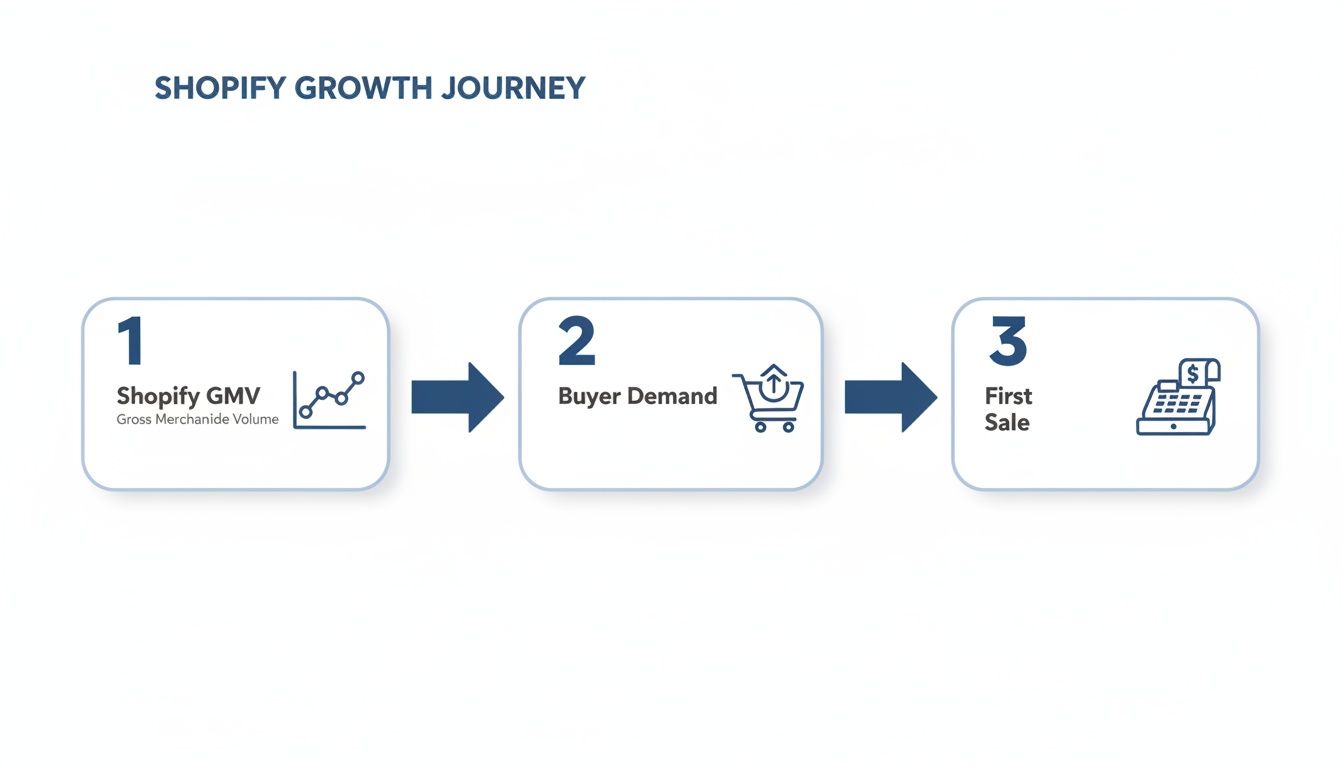
This simple visual breaks down the journey from massive platform growth right down to your first sale.
As the infographic shows, Shopify's incredible transaction volume directly fuels buyer demand. This creates a constant stream of opportunities for new entrepreneurs to get that first, exhilarating sale notification.
Your Opportunity in This Growing Market
So, what does this massive market actually mean for you and your print-on-demand goals? It means you have a historic advantage. You aren't starting from ground zero, trying to convince people to shop online. You're stepping into a mature marketplace with deeply ingrained buying habits.
The biggest hurdle isn't creating demand; it's effectively capturing a slice of the demand that already exists. Your focus should be on differentiation, connection, and execution.
This environment is set up for you to:
Reach a Global Audience: Your store isn't stuck in one place. With Shopify, you can sell to customers down the street or on the other side of the world.
Build a Real Brand: The tools and traffic are there to build something more than just a store—you can create a lasting brand that connects with a loyal community.
Achieve Financial Freedom: The low startup costs of print-on-demand, combined with the immense sales volume on Shopify, create a very real path toward building a sustainable, profitable business.
Let's summarize how these big-picture trends translate into direct actions for your POD store.
Shopify Trends and Your POD Action Plan
Here is a summary of key Shopify trends and the direct actions you can take to leverage them for your print-on-demand store.
Key Shopify Trend
What This Means for Your Store
Your Actionable Next Step
Massive GMV Growth
A larger pool of active, paying customers exists than ever before.
Focus on niche targeting. Instead of trying to appeal to everyone, pinpoint a specific audience within the larger market.
Global Marketplace
Your potential customer base isn't limited by borders.
Research international shipping options with your POD provider and consider running targeted ads in other English-speaking countries.
Established Buyer Behavior
Shoppers are comfortable and confident buying online from independent brands.
Build trust quickly with professional branding, clear product photos, and prominent social proof (reviews, testimonials).
Low Barrier to Entry
It's easier than ever to start, but also easier for competitors to emerge.
Differentiate with unique designs and a strong brand voice. Don't just sell t-shirts; sell an identity.
Tapping into these trends is how you turn a small POD idea into a serious business. You should feel genuinely excited about this moment. The potential to build something incredible for yourself is very, very real.
Let's get started.
Optimizing Your Storefront for Higher Conversions
Think of your Shopify store like a brick-and-mortar shop. If the front door is jammed, the aisles are a total mess, and products are tossed on shelves without any thought, people are going to walk right back out. Your online store is no different. A slow, confusing website is the quickest way to kill a sale before you even have a shot.
The great news? Crafting an incredible shopping experience is completely in your hands. It’s all about building a seamless, trustworthy, and genuinely exciting space that doesn’t just display your products—it convinces visitors to hit 'Add to Cart' without a second thought. This is how you stop being just another store and start turning casual browsers into loyal fans.
Build on a High-Speed Foundation
Long before a customer sees your killer designs, they feel your site's load time. In ecommerce, speed is everything. A mere one-second delay can slash conversions by 7%. For any store with serious growth ambitions, that’s a painful amount of cash left on the table.
Your theme is the bedrock of this experience. It's so tempting to pick one based on looks alone, but you've got to put performance and mobile experience first. With over 60% of online shopping now happening on phones, a clunky mobile site isn't just an annoyance; it's a deal-breaker.
Go for a Lightweight Theme: Hunt for themes known for their clean code and speedy load times. The Shopify Theme Store even provides performance scores to help you choose.
Embrace Mobile-First Design: Your store absolutely must look and work flawlessly on a smartphone. Go through every single page on your phone, from the homepage to the final checkout screen.
Crush Your Images: Huge image files are the #1 reason for slow websites, hands down. Use an image compression tool to shrink your files before you upload them.
Nailing these technical basics means your visitors get a smooth, frustration-free journey from the second they arrive. For a much deeper dive, our guide on Shopify conversion rate optimization breaks down these foundational elements in serious detail.
Craft Product Pages That Actually Sell
Your product page is your digital salesperson. It has one job: to be persuasive, informative, and build instant trust. This is your chance to handle objections, answer questions before they’re even asked, and make your designs feel real and tangible.
Forget just listing features like "100% cotton t-shirt." That’s boring. Sell the feeling. Who is this design for? What statement does it make when they wear it? Use punchy bullet points to call out the key benefits so people can scan them easily.
Your product visuals do the heaviest lifting. High-quality, professional mockups are non-negotiable. They build immediate trust and help customers instantly picture themselves wearing your apparel.
This is where a tool like AvatarIQ can completely change the game. Instead of shelling out for expensive photoshoots, you can generate an endless variety of photorealistic mockups showing your designs on diverse models in all sorts of settings. You get a massive library of professional assets that scream credibility and make your products look incredible.
Make Navigation Effortless
It’s simple: if customers can’t find what they want, they can't buy it. An intuitive, no-brainer navigation structure is your best tool for guiding visitors through your store and helping them discover products they'll love.
A solid rule to live by is the "three-click rule." A customer should be able to get to any product from your homepage in three clicks or less. If you're running campaigns to specific offers, understanding landing page design best practices is also critical for getting the most out of every click.
Keep your main menu clean. Use logical categories that people expect, like "New Arrivals," "T-Shirts," "Hoodies," and "Best Sellers." A clear path removes friction and keeps the focus where it should be: on the shopping experience.
Creating Products and Offers Customers Love
A high-performance storefront is crucial, but let's be honest: even the slickest website can't save a product that doesn't connect with people. The real engine of explosive growth comes from creating designs and offers that genuinely resonate with your target audience. This is where you shift from just selling stuff to building a brand people are actually excited about.
The biggest hurdle for most entrepreneurs? The constant pressure to dream up new, winning ideas. It can feel like you're just throwing darts in the dark, hoping something sticks. But what if you could take the guesswork out of it and systematically create products you know people already want?
Uncovering Winning Ideas with Apparel Cloning
The secret isn't about reinventing the wheel. It's about finding what's already working and giving it your own unique spin for an untapped audience. This is the core principle behind our Apparel Cloning method—a systematic way to identify proven concepts and adapt them for your niche.
Instead of starting from a blank page, you begin by researching designs that are already a hit with a specific group. Maybe it’s a certain style of humor, a hobby, or a shared passion. You're not copying the designs themselves; you're "cloning" the successful concept behind them and creating something fresh for a different but related audience.
For example, you might spot a t-shirt with a witty phrase about coffee that's selling like crazy. The winning concept here is "clever saying about a beloved daily ritual." You could clone that concept for the tea-drinking community, cat lovers, or bookworms, creating a unique product with a built-in audience ready to buy.
Generate Stunning Visuals with AvatarIQ
Once you have a winning concept, the next challenge is bringing it to life visually. In print on demand, your mockups are everything. Customers can't touch or feel the product, so your images have to do all the heavy lifting to build desire and trust. This is often where new store owners get stuck, thinking they need professional design skills or expensive photoshoots.
This is precisely why we built AvatarIQ, our proprietary AI tool. It gives anyone, regardless of their design experience, the power to create an endless supply of unique designs and professional, photorealistic mockups in minutes.
Forget spending days trying to create visuals. With AvatarIQ, you can generate an entire collection of high-quality product images that look like they came from a professional photoshoot, giving your store instant credibility.
Imagine being able to:
Create Unique Designs Instantly: Just describe the design you want, and the AI will generate it for you.
Produce Photorealistic Mockups: Showcase your designs on diverse models in various settings without hiring a single person.
Speed Up Your Workflow: Go from a simple idea to a fully merchandised product page in a fraction of the time.
This tool completely removes one of the biggest and most expensive roadblocks in print on demand, letting you focus on what really matters: finding great concepts and getting them in front of customers.
Crafting Offers That Boost Your Bottom Line
A great product is the first step, but a truly irresistible offer is what drives a higher Average Order Value (AOV) and seriously increases your Shopify sales. The goal is simple: encourage customers to spend a little more with each transaction. The impact on your overall profitability can be massive.
But effective offers aren't just about slapping a discount on everything. They're strategic incentives that make customers feel like they're getting an incredible deal.
Here are a few powerful offer strategies you can implement right away:
Product Bundles: Group 2-3 related products together for a slightly discounted price. For instance, bundle a popular t-shirt with a matching hoodie and a mug. This not only bumps up the order value but also introduces customers to more of your product catalog.
Free Shipping Thresholds: This one's a classic for a reason—it works. Research shows that 73% of shoppers are more likely to buy if they can get free shipping. Just set a threshold that’s slightly above your current AOV (e.g., "Free Shipping on Orders Over $75"). It’s the perfect nudge to get customers to add one more item to their cart.
Tiered Discounts: Offer escalating discounts based on cart value, like "10% off $50, 15% off $75, 20% off $100." This gamifies the shopping experience and gives customers a clear incentive to spend more to save more.
Of course, crafting the right offer is closely tied to your product costs and profit margins. To make sure your promotions are always profitable, you should check out our guide on how to price print on demand products. It'll give you a solid framework for setting prices that support these kinds of growth strategies.
Developing a Profitable Advertising Strategy
Throwing money at paid ads without a solid plan is the fastest way to burn through your cash. A lot of store owners treat it like a slot machine—pulling the lever and just hoping for a jackpot. But a truly profitable advertising strategy isn't about luck. It's a deliberate system built on creative storytelling, smart testing, and data-driven decisions that turns your ad spend into a predictable growth engine.
This is your roadmap to building that engine. Forget about generic, lifeless ads that everyone just scrolls past. We're going to build a creative strategy that actually stops the scroll, connects with your ideal customer on a deeper level, and drives consistent sales for your Shopify store. This is how you shift from gambling to investing.
Stop the Scroll with Compelling Creative
In a crowded social media feed, your ad has less than two seconds to grab someone's attention. That’s it. Your creative—the combination of your image, video, and text—is the single most important part of that equation.
Bland, generic mockups just won't cut it anymore. Your visuals need to tell a story and make an instant connection. Instead of relying on basic product shots, you can use a tool like AvatarIQ to generate an entire library of professional, photorealistic mockups. Imagine showcasing your designs on a diverse range of models, in unique settings that perfectly match your brand's vibe, all without a single photoshoot. This immediately elevates your brand's perceived value.
Your ad creative isn't just about showing a product; it's about selling a feeling, an identity, or a solution. The best ads make the viewer think, "That's for me."
Think about who you're targeting. An ad for a funny t-shirt aimed at dog lovers should feel completely different from one targeting passionate hikers. The language, the imagery, and the entire mood need to align perfectly with that specific audience.
A Simple Framework for Effective Ad Testing
One of the biggest mistakes I see new advertisers make is testing too many things at once. When an ad fails, they have no idea why. Was it the image? The headline? The audience? A disciplined testing framework is the only way to find your winning combination without burning through your budget.
Start with a simple but powerful approach:
Test Your Creative First: Kick things off by testing 3-5 completely different images or video concepts. Run them against the same audience and with the same ad copy. Your only goal here is to find the visual that resonates most.
Then, Test Your Copy: Once you have a winning visual, lock it in. Now, test 2-3 different headlines or body text variations. Focus on different angles—one might be humorous, another might focus on a benefit, and a third might ask a direct question.
Finally, Test Your Audience: With your winning creative and copy combo, you can start testing it against different audience segments to see where you get the most traction.
This methodical process gives you clear, actionable data at each stage. You're not guessing; you're letting the numbers guide you to your most profitable ad.
Structuring Campaigns for Learning and Growth
How you structure your campaigns on platforms like Meta is just as important as the ads themselves. Don't just dump everything into one massive campaign. A smart structure lets you learn faster, control your budget effectively, and scale your winners with confidence.
I always recommend a simple three-stage funnel structure:
Top of Funnel (TOFU): This is your prospecting stage. The goal here is to introduce your brand to cold audiences—people who have never heard of you. Use your most engaging, thumb-stopping creative to make a strong first impression.
Middle of Funnel (MOFU): This is for retargeting. You'll show ads to people who have engaged with your brand (liked a post, visited your site) but haven't bought anything yet. Use these ads to build more trust, flash some social proof like reviews, or highlight different product benefits.
Bottom of Funnel (BOFU): This is your final push. Target people who added items to their cart but bailed before checking out. These ads can feature a gentle reminder or a small incentive, like a discount code, to get them over the finish line.
This structured approach makes sure you're delivering the right message to the right person at the right time. It also helps you optimize your ad spend, as you’ll naturally allocate more budget to the stages that are delivering the best results. A key part of this is keeping your acquisition costs in check. For a deeper dive on that, check out our guide on how to reduce customer acquisition cost.
By mastering these principles, you turn your advertising from a frustrating expense into a powerful investment that fuels your store's growth.
Building Loyalty to Maximize Customer Lifetime Value
Getting that first sale feels incredible. It's the ultimate proof that your designs, your store, and your ad strategy are actually working.
But the real money—the kind that builds a stable, long-term brand—isn't in that first transaction. It’s in turning that first-time buyer into a repeat customer. This is how you shift from constantly chasing new sales to creating a predictable, reliable revenue stream.
Here’s an exciting truth: acquiring a new customer can cost five times more than keeping an existing one. That’s why your post-purchase experience isn’t just a "nice-to-have." It's one of the single most profitable areas you can focus on to increase your Shopify sales. It’s all about making your customers feel so valued that coming back is a no-brainer.
The Power of Post-Purchase Automation
The moment someone hits "buy" is when their excitement for your brand is at its absolute peak. Your job is to grab onto that excitement and start building a genuine relationship. You don’t need anything fancy; a few simple, automated email flows can do all the heavy lifting for you 24/7.
Start with the basics that make customers feel appreciated, not just processed.
The Welcome Email: This needs to fire off the second they make their first purchase. Forget about selling them something else right away. Just say thank you. Reinforce why they made an awesome choice and officially welcome them to your brand's community.
The "Thank You" Sequence: About a week or two after their order is delivered, check in. A simple "How are you liking it?" goes a long way. This is also a great, low-pressure time to ask for a review. It shows you care about their experience, not just their wallet.
These small, automated touchpoints build a sense of connection and keep your brand in their mind for all the right reasons.
Winning Back Almost-Customers
If there's one automation you need to set up today, it's the abandoned cart sequence. A mind-boggling 70% of online shopping carts are left behind before checkout. That's a massive pile of potential cash just sitting there, waiting for you to give it a gentle nudge.
Your abandoned cart email doesn't have to be pushy. Think of it as a friendly reminder. Life happens—the dog barks, a meeting starts, the browser tab gets closed by mistake. A simple email showing them exactly what they left in their cart is often all it takes to bring them right back.
A well-crafted abandoned cart sequence can claw back up to 10-15% of what would have been lost sales. It’s one of the highest-return activities you can implement to immediately boost revenue without spending a single extra dollar on ads.
Start with a reminder email about an hour after they leave. If that doesn't do the trick, follow up 24 hours later, maybe with a small incentive like a 10% discount or free shipping to seal the deal. This one automation can make a huge difference to your bottom line.
Encouraging the Next Purchase
Once you’ve built that initial goodwill, you can get strategic about driving repeat business. Your existing customers are gold because they already know and trust you. Your goal now is to make them feel like insiders—part of an exclusive club.
Here are a few battle-tested ways to turn one-time shoppers into loyal fans:
Exclusive Discounts: Send special discount codes reserved only for past buyers. When you frame it as a "thank you for your loyalty," it makes them feel special and gives them a clear reason to shop again.
Early Access to New Designs: Got a new collection dropping? Give your existing customers a 24-hour head start before you announce it to the public. The sense of urgency and exclusivity is a powerful motivator.
Loyalty Programs: Set up a simple points-based system. Customers earn rewards for every dollar they spend, which they can redeem for discounts later. It gamifies the experience and gives them a tangible reason to stick with you over a competitor.
When you nail these retention strategies, you stop thinking of your customer base as a list of transactions and start seeing it as a community of advocates. For a deeper dive into the numbers and tactics behind this, you might also want to learn how to increase Customer Lifetime Value. This is how you build a stable foundation for real, long-term growth.
Frequently Asked Questions About Boosting Shopify Sales
Let's dive into some of the questions we hear all the time from entrepreneurs who are ready to make a real go of it. We'll cut through the noise and tackle the real-world hurdles you'll face in the print-on-demand game.
How Much Money Do I Need to Start?
This is where print-on-demand really shines. Forget needing a massive bank loan. Your startup costs are ridiculously low compared to a traditional retail business because you're not buying a warehouse full of t-shirts upfront. Your only fixed costs are your Shopify plan and any apps you decide are worth it.
The real variable is your ad budget. And even that doesn't have to be scary. You can get in the game and start testing the waters with as little as $10-$20 a day. The playbook is simple: start small, find an ad that gets traction, and then pour the profits right back into your ad spend to scale. This lets you bootstrap your growth without a huge pile of cash.
Honestly, your most valuable investment at the start isn't money—it's your time and hustle. Get obsessed with learning, finding killer designs, and building your store the right way. The money will follow.
Do I Need to Be a Designer to Succeed?
Absolutely not. This is probably the biggest myth that stops people dead in their tracks. While a good eye for what looks cool is a plus, you don't need to be a design expert to create apparel that sells like crazy.
This is the entire reason we built tools like AvatarIQ. It’s an AI design generator that lets you create completely unique, pro-level designs just by typing out what you want. It also whips up an endless stream of photorealistic mockups, making your products look like they belong in a high-end catalog, all without touching complicated design software.
Your job isn't to be the next great graphic artist. Your job is to be a smart marketer who can spot a winning idea. Let the tools do the creative heavy lifting.
How Do I Find Winning Product Ideas?
Here’s the secret: you don't have to reinvent the wheel. The fastest path to sales is to figure out what’s already working and then put your own unique spin on it for a different audience. We've built an entire system around this called Apparel Cloning. It’s a methodical way to break down successful products to find the "secret sauce" that makes them fly off the shelves.
Here's the quick and dirty version:
Hunt for Proven Concepts: Scope out designs in big niches that are getting tons of likes, shares, and sales.
Find the Core Idea: What's the joke, the passion, or the identity that people are connecting with? That’s your concept.
Clone it for a New Niche: Take that core concept and create a fresh design for a different but similar group of people.
This process kills the guesswork. You’re launching products based on proven formulas, not just a gut feeling, which dramatically stacks the odds of success in your favor. You aren't copying—you're being a savvy marketer.
How Long Until I Make My First Sale?
There's no magic number here; it really comes down to your effort, the niche you choose, and how you run your ads. But what I can tell you is that the runway to your first sale is way shorter than you think. We've had dedicated students in our Apparel Cloning course get that first sale notification within a few days of turning on their ads.
It all boils down to consistent, focused action. Think about it: an entrepreneur on Shopify makes their first sale every 26 seconds. The opportunity is massive. If your store is dialed in, your product is a must-have, and your ads hit the right people, that first cha-ching can happen fast. And trust me, that feeling is what will fuel you to keep going.
Ready to stop guessing and start building a real, profitable print-on-demand business? At Skup, we've helped thousands of entrepreneurs just like you go from zero to building sustainable brands. We give you the exact systems, tools, and coaching to make it happen.
You launch your store, get your first sales, and finally feel like the machine is working. Then the email hits. A customer disputed a charge. The payment is frozen, the order might already be delivered, and now you're staring at a problem that feels way bigger than the sale itself. That first chargeback messes with…
Your phone shows sales. Orders are coming in. The store feels alive. Then you open your payouts, look at ad spend, check fulfillment costs, and realize revenue didn't answer the question that matters. What did each sale leave behind? That's where most POD sellers either get sharp or stay confused. They chase top-line numbers, celebrate…
Your shipping policy can tank conversion before your product ever gets a fair shot. In POD, customers are not just judging price and design. They are judging certainty. If your shipping page blurs production time with transit time, buyers fill in the gaps themselves, and they usually assume the fastest possible outcome. Sellfy notes that…