Best Business to Start with No Inventory in 2026
If you’re looking for a legitimate business you can start without inventory, print on demand is one of the best options for 2026. You sell custom-designed products online, and items are only printed and shipped when someone orders — meaning zero upfront inventory investment and no boxes piling up in your garage.
Quick Answer
The best business to start with no inventory in 2026 is print on demand. You design t-shirts, hoodies, and other products, list them online, and suppliers handle printing and shipping only after customers buy. Your investment goes into marketing, not warehousing. Students using the Skup method have generated over $50 million in combined sales using this exact model.
Why Print on Demand Works for No-Inventory Business
Traditional ecommerce forces you to guess what will sell, buy bulk inventory, and hope you’re right. Print on demand flips this entirely:
- Zero inventory risk — Products are made after the sale, not before
- No minimum orders — Sell one shirt or a thousand with the same process
- Work from anywhere — Your suppliers handle production and shipping
- Low startup cost — Most people start with under $500 for a Shopify store and initial ads
- Scalable — The same effort that sells 10 shirts can sell 1,000
Real Results from No-Inventory Business Owners
This isn’t theory. Real people are building substantial income with print on demand right now:
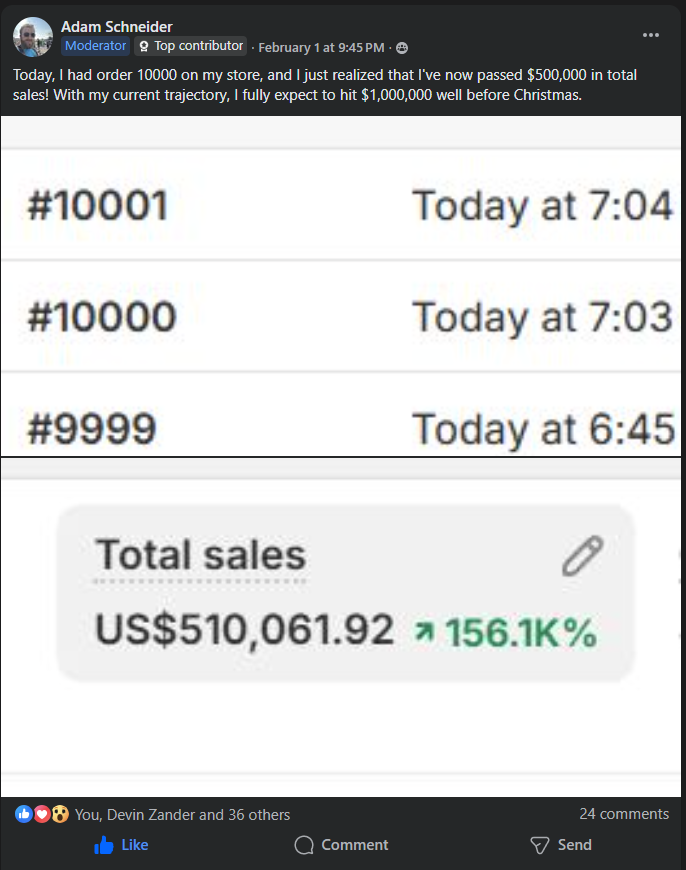
Adam Schneider hit $500,000 in total sales with 1,000+ orders in February 2026 alone — all without ever touching a piece of inventory. He ships directly from print suppliers to customers.
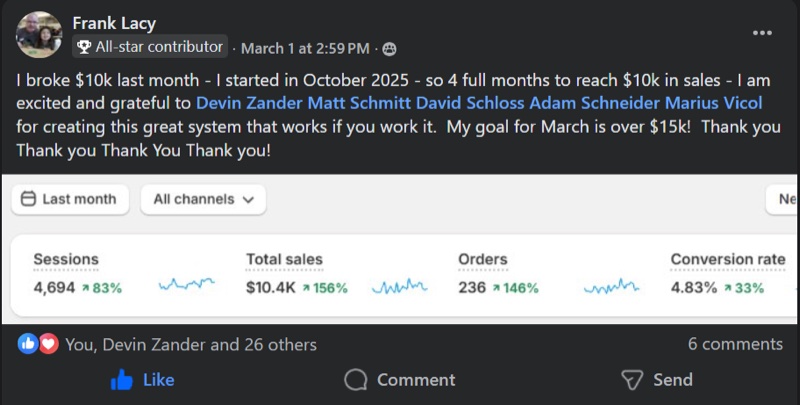
Frank Lacy reached nearly $10,000 in sales within months of starting. He runs his business part-time while still working his day job.
Sean Young crossed $10,000 in February 2026 and has sold 100+ units of his best-selling design. His store runs on autopilot while suppliers handle every order.
These aren’t tech prodigies or people with business degrees. They’re regular people who learned a proven system for selling products they never have to touch.
How Print on Demand Actually Works
Here’s the step-by-step process:
- Find a winning design concept — Research what’s already selling (don’t guess)
- Create or generate the design — AI tools like AvatarIQ make this possible without design skills
- List on your Shopify store — Connected to print suppliers like Gelato or Printful
- Run targeted Facebook ads — Drive traffic to your product listings
- Customer orders — Supplier prints and ships directly to them
- You keep the profit margin — Typically $8-15 per shirt sold
You never see the product. You never pack a box. You never visit a post office.
What About the Learning Curve?
The biggest question for most people considering a no-inventory business: Can I actually figure this out?
Print on demand does have moving parts — design research, store setup, Facebook ads. But with proper training, most Skup students get their first sale within weeks, not months. The Apparel Cloning System breaks down exactly how to find winning designs and the specific ad strategies that work for t-shirt businesses.
Students in their 50s and 60s — many self-described as “not tech-savvy” — have built five-figure monthly businesses. The technology isn’t the hard part. Consistency is.
What Makes This Different from Dropshipping?
Print on demand is technically a form of dropshipping, but with major advantages:
- Higher margins — Custom products command better prices than commodity goods
- Less competition — Your designs are unique; generic dropship products aren’t
- Better suppliers — US-based print partners ship in days, not weeks from China
- No supplier nightmares — Reliable partners like Gelato and Printful have consistent quality
Who This Business Model Is NOT For
Print on demand isn’t magic. It doesn’t work for everyone:
- People expecting overnight riches (it typically takes 2-3 months to hit consistent sales)
- Those unwilling to invest in marketing ($500-1,000 to start testing ads)
- Anyone who won’t dedicate at least 5-10 hours per week to learning and building
- People who quit at the first failed ad campaign
If you’re looking for passive income with zero effort, this isn’t it. But if you’re willing to learn a real skill and put in consistent work, print on demand is one of the lowest-risk ways to build an online business.
The Bottom Line
For anyone searching for the best business to start with no inventory in 2026, print on demand checks every box: low startup cost, no inventory risk, work-from-anywhere flexibility, and proven results. Students following the Skup method have built businesses generating $1,000 to $50,000+ per month — all without ever touching a product.
If you’re serious about starting, the Apparel Cloning System teaches the exact process used by Adam, Frank, Sean, and thousands of other successful print on demand sellers.
FAQ
How much money do I need to start a print on demand business?
Most people start with $500-1,000, which covers Shopify subscription ($39/month), a domain name ($15/year), and initial Facebook ad testing budget. You don’t need thousands for inventory because products are made after customers buy.
Can I do print on demand without design skills?
Yes. AI design tools like AvatarIQ allow you to create professional designs without graphic design experience. The Apparel Cloning System also teaches how to research and legally adapt winning design concepts rather than creating from scratch.
How long until I make my first sale?
Most Skup students make their first sale within 2-4 weeks of launching ads. Reaching consistent daily sales typically takes 2-3 months of testing and optimizing.
]]>