Home » Blog » The 4 Stages of Product Life Cycle for POD Success
Just like a hit song climbs the charts, peaks, and eventually fades into a "classic rock" station, every single product you sell has a natural lifespan. It's an exciting journey.
The 4 stages of product life cycle—Introduction, Growth, Maturity, and Decline—give you a framework for understanding that journey. And honestly? Getting a handle on this concept is what separates the flash-in-the-pan stores from the brands that build real, sustainable profit.
Your Roadmap to the Product Life Cycle in Ecommerce
Ever launched a print-on-demand design you were sure was a winner, only to see it fizzle out? Or had a best-seller suddenly drop off a cliff? That’s not bad luck; it’s the product life cycle in action, and it represents a massive opportunity.
Think of it as a predictable roadmap. Once you learn to read the signs, you stop reacting to what's happening and start anticipating what's next. This guide is your playbook, turning that abstract business school theory into concrete actions for your Shopify or print-on-demand store.
We’re going to break down exactly how to spot which stage your products are in, and then adapt your marketing, pricing, and creative to squeeze every last drop of profit out of them. A solid grasp of the Print On Demand Business Model is the perfect foundation for putting these strategies to work.
The 4 Stages of Product Life Cycle at a Glance
Before we really get into the weeds, let's do a quick flyover of the four stages. Think of this as the "you are here" map for your products.
To make it even clearer, here’s a quick rundown of what to expect in each phase.
The 4 Stages of Product Life Cycle at a Glance
Stage
Primary Goal
Sales Volume
Competition Level
Introduction
Build awareness & validate
Low
Very Low
Growth
Maximize market share
Rapidly Increasing
Growing
Maturity
Maximize profit & defend share
Peak / Stable
High
Decline
Milk remaining value / Liquidate
Falling
Declining
This table gives you the big picture, but the real power comes from knowing how to use this information.
The magic isn't just knowing the stages exist. It's using them to see what’s coming around the corner. That foresight is what lets you build a business that actually delivers on the profit and freedom you’re chasing.
Stage 1: Introduction – Igniting Your Next Big Idea
Every viral t-shirt and million-dollar product starts right here, in the Introduction stage. This is the exciting, opportunity-filled launchpad for your next big thing. For print-on-demand brands, think of this as your creative lab—a place to throw things at the wall and see what sticks with your audience.
Let's be clear: your primary goal right now isn't profit. It's market validation. You're just trying to answer one critical question: "Will people actually open their wallets for this?" Because of that, sales might be slow and feel random as you work to get your first eyeballs on the product.
This phase has a few classic tells. Your customer acquisition costs (CAC) might feel high, but you won't see much competition—mainly because nobody knows your awesome idea exists yet. Don't sweat the low initial sales numbers; that's just part of the exciting game of discovery.
Finding That First Spark
Your entire marketing strategy here boils down to discovery and learning. Instead of dumping your whole budget into a single Hail Mary campaign, the smart move is to run several small, targeted ad campaigns. You're testing different audiences, different messages, and different creative to find that first flicker of interest that tells you you're onto something big.
This is also prime time for creative experimentation. How do you find a winning design without spending weeks creating everything by hand? This is where a tool like our own AvatarIQ can give you a massive leg up. It lets you generate dozens of unique design variations and pop them onto professional mockups in minutes, which means you can test more ideas, faster.
And when you’re trying to catch someone’s eye for the first time, nailing your visuals with high-quality apparel product photography is non-negotiable. It’s what makes that first impression count and gets you those crucial early sales.
The goal in the Introduction stage isn't to hit a home run on your first swing. It’s to take as many swings as you can, learn from every single one, and figure out which design has real bestseller potential.
Key Activities for the Introduction Stage
To really make this phase count, you need to focus on a few key activities that will set the foundation for future growth.
Niche Exploration: This is the perfect time to see if your ideas have legs. If you’re drawing a blank, learning how to find niches for print on demand can help you discover audiences no one else is talking to.
Audience Testing: Use small ad budgets on platforms like Facebook and Instagram to see how different demographics and interest groups react to your designs.
Feedback Collection: Pay very close attention to the comments, DMs, and any early customer emails. This qualitative feedback is gold and often more valuable than your raw sales data at this stage.
Price Testing: Don't just set a price and forget it. Play around with different price points to figure out what the market is willing to pay. You might be surprised.
By staying focused on validation and learning, you're building the launchpad for explosive growth when your product is ready to move into the next phase.
Stage 2: Growth — Scaling Your Winning Designs
Alright, welcome to the Growth stage. This is the part every ecommerce entrepreneur dreams about. It’s the most electrifying phase of the whole cycle, where all that initial testing finally pays off and one of your designs just… catches fire. You found a winner. Now it's time to pour gasoline on it.
This is when you'll see sales start to climb—and fast. Your design is gaining real traction, and word-of-mouth starts to spread like wildfire. As you scale up, production gets more efficient, and those profit margins start looking a whole lot healthier. This is the moment you've been grinding for.
But heads up: this is also when the vultures start circling. Competitors will see your success and try to knock off your designs, which makes it absolutely critical to lock down your brand’s spot in the market.
Key Signals of the Growth Stage
Knowing you’ve hit the Growth stage is everything. Get it right, and you can ride the wave for all it's worth. Miss the signs, and you miss the opportunity. The signals are usually crystal clear and incredibly motivating for any store owner.
Here’s what to look out for:
Exponential Sales Growth: We’re not talking about a little bump. Your daily and weekly sales numbers are accelerating. That initial trickle of orders is turning into a flood.
Decreasing Ad Costs: As your design gets organic buzz and word-of-mouth marketing kicks in, your customer acquisition cost (CAC) will often drop. Your ads just work better because social proof is doing the heavy lifting. We have a whole guide on how to reduce customer acquisition cost if you want to dive deeper.
The Copycats Arrive: Finding other stores selling knock-offs of your design can be a rush of adrenaline. It’s also the ultimate form of validation. It’s undeniable proof you’ve struck gold on a profitable trend.
This idea of a product's journey isn't some new fad; it's a cornerstone marketing concept. Way back in 1966, an economist named Raymond Vernon introduced the International Product Life Cycle theory, which laid out the classic 4 stages of product life cycle that smart businesses still follow today. The model shows how products—from the iPhone down to a t-shirt design—move from a slow, high-cost launch to an explosive growth phase where demand spikes and profits soar, before eventually leveling off. For print-on-demand sellers, this cycle is your roadmap.
Think of it this way: The Growth stage is when you stop being a prospector hunting for gold and become the owner of a booming gold mine. Your job isn’t to find the gold anymore—it’s to get as much of it out of the ground as fast as you possibly can.
Your Marketing Playbook for Growth
Now that you have a certified winner, your entire marketing strategy needs to pivot. Hard. The days of tiny test budgets are over. This is the time for aggressive, confident scaling.
Your focus should be simple: dump resources into what’s already working. Crank up the ad spend on your winning campaigns and start building out lookalike audiences. You have hard data telling you exactly who your ideal customer is, so now you can use it to find millions more just like them.
This is the perfect time to get systematic. It’s the core principle we teach in our own apparel cloning course. Once you understand the triggers that signal a product is entering the Growth stage, you can create a repeatable process to spot other winners just as they’re about to take off. This allows you to duplicate your success in brand-new niches and build a business that isn’t just a one-hit wonder, but a resilient, money-printing machine.
Stage 3: Maturity — Maximizing Profit at the Peak
After the thrilling chaos of the Growth stage, your product finally hits its stride and enters Maturity. Think of this as the mountaintop you’ve been climbing towards. Your sales have reached their peak and are starting to level off. For most successful print-on-demand products, this is actually the longest and most profitable part of the whole journey.
By now, your product is a well-known player in its niche. But with success comes attention. The market has likely gotten crowded with competitors who saw what you were doing and wanted a piece of the action. The game is no longer about explosive, breakneck growth; it's about defending your territory and squeezing every drop of profit from what you've built.
Shifting From Acquisition to Retention
The signs of the Maturity stage are pretty clear: sales growth slows from a sprint to a comfortable jog, competition gets fierce, and you'll start feeling more pressure on your prices and margins. Your main goal has to shift from aggressive customer acquisition to customer retention and maximizing profitability. It’s time to work smarter, not just harder.
This is where your marketing needs to pivot hard towards differentiation. When customers have a dozen similar options, why should they choose you? It’s time to lean into what makes your brand, your brand.
Highlight Superior Quality: Start talking up the quality of your garments or the vibrancy of your prints.
Tell a Compelling Brand Story: Connect with your audience on a deeper level. It’s not just a shirt; it’s a statement.
Offer Exceptional Customer Service: Create loyal fans who will pick you over a cheaper knock-off every single time.
In the Maturity stage, you're no longer just selling a t-shirt; you're selling your brand. The trust and loyalty you build now are what will sustain your business for the long haul, turning one-time buyers into repeat customers.
Breathing New Life into a Bestseller
One of the most powerful moves you can make during this phase is to introduce variations of your winning products. This strategy keeps your offerings fresh and gives your existing, loyal customers new reasons to come back and buy again.
You don't have to reinvent the wheel. If your original t-shirt design is a certified bestseller, why not give it more places to live? With a tool like our own AvatarIQ, you can effortlessly adapt that winning design onto hoodies, mugs, tank tops, or phone cases. It's a simple move that lets you capture way more revenue from a customer base that already loves your core concept.
Pricing also becomes a critical lever you need to pull. As you face more competition, you have to get strategic. Understanding how to price print on demand products effectively is absolutely essential for keeping your margins healthy without scaring away your hard-won customers. This stage is all about leveraging your established success to secure your financial freedom.
Stage 4 Decline: Making Smart Strategic Choices
Sooner or later, every product's journey hits the Decline stage. This isn't a sign you messed up; it's just the natural end of the road where sales start to consistently slide. It could be due to a million different things—market trends zigging while you zagged, a new innovation making your design feel old, or the market just getting too crowded.
The warning signs are usually pretty loud. You'll see sales tapering off, and profit margins getting squeezed. Seeing this happen to a product you've poured your heart into can feel tough, but this is exactly where smart entrepreneurs separate themselves from the pack. It’s a strategic pivot, not a dead end.
Think of this as a chance to be decisive. Instead of clinging to a fading star, you get to make the tough, forward-thinking calls that set your business up for its next big win.
Your Three Strategic Options
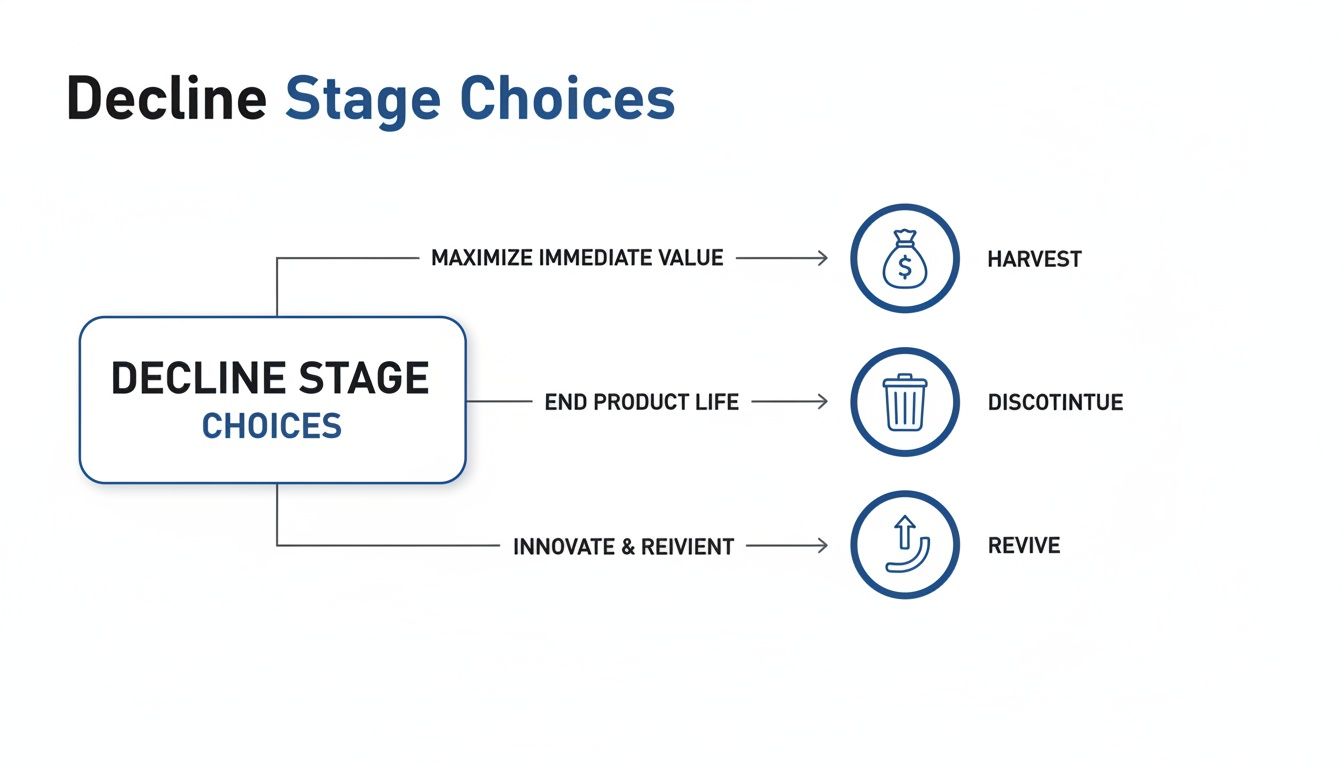
When a design starts to decline, you’ve really got three ways to play it. None of them are inherently right or wrong—the best choice depends entirely on your business goals, your resources, and your vision for the brand.
Here are the paths you can take:
Harvest the Product: This is all about maximizing profit on the way out. You cut off all marketing and ad spend completely. The idea is to milk every last drop of profit from organic sales or die-hard fans who are still searching for it, all with zero acquisition cost.
Discontinue the Product: Sometimes, a clean break is the best move. Pulling the plug frees up your time, mental energy, and, most importantly, your cash. You can immediately funnel all those resources into developing and launching your next potential bestseller.
Attempt a Revival: This is the high-effort, high-reward option. You try to breathe new life into the product. Maybe you pivot to a totally new niche, relaunch it with a fresh creative campaign, or bundle it with a newer, more popular item to move inventory.
For print-on-demand sellers, the Decline stage is a gift. It’s the perfect, low-risk moment to archive an old design, analyze what you learned from its journey, and apply those priceless insights to your next launch.
This final phase of the 4 stages of product life cycle isn't about loss; it's about making room for what's next. Every product that fades away clears the path for a new one to start its own climb to the top.
Your POD Product Life Cycle Action Plan
Alright, now that you've got the theory down on the 4 stages of product life cycle, it's time to put that knowledge to work. Let's build a real-deal game plan for your print-on-demand business. This is how you move from just selling shirts to building a resilient brand that creates the financial freedom you’re chasing. It’s all about being proactive, not reactive.
The secret sauce is listening to your data. Everything from your Shopify sales trends to your ad metrics is telling you a story, pinpointing exactly where your products are on their journey. This framework takes the guesswork out of the equation and empowers you to make smarter, more profitable decisions every step of the way.
Stage-by-Stage Decision Making
Your strategy can't be static; it has to evolve as your product moves through its lifecycle. Knowing which stage you're in tells you exactly what your next move should be.
Introduction Stage: Your one and only mission here is validation. Forget about profits for a minute. Use low-budget ad tests and fire up a tool like our own AvatarIQ to spin up creative variations. You're just looking for that initial spark of interest. Focus on learning, not earning.
Growth Stage: Okay, you've got a confirmed winner. Now it's time to hit the gas and scale aggressively. Pour your budget into those winning ad campaigns and start building out lookalike audiences. This is the core strategy we get deep into in our own apparel cloning course.
Maturity Stage: Sales are still high, but they've plateaued. The growth curve is flattening out. Your focus needs to shift from pure customer acquisition to retention and making your brand stand out. This is where you emphasize quality, roll out new product variations, and really dial in your profit margins.
Decline Stage: The numbers don't lie—sales are consistently dropping. Don't worry. This is a natural part of the cycle, and it's time to make a strategic choice.
This flowchart breaks down the three powerful moves you can make when a product officially hits the Decline stage.
Each option—Harvest, Discontinue, or Revive—is a totally valid strategy. The goal is to free up your time, energy, and money for your next winning design.
By mastering this action plan, you stop simply selling products and start building a predictable, profitable system. Each stage presents a unique opportunity, and recognizing it is the key to creating a business that lasts. This is your roadmap to success.
Your Questions, Answered
Getting a handle on the 4 stages of the product life cycle isn't a one-and-done deal; it's something you'll constantly be revisiting as an entrepreneur. Here are a few common questions I see from other POD store owners.
How Can I Tell Which Stage My POD Product Is In?
The story is right there in your data. Crack open your Shopify dashboard and your ad manager, and look at the trends.
Is a new product getting just a trickle of sales with high ad costs? That’s the Introduction stage. Are sales suddenly taking off like a rocket while your ad costs get more efficient? You’ve hit Growth. If your sales are high and steady but you're fighting off copycats left and right, welcome to Maturity. And if you see a steady, undeniable slide in sales over a few weeks or months, that's the Decline.
Can a Product Go Back to the Growth Stage?
You bet it can! This is called "cycle extension," and it's a game-changer when you pull it off. You can absolutely breathe new life into a product and kick it back into a growth spurt.
Think about targeting a completely new audience with fresh ad angles. You could also launch a whole new set of design variations using a tool like our own AvatarIQ to see what resonates. Or, take a proven seller and spin up a holiday-themed version to catch that seasonal wave. It's all about strategic reinvention.
How Long Does Each Stage Last?
There's no magic number here. A viral, meme-based t-shirt might go through its entire life cycle in a couple of months. On the flip side, a design aimed at an evergreen niche—like a specific hobby or profession—could chill in the Maturity stage for years.
The real key isn't about timing the stages perfectly. It's about keeping a close eye on your numbers and being ready to pivot your strategy the moment the data tells you a change is happening.
Ready to create killer, high-converting product mockups and designs in minutes? With Skup, our exclusive AI tool, AvatarIQ, lets you generate endless creative variations to speed up your entire launch process. Stop wasting time and start testing more winning ideas today. Learn more about AvatarIQ here.
When you’re just starting out in ecommerce, “supply chain management” sounds like some complicated corporate term meant for massive companies. But let's ditch that idea. It's not just about moving boxes; it's the entire journey your product takes from a design idea to the moment a customer excitedly unboxes their order. It's one of the…
Does it feel like Etsy’s shipping costs are some kind of impossible puzzle designed to chew up your profits? Trust me, you’re not alone. So many sellers get stuck here, but mastering your etsy shipping costs is a game you can absolutely win. This guide is the complete playbook, built by founders who run 8-figure…
A DTF print shirt is what happens when you print a design onto a special transfer film, apply an adhesive, and then heat-press it directly onto a garment. The final product is a crisp, vibrant, and surprisingly durable shirt that feels fantastic. For entrepreneurs, this method isn't just another option—it's a massive opportunity. Welcome to…