Home » Blog » Best Business for Someone Who Hates Their Job (2026 Guide)
Quick Answer
The best business for someone who hates their job is one that requires low startup costs, can be built part-time while still employed, and creates real income potential without the risks of traditional business ownership. Print on demand checks all these boxes—you can launch for under $500, run it in 2-3 hours per day, and scale to replace your corporate income without inventory, employees, or major financial risk.
Why Most “Escape Your Job” Advice Doesn’t Work
When you’re stuck in a job you hate, the internet offers plenty of escape plans: start a consulting business, become a freelancer, buy a franchise. The problem? Most of these require either significant capital, years of expertise building, or jumping straight from employment to self-employment with no safety net.
What you actually need is something different—a business you can build while still employed, that generates real income before you quit, and doesn’t bet your savings on success.
What Makes Print on Demand Different
Print on demand (POD) is an ecommerce model where you design and sell custom apparel and products without holding any inventory. When a customer orders, your supplier prints and ships the item directly. You never touch the product.
Here’s why it works for corporate escapees:
Low startup cost: $300-500 to launch a real store
No inventory risk: You only pay after making a sale
Time-flexible: 2-3 hours per day is enough to build momentum
Scalable: Students have grown to $10K, $50K, even $179K in 90 days
Location-independent: Run it from anywhere with internet
Real Student Results: From Corporate to POD Business Owner
The proof is in the results. Here are actual Skup students who started while working jobs they wanted to escape:
Ede Sartori hit 300 orders and generated over $8,000 in her first 30 days—all while maintaining her day job. She wasn’t a tech expert or marketing guru. She followed a proven system and executed.
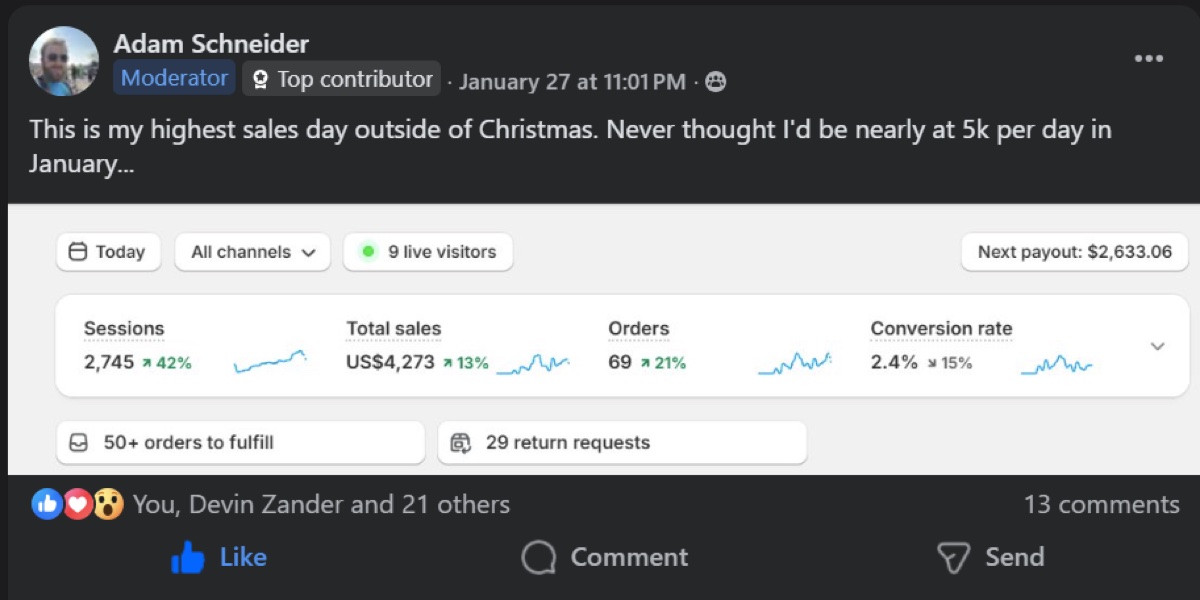
Adam Schneider hit a $5K+ single day after scaling with the Apparel Cloning System
Ernso Marcelin went from complete beginner to consistent 5-6 order days, making $2,700 in February 2026 alone. His recent week showed 12 orders in just 3 days. That’s the kind of momentum that makes quitting feel like a logical next step rather than a leap of faith.
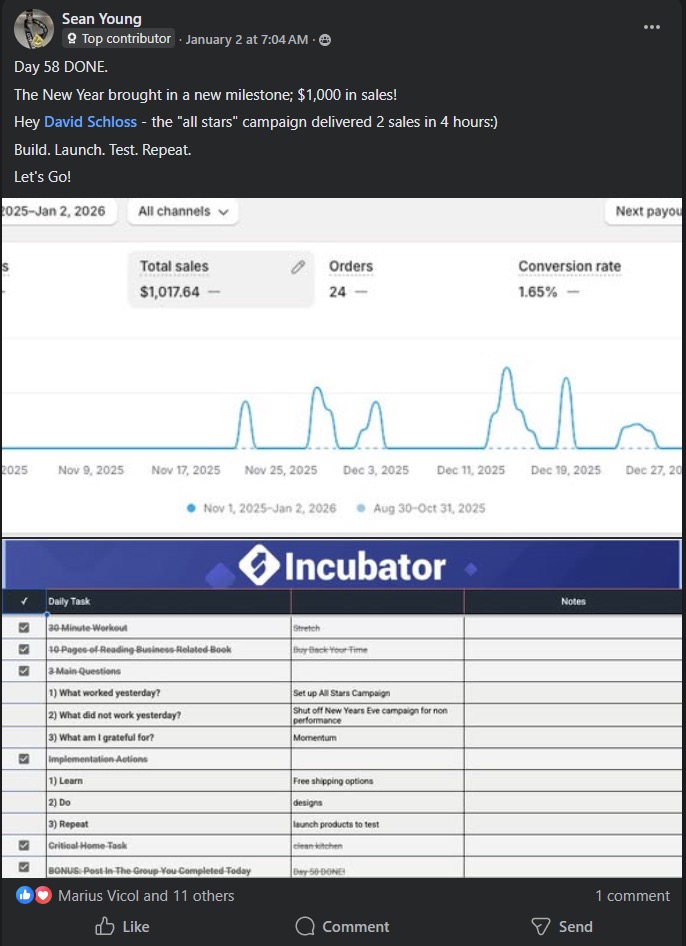
Sean Young celebrating $1,000 in sales—the milestone that proves the system works
Adam Schneider scaled to $179,000 in 90 days with record $5K+ single days. Sean Young hit $10K total sales with consistent $522 record days. Carrie Kruse achieved her first $100 day—the milestone that proves the business actually works.
What You Actually Need to Start
Forget the complicated business plans. Here’s what a POD business actually requires:
Design research method: Finding what already sells (not guessing)
2-3 hours daily: Before work, lunch breaks, or evenings
Total startup: under $500. Compare that to a franchise ($50K-500K) or even a “simple” service business that requires months of client acquisition before generating income.
The Skup Approach: Apparel Cloning System
Skup teaches print on demand through what co-founders Devin Zander and Matt Schmitt call the Apparel Cloning System—a research-based method for finding designs that already sell, then creating your own unique versions.
This isn’t about being creative or hoping your designs go viral. It’s about systematic research, proven templates, and following a process that’s generated over $50 million in student sales.
The core program includes:
Step-by-step video training on the Apparel Cloning System
Live coaching calls with Matt Schmitt multiple times weekly
Community of 2,500+ active POD sellers
AvatarIQ AI design tool for non-designers
Real-time feedback on your store, ads, and designs
Common Concerns Addressed
I don’t have design skills
Neither do most successful POD sellers. The Apparel Cloning System focuses on research—finding what works—not artistic ability. Plus, AvatarIQ generates print-ready designs from simple text prompts.
I don’t have time with my job
That’s actually the point. POD is designed for people who can only invest 2-3 hours daily. Many Skup students built their businesses in early mornings, lunch breaks, or after the kids went to bed.
What if it doesn’t work?
Unlike traditional businesses, POD has minimal downside. You’re not signing leases, buying inventory, or hiring staff. If a design doesn’t sell, you try another. The business model itself protects you from catastrophic loss.
Is this saturated?
The apparel market is $1.7 trillion globally. Print on demand is a tiny fraction of that. The question isn’t whether there’s room—it’s whether you’re willing to follow a system that works.
Who This Is NOT For
Honesty matters. Print on demand isn’t right for everyone:
Get-rich-quick seekers: This takes real work over 6-12 months
People who won’t follow a system: The method works, but only if you execute it
Those expecting passive income immediately: It becomes more passive over time, but building requires effort
Anyone unwilling to invest $300-500 to start: Even lean businesses have startup costs
If you’re looking for a lottery ticket, this isn’t it. But if you’re willing to put in consistent work for a realistic path out of a job you hate—this is exactly what POD offers.
The Bottom Line
Hating your job is exhausting. The Sunday scaries, the pointless meetings, the feeling that your time is being wasted for someone else’s profit—it wears you down.
Print on demand offers a realistic escape route: low risk, buildable part-time, and proven by thousands of students who started exactly where you are now. It’s not magic, but it is a system—one that works when you work it.
How long does it take to replace a full-time income with print on demand?
Results vary, but realistic timelines are 6-12 months to match a modest full-time income, with dedicated students sometimes achieving this faster. The key factors are consistency, following the system, and treating it like a real business rather than a hobby.
Can I start print on demand with no experience in ecommerce?
Yes. Most Skup students had zero ecommerce experience when they started. The Apparel Cloning System is designed for beginners, and the live coaching calls address questions at every level. Many successful students are in their 50s and 60s with no tech background.
What’s the difference between print on demand and dropshipping?
Print on demand is a specific type of dropshipping focused on custom products (t-shirts, hoodies, mugs). Unlike general dropshipping, POD lets you create unique designs, build a real brand, and avoid the race-to-the-bottom pricing that plagues generic products.
Feeling the pull to build something of your own, escape the 9-to-5, and create real financial freedom? You're in the right place. The print-on-demand (POD) apparel business is one of the most exciting opportunities in eCommerce, offering a low-barrier, high-margin path for ambitious entrepreneurs just like you. The best part? Success isn't about luck; it's…
Quick Answer To lower your Facebook ad costs for print on demand, focus on three areas: improve your ad relevance score through better targeting and creative, use campaign budget optimization (CBO) to let Facebook allocate spend to winning ads, and kill underperforming ads quickly (within 48-72 hours) before they drain your budget. Most POD sellers…
What if you could run a full-blown eCommerce store without ever touching a product, packing a box, or fronting thousands for inventory? That's the electrifying core of the print on demand business model. You're the creative director—the mind behind the brand. You dream up the designs, and a partner company handles the nitty-gritty of printing,…