Home » Blog » 10 Customer Segmentation Examples to Skyrocket Your eCommerce Growth in 2026
Imagine knowing exactly what your customers want before they do. For entrepreneurs seeking financial freedom and a way out of the 9-to-5 grind, this isn't just a superpower; it's the foundation of a successful business. The world of eCommerce, especially in high-margin models like print-on-demand, is buzzing with incredible opportunity. The key to unlocking sustainable profits isn't about having a massive advertising budget; it's about understanding your audience on a deeper, more personal level.
This is where the power of customer segmentation comes in. By strategically grouping your audience based on shared characteristics, behaviors, or motivations, you can stop sending generic messages and start delivering hyper-relevant offers and experiences. This is how you turn a casual browser into a loyal, repeat customer and build a brand people truly connect with. Forget the one-size-fits-all marketing that wastes your time and money.
This article provides a blueprint with 10 powerful customer segmentation examples designed specifically for eCommerce entrepreneurs. You'll learn not just what these segments are but how to use them to create authentic connections, build something you're proud of, and feel that incredible excitement of watching your sales climb. To truly stop guessing and start growing, you can even dive deeper into understanding your customers' individual needs with advanced techniques like AI customer profiling and personalization. Let's explore the strategies that will transform your approach and help you build the flexible, profitable business you've been dreaming of.
1. Demographic Segmentation by Age & Life Stage
Demographic segmentation is a foundational strategy that involves dividing your market based on observable, people-based data like age, gender, income, and life stage. For eCommerce brands, this goes beyond simple age brackets; it’s about understanding the unique motivations, needs, and purchasing power tied to a person's current life circumstances. This method is one of the most straightforward yet powerful customer segmentation examples because it directly correlates with a person's lifestyle, available time, and financial priorities.
A 22-year-old recent graduate starting a side hustle has different goals than a 38-year-old parent looking to replace a 9-to-5 income. The recent grad may be motivated by pure passion and innovation, while the parent is driven by the need for flexibility and financial security for their family. Understanding this distinction allows you to tailor your messaging, product recommendations, and support systems to resonate deeply with each group.
Strategic Breakdown
Business Goal: Increase relevance and conversion rates by aligning marketing messages with the specific life stage needs and motivations of different age cohorts.
Key Signals: Age data (from sign-ups or analytics), survey responses (e.g., "What is your primary goal?"), purchase history (e.g., buying children's apparel designs vs. business-themed designs), and content engagement.
Audience Size: Typically large, as it can encompass your entire customer base, but broken down into several smaller, more manageable segments (e.g., 18-26, 27-42, 43+).
Recommended Tactics
On-Site: Use dynamic content on your homepage to show different hero images and calls-to-action based on age or inferred life stage. For example, show a younger entrepreneur for visitors under 25 and a family-focused image for visitors aged 30-45.
Email Marketing: Create separate email onboarding flows. A "Young Professional" segment might receive content about building a brand from scratch, while a "Parent & Caregiver" segment gets tips on time management and creating a business around family life.
Ad Campaigns: Run targeted ad campaigns on platforms like Facebook and Instagram. Use ad copy like "Build a flexible business around your family's schedule" for parents and "Turn your creative passion into profit" for younger audiences. This focused messaging dramatically improves ad performance.
2. Behavioral Segmentation by Experience Level
Behavioral segmentation based on experience level divides your audience by their familiarity and expertise with your industry or product. For an eCommerce or Print-on-Demand business, this means distinguishing between a complete beginner launching their first store and an advanced seller managing a six-figure operation. This approach is one of the most effective customer segmentation examples because it allows you to tailor education, support, and product offerings to what a customer actually needs to succeed at their current stage.
A beginner is motivated by the dream of escaping the 9-to-5 and needs foundational, step-by-step guidance to achieve their first sale. An experienced entrepreneur, however, is driven by optimization and scale; they need advanced strategies to increase profit margins and automate workflows. Recognizing this gap is crucial. A beginner needs the confidence-building framework of our Apparel Cloning course, while an advanced user is ready for high-level scaling tactics.
Strategic Breakdown
Business Goal: Increase customer lifetime value and reduce churn by providing a clear, progressive path from beginner to expert, matching educational content and tools to their current needs.
Key Signals: Self-reported experience level during onboarding, engagement with beginner vs. advanced content (e.g., course completion), software usage patterns, support ticket inquiries (basic vs. complex questions), and previous purchase history.
Audience Size: Varies widely. For many platforms, the beginner segment is the largest, often representing over 60% of new users, while the "expert" segment is smaller but highly valuable.
Recommended Tactics
On-Site: Use a simple onboarding quiz ("What's your current level of eCommerce experience?") to immediately segment new users. This allows you to personalize their dashboard, showing beginner-friendly guides to one group and advanced workshops to another.
Email Marketing: Create distinct email nurture sequences. The "Beginner" track should focus on building confidence with "quick win" tutorials and foundational concepts. The "Advanced" track can skip the basics and share case studies on scaling, team building, and profit optimization.
Ad Campaigns: Target lookalike audiences based on your most successful advanced users to find more high-potential customers. For cold audiences, use messaging that addresses specific pain points, like "Your first profitable design, simplified" for beginners and "Automate your design workflow" for experienced sellers, showcasing tools like AvatarIQ.
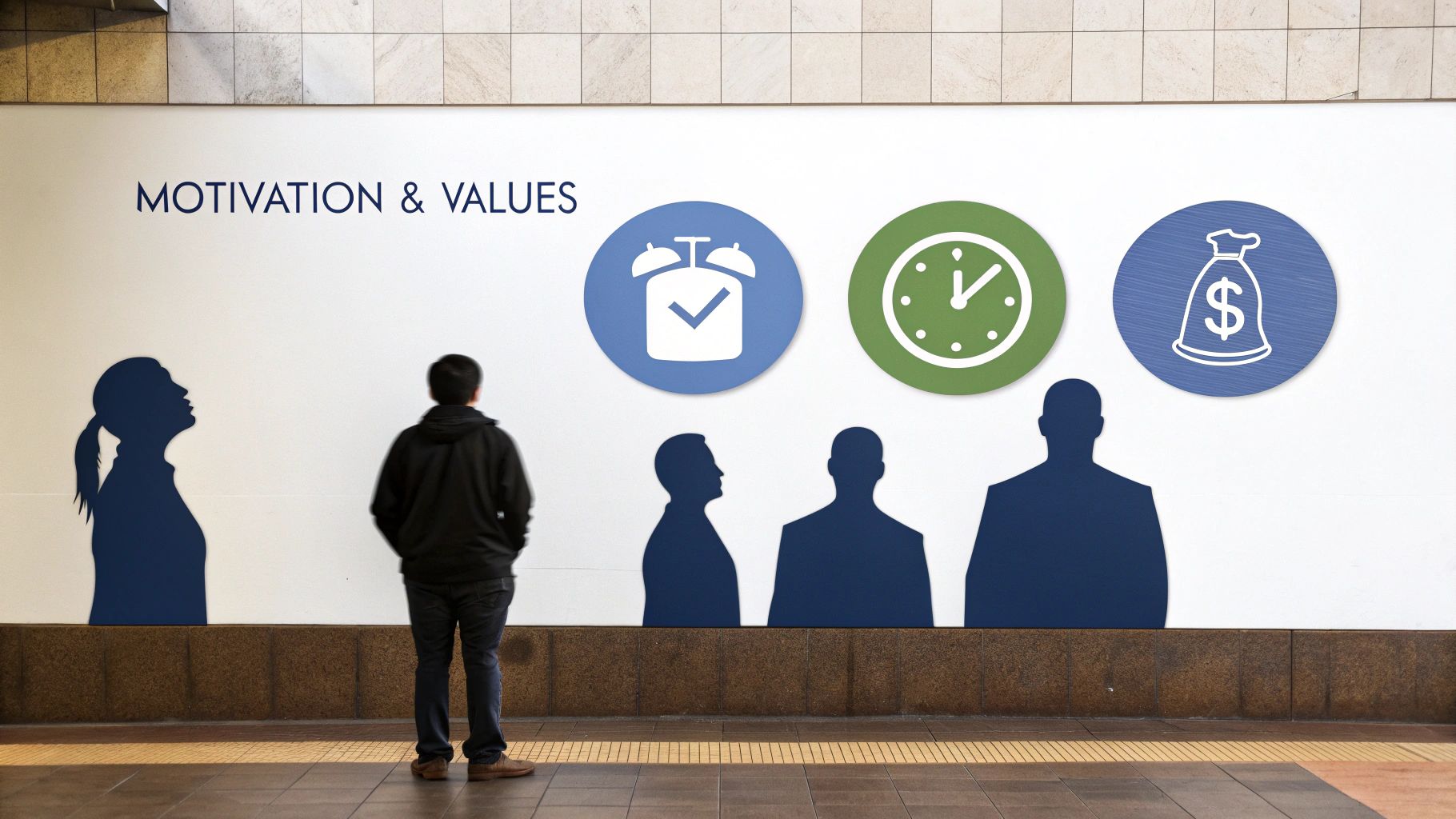
3. Psychographic Segmentation by Motivation & Values
Psychographic segmentation moves beyond "who" your customers are and focuses on "why" they buy. It groups people based on their underlying motivations, values, lifestyles, and aspirations. For an eCommerce brand, especially one empowering entrepreneurs, this is a crucial strategy. Understanding whether a customer is driven by financial freedom, creative autonomy, or time flexibility allows you to craft messaging that connects on a deeply personal level, making it one of the most insightful customer segmentation examples.
Someone building a business to escape the 9-to-5 grind responds to different language than someone driven by the pure pride of creating a brand from scratch. The "Freedom Seeker" wants to hear about controlling their schedule to attend their kids' school events. The "Builder" is motivated by seeing their unique vision come to life. These psychographic differences influence product positioning and marketing angles far more than age or income alone. When delving into psychographic segmentation, understanding the subtle influence of psychological triggers on consumer behavior can provide invaluable insights into customer motivations and values. For more on this, explore how uncovering the ugly truth about psychological triggers in marketing can transform your conversion pipeline.
Strategic Breakdown
Business Goal: Boost engagement and long-term loyalty by aligning the brand's core value proposition with the intrinsic motivations of different customer segments.
Key Signals: Onboarding survey responses (e.g., "What is your #1 goal with your business?"), content consumption (e.g., reading blog posts on "time freedom" vs. "scaling to seven figures"), and customer interview feedback.
Audience Size: Can vary widely. You might identify two to four core motivational segments that represent the majority of your customer base.
Recommended Tactics
On-Site: Feature case studies and testimonials that speak to different core values. Showcase a parent who built a flexible business alongside one of an entrepreneur who hit a major revenue milestone. This validates multiple paths to success.
Email Marketing: Create separate email sequences based on a customer's stated motivation from an initial quiz or survey. A "Security Seeker" segment might receive content on building sustainable, high-margin businesses, while a "Builder" segment gets tips on brand creation and product design.
Ad Campaigns: Lead with motivation-based headlines in your ad copy. Use phrases like "Build a Business on Your Terms" for the autonomy-driven segment and "Create Your Path to Financial Freedom" for those focused on escaping their day job. This ensures your message immediately resonates with the viewer's core "why."
4. Financial Segmentation by Budget & Investment Capacity
Financial segmentation involves dividing your audience based on their available capital, monthly budget, and overall investment capacity. For aspiring entrepreneurs, especially in the Print-on-Demand space, this is a critical factor. It directly determines which products, strategies, and support systems they can access. This approach is one of the most practical customer segmentation examples because it acknowledges that every founder's financial journey is unique.
A parent working part-time has different cash flow constraints than a full-time entrepreneur with savings to invest in advertising and scaling. The part-time parent needs a low-risk, bootstrap-friendly entry point, while the investor is looking for aggressive growth strategies. Understanding this distinction allows you to position your offerings perfectly, from free resources to high-ticket coaching, ensuring everyone has a viable path to success.
Strategic Breakdown
Business Goal: Maximize customer lifetime value by offering appropriately priced solutions and clear upgrade paths that align with a customer's growing business and budget.
Key Signals: Onboarding survey questions ("What is your starting ad budget?"), product purchases (free vs. paid courses), and pricing page behavior.
Audience Size: This segment can be split into distinct tiers, such as "Bootstrappers" ($0-$500 budget), "Growth Stage" ($500-$5k budget), and "Scaling Investors" ($10k+ budget).
Recommended Tactics
On-Site: Present tiered solutions clearly. For example, showcase our Apparel Cloning course as the ideal starting point for a $0-startup, while positioning advanced coaching for entrepreneurs ready to invest in massive scale. Use profitability calculators to help visitors understand the potential ROI at different investment levels.
Email Marketing: Create separate funnels for "bootstrap" and "scaling" segments. The bootstrap track could highlight case studies of students starting with just $5-$50 per day in ads, while the scaling track focuses on strategies to maximize a larger ad spend. This ensures your content is always relevant and encouraging.
Ad Campaigns: Tailor ad copy to financial realities. Use messaging like "Start your POD empire with a tiny ad budget" for bootstrappers. For higher-investment segments, use copy like "Ready to scale your winning ads? We'll show you how." This precision targeting speaks directly to the prospect's immediate financial capacity and goals.
5. Geographic Segmentation by Location & Market Maturity
Geographic segmentation involves dividing your audience based on their physical location, but for an eCommerce entrepreneur, it's far more nuanced than just city or state. It's about understanding regional market saturation, local trends, advertising costs, and cultural nuances that dictate purchasing behavior. This approach is one of the most practical customer segmentation examples because it directly impacts your advertising spend, niche viability, and even your support availability.
An entrepreneur targeting a "Texas pride" apparel niche will find a receptive, but potentially competitive, audience within the state. In contrast, that same niche may have lower ad costs but also lower demand in Oregon. Understanding these dynamics allows you to allocate your marketing budget more effectively, identify underserved local markets, and tailor product designs to resonate with regional identity, turning geography from a simple data point into a powerful strategic advantage.
Strategic Breakdown
Business Goal: Optimize advertising spend and increase conversion rates by targeting regional niches and adapting marketing to local market conditions.
Key Signals: Customer shipping addresses, IP address location data from your website, location targeting data from ad platforms (e.g., Facebook Ads Manager), and sales data broken down by state or city.
Audience Size: Can be national or global, but is segmented into highly specific regional or local cohorts (e.g., "Florida Coastal Towns," "Midwest Metro Areas").
Recommended Tactics
On-Site: Use geo-targeting to display relevant testimonials or case studies. For example, show a visitor from California a success story of a user from Los Angeles who built a thriving brand. This builds immediate trust and relevance.
Email Marketing: Segment your email list by time zone to ensure marketing messages are delivered at optimal times, such as morning or evening commute hours. Announce region-specific virtual events or coaching call blocks, like "West Coast Evening Session."
Ad Campaigns: Tailor ad creative and copy to specific locations. Run ads for "Florida Lifestyle" apparel designs exclusively to users in Florida, referencing local landmarks or sayings. Analyze regional ad costs and focus your budget on areas with a higher return on ad spend (ROAS) for your specific niche.
6. Firmographic Segmentation by Business Stage & Revenue Scale
Firmographic segmentation is the B2B equivalent of demographics, involving the division of a market based on business characteristics. For eCommerce platforms and educational companies serving entrepreneurs, this means segmenting customers by their business stage, current revenue, team size, and growth trajectory. This is one of the most crucial customer segmentation examples for B2B services because a founder's needs change dramatically as their business evolves from a pre-launch idea to a scaling operation.
A brand new entrepreneur with zero revenue needs foundational, step-by-step guidance to get their first sale. In contrast, a seller already making $50,000 per month needs advanced strategies for scaling operations, hiring, and optimizing profitability. Understanding this distinction allows you to create a clear product pathway, ensuring you offer the right solution at the right time, guiding customers from one stage of success to the next.
Strategic Breakdown
Business Goal: Increase customer lifetime value and product adoption by creating a clear, tiered product ecosystem that supports entrepreneurs at every stage of their journey.
Key Signals: Self-reported data from quizzes or onboarding forms (e.g., "What is your current monthly revenue?"), product purchase history (entry-level vs. advanced courses), and website behavior.
Audience Size: Can be large but is best segmented into distinct stages: Pre-launch ($0 revenue), Early Growth ($1k-$10k/mo), and Scaling ($10k+/mo).
Recommended Tactics
On-Site: Use intake forms or quizzes to ask new visitors about their business goals and current revenue. Dynamically recommend the most appropriate product, such as presenting Apparel Cloning to beginners and an incubator program to established sellers.
Email Marketing: Create separate, segmented email flows for different business stages. A "Pre-launch" segment receives content on finding a niche and making a first sale, while a "Ready to Scale" segment gets case studies and strategies for breaking through revenue plateaus.
Ad Campaigns: Tailor ad messaging to specific revenue levels. For aspiring entrepreneurs, use copy like, "Your blueprint to go from $0 to your first $1,000." For established sellers, use aspirational messaging like, "See how sellers like you scale to $100k/month and beyond with our systems."
7. Needs-Based Segmentation by Specific Problems & Pain Points
Needs-based segmentation moves beyond who your customers are and focuses on why they are buying. This powerful strategy involves dividing your audience based on the specific problems, challenges, or pain points they are trying to solve. For eCommerce entrepreneurs, this is one of the most effective customer segmentation examples because it allows you to position your products as direct solutions to their most urgent needs, dramatically increasing relevance and conversion rates.
An aspiring entrepreneur struggling to find a profitable idea has a fundamentally different need than a growing seller hitting a scaling plateau. The first needs a proven framework for product selection, while the second needs advanced strategies to break through to the next level. By identifying these distinct pain points, you can map your solutions directly to their problems, turning your marketing from a generic broadcast into a highly specific, problem-solving conversation.
Strategic Breakdown
Business Goal: Increase product adoption and sales by positioning specific products as the ideal solution to a customer's clearly defined problem.
Key Signals: Onboarding quiz responses (e.g., "What is your #1 business challenge right now?"), content engagement (e.g., reading blog posts on niche selection vs. scaling), customer support tickets, and direct survey feedback.
Audience Size: Variable; can range from broad segments (e.g., 'Beginners') to micro-segments (e.g., 'Struggling with ad creatives'), depending on the specificity of the pain point.
Recommended Tactics
On-Site: Use an interactive quiz or survey for new visitors to identify their primary challenge. Based on their answer, dynamically recommend the most relevant product. For someone who selects "Finding winning products," you can immediately point them to our Apparel Cloning course. To dive deeper, learn more about choosing a profitable niche.
Email Marketing: Create separate, problem-focused email flows. A segment that indicates "design creation is too slow or expensive" should receive emails highlighting how AvatarIQ’s AI can generate professional designs in seconds, while a "stuck at $10k/month" segment should get content about advanced scaling programs.
Ad Campaigns: Tailor ad copy to directly address specific pain points. For example, run ads with headlines like "Can't Afford a Designer? Create Unlimited Designs with AI" targeting the design-struggle segment, and "Your Store is Growing. Now What?" for the scaling-challenge segment.
8. Channel Segmentation by Customer Acquisition & Engagement Source
Understanding how a customer finds you is just as important as knowing who they are. Channel segmentation involves dividing your audience based on their acquisition source, whether it's organic search, social media, paid ads, or a referral. This is one of the most insightful customer segmentation examples because different channels attract distinct mindsets and motivations, directly influencing how a person interacts with your brand.
A customer who discovers your brand after watching a detailed YouTube tutorial has different expectations than someone who clicked a result-focused Facebook ad. The YouTube viewer is likely a research-heavy learner seeking in-depth knowledge, while the ad-clicker is often an impulse-driven buyer motivated by a specific outcome. Tailoring your messaging to their original context creates a seamless and more persuasive customer journey.
Strategic Breakdown
Business Goal: Boost conversion rates and lifetime value by aligning the customer experience with the mindset and intent of the acquisition channel.
Key Signals: First-touch attribution data (from Google Analytics or your CRM), UTM parameters in marketing campaigns, "How did you hear about us?" survey responses, and referral program tracking.
Audience Size: Varies by channel. You may have a large segment from organic search and a smaller, high-value segment from referrals.
Recommended Tactics
On-Site: Personalize landing page headlines and content based on the referring URL or UTM source. A visitor from a podcast might see a headline like, "As Heard On The E-com Freedom Podcast," creating instant familiarity and trust.
Email Marketing: Create distinct onboarding sequences for each major channel. A user from YouTube could receive more educational content and video tutorials, while a user from a paid ad gets a quick-start guide focused on achieving results fast.
Ad Campaigns: Use your best customers from a specific channel to build powerful new audiences. For instance, you can use a segment of high-LTV customers acquired through Facebook to create a potent seed audience. Learn more about building powerful Facebook lookalike audiences to find more customers just like them.
9. Engagement Segmentation by Participation Level & Community Involvement
Engagement segmentation moves beyond purchase data to categorize customers based on their interaction level with your brand’s ecosystem. This includes everything from passively watching videos to actively participating in community forums, attending group calls, or using one-on-one mentorship. For an eCommerce brand building a community, this is one of the most predictive customer segmentation examples because engagement is a powerful indicator of future success, loyalty, and lifetime value.
A passive customer might view your Apparel Cloning course as a one-time resource, while a highly engaged member sees it as their business support system. The engaged member joins weekly calls, contributes to the community, and ultimately achieves greater success, reinforcing their connection to your brand. Understanding this difference allows you to nurture passive users toward deeper engagement and reward active members for their commitment, transforming customers into brand advocates.
Strategic Breakdown
Business Goal: Increase customer lifetime value and success rates by nurturing passive users into active community members and identifying high-potential customers for advanced programs.
Key Signals: Community forum posts, group call attendance, one-on-one sessions completed, content consumption (video watch time), support ticket frequency, and referrals made.
Audience Size: Variable. Your 'highly engaged' segment will be small and valuable, while the 'passive' segment will likely be much larger, representing a significant growth opportunity.
Recommended Tactics
On-Site: Display social proof that highlights community activity. Use banners like, "Join 500+ entrepreneurs on our weekly strategy call" to encourage passive visitors to get involved and see the value beyond the initial purchase.
Email Marketing: Create a dedicated "engagement onboarding" flow for new customers. The first emails should guide them to join the community, watch an introductory video, and sign up for their first group call to build early momentum. Run re-engagement campaigns for passive users, prompting them to take the next step.
Ad Campaigns: Use testimonials from your most engaged and successful members in your ad creative. Ad copy like, "See how Jane built her brand with support from our weekly calls" showcases the tangible benefits of community involvement, attracting prospects who value collaboration and support.
10. Product-Affinity Segmentation by Interest in Specific Solutions
Product-affinity segmentation involves dividing customers based on which specific products or solutions they are most likely to need and purchase. For a business with multiple distinct offerings, this is one of the most crucial customer segmentation examples for maximizing relevance and driving conversions. It moves beyond general demographics to understand the specific problem a customer is trying to solve right now. This ensures you present the right solution to the right person at the right time, making your marketing feel less like a sales pitch and more like a helpful recommendation.
An aspiring entrepreneur struggling with design creation has a high affinity for a tool like AvatarIQ, which solves that exact pain point. In contrast, a seasoned seller earning $20,000 per month has a high affinity for an advanced program, which focuses on scaling. Presenting an advanced program to the beginner would be overwhelming, while showing AvatarIQ to the scaling expert would miss the mark. Effective product-affinity segmentation connects customer needs directly to your solutions.
Strategic Breakdown
Business Goal: Increase product adoption, upsells, and conversion rates by matching customers with the most relevant product for their current business stage and challenges.
Key Signals: Onboarding quiz answers ("What is your biggest challenge?"), purchase history, engagement with product-specific content (case studies, blog posts), and stated revenue goals.
Audience Size: Varies by product; you'll have distinct segments for each core offering, such as a large "Beginner" segment for introductory products and a smaller, more targeted "Scaler" segment for high-ticket programs.
Recommended Tactics
On-Site: Implement a product discovery quiz during onboarding. Ask questions like, "What's your current monthly revenue?" or "What's your biggest hurdle: finding winning products or creating designs?" to guide users to the perfect solution.
Email Marketing: Create product-specific email sequences. Send an "AvatarIQ" flow highlighting design automation benefits to users who express a need for creative help. For those stuck at a certain revenue level, send an advanced program flow showcasing scaling strategies and student success stories.
Ad Campaigns: Run hyper-targeted ad campaigns based on inferred affinity. Use ad copy like, "Struggling to create winning designs? Let AI help," for an AvatarIQ audience, and, "Ready to scale your store from $15k to $100k/month?" for an advanced program-focused segment. This targeted messaging dramatically improves ad relevance and ROI.
10-Point Customer Segmentation Comparison
🔄 Implementation Complexity
⚡ Resource Requirements
📊 Expected Outcomes
💡 Ideal Use Cases
⭐ Key Advantages
Demographic Segmentation by Age & Life Stage — Low: straightforward age/life-stage bins
Low: standard CRM fields, basic surveys
Moderate: better messaging fit and purchase pattern prediction
Broad targeting; tailor messaging by life circumstances (parents, students)
Easy to implement; quickly actionable for targeting
Behavioral Segmentation by Experience Level — Medium: track experience signals and progress
Product recommendations, upsell funnels, onboarding to appropriate product
Maximizes relevance and lifetime value through right-fit offers
Your Blueprint for Action: Building a Business That Understands Its Customers
You’ve just explored a comprehensive list of powerful customer segmentation examples, moving far beyond generic marketing and into the realm of truly strategic, personalized communication. We’ve dissected everything from demographic and behavioral segments to more nuanced models like psychographic and needs-based segmentation. The common thread connecting all these strategies is one simple but transformative idea: understanding is the ultimate business advantage.
Generic, one-size-fits-all marketing is a recipe for wasted ad spend and missed opportunities. It’s like shouting into a crowded room and hoping the right person hears you. The detailed segmentation examples in this article are your blueprint for turning that shout into a meaningful conversation, tailored to the specific needs, motivations, and goals of your ideal customers.
From Theory to Tangible Growth
The true power of segmentation isn’t just in the data; it’s in the action it inspires. By recognizing the distinct needs of an eCommerce beginner versus a seasoned entrepreneur, or the unique motivations of a parent seeking time freedom, you can craft offers, messages, and product recommendations that resonate on a much deeper level.
Let's recap the core theme:
Clarity Over Clutter: Segmentation cuts through the noise. It helps you focus your limited resources on the audiences most likely to convert and become loyal, long-term customers.
Connection Over Conversion: While sales are the goal, genuine connection is the path. When customers feel seen and understood, they are more likely to trust your brand and purchase from you repeatedly.
Profitability Over Popularity: Targeting high-value segments, like those with a high budget or a strong affinity for your core products, directly improves your profit margins and the overall financial health of your print-on-demand business.
The journey to building a successful eCommerce brand, one that provides financial freedom and frees you from the 9-to-5 grind, starts with this fundamental step. You don’t need to implement all ten segmentation models at once. The key is to begin.
Your Actionable Next Steps
Feeling excited about the possibilities is the first step. Turning that excitement into action is what creates results. Here’s how you can start today:
Choose Your Starting Point: Review the customer segmentation examples we covered. Which one or two feel most relevant to your business right now? Perhaps it’s focusing on the Needs-Based Segment of beginners who struggle with design, or the Psychographic Segment of entrepreneurs motivated by lifestyle goals. Pick one and commit.
Gather Your Insights: Start looking at your existing data, even if it’s small. Use customer surveys, analyze purchase history, or simply talk to your first few customers. What patterns do you see? Where are they coming from? What problems are they trying to solve?
Deploy a Targeted Tactic: Launch a small, focused campaign based on your chosen segment. This could be a specific email flow for new subscribers (Behavioral Segmentation) or a targeted ad campaign for people interested in building a side hustle (Psychographic Segmentation).
Leverage the Right Tools: Don't let the technical side slow you down. The most successful entrepreneurs leverage technology to automate and scale. For creating stunning, high-converting designs without any experience, a tool like our AI-powered AvatarIQ is essential. It removes the biggest bottleneck for many print-on-demand sellers.
Mastering these concepts is your ticket to building a resilient, high-margin business that doesn't just survive, but thrives. You are building something of your own, gaining control over your time, and creating the life you've envisioned. The opportunity has never been greater, and with this blueprint, you are perfectly positioned to seize it.
Quick Answer AvatarIQ is an AI design generation tool built specifically for print-on-demand sellers. Developed by Skup’s co-founders Devin Zander and Matt Schmitt, it creates print-ready t-shirt designs from text prompts — no design skills required. At $97/month, it’s positioned as a specialized alternative to general tools like Midjourney, with templates and workflows optimized for…
Tired of the 9-to-5 and ready to build something of your own? I get it. The drive for financial freedom—and control over your own time—is why millions are launching side businesses. It's not just about extra cash; it's about building a real asset that gives you options outside of a traditional job. The best part?…
Quick Answer To test print on demand designs effectively, run small-budget Facebook ad campaigns ($5-10/day per design) for 3-5 days, track key metrics like cost per click and add-to-carts, and let the data—not emotions—tell you which designs to scale and which to kill. Most beginners need to test 10-20 designs before finding their first consistent…