Home » Blog » How Long Does Facebook Take to Optimize Ads? POD Seller Guide
You launched your Facebook ad, it’s been running for a few hours, and the results look terrible. Should you kill it? Or does Facebook need more time to optimize?
This is one of the most common questions in print-on-demand, and getting it wrong costs money either way—killing winners too early or letting losers drain your budget.
Quick Answer: How Long Does Facebook Take to Optimize?
Facebook typically needs 24-72 hours and at least 50 optimization events to exit the learning phase. For most POD sellers spending $10-20/day, this means 3-7 days before you can reliably judge performance. Killing ads before this point often means killing potential winners.
Understanding Facebook’s Learning Phase
When you launch a new ad, Facebook enters what it calls the “learning phase.” During this time, the algorithm is testing your ad against different audiences to find who’s most likely to take your desired action (usually purchases or add-to-carts).
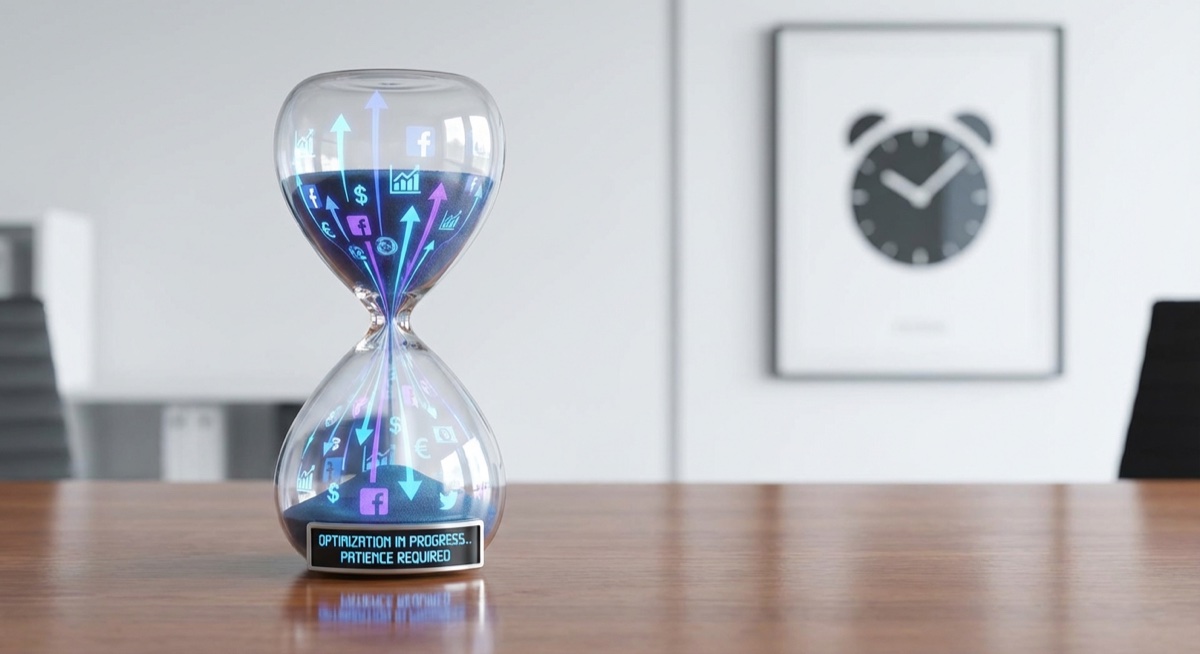
Facebook’s algorithm needs time to learn who responds best to your ads
What happens during learning phase:
Costs are typically higher and more volatile
Performance swings day-to-day are normal
Facebook is gathering data, not optimizing yet
Learning phase ends when:
Your ad set gets ~50 optimization events (purchases, add-to-carts, etc.)
OR about 7 days pass without significant changes
The Real Timeline for POD Sellers
Here’s what to expect based on typical POD ad budgets:
Day 1: Don’t judge anything. Costs will be all over the place. This is normal.
Days 2-3: Look for early signals—are you getting clicks? Any add-to-carts? If you’ve spent $15-20 with zero engagement, that’s a red flag.
Days 4-7: This is when real patterns emerge. If you’re getting consistent add-to-carts but no purchases, it might be a pricing or checkout issue. If you’re getting purchases, start calculating your actual ROAS.
After Day 7: You should have enough data to make informed decisions. Winners become clear, losers are obvious.
Reviewing your metrics after the learning phase gives you reliable data to act on
What Matt Schmitt Says About Ad Optimization
“I see people kill ads after 4 hours because the CPC looks high,” says Matt Schmitt, co-founder of Skup. “That’s not enough data. Facebook is still figuring out who to show your ad to. Give it at least through the next day before you even start worrying.”
His rule of thumb: “If you had a good day Friday and a bad day Saturday, don’t turn it off Saturday night. Give it through Monday. Weekends can be weird for some niches.”
Signs Facebook Has Optimized Your Ad
You’ll know optimization is working when you see:
Stabilizing costs — CPC and CPM stop swinging wildly
Consistent results — Similar performance day-over-day
“Learning” label disappears — Check your ad set status in Ads Manager
Lower cost per result — Efficiency improves as targeting refines
When to Kill an Ad Early (Before Optimization)
Sometimes you don’t need to wait. Kill early if:
$15-20 spent with zero add-to-carts — The creative isn’t connecting
CPC over $3 consistently — Targeting or creative issue
Zero clicks after $5 — The ad isn’t grabbing attention
CTR under 0.5% — Creative problem, not an optimization problem
These are creative problems, not optimization problems. More time won’t fix them.
Common Mistakes That Hurt Optimization
1. Making changes during learning phase
Every time you edit budget, targeting, or creative, the learning phase restarts. Let it run.
2. Budget too low
At $5/day, Facebook can’t gather enough data. Minimum $10-15/day for meaningful optimization.
3. Checking too often
Looking at your ads every hour creates anxiety and leads to premature decisions. Check once in the morning, once at night.
4. Optimizing for the wrong event
If you’re optimizing for link clicks instead of purchases, Facebook finds clickers—not buyers.
5. Too many ad variations
Running 10 ads with $10/day means each ad gets $1. Not enough data for any to optimize.
The Bottom Line
Facebook needs time to learn. For most POD sellers, that means:
Minimum 24-48 hours before making any judgments
3-7 days for reliable performance data
$20-30 spent before deciding to kill an ad
The exception: obvious creative failures (no clicks, no engagement) can be killed after $10-15. But if people are clicking, give Facebook time to find your buyers.
Want more guidance on Facebook ads for print-on-demand? Skup’s coaching program includes weekly live calls where you can get feedback on your specific campaigns.
FAQ
Why does my CPC start high and then drop?
Facebook initially shows your ad to a broad test audience. As it learns who engages, it narrows targeting to more relevant users, which typically lowers your CPC. This is normal optimization behavior.
Should I use CBO or ABO while Facebook is learning?
For testing new designs, ABO (ad set budget optimization) gives you more control. Once you have proven winners, CBO helps Facebook allocate budget to your best performers automatically.
My ad was doing well then suddenly got worse. What happened?
Several possibilities: audience fatigue (same people seeing it too often), increased competition, or Facebook expanding to less qualified audiences. Try duplicating the ad to reset learning, or refresh your creative.
The smartest beginners in print on demand don’t start with the most crowded product. They start where buyers already assign value fast. Caps do that. The category sits inside a market that’s projected to grow to $57.49 billion to $102.99 billion by 2033 to 2034, which means the broader print-on-demand market could multiply 5 to…
You’re at the point where your store is proving the model works. Orders are coming in. A few designs are carrying more than the rest. Your ads are finding buyers. But your fulfillment partner is starting to feel like the ceiling, not the engine. Turnaround slips. Print quality varies. Margin gets thinner every time a…
A lot of people start looking up how to sell print on demand at the same moment in life. Work feels fixed. Income feels capped. You want something you can build after hours that does not require buying piles of inventory, renting a warehouse, or guessing how many units to order. That is why POD…