Home » Blog » How to Sell Print on Demand on Etsy The Definitive Guide
Selling print on demand on Etsy boils down to a few key stages: finding a profitable niche, creating designs people actually want to buy, setting up your shop the right way, and finally, launching your products. The best part? It's almost entirely automated. Once a customer buys something, your print-on-demand partner handles all the printing, packing, and shipping. You just focus on the fun stuff.
Your Blueprint for a Profitable Etsy POD Shop
This is your launchpad for building a real print-on-demand business on Etsy. Think of this less as a guide and more as a practical roadmap from someone who's been in the trenches. We're going to sidestep the common pitfalls and tap directly into a massive marketplace with over 89 million active buyers all looking for unique stuff.
My goal is simple: to get you from a rough idea to your first sale, feeling confident and excited, not overwhelmed. We'll break down the exact systems that successful POD shops use every day.
The Path from Idea to Income
The journey is surprisingly straightforward, even if you're a complete beginner. This flowchart breaks down the entire process into three simple phases, showing how a creative spark can turn into a legitimate business.
Success isn't about doing a hundred different things. It's about executing a few key steps exceptionally well. This is where you can start building something that could eventually replace your 9-to-5. The opportunity is immense, and getting started is easier than ever.
Why Print on Demand on Etsy Is a Golden Opportunity
You’re plugging into a marketplace where creativity isn't just a bonus—it's the main event. Etsy gives you a built-in audience that is actively searching for the exact kind of custom, unique apparel you'll be creating. Unlike starting from scratch, you don't have to spend a fortune trying to find customers; they're already on the platform.
Here’s why this model is so powerful, especially for new entrepreneurs:
No Inventory, No Risk: This is the big one. You never have to buy products upfront. An item is only made after a customer pays for it, meaning you can focus entirely on creating incredible designs.
Low Startup Costs: Since you're not buying stock, your initial investment is tiny. Your main focus is on creating killer designs that resonate with your audience.
Complete Automation: Once your listings are live and connected to a partner like Printify or Printful, the fulfillment process runs on autopilot. This frees you up to work on your business—researching trends and making new designs—instead of just in it.
To help you get started, I’ve put together a quick checklist that summarizes the essential steps we'll be covering. Think of this as your bird's-eye view of the launch process.
Your Etsy POD Launch Checklist
Phase
Key Action
Why It Matters
1. Research & Strategy
Find a Profitable Niche
Selling to a specific, passionate audience is far easier than trying to sell to everyone. This is where the money is.
2. Creation & Setup
Create Designs & Mockups
Your designs are your product. High-quality, eye-catching mockups are crucial for making that first impression count.
3. Fulfillment & Logistics
Choose a POD Partner
This company will print and ship your products. Their reliability directly impacts your brand's reputation and customer satisfaction.
4. Shop Launch
Optimize Your Etsy Listings
Using the right keywords (SEO) helps Etsy's 89 million buyers find your products. Good SEO is your best free marketing tool.
5. Operations & Growth
Market, Manage & Scale
Getting your first sale is just the beginning. Consistent promotion and great customer service turn one-time buyers into repeat fans.
This table maps out the core pillars of a successful shop. Follow these steps, and you'll be building on a solid foundation from day one.
This guide is about building a real, sustainable business that gives you the financial freedom you're looking for. Let's get started and do it right.
Finding Your Winning Niche and Product Ideas
The secret to blowing up on Etsy isn't about chasing every trend that pops up. It's about finding a profitable niche and completely dominating it until you're the go-to shop.
Instead of guessing what might sell, what if you could launch products that already have a passionate, built-in audience waiting to buy? This is the whole idea behind a method we call Apparel Cloning. It’s a smart way to find designs that are already proven winners and use them as a blueprint for your own stuff.
De-Risk Your Business with Data
We're not fans of the "throw designs at the wall and see what sticks" strategy. Instead, we lean on data to find products that are on the verge of exploding—we're talking about items with sales velocity jumping by 500% or even 1300%. These aren’t just random viral hits; they're clear signals of a hungry market.
When you focus on what's already working, you take all the guesswork out of the equation. You start to see which designs are pulling in thousands each month and can break down why they're so successful. It's all about reverse-engineering that success by understanding what connects with a specific audience.
The goal isn't to copy; it's to clone the success framework. You analyze the audience, the message, and the design style, then replicate that formula with your own unique twist. This ensures you launch products people are already searching for.
The Power of Passionate Niches
A niche is way more than just a product category; it's a community built around a shared hobby, passion, or identity. Think about the difference between a generic "dog lover" t-shirt and a shirt made specifically for "Corgi Moms Who Love Hiking." That second one speaks directly to someone's identity and is way more likely to get the click and the sale.
Here’s why drilling down into a niche is so powerful:
Less Competition: While everyone else is fighting over broad keywords, you can completely own a more specific, long-tail search term.
Higher Conversion Rates: Shoppers are way more likely to buy from a shop that "gets" them and feels like it was made just for them.
Built-in Marketing: Passionate communities love to share things they're into. Your products become a badge of honor that customers are actually excited to show off.
For instance, a shop dedicated to witty apparel for book lovers or inside jokes for nurses has a much clearer path to making money than a general store with a random mix of designs. To really dive deep on this, check out our full guide on how to find niches for print on demand.
Validating Your Product Ideas Before You Create Them
The print-on-demand market is projected to rocket toward $58 billion by 2033, which shows the incredible potential available to you. Success comes from mastering product research to spot designs with massive growth potential—like those showing 1300% growth or pulling in $16.6k from 1,500 sales in just a few months.
Validation is that critical step that separates thriving businesses from failed hobbies. Before you even open a design program, you need proof that a real demand exists.
Here’s a simple framework for validating your ideas:
Analyze Sales Data: Look for listings with a high number of recent reviews and favorites. This is direct proof that people are actively buying right now.
Study the Competition: Who are the top dogs in this niche? What makes their listings so good? Pay close attention to their mockups, titles, and descriptions.
Identify the Angle: What makes a certain design connect with people? Is it funny, sentimental, empowering, or just super relatable? This is the emotional hook you need to figure out.
Once you’ve identified these winning ingredients, you can start brainstorming your own unique takes. You'll be able to launch with confidence, armed with the knowledge that you're creating something people actually want to buy. This is how you build a catalog of products that are destined to sell from day one.
Creating Designs and Mockups That Convert
This is where the magic really happens. Your designs are the absolute core of your print-on-demand business, but I'll let you in on a secret that trips up almost every beginner: you do not need to be a professional artist to create products that sell like crazy.
For most new Etsy sellers, the biggest hurdle is the fear of design itself. We're about to get rid of that barrier completely.
The whole game in e-commerce right now is about working smarter, not harder. You can now go from a winning product idea to a full collection of stunning, ready-to-sell designs in a matter of minutes, not weeks. This is your unfair advantage.
Automate Your Creativity with AI
Forget spending hours staring at a blank screen or getting bogged down by complicated software. The future of design is here, and it’s genuinely exciting. We actually built our own tool, AvatarIQ, specifically to solve this exact problem for apparel sellers. Think of it as an AI-powered design engine that lets you spin up dozens of unique, high-quality apparel designs in just a few clicks.
Even if you have zero design experience, you can type in simple text prompts based on your niche research and watch the AI bring your concepts to life. This means you can rapidly test different ideas, color schemes, and styles without sinking any real time or money into it. It’s all about speed and quality, letting you build a massive, diverse catalog faster than you ever thought possible.
The real power here isn't just making one design; it's about creating an entire, cohesive collection. This gives your shop an instant professional look, builds trust, and encourages customers to buy multiple items at once.
Create Mockups That Stop the Scroll
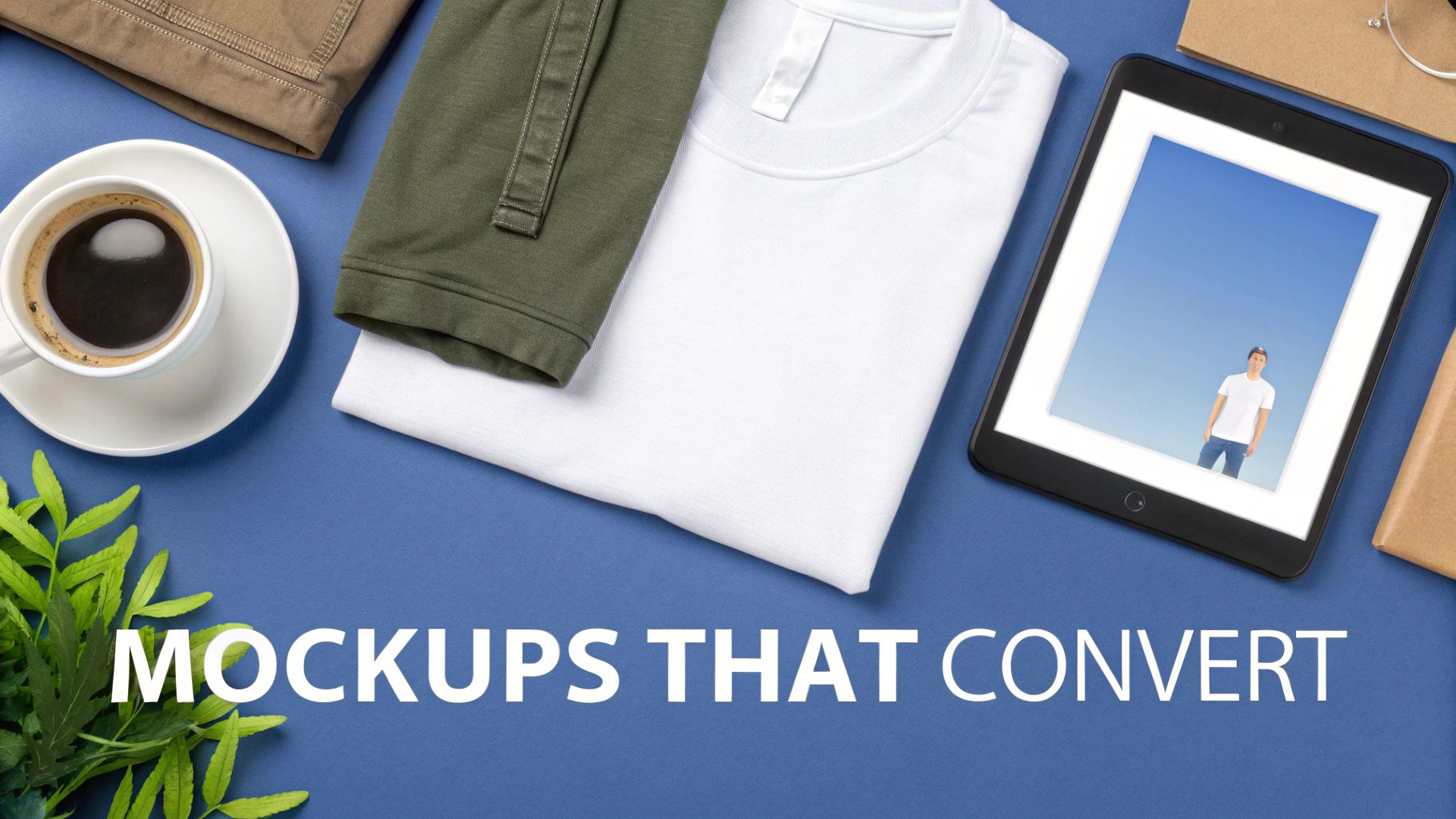
On Etsy, your product photos are everything. Shoppers can't touch or feel your t-shirts, so your mockups have to do all the heavy lifting. Low-quality, generic mockups are one of the quickest ways to kill a potential sale. Trust me, customers can spot a lazy mockup from a mile away.
This is another area where AvatarIQ is a complete game-changer. It doesn't just create the designs; it also lets you generate gorgeous, professional mockups and photoshoots without ever needing a model or photographer.
Generate Lifestyle Photos: Create realistic images of diverse models wearing your designs in all sorts of settings.
Produce Flat Lays: Craft clean, professional flat lay images that show off the quality of your products.
Ensure Cohesion: Keep a consistent aesthetic across all your listings for a powerful, branded look.
This is exactly how you stand out in a crowded marketplace. When a shopper sees a realistic photo of someone who looks like them wearing your shirt, it creates an immediate connection. It makes it easy for them to picture themselves owning it. We have a more detailed article covering how to design for print on demand that you might find helpful.
Principles of High-Converting Designs
While AI gives you the tools, your strategy is what actually drives sales. A great design isn't just about cool graphics; it's about connecting with a specific person. It should feel like an inside joke or a badge of honor for the niche you're targeting.
Think back to the Apparel Cloning method we talked about. Your designs should come from data and a solid understanding of what’s already proven to work. To create unique and captivating visuals for your products, you might also want to leverage resources like a Midjourney free alternative for AI image generation.
Here are a few core principles to always keep in mind:
Readability is Key: Make sure any text is crystal clear and easy to read, even on a tiny thumbnail image.
Speak the Niche's Language: Use phrases, symbols, and humor that only your target audience will truly "get."
Visual Balance Matters: A well-composed design is just more pleasing to the eye and looks more premium.
When you combine the strategic insights from your research with the raw creative power of AI, you build a system for producing winner after winner. You'll be ready to fill your Etsy shop with incredible products that not only look amazing but are primed to sell from day one. This is how you build real momentum and create a business that gets you excited.
Setting Up Your Etsy Shop for Success
Alright, you’ve got some killer designs ready to go. Now it's time to build your digital storefront. A well-built Etsy shop is so much more than a place to hang your digital shingle; it’s your 24/7 salesperson, working around the clock to turn casual browsers into paying customers. This is where we connect all the dots and get your business engine running.
The real beauty of print on demand is building a business that’s almost completely automated. When you pick the right partners, you create a seamless system. Orders come in, they get printed, and they ship out directly to your customer without you ever touching a single roll of packing tape. This is how you build a business that gives you freedom, not just another job.
Let's get your shop set up for that level of success right from day one.
Choosing Your Print on Demand Partner
Your print on demand (POD) partner is, without a doubt, the backbone of your entire operation. They are the ones physically creating and shipping the product your customer receives, so picking a reliable company is completely non-negotiable. Their quality, their shipping speed, and their customer service are a direct reflection of your brand.
When you're vetting potential partners, you're really looking for a few key things:
Seamless Etsy Integration: This is the magic ingredient. The partner must connect directly to your Etsy shop. This is what makes the automation happen, pushing customer orders straight to fulfillment without you lifting a finger.
Product Catalog: Do they have what you want to sell? Make sure they offer the specific premium t-shirts, cozy hoodies, or whatever other apparel items you've decided will fly off the shelves in your niche.
Production and Shipping Times: In the world of Etsy, speed matters. A lot. Look for partners with a proven track record of getting orders out the door quickly and reliably. This is a massive factor in customer satisfaction and getting those coveted 5-star reviews.
Getting your chosen partner integrated is usually pretty straightforward. You'll connect your Etsy account from inside your POD provider’s dashboard. Once that's done, you can push new products directly from their platform over to your Etsy store as drafts, ready for you to finalize.
Mastering Etsy SEO to Get Discovered
Let's be real: with over 7.5 million active sellers on the platform, just showing up isn't enough. Getting your products seen is priority number one. This is where Etsy SEO (Search Engine Optimization) comes into play. It's simply the art and science of using the right keywords so Etsy’s algorithm shows your listings to shoppers who are actively looking for exactly what you're selling.
Think of it this way: your customer types a phrase into the search bar. Your only job is to make sure your listing uses those very same phrases.
Here’s how you dial in your listings for maximum visibility:
Titles: Your title is the most important piece of SEO real estate you have. Lead with your strongest, most specific keywords. Don't just say "Cool T-Shirt." Instead, go for something like, "Vintage Hiking T-Shirt for Mountain Lovers, Retro Nature Graphic Tee." See the difference?
Tags: Etsy gives you 13 tags for every listing. Use every single one. Put yourself in your customer's shoes and use multi-word phrases (these are called long-tail keywords) that describe the product, the design, the niche, and who it’s for. Think "gift for dad," "outdoorsy apparel," or "gorpcore shirt."
Descriptions: Weave your keywords naturally into your product description. This is your chance to sell. Tell a story about the design, describe the soft feel of the fabric, and paint a picture of how awesome the customer will feel wearing it.
Pricing Your Products for Profit
Pricing is where the rubber really meets the road—it’s where your idea starts to feel like a real, money-making business. The goal here isn't to be the cheapest shop on Etsy. The goal is to be profitable while offering fantastic value. We're aiming for a healthy 30-50% profit margin on every single sale.
Here’s a dead-simple formula to get you started:
(Product Cost + Shipping Cost) x 2 = Your Retail Price
Let's say your POD partner charges you $15 for the shirt and $5 for shipping. Your total cost is $20. Doubling that gives you a retail price of $40. Boom—a 50% profit margin ($20 profit) before Etsy takes their fees. This gives you a nice buffer to run sales and promotions later without torpedoing your profits.
A quick pro tip: Offering "free shipping" is a massive psychological trigger for buyers on Etsy. You can easily do this by simply rolling the shipping cost into your retail price. The customer feels like they're getting a great deal, and you maintain your target profit margin. It's a win-win.
Follow these steps, and you’ll build a shop that isn't just nice to look at, but is a finely-tuned machine designed for visibility and profitability. You’re not just listing a t-shirt; you’re creating an incredible asset that can generate sales around the clock, bringing you that much closer to the financial freedom you’re working toward.
Alright, your shop is live. You've done the hard work of setting up the foundation, and now comes the fun part: turning all that research and design into actual cash. The journey from your very first sale to a legitimate, growing brand is all about momentum, and it starts the second you hit "publish."
The first few weeks are critical. You're essentially teaching the Etsy algorithm that your shop is active, relevant, and worth showing to people. You want to come out of the gate strong. Aim to launch with an initial lineup of at least 50 to 100 products. It sounds like a lot, but this isn't about burning yourself out. It's about casting a wide net and giving yourself the best possible chance of being discovered through all sorts of different keywords and designs.
Managing Your First Orders Like a Pro
That first "cha-ching" notification from Etsy? You'll never forget it. It's the moment your idea becomes real. Now, because you've already hooked up a solid print-on-demand partner, the actual fulfillment is handled for you. But your job in making sure the customer has an amazing experience is just getting started.
The second an order pops up, here’s what you do:
Send a quick thank you. A simple, friendly message confirming you've received their order builds immediate trust. It shows there's a real person behind the shop who actually cares.
Keep an eye on production. Pop into your POD partner's dashboard every now and then to check the order status. Issues are rare with good partners, but if something does come up, you'll be the first to know and can give your customer a heads-up before they even have a chance to wonder where their stuff is.
Be ready for questions. People will ask about shipping times, tracking, or how to care for their new shirt. Have some polite, pre-written responses saved so you can answer quickly and professionally.
Seriously, killer customer service is your best marketing tool. It’s what turns a one-time buyer into a repeat fan who tells their friends about you.
Encouraging Reviews to Build Social Proof
Positive reviews are pure gold on Etsy. They're the social proof that tells new shoppers, "Hey, this place is legit, the products are great, and you can buy with confidence."
Once you see an order has been delivered, it's totally okay to send a gentle follow-up. Don't be pushy, just be genuine.
Something like this works great: "Hi [Customer Name]! I saw your order was delivered and I really hope you're loving it. If you have a second, sharing your experience in a review would mean the world to my small shop. Thanks so much!"
A simple, appreciative nudge is often all it takes. Every 5-star review you get makes the next sale that much easier to land.
Scaling What Works with Data and Ads
Once you have a few sales under your belt, it’s time to get strategic. Your sales data is a treasure map showing you exactly what's resonating with customers. Dive into your stats and look for the designs getting the most favorites, clicks, and, of course, purchases. Those are your winners.
The smartest way to scale is to double down on what’s already working. One seller I know had an incredible $28,000 December, and instead of letting the post-holiday slump get them down, they turned it into a $10,100 January. How? They just expanded on their bestsellers. They added back prints to popular t-shirts or offered the same hit designs on hoodies and sweatshirts. No need to reinvent the wheel. You can see a full breakdown in their Etsy print on demand income report.
When you've clearly identified a star product, that's when you might consider putting a little money into Etsy Ads. This isn't about gambling; it's about pouring gasoline on a fire that's already burning. Promoting a proven bestseller with even a small daily budget can drive a ton of targeted traffic right to the listing that’s most likely to convert. This creates a powerful cycle of more sales, more visibility, and even more sales.
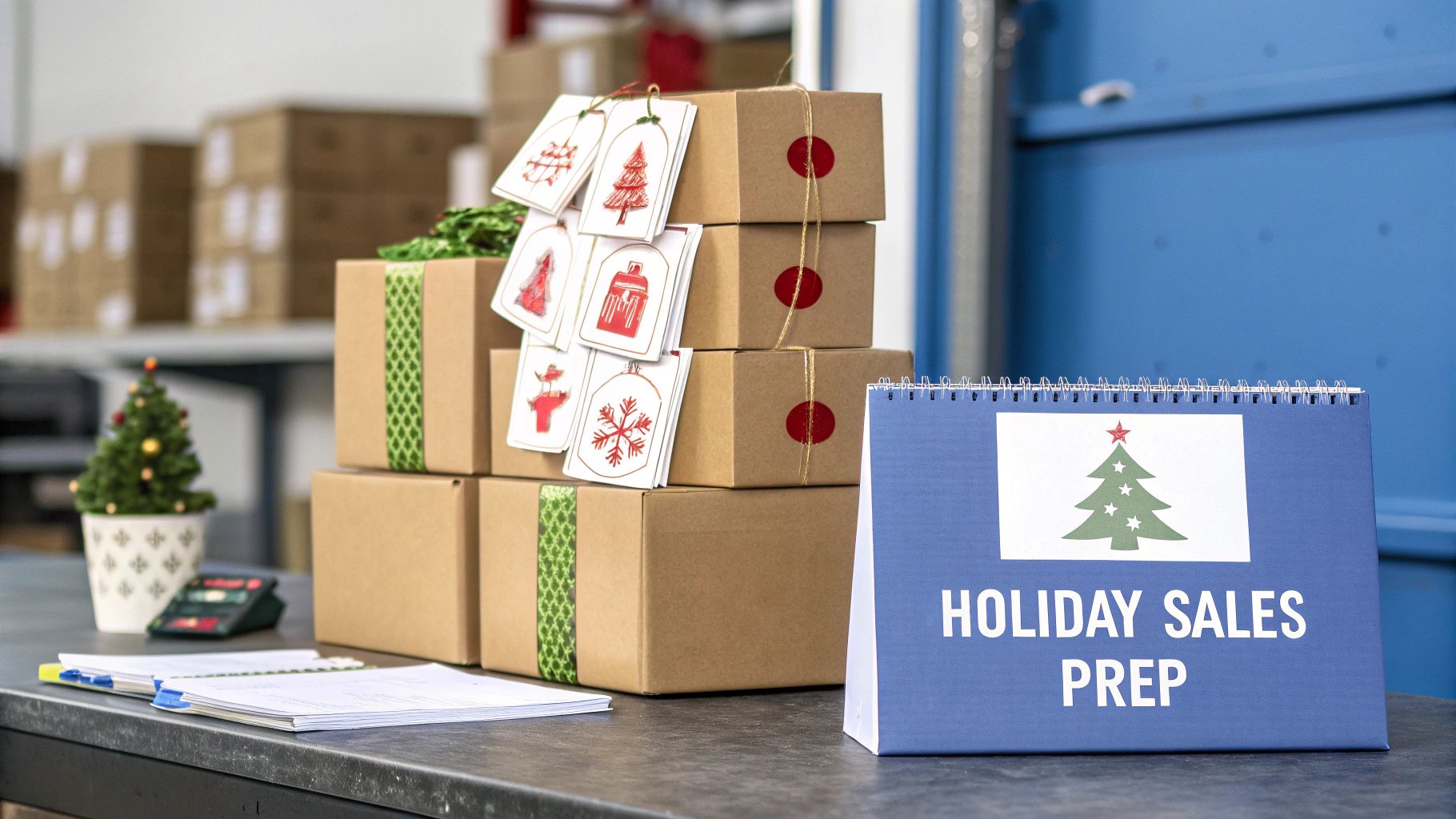
Preparing for Holiday Sales and Peak Seasons
The fourth quarter is where a print-on-demand shop can absolutely explode. This isn’t just another busy season; it’s a massive wave of opportunity that can honestly define your entire year. But here’s the thing: winning in Q4 doesn't start in December. It starts now.
Success during the holiday rush is all about laying the groundwork early. By October, your goal should be to have a solid catalog of at least 200 listings. That number isn't just pulled out of thin air. It’s about casting the widest possible net to catch the insane amount of gift-shopping traffic that hits Etsy. More listings simply mean more chances for buyers to find you.
Capitalizing on Holiday Themes
It’s time to shift your design strategy to focus squarely on holiday themes. This is when you need to dive into what shoppers are actively searching for, and I mean really searching for, not just guessing.
Get more specific than just "holiday cheer." Think about the actual events and vibes:
Christmas: Go for cozy, nostalgic, and funny. "Ugly Christmas sweater" patterns on t-shirts are a classic for a reason, and witty phrases about family gatherings always hit the mark.
Thanksgiving: Focus on gratitude, family, and that whole autumn aesthetic. Designs about food, football, and funny family dynamics are consistent sellers.
Hanukkah: Create designs celebrating the Festival of Lights. You can go modern or traditional with the visuals, but clever messaging is key.
The real game-changer here is personalization. Shoppers get desperate for unique gifts, and the ability to add a name, a date, or a custom message to a design makes a product nearly irresistible. Offering this simple option can seriously boost your conversion rates. For a deeper look, check out our guide on navigating print on demand for the holidays.
Creating Urgency and Managing Volume
As the holidays creep closer, you need to light a fire under your shoppers. Creating a sense of urgency is a powerful sales tool. Make sure you display shipping deadlines prominently—I’m talking right there in your product photos and descriptions. A simple banner saying "Order by Dec 10th for Christmas Delivery!" pushes those on-the-fence shoppers to click "buy" before it's too late.
This season is teed up to be massive. Consumer confidence is up, and online spending is set to break records, especially on Etsy where fast, custom gifts are king. You’ll see a huge traffic surge in the first two weeks of December from last-minute buyers who are racing against those shipping deadlines. That's high-urgency selling at its finest. The data backs this up: one POD shop we tracked jumped from $21k in November to $28k in December. That’s the kind of momentum we’re talking about.
With the right plan, the holiday rush isn't overwhelming—it's exhilarating. It's the perfect opportunity to generate incredible revenue and build momentum that will carry your business into a strong new year.
Preparing now is how you turn a side hustle into a serious income stream. The work you put in today will pay off big time when those holiday sales notifications start lighting up your phone. Get excited, because this is your chance to see what your business is truly capable of.
Got Questions About Selling POD on Etsy?
Diving into the world of print on demand on Etsy can feel like a massive undertaking, but honestly, it's one of the most exciting and accessible ways to build a real business right now. Most people starting out have the exact same questions, so let's tackle them head-on.
My goal here is to give you the clarity you need to move forward with confidence.
How Much Money Do I Really Need to Start?
This is probably the number one reason print on demand is such a fantastic model for beginners: the startup costs are ridiculously low. You’re not buying boxes of t-shirts and hoping they sell, so you are building an asset from day one.
Your main upfront costs are minimal. Here’s the breakdown:
Etsy Listing Fees: It’s just $0.20 to list a product, and that listing stays active for four whole months.
Transaction Fees: Once you make a sale, Etsy takes a small cut. No sale, no fee. Simple.
Design Tools: This is where you can be really smart. Forget expensive, complicated software. A tool like AvatarIQ is a total game-changer, giving you everything you need for pro-level designs and mockups for a low monthly fee.
Seriously, you can get your shop live and stocked with your first batch of designs for less than a decent dinner out. That low barrier to entry is what makes this opportunity so powerful.
Do I Need to Be an Artist to Succeed?
Absolutely not. This is a huge misconception that paralyzes so many would-be entrepreneurs. Success with print on demand isn't about being a Picasso; it’s about understanding your audience and creating designs that resonate with them.
Many of the top-selling Etsy POD shops are run by marketers and entrepreneurs, not traditional artists. They use proven research strategies, like our Apparel Cloning system, to find out what's already flying off the virtual shelves and then create their own unique spin on it.
With powerful AI tools like AvatarIQ, you can generate stunning, professional-quality designs in a matter of minutes, even if you can't draw a stick figure. Your real skill is in your ideas and your ability to spot what people want, not your technical drawing ability.
Is Print on Demand on Etsy Just Too Saturated?
Look, while it's true there are a lot of sellers on Etsy, the market is nowhere near saturated with quality, niche-specific products. Millions of buyers flood Etsy every single day, and they aren't looking for generic junk. They're searching for unique items that speak directly to their passions and hobbies.
The sellers who cry "saturation" are usually the ones trying to sell generic "dog shirts" to everyone. The magic happens when you get specific. Instead of "dog shirts," think "gifts for corgi-loving nurses." By niching down, you cut straight through the noise and connect with a dedicated audience that is actively looking for what you have to offer. The opportunity isn't just there; it's growing every single day for sellers who are willing to be strategic.
This whole journey is about building a business that gives you the freedom you've been looking for. At Skup, we’ve helped thousands of beginners just like you turn simple ideas into profitable print-on-demand stores. We provide the blueprint, the tools, and the coaching to make it a reality. Learn more about our approach at https://skup.net and start building your dream business today.
Does it feel like Etsy’s shipping costs are some kind of impossible puzzle designed to chew up your profits? Trust me, you’re not alone. So many sellers get stuck here, but mastering your etsy shipping costs is a game you can absolutely win. This guide is the complete playbook, built by founders who run 8-figure…
A DTF print shirt is what happens when you print a design onto a special transfer film, apply an adhesive, and then heat-press it directly onto a garment. The final product is a crisp, vibrant, and surprisingly durable shirt that feels fantastic. For entrepreneurs, this method isn't just another option—it's a massive opportunity. Welcome to…
Imagine launching a full-blown apparel brand without ever touching a single t-shirt or hoodie. That’s the magic of print on demand, and if you’ve been waiting for the right moment to jump in, this is it. This is your complete roadmap to getting your first sale and building a real, high-margin brand from the ground…