Home » Blog » How to Start a Clothing Line Business from Scratch
So, you want to start a clothing line.
The dream often feels huge—like you need a massive loan, a warehouse, and connections in the fashion world just to get a foot in the door. But here's the reality: the old rules are dead. You can build a real, profitable brand from your laptop with little more than a great idea.
This isn't just a guide; it's the modern playbook. I'm going to walk you through the exact strategies we've used to build and scale multiple 8-figure eCommerce businesses, focusing on a path that minimizes risk and lets your creativity run wild.
The New Way to Launch a Brand
Forget everything you think you know about needing mountains of cash for inventory. The secret sauce is leveraging a business model that works for you, not against you.
Enter print-on-demand (POD).
It's a game-changer. With POD, you partner with a supplier who handles printing, packing, and shipping for you. When a customer buys a t-shirt from your Shopify store, the order goes straight to your partner, they create the product, and ship it directly to the customer. You never touch a single piece of inventory.
Why is this so powerful?
Zero Inventory Risk: You don't pay for a product until after a customer has paid you. The days of buying 500 t-shirts and hoping they sell are over.
Unlimited Creative Freedom: Want to test a dozen new designs this week? Go for it. There's no financial penalty for experimenting.
Total Location Independence: As long as you have a laptop and an internet connection, you're in business.
This is about more than just selling clothes. It's about building a community, creating financial freedom, and taking back control of your time. The opportunity in eCommerce right now is absolutely massive.
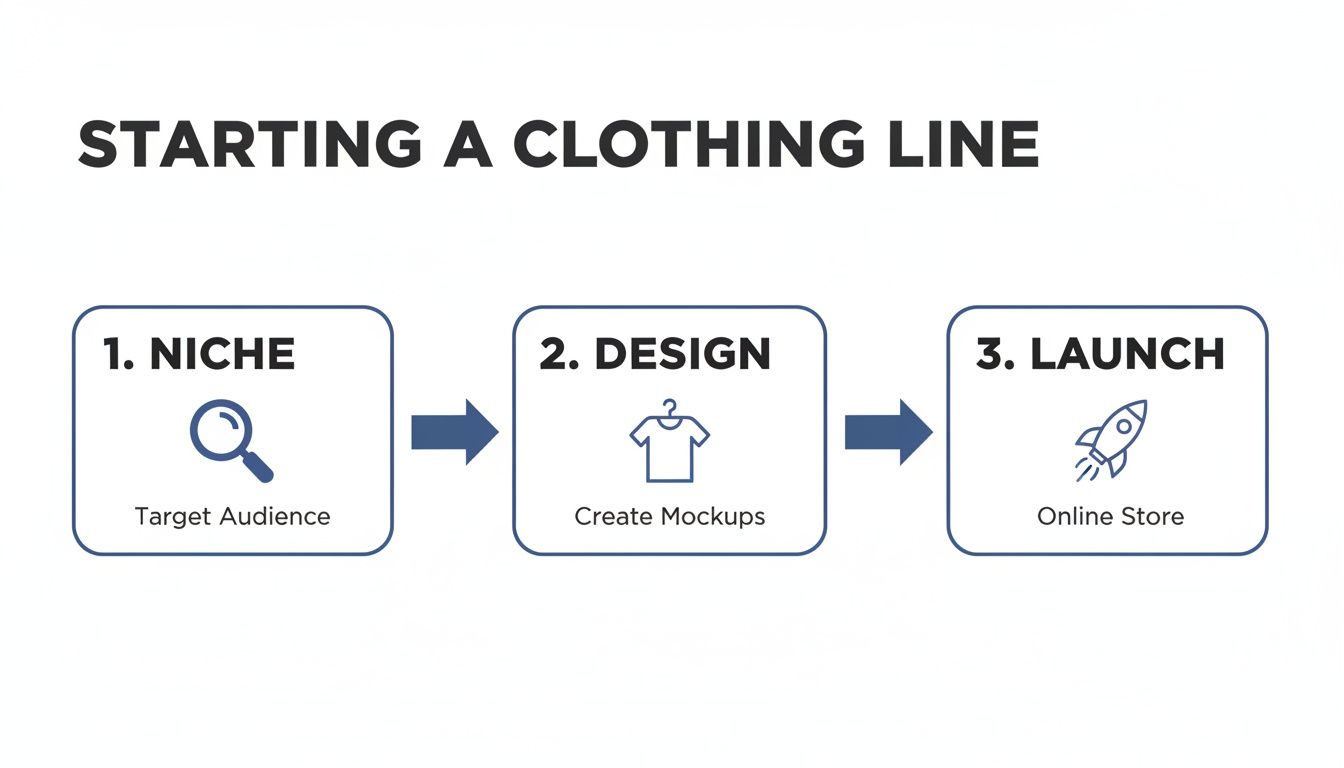
The entire process boils down to a few core stages. It’s simpler than you might think.
As you can see, it all comes down to nailing three things: finding your people (niche), creating designs they'll love, and launching a store that converts.
Getting started is surprisingly accessible. Thanks to the print-on-demand model, you can launch with almost nothing. Seriously. You could kick things off with as little as $2, which is exactly why 63% of our customers jump in with zero prior eCommerce experience. If you want to dive deeper, Starter Story has some great insights on the low startup costs for a modern clothing line.
Before we dive into the nitty-gritty of each step, let's get a high-level view of what your first three months will look like. This isn't a rigid timeline, but it's a solid framework to keep you moving from idea to your first sale.
Key Milestones for Your First 90 Days
Phase
Key Actions
Primary Goal
Month 1: Foundation
Define your niche & target customer
Brainstorm brand name & designs
Set up Shopify store basics
Go from a vague idea to a clear, actionable concept.
Month 2: Build & Test
Finalize initial designs
Set up print-on-demand integration
Order product samples
Build out key store pages
Create a tangible product and a functional online store.
Month 3: Launch & Learn
Set your pricing strategy
Launch initial marketing campaigns
Gather customer feedback
Analyze first sales data
Get your first sale and learn what resonates with your audience.
Think of this table as your roadmap. It breaks a massive goal—launching a business—into small, manageable chunks. Focus on one phase at a time, and you'll be amazed at how quickly you can make real progress.
Finding a Profitable Niche for Your Brand
Let's get one thing straight: the single biggest mistake new clothing brands make is trying to sell to everyone. It's a surefire way to get lost in the noise. The real secret is connecting deeply and authentically with a very specific group of people. This is your niche, and nailing it is the most critical first step you'll take.
Forget appealing to the masses. Think smaller. Way smaller.
Think about the passions, hobbies, professions, or weird little communities that are currently being ignored by the big players. Who are these people? What do they love so much they’d literally wear it on their chest?
This is where the gold is. Are you making apparel for:
Dedicated nurses pulling the graveyard shift?
Classic car fanatics who live and breathe for their weekend projects?
Passionate dog moms who treat their fur babies like royalty?
Each of these groups has its own language, inside jokes, and a powerful shared identity. When your brand speaks directly to that identity, you stop just selling a t-shirt. You start building a tribe.
The Apparel Cloning Method
Guesswork is the fastest way to kill a new business. That’s why we live by the ‘Apparel Cloning’ method—a system for digging up concepts that are already proven to sell. This isn't about ripping people off; it's about smart market research.
The idea is simple: you find successful designs or themes in broad markets and then create your own unique spin for a smaller, untapped audience. It completely removes the risk of pouring your heart and soul into something nobody wants. You're building on a foundation of proven demand, which is a massive leg up.
For instance, a generic "I love coffee" shirt is forgettable. But a shirt that says "Fueled by Caffeine and Charting" for nurses? That’s specific, it’s relatable, and it speaks their language. This is the exact strategy we teach in our Apparel Cloning course, empowering you to find winning ideas from day one.
Defining Your Brand Identity
Once you have a few promising niches in mind, it's time to start developing a strong branding strategy and market positioning that makes you stand out. Your brand identity is so much more than a slick logo. It's the whole vibe—the story, the feeling, the personality behind your products.
A strong brand makes your ideal customer feel like they've finally found a company that gets them. This comes down to two key pieces: a memorable name and a distinct voice.
Choosing a Brand Name: It needs to be easy to remember, simple to spell, and hint at what you're all about. Start brainstorming words that resonate with your niche. If you're targeting fishermen, think about terms like "Reel," "Hooked," or "Tide."
Defining Your Brand Voice: How does your brand sound? Is it sarcastic and witty? Is it motivational and inspiring? Your voice has to be consistent across your website, your product descriptions, and every social media post. This is how you build a community, not just a customer list.
Your brand is a promise to your customer. It’s a promise of quality, a shared value, or a sense of belonging. When a customer wears your clothing, they're telling the world a little bit about who they are.
Deciding between a niche focus and a general store is a fundamental choice for any new eCommerce brand. If you want to dive deeper into this, check out our guide on the pros and cons of running a niche vs. a general store. Building a powerful brand around a dedicated community is one of the most rewarding parts of this journey, and it sets you on a clear path to your first sale and beyond.
Bring Your Winning Designs to Life with AvatarIQ
This is where so many aspiring brand owners get stuck. The fear of not being a "designer" can feel like a massive wall, but trust me, that wall has come crashing down. You absolutely do not need to be an artist or a design software wizard to create incredible, sellable apparel.
The old way was a grind. You'd spend hundreds, if not thousands, on freelance designers. It was a slow, painful process filled with endless back-and-forth revisions, and you still had no guarantee you’d end up with something your customers would actually buy. That entire mess is now obsolete.
The modern, smarter approach? Use AI to bring your ideas to life instantly. This is where the real fun begins. You get to be the creative director, guiding the vision without getting bogged down in the technical details.
Generate Unique Designs Without Any Skill
Imagine having a world-class designer on call 24/7, ready to pump out anything you can dream up in seconds. That's the power you get with specialized AI tools. This is exactly why we built AvatarIQ, our own AI design and mockup generator.
Instead of staring at a blank canvas, you just describe the design you want. Get specific, get creative, and test dozens of variations in minutes. This speed lets you execute the Apparel Cloning method with ridiculous efficiency, cranking out unique designs for your niche with zero friction.
The most successful brands aren’t run by the best artists; they're run by people who are the best at understanding their audience. AI empowers you to focus on the customer, not on complex design software.
This is a massive opportunity. It completely levels the playing field, letting your creativity and knowledge of your market become your biggest assets. You can learn more about how to use AvatarIQ for your brand and see for yourself just how easy this is.
Create Photorealistic Mockups That Build Trust
A killer design is only half the battle. How you present it is what convinces a customer to hit "Add to Cart." Professional product photos used to mean expensive photoshoots with models, lighting, and cameras. It was another huge cost that held new brands back.
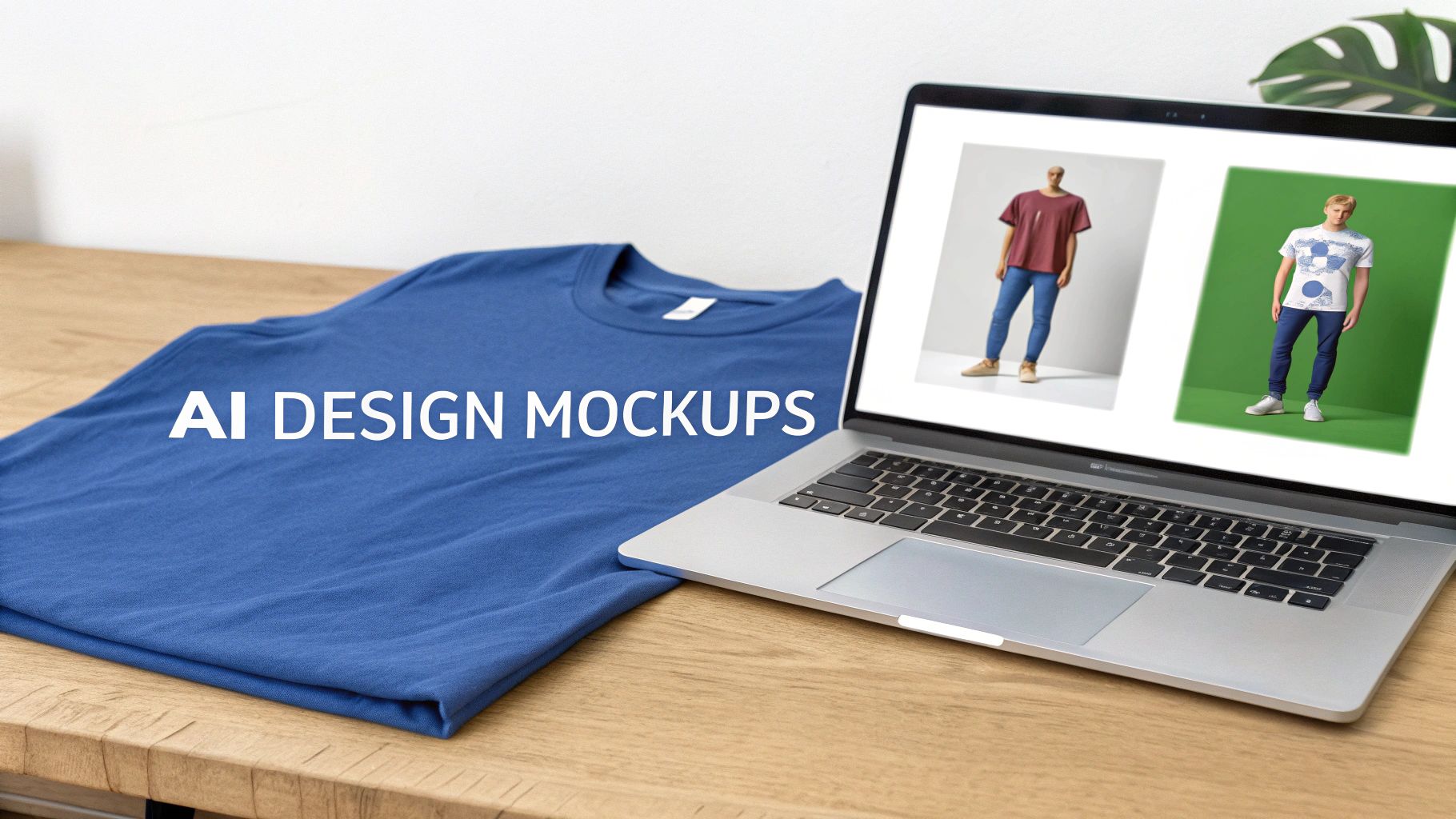
AvatarIQ completely solves this by generating stunning, photorealistic mockups of your clothing on AI-generated models. This gives your store a legit, high-quality look from day one. Customers see your products in a real-world context, which builds the trust they need to make a purchase.
You can create mockups that perfectly match your brand’s vibe:
Generate models that look like your target customer.
Place them in scenes that fit your niche (think a gym for fitness apparel or a coffee shop for a bookish brand).
Showcase your designs from multiple angles and on different body types.
This capability is an absolute game-changer. It gives you an endless supply of marketing creative for your ads and social media, making your brand look like an established player right out of the gate.
By combining AI design generation with photorealistic mockups, you eliminate the two most expensive and time-consuming parts of creating products. You can now go from a simple idea to a professional, store-ready product in minutes, not weeks.
Building Your Shopify Store to Convert Visitors
With your niche locked in and your designs fired up, it’s time to build your digital headquarters. Think of your Shopify store as more than just a website—it’s your virtual storefront, your brand’s home, and the engine that will turn curious visitors into paying customers. Getting this part right is what creates a business that basically runs itself, even while you sleep.
The timing couldn’t be better. In the US, e-commerce snatched up 20.54% of all fashion retail sales in 2023, and clothing was the single most purchased item online at a whopping 43%. This isn't just a trend; it's a massive digital marketplace where your brand is set to thrive.
You're tapping into a system where even the biggest names in fashion make most of their money online. This is your chance to build a brand that connects directly with people in the exact space they're already shopping.
Choosing Your Theme and Brand Vibe
Your store's design is your first impression, and you only get one. A clean, professional, and mobile-friendly theme is completely non-negotiable, especially since well over half of all online traffic now comes from phones. The Shopify theme store has plenty of great options, both free and paid, to get you started.
When you’re picking a theme, focus on these three things:
Speed: A site that loads in a blink keeps people engaged. A slow site kills sales.
Clarity: Navigation has to be dead simple. If people can't find what they want, they'll leave.
Visuals: Look for themes that let your product mockups be the star of the show.
Think of your theme as a blank canvas. It’s there to make your brand’s personality and your products shine, not to overcomplicate things. When in doubt, keep it simple.
Crafting Product Pages That Sell
Your product pages are your digital salespeople. This is where you have a one-on-one conversation with a potential buyer, and every single element needs to work together to build desire and, just as importantly, trust. A great product page does more than list features; it tells a story.
Start with a killer product description. Instead of just "100% Cotton T-Shirt," paint a picture. Talk about how the fabric feels, the story that inspired the design, or how wearing it helps your customer express who they are. You need to speak their language.
Your product description should answer one question from the customer's point of view: "What's in it for me?" It’s less about the item and more about the person who will wear it.
From there, you need incredible images. Since you’re starting with photorealistic mockups from a tool like AvatarIQ, you’re already miles ahead. You have a library of professional, model-shot images ready to go. This is a huge advantage that builds instant credibility and lets customers see exactly how your designs look in the real world.
Integrating Your Print-on-Demand Partner
Here's where the magic of automation kicks in. Connecting your print-on-demand supplier to your Shopify store creates a totally seamless, hands-off fulfillment process. Most of the top-tier POD suppliers have a Shopify app that makes this process incredibly simple—usually just a few clicks.
Once it's connected, any order a customer places is automatically sent to your supplier. They handle the printing, packing, and shipping directly to your customer. You don't have to lift a finger. This frees you up to focus on what actually grows the business: marketing and connecting with your community.
Building Trust and Optimizing for Conversions
Getting traffic to your site is one thing; turning that traffic into sales is the real game. This is the science of conversion rate optimization (CRO), and it’s something we obsess over in our own 8-figure businesses.
Several key elements work together to build the trust someone needs to pull out their credit card:
Clear Shipping and Return Policies: No one likes surprises. Be completely upfront about shipping times and costs. A clear, fair return policy removes a ton of anxiety for first-time buyers.
Customer Reviews: Social proof is everything. Encourage your first customers to leave reviews (maybe offer a small discount on their next purchase) and feature them right on your product pages.
A Real "About Us" Page: Share your story. People connect with people, not faceless corporations. Tell them why you started this brand and what it stands for.
Getting the foundation right is critical. For a comprehensive walkthrough, you can follow a guide on how to set up a Shopify store to nail the basics. But don't stop there—improving your store's conversion rate is a never-ending process. To dive deeper, check out our own guide on how to increase your ecommerce conversion rate.
Building a store that works like an efficient sales machine from day one is one of the most exciting parts of this whole journey.
Marketing Your Brand to Drive First Sales
Alright, you've done the hard work. Your Shopify store looks amazing, the designs are ready to go, and your POD partner is lined up. Now for the fun part: actually getting your brand in front of people and making those first few sales.
Let's be real: a great store is completely invisible without marketing. This is the moment you turn all that creative energy into actual revenue and start building a real community. While there are a million ways to market a brand, we're going to zero in on the single most powerful strategy for new POD stores: paid advertising on Meta (that's Facebook and Instagram).
This isn't about guessing or just throwing money at the wall. It’s a calculated, beginner-friendly process that lets you start with a tiny budget, test your designs, and let the data tell you exactly what people want to buy. This is the same basic process our founder uses to manage over $200k per month in ad spend, just scaled way down for your first launch.
Launching Your First Ad Campaigns on Meta
Meta’s ad platform is a beast because you can get hyper-specific with your targeting. You can put your designs directly in front of people who are into the exact hobbies, passions, and communities that your niche is built around.
Your only goal at the start is to find a winning product. That’s a design-and-product combo that gets a great reaction from your audience and, most importantly, generates sales profitably. The fastest way to find it is through testing.
Don't overcomplicate it. You can start with a tiny daily budget—even $10 to $20 per day is plenty to start collecting good data. Set up a simple campaign with a few different ad sets, each one targeting a slightly different angle of your niche.
For example, if your niche is dog lovers, you could target:
People interested in specific breeds (like Golden Retrievers or French Bulldogs).
Followers of big dog-related Instagram pages or influencers.
Users who've shown interest in buying dog accessories or shopping at pet stores.
Creating Ad Creatives That Stop the Scroll
Your ad creative—the image or video in your ad—is everything. It's what makes someone stop scrolling and pay attention. The good news? If you used a tool like AvatarIQ for your product mockups, you're already sitting on a goldmine of professional, eye-catching images.
Here are a few quick tips for making ads that convert:
Use your absolute best mockups. Show off your designs on those high-quality, photorealistic models you generated. It builds instant trust and makes your brand look legit from day one.
Keep your ad copy simple and direct. Talk like your customers talk. A short, punchy headline that taps into their identity works way better than a generic "Buy my shirt!" pitch.
Have a clear call-to-action (CTA). Tell people exactly what to do next. "Shop Now" or "Grab Yours Here" leaves no room for confusion.
The best part of the print-on-demand model is that you can test dozens of designs with zero financial risk. Let your ad performance be your guide. It will tell you which designs to push and which ones to ditch. You're basically doing market research in real-time.
Once your ads are live, peek at the data daily. You're looking for which designs get the most clicks and, eventually, sales. When you spot a winner, you can start slowly increasing the budget behind it. This is exactly how you go from your first sale to consistent daily revenue.
Foundational Marketing Beyond Paid Ads
While paid ads are your fast track to initial sales, you should also be laying the groundwork for the long term with other marketing channels. These efforts will support your ad campaigns and help you build a loyal community that keeps coming back.
Social Media Presence Get your profiles set up on the platforms where your audience hangs out, which is probably Instagram and Facebook. You don't need to post five times a day. Just focus on sharing your best mockups, engaging with comments, and building a visual identity for your brand. Think of your social profiles as social proof for anyone who discovers you through an ad.
Email Marketing Start collecting emails from the moment you launch. Add a simple popup or signup form to your Shopify store offering a small incentive, like 10% off, for an email address. Even if someone doesn't buy right away, getting their email means you can market to them for free later. Announcing new designs or special promos to your email list is one of the most powerful ways to drive sales from your most dedicated fans.
Scaling from Side Hustle to Full-Time Freedom
Getting those first few sales is an incredible rush, but the real magic happens when you turn that spark into a wildfire of consistent, life-changing income. This is the moment your clothing line stops being just a side project and starts becoming a true freedom machine. It all boils down to one thing: strategically reinvesting your profits to blow up your customer base.
Forget working harder; it’s all about working smarter. Once your initial ad tests have pointed you to a winning product, it’s time to pour some serious gasoline on that fire.
You’ll take every dollar of profit and funnel it directly back into your ad budget. This lets you reach a much bigger slice of your audience, kicking off a powerful growth loop: sales fund more ads, which generate even more sales.
Building Your Brand Assets
As you start cranking up the ad spend, your focus needs to shift to building long-term assets—the kind that can generate sales on demand. Expanding your product catalog is a huge piece of this.
Use the data from your ads to guide your next moves. If that shirt celebrating Golden Retrievers sold like crazy, it's a no-brainer to roll out designs for other popular breeds. You’re not guessing; you’re giving a hungry audience exactly what they’ve shown you they want.
At the same time, you have to be obsessive about building your email list. Every single customer is a chance to capture an email address. This list will quickly become one of your most valuable assets, giving you a direct line to a warm audience that already knows and loves your brand. Think about it: free sales, just by sending an email announcing a new drop.
True freedom isn't just about making more money. It’s about building systems that generate that money without you having to be chained to your laptop 24/7. This is how you go from being a business operator to a business owner.
This journey is incredibly exciting. When you're ready to make the jump from $10k per month to six or even seven figures, it takes a massive mindset shift. That's exactly why we developed our programs.
We walk entrepreneurs through building the advanced systems required for that kind of sustainable, long-term growth. The end game isn't just a fat bank account; it's building a business that gives you both financial security and the time to actually go out and enjoy it. This is where the dream of starting a clothing line gets real.
Diving into the world of eCommerce is a rush, but let's be real—it's normal to have a ton of questions swirling around. We've walked thousands of entrepreneurs through launching their brands with our Apparel Cloning system, and we see the same handful of questions pop up time and again.
Let's just cut to the chase and answer them right now.
So, How Much Money Do I Really Need to Start?
This is the absolute best part about building a brand today. Because of print-on-demand, the days of needing a massive, risky upfront investment are completely over. Forget dropping thousands on inventory that you can only hope will sell.
Your main costs are your Shopify subscription and a small budget to get your first ads out the door. You can seriously start testing the waters with just $5-$10 a day on ads.
Since the product is only created and paid for after a customer has already given you their money, the financial risk is practically zero.
Do I Need to Be a Designer to Actually Succeed?
Not a chance. I've seen it time and time again: success in this game is all about killer marketing and truly getting inside the head of your niche—it has almost nothing to do with your ability to draw.
The real skill is spotting proven ideas that are already working and then creating your own unique spin for a specific audience. That’s a research skill, not an art degree.
You don't need to be a design software wizard anymore. With powerful tools like AvatarIQ, you can generate incredible, professional-grade designs with just a few simple text prompts. It's your creativity and market insight that will make you money, not your technical design skills.
How Long Until I Make My First Sale?
If you have a solid, focused strategy, seeing your first sale within just a few days of turning on your ads is totally realistic.
The whole point of the Apparel Cloning System is to cut out all the guesswork and get you to that first cha-ching moment as fast as possible. When you target a super passionate niche with a design concept that's already proven to resonate, you're not just throwing things at a wall—you're connecting with paying customers almost immediately.
Isn't the Clothing Market Totally Saturated?
Look, if you're trying to launch a generic, "for everyone" t-shirt brand, then yeah, you're going to have a rough time. The general clothing market is a beast.
But that's not where the money is.
The real opportunity is in niching down and getting hyper-specific. Forget trying to be the next Nike. Instead, aim to become the absolute go-to brand for a dedicated community, whether it's pug owners, rock climbing fanatics, or people who are obsessed with vintage synthesizers. There are thousands of these untapped niches just waiting for a brand to finally speak their language.
Ready to stop wondering and start building? At Skup, we give you the training, tools, and hands-on coaching to go from zero to a real, thriving eCommerce business. Start your journey with us today!
Imagine launching a full-blown apparel brand without ever touching a single t-shirt or hoodie. That’s the magic of print on demand, and if you’ve been waiting for the right moment to jump in, this is it. This is your complete roadmap to getting your first sale and building a real, high-margin brand from the ground…
Quick Answer Matt Schmitt is the co-founder of Skup, a print-on-demand ecommerce training company. With over $30 million in personal ecommerce sales and a decade of experience building and scaling POD stores, Matt oversees Skup’s coaching program and teaches the systems that helped him exit multiple 7-figure businesses. His students have collectively generated tens of…
Ready to turn your creativity into cash? The fastest way to make money selling t-shirts is to find designs that are already crushing it, create even better versions with your own unique spin, and sell them to passionate audiences. The exciting world of print-on-demand allows you to start with virtually zero risk and build a…