Home » Blog » 10 Profitable Print On Demand Business Ideas to Start in 2026
Are you searching for a business model that offers creative freedom, low startup costs, and incredible profit potential? The print-on-demand (POD) apparel industry is booming, creating a massive opportunity for aspiring entrepreneurs just like you. The dream of building your own brand and escaping the 9-to-5 grind is more achievable than ever before. With POD, you get to focus on the fun part—creating amazing designs—while someone else handles the printing, packing, and shipping.
This article is not just another list of generic print on demand business ideas. It is a strategic roadmap designed to give you a clear advantage. We are breaking down ten powerful business blueprints, each a proven path to building a sustainable, high-margin e-commerce brand from scratch. Each entry goes beyond the basics, offering a comprehensive plan that includes:
Target Audience Analysis: Pinpoint exactly who you're selling to.
Actionable Design Hooks: Learn how to create apparel that captures attention and drives sales.
Profitability Estimates: Understand the real financial potential of each idea.
Quick Testing Steps: Validate your concepts without wasting time or money.
These are the exact strategies used by the founders of Skup to generate over $50 million in sales, and they have helped thousands of students replicate that success. Whether you're a complete beginner or looking to scale an existing store, you will find actionable steps to move forward with confidence. Get ready to feel excited, because your journey to building something you are proud of starts right now.
1. Niche-Focused T-Shirt and Apparel Collections
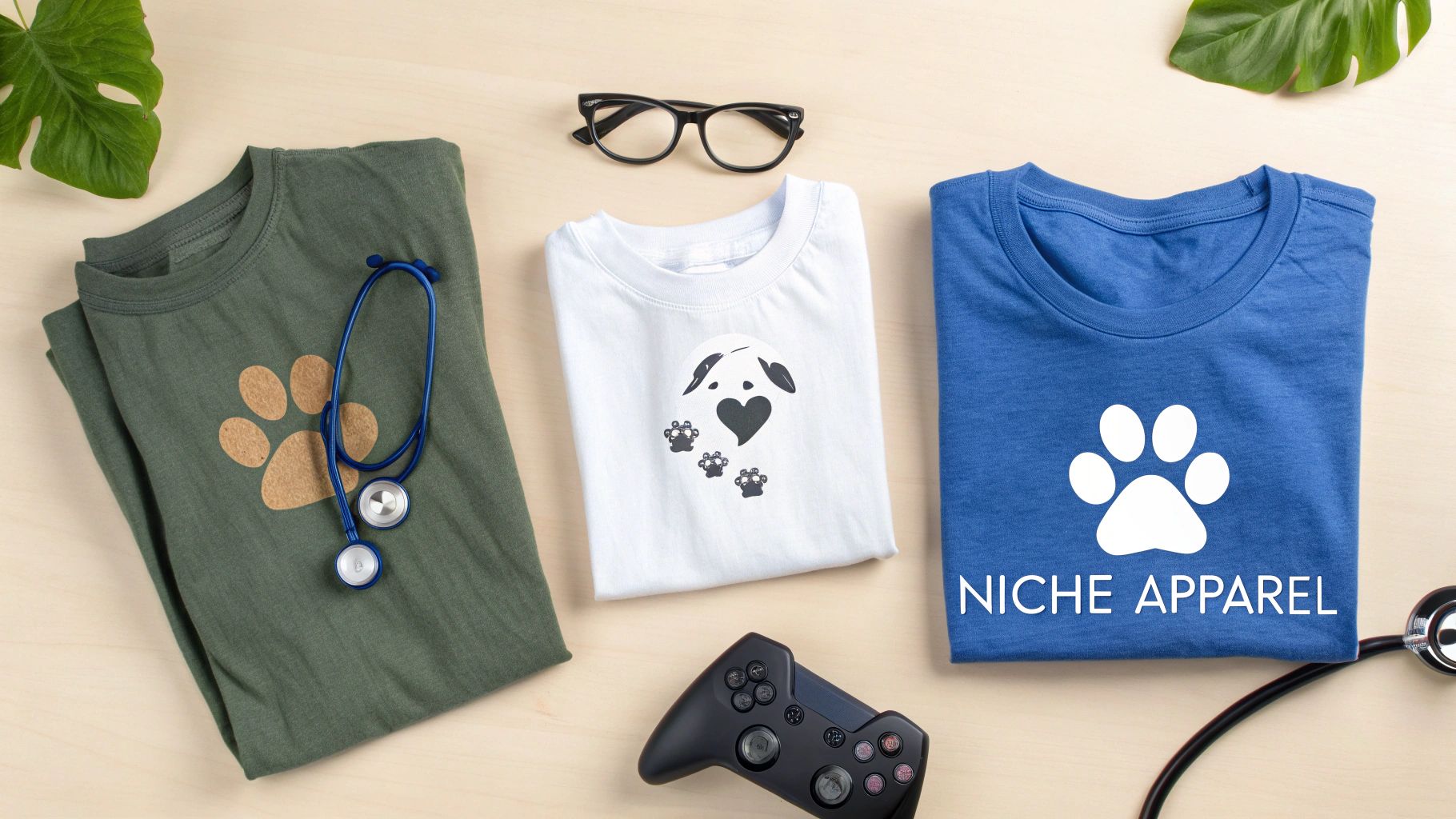
One of the most powerful and profitable print on demand business ideas is to move away from generic, mass-market designs and instead create apparel for highly specific, passionate communities. This approach involves identifying an underserved niche, such as a particular profession, hobby, or dog breed, and creating designs that resonate deeply with that audience's identity, humor, and shared experiences.
Instead of selling a t-shirt that says "I Love Dogs," a niche-focused brand would create one that says "Golden Retriever Parent," "Sighthound Squad," or features an inside joke only a veterinarian technician would understand. This specificity creates an instant connection, transforming a simple piece of clothing into a badge of identity. Because the designs speak directly to them, customers are often willing to pay a premium price, leading to higher profit margins. This strategy is central to proven methodologies like the Apparel Cloning System, which focuses on replicating successful niche concepts.
Quick Start and Validation
To get started, focus on communities you are already a part of or have a deep understanding of. This authentic connection will be your greatest asset in creating designs that feel genuine.
Design Prototyping: Use an AI-powered tool like AvatarIQ to rapidly generate a batch of 5-10 design concepts and mockups. This allows you to visualize your collection and test ideas without any initial investment in design software or artists.
Community Testing: Share your mockups in relevant Facebook groups, subreddits, or online forums. Pay close attention to the feedback, comments, and engagement to validate which designs have the most potential before you launch your store.
Build Your Audience: From day one, focus on building an email list. Offer a small discount for signing up and use it to announce new designs, turning one-time buyers into loyal, repeat customers.
Key Insight: The goal is to become the go-to brand for a specific community. When someone wants a shirt that celebrates being a nurse, a rock climber, or a resident of a small town, your store should be the first place they look. To dive deeper into finding the perfect community for your brand, explore these proven strategies on how to find niches for print on demand.
2. AI-Powered Design and Mockup Generation for Apparel
One of the most revolutionary print on demand business ideas is leveraging artificial intelligence to automate the entire creative process. This strategy allows entrepreneurs, especially those without a design background, to generate professional-grade apparel designs and stunning product mockups in minutes, not weeks. It completely removes the traditional bottlenecks of hiring expensive designers or photographers.
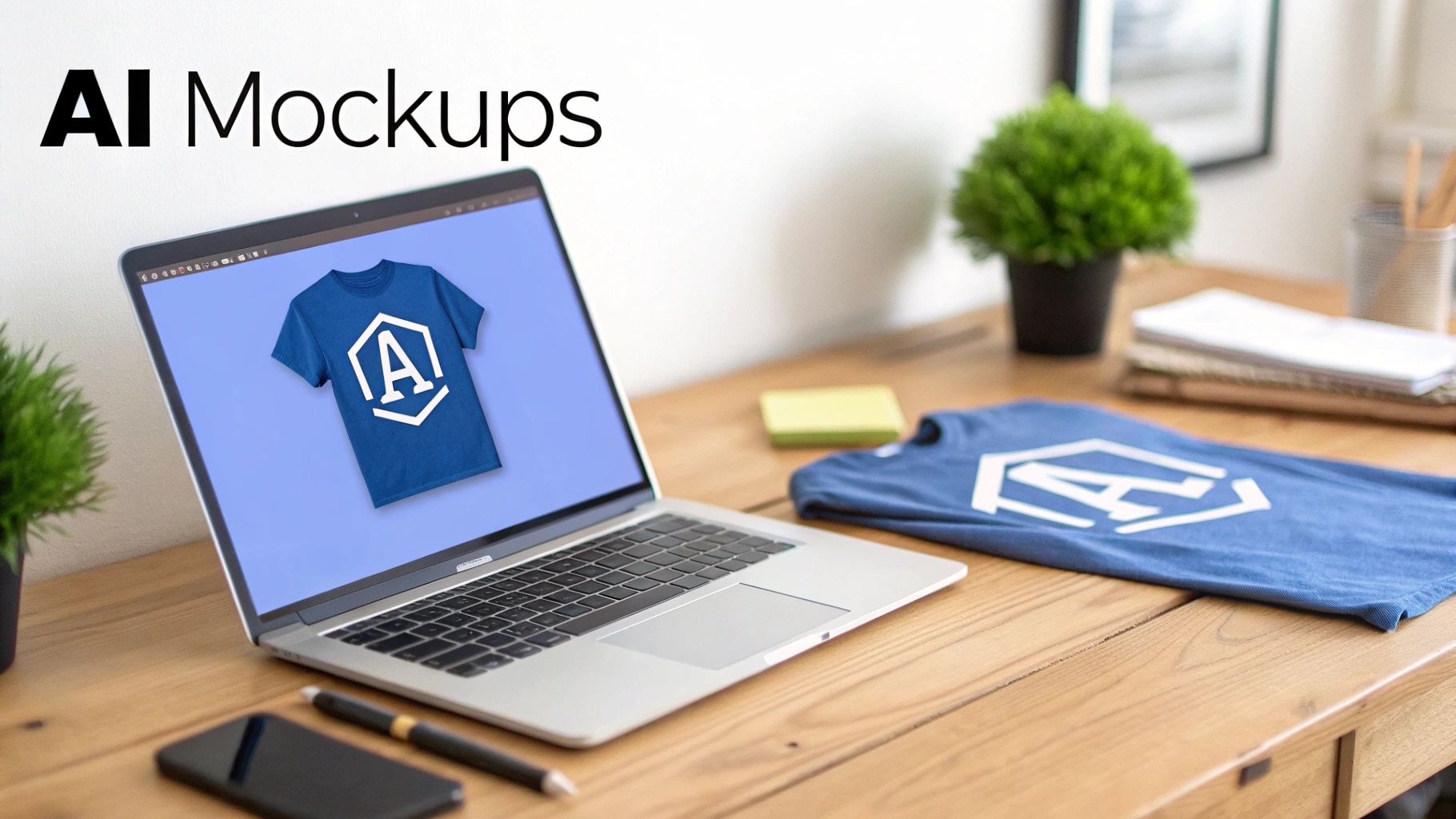
Instead of manually creating designs or paying for stock images, AI tools can generate unique graphics based on simple text prompts. More importantly, they can create hyper-realistic mockups and lifestyle photoshoots, showcasing your apparel on models in various settings. This allows you to produce an entire catalog of high-converting product images without ever touching a camera, dramatically reducing costs and accelerating your speed to market. This approach lets you test dozens of ideas quickly to find winning products.
Quick Start and Validation
To get started, you can go from a simple idea to a fully mocked-up product line ready for testing in just a few steps. The key is rapid iteration and using data to guide your decisions.
Generate Designs Instantly: Use an all-in-one AI tool like AvatarIQ to turn your niche ideas into dozens of design variations. Simply describe what you want, and the AI will handle the creative work, giving you plenty of options to choose from.
Create Realistic Mockups: Once you have a few strong designs, use the same platform to generate professional mockups. Place your designs on models, in flat lays, or in lifestyle scenes that will resonate with your target audience.
Test and Scale: Launch small ad campaigns on social media using your best AI-generated mockups. Drive traffic to your store and monitor which designs get the most clicks and sales. Double down on the winners and discard the rest.
Key Insight: AI is the ultimate unfair advantage for new print on demand entrepreneurs. It levels the playing field, enabling you to compete with established brands by producing high-quality visuals at a fraction of the cost and time. This frees you to focus on marketing and scaling your business.
3. Facebook and Meta Advertising-Optimized Apparel Campaigns
Instead of waiting for organic traffic, one of the most scalable print on demand business ideas is to build a brand powered by strategic paid advertising on platforms like Facebook and Meta. This approach involves systematically testing designs with small, targeted ad spends, identifying "winner" products that resonate with cold audiences, and then scaling the budget to generate predictable, profitable sales. It transforms your store from a passive project into a proactive customer acquisition machine.
This method, championed by experts who manage six-figure monthly ad spends, is how countless Skup students scale from zero to over $10k per month. By leveraging Meta's powerful targeting tools, you can place your niche apparel designs directly in front of the most likely buyers, whether they're passionate dog lovers or professionals in a specific field. This directness allows for rapid market feedback and the ability to build momentum far faster than relying on organic growth alone.
Quick Start and Validation
To get started, you need a disciplined testing methodology and a focus on data. The goal is to spend small to learn big, then invest heavily in what's proven to work.
Systematic Testing: Begin by launching several ad sets at a low daily budget, such as $5-$10 each. Test multiple creative variations (different designs, ad copy, and video versus static images) to see what captures attention and drives clicks.
Pixel-Perfect Tracking: Ensure the Meta Pixel is correctly installed on your store and landing pages from day one. This data is critical for tracking conversions, optimizing your campaigns, and eventually building powerful lookalike and retargeting audiences.
Scale Winners Gradually: Once an ad set proves profitable, don't double the budget overnight. Scale gradually by increasing the daily spend by 20-30% every few days to maintain campaign stability and efficiency.
Key Insight: Paid advertising turns your business into a controllable system where you can directly influence your growth. By mastering the relationship between ad spend and revenue, you can build a highly scalable and profitable apparel brand. A crucial part of this is understanding your metrics; learn more about calculating your return on ad spend to ensure every dollar is working for you.
4. Apparel Cloning: Replicating Winning Products with Unique Designs
Instead of reinventing the wheel, one of the most effective print on demand business ideas is to identify what's already working and create a better, unique version. This method, known as apparel cloning, involves analyzing successful products in a given niche and using those insights as a blueprint to launch your own differentiated designs. It removes the guesswork and provides a clear, data-backed path to profitability by starting with proven market demand.
This strategy isn't about copying; it's about competitive analysis and strategic improvement. For example, if you see a simple text-based t-shirt for nurses selling well, you can create a more visually engaging design with unique graphics and a clever slogan for the same audience. The core of this model is taught in our Apparel Cloning System, which has helped countless entrepreneurs build brands that generate thousands per month by ethically replicating and improving upon successful concepts.
Quick Start and Validation
Getting started with apparel cloning requires research and a focus on differentiation. Your goal is to serve the same passionate audience with a product that feels fresh and new.
Competitive Analysis: Identify 10-20 successful print on demand stores or products in a niche you're interested in. Analyze their best-sellers to understand the core messaging, color palettes, and design elements that resonate with their customers.
Design Differentiation: Use a tool like AvatarIQ to rapidly generate unique design variations based on your research. Experiment with different fonts, graphics, and layouts to create a product that stands out while still appealing to the target audience's proven interests.
Strategic Launch: Price your products competitively based on your analysis, and test your new designs with small, targeted ad campaigns. This allows you to validate your approach with minimal risk before scaling up your marketing efforts.
Key Insight: Success in apparel cloning comes from understanding why a competitor's product is winning and then creating your own superior version. Focus on building a distinct brand identity, higher quality designs, and a stronger connection with the community. Learn more about this powerful business model with the official Apparel Cloning System.
5. Email Marketing and Customer Retention for Repeat Sales
One of the most sustainable print on demand business ideas focuses not on finding new customers, but on maximizing the value of the ones you already have. This strategy involves building an email list and using targeted campaigns to convert one-time buyers into loyal, repeat customers. It’s about creating a predictable revenue stream that doesn't rely solely on expensive paid advertising.
Instead of constantly paying to acquire new traffic, you build a direct line of communication with an audience that has already proven its interest in your brand. Successful POD entrepreneurs often see repeat purchase rates of 20-40% by using email to announce new designs, promote seasonal collections, and run exclusive flash sales. This approach transforms your store from a simple transaction hub into a thriving community brand with a dedicated following.
Quick Start and Validation
From the very first day you launch your store, your primary goal should be to capture visitor emails. This asset is more valuable than social media followers because you own and control it completely.
Build Your List: Offer a compelling reason for visitors to subscribe, such as a 15% discount on their first order, a free design guide, or exclusive access to new drops. Make the signup form prominent on your website.
Automate Your Welcome: Set up an automated welcome email sequence for new subscribers. This could include a welcome message, your brand story, a reminder of their discount code, and a showcase of your bestselling designs.
Segment and Target: As your list grows, segment subscribers based on their purchase history. If someone bought a cat-themed shirt, they should receive emails about your new feline designs, not your dog collection. This personalization dramatically increases engagement and sales.
Key Insight: Acquiring a new customer can cost five times more than retaining an existing one. By focusing on email marketing, you lower your overall marketing spend and build a more profitable, resilient business. To complement your email campaigns, you can also explore effective retargeting advertising strategies to re-engage website visitors who didn't make a purchase. For a deeper dive into building lasting customer relationships, check out these powerful eCommerce customer retention strategies.
6. Multi-Product Line Expansion: Beyond T-Shirts
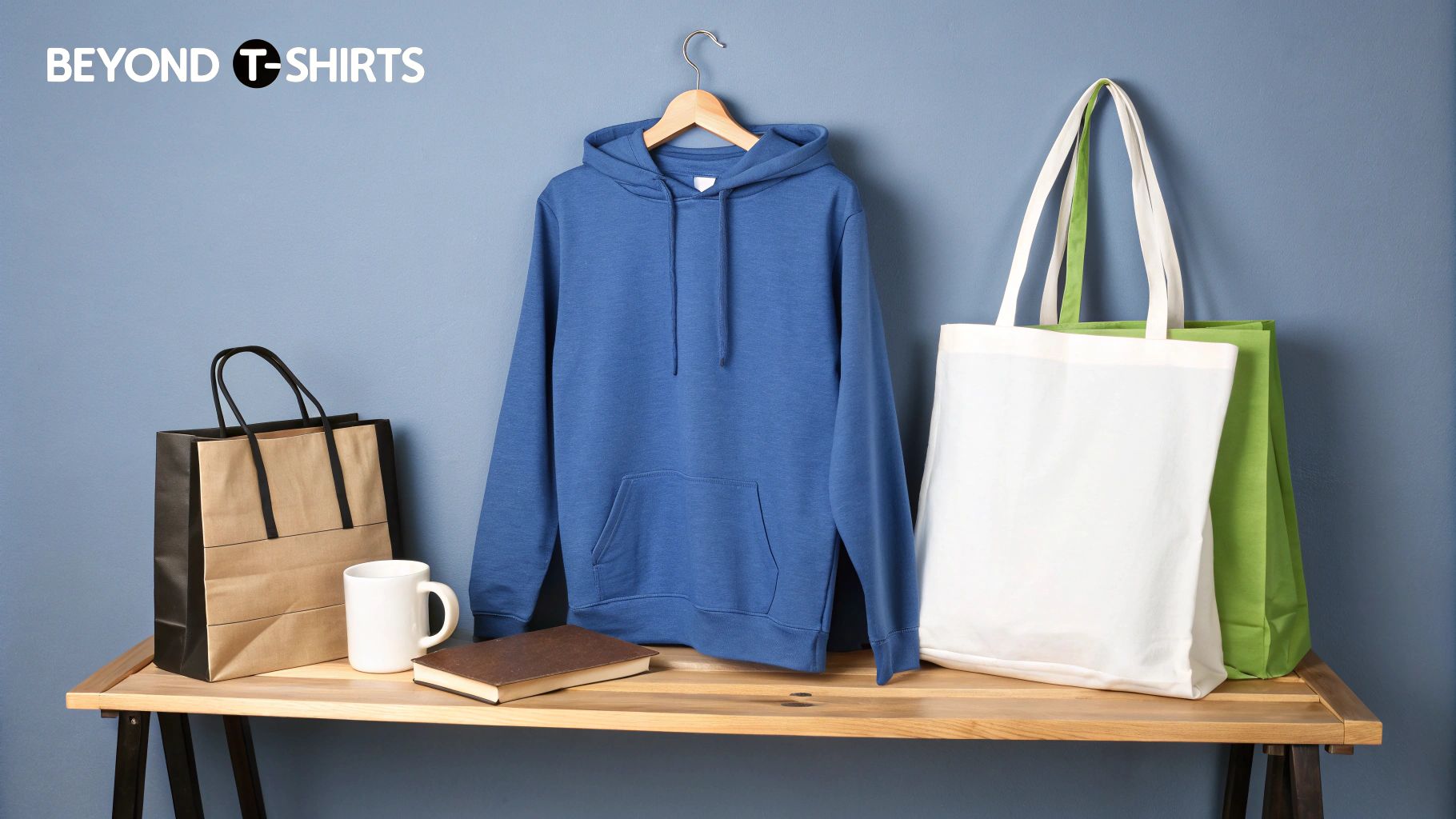
Once you've found a winning niche and a few popular designs, one of the most effective print on demand business ideas is to scale by expanding your product catalog. Instead of only selling t-shirts, you can leverage your existing audience and marketing efforts by offering the same beloved designs on a wider range of items. This strategy dramatically increases your average order value (AOV) and the lifetime value of each customer.
A customer who loves your design for a "Dog Mom" t-shirt is a prime candidate to also purchase a matching hoodie, tote bag, or coffee mug. By offering these complementary products, you turn a single sale into a multi-item purchase, maximizing your revenue from the same marketing spend. This approach transforms your store from a simple t-shirt shop into a comprehensive brand destination for your niche, building deeper loyalty and encouraging repeat business.
Quick Start and Validation
Expanding your product line is a low-risk way to grow, as you're building on proven success. The key is to introduce new products strategically to your warm audience first.
Product Prototyping: Use an AI tool like AvatarIQ to instantly generate high-quality mockups of your best-selling designs on new products like hoodies, hats, or mugs. This allows you to visualize and test your expanded product line without any upfront cost or inventory.
Audience Polling: Before adding a product to your store, share the mockups with your existing email list or social media followers. Ask them directly which items they would be most excited to buy, letting your customers guide your expansion.
Create Product Bundles: Encourage larger purchases by offering a small discount for buying multiple items. For example, create a "Nurse's Off-Duty Kit" bundle that includes a t-shirt, a hoodie, and a tote bag, which is a powerful tactic for increasing your AOV.
Key Insight: Your most popular designs are valuable assets that can be leveraged across multiple product types. Expanding your catalog isn't about finding new ideas; it's about giving your loyal customers more ways to buy the designs they already love from you.
7. Seasonal and Event-Based Apparel Launches
A highly effective print on demand business idea is to capitalize on the predictable, recurring waves of consumer spending tied to seasons, holidays, and cultural events. This strategy involves creating time-sensitive apparel collections that align with specific moments throughout the year, from major holidays like Christmas and Halloween to seasonal shifts like summer vacation or back-to-school.
Instead of selling a generic design year-round, this model focuses on relevance and urgency. For example, a brand could launch a collection of "Ugly Christmas Sweaters" in November, spooky-themed hoodies in September, or witty teacher appreciation shirts in August. Because these products have a built-in purchase deadline, you can leverage marketing tactics like "limited edition" drops and countdown timers to create powerful buying triggers. This approach taps into existing excitement and purchasing intent, making it easier to capture sales during peak shopping periods.
Quick Start and Validation
Success with this model hinges on planning and timing. You must work several months ahead of any given holiday or event to allow for design, testing, and marketing campaign setup.
Design Prototyping: Three to four months before a target holiday, use an AI-powered tool like AvatarIQ to generate a wide array of design concepts. For Halloween, you could create variations of ghost, pumpkin, and witty witch-themed designs to see what visual styles might perform best.
Community Testing: Start running simple ad campaigns with your mockups 4-6 weeks before the peak season begins. Test your designs with small audiences on platforms like Facebook or Instagram to identify the winning concepts based on engagement and click-through rates.
Build Your Audience: Create an email list specifically for seasonal announcements. Run a giveaway or offer a future discount to entice sign-ups, then use this list to launch your collection to a warm audience, generating initial sales and momentum.
Key Insight: The seasonal market is driven by tradition and emotion. Your goal is to create designs that become part of a customer's annual celebration, whether it's a funny Thanksgiving shirt the family looks forward to or a "First Day of School" design for a proud parent. This builds anticipation and repeat business year after year.
8. Brand Building and Community Engagement for Long-Term Success
One of the most sustainable and powerful print on demand business ideas is to move beyond simply selling products and focus on building a genuine brand with an engaged community. This strategy involves creating a distinct voice, consistent messaging, and fostering real interactions to build a loyal following that buys from you not just for the designs, but for what your brand represents.
Instead of relying solely on paid ads, a community-focused brand generates organic growth through word-of-mouth and user-generated content. When customers feel like part of a tribe, they become your most passionate advocates. This approach cultivates immense trust, allowing for premium pricing and reducing marketing costs over time. Brands with highly engaged six-figure followings didn't get there by accident; they built a movement around a shared identity, whether for a dog breed, a profession, or a lifestyle.
Quick Start and Validation
To begin, define what your brand stands for beyond just the products. What are your core values? What is the mission? This clarity will guide every decision you make.
Define Your Identity: Establish your brand's personality. Are you humorous, inspirational, edgy, or supportive? Create a simple brand guide with your logo, color palette, and font choices to ensure everything you post is consistent and recognizable.
Encourage Participation: Launch your brand with a call for user-generated content. Run a contest asking customers to share photos wearing your apparel with a specific hashtag. This not only gives you authentic social proof but also makes your first customers feel like founding members of the community.
Start the Conversation: From day one, actively engage with your followers. Respond to every comment and DM, ask questions in your posts, and share customer stories. The goal is to make your social media feed a two-way conversation, not just a product catalog.
Key Insight: A strong brand transforms customers into a community, and a community creates a defensive moat around your business that competitors can't easily replicate. You're not just selling apparel; you're offering a sense of belonging. This foundation is essential for scaling to seven figures and beyond.
9. Conversion Rate Optimization: Maximizing Revenue from Existing Traffic
Instead of focusing solely on getting new customers, one of the most impactful print on demand business ideas is to maximize the revenue you get from the visitors you already have. This is Conversion Rate Optimization (CRO), the process of systematically improving your website to turn more browsers into buyers. Even small, data-driven tweaks can lead to significant increases in profit without needing to spend more on advertising.
The core principle is to remove friction and build trust at every step of the customer journey. For example, simplifying your checkout from five steps down to two can dramatically reduce cart abandonment. Similarly, adding high-quality customer reviews and a clear money-back guarantee can give hesitant shoppers the confidence they need to complete a purchase. By improving elements like product photography, page copy, and pricing strategy, you make your store more effective at converting traffic into sales.
Quick Start and Validation
Begin by establishing your baseline metrics, like your current conversion rate, before making any changes. This allows you to accurately measure the impact of your tests.
Improve Product Mockups: Your product images are your most powerful sales tool. Use a tool like AvatarIQ to generate hyper-realistic, high-quality mockups that make your designs look like premium retail products, which can instantly lift your conversion rate.
Test One Variable: Start by testing a single, high-impact element. For instance, rewrite your product descriptions to focus on the benefits and feelings associated with the design, not just its features. Run this test for a week and compare the results to your baseline.
Simplify the Checkout: Go through your own checkout process. Identify and remove any unnecessary fields or steps. The goal is to make it as fast and effortless as possible for someone to give you their money.
Key Insight: Optimizing your store isn't a one-time task; it's an ongoing process of improvement. A 1% increase in your conversion rate might seem small, but it compounds over time, adding directly to your bottom line and making your advertising efforts significantly more profitable.
10. Influencer Partnerships, Affiliate Programs, and Content Authority
Instead of relying solely on paid ads, one of the most scalable print on demand business ideas is to build a distribution engine through partnerships and content. This approach involves collaborating with micro-influencers and affiliates who have the trust of your target niche, while simultaneously creating valuable content that attracts organic traffic and establishes your brand as an authority. This creates a powerful, long-term growth flywheel that builds genuine brand equity.
For example, a print on demand store selling apparel for yoga enthusiasts could partner with micro-influencers in the wellness space, offering them a commission on sales. At the same time, the brand could publish blog posts or video guides on topics like "The Best Poses for Beginners" or "Choosing the Right Yoga Mat," embedding their product links naturally within the content. This dual strategy drives both immediate sales and sustainable, long-term traffic.
Quick Start and Validation
To begin, focus on building relationships with creators who have an authentic connection with their audience, even if their following is small. Genuine engagement is far more valuable than a large, passive follower count.
Identify Partners: Search Instagram, TikTok, and YouTube for micro-influencers (10k-50k followers) in your niche. Look for creators with high engagement rates (likes and comments) and an audience that aligns perfectly with your ideal customer.
Structure Your Offer: Reach out with a clear proposal. Offer free products for them to showcase and a competitive affiliate commission (15-30% is standard) on any sales driven through their unique discount code or link.
Content Strategy: Brainstorm 5-10 content ideas that solve a problem or answer a question for your audience. For a brand targeting nurses, this could be "5 Tips for Surviving a 12-Hour Shift." Create a simple blog post or video, optimize it for relevant keywords, and share it across your social channels.
Key Insight: The goal is to create a marketing ecosystem where influencers drive targeted traffic and your content captures and nurtures that audience. This combination reduces your reliance on paid advertising and builds a more resilient business. To amplify your brand's reach and drive sales effectively, especially when building content authority, dive into strategies for running influencer marketing campaigns that convert.
10-Point Comparison: Print-on-Demand Business Ideas
Strategy
Implementation Complexity 🔄
Resource Requirements ⚡
Expected Outcomes 📊
Ideal Use Cases 💡
Key Advantages ⭐
Niche-Focused T-Shirt and Apparel Collections
Medium — needs niche research & consistent design
Low–Medium — POD model; ~$500–$2k startup, ads/tools
Loyal niche customers; high margins; sustainable growth
You've just walked through ten powerful and proven print on demand business ideas, each one a potential blueprint for your own success story. From mastering niche-focused apparel and leveraging AI-powered design to cloning winning products and building a loyal community, the path to a thriving eCommerce brand has never been clearer. The excitement you feel is the starting line, not the finish line. The potential to escape the 9-to-5 grind, provide for your family, and build something you truly own is not a distant dream; it's an achievable reality.
The core takeaway is that success in this industry isn't about luck. It's about having a strategic plan and the right tools to execute it. You've seen how focusing on a specific audience, creating designs that resonate, and marketing with precision can transform a simple idea into a profitable venture. The journey from beginner to seasoned entrepreneur is paved with focused action, not just passive learning.
From Idea to Income: Your Actionable Next Steps
The difference between those who succeed and those who just dream is execution. You now have the knowledge, but turning that knowledge into profit requires a clear, step-by-step process. Forget the guesswork and overwhelming "what ifs." It's time to channel your motivation into a system built for results.
Here’s your immediate action plan:
Revisit Your Favorite Idea: Go back through the list and select the one business idea that sparked the most excitement for you. Is it cloning a winning product? Is it building a brand around a passionate niche? Lock in your focus.
Commit to One Proven System: Instead of trying to piece together conflicting advice from dozens of sources, commit to a single, proven methodology. This is where our Apparel Cloning System becomes your playbook, guiding you through finding profitable products and scaling them effectively.
Eliminate the Design Barrier: The single biggest hurdle for most new sellers is creating high-quality, professional designs that sell. This is where AvatarIQ, our proprietary software, gives you an immediate and powerful advantage. You can generate stunning, conversion-optimized designs and mockups in minutes, even with zero prior experience. This allows you to test ideas faster and launch campaigns with confidence.
The Real Opportunity: Building Your Future
Mastering these print on demand concepts is about so much more than just selling t-shirts. It's about building a sustainable asset that generates income, giving you the freedom to control your time and your financial future. Each successful product launch and every happy customer email builds momentum, proving that you have what it takes to create the lifestyle you desire.
You have the ambition. You have the guide. The only thing missing is your first step. The ideas in this article are your map, but it's time to start the engine and begin the journey. Stop waiting for the "perfect" moment and start building something amazing today. You have everything you need to succeed.
Ready to turn these ideas into a real, profitable business? The Skup platform, including our Apparel Cloning System and AvatarIQ design software, was built specifically to help beginners launch and scale their print on demand stores. Stop guessing and start building with a proven system by visiting Skup to see how we can help you achieve your first $10k month.
Imagine launching a full-blown apparel brand without ever touching a single t-shirt or hoodie. That’s the magic of print on demand, and if you’ve been waiting for the right moment to jump in, this is it. This is your complete roadmap to getting your first sale and building a real, high-margin brand from the ground…
Quick Answer Matt Schmitt is the co-founder of Skup, a print-on-demand ecommerce training company. With over $30 million in personal ecommerce sales and a decade of experience building and scaling POD stores, Matt oversees Skup’s coaching program and teaches the systems that helped him exit multiple 7-figure businesses. His students have collectively generated tens of…
Ready to turn your creativity into cash? The fastest way to make money selling t-shirts is to find designs that are already crushing it, create even better versions with your own unique spin, and sell them to passionate audiences. The exciting world of print-on-demand allows you to start with virtually zero risk and build a…