Home » Blog » Understanding Print on Demand Profit Margins
Welcome to the starting line of your e-commerce journey! Let's talk about the single most important number separating a fun side project from a life-changing business: your print on demand profit margin.
A healthy margin isn't some mythical number only the pros can hit. A solid 30-50% is not just possible—it's the achievable standard that fuels real, sustainable growth. This is where you get the cash flow to build a real brand and create the future you've always imagined.
Why Profit Margin Is Your Most Important Number
Think of your print-on-demand (POD) business like a high-performance car. Your killer designs and slick marketing are the engine, for sure. But your profit margin? That’s the fuel. Without enough fuel, even the most powerful engine is just a hunk of metal going nowhere.
This one number dictates everything you can do.
With a strong profit margin, you suddenly have the power to:
Invest in Growth: This is your ad budget. It's the cash you need to test new products, experiment with different designs, and get your brand in front of way more people.
Weather Market Changes: Slow sales months happen. Ad costs creep up. Healthy margins create a financial cushion that lets you ride out the bumps with confidence, not panic.
Scale with Confidence: When you know your numbers inside and out, you can confidently turn up the volume. This is how you go from a side hustle to a full-time brand that can actually change your life.
This isn't about getting lost in complicated spreadsheets or boring financial theory. It’s about one simple, powerful concept that every single 8-figure POD brand has mastered. Understanding your margins is the first—and most critical—step to building a real, sellable asset that gives you true freedom.
The Massive Opportunity in Print on Demand
Here's the best part: you're jumping in at the perfect time. The excitement around POD isn't just hype; it's backed by some seriously explosive market growth.
The global POD market is projected to skyrocket from USD 10.78 billion in 2025 to a staggering USD 57.49 billion by 2033. That’s a compound annual growth rate (CAGR) of 23.6%, which points to an insane and sustained demand for custom products. If you're curious, you can dig into more of these exciting POD industry trends on onprintshop.com.
This incredible growth trajectory presents a compelling opportunity for new entrepreneurs. It means more customers are actively looking for the unique products you can create, creating a clear path for building a profitable brand.
What this means for you is simple: the opportunity is massive and the demand is proven. By zeroing in on your print on demand profit margins from day one, you position yourself to grab a piece of this rapidly growing pie. You have the ability to build a business that not only generates income but gives you true freedom.
Let's get started.
Calculating Your Actual Profit Margin
Alright, let's pull back the curtain on "profit margin." It sounds like something you'd hear in a stuffy boardroom, but for a print-on-demand seller, it’s the single most important number you need to know.
Think of it this way: you sell a t-shirt for $30. After your supplier prints it and ships it, you're left with $13 in your pocket. Your profit margin is simply that $13 shown as a percentage of the original $30 sale price.
This one number tells you the health of your business at a glance. It's that simple, and that powerful.
The Simple Profit Margin Formula
You don't need a finance degree or a complicated spreadsheet. All it takes to get a crystal-clear picture of your business's profitability is this one little formula.
Profit Margin (%) = [(Retail Price – Total Costs) / Retail Price] x 100
This formula shows you exactly what percentage of every dollar you bring in is pure profit. A bigger percentage means more cash to reinvest, more freedom to experiment with new designs, and a faster path to building a real, sustainable business.
Let’s plug in some real numbers and see how it works.
A T-Shirt Profit Margin Example
Let's walk through calculating the margin for a classic print-on-demand t-shirt. Breaking it down step-by-step makes it easy to see exactly where your money is going and how much you're keeping.
Here’s a simple table to visualize the process:
Item
Example Cost or Price
Calculation Step
Retail Price
$30.00
This is the price you charge your customer.
Product & Printing Cost
$12.00
The base cost from your POD supplier.
Shipping Cost
$4.50
The cost to ship the item to the customer.
Total Costs
$16.50
Product Cost + Shipping Cost.
Gross Profit
$13.50
Retail Price – Total Costs ($30.00 – $16.50).
Profit Margin
45%
(Gross Profit / Retail Price) x 100.
With a 45% profit margin, you've built a healthy buffer into your pricing. That's a fantastic result! This kind of margin gives you the cash flow to run ads, try out new design ideas, and scale your brand without feeling squeezed. For a more detailed breakdown, a good Shopify profit margin calculator can help you factor in every last expense.
Aiming For The Sweet Spot
So, what should you be aiming for? While there's no single magic number, most successful print-on-demand stores operate with profit margins somewhere between 20% and 50%.
If you can land in that 30–50% range, you're in a great position. It gives you enough breathing room to cover marketing costs and still have enough left over to pay yourself and grow the business. It’s the sweet spot that separates a side hustle from a serious eCommerce brand. To learn more about setting the right prices to hit these numbers, check out our guide on how to price print on demand products.
Uncovering the Hidden Costs in Your POD Business
If you only know your base product and shipping costs, you’re missing a huge piece of the puzzle. The real pros—the ones who are building incredible businesses in this space—know that’s only half the story. A handful of small expenses can quietly impact your print on demand profit margins, turning a great sale into a break-even one.
These "profit shrinkers" are the variables that separate the pros from the beginners. Once you shine a light on them, you can set your prices with total confidence, knowing your bottom line is protected from day one.
Beyond the T-Shirt and the Mailer
Every single successful POD store owner I know accounts for way more than the basics. There are several fees baked into the very act of selling online, and they will add up faster than you think if you’re not watching them like a hawk.
Here are the most common costs you absolutely have to factor into your pricing:
Platform Fees: This is the monthly subscription for your digital real estate, like your Shopify plan. It’s a fixed cost that your sales volume and margins need to cover every month, no exceptions.
Transaction Fees: Payment processors like Stripe or PayPal take a slice of every single sale. A common rate is 2.9% + $0.30 for every transaction. It might sound small, but over hundreds or thousands of sales, it’s a significant chunk of change.
App Subscriptions: Let's be real, most stores run on apps—for email marketing, reviews, upsells, you name it. Those monthly subscriptions are part of your operating costs and need to be baked into your financial planning.
Being aware of these costs is a huge advantage. You can get a better handle on how to factor all of this into your numbers by using a good eCommerce profit calculator.
You Need to Reframe Your Advertising Spend
It's tempting to view your ad budget as just another expense. But that's not how successful brand owners see it. Advertising isn't just a cost; it's the single most important investment you can make in your business's growth.
Think of it this way: your ad spend is the engine that actually brings people through your digital doors. Without it, even the most incredible designs are just hidden gems.
When you set aside a part of your profit margin for advertising, you aren't losing money. You're strategically reinvesting it to get new customers, drive more sales, and build a brand that can scale into a real, long-term asset.
Once you account for every single expense—from the blank t-shirt to the final ad click that got the sale—you gain total control over your profitability. This clarity gives you the power to set smart prices, ensuring every order pushes you closer to your goals and helps build the eCommerce future you're working so hard for.
Seven Ways to Seriously Boost Your Profit Margins
Knowing your costs is half the battle. Now, it's time to go on offense.
Taking control of your print on demand profit margins isn’t about some complex financial wizardry. It’s about making a series of smart, deliberate moves that stack up in a big way over time.
Think of this as your playbook. These seven strategies are the exact levers we pull in our own 8-figure businesses to protect profitability and fuel growth. Each one is a practical step you can take right now to build a stronger, more resilient eCommerce brand.
1. Master Value-Based Pricing
Cost-plus pricing—where you just tack a percentage onto your cost—is a starting point, not a real strategy. The real money is in value-based pricing, where you price your products based on what your customers believe they're worth.
If you’ve nailed a killer design for a super-passionate niche, its perceived value is way higher than the cost of a blank t-shirt and some ink. Price with confidence! A higher price tag not only fattens your margin on every single sale but also positions your brand as a premium choice, which naturally attracts more serious buyers.
2. Get Strategic With Your Product Catalog
Let's be real: not all products are created equal. Some just have healthier margins built-in. While a standard t-shirt is a fantastic workhorse for any store, branching out can unlock some serious profitability.
Look at adding products with better built-in margins:
Accessories: Things like hats, mugs, and tote bags often have lower base costs but a high perceived value. That gap is pure profit for you.
Premium Blanks: Offer a higher-quality, softer tee or a beefy, heavyweight hoodie for a higher price. You'd be surprised how many people will pay more for better quality, significantly boosting your profit per item.
Niche-Specific Gear: Think beyond clothes. If you're crushing it in the pet niche, a custom dog bandana could have a much better margin than yet another t-shirt design.
3. Pump Up Your Average Order Value (AOV)
One of the quickest ways to improve overall profitability is to get each customer to spend a little more every time they check out. The beauty of this is you don't need to find new customers; you just have to offer more value to the ones you already have.
You can start boosting your AOV today with these simple tactics:
Product Bundles: Create a simple package of 2-3 related items for a slight discount. Think about bundling a t-shirt, a hat, and a sticker with the same awesome design.
Tiered Discounts & Shipping Thresholds: Use incentives like "Buy 2, Get 10% Off" or, the fan-favorite, "Free Shipping on Orders Over $75." These little nudges encourage shoppers to add just one more thing to their cart.
Increasing your average order value is pure profit acceleration. You've already paid to get that customer to your store, so every extra dollar they spend goes almost entirely to your bottom line.
4. Bundle and Upsell Like a Pro
To take things a step further, post-purchase upsells are an absolute game-changer. Right after a customer clicks "buy," you offer them a special, one-time deal on a related product. This is the perfect moment—they've already trusted you with their credit card and are feeling good about their purchase.
Imagine a simple upsell flow: a customer buys a t-shirt, and on the confirmation page, you immediately offer them a matching hoodie at a 20% discount. Since there are no extra shipping or marketing costs, the margin on that second item is massive.
5. Kill Your Design and Mockup Costs
Paying for designers or using expensive software can bleed your profits dry before you even make a sale. For new sellers, this is one of the biggest hidden cash drains. Every dollar you spend on design comes directly out of your potential profit.
This is the exact problem we built AvatarIQ to solve. It lets you generate unlimited, incredible designs and hyper-realistic mockups in seconds. When you bring this process in-house with a powerful AI tool, you can test more ideas, find winners faster, and keep 100% of your creative budget.
6. Double Down on Your Niche
Broad, generic designs force you to compete on price, which is always a race to the bottom. Don't play that game. Instead, go deep into a specific, passionate niche.
When you create designs that truly connect with a dedicated community—whether it's bass fishing fanatics, urban gardeners, or classic car junkies—your products become "must-have" items. People in passionate niches are way less sensitive to price and will happily pay more for designs that speak to their identity. This gives you the power to command higher prices and, you guessed it, higher margins.
7. Get Your Ad Strategy Dialed In
Your advertising isn't just an expense; it's an investment that needs to deliver a clear return. You have to constantly monitor your ad performance and optimize for a lower Cost Per Acquisition (CPA).
Even a tiny improvement in your ad efficiency translates directly to a healthier bottom line. The less you have to spend to get a customer in the door, the more profit you keep from each sale. This is how you scale a business sustainably, turning ad spend into predictable, profitable growth.
Profit Margin Booster Checklist
To help you put all this into practice, we've put together a quick checklist. Use this to identify the low-hanging fruit in your own business and start making changes today.
Strategy
Primary Impact Area
Difficulty to Implement
Value-Based Pricing
Revenue per Sale
Medium
Strategic Product Selection
Cost of Goods Sold (COGS)
Low
Increase Average Order Value
Revenue per Customer
Low
Bundle & Upsell
Revenue per Customer
Medium
Eliminate Design Costs
Operating Expenses
Low (with the right tool)
Focus on Your Niche
Revenue per Sale
Medium
Refine Ad Strategy
Customer Acquisition Cost
High
Each of these strategies is a lever you can pull. Start with the ones that feel easiest to implement and work your way up. Small, consistent improvements are what build a truly profitable print-on-demand empire.
How to Design Smarter, Not Harder, with AI
Let's be honest: one of the biggest hurdles for anyone getting into print-on-demand is the constant need for fresh, high-quality designs. This is where most new sellers get stuck. You either sink countless hours into creating them yourself or spend money on a designer, both of which eat directly into your precious print-on-demand profit margins.
Every dollar you spend on a design is one less dollar in your pocket. It's a classic bottleneck that slows you down.
This is the exact problem we built AvatarIQ to solve. It's an AI tool designed to help you generate stunning, sellable apparel designs and ridiculously realistic mockups in just a few seconds.
Think of it like having an entire design team on call, ready to bring your ideas to life the moment you have them. This is what working smarter, not harder, really looks like.
Say Goodbye to the Design Bottleneck
The old way of getting designs made is slow and expensive. You can spend a whole weekend trying to create something yourself, or you can hire a freelancer and hope they get your vision. Both paths slow you down and limit your ability to find winning products.
And in the print-on-demand game, testing new ideas is everything.
When you remove that bottleneck, you suddenly unlock incredible speed and agility. Instead of struggling to launch one or two designs a week, you can launch ten. This explosion in output lets you get sales data back way faster, figure out what your customers really want, and go all-in on the winners without a massive upfront investment.
By automating the creative part, your job shifts from making designs to strategizing which designs will sell. That's how you build a scalable, high-margin business today.
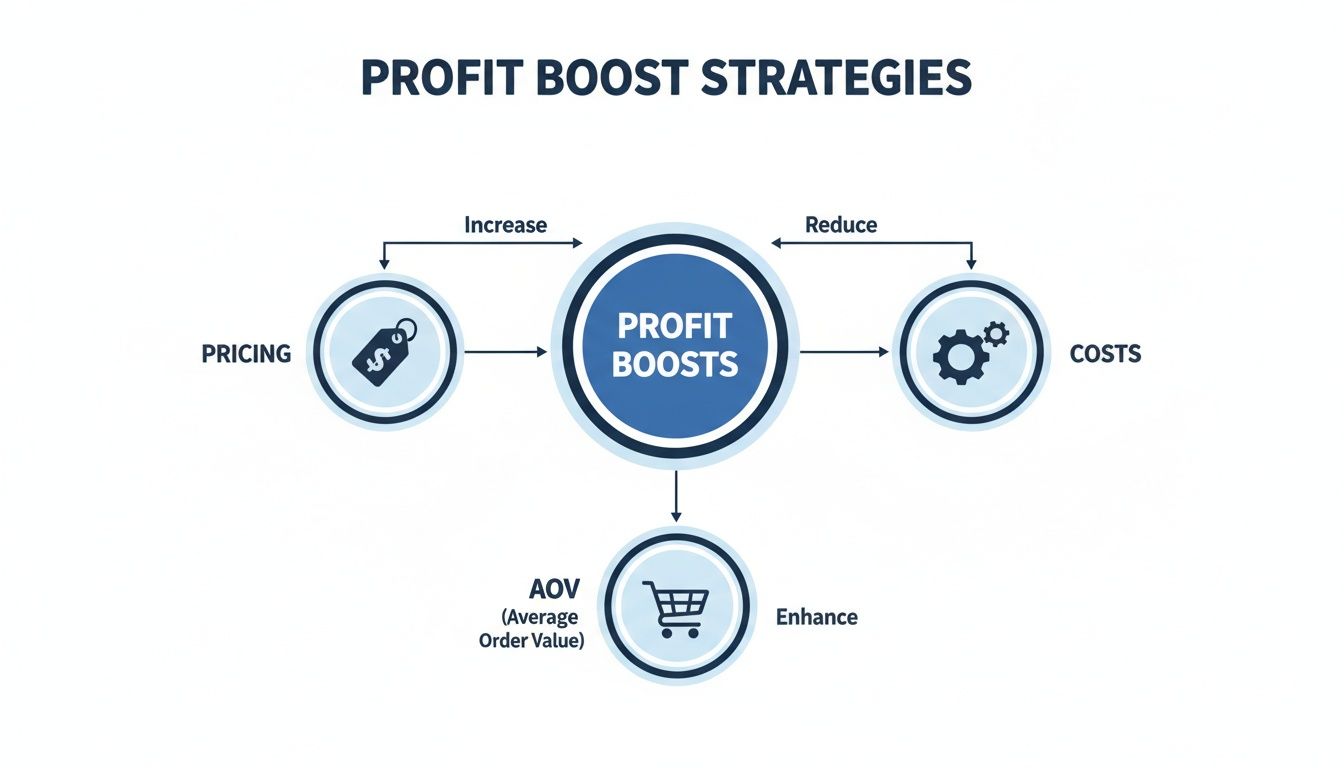
This diagram breaks down the three core pillars of a profitable operation. You'll notice that efficient design and marketing supercharge every single one of them.
As you can see, boosting your bottom line comes down to cutting costs, smart pricing, and increasing your average order value—and a faster design workflow gives you a massive edge in all three areas.
Build a Profitable Brand Faster
Using a tool like AvatarIQ isn't just about saving a few bucks on freelancers. It completely changes how you can build and scale your brand. You can jump into more niches, test out crazier creative angles, and react to a trending topic almost instantly.
Drastically Reduce Creative Costs: When you can generate unlimited designs yourself, you wipe out freelancer fees and software subscriptions. That directly boosts your profit margin on every single thing you sell.
Test and Validate Ideas Instantly: Have a wild idea for a new niche at 2 AM? You can generate ten different design concepts and create professional mockups in minutes, not days.
Scale Winners with Confidence: Once a design starts selling like crazy, you can easily create dozens of variations and expand that single winner into an entire product line.
By bringing design creation in-house with AI, you're taking direct control over a huge expense. This protects your margins and frees up cash to reinvest in what actually grows your business—marketing and ads. For a deeper dive into creative strategies, check out our guide on how to design for print on demand.
And design is just the beginning. AI is set to change almost every part of e-commerce. To learn more about where this is all headed, you might want to explore resources on how to implement AI in e-commerce brands. It’s an exciting time, and this tech can help you build the business you've been dreaming of.
Your Blueprint for a Profitable POD Future
You've made it through the nuts and bolts. Now you have the knowledge and the real-world strategies to build a print-on-demand business that actually turns a profit. The path forward from here isn't about magic formulas; it's about creating real value for an audience you care about, pricing your products with confidence, and watching your costs like a hawk to protect that hard-earned money.
The opportunity in eCommerce is massive, and you’re in the perfect spot to grab a piece of it. This is your chance to stop wondering "what if" and start building. With tools like AvatarIQ, you can ditch the design bottlenecks that kill momentum and get incredible products to market faster than you thought possible. That kind of efficiency goes straight to your bottom line, boosting your print on demand profit margins from day one.
Embrace the Excitement of Building
Don't let the fear of not having it all figured out paralyze you. The journey to a profitable business doesn't start with a perfect plan—it starts with the first design you launch and the first sale you make. Every step is a win, a lesson, and another brick in the foundation of the future you're building for yourself.
The secret isn't some hidden tactic. It's just consistent, focused action. Think of this guide as your roadmap—now it’s time to put the key in the ignition and start driving.
This is your shot to build something you truly own, something that can support your family and finally give you control over your time.
Your Next Steps to Success
If you're genuinely ready to stop dreaming and start doing, we're here to help you get there. For anyone who wants a proven, step-by-step system, our Apparel Cloning program is built to take you from zero to your first big wins. We've stripped out all the guesswork to give you the exact framework we use to scale our own stores.
The market is out there, waiting for your unique ideas. Trust the process, get excited, and go build the profitable business you deserve. Your future is ready when you are.
Common Questions Answered
When you're getting started with print-on-demand, a ton of questions pop up, especially when it comes to the money side of things. I get it. Let's cut through the noise and tackle the big ones you're probably wrestling with right now.
My goal here is to give you clear, straight-up answers from someone who's been in the trenches. You've got the ideas and the hustle; these answers will help you build the profitable business you're picturing.
What Is a Good Profit Margin for a T-Shirt?
You should be shooting for a profit margin between 30% and 50% on a print-on-demand t-shirt. Landing in that sweet spot is a great sign that you’ve priced your shirt correctly to cover everything that eats into your revenue.
That includes the cost of the blank shirt, the printing, shipping, any platform fees, and—most importantly—your ad spend. A healthy margin like this isn't just about what you pocket; it's the fuel that lets you reinvest in your brand, launch new designs, and really crank up your marketing.
How Can I Increase My Margins Without Raising Prices?
Absolutely. You don't have to jack up your prices and risk scaring off customers. The secret is to get surgical about cutting your costs. Your first move should be finding a POD supplier that hits that perfect balance between quality and lower base product costs.
Another game-changer is to stop paying for designs. Seriously. Tools like AvatarIQ let you crank out unlimited, high-quality designs and mockups yourself for a simple monthly fee. This flips a variable, unpredictable expense into a low, fixed cost. Every single dollar you save on a designer is a dollar that drops straight to your bottom line.
Are Higher Priced Products Always More Profitable?
Not at all. This is a classic trap. It's easy to assume a bigger price tag automatically equals more profit, but that's rarely the whole story. Sure, premium items like hoodies or embroidered jackets have a higher retail price, but they also have a much higher base cost from your supplier.
The metric you really need to obsess over is your percentage margin, not the raw profit in dollars.
Think about it: a $25 t-shirt with a solid 40% margin ($10 profit) is often a much better engine for growth than a $50 hoodie with a thin 25% margin ($12.50 profit). Why? Because you can usually sell the lower-priced tees in much higher volume. That generates more cash flow, which you can then pour back into ads to scale your business way faster.
Ready to put these ideas to work? At Skup, we're obsessed with giving entrepreneurs the tools and training to build profitable eCommerce businesses from scratch.
Imagine launching a full-blown apparel brand without ever touching a single t-shirt or hoodie. That’s the magic of print on demand, and if you’ve been waiting for the right moment to jump in, this is it. This is your complete roadmap to getting your first sale and building a real, high-margin brand from the ground…
Quick Answer Matt Schmitt is the co-founder of Skup, a print-on-demand ecommerce training company. With over $30 million in personal ecommerce sales and a decade of experience building and scaling POD stores, Matt oversees Skup’s coaching program and teaches the systems that helped him exit multiple 7-figure businesses. His students have collectively generated tens of…
Ready to turn your creativity into cash? The fastest way to make money selling t-shirts is to find designs that are already crushing it, create even better versions with your own unique spin, and sell them to passionate audiences. The exciting world of print-on-demand allows you to start with virtually zero risk and build a…